Acta Paedagogica Vilnensia ISSN 1392-5016 eISSN 1648-665X
2025, vol. 55, pp. 108–121 DOI: https://doi.org/10.15388/ActPaed.2025.55.7
Marina Đuranović
University of Zagreb Faculty of Teacher Education, Croatia
marina.duranovic@ufzg.hr
https://orcid.org/0000-0001-7199-5488
https://ror.org/00mv6sv71
Irena Klasnić
University of Zagreb Faculty of Teacher Education, Croatia
irena.klasnic@ufzg.hr
https://orcid.org/0000-0002-0315-3104
https://ror.org/00mv6sv71
Tomislava Vidić
University of Zagreb Faculty of Teacher Education, Croatia
tomislava.vidic@ufzg.hr
https://orcid.org/0000-0003-2040-2667
https://ror.org/00mv6sv71
Abstract. Over the past few years, the number of children diagnosed with Attention Deficit Hyperactivity Disorder (ADHD) has been on a significant increase. Children with ADHD are inattentive, restless, and impulsive. For them, the process of growth and development is much more difficult than for children with typical development. They have difficulties in everyday functioning in the family and school environment. These difficulties are evident in their emotional and social functioning. Due to their inappropriate and strong reactions, hyperactive children are frequently rejected and isolated by peers. In order for children with ADHD to become able to function successfully in everyday activities, they need understanding, support and help from adults, primarily from their parents and teachers. It should also be pointed out that children with ADHD, apart from the previously mentioned difficulties, also have numerous positive traits, strengths, and abilities. The contemporary approach to ADHD suggests neurodiversity as a possible alternative paradigm.
Keywords: ADHD, antecedent strategies, child, school.
Santrauka. Per pastaruosius kelerius metus gerokai išaugo vaikų, kuriems nustatytas aktyvumo ir dėmesio sutrikimas (ADHD), skaičius. Vaikai, sergantys ADHD, yra nedėmesingi, neramūs ir impulsyvūs. Jų augimas ir vystymasis vyksta daug sudėtingiau nei tipiškai besivystančių vaikų, jie patiria sunkumų kasdieniame gyvenime šeimoje ir mokykloje. Šie sunkumai pasireiškia ir jų emociniame bei socialiniame gyvenime. Dėl netinkamų ir stiprių reakcijų hiperaktyvūs vaikai dažnai patiria dar ir bendraamžių atstūmimą bei izoliaciją. Kad vaikai su ADHD galėtų sėkmingai funkcionuoti kasdieniame gyvenime, jiems reikalingas suaugusiųjų, visų pirma tėvų ir mokytojų, supratimas, parama ir pagalba. Dera pabrėžti ir tai, kad vaikai su ADHD, be minėtų sunkumų, turi ir daug teigiamų savybių, stiprybių bei gebėjimų. Šiuolaikinis požiūris į ADHD siūlo neurodiversumą kaip galimą alternatyvią paradigmą.
Pagrindiniai žodžiai: ADHD (aktyvumo ir dėmesio sutrikimas), antecedentinės (priešpriešinės) strategijos, vaikas, mokykla.
_______
Received: 02/04/2024. Accepted: 10/10/2025
Copyright © Marina Đuranović, Irena Klasnić, Tomislava Vidić, 2025. Published by Vilnius University Press. This is an Open Access article distributed under the terms of the Creative Commons Attribution Licence (CC BY), which permits unrestricted use, distribution, and reproduction in any medium, provided the original author and source are credited.
The period of childhood is characterized by many complex requirements and tasks, and adults expect children to meet these requirements and execute the tasks successfully. A great majority of children succeed in doing so, while there are those who face numerous challenges during the period of growing up. Among others, these are the children who find it difficult to adjust to and function well in the social context (family, kindergarten, and school), that is, hyperactive children.
Hyperactivity disorder was described for the first time in 1845 by Dr. Heinrich Hoffmann (1809–1849), a German psychiatrist. In his book, The Story of Fidgety Philip, which contains poems for his 3-year-old son, he provided a meticulous description of a hyperactive boy (Barkley, 2006). Scientific accounts of this disorder date back to 1902, when G. F. Still (1868–1941), an English paediatrician, mentioned it in his papers. He described some abnormal conditions in children, that is, their inability to control their own actions. He believed that it was a consequence of genetic disorder. The boys whose behaviour he had observed and recorded tended to be impulsive, aggressive, restless, and prone to self-harm as well as emotional outbursts (Still, 2006).
A restless child became a more frequent topic of research after 1920, when the encephalitis pandemic in the USA ended. It was noticed that many children who had recovered from this disease changed their behaviour and became impulsive, ill-tempered, aggressive, distracted, and unable to control their emotional outbursts. In numerous professional papers written at that time, it was claimed that the cause of such behaviour was a slight brain damage that could not have been determined by applying the common diagnostic procedures or medical examinations. Rather, the only criterion for such diagnosis was a child’s behaviour. Since then, disorders of that kind were referred to as Minimal Cerebral Dysfunction (MCD) (Kocijan-Hercigonja, Buljan-Flander, & Vučković, 1999).
Laufer, a paediatric psychiatrist, and Denhoff, a paediatric neurologist, believed that the term should include clinical characteristics of this kind of behaviour. Therefore, around 1957, the term MCD was replaced with Hyperkinetic impulse disorder (Kocijan-Hercigonja et al., 1999). The term Attention Deficit Disorder (ADD) was introduced for the first time in 1980, while the term Attention Deficit Hyperactivity Disorder (ADHD) was introduced in the literature in 1987 (Dodig-Ćurković et al., 2013).
In the scientific literature, attention deficit hyperactivity disorder is described as a developmental and behavioural disorder characterized by the symptoms such as restlessness, impulsiveness, and hyperactivity (APA, 2013; Dodig-Ćurković et al., 2013; Paradžik et al., 2017). It emerges due to a person’s inability to inhibit certain patterns of behaviour (Sekušak-Galešev, 2005). Attention deficit hyperactivity disorder is the most frequent neurodevelopmental disorder that can be detected in childhood (Thapar & Cooper, 2016). The prevalence of ADHD in children under the age of 12 is about 7.6%, while in adolescents within the age range of 12–18 it is 5.6% (Salari et al., 2023). There are multiple factors accounting for ADHD, including a combination of genetics and environment (Wylock, Borghini, Slama, & Delvenne, 2023). It is important to know that ADHD is not associated with intelligence, carelessness, or laziness of a person, nor is it related with their personal attitudes (Safren, Sprich, Parlman, & Otto, 2017). Unfortunately, research indicates that children with ADHD seem to be at a greater risk of not only developing many other disorders, such as depression, anxiety, and substance abuse (Franke et al., 2018), but also of being rejected by peers and adults.
The aim of this small-scale, in-depth literature review was to identify and explore the relevant recent research on the challenges of teaching children within the school context, with special emphasis placed on the empirically supported potential ways of providing support and on applying antecedent strategies in the classroom.
The following research questions were formed:
A literature search was conducted in order to identify the studies conducted on the topics of a) empirically supported potential ways of providing support for children with ADHD in the school context, and b) antecedent strategies focused on providing support for ADHD students in the classroom. The literature search was limited to scientific papers published in English within the period from 2015 to 2025.
ADHD is usually diagnosed when the child starts going to school, although the symptoms emerge in the early childhood and preschool phase. ADHD undermines the child’s social, emotional, and academic functioning. In the Republic of Croatia, following the principle of inclusion, children with ADHD are included in regular schools. The class is one of the most important types of environment in which children with ADHD can develop and maintain good, positive relationships with others, mostly peers and teachers.
ADHD leads to a range of negative outcomes in children, including lower academic achievement or problems with other students (Lollar, 2008). Very frequently, children with ADHD symptoms fail to establish quality interaction with peers as they are rejected because of their inflexibility, dominance, lack of tact, sensitivity, and carelessness (Capodieci, Rivetti, & Cornoldi, 2019). Children with ADHD are frequently unaware of the feelings and needs of their peers, which makes it difficult for them to make friends and maintain friendships (Cordier, Bundy, Hocking, & Einfeld, 2010). Since children with ADHD often disrupt the activities of others, have a strong wish to be dominant and are not able to assess social relationships, they are avoided by their peers (Paradžik et al., 2017). Children with ADHD symptoms tend to exhibit antagonistic, provocative, and sometimes even delinquent behaviour, so their peers mostly avoid socializing with them (Farmakopoulou, 2015, as cited in Labrinopoulou, 2022).
Unfortunately, behaviour of children with ADHD is often misinterpreted, even when it is prosocial and situation-appropriate. Due to its intensity (e.g., speaking loudly), peers perceive it as intrusive and repulsive, which makes children with ADHD feel powerless and confused (Barkley, 2006). Experimental testing revealed that collaborative learning, organized in small groups, improves the position of children with ADHD symptoms in the class. After the experiment, the number of peers willing to play with them increased, as well as their willingness to share the desk with them (Capodieci et al., 2019).
Children with ADHD find it difficult to adjust to the rigid school system. Their successful integration is associated with teachers’ positive attitudes and readiness to create an inclusive classroom. Unfortunately, teachers tend to perceive children with ADHD less favourably with regard to intelligence, personality, and behaviour in comparison with their peers who do not have ADHD (Batzle, Weyandt, Janusis, & Deviett, 2010). The teacher should provide constant help and support to children with ADHD. It is important to adjust the methods and demands to students. The adjustment includes the application of suitable teaching methods and procedures and didactic materials, while demands include the time allowed for a certain task, and the methods of work, assessment, etc. A child with ADHD needs significantly more understanding than other children. In order to understand such a child, teachers themselves need to be educated about and familiar with his/her difficulties, establish quality cooperation with the child’s family and, if necessary, ask for and receive appropriate professional help and support from the school counselling team. In spite of that, it is evident that there is an insufficient number of pedagogical studies focused on the methods which might help solve the problems of working with children with ADHD in comparison with the studies focusing on the ways of treating behavioural and social difficulties associated with the disorder (Jitendra, DuPaul, Someki, & Tresco, 2008).
In order to avoid stigmatisation, alienation, and low self-perception of students with ADHD, it is necessary to be familiar with the ADHD symptoms and their potential influence on learning and social functioning of students. However, literature has shown that teachers often lack knowledge about ADHD (Gwernan-Jones et al., 2016). It should be pointed out that research results are not consistent, and that some studies indicate that teachers have good knowledge about ADHD (Mohr-Jensen, Steen-Jensen, Bang-Schnack, & Thingvad, 2019). However, there is a general agreement that interventions should be made as early as possible, considering a less-than-favourable prognosis for children with ADHD (DuPaul, Weyandt, & Janusis, 2011). Students with ADHD do not feel as close to their teachers as their peers who do not have ADHD, which is confirmed by teachers’ perceptions as well (Ewe, 2019). Recent studies have confirmed the previously established importance of the connection between teachers and students (Zendarski et al., 2020), and the quality of these relationships is influenced by the students’ gender, medications they are taking, the type of ADHD they have, their cognitive functions and behaviour, the teachers’ work experience and self-efficacy, and the students’ social and economic status. However, it has been shown that students with ADHD tend to have lower quality relationships with teachers than students without ADHD. It was also revealed that ADHD and students’ gender (boys) significantly contribute to lower quality relationships between students and teachers. The only positive predictor of the relationship was a student’s socioeconomic status. Similar results were obtained in a longitudinal study carried out with younger students (Rushton, Giallo, & Efron, 2020). While monitoring the emotional engagement of ADHD students in school during the period of five years, a negative relationship was determined, and a partial mediation role of conflicts between teachers and students was detected as well. The degree of ADHD symptoms in seven-year-olds can have a significant influence on their emotional engagement three or five years later, and it also influences the relationships between teachers and students and their conflicts. The more pronounced the ADHD symptoms are in seven-year-olds, the fewer positive emotions related to school they have in the upper grades of primary school. That is precisely why timely interventions are important, as they reduce the amount of student conflicts, improve long-term relationships in schools and develop positive attitudes of students to school. In most cases, students with ADHD exhibit significant learning difficulties, problem behaviour and problems in relationships with others, so interventions at the school level are important as they can facilitate the process of learning and socialization (DuPaul, Gormley, & Laracy, 2014). Capodieci et al. (2019) point out that those teachers who accept these children can reduce strong correlation between unacceptable behaviour of these children and their sociometric status. Apart from the fact that relationships between teachers and ADHD students are characterized by limited emotional closeness, there is also an increased level of conflict (Ewe, 2019).
The teachers’ knowledge about ADHD, as well as the competencies and skills they apply while working with students are necessary for teaching students with ADHD. The research carried out by Jia, Mikami, and Normand (2021) has shown that the quality of positive relationships between teachers and students along with good social skills of parents lead to better social skills of students with ADHD. Apart from that, quality relationships between teachers and students reduce the correlation between internalizing behaviour and students’ poor social skills. The authors point out the importance of the teacher-student relationship, as it is important for accepting students with ADHD and helping them acquire social skills.
The teachers who use the strategies designed for improving children’s behaviour in the class and those which encourage peers to be more inclusive are efficient in improving the sociometric status of all students. Some of the strategies have been highly efficient for children with more pronounced ADHD symptoms (Mikami, Owens, Hudec, Kassab, & Evans, 2019). The strategies mentioned by Mikami, Owens, Hudec, Kassab, and Evans (2019) include explicit teacher’s encouragement of students to exhibit positive behaviour in the class, higher expectations that teachers have of students’ behaviour by using the specific content designed for student inclusion, the change in peer perception of a particular student, and the time the teachers devote to students.
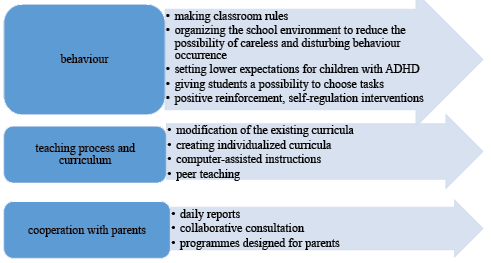
According to the available literature, the interventions made in school are mainly directed at improving the patterns of behaviour, the teaching process, and curricula, as well as forming partnerships with parents of children with ADHD, in order to establish a connection between the school and family environment.
Some of the typical difficulties of children with ADHD are problems with executive functions. A meta-analysis performed by Veloso, Vicente, and Filipe (2019), which included research conducted in the period between 2008 and 2018, confirmed that cognitive training of children with ADHD can be an efficient intervention for children and adolescents, as well as a potential additional method for treating ADHD. The tasks presented in cognitive training may vary and are usually carried out as games aimed at improving a whole range of capabilities, such as work memory, attention, inhibition control, planning and cognitive flexibilities. These tasks can be carried out on and without a computer. The meta-analysis confirmed the positive effects of cognitive training on the ADHD symptoms, executive functions, school success, reduced passivity during tasks, and improvement in the social skills of students. A study carried out by Tamm, Loren, Peugh, and Ciesielski (2020) showed that executive functions of students with ADHD are associated with their poor reading, writing and arithmetic skills, while ADHD symptoms disrupted their relationships with peers and behaviour in the classroom.
Physical activity has also proved to be useful for students with ADHD, except in cases when those students were taking medications (Welsch et al., 2021). It has already been known that physical activity is beneficial to children with ADHD. However, older children with ADHD seem to be less prone to sports activities. For example, in a study conducted by Tandon et al. (2019), it was found that older students do not spend the amount of time recommended for doing physical activities, sleeping, and using screens. By developing such unhealthy habits, they enter the risk group for developing sedentary behaviour and are at a higher risk of becoming obese. Taylor, Novo, and Foreman (2019) found that specially designed kinesiological exercises which stimulate and maintain engagement of children with ADHD can significantly reduce the symptoms of ADHD in the school environment to a great effect.
Schuck, Emmerson, Fine, and Lakes (2015) carried out a study on a sample consisting of 24 children with ADHD. The respondents were randomly divided into two groups and were undergoing the same cognitive behavioural therapy. In one group, they were using toy dogs (realistic toys), while, in the second group, three certified therapy dogs were used, with the help of their guides (partners). The obtained results suggest that there was an improvement in children’s social skills and prosocial behaviour in both groups. However, children from the group in which therapy dogs were involved exhibited a significant decrease in the number of serious ADHD symptoms in comparison with the group where the therapy dogs were not used. An interesting case study conducted in the Czech Republic shows positive results of introducing a dog assistant in work with children with ADHD (Juríčková, Bozděchová, Machová, & Vadroňová, 2020). A seven-year-old first grader with diagnosed attention disorder, ADHD, dysgraphia, and dyslexia, spent a year with his dog assistant present in the classroom. The testing of his abilities and behaviour was performed at the beginning and at the end of the year. At the beginning, apart from the initial diagnosis, it was detected that the student had difficulties persevering in any activity, he was constantly restless, reacted impulsively, had lots of fights with his peers, and sometimes was even impertinent to his teacher. At the end of the school year, the boy exhibited more prosocial behaviour, he accepted authority, showed thrill and enthusiasm, had better motor skills, was better at spatial orientation and had improved drawing and reading comprehension skills. Similar results were obtained in a study involving a girl who had a dog assistant. Although the authors point out that the study was not parallel and was not conducted with children without ADHD symptoms, these results point to possible improvements in directing students’ attention to learning with the help of a dog. It has been shown that dogs can provide emotional support and be reliable assistants to children, as well as help them overcome the fear of failure.
Some studies suggest that spending time outdoors and getting involved in nature activities can have positive effects on children with ADHD, because they seem to be more focused after walking outside or in a forest, their behaviour is less impulsive and careless, and their feelings are more positive (Hood & Baumann, 2024). In line with this, outdoor classroom could have a beneficial effect both on the children with typical and children with atypical development, including children with ADHD.
The excessive use of smartphones poses a threat for developing addiction and for other consequences in children who do not have ADHD symptoms. For example, a four-year longitudinal study (Sihoe, Mueller, & Liu, 2023) of the habits of smartphone usage in adolescents revealed that for adolescents who, due to excessive use of smartphones, exhibit first symptoms of addiction (discomfort, longing, need, etc.), such behaviour can be a risk factor for developing ADHD in their adolescent age. Excessive use of smartphones can lead to addiction both in children with and without ADHD symptoms. However, it seems that children with ADHD are more susceptible to addiction. Masi et al. (2021) found in their cross-sectional study that children with ADHD are highly sensitive, and that there is a risk of developing addiction to video games. In comparison with children without ADHD, children with ADHD tend to use video games more and exhibit more addictive behaviour patterns. Besides that, due to excessive use of video games, their initial ADHD symptoms become more pronounced and aggravated, and, of these, primarily, problems in behaviour and socialization get manifested. It seems that ADHD symptoms and addiction to video games have a bidirectional relationship: the symptoms make video games seem more attractive, while playing them aggravates the symptoms and enables engagement in activities which continuously strengthen the need for instant gratification. Long-term playing of video games can make children more prone to unpredictable reactions and make them more impatient, without encouraging behaviour directed towards thinking. Therefore, the role of parents and teachers should be to control screen time and to direct students to other, quality activities. The contemporary approach to ADHD frequently uses technological achievements to help children in numerous aspects of functioning. Ou et al. (2020) found that children with ADHD improved their attention, hyperactivity/impulsive reactions and defiance after a three-month training for using a virtual reality game console. Since the research results have not yielded consistent results, additional studies on using technology with children with ADHD symptoms should be conducted.
In order to prevent or reduce the possibility of undesirable and disturbing student behaviour, numerous interventions are made. DuPaul and Weyandt (2006: 162) point out that these include antecedent-based strategies, consequence-based strategies, and self-management approaches. In many cases, the optimal behavioural protocol will include components of all three approaches to ensure a balanced treatment plan. In this paper, the emphasis is placed on antecedent-based strategies. Teachers use various antecedent strategies in the school environment in order to prevent the negative reactions from students with ADHD. Antecedent strategies aim to prevent the undesirable types of behaviour before they occur, so these strategies could be desirable for teachers because they are simple and efficient, and can easily be incorporated into the existing routines (Robichaux, 2016). Antecedent-based strategies are focused on giving clear and simple instructions to children, with an explanation of what kind of behaviour is expected in a particular situation (Staff et al., 2021). The strategies mentioned above include interventions such as changes in the seating arrangement, choice-making, setting the rules, increased praise, modification of the assigned tasks, and teacher greetings.
The seating arrangement can be altered by changing the position of desks in the classroom (desks can be arranged in rows, lines, semi-circles, or by grouping two or three desks together), by changing the places where students sit, and by using certain aids such pillows and carpets, and stability balls as classroom chairs. Based on research results, Gaston, Moore, and Butler (2016) showed that sitting on stability balls instead of sitting on regular classroom chairs can improve the concentration span and reduce anxious behaviour. Stability balls were well accepted both by the teachers and students.
The strategies which enable students to choose also provide an opportunity for them to choose between two or more options themselves (for example, choosing a stanza of the poem they need to illustrate or a mathematical task which they will solve). Introducing the possibility to choose increases the level of student engagement and reduces the amount of disturbing behaviour (Tounsi et al., 2021).
Setting the rules is also an example of an antecedent-based strategy. The most efficient rules are those set by active participation of children (Buzanko & Andrews, 2015).
Using increased praise is a strategy that can help teachers create an appropriate type of behaviour of ADHD students. Behaviour-specific praise as an antecedent-based strategy implies stating the specific desirable behaviour of a particular student (e.g., Ivan, I am sure you will do your best to complete the whole task.) before the undesirable behaviour occurs. It is recommended to praise the child more in terms of the effort they have invested than the correct answer they may have provided (Jenkins & Floress, 2015).
Task modification can be done in two ways: by reducing the number of tasks (so that the students get fewer tasks) or by dividing a task into smaller units between which students can take short breaks. In that way, students do not have to focus their attention on a single task/activity for a longer period of time.
Another antecedent strategy is teacher greetings, which is related to the way in which teachers greet students before they enter the classroom. While greeting students, the teacher pays greater attention to the students, with the aim of encouraging their desirable behaviour and engagement in the activities which will be assigned later on in the classroom. Shields-Lysiak, Boyd, Iorio, and Vasquez (2020) point out that the function of personalized and consistent use of greetings is to build a community and to promote care and inclusion.
It should also be pointed out that there are other antecedent strategies which have not been mentioned here, but which are used in the classroom while teaching all students and/or those with learning difficulties. The advancement of technology also increases the significance of assistive technology, which will be more important for children with ADHD in the future.
ADHD makes everyday functioning of children with ADHD difficult and is associated with numerous negative developmental outcomes. In order to reduce the negative impact on the child’s growth and development, an early intervention and prevention are of great importance. Early identification of children with ADHD enables timely, early interventions which help reduce the risk of ADHD or alleviate its impact (Sonuga-Barke et al., 2023). Also, timely prevention could have a positive impact on future education and other aspects of the child’s life.
Based on the meta-analysis carried out on 31 studies, Hoogman, Stolte, Baas, and Kroesbergen (2020) point out that most studies have found evidence for improved divergent thinking and improved creative skills/abilities in people with ADHD. Sonuga-Barke et al. (2023) claim that people with ADHD could find their own niche in which they could excel. It could, for example, help them use their energy or creative ability of thinking outside the box, or to help them take risks, which is expected from successful entrepreneurs.
The latest considerations about ADHD move away from defining ADHD as a neurodevelopmental disorder. Instead, they start from the concept based on the social and cultural rights of an individual and suggest neurodiversity as a potential alternative paradigm (Pellicano & den Houting, 2022). Such an approach to ADHD does not view it as a disorder, but as something that was constructed by society and something that depends on the context. It emphasizes the acceptance of people with ADHD by their families, peers, school, and broader community and seeks the best way to create the environment which promotes personal engagement and builds resilience to encourage further growth and development (Sonuga-Barke et al., 2023).
When referring to ADHD in children and adolescents, the focus is primarily on their difficulties and problems. However, the fact is that both children and adolescents with ADHD have many positive traits. They can be extremely focused on something that interests them, as well as be creative, sympathetic, kind, honest in expressing their emotions, environmentally aware, and good at using new technologies. Pedagogically considered solutions, both in a scientific and reflexive way, should create new opportunities for all children, including those with ADHD.
Moore, Russell, Arnell, and Ford (2017) point out that, comparing medication and other non-pharmacological treatment, there is significantly less evidence relating to school-based interventions which support the needs of children with ADHD in the school context. Apart from that, a majority of the studies published about ADHD belong to the fields of psychology, psychiatry, mental health or medicine. A limited number of studies on teaching children with ADHD in the school context with a strong pedagogical and didactic perspective is an obstacle to a holistic understanding of the child.
Some of the strategies used by teachers in the classroom are efficient while working with some children, while they are inefficient while working with some other children. Some strategies will not have a consistent effect for the same child throughout their process of education (McDougal et al., 2023). All that has been mentioned above implies the need for training teachers for using various strategies in order to be able to approach each child individually and to respond to the specific needs of children with ADHD. As there are gaps in teacher knowledge about ADHD (Monteiro, Donham, & Klaib, 2022), it is necessary to introduce changes into the existing teacher education study programmes, as well as into the content of teachers’ professional development programmes. Future studies should focus on creating teacher programmes with a strong pedagogical perspective in order to expand their knowledge about ADHD and specific needs of students, as well as to help them develop positive attitudes to students with ADHD.
Marina Đuranović: Conceptualization; Writing – Original Draft; Writing – Review and Editing. Irena Klasnić: Writing – Original Draft; Writing – Review and Editing.
Tomislava Vidić: Writing – Original Draft; Writing – Review and Editing.
All authors have read and approved the final version of the manuscript.
Funding. The study was conducted without specifically designated funding.
Conflict of interest. The authors declare no conflict of interest.
References
American Psychiatric Association. (2013). Diagnostic and statistical manual of mental disorders (5th ed.). Arlington: American Psychiatric Association. https://doi.org/10.1176/appi.books.9780890425596
Barkley, R. A. (Ed.). (2006). Attention-Deficit Hyperactivity Disorder: A Handbook for Diagnosis and Treatment (3rd ed.). New York: The Guilford Press.
Batzle, C., Weyandt, L., Janusis, G., & Deviett, T. (2010). Potential impact of ADHD with stimulant medication label on teacher expectations. Journal of Attention Disorders, 14(2), 157–166. https://doi.org/10.1177/1087054709347178
Buzanko, C., & Andrews, J. J. W. (2015). School-based interventions for children diagnosed with ADHD. The Inclusive Educator Journal, 1(1), 20–28.
Capodieci, A., Rivetti, T., & Cornoldi, C. (2019). A cooperative learning classroom intervention for increasing peer’s acceptance of children with ADHD. Journal of Attention Disorders, 23(3), 282–292. https://doi.org/10.1177/1087054716666952
Cordier, R., Bundy, A., Hocking, C., & Einfeld, S. (2010). Comparison of the play of children with attention deficit hyperactivity disorder by subtypes. Australian Occupational Therapy Journal, 57(2), 137–145. https://doi.org/10.1111/j.1440-1630.2009.00821.x
Dodig-Ćurković, K., Grgić, M., Radić, J., Ćurković, M., … Kralik, K. (2013). Psihopatologija dječje i adolescentne dobi [Child and Adolescent Psychopathology]. Osijek: Svjetla grada.
DuPaul, G. J., Gormley, M. J., & Laracy, S. D. (2014). School-based intervention for elementary school students with ADHD. Child and Adolescent Psychiatric Clinics of North America, 23(4), 687–697. https://doi.org/10.1016/j.chc.2014.05.003
DuPaul, G. J., Weyandt, L. L., & Janusis, G. M. (2011). ADHD in the classroom: Effective intervention strategies. Theory Into Practice, 50(1), 35–42. https://doi.org/10.1080/00405841.2011.534935
DuPaul, G. J., & Weyandt, L. L. (2006). School based intervention for children with Attention Deficit Hyperactivity Disorder: Effects on academic, social, and behavioral functioning. International Journal of Disability, Development and Education, 53(2), 161–176. https://doi.org/10.1080/10349120600716141
Ewe, L. P. (2019). ADHD symptoms and the teacher–student relationship: A systematic literature review. Emotional and Behavioural Difficulties, 24(2), 136–155. https://doi.org/10.1080/13632752.2019.1597562
Franke, B., Michelini, G., Asherson, P., Banaschewski, T., Bilbow, A., Buitelaar, J. K., Cormand, B., Faraone, S. V., Ginsberg, Y., Haavik, J., Kuntsi, J., Larsson, H., Lesch, K.-P., Ramos-Quiroga, J. A., Réthelyi, J. M., Ribases, M., & Reif, A. (2018). Live fast, die young? A review on the developmental trajectories of ADHD across the lifespan. European Neuropsychopharmacology, 28(10), 1059–1088. https://doi.org/10.1016/j.euroneuro.2018.08.001
Gaston, A., Moore, S., Butler, L. (2016). Sitting on a stability ball improves attention span and reduces anxious/depressive symptomatology among grade 2 students: A prospective case-control field experiment. International Journal of Educational Research, 77, 136–142. https://doi.org/10.1016/j.ijer.2016.03.009
Gwernan-Jones, R., Moore, D. A., Cooper, P., Russel, A. E., Richardson, M., Rogers, M., Thompson-Coon, J., Stein, K., Ford, T. J., & Garside, R. (2016). A systematic review and synthesis of qualitative research: The influence of school context on symptoms of attention deficit hyperactivity disorder. Emotional and Behavioural Difficulties, 21(1), 83–100. https://doi.org/10.1080/13632752.2015.1120055
Hood, M., Baumann, O. (2024). Could nature contribute to the management of ADHD in children? A systematic review. International Journal of Environmental Research and Public Health, 21(6), Article 736. https://doi.org/10.3390/ijerph21060736
Hoogman, M., Stolte, M., Baas, M., & Kroesbergen, E. (2020). Creativity and ADHD: A review of behavioral studies, the effect of psychostimulants and neural underpinnings. Neuroscience & Biobehavioural Reviews, 119, 66–85. https://doi.org/10.1016/j.neubiorev.2020.09.029
Jenkins, L. N., Floress, M. T., & Reinke, W. (2015). Rates and types of teacher praise: A review and future directions. Psychology in the Schools, 52(5), 463–476. https://doi.org/10.1002/pits.21835
Jia, R. M., Mikami, A. Y., & Normand, S. (2021). Social resilience in children with ADHD: Parent and teacher factors. Journal of Child and Family Studies, 30(4), 839–854. https://doi.org/10.1007/s10826-021-01907-5
Jitendra, A. K., DuPaul, G. J., Someki, F., & Tresco, K. E. (2008). Enhancing academic achievement for children with attention-deficit/hyperactivity disorder: Evidence from school-based intervention research. Developmental Disability Research Review, 14(4), 325–330. https://doi.org/10.1002/ddrr.39
Juríčková, V., Bozděchová, A., Machová, K., & Vadroňová, M. (2020). Effect of animal assisted education with a dog within children with ADHD in the classroom: A case study. Child and Adolescent Social Work Journal, 37(6), 677–684. https://doi.org/10.1007/s10560-020-00716-x
Kocijan-Hercigonja, D., Buljan-Flander, G., & Vučković, D. (1999). Hiperaktivno dijete: uznemireni roditelji i odgajatelji (2. izdanje) [The Hyperactive Child: Distressed Parents and Educators (2nd ed.)]. Jastrebarsko: Naklada Slap.
Labrinopoulou, M. (2022). The views of preschool teachers on the integration of children with attention deficit hyperactivity disorder (ADHD) in kindergarten. Open Access Library Journal, 9(8), 1–19. https://doi.org/10.4236/oalib.1109136
Lollar, D. J. (2008). Function, impairment and long-term outcomes in children with ADHD and how to measure them. Psychiatric Annals, 38(1), 28–36. https://doi.org/10.3928/00485713-20080101-06
Masi, L., Abadie, P., Herba, C., Emond, M., Gingras, M.-P., & Amor, L. B. (2021). Video games in ADHD and non-ADHD children: Modalities of use and association with ADHD symptoms. Frontiers in Pediatrics, 9, Article 632272. https://doi.org/10.3389/fped.2021.632272
McDougal, E., Tai, C., Stewart, T. M., Booth, J. N., & Rhodes, S. M. (2023). Understanding and supporting attention deficit hyperactivity disorder (ADHD) in the primary school classroom: Perspectives of children with ADHD and their teachers. Journal of Autism and Developmental Disorders, 53(9), 3406–3421. https://doi.org/10.1007/s10803-022-05639-3
Mikami, A. Y., Owens, J. S., Hudec, K. L., Kassab, H., Evans, S. W. (2019). Classroom strategies designed to reduce child problem behavior and increase peer inclusiveness: Does teacher use predict students’ sociometric ratings? School Mental Health, 12(2), 250–264. https://doi.org/10.1007/s12310-019-09352-y
Mohr-Jensen, C., Steen-Jensen, T., Bang-Schnack, M., & Thingvad, H. (2019). What do primary and secondary school teachers know about ADHD in children? Findings from a systematic review and a representative, nationwide sample of Danish teachers. Journal of Attention Disorders, 23(3), 206–219. https://doi.org/10.1177/1087054715599206
Monteiro, E., Donham, A., & Klaib, M. (2022). Teacher characteristics and ADHD intervention outcomes in schools. Educational Research, 64(3), 257–276. https://doi.org/10.1080/00131881.2022.2087711
Moore, D. A., Russell, A. E., Arnell, S., & Ford, T. J. (2017). Educators’ experiences of managing students with ADHD: A qualitative study. Child: Care, Health and Development, 43(4), 489–498. https://doi.org/10.1111/cch.12448
Ou, Y. K., Wang, Y. L., Chang, H. C., Yen, S.-Y., Zheng, Y.-H., Lee, B. -O. (2020). Development of virtual reality rehabilitation games for children with attention-deficit hyperactivity disorder. Journal of Ambient Intelligence and Humanized Computing, 11, 5713–5720. https://doi.org/10.1007/s12652-020-01945-9
Paradžik, Lj., Kordić, A., Biško, A., Ercegović, N., Karapetrić Bolfan, Lj., & Boričević Maršanić, V. (2017). Kognitivno-bihevioralni tretman djeteta s hiperkinetskim poremećajem [Cognitive behavioural therapy of a child with hyperkinetic disorder]. Socijalna psihijatrija [Social Psychiatry], 45(3), 217–225. https://hrcak.srce.hr/190352
Pellicano, E., & den Houting, J. (2022). Annual research review: Shifting from ‘normal science’ to neurodiversity in autism science. Journal of Child Psychology & Psychiatry, 63(4), 381–396. https://doi.org/10.1111/jcpp.13534
Robichaux, N. M. (2016). Effects of various seating arrangements on disruptive classroom behavior (Publication No. 3696) [Doctoral Dissertation, Louisiana State University and Agricultural & Mechanical College].
Rushton, S., Giallo, R., & Efron, D. (2020). ADHD and emotional engagement with school in the primary years: Investigating the role of student–teacher relationships. British Journal of Educational Psychology, 90(Suppl. 1), 193–209. https://doi.org/10.1111/bjep.12316
Safren, S. A., Sprich, S. E., Parlman, C. A., & Otto, M. W. (2017). Mastering Your Adult ADHD (2nd. ed.). Oxford: Oxford University Press.
Salari, N., Ghasemi, H., Abdoli, N., Rahmani, A., Shiri, M. H., Hashemian, A. H., Akbari, H., & Mohammadi, M. (2023). The global prevalence of ADHD in children and adolescents: A systematic review and meta-analysis. Italian Journal of Pediatrics, 49(1), Article 48. https://doi.org/10.1186/s13052-023-01456-1
Schuck, S. E., Emmerson, N. A., Fine, A. H., & Lakes, K. D. (2015). Canine-assisted therapy for children with ADHD: preliminary findings from the positive assertive cooperative kids study. Journal of attention disorders, 19(2), 125–137. https://doi.org/10.1177/1087054713502080
Sekušak-Galešev, S. (2005). Hiperaktivnost [Hyperactivity]. Dijete i društvo [Child and society], 7(1), 40–59.
Shields-Lysiak, L., Boyd, M., Iorio, Jr, J., & Vasquez, C. (2020). Classroom greetings: More than a simple hello. Iranian Journal of Language Teaching Research, 8(3 (Special Issue)), 41–56. https://doi.org/10.30466/ijltr.2020.120933
Sihoe, C. E., Mueller, U., & Liu, S. (2023). Perceived smartphone addiction predicts ADHD symptomatology in middle school adolescents: A longitudinal study. Computers in Human Behavior Reports, 12, Article 100335. https://doi.org/10.1016/j.chbr.2023.100335
Sonuga-Barke, E. J. S., Becker, S. P., Bölte, S., Castellanos, F. X., Franke, B., Newcorn, J. H., Nigg, J. T., Rohde, L. A., & Simonoff, E. (2023). Annual research review: Perspectives on progress in ADHD science – from characterization to cause. Journal of Child Psychology and Psychiatry, 64(4), 506–532. https://doi.org/10.1111/jcpp.13696
Staff, A. I., van den Hoofdakker, B. J., van der Oord, S., Hornstra, R., Hoekstra, P. J., Twisk, J. W. R., … Luman, M. (2021). Effectiveness of specific techniques in behavioral teacher training for childhood ADHD: A randomized controlled microtrial. Journal of Clinical Child & Adolescent Psychology, 50(6), 763–779. https://doi.org/10.1080/15374416.2020.1846542
Still, G. F. (2006). Some abnormal psychical conditions in children: Excerpts from three lectures. Journal of Attention Disorders, 10(2), 126–136. https://doi.org/10.1177/1087054706288114
Tamm, L., Loren, R. E., Peugh, J., & Ciesielski, H. A. (2020). The association of executive functioning with academic, behavior, and social performance ratings in children with ADHD. Journal of Learning Disabilities, 54(2), 1–15. https://doi.org/10.1177/0022219420961338
Tandon, P. S., Sasser, T., Gonzalez, E. S., Whitlock, K. B., Christakis, D. A., & Stein, M. A. (2019). Physical activity, screen time, and sleep in children. Journal of Physical Activity and Health, 16(6), 416–422. https://doi.org/10.1123/jpah.2018-0215
Taylor, A., Novo, D., & Foreman, D. (2019). An exercise program designed for children with attention deficit/hyperactivity disorder for use in school physical education: Feasibility and utility. Healthcare, 7(3), Article 102. https://doi.org/10.3390/healthcare7030102
Thapar, A., & Cooper, M. (2016). Attention deficit hyperactivity disorder. Lancet, 387, 1240–1250. https://doi.org/10.1016/S0140-6736(15)00238-X
Tounsi, O., Masmoudi, L., Trabelsi, K., Koubaa, A., Clark, C., Anouda, C., & Bahloul, M. (2021). Effects of class-wide choice making on the behaviour of students with mild intellectual disability. International Journal of Disability, Development and Education, 69(1), 33–46. https://doi.org/10.1080/1034912X.2021.1998889
Veloso, A., Vicente, S. G., & Filipe, M. G. (2019). Effectiveness of cognitive training for school-aged children and adolescents with attention deficit/hyperactivity disorder: A systematic review. Frontiers in Psychology, 10, Article 2983. https://doi.org/10.3389/fpsyg.2019.02983
Welsch, L., Alliott, O., Kelly, P., Fawkner, S., Booth, J., & Niven, A. (2021). The effect of physical activity interventions on executive functions in children with ADHD: A systematic review and meta-analysis. Mental Health and Physical Activity, 20, Article 100379. https://doi.org/10.1016/j.mhpa.2020.100379
Wylock, J. F., Borghini, A., Slama, H., & Delvenne, V. (2023). Child attachment and ADHD: A systematic review. European Child & Adolescent Psychiatry, 32(1), 5–16. https://doi.org/10.1007/s00787-021-01773-y
Zendarski, N., Haebich, K., Bhide, S., Quek, J., Nicholson, J. M., Jacobs, K. E., Efron, D., Sciberras, E. (2020). Student–teacher relationship quality in children with and without ADHD: A cross-sectional community based study. Early Childhood Research Quarterly, 51(2nd quarter), 275–284. https://doi.org/10.1016/j.ecresq.2019.12.006