Acta Paedagogica Vilnensia ISSN 1392-5016 eISSN 1648-665X
2025, vol. 55, pp. 144–156 DOI: https://doi.org/10.15388/ActPaed.2025.55.9
Vladimír Fedorko
Department of Preschool and Elementary Pedagogy and Psychology, Faculty of Education
University of Prešov, Slovakia
vladimir.fedorko@unipo.sk
https://orcid.org/0009-0005-6232-1322
https://ror.org/02ndfsn03
Roman Kroufek
Department of Preschool and Primary Education, Faculty of Education
Jan Evangelista Purkyně University in Ústí nad Labem, Czech Republic
roman.kroufek@ujep.cz
https://orcid.org/0000-0003-4188-8715
https://ror.org/04vjwcp92
Jozef Liba
Department of Natural Sciences and Technical Disciplines of the Faculty of Education
University of Prešov, Slovakia
jozef.liba@unipo.sk
https://orcid.org/0000-0001-6437-3082
Janka Ferencová
Department of Preschool and Elementary Pedagogy and Psychology, Faculty of Education University of Prešov, Slovakia
janka.ferencová@unipo.sk
https://orcid.org/0009-0008-0795-4620
https://ror.org/02ndfsn03
Abstract. The study examined the perceived professional self-efficacy of kindergarten teachers (N1 = 204) and university students (N2 = 215) studying preschool pedagogy in Slovakia in the context of the influence of independent variables such as age, marital status, religiosity, years of experience, and education level. The kindergarten teacher’s perceived professional self-efficacy was examined by adapting the Teacher Efficacy Scale used in Slovakia. The research findings indicate statistically significant differences between in-service and pre-service teachers and provide reactions to the context of the influence of the independent variables. The respondents’ experience with educational realities emerged as the most significant variable. Experienced teachers and students with at least some experience had higher self-efficacy than the inexperienced ones. However, there is a group of respondents without adequate experience who, on the contrary, overestimate their abilities and thus their self-efficacy probably does not correspond to reality. Religious affiliation also appears to be a potentially significant factor, which played a role especially for pre-service teachers.
Keywords: self-efficacy, kindergarten teachers, pre-service teachers, confirmatory factor analysis.
Santrauka. Tyrime buvo nagrinėjamas Slovakijos ikimokyklinio ugdymo pedagogikos studijas studijuojančių universitetinių studentų (N2 = 215) ir darželių mokytojų (N1 = 204) suvoktas profesinis saviveiksmingumas, atsižvelgiant į nepriklausomus kintamuosius, tokius kaip amžius, šeiminė padėtis, religinis tikėjimas, darbo patirtis ir išsilavinimo lygmuo. Darželių mokytojų suvoktas profesinis saviveiksmingumas buvo tiriamas adaptuojant Slovakijoje taikomą Mokytojų saviveiksmingumo skalę. Tyrimo rezultatai atskleidė statistiškai reikšmingus skirtumus tarp praktikuojančių ir būsimųjų mokytojų bei parodė nepriklausomų kintamųjų įtakos kontekstą. Respondentų patirtis, susijusi su ugdymo realijomis, išryškėjo kaip reikšmingiausias veiksnys. Patyrę mokytojai ir studentai, turintys bent minimalią praktinę patirtį, pasižymėjo aukštesniu saviveiksmingumu nei nepatyrę asmenys. Tačiau nustatyta respondentų grupė, neturinti pakankamos patirties, kurie, priešingai, linkę pervertinti savo gebėjimus, todėl jų saviveiksmingumo vertinimas tikriausiai neatitinka realybės. Religinė priklausomybė taip pat pasirodė esanti potencialiai reikšmingas veiksnys, ypač turintis įtakos būsimiems mokytojams.
Raktažodžiai: saviveiksmingumas, darželių mokytojai, būsimi mokytojai, patvirtinamoji faktorinė analizė.
_________
Received: 08/10/2025. Accepted: 26/11/2025
Copyright © Vladimír Fedorko, Roman Kroufek, Jozef Liba, Janka Ferencová, 2025. Published by Vilnius University Press. This is an Open Access article distributed under the terms of the Creative Commons Attribution Licence (CC BY), which permits unrestricted use, distribution, and reproduction in any medium, provided the original author and source are credited.
The personal and individualized values of teachers foster their educational goals and good prosocial behaviour with regard to their interaction with children in a school environment. What is more, values may promote subjective well-being and an individual sense of self-efficacy. Not only does the teachers’ belief in their ability to effectively manage tasks, responsibilities, and challenges related to professional teaching practice help them to become facilitators of academic success, but it also reinforces their willingness to become extremely skilled teachers.
The concept of self-efficacy derives from the theory of social learning proposed by Bandura (Bandura, 1977, 1986). The perception of self-efficacy is the individual’s faith in his/her ability to successfully demonstrate behaviour required to attain an expected result (Bahadır, 2002). Bandura’s (1986) self-efficacy perception affects an individual’s: a) choice of activities, b) perseverance when confronted with hardships, c) level of his/her effort and d) performance. Work self-efficacy is considered an important predictor of successful professional practice (e.g., Zee & Koomen, 2016), and therefore it is important to examine this phenomenon from several points of view, so that the quality of undergraduate training of future teachers in post-communist countries increases and, consequently, the quality of teaching of practical teachers reaches a higher level. The lack of opportunities to increase self-efficacy for less experienced, part-time educators and family-based working educators are discussed in terms of Bandura’s (1997) sources of self-efficacy (Reyhing & Perren, 2021). Numerous studies support the assumption of the importance of self-efficacy on human achievement in many areas like sports, health business, or education (Bandura, 1997).
Teacher self-efficacy is defined as educators’ beliefs in their ability to effectively teach and positively impact student outcomes, even when faced with challenges (Gavora, 2010; Finnegan, 2013; Martin & Mulvihill, 2019; Lazarides & Warner, 2020). This concept influences teachers’ motivation, behaviour, and resilience (Finnegan, 2013). Teachers denoted by high self-efficacy are more open to new teaching methods, they set themselves challenging goals and persist in the face of difficulties; they also experience less burnout and enjoy higher job satisfaction, while their students show improved motivation and academic achievement (Lazarides & Warner, 2020). Teachers with low self-efficacy sometimes approach teaching in a negative manner and do not always know how to provide opportunities for in-depth learning (Bandura, 1997). Furthermore, a teacher with a low level of perceived professional efficacy tends to set lower teaching goals (Muijs & Reynolds, 2002; Tschannen-Moran & Woolfolk Hoy, 2001), which is quite understandable as these are easier to achieve. They also look for easy teaching methods (Ross & Bruce 2007) and avoid non-standard teaching ones as these require greater preparation on the part of the teacher, and it is not uncommon that – even with meticulously prepared lesson plans – the teacher may fail to achieve the lesson goal. Some authors further state that teachers manifesting lower perceived professional efficacy are more likely to choose a transmissive teaching style, where the teacher is in control of delivering pre-existing knowledge which the students memorise because they reproduce it as accurately as possible. Such teachers are more critical of student errors compared to teachers with high levels of perceived professional efficacy (Ashton & Webb, 1986); if a student cannot answer a question promptly, the teacher will call out someone else who can answer his or her question (Gibson & Dembo, 1984). In addition, these teachers are less passionate about the teaching profession, which they regard more as a way of securing an income than as a job with a deeper mission (Allinder, 1994; Evers et al., 2002); they tend to do only what is expected of them and nothing beyond it. Fuchs et al. (1992) and Guskey (1988) even posited that teachers with low levels of perceived professional efficacy were resistant to innovations and changes with respect to the educational environment. Eventually, a teacher with a negatively perceived professional efficacy may fall into an unfavourable psychological state and even suffer from burnout syndrome (Evers et al., 2002; Schwarzer & Hallum, 2008).
According to Lazarides and Warner (2020), the development of self-efficacy is influenced by four sources: mastery experience, vicarious experience, verbal persuasion, and somatic and affective states. Experienced teachers have higher general teaching efficacy and efficacy in specific areas than pre-service and novice teachers (Putman, 2012). According to Soodak et al. (1998), the level of self-image and self-efficacy of the teachers has an effect on quality of work in their professional life. It has been found that teachers with high self-efficacy tend to get better accustomed to changes in their professional life than teachers with lower self-efficacy self-perception (cf. Buell et al., 1999; Larrivee & Cook, 1979; Soodak & Podell, 1993; Soodak et al., 1998; Weisel & Dror, 2006).
Teacher self-efficacy can be measured by using validated scales, such as the Teacher Efficacy Scale, created by Gibson & Dembo (1984) and adapted for use in Slovakia by Gavora (2009). The result of Gibson and Dembo’s study was a 16-item instrument consisting of two uncorrelated subscales; personal teaching efficacy (nine items) and general teaching efficacy (seven items). The TES has subsequently become the predominant instrument in the study of teacher efficacy. Gavora (2009) adapted the scale for the Slovak environment. In his conception, the scale was shortened to ten items which respected the two original dimensions. The level of agreement with each statement was expressed on a classic five-point Likert scale. This version was further modified in this study.
Beginning kindergarten teachers tend to have lower self-efficacy than experienced teachers. (Schreiber, 2020). Teachers in kindergartens generally report high levels of self-efficacy, particularly in educational skills, but lower efficacy in parental involvement and creating a safe, stimulating work environment (Kulawska, 2017). Atsoniou (2020) found out that self-efficacy in preschool teachers relates to classroom management, student engagement, and teaching strategies. However, children with special needs are a challenge, and kindergarten teachers feel having less self-efficacy in conjunction with them (Guo et al., 2021). Little is known about how teacher self-efficacy is affected by socio-demographic factors such as age, highest educational attainment, or religion, which can play a significant role in largely religious (Podolinská et al., 2019) states such as Slovakia.
The nature and scope of the research problem lies in the fact that kindergarten teachers and students (i.e., future kindergarten teachers) in Slovakia are under pressure to deliver excellent performance at work and to be proactive with respect to establishing a child – parent – teacher relationship. Such pressure may affect their academic performance, motivation, and wellbeing. Considering the teaching profession in Slovakia, the concept of self-efficacy is an underrepresented topic despite its various effects on performance at school, and particularly pre-school education may face several challenges with respect to this concept.
This research aims to answer three research questions:
The study was based on the sample of 1) kindergarten teachers from all over Slovakia; 2) students enrolled on pre-primary education programs (faculties of education in Bratislava, Trnava, Nitra, Banská Bystrica, Ružomberok, and Prešov).
Within the research sample, of the total N = 419 respondents, 215 were students, which is 51.31% of the research sample. The second part of the research sample comprises a total number of 204 teachers, which represents 48.69% of the research sample. A more detailed overview of the research sample with respect to age and gender is presented in Table 1. The table shows that both kindergarten teachers and students preparing to become kindergarten teachers are predominantly females (students 99.53% and teachers 99.02%). The category of gender was not further analysed in this study as a result of this overwhelming trend.
|
N=419 |
Summary Table for all Multiple Response Items |
|||||||
|
Respondent |
Gender |
Age |
Age |
Age |
Age |
Age |
Row |
|
|
Count |
student |
F |
194 |
20 |
0 |
0 |
0 |
214 |
|
Column Percent |
99.49% |
100.00% |
||||||
|
Row Percent |
90.65% |
9.35% |
0.00% |
0.00% |
0.00% |
|||
|
Table Percent |
90.23% |
9.30% |
0.00% |
0.00% |
0.00% |
99.53% |
||
|
Count |
student |
M |
1 |
0 |
0 |
0 |
0 |
1 |
|
Column Percent |
0.51% |
0.00% |
||||||
|
Row Percent |
100.00% |
0.00% |
0.00% |
0.00% |
0.00% |
|||
|
Table Percent |
0.47% |
0.00% |
0.00% |
0.00% |
0.00% |
0.47% |
||
|
Count |
Total |
195 |
20 |
0 |
0 |
0 |
215 |
|
|
Table Percent |
90.70% |
9.30% |
0.00% |
0.00% |
0.00% |
100.00% |
||
|
Count |
teacher |
F |
15 |
39 |
53 |
81 |
14 |
202 |
|
Column Percent |
93.75% |
97.50% |
100.00% |
100.00% |
100.00% |
|||
|
Row Percent |
7.43% |
19.31% |
26.24% |
40.10% |
6.93% |
|||
|
Table Percent |
7.35% |
19.12% |
25.98% |
39.71% |
6.86% |
99.02% |
||
|
Count |
teacher |
M |
1 |
1 |
0 |
0 |
0 |
2 |
|
Column Percent |
6.25% |
2.50% |
0.00% |
0.00% |
0.00% |
|||
|
Row Percent |
50.00% |
50.00% |
0.00% |
0.00% |
0.00% |
|||
|
Table Percent |
0.49% |
0.49% |
0.00% |
0.00% |
0.00% |
0.98% |
||
|
Count |
Total |
16 |
40 |
53 |
81 |
14 |
204 |
|
|
Table Percent |
7.84% |
19.61% |
25.98% |
39.71% |
6.86% |
100.00% |
||
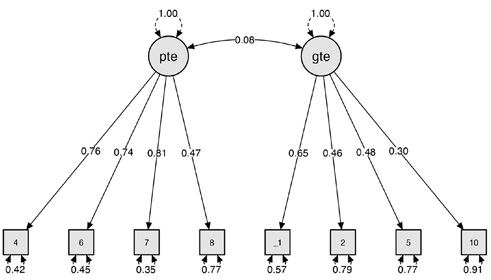
The teacher’s perceived professional self-efficacy was examined by adapting the Teacher Efficacy Scale (Gibson & Dembo, 1984), which has already been used in Slovakia by Gavora (2009). The items of TES were measured on a five-point Likert-type scale with answers ranging from ‘strongly disagree’ to ‘strongly agree’. From the original instrument, Gavora created a ten-item scale for Slovak teachers which measured two dimensions: personal teaching efficacy – PTE, and general teaching efficacy – GTE. This version of the instrument was used as a basis for adaptation for kindergarten teachers. Since the factor structure of the instrument is well-known (Gibson & Dembo, 1984; Gavora, 2009), our modified version was subjected to Confirmatory Factor Analysis (CFA). The original form with six items in the first factor and four in the second factor had a poor model fit (chi-square = 112. 43, df = 34, p <0.001; CFI = 0.92; GFI = 0.99; RMSEA = 0.08; SRMR = 0.07). Thus, the model was adjusted to remove two items that saturated the first factor at the lowest level. The model fit of the new model is satisfactory: chi-square = 41.12, df = 19, p = 0.002; CFI = 0.97; GFI = 0.99; RMSEA = 0.05; SRMR = 0.05 (see Figure 1). The modified scale can be seen in Appendix 1.
Figure 1. Confirmatory factor analysis for TES for preschool teachers in Slovakia
Note. pte = personal teaching efficacy, gte = general teaching efficacy; number of item by Gavora (2009).
The reliability of this modified instrument was α = 0.70 for the personal teaching efficacy scale and α = 0.50 for the general teaching efficacy scale, which is consistent with the findings of Gavora (2009), who found α = 0.73 and 0.54, respectively. In their work, Henson et al. (2001) examined 25 research studies that use TES and found a range between .63 and .89 for the first factor and from .55 to .82 for the reliability of the second factor. The oscillation in the range might be present due to the fact that the questionnaire was administered in various environments and with teachers of different levels of qualification (Gavora, 2009, 2011). The relatively low reliability of the second factor shall be discussed in the research limitations.
In addition to the TES, the sociodemographic data on the respondents were also collected, specifically, the age, location of kindergarten, length of teaching experience, marital status, religion, and highest educational attainment.
Data analysis was performed in JASP 0.19. The following statistical analytical methods were used: confirmatory factor analysis, Cronbach’s alpha coefficient calculation, Student’s t-test’ ANOVA followed by Tukey’s post hoc test. Wherever relevant, the effect size was investigated, specifically, Cohen’s d for t-test and Fisher’s eta (η2) for ANOVA. Cohen’s d is interpreted as follows: small effect size (d = 0.2), medium effect size (d = 0.5), and large effect size (d = 0.8) (cf. Cohen, 1988). η2 is in the interval <0;1>, and after multiplying it by 100, the result can be interpreted as the percentage of variance explained.
To answer the second research question, a comparison was made between the performance of kindergarten teachers and kindergarten teacher education students. The results are presented in Table 2. For both personal teaching efficacy and general teaching efficacy, practicing teachers scored significantly higher, with the effect of this difference being moderate. The results for both groups are slightly above average in all cases.
|
M(teacher) |
SD |
M(student) |
SD |
t |
p |
d |
|
|
PTE |
3.96 |
0.53 |
3.80 |
0.49 |
3.12 |
0.002 |
0.31 |
|
GTE |
3.50 |
0.67 |
3.27 |
0.62 |
3.64 |
<0.001 |
0.36 |
The size of the place (village or town) where the kindergarten is located did not play a significant role for either PTE (t = 0.26, p = 0.80, d = 0.18) or GTE (t = 0.48, p = 0.64, d = 0.08).
For teachers in PTE, age played a role (F = 3.23, p = 0.01, η2 = 0.061), and a subsequent post-hoc analysis showed a significant difference between teachers in the 31–40 y.o. age group and those in the oldest age group, specifically, 61+ (p = 0.02, d = -0.94). The oldest teachers (M = 4.29) and the youngest teachers (M = 4.14) had the highest mean scores for PTE, while the 31–40 y.o. age group had the lowest score. No differences due to age were found for GTE (F = 1.41, p = 0.23, η2 = 0.028). For students, age did not play a significant role in PTE (F = 0.90, p = 0.47, η2 = 0.017), although there were interesting differences between the youngest students in the 18–20 years category (M = 3.68) and the oldest students in the 27–29 years category (M = 4.00) and in the 30+ years (M = 3.95) category. Age was not significant in GTE (F = 1.13, p = 0.34, η2 = 0.021) for students, either.
The marital status did not play a role for teachers either for PTE (F = 0.72, p = 0.49, η2 = 0.007) or GTE (F = 0.72, p = 0.49, η2 = 0.007). For students, the marital status did not play a role for PTE (t = 0.78, p = 0.44, d = 0.16), but it did for GTE (t = 2.67, p = 0.008, d = 0.55), with the married respondents (M = 3.57) achieving higher values than single individuals (M = 3.23). This is probably related to the fact that the married group includes older students.
The religious affiliation did not play a role for teachers in either PTE (F = 1.17, p = 0.31, η2 = 0.01) or GTE (F = 1.17, p = 0.28, η2 = 0.019). Students who declared a religious affiliation (M = 3.82) or refused to comment on this item (M = 3.82) scored significantly (F = 3.76, p = 0.03, η2 = 0.034) higher in PTE, however, than students with no religious affiliation (M = 3.41). This was confirmed by a post hoc test, which was significant for the religion – non-religion pair (p = 0.018, d = 0.85). In GTE, religion, again, played a role, with believers (M = 3.24) scoring significantly (F = 3.53, p = 0.03, η2 = 0.032) lower than non-believers (M = 3.71), which was also confirmed by a post-hoc test (p = 0.039, d = -0.76).
Highest educational attainment had the greatest effect on PTE in teachers, with the ones with a high school certificate (M = 4.07) having the highest values, and teachers with a bachelor’s (M = 3.84) or master’s (3.88) degree having the lowest values. The difference was significant (F = 3.75, p = 0.03, η2 = 0.036), and a subsequent post-hoc analysis showed a significant difference between those with only a high school education and those with a master’s degree (p = 0.03, d = 0.37). For GTE, however, no significant difference was found for teachers (F = 0.94, p = 0.39, η2 = 0.009). For students, no significant effect of highest educational attainment was found for either PTE (F = 0.37, p = 0.69, η2 = 0.004) or GTE (F = 2.21, p = 0.11, η2 = 0.02).
The teachers’ length of teaching experience had no significant effect on PTE (F = 1.34, p = 0.24, η2 = 0.039) or GTE (F = 0.39, p = 0.89, η2 = 0.012) values. Students who had some teaching experience (M = 3.95) scored significantly (t = 2.94, p = 0.004, d = 0.43) higher in PTE than students with no experience (M = 3.74). In GTE, no effect was found (t = 0.13, p = 0.90, d = 0.02).
When Gibson and Dembo introduced the Teacher Efficacy Scale in 1984, they laid the foundation for extensive research into how teachers perceive their role in the educational process. Over the next forty years, the scale has been used to measure teacher self-efficacy in many countries (Dussault, 2001; Gavora, 2011; Sharma et al., 2012; Loreman et al., 2013), including the present one, discussing Slovak kindergarten teachers. The items on the instrument, as developed by Gavora (2009), were modified to fit the kindergarten setting and terminology, and two items were removed after confirmatory factor analysis. The resulting two-dimensional scale aims to measure the personal teaching efficacy and the general teaching efficacy of in-service and pre-service kindergarten teachers in the spirit that was set by Gibson & Dembo (1984).
The findings indicate that experienced teachers tend to have higher levels of perceived and general teaching efficacy, which aligns with studies showing that experience plays a crucial role in developing this self-efficacy (Putman, 2012; Buell et al., 1999). Self-efficacy of in-service teachers was significantly higher than that of student teachers training to work in the kindergarten in both dimensions studied. The point that experience plays a role in shaping self-efficacy was also confirmed by the fact that higher scores were achieved by those students who declared having at least one year of teaching experience in kindergarten. This is consistent with the findings of other studies that have highlighted the positive impact of teaching practice on the self-efficacy of students in various teaching programs: social studies (Topkaya, 2016), language education (Rupp & Becker, 2021; Safura & Helmanda, 2022), physical education (Martins et al., 2014), or primary education (Yilmaz & Çavaş, 2007).
The results showed another interesting finding related to the level of teaching experience: kindergarten teachers who had only a high school education were denoted by higher personal teaching efficacy than those who had already graduated from college. Similarly, the highest PBE values were not only measured for the most senior and therefore experienced teachers, but also for the youngest ones. Thus, some of the teachers who do not have deeper insight or sufficient experience may be overestimating their abilities. Kulawska (2017) pointed to a similar phenomenon in primary school teachers, while Schwarzer & Hallum (2008) linked such unjustifiably high self-efficacy to job stress and possible burnout.
An interesting phenomenon highlighted by the research is the possible influence of religious beliefs on teacher self-efficacy. This was only found to be true for student teachers, in that religious students had higher personal teaching efficacy and lower general teaching efficacy. Slovakia is a relatively religious country where Christianity is predominant, and, as can be seen, this affects the expectations that teaching students have related to their future profession. Research shows that it is easier for a religious person to cope with stress and worry because they have a higher degree of subjectively perceived emotional comfort (Thouless, 1971; Argyle, 1990; Pismanik, 2011; Suchkova, 2009;). However, the assumption that religious beliefs would automatically lead to higher self-efficacy has not been confirmed for teachers, and thus this topic requires deeper future research, not least because it is not considered in current research on teachers’ self-efficacy.
The present study has several limitations. Firstly, a limitation of the study stems from the self-reporting nature of the research questionnaire as the participants may not have been fully aware of the totality perceptions of the self, or of the fluctuations that these perceptions may present (Murk, 2013). Secondly, the relatively small sample of the respondents is, by itself, a limitation, and, consequently, the results must be seen in that light. Thirdly we have to consider the problematic reliability of the general teaching efficacy scale, which is at the lower end of acceptance. Modifications to this scale did not increase reliability, and, in future research, it would be useful to expand the scale so that to include additional items for kindergarten teacher respondents.
The results show that university students are not as confident of their abilities as teachers, a fact which is clearly conditioned by the experience of the teachers. Also, comparing kindergarten teachers and future kindergarten teachers (students) shows that university students are more receptive to the possible potentiality of education and training than already working teachers. Furthermore, the results show a significant difference between the group of students with no religion and those with religion, with such conclusions indicating a significant influence of religion on the personality – although it is important to state that secularization is on the rise in Slovakia. Finally, the implications arising from the results point to the lack of practical experience of university students, which leaves a mark on their perceived professional self-efficacy. The fact that Slovakia is one of the countries with the lowest proportion of practical training in teacher education attests to the latter. The inexperience of students and beginning teachers who have not gone on to college after high school then leads to an overestimation of their abilities and skills. In conclusion, understanding the major dominant predictors of the perceived professional self-efficacy of teachers has important benefits in working towards the wellbeing of teachers, as well as the effectiveness and improvement of the teacher, the educational process, and the school itself.
Roman Kroufek: conceptualization, data curation, formal analysis, software, validation, writing – original draft.
Vladimír Fedorko: conceptualization, data curation, formal analysis, investigation, methodology, project administration, resources, supervision, visualization, writing – original draft.
Jozef Liba: conceptualization, formal analysis, supervision, writing – editing.
Janka Ferencová: conceptualization, formal analysis, methodology, writing – editing
No funding was received to assist with the preparation of this manuscript.
All authors certify that they have no affiliations with or involvement in any organization or entity with any financial interest or non-financial interest in the subject matter or materials discussed in this manuscript.
Approval was obtained from the Research Ethics Committee of the University of Prešov in Prešov, Slovakia. The procedures used in this study adhere to the tenets of the Declaration of Helsinki.
References
Allinder, R. M. (1994). The Relationship Between Efficacy and the Instructional Practices of Special Education Teachers and Consultants. Teacher Education and Special Education, 17(2), 86–95. https://doi.org/10.1177/088840649401700203
Argyle, M. (1990). The psychology of happiness. London: Routledge. https://doi.org/10.4324/9781315812212
Atsoniou, M.(2020) Researching Teaching Self-Efficacy of Pre-School Teachers. Open Access Library Journal, 7, Article e6447. https://doi.org/10.4236/oalib.1106447
Ashton, P. T., & Webb, R. B. (1986). Making a difference: Teachers’ sense of efficacy and student achievement. Longman.
Bandura, A. (1977). Self-efficacy: Toward a unifying theory of behavioral change. Psychological Review, 84(2), 191–215. https://doi.org/10.1037/0033-295X.84.2.191
Bandura, A. (1986). Social foundations of thought and action: A social cognitive theory. Prentice-Hall, Inc.
Bandura, A. (1997). Self-efficacy: The exercise of control. W H Freeman/Times Books/ Henry Holt & Co.
Bahadır, A. K. (2002). Modernitenin Yıkıcı Etkileri Karşısında Savunmasız İnsan. Selçuk Üniversitesi İlahiyat Fakültesi Dergisi, 13, 129–142.
Buell, M. J., Gamel-McCormick, M., & Hallam, R. A. (1999). Inclusion in a Childcare Context: Experiences and Attitudes of Family Childcare Providers. Topics in Early Childhood Special Education, 19(4), 217–224. https://doi.org/10.1177/027112149901900402
Dussault, M., Villeneuve, P., & Deaudelin, C. (2001). L’échelle d’autoefficacité des enseignants: validation canadienne-française du Teacher efficacy scale. Revue des sciences de l’éducation, 27(1), 181–194.
Evers, W. J., Brouwers, A., & Tomic, W. (2002). Burnout and self-efficacy: A study on teachers‘ beliefs when implementing an innovative educational system in the Netherlands. British Journal of Educational Psychology, 72(2), 227–244. https://doi.org/10.1348/000709902158865
Finnegan, R. S. (2013). Linking teacher self-efficacy to teacher evaluations. Journal of Cross-Disciplinary Perspectives in Education, 6(1), 18–25.
Fuchs, L. S., Fuchs, D., & Bishop, N. (1992). Instructional adaptation for students at risk. The Journal of Educational Research, 86(2), 70–84. https://doi.org/10.1080/00220671.1992.9941143
Gavora, P. (2009). Ako učiteľ vníma svoju profesijnú zdatnosť. (How a teacher perceives their occupational self-efficacy). In B. Kasáčová, M. Cabanová, (Eds.). Profesia učiteľa v predprimárnej a primárnej edukácii v teórii a výskumoch (Profession of a pre-primary and primary education teacher in theory and research) (pp.41–47). Banská Bystrica: PF Univerzita Mateja Bela.
Gavora, P. (2011). Measuring the self-efficacy of in-service teachers in Slovakia. Orbis Scholae, 5(2). 79–94. https://doi.org/10.14712/23363177.2018.102
Gibson, S., & Dembo, M. H. (1984). Teacher efficacy: A construct validation. Journal of Educational Psychology, 76(4), 569–582. https://doi.org/10.1037/0022-0663.76.4.569
Guo, Y., Dynia, J. M., & Lai, M. H. C. (2021). Early childhood Special education teachers‘ self-efficacy in relation to individual children: Links to children‘s literacy learning. Early Childhood Research Quarterly, 54(1), 153–163. https://doi.org/10.1016/j.ecresq.2020.09.002
Guskey, T. R. (1988). Teacher efficacy, self-concept, and attitudes toward the implementation of instructional
innovation. Teaching and Teacher Education, 4(1), 63–69. https://doi.org/10.1016/0742-051X(88)90025-X
Kulawska, E. (2017). Poczucie własnej skuteczności nauczycieli edukacji wczesnoszkolnej. Forum Pedagogiczne, 7(2), 237–252. https://doi.org/10.21697/fp.2017.2.17
Larrivee, B., & Cook, L. (1979). Mainstreaming: A Study of the Variables Affecting Teacher Attitude. The Journal of Special Education, 13(3), 315–324. https://doi.org/10.1177/002246697901300310
Lazarides, R., & Warner, L. M. (2020). Teacher Self-Efficacy. Oxford Research Encyclopedia of Education. https://doi.org/10.1093/acrefore/9780190264093.013.890
Loreman, T., Sharma, U., & Forlin, C. (2013). Do Pre-service Teachers Feel Ready to Teach in Inclusive Classrooms? A Four Country Study of Teaching Self-efficacy. Australian Journal of Teacher Education, 38(1), Article 3. https://doi.org/10.14221/ajte.2013v38n1.10
Martin, L. E., & Mulvihill, T. M. (2019). Voices in Education: Teacher Self-Efficacy in Education. The Teacher Educator, 54(3), 195–205. https://doi.org/10.1080/08878730.2019.1615030
Martins, M., Costa, J., & Onofe, M. (2014). Practicum experiences as sources of pre-service teachers’ self-efficacy. European Journal of Teacher Education, 38(2), 263–279. https://doi.org/10.1080/02619768.2014.968705
Muijs, D. & Reynolds, D. (2002). Teachers‘ beliefs and behaviors: What really matters? Journal of Classroom Interaction, 37(2), 3–15.
Murk, C. J. (2013). Defining self-esteem as a relationship between competence and worthiness: How a two-factor approach integrates the cognitive and affective dimensions of self-esteem. Polish Psychological Bulletin 44(2), 157–164. https://doi.org/10.2478/ppb-2013-0018
Pismanik, M., G. (2011). The values of morality under the cover of religion. Social values and timing. Kurgan.
Putman, S. M. (2012). Investigating Teacher Efficacy: Comparing Preservice and Inservice Teachers with Different Levels of Experience. Action in Teacher Education, 34(1). https://doi.org/10.1080/01626620.2012.642285
Reyhing, Y., & Perren, S. (2021) Self-Efficacy in Early Childhood Education and Care: What Predicts Patterns of Stability and Change in Educator Self-Efficacy? Frontiers in Education, 6, Article 634275. https://doi.org/10.3389/feduc.2021.634275
Ross, J., & Bruce, C. (2007). Professional development effects on teacher efficacy: Results of a randomized field trial. The Journal of Educational Research, 101(1), 50–60. https://doi.org/10.3200/JOER.101.1.50-60
Rupp, D., & Becker, E. S. (2021). Situational fluctuations in student teachers’ self-efficacy and its relation to perceived teaching experiences and cooperating teachers’ discourse elements during the teaching practicum. Teaching and Teacher Education, 99, Article 103252. https://doi.org/10.1016/j.tate.2020.103252
Safura, S., & Helmanda, C. M. (2022). Students Teachers’ Self-efficacy and Teaching Effectiveness. International Journal of English Education and Linguistics, 4(2), 109–115. https://doi.org/10.33650/ijoeel.v4i2.4653
Schreiber, I. (2020). Patterns in Kindergarten: Teachers’ Knowledge of Content andPupils and Associated Self-Efficacy Beliefs. Scientia in Educatione, 11(1), 69–81. https://doi.org/10.14712/18047106.1543
Schwarzer, R., & Hallum, S. (2008). Perceived teacher self-efficacy as a predictor of job stress and burnout. Applied Psychology: An International Review, 57(Suppl 1), 152–171. https://doi.org/10.1111/j.1464-0597.2008.00359.x
Sharma, U., Loreman, T., & Forlin, C. (2012). Measuring teacher efficacy to implement inklusive practices. Journal of Research in Special Educational Needs, 12(1), 12–21. https://doi.org/10.1111/j.1471-3802.2011.01200.x
Soodak, L. C., Podell, D. M. (1993). Teacher efficacy and student problem as factors in special education referral. The Journal of Special Education, 27(1), 66–81. https://doi.org/10.1177/002246699302700105
Soodak, L. C., Podell, D. M., & Lehman, L. R. (1998). Teacher, student, and school attributes as predictors of teachers‘ responses to inclusion. The Journal of Special Education, 31(4), 480–497. https://doi.org/10.1177/002246699803100405
Suchkova, O., V. (2009). Socio-psychological aspects of religiosity of youth in the context of psychological safety. Russian State Teachers Training University.
Thouless, R., H. (1971). An Introduction to the Psychology of Religion. Cambridge University Press.
Topkaya, Y. (2016). The Effect of Teaching Practice Lessons on Social Studies Teachers’ Self-efficacy Perceptions. Anthropologist, 23(1-2), 236–244.
Tschannen-Moran, M., & Woolfolk Hoy, A. (2001). Teacher efficacy: Capturing an elusive construct. Teaching and Teacher Education, 17(7), 783–805. https://doi.org/10.1016/S0742-051X(01)00036-1
Weisel, A., Dror, O. (2006). School climate, sense of efficacy and Israeli teachers’ attitudes toward inclusion of students with special needs. Education, Citizenship and Social Justice, 1(2), 157–174. https://doi.org/10.1177/1746197906064677
Yilmaz, H., Çavaş, P. H. (2007). The Effect of the Teaching Practice on Pre-service Elementary Teachers’ Science Teaching Efficacy and Classroom Management Beliefs. Eurasia Journal of Mathematics, Science & Technology Education, 4(1), 45–54. https://doi.org/10.12973/ejmste/75305
Podolinská, T. Z., Tížik, M., & Majo, J. (2019). Religiosity in Slovakia: Structure, Dynamics, and Spatial Diversification. Central European Journal for Contemporary Religion, 3(1), 1–33.
Zee, M., Koomen, H. M. Y. (2016). Teacher Self-Efficacy and Its Effects on Classroom Processes, Student Academic Adjustment, and Teacher Well-Being: A Synthesis of 40 Years of Research. Review of Educational Research, 86(4), 981–1015. https://doi.org/10.3102/0034654315626801
|
Personal teaching efficacy |
4. When a child improves in his/her upbringing and education, it is because I have found a way to approach him/her. |
|
6. When children improve in their educational performance in kindergarten, it is usually because I’ve found effective ways of nurturing and educating them. |
|
|
7. When a child promptly learns something new in kindergarten, it is because I know effective ways to explain it. |
|
|
8. If a child is disruptive in kindergarten, I am confident that I will find ways to guide him/her quickly. |
|
|
General teaching efficacy |
1. Education in kindergarten has little influence on children compared to the influence of their family environment. |
|
2. The amount learned in kindergarten is directly proportional to a supportive family environment. |
|
|
5. The teacher does not have much opportunity to influence the child’s educational performance because the family environment plays a major role in motivating the child to perform at his/her best. |
|
|
10. Even if the teacher has very good knowledge and skills, many children are not affected by his/her actions. |
Note. The numbers of items come from the Slovak version of the TES by Gavora (2009, 2012).