Acta Paedagogica Vilnensia ISSN 1392-5016 eISSN 1648-665X
2025, vol. 55, pp. 40–59 DOI: https://doi.org/10.15388/ActPaed.2025.55.3
Aušra Cane (Karaliūtė)
The Open University: Milton Keynes, England, GB
ausra.cane@open.ac.uk
https://orcid.org/0009-0001-3964-8539
ROR: https://ror.org/05mzfcs16
Abstract. This qualitative study examines the experiences of children and youth during Soviet oppression between the years 1980 and 1990. In-depth interviews were conducted with eight participants from Kybartai, Kaunas Petrašiūnai, Vilkaviškis, and Prienai parishes, where the respondents underwent formative experiences during their childhood and adolescence. Additionally, three educators were interviewed to contextualize these experiences. The primary findings reveal that youth development within Catholic parishes was influenced by both religious and national ideals. Youth movement during Soviet times in Lithuania was powerfully influenced by underground church communities, underground literature, and inspiring role models. According to Gailienė and other scholars, experiences encountered during childhood and adolescence – and particularly under adverse conditions – have enduring impacts on identity formation and resilience. The lack of open discussion regarding Soviet-era traumas and the denial of historical injustice(s) have impeded processes of healing and understanding.
Keywords: Formative experiences, underground movement, ‘Lietuvos ateitis’, trauma, childhood and youth.
Santrauka. Tyrime nagrinėjamos sovietinio laikotarpio (1980–1990) vaikų ir jaunimo ugdymo patirtys. Kokybiniuose interviu dalyvavo aštuoni dalyviai iš Kybartų, Kauno miesto, Petrašiūnų rajono, Vilkaviškio ir Prienų parapijų, kurie pasidalijo savo vaikystės bei jaunystės ugdymo patirtimis. Siekiant vaikų ir jaunimo patirtis atskleisti to meto istoriniame bei kultūriniame kontekste, dalyvauti mokslinio tyrimo projekte duodant interviu buvo pakviesti ir trys to meto pedagogai. Pirminiai duomenys atskleidė religinių ir tautinių idealų svarbą ugdant vaikus ir jaunimą parapijose. Tyrimo išvadose atskleidžiama, kad sovietinio laikmečio jaunimo judėjimui Lietuvoje turėjo įtakos pogrindžio bažnytinės bendruomenės, pogrindžio spauda bei iškilios ir įkvepiančios asmenybės. Gailienės ir kitų akademikų tyrimai parodė, kad priešiškos ar net traumuojančios vaikų ir jaunimo patirtys gali turėti ilgalaikę įtaką žmogaus identiteto bei atsparumo formacijai. Tyrimas parodė sovietinio laikotarpio traumas, vengimą pripažinti istorinį neteisingumą bei atviro dialogo stoką, kas dar ir šiandien trukdo to meto vaikų ir jaunimo gijimo ir supratimo procesams.
Pagrindiniai žodžiai: ugdymo patirtys, pogrindžio judėjimas, „Lietuvos ateitis“, trauma, vaikai ir jaunimas.
________
Received: 24/08/2025. Accepted: 30/11/2025
Copyright © Aušra Cane (Karaliūtė), 2025. Published by Vilnius University Press. This is an Open Access article distributed under the terms of the Creative Commons Attribution Licence (CC BY), which permits unrestricted use, distribution, and reproduction in any medium, provided the original author and source are credited.
The Soviet Union, guided by Marxist-Leninist ideology, promoted state-sponsored atheism through education, public campaigns and especially media (Streikus, 2003). This approach was reinforced by anti-religious legislation, such as the 1975 amendments to the Law on Religious Associations, which introduced stricter controls over religious gatherings and further limited religious education and activities beyond worship (Steeves, 1977). Educational institutions, particularly through lessons in history and involvement in youth groups like the Young Pioneers, actively promoted secular principles by teaching scientific atheism and emphasising attitudes and beliefs considered suitable for Soviet society (Naudžiūnienė, 2020; Pospielovsky, 1988; Van Den Bercken, 1989). In addition, families were expected to reinforce and uphold these ideological convictions at home Although Gorbachev’s education reforms promised modernisation, atheistic communist indoctrination remained at the core of the education system (Oscar, 1988). The regime continued to persecute religious believers, kept places of worship closed, and punished clergy in order to suppress religious influence. Authorities also kept surveillance of religious communities, enforcing bans on youth participation in church activities and restricting the publication and dissemination of religious literature.
Nevertheless, many Catholic parishes in Lithuania continued to provide at least minimal sacramental preparation for children. A minority of parishes offered more extensive formative initiatives. In these parishes, children and youth were guided by dissident priests, religious sisters, and laypeople. Underground literature played a significant role alongside other formative activities such as spiritual retreats, youth meetings and gatherings, pilgrimages, summer camps, theatrical performances, and others (Subačius, 2015, p. 500, 509, 510). At a commemorative event marking the 50-year anniversary of the Chronicle of the Lithuanian Catholic Church, one presenter emphasized that “many people worked tirelessly and remained unseen; they wish to remain invisible now [...] even little people (children) can contribute to great events, and as adults can share their experiences with younger generations” [timestamp: 1:20:30] (Lietuvos Katalikų Bažnyčios Kronikai - 50, 2022).
To date, there has been minimal academic research examining the experiences of children and young people who were actively involved in underground Church movements – their feelings, values, reflections on that period, or insights into their formative experiences. These children and young people positioned themselves in direct opposition to atheistic ideology. Although the organizing committee of the jubilee of Kronika may have assumed that many young people preferred to remain ‘invisible’ or ‘anonymous’, the purpose of this research is to demonstrate the contrary.
Limited research into the experiences and attitudes of school pupils in the general population during the late Soviet era (1960s–1980s) offers valuable context for this study (Stonkuvienė, 2023). Although the Soviet ideology professed egalitarianism, access to further education for pupils was influenced by several factors, such as their parents’ economic situation, their ability to secure ‘blat’ (preferential treatment through connections or payments), or their affiliation with the nomenklatura. Stonkuvienė’s (2023) findings also reveal that pupils from rural schools were given fewer opportunities. It can be reasonably inferred that those from religious families, and those actively engaged in underground activism, encountered additional layers of adversity when seeking access to further education.
The Chronicle of the Lithuanian Catholic Church (hereafter Kronika) documented instances of the treatment of children and young people in Soviet schools. For example, Kronika No. 70 reports that, on October 21, 1985, the pioneer leader together with the headmaster assistant of Kiaukliai Middle (i.e., grades 1 to 8) School reprimanded a fourth-grade student, Inga Zvingevič, for attending church. The teachers also checked if she was wearing a cross under her clothing by unbuttoning her uniform. Afterward, Inga returned to her class visibly upset, was taken home, and her mother was asked to provide an explanation regarding her daughter’s actions (70 Kronika, 1986) This example is one among more than 5,000 cases of human rights violations reported involving adults, young people, and children in Lithuania (Lekštutienė, 2022).
There are limited written sources detailing the formation of children and young people in Catholic parishes (Liutikas, 2003). These activities were prohibited at the time and thus often took place secretly or underground. Underground literature provides some insight into the main objectives of youth formation. Vytautas Skuodis offers an overview of the underground literature (Skuodis, 1987). However, many publications did not reach a wide audience, as their copies were published in small quantities and were available for short periods at a time.
This research investigates the experiences of children and young people who were active in Catholic parishes during the approximately ten years preceding the collapse of the Soviet regime, while focusing on their efforts to express religious beliefs. Nationalistic ideals were also a component of their ideological perspective.
The formative experiences encountered by young individuals have been a central subject of inquiry within the fields of psychology, education, sociology, and anthropology. These developmental periods, spanning childhood and adolescence, are widely regarded as determinants in shaping identity, values, emotional well-being, and the subsequent adult life trajectories. This literature review provides some evaluation of existing research on formative experiences, thereby emphasising the underlying mechanisms, contexts, and outcomes that contribute to the distinctive impact of particular developmental events on youth.
Sociological theorists, including Bronfenbrenner (1981), introduced the ecological systems theory, which explains formative experiences as occurring within interconnected contexts: the microsystem (family, peers), mesosystem (school-community relationships), exosystem (parental work environments), and macrosystem (cultural values). This perspective emphasizes that formative experiences occur within larger social frameworks rather than as isolated occurrences.
The family serves as the fundamental environment for early developmental experiences. Empirical research demonstrates that nurturing and engaged parenting contributes to the growth of resilience and self-esteem, whereas negative experiences – such as neglect or familial conflict – can result in persistent adverse outcomes (Baumrind, 1991; Masten, 2001).
As individuals transition into adolescence, the impact of peer relationships becomes increasingly pronounced. Peer interactions serve as avenues for social learning, emotional support, and the development of personal identity (Brown & Larson, 2009; Yibing Li et al., 2011). Constructive connections with peers are linked to improved well-being, heightened academic engagement, and enhanced social competence. Conversely, adverse peer experiences – such as bullying or exclusion – may result in significant psychological consequences, including a greater risk of anxiety, depression, and a reduced self-esteem (Juvonen & Graham, 2014; Rothon et al., 2011).
Research conducted by Steinberg and Morris (2001) underscores the influence of peer pressure on risk-taking behaviours throughout adolescence. These insights indicate that peer groups possess the capacity to reinforce prosocial conduct while also fostering exploration of identity and boundaries.
Schools play a central role in shaping the formative experiences of young people by providing structured environments for learning, socialisation, and personal development. Research highlights the importance of factors such as school climate, supportive teacher-student relationships, and access to extracurricular activities in fostering positive outcomes (Eccles & Roeser, 2011). When educational settings encourage autonomy, competence, and relatedness, they predict higher levels of academic engagement and success (Ryan & Deci, 2000), while inclusive and emotionally supportive school cultures are particularly beneficial for marginalised youth. Participation in extracurricular activities – including sports, arts, and community service – further contributes to skill development, leadership, and meaningful social connections, correlating with a greater self-esteem and a stronger sense of agency (Mahoney et al., 2003).
Beyond family and school, the broader cultural context plays a critical role in shaping formative experiences. Cultural norms, traditions, and collective narratives inform identity and guide behaviour (Markus & Kitayama, 1991). Identity formation stands as a central task of adolescence, with young people navigating questions of belonging, purpose, and aspirations for the future. Positive formative experiences foster optimism, perseverance, and emotional balance (Seligman, 2002), while negative or disrupted experiences, such as chronic stress, discrimination, or trauma, can undermine psychological health and restrict opportunities for growth.
Literature on formative experiences emphasises the significance of critical life events in shaping young people’s trajectories. These moments often prompt reflection, adaptation, and growth, but can also be sources of trauma and instability (Rutter, 1987).
Studies on resilience have shown that protective factors, such as supportive relationships, coping skills, and community resources, can buffer the effects of adversity and promote positive adaptation (Masten, 2001).
In common usage, ‘trauma’ refers to a range of unpleasant or disturbing events. In contrast, diagnostic manuals define trauma as an event that is outside the usual scope of human experience and could potentially harm anyone. Examples include witnessing serious accidents, the death of others, or being a victim of torture, terrorism, rape, or other crimes. Not every stressful experience or life difficulty qualifies as trauma (Gailienė, 2021). Some lived experiences of young people and children, such as witnessing the imprisonment or death of leaders and peers, undergoing severe interrogations by authorities like the KGB, and facing persecution or bullying at school, may amount to traumatic experiences.
Danutė Gailienė (2021) cites Cohoun and Tedeschi (1999), indicating that experiences occurring during childhood and youth are especially significant due to their potential long-term effect on personality and resilience development. Early identity formation in youth plays a key role in this process. Childhood traumas can therefore impact personality development. Gailienė notes that there was systematic denial of the crimes committed under the Soviet regime, with little reflection on the consequences of the fifty years of occupation. According to Gailienė, there were efforts to avoid or ‘forget’ the past and refrain from related discussions. However, as time passed, historical memories resurfaced, influenced by competing ideologies and remaining elements of the Soviet nomenclature (Kubilius, 2003, and Rubavičius, 2007, as cited in Gailienė, 2021). Gailienė questions the consequences of such denial of historical truth, while suggesting that it can result in attempts to relativize or deny criminal acts, feelings of injustice and resentment among resistance members and victims’ families, and a lack of academic research. Some memoirs of political activists may present a partial historical account without deeper analysis. Gailienė acknowledges that each person encounters individual realities, and that it is not appropriate to judge how people reflect upon their biographies and identity formation. When perpetrators are not publicly recognized, traumatic experiences can be perpetuated for survivors (Gailienė, 2021, p. 134). Consequently, investigating the experiences of individuals who were children or young people 40 to 50 years ago holds considerable significance.
Physical underground publications were limited and accessible only to a select group of adults and youth in Lithuania during the times of occupation. Nevertheless, in certain more active parishes, dissident priests, religious sisters, and laypersons managed to distribute some of these materials – including Kronika, Aušra, Lietuvos Ateitis, among others – to both young people and adults (‘Iš Kybartiečio Kęsto Juozo Mačiulaičio Prisiminimų Apie LKB kroniką’, 2021; Karaliute Cane, 2023; Navickas, 2013). Additionally, Kronika, alongside other underground publications such as Aušra and Lietuvos Ateitis, could be accessed through European and American radio stations (Katalikų interneto tarnyba, 2000).
While the primary focus of Kronika was not on youth formation, it did highlight the persecution of young people’s and children’s religious faith and freedom of expression, thereby ensuring that their voices were acknowledged, albeit indirectly. In contrast, Aušra – also initiated by Kronika’s editorial team – aimed “to reveal factual material on ethnical oppression, document the destruction of national culture, present an undistorted account of modern Lithuanian history, and encourage hope for Lithuanian independence” (Bubnys, 2025). These topics were often misrepresented to children and youth in schools (‘„Pirmieji „Aušros“ Spinduliai“’, 1975).
While the majority of underground publications were directed toward adults, in 1979, Povilas Butkevičius revived the youth publication Ateitis (en. The Future), the first issue of which was titled Lietuvos Ateitis (en. Future of Lithuania) (Gelžinis, 2023). This publication ceased after only a few issues due to intense KGB persecution and is often confused with another youth publication, Lietuvos Ateitis, launched in January 1982. Issue No. 53 of Kronika reported:
“Lietuvos ateitis” No. 1 is a new underground publication specifically aimed at Lithuanian youth: ‘It is important to have a publication for young people where they can freely express their views, share convictions, and discuss issues relevant to them. Such a platform is not only useful but crucially important.” (‘Nauji Leidiniai’, 1982)
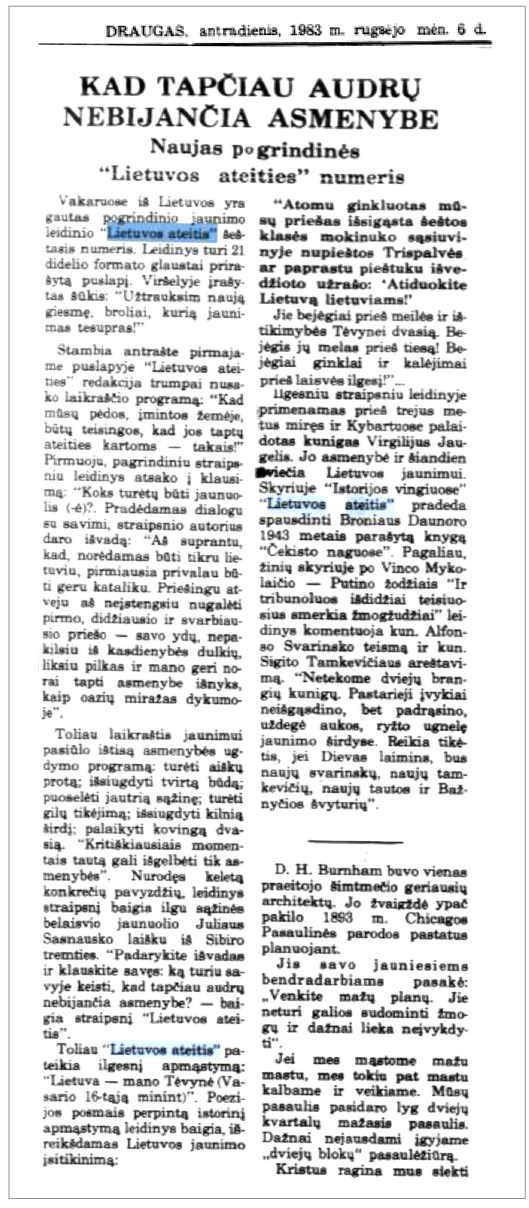
This new periodical highlighted the struggles, heroism, and sacrifices of Lithuanian youth. For instance, Issue No. 2 profiled the young priest Virgilijus Jaugelis, who was imprisoned for his beliefs and died at an early age. He was presented as a role model, and young readers contributed reflections on his life. Subsequent issues featured a letter by Julius Sasnauskas and provided thorough guidance on youth development, including the cultivation of a sharp mind, strong character, heightened consciousness, deep faith, generous spirit, and Christian values (‘Kad Tapčiau Audrų Nebijančia Asmenybe. Naujas Pogrindinės “Lietuvos Ateities” Numeris’, 1983).
Lietuvos Ateitis also fostered discussion on topics such as “What kind of religious youth should we have today?”, by offering concrete guidance for young believers in serving both faith and country. Nun Birutė Briliūtė was the initiator and first editor of this publication, while Saulius Kelpšas supplied the material and facilitated distribution across numerous Lithuanian parishes. The final issue was edited by Antanas Patackas, following Briliūtė’s transition to serve exclusively on Kronika’s editorial team after its editor was imprisoned (Briliūtė, 1998; Spengla, 2001, p. 34–35). The Chicago-based daily newsletter Draugas published a number of the texts from Lietuvos Ateitis upon these texts reaching the West, whereas Vatican Radio broadcasted them in Lithuanian.
Underground literature, along with spiritual retreats as well as various gatherings and events for youth, contributed to character development, provided support during persecutions at school, and aided in identity formation. Persecution by the KGB and difficulties experienced at school during formative years may have significantly influenced the development of these young people into adulthood. It is widely believed that many youths and children of that era lacked opportunities to reflect deeply on their experiences, including those that were painful or potentially traumatic. Additionally, their life choices – often involving considerable risk to their futures – were seldom acknowledged.
Qualitative research methods are especially valuable for exploring complex, subjective, and nuanced human experiences. This approach allows for deep engagement with the participants’ narratives, exploring not just what happened in their formative years, but how these experiences are interpreted and given meaning in adulthood. For this methodology, narrative inquiry was deemed appropriate, as it centres on personal stories and their significance (Pino Gavidia & Adu, 2022).
Two research questions are highlighted in this research:
• What were the key formative experiences of children and youth involved in underground movements within the Lithuanian Catholic Church from 1980 to 1990?
• How are these experiences evaluated in retrospect?
These questions guided the interview without constraining the participants’ responses, thus allowing new insights to emerge. Interviews were conducted in the respondents’ native (i.e., Lithuanian) language, and then translated into English. The data were systematically analysed by identifying, analysing, and reporting themes within the amassed information. This involved coding the data, sorting codes into themes, and reviewing the themes for coherence and distinction (Braun & Clarke, 2019).
The researcher participated in the underground youth movement in person and received recognition from the Genocide and Resistance Centre of Lithuania for involvement in nonviolent resistance during the Soviet occupation. The researcher was familiar with many young individuals who participated in the resistance. In the summer and autumn of 2023, an open invitation was sent to 25 people who were active during the soviet times in four Lithuanian towns: Kybartai, Kaunas Petrašiūnai Parish, Vilkaviškis, and Prienai. Eleven participants (including four men and six women) agreed to take part in the research project; whereas, others responded positively but could not participate due to time or other constraints. Data saturation was reached with the 8th respondent. Six respondents took part in the interview individually on the Zoom or Messenger platforms, which lasted between 45 and 120 minutes; the interviews were recorded, transcribed verbatim, and coded. Two respondents provided detailed written answers to all open-ended questions. All participants answered the same set of open-ended semi-structured interview questions. The respondents were made aware that they could withdraw their consent at any time (British Educational Research Association [BERA], 2024, p. 19). In the course of the interviews, it was established that the perspectives sourced from some respondents’ former teachers would add further context to the formative experiences. Four teachers from Kybartai secondary school were contacted, and three of them shared their views via Zoom and Messenger. These interviews lasted between 45 and 80 minutes each. While most participants consented to having their names published, two refused. As the data collection progressed, sensitive issues emerged regarding traumatic experiences, reconciliation, and naming those individuals who cooperated with the KGB. To minimize the risks involved, all respondent names were anonymized (refer to British Educational Research Association [BERA], 2024, p. 23).
All respondents noted significant factors involved in shaping their worldviews and maintaining their commitment to action against the political regime.
Youth retreats emerged as pivotal experiences in the spiritual growth of Lithuanian youths, with participants like Respondent A recalling transformative moments such as a retreat led by Rev. Sigitas Tamkevičius at age thirteen – this impact was felt universally by those involved. These clandestine gatherings often fostered connections with underground nuns, who played central roles in organizing secret meetings of the youth, frequently in collaboration with priests engaged in the underground movement. Influential figures such as Sister Gema Stanelytė, founder of the Eucharistijos Bičiuliai (en. Fellowship of the Eucharist), and Birutė Briliūtė, editor of the youth journal Lietuvos Ateitis, were commonly cited for their leadership and inspiration. During these meetings, young people engaged deeply with underground publications, such as Kronika, Aušra, and Lietuvos Ateitis, and circulated some banned literature such as Aleksandr Solzhenitsyn’s The Gulag Archipelago. Occasionally, the presence of dissidents and prominent underground activists provided further encouragement. Respondent A, for example, described how reading about courageous peers in Lietuvos Ateitis emboldened her own and Respondent H’s commitment to truth and freedom, and she vividly recounted the thrill – and danger – of evading the militia in Garliava, likening it to an adventure. These formative experiences spurred many youths to report human rights violations, gather signatures opposing dissident imprisonment, distribute samizdat literature, and erect crosses as acts of civil disobedience. While not every participant joined the most hazardous activities – Respondent D, for instance, noted that Fr. Gražulis likely refrained from asking youths to copy Kronika for their own safety – many, including herself, duplicated underground literature and took part in covert operations, expressing pride in the trust placed in them. For some, like Respondent A, these encounters inspired willingness to risk their educational and professional futures, a choice she never regretted, affirming, “I was determined to do all I could, up to the end”. Ultimately, these experiences profoundly shaped the worldviews, agency, and civic engagement of Lithuanian youth living under the Soviet rule.
The respondents reflected on the literature that shaped their perspectives, with Respondent C recalling his childhood readings of fairy tales and stories of bravery, later enriched by books on the lives of saints that offered life models. This sentiment was echoed by Respondent G, who noted that their own introduction to the underground movement began with regular choir rehearsals led by Sister Birutė Briliūtė; these sessions often led to more formal gatherings where current events and underground publications were being discussed. Respondent C’s experience mirrored this gradual approach, as her involvement in the movement also began with choir practice in her parish. The process of joining the underground was incremental, and the identities of those who published and edited periodicals such as Kronika, Aušra, and Lietuvos Ateitis were largely unknown to the participants – except, perhaps, for Kronika. As forty years have passed, the respondents frequently struggle to recall which ideas and readings were tied to each publication, while noting that their content and messages were fundamentally aligned. While Kronika primarily documented human rights violations and called for action, Aušra and Lietuvos Ateitis focused on instilling the Christian ideals, offering guidance for surviving KGB interrogations, poetry, and letters from exiled youth resisters such as Julius Sasnauskas. Particularly, the poetry by Bernardas Brazdžionis served to idealize the Lithuanian resistance, Siberian exile, and the aspiration for independence. Youth groups from the Kybartai and Petrašiūnai parishes collaborated to stage a theatrical production combining Brazdžionis poetry and resistance songs, which was an experience so formative that Respondent E can still recite verses performed over forty years ago.
Respondent C, along with other respondents, participated in monthly youth gatherings that took place in various locations, such as Kybartai Parish sacristy, Kaunas (specifically, Petrašiūnai Parish), and Garliava, where the current affairs and underground literature were being discussed under the guidance of Sister Birutė Briliūtė and Saulius Kelpšas. Respondent C recalled that Saulius Kelpšas, who was regarded as a central figure in the underground youth movement, served as an inspiring role model for the younger participants, especially adolescent boys. He was deeply influenced by the character and personality of Saulius, by his kindness, patience, calmness, and readiness to take risks, and observed that Saulius was notably older than him. While Respondent C credited his parents with shaping his early development, he emphasized that active participation in the underground movement, exposure to its literature, and engagement in youth meetings had a profound and lasting impact on his worldview. This influence was heightened by interactions with prominent examples of faith and resilience, including Rev. Sigitas Tamkevicius – a dissident priest from Kybartai Parish who endured imprisonment and exile in Siberia – and nuns Birutė Briliūtė and Bernadeta Mališkaitė, both of whom underwent KGB interrogation for their involvement in editing texts for Kronika. Respondent C described the environment as one marked by persistent KGB interrogations, daily challenges, and the need for personal sacrifice. Respondent G remembered Fr. Virgilijus Jaugelis, who, after suffering imprisonment and torture by the KGB, returned to serve at Kybartai Parish, thereby exemplifying moral integrity. Echoing Respondent C’s reflections, Respondent F highlighted the enduring value of these personal examples, by remarking that the actions of these individuals truly reflected their convictions and still continue to be held in high regard.
Families – parents, siblings, and grandparents – were instrumental in shaping the respondents’ early worldviews and attitudes toward resistance, providing both subtle guidance and overt support throughout their formative years. For Respondent B, her family’s quiet dissent from the prevailing social norms left an indelible mark; Respondent C was deeply influenced by her traditional, faith-oriented upbringing, while Respondent A credited a patriotic grandmother and supportive parents for instilling her with strong values. One of the Respondent’s mother, herself a former prisoner due to her resistance activities, emerged as a guiding force in the family, fostering love, faith, and patriotism. Although familial influence was pivotal during childhood, its importance gradually diminished as the respondents matured and external figures – such as parish priests – assumed greater significance in their lives. Parents were not always fully aware of their children’s specific activities, and yet a sense of tacit support persisted, with children often intuiting unspoken encouragement despite the high risks involved. For instance, when Respondent C and his friends secretly planned to display the Lithuanian flag, parental warnings were common, though not always effective in deterring the youthful bravado. Despite the challenges, all the respondents remain committed to passing down these values to subsequent generations, taking pride in their children’s interest in family history and social involvement. However, several respondents observed that younger generations, while facing new challenges, are sometimes less inclined to remember the sacrifices made for Lithuanian independence.
Respondent B (at timestamp 15:40) recalled feeling different from her peers, describing others as “just children” while she was guided by clear goals and a sense that something was wrong in her environment. Respondent C also struggled to explain his ethical instincts, saying, “If you felt you needed to do something, you just did it without question” (timestamp 00:15:01).
Many interviewees noted that their childhood environment was restrictive, with few opportunities for personal choice. Still, a clear understanding was manifested of what was morally right. Respondent A believed that her generation found maturing easier than the current ones. Respondent C remarked that the values taught in communist schools felt unrealistic, like promises of a brighter future for Lenin’s children on collective farms. He found it easy to distinguish adversaries – teachers, KGB officers, and ‘friends’ – but added that young people were often unaware of the complexities of life.
Respondent C stated that the traditional family values, faith, and patriotism were learned mainly through the Church and family. While it was not always easy to follow these principles, Respondent F remembered how he and his brothers sought self-improvement, inspired by dissidents.
Authenticity, integrity, and sincerity – in the sense of living by one’s beliefs and speaking the truth – were mainly instilled by families and dissidents in their parishes. All participants noted that these values deeply shaped their youth years and are still continuing to guide them. Respondent B affirmed carrying these values even during persecution. Respondents A, C and E highlighted faith, freedom, friendship, fellowship, and chastity as formative, passed down to their children. While the next generation may be less religious, they still turn to faith and prayer in important moments in life. All respondents agreed that the values from their youth continue to shape their lives. Many of them actively work for positive change in society through volunteer work (Respondents C and H).
The degree of involvement in resistance and risk-taking varied among the respondents. Some, like Respondent B, managed to avoid direct confrontation with the KGB, by attributing this to a sense of inner caution, while Respondent E similarly described feeling prompted not to participate when friends were taking part in risky actions such as erecting a cross in someone’s front yard, or when traveling to protests and pilgrimages, where their peers were sometimes arrested. While some youth avoided becoming KGB targets, many took part in less direct resistance; respondents from Kybartai Parish recalled walking on their knees around the parish church, praying the rosary in protest of the imprisonment of priests and community members, which was a protest, repeated for weeks, that was conducted in front of teachers and KGB agents who recorded the names from behind the church fence. Respondent B recalled that going on their knees around the church in pain was to show that there was grave injustice. Imprisonment of figures like priest Kastytis Matulionis and teenager Romas Žemaitis deeply affected the youth, spurring them to further protest. In addition to public demonstrations, private acts of resistance took place as well; some, like Respondent C, were tasked with copying underground literature using a typewriter or removing atheistic displays from schools, sometimes without facing punishment. Others engaged in more daring acts: Respondent C and his friends secretly planned and raised the Lithuanian flag atop their school for Independence Day, upon consulting youth leader Saulius Kelpšas. Their meticulous secrecy meant that even close peers and family were unaware, and when the flag and writings appeared on the day, teachers scrambled to erase them while students were celebrating with national ribbons and sashes. Respondent C later felt excitement mixed with guilt, especially after Romas Žemaitis was imprisoned for defending a priest during a procession. Despite oppression, the respondents felt fortunate to be part of the underground movement; Respondent A recalled the joy and sense of community found in celebrations, pilgrimages, and gatherings, explaining that:
“At that time, we were school pupils. We had dreams for our future, but those plans became secondary when we joined the underground movement. Even though we realized our future might not unfold as we hoped, we still believed something good awaited us. We read, studied, and did all we could.” [written response]
Many respondents recounted significant traumatic experiences from their school years, often involving imprisonment or death of their leaders and peers, humiliation, exclusion and threats felt at school, as well as fear about their future prospects.
For many, the most harrowing moments revolved around the imprisonment and death of youth leaders, which were events that cast daunting shadows over their formative years. Respondent C vividly remembered the pain that followed the incarceration of Fr. Kastytis Matulionis, the subsequent prohibition of Sister Birutė’s work, and the distress caused by the imprisonment of his peer Romas. The sense of guilt that weighed upon him was profound, even as he recognised that it was misplaced. Respondent H, too, recounted the emotional toll of preparing the body of Fr. Juozas Zdebskis after his death, describing how he and others were forced to evade KGB surveillance throughout the night in order to make funeral arrangements. These personal recollections underscore the lasting impact of political repression and loss, forming a central thread in the tapestry of traumatic experiences recounted by respondents.
Respondent B recalled the persistent feeling of being an outsider during her school years, describing how children intuitively sense when they are unwelcome, particularly during preparations for important events – as she was often ‘used’ and excluded, asked to leave just as the official proceedings began, which was a pattern that repeated multiple times. Her humiliation deepened when she was singled out before her class for refusing to join the communist youth organisation, while Respondent A suffered similar punitive grading and public humiliation from her form tutor but found solace in the occasional kindness of certain teachers. Respondent C, reflecting on the complex spectrum of teacher behaviour, described how some of them remained neutral, while others actively persecuted and humiliated him, prompting particular gratitude for his father, who once confronted school authorities and threatened to escalate their behaviour to Moscow after discovering that his children were barred from attending church. Respondent G recounted that the mistreatment he was facing at school led him to leave after the eighth grade, which would be the UK equivalent of completing GCSEs, having been locked in the building to prevent avoidance of the pioneers organisation and being forced to flee without his coat; after relocating to Kaunas, where lecturers were instructed to ‘re-educate’ him, he never faced the same humiliation. Similarly, Respondent D encountered institutional pressure after her exams, being told that she must join the communist youth organisation to continue her studies, and, when she refused, she took a gap year before attending a different school, where persecution was less severe, but church attendance remained restricted, whereas surveillance was persistent. Despite these challenges, both Respondent D and Respondent G expressed empathy for their persecutors, believing their actions were often dictated by external pressures, and, together, these testimonies highlight how exclusion and repression shaped, but did not entirely diminish, the resilience and compassion of those who endured them. Collectively, these accounts underscore the deep wounds inflicted by exclusion, humiliation, and institutional repression, as well as the lasting impact that such experiences had on those who lived through them.
The trauma experienced by many respondents did not simply fade with the collapse of the communist regime; in fact, it took on new dimensions, particularly as the former persecuting teachers assumed prominent positions within the Church. Respondent B reflected on this complex reality, expressing understanding for those teachers who had merely wanted to keep their jobs, noting that many have since passed away and emphasising that “we do not have the right to condemn them”. Still, she could not ignore the irony that those who had once “choked us” were now highly respected among priests. Respondent G offered a similar perspective, recounting the pain of being labelled ‘closed-minded’ in front of classmates and admitting that, although many of those teachers and principal assistants were now gone, the memories remained strong enough that he still avoided returning to his school building, even as his own children were studying there. Another respondent was struck by seeing her former teachers interviewed on YouTube, which prompted her to consider the impact that students’ resistance may have had on educators at the time. Some teachers, she realised, had been candid about feeling inconvenienced, angry, or burdened by their students’ defiance, and she had once hoped they might express shame or regret for their actions. Another respondent reflected with a sense of resignation on how their suffering had gone unrecognised for decades, pointing out that no apologies had ever been offered, and their trauma remained absent from the school’s recorded history – which is a hidden chapter in their collective past.
Respondent C reflected on the crucial role of peer support during periods of adversity, while acknowledging, however, that moments of betrayal were an inescapable reality – often only coming to light long after the events themselves. Respondent A, for instance, recounted the unsettling revelation that a friend had been assigned by the KGB to monitor her activities. Once aware, she carefully avoided this ‘friend’ whenever participating in resistance work, while understanding the risks involved. Despite the gravity of such betrayals, neither Respondent A nor her peers harboured lasting resentment. Respondent E offered a generous perspective, suggesting that these people might have had reasons – perhaps they were broken by the KGB. Respondent H, too, recalled the complex duality of a close friend who was both active in youth movements and secretly linked to the KGB, reinforcing the wisdom once shared by Fr. Juozas Zdebskis: “You do not know what methods the KGB used to crush young people”. These narratives reveal the intricacies of trust and survival within a climate of suspicion and repression.
Respondent A suggested that persecution built resilience. “If I were on my own, it would be difficult, but I felt part of like-minded people”. Instead of trauma, she felt gratitude for the resilience developed and pity for those who served against Lithuanian independence and the Church. She recalled a class reunion where her form tutor apologised to her in front of the year group for unjust treatment. Respondent A was pleased that those who had done wrong could acknowledge it and apologise. Respondent D’s story further illustrated the pressures the teachers were facing: one teacher confided that she was summoned to the headteacher’s office every morning before lessons, receiving instructions on how to handle Respondent D, a student perceived as ‘resistant’. Despite the climate of suspicion, not all teachers chose the path of persecution; Respondent D, for example, recalled a teacher who, after reading her essay, took the time to correct her mistakes to ensure that she would receive the highest grade possible
Reflecting on their formative experiences within the community, many respondents recall a close-knit group bound by camaraderie and shared purpose. Respondent B remembered those years as the best of their life, highlighting the group’s unity and the sense that everything was fine. Respondent C, too, described this period as the happiest of their life, attributing lasting friendships and a sense of fulfilment to their involvement in youth gatherings filled with prayer, retreats, camps, and meaningful activities. Community life included traveling, camping, choir rehearsals, and being taught by nuns and priests, while the sharing of underground literature further enriched their learning. Respondent D reminisced about lively meetings filled with singing, dancing, exchanging ideas, staying at each other’s homes, and compiling prayer books from clandestine texts. Respondent G fondly recalled celebrations such as Joninės (St. John’s Day), treats prepared by Sister Virginija, and children’s choir at Easter. Yet these joyful memories were shadowed by the reality of persecution and interrogations at school and by the KGB – these were challenges that, though daunting, became more bearable with the support of friends. Respondents G and F noted that anxiety over potential repercussions dissipated among like-minded peers; despite pressure during interrogations, betrayal was never an option. Respondent E recounted significant distress, especially when friends faced questioning, and remembered the particular difficulty when the KGB interrogated their mother at home. Respondent D reflected on the empowering nature of resistance in youth, by emphasizing that courage was fostered by the solidarity of the community. For these individuals, their actions – though shaped by extraordinary circumstances – were not seen by themselves as heroic, but simply as the natural course of life within a resilient and supportive group.
Perspectives among the teachers respondents diverged regarding how children were being treated in schools and the underlying reasons for such treatment. Evidence suggests that when children were being targeted by both the KGB and school authorities, teachers themselves also became targets. However, one teacher noted that none of their colleagues were ever reprimanded for not participating in this targeting, even though teachers were often asked to monitor or single out specific children. According to this teacher, the youth of that era were ‘brave and maximalist’, feeling a strong sense of righteousness, a behaviour that some educators found concerning. This period was described as challenging for everyone involved, and, in another teacher’s view, the difficulties extended beyond the question of religious convictions. Instead, much depended on the child’s behaviour, i.e., whether it was provocative, challenging, or passively condemnatory, or if the child simply lacked politeness. Another respondent agreed, while adding that youth organisations, such as the Pioneer and Komsomol groups, failed to appeal to these children, as they did not offer ‘shady’ activities. One respondent described the underground youth as foolhardy. When reprimanding students, the respondent made an effort to remain kind and avoid causing harm. Two educators emphasised that, more often than not, the struggles within schools were not ideological battles; rather, their primary concern was the future of the children in their care.
Among the three respondents, one was particularly explicit in recognising that children were being persecuted for their faith at the same school. According to this account, teachers were required to identify students who attended church and displayed religious tendencies. The pressure on educators intensified when the Vatican Radio began broadcasting reports about the persecution of schoolchildren, naming the most active teachers involved. At Kybartai school, regular mandatory meetings were held for all staff, instructing them on how to further these objectives and contribute to the cause of Fr. S. Tamkevičius’s arrest. During this period, the pervasive presence of the KGB in the school underscored an atmosphere of fear and control; the primary aim was to diminish the influence of S. Tamkevičius on the youth. The respondent further recalled instances where teachers themselves became targets of scrutiny – particularly those who attended church, even in other towns. Some paid a steep price for their faith: for example, Ona Brilienė, a mathematics teacher known for her composure, kindness, and popularity among students, lost her teaching position after someone discovered photographs of her children’s baptism and she refused to cease going to church. These recollections reveal the profound personal and professional consequences that religious conviction could entail under such an oppressive system.
All respondents recalled how they were required to organise events – especially on Christmas Eve – with the deliberate purpose of discouraging pupils from attending church. One respondent maintained that teachers always retained some measure of free will and could choose either to comply with or quietly refuse the school’s demands to persecute children for their religious beliefs. It was common practice to write official reports that conformed to what school authorities wanted to hear, while in reality taking little or no punitive action. While some educators took an overzealous approach to persecution, this respondent recalled a formative moment in their final year of school, when a class teacher, recognising the anti-Soviet character of their essay, privately praised it as the best in class and returned it rather than reporting the essay to the authorities. Nonetheless, the respondent recounted significant abuse from other teachers during their schooling. They also revealed that, although they were pressured to participate in the persecution of children, they quietly refused to comply, instead focusing on their teaching and supporting their students without drawing attention to their dissent.
Despite the profound hardships described, none of the respondents addressed the process of reconciliation or acknowledged whether those children, once persecuted for their faith and now adults, should be approached and their experiences recognised. After the collapse of the Soviet regime, a significant shift occurred: many teachers, including all the respondents, joined local movements that played a vital role in Lithuania’s struggle to regain independence. One respondent vividly recalled the pervasive fear that lingered during those uncertain times, as the political outcome remained unclear and the presence of the KGB was still being acutely felt. The transition from an atmosphere of control and suppression to one of hopeful activism speaks to the resilience and adaptability of those who endured – and ultimately helped to shape – a new chapter in their nation’s history.
• Youth movement during the Soviet times in Lithuania was powerfully influenced by underground church communities, underground literature, and inspiring role models. These factors cultivated a resilient spirit of resistance among young people, even as they faced significant dangers. Evidence suggests that the foundations for such activism often lay within the family, where faith and patriotism instilled values that inspired youth to challenge the oppressive regime – these were the principles that continued to shape their lives long after their formative years.
• Experiences of trauma and adversity, such as exclusion, humiliation, and the loss of mentors, were common among these activists. Yet, such hardships frequently served to deepen their commitment to truth, freedom, and solidarity. Peer support and trusted community networks played a vital role in sustaining the courage and resilience necessary for resistance. While acts of betrayal did occur, these were often viewed with empathy, given the intense pressures exerted by the Soviet authorities.
• Teachers occupied complex positions within this environment; some acted as agents of repression, while others quietly supported students’ convictions. This duality revealed the nuanced realities of school life under Soviet surveillance. Acts of resistance among Lithuanian youth ranged from distributing underground publications to engaging in symbolic public protests, demonstrating both inventiveness and resolve.
• The legacy of these movements endures, with many former activists continuing to pass on values of authenticity, faith, and civic responsibility to the next generation. Despite facing profound hardships, many have shown remarkable capacity for reconciliation and empathy towards former adversaries, recognising the pressures faced by teachers and peers and valuing forgiveness and understanding.
• During the Soviet era, religious education for children and youth in Lithuania was forbidden. Nevertheless, certain Catholic parishes managed to provide underground sacramental preparation and formative activities, guided by dissident priests and laypeople. Supported by clandestine literature, these initiatives included spiritual retreats, meetings, and other gatherings. Incidents, such as the persecution of Inga Zvingevič, exemplify the extent of repression endured by young believers, with over 5,000 documented violations. Research suggests that youth formation in Catholic parishes was shaped by both religious and national ideals, despite limited written records.
• Childhood and adolescence experiences, especially those marked by adversity, have lasting effects on identity and resilience, as observed by researchers, e.g., by Gailienė. The silence surrounding Soviet-era traumas and the denial of past crimes have hindered collective healing and understanding. This research confirms that young people who were actively involved in underground movements and faced persecution are keen to share their experiences and have their voices acknowledged. It is essential for peer communities to recognise the sacrifices and hardships endured, as this acknowledgment will enrich society’s understanding of Lithuania’s struggle for independence and provide valuable insights for the future.
References
70 Kronika. (1986). Sovietinėje mokykloje. Retrieved from https://lkbkronika.lt/index.php/70-kronika-1986-m/sovietineje-mokykloje
Baumrind, D. (1991). The Influence of Parenting Style on Adolescent Competence and Substance Use. The Journal of Early Adolescence, 11(1), 56–95. https://doi.org/10.1177/0272431691111004
Bažnyčios Kronikos Fondas. (2021, December 31). Iš kybartiečio Kęsto Juozo Mačiulaičio prisiminimų apie LKB kroniką. Retrieved from https://www.kronikosfondas.lt/liudijimai/is-kybartiecio-kesto-juozo-maciulaicio-prisiminimu-apie-lkb-kronika/
Braun, V.; Clarke, V. (2019). Reflecting on reflexive thematic analysis. Qualitative Research in Sport, Exercise and Health, 11(4), 589–597. https://doi.org/10.1080/2159676X.2019.1628806
Briliūtė, B. (1998). Keli štrichai „LKB Kronikos“ tema. In Lietuvos Katalikų bažnyčios Kronika, Jubiliejinės konferencijos medžiaga (pp. 75–86). Lietuvos gyventojų genocido ir rezistencijos tyrimo centro leidinys.
British Educational Research Association [BERA]. (2024, May 17). Ethical Guidelines for Educational Research (5th ed.). Retrieved from https://www.bera.ac.uk/publication/ethical-guidelines-for-educational-research-fifth-edition-2024-online
Bronfenbrenner, U. (1981). The Ecology of Human Development: Experiments by Nature and Design. Harvard University Press. https://doi.org/10.2307/j.ctv26071r6
Brown, B. B.; Larson, J. (2009). Peer Relationships in Adolescence. In R. M. Lerner & L. Steinberg (Eds.), Handbook of Adolescent Psychology (1st ed.) (pp. 74–103). Wiley. https://doi.org/10.1002/9780470479193.adlpsy002004
Bubnys, A. (2025, June 6). Pogrindžio leidinys Aušra (1975-1988). XXI Amžius. https://xxiamzius.lt/straipsniai/pogrindzio-leidinys-ausra-1975-1988
Eccles, J. S., & Roeser, R. W. (2011). Schools as Developmental Contexts During Adolescence. Journal of Research on Adolescence, 21(1), 225–241. https://doi.org/10.1111/j.1532-7795.2010.00725.x
Gailienė, D. (2021). Ką jie mums padarė. Lietuvos gyvenimas traumų psichologijos žvilgsniu. Tyto alba.
Gelžinis, A. (2023, May 26). Politiniam kaliniui, pogrindžio spaudos leidėjui, gydytojui Povilui Butkevičiui – 100. Bernardinai.lt. https://www.bernardinai.lt/politiniam-kaliniui-pogrindzio-spaudos-leidejui-gydytojui-povilui-butkeviciui-100
Juvonen, J.; Graham, S. (2014). Bullying in Schools: The Power of Bullies and the Plight of Victims. Annual Review of Psychology, 65(1), 159–185. https://doi.org/10.1146/annurev-psych-010213-115030
Kad tapčiau audrų nebijančia asmenybe. Naujas pogrindinės „Lietuvos ateities“ numeris. (1983, September 6). Draugas, 77(176), 4. https://www.draugas.org/archive/1983_reg/1983-09-06-DRAUGAS-i7-8.pdf
Karaliūtė Cane, A. (2023, March 11). Dievo vedimas ar nesibaigiantis gyvenimo nuotykis? Bernardinai.lt. https://www.bernardinai.lt/dievo-vedimas-ar-nesibaigiantis-gyvenimo-nuotykis/
Katalikų interneto tarnyba. (2000). Lietuvos Katalikų Bažnyčios Kronika, Bažnyčia ir valstybė. http://www.lcn.lt/paveldas2000_relig/all/c_7_1.htm
Lekstutiene, I. (2022, September 2). Lietuvos Katalikų Bažnyčios Kronika. https://epale.ec.europa.eu/lt/content/lietuvos-kataliku-baznycios-kronika
Lietuvos katalikų bažnyčios kronikai–50. (2022). [Video]. LRT.lt Mediateka. https://www.lrt.lt/mediateka/irasas/2000212487/koncertas-lietuvos-kataliku-baznycios-kronikai-50
Liutikas, D. (2003). Jaunimo religingumo problema sovietinio ateizmo metais [The problem of youth religiosity under Soviet atheism]. In A. Vosyliūtė (Ed.), Jaunimo vertybinės orientacijos (pp.124–134). Socialinių tyrimų institutas.
Mahoney, J. L., Cairns, B. D., & Farmer, T. W. (2003). Promoting interpersonal competence and educational success through extracurricular activity participation. Journal of Educational Psychology, 95(2), 409–418. https://doi.org/10.1037/0022-0663.95.2.409
Markus, H. R.; Kitayama, S. (1991). Culture and the self: Implications for cognition, emotion, and motivation. Psychological Review, 98(2), 224–253. https://doi.org/10.1037/0033-295X.98.2.224
Masten, A. S. (2001). Ordinary magic: Resilience processes in development. American Psychologist, 56(3), 227–238. https://doi.org/10.1037/0003-066X.56.3.227
Naudžiūnienė, A. (2020). History of Education as a Form of Value Indoctrination in Soviet Lithuania. In Educational Reforms Worldwide (pp. 42–48). Bulgarian Education Society. https://files.eric.ed.gov/fulltext/ED608378.pdf
Nauji leidiniai. (1982). 53 Kronika. Retrieved from https://lkbkronika.lt/index.php/53-kronika-1982-m?start=14
Navickas, A.; Sopranaitė, R. (Eds.). (2013). Laisvė ir tikėjimas: Krikščioniški trileriai sovietmečiu. Ateities Leidybos Centras, Bernardinai.lt.
Oscar, A. (1988). The Reform of the Soviet Education System: Between Modernization and Ideological Control. In Gorbachev and the Soviet Future. Routledge.
Pino Gavidia, L. A.; Adu, J. (2022). Critical Narrative Inquiry: An Examination of a Methodological Approach. International Journal of Qualitative Methods, 21, 16094069221081594. https://doi.org/10.1177/16094069221081594
„Pirmieji „Aušros“ spinduliai“. (1975). Aušra, Vol. 1(X-1977. II. 16, Chicago), 6.
Pospielovsky, D. V. (1988). Church and State Under Gorbachev: What to Expect? In Gorbachev and the Soviet Future. Routledge.
Rothon, C., Head, J., Klineberg, E., & Stansfeld, S. (2011). Can social support protect bullied adolescents from adverse outcomes? A prospective study on the effects of bullying on the educational achievement and mental health of adolescents at secondary schools in East London. Journal of Adolescence, 34(3), 579–588. https://doi.org/10.1016/j.adolescence.2010.02.007
Rutter, M. (1987). Psychosocial resilience and protective mechanisms. American Journal of Orthopsychiatry, 57(3), 316–331. https://doi.org/10.1111/j.1939-0025.1987.tb03541.x
Ryan, R. M.; Deci, E. L. (2000). Self-determination theory and the facilitation of intrinsic motivation, social development, and well-being. American Psychologist, 55(1), 68–78. https://doi.org/10.1037/0003-066X.55.1.68
Seligman, M. E. P. (2002). Positive psychology, positive prevention, and positive therapy. In C. R. Snyder & S. J. Lopez (Eds.), Handbook of positive psychology (pp. 3–9). Oxford University Press.
Skuodis, V. (1987, December 10). 1. Lietuvos pogrindžio spaudos žingsniai. Retrieved from http://sas.ateitis.lt/wp-content/uploads/2018/05/Suoprotis.-KBK.pdf
Spengla, V. (2001). Bažnyčia, ‘Kronika’ ir KGB voratinklis (Antras, pataisytas ir papildytas leidimas). „Katalikų akademijos“ leidykla. https://lkbkronika.lt/files/pdf/Spengla-baznycia-kronika-kgb-.pdf
Steeves, P. D. (1977). Amendment of Soviet Law concerning Religious Groups. Journal of Church and State, 19(1), 37–52. https://doi.org/10.1093/jcs/19.1.37
Steinberg, L., & Morris, A. S. (2001). Adolescent Development. Annual Review of Psychology, 52(1), 83–110. https://doi.org/10.1146/annurev.psych.52.1.83
Stonkuvienė, I. (2023). The Equal and the More Equal: Pupils’ Experiences of School in Lithuania in the late Soviet Era. Journal of Education Culture and Society, 14(1), 124–142. https://doi.org/10.15503/jecs2023.1.124.142
Streikus, A. (2003). Character of the Atheist Propaganda in Lithuania in 1975 to 1988. Genocidas Ir Rezistencija, 1(13), 7–21. https://doi.org/10.61903/GR.2003.101
Subačius, P. V. (2015). Dvidešimt penkeri religinės laisvės metai 1988-2013: Krikščionys Lietuvos visuomenėje po Atgimimo: monografija. Lietuvių Katalikų Mokslo Akademija.
Van Den Bercken, W. (1989). Ideology and Atheism in the Soviet Union. Mouton De Gruyter. https://play.google.com/books/reader?id=MHuVDwAAQBAJ&pg=GBS.PP4&hl=en_GB
Yibing Li, Doyle Lynch, A., Kalvin, C., Jianjun Liu, & Lerner, R. M. (2011). Peer relationships as a context for the development of school engagement during early adolescence. International Journal of Behavioral Development, 35(4), 329–342. https://doi.org/10.1177/0165025411402578