Acta Paedagogica Vilnensia ISSN 1392-5016 eISSN 1648-665X
2026, vol. 56, pp. 62–79 DOI: https://doi.org/10.15388/ActPaed.2026.56.4
Svetlana Surikova
Faculty of Education Sciences and Psychology, Scientific Institute of Pedagogy,
University of Latvia
svetlana.surikova@lu.lv
https://orcid.org/0000-0002-3025-6344
https://ror.org/05g3mes96
Tamāra Pīgozne
Faculty of Education Sciences and Psychology, Scientific Institute of Pedagogy,
University of Latvia
tamara.pigozne@lu.lv
https://orcid.org/0000-0002-4518-7644
https://ror.org/05g3mes96
Abstract. This study explores 1,240 Latvian parents’ and 542 teachers’ views on character education, its value, impact on achievement, and prioritised virtues. A survey highlights shared belief in its importance and positive academic effects but reveals differing virtue priorities. Parents emphasise good judgement, confidence, curiosity, and civility, while teachers focus on civility, good judgement, honesty, and curiosity. Both groups undervalue the other’s emphasis on character education. An improved family-school dialogue could enhance collaboration and foster balanced development in pupils.
Keywords: character education, parents’ perspectives, teachers’ perspectives, virtues, academic achievement.
Santrauka. Šiame tyrime nagrinėjamas Latvijos tėvų ir mokytojų požiūris į charakterio ugdymą, ypatingą dėmesį skiriant jo svarbai, suvokiamam poveikiui mokinių pasiekimams bei dorybėms, kurioms teikiama pirmenybė. Atlikta internetinė apklausa, kurioje dalyvavo 1 782 respondentai, iš jų 1 240 tėvų, o 542 – mokytojai. Rezultatai atskleidė, kad tėvų ir mokytojų nuomonės dėl charakterio ugdymo svarbos ir jo teigiamos įtakos akademiniams rezultatams labai sutampa. Tačiau pastebima skirtumų tarp to, kokioms savybėms kiekviena grupė teikia pirmenybę. Tėvai didžiausią svarbą teikia gebėjimui priimti teisingus sprendimus, paskui – pasitikėjimui savimi, smalsumui ir mandagumui, o mokytojai pirmiausia išskiria mandagumą, paskui – gebėjimą priimti teisingus sprendimus, sąžiningumą ir smalsumą. Aukštas gebėjimo priimti teisingus sprendimus, smalsumo ir mandagumo vertinimas rodo bendrą dėmesį intelektinėms ir pilietinėms dorybėms. Be to, abi grupės linkusios teigti, kad kitai grupei charakterio ugdymas ne toks svarbus kaip akademiniai pasiekimai – tai rodo komunikacijos tarp grupių spragas. Šie rezultatai leidžia teigti, kad būtinas glaudesnis tėvų ir mokytojų dialogas bei bendradarbiavimas siekiant geriau suprasti vieniems kitų ugdymo tikslus. Pašalinus suvokimo skirtumus galėtų didėti charakterio ugdymo veiksmingumas, o požiūris į jį galėtų būti labiau suderintas; toks požiūris skatintų tiek akademinę sėkmę, tiek visapusišką mokinių vystymąsi. Tyrimas padeda geriau suprasti pagrindinių suinteresuotųjų šalių vaidmenis ir prioritetus charakterio ugdymo srityje bei pateikia įžvalgų, kaip stiprinti šeimos ir mokyklos bendradarbiavimą.
Pagrindiniai žodžiai: charakterio ugdymas, tėvų požiūris, mokytojų požiūris, dorybės, akademiniai pasiekimai.
_________
Received: 21/12/2024. Accepted: 30/12/2025
Copyright © Svetlana Surikova, Tamāra Pīgozne, 2026. Published by Vilnius University Press. This is an Open Access article distributed under the terms of the Creative Commons Attribution Licence (CC BY), which permits unrestricted use, distribution, and reproduction in any medium, provided the original author and source are credited.
In recent decades, character education has gained increasing significance worldwide, leading to extensive research on various aspects of character education across different countries and continents (Arthur et al., 2015; Berkowitz, 2021; Chairunnisa & Istaryatiningtias, 2022; Gündoğdu et al., 2019, 2022; Harrison et al., 2020; Kropfreiter et al., 2024; McGrath, 2018; McGrath et al., 2022; Surikova & Fernández González, 2023). A significant portion of both national and international studies focuses on exploring teachers’ opinions (Gündoğdu et al., 2019, 2022; Kropfreiter et al., 2024; Mandich, 2023; Mathison, 1999; Phillips, 2018), including subject-specific perspectives, for instance, religious education teachers’ (Metcalfe & Moulin-Stożek, 2020; Metcalfe et al., 2023) and physical education teachers’ opinions on character education (Tutkun et al., 2017; Yıldırım & Gürpınar, 2023). Additionally, some studies investigate parents’ perspectives on home-based character education activities (Paul et al., 2022), their views on family-school collaboration for character education (Surikova & Fernández González, 2022), or the values intended to be taught in social studies lessons (Tay & Yıldırım, 2009).
A few national comparative studies have been conducted to explore both teachers’ and parents’ perspectives on character education (Crow, 1997; Duran & Sariçam, 2016; Epçaçan & Sevgi, 2021; Harrison et al., 2018, 2022; Surikova & Fernández González, 2021).
Crow’s (1997) study, which was limited to one middle school (Grades 6–8) in a suburban school district in Texas, USA, involved a total of 48 teachers and 193 parents. The findings suggested that there could be significant alignment between parents and teachers regarding the teaching of certain character traits in schools, as responses from both groups were remarkably similar, indicating a shared belief in many of the same values. This agreement between parents and teachers is a crucial step towards the successful implementation of character education in public schools.
Duran and Sariçam (2016) conducted a qualitative study in Adıyaman City Centre, Turkey, to examine parents’ and teachers’ views on the character and character traits of preschoolers. The study involved 10 preschool teachers and 15 parents. The findings revealed that parents and teachers held divergent opinions about character. Additionally, the expectations and observations of parents and teachers regarding children’s character traits varied. The study showed that parents primarily saw themselves as responsible for the development of their children’s character. Furthermore, teachers expressed contrasting views on the role of parents in fostering these character traits in children.
Epçaçan and Sevgi (2021) conducted a qualitative study to assess the influence of parents and teachers on the character education of secondary school pupils, drawing on the perspectives of both groups. The study involved 15 teachers and 15 parents from 11 secondary schools in Siirt province, Turkey. According to the participants, character education involves instilling fundamental moral values in children from a young age, a responsibility that both parents and teachers significantly share. The study highlighted that parents and teachers believe they must serve as positive role models, maintain healthy communication with children, provide a loving and supportive home environment, and demonstrate honesty, consistency, and a solution-oriented approach. Additionally, they emphasised the importance of keeping children away from negative influences and fostering a lifelong commitment to learning.
Harrison et al. (2018) and Harrison et al. (2022) reported the initial findings from the first phase of the Parent-Teacher Partnerships and Character Education project, which gathered evidence through a questionnaire completed by 376 parents and 137 teachers from UK schools. The study aimed to explore the extent of shared understanding between parents and teachers regarding the importance of character education, as well as the perceived barriers and enablers to their collaboration in this area. The key findings revealed that both parents and teachers prioritised character development over academic attainment, yet each group believed the other prioritised attainment. Both groups ranked moral virtues as the most important, followed by performance virtues. However, parents believed that teachers placed the least emphasis on moral virtues and the greatest emphasis on civic virtues. The quality of communication was identified by both parents and teachers as the most crucial enabler of a positive relationship, while the biggest barrier mentioned by both groups was a lack of time.
Surikova and Fernández González (2021) conducted a mixed-method study to explore how the role of schools and teachers in character education is perceived in Latvia. The study analysed the perspectives of 1,116 participants, comprising 461 parents, 496 teachers, and 159 school leaders. The findings revealed that many participants believe that schools should foster pupils’ character development alongside academic achievement. While teachers are expected to promote good morals and values using both ‘caught’ and ‘taught’ strategies, the primary responsibility for children’s moral development is viewed as resting with parents and families rather than with teachers and schools. Nevertheless, the majority of both school staff (teachers and school leaders) and parents supported the idea of shared responsibility and collaboration between schools and families to enhance character education both within and beyond the classroom.
Previous national comparative studies on character education reveal both commonalities and differences in parents’ and teachers’ perspectives. Studies in the USA, Turkey, the UK, and Latvia show varying alignment between parents and teachers, particularly regarding responsibility for children’s moral development. While shared responsibility is often emphasised, opinions on roles and priorities differ across countries and contexts.
Gündoğdu et al. (2022) conducted a cross-cultural study to investigate the opinions of American, German, and Turkish classroom teachers on character education, gathering data from 419 teachers across the three countries. The study identified both similarities and differences in the views of teachers from these diverse cultural contexts. However, there remains a notable gap in international comparative studies regarding the comparison of perspectives of both key stakeholders in the education system – namely, parents and teachers.
At the end of 2023, the European Character Virtues Association, in collaboration with universities from multiple European countries, launched the project titled “Teachers’ and Parents’ Perspectives on Character Education in Europe” (TEPACE). The primary aim of the project is to assess the attitudes of parents and teachers towards character education across European countries, including Austria, the Czech Republic, Poland, Spain, Italy, Slovakia, Germany, and Latvia, among others, by using a comparative approach within the national and international stages. Specially adapted questionnaires for teachers and parents were translated into the languages of the participating countries and distributed by project partners within their respective nations.
As part of the TEPACE project, this study addresses a central research question within the national stage: “What are the beliefs of Latvian teachers and parents on character education in schools, and what similarities and differences exist between their perspectives?”. This question is further explored through five sub-questions: What do parents and teachers think about the importance of character education in schools? What do they think about the impact of a greater focus on character education on children’s (pupils’) attainment? Which virtues do they consider most important? Do they prioritise character development over academic achievement? What do they perceive the other group prioritises?
Between February and March 2024, two questionnaires from the TEPACE project, developed based on previous studies (Harrison et al., 2018, 2022), were translated into Latvian. The Latvian version of the parent questionnaire included an informed consent section, nine demographic items, ten single-choice or scale questions, three multiple-response questions, and one open-ended question. The Latvian version of the teacher questionnaire similarly included an informed consent section, nine demographic items, 16 single-choice or scale questions, two multiple-response questions, and one open-ended question.
Following the issue of ethical approval No 71-46/174 (13 December 2023) provided by the Research Ethics Committee of the University of Latvia, electronic invitations were sent out at the end of March 2024 to the email addresses of 569 general education institutions across Latvia. To support the data collection process, additional efforts were made, including direct communication with school representatives via phone calls, emails, and face-to-face meetings to encourage participation of school teachers and parents with children of a school age.
The data collection was conducted by using a web-based survey developed and hosted on the Qualtrics platform. The survey was completed on 31 May 2024, yielding 2,540 responses from 166 general education institutions. Of these, the final analytic sample included 1,782 respondents who fully completed the questionnaire.
The teacher sample consisted of 542 respondents, with the majority (43.3%) based in the Riga region. The remaining teachers were distributed across Kurzeme (12.7%), Vidzeme (15.5%), Zemgale (16.8%), and Latgale (11.6%). The sample was predominantly female, with 91.3% women, 5.9% men, and 2.8% preferring not to disclose their gender. In terms of age, most teachers were aged between 45 and 64, with 31.9% aged 45–54 and 32.1% aged 55–64. The sample also included younger teachers aged 18–24 (1.8%) and 25–34 (8.7%), as well as those aged 65 and older (5.4%). Nearly all teachers (97.8%) worked in public schools, with only a small proportion (2.2%) employed in private institutions. Regarding the subjects taught, a significant number specialised in the mother tongue (28.6%), mathematics (23.4%), and social studies (23.6%). Other subjects included second languages (16.8%), sciences (22.0%), humanities (12.4%), and fine arts (16.8%). Teachers’ professional experience varied, with the largest groups having more than 30 years (34.7%) and 21–30 years (24.9%) of experience. The levels of education taught ranged from preschool (4.6%) to upper secondary (32.7%), with the majority engaged in primary (49.3%) and lower secondary education (69.9%).
The parent sample comprised 1,240 respondents, with a significant majority (54.8%) from the Riga region. Zemgale followed with 27.7%, while the remaining regions had notably fewer respondents. The sample was also predominantly female (87.3%), with 8.9% male respondents and 3.9% preferring not to disclose their gender. The age distribution was heavily concentrated in the 35–44 age group (61.0%), followed by the 45–54 age group (25.5%), with younger and older age groups being minimally represented. Regarding marital status, 67.9% were married, while 15.0% lived together without formal registration. The remaining respondents were single, divorced, widowed, or remarried. In terms of children, nearly half (45.6%) of the respondents had two children, with 24.1% having three. The respondents were well-qualified, with most holding at least a bachelor’s degree (26.2%) or a master’s degree (25.3%). Regarding their children’s schooling, most indicated that their children attended lower secondary school (56.9%) and primary school (54.8%), with notable representation in kindergartens (23.8%) and upper secondary schools (19.1%).
To summarise, the parent sample is characterised by a predominance of married, middle-aged females with a substantial level of education, mainly residing in the Riga and Zemgale regions, and having two children. The teacher sample was predominantly female, middle-aged, and highly experienced, with the majority working in public schools. They teach a wide range of subjects, with significant representation in core academic areas such as mother language, mathematics, and sciences. The teachers are also well-distributed across different levels of education, with a strong presence in primary and lower secondary education. Most respondents are from the Riga region (54.8% of parents, 43.4% of teachers). The majority of respondents are female (parents: 87.3%, teachers: 91.3%). Parents are mostly aged 35–44 (61%), while teachers are most teachers (64.0%) were aged between 45 and 64.
The quantitative data were processed and analysed by using IBM SPSS Statistics 22. Descriptive statistics were applied to single-choice and scale questions, while multiple-response methods were used for multiple-choice questions. The one-sample Kolmogorov-Smirnov test assessed data distribution, and internal consistency was evaluated through reliability analysis (Cronbach’s alpha) for the parent questionnaire (α = .762) and the teacher questionnaire (α = .745). To compare the two independent respondent groups (teachers and parents), a joint data matrix (α = .834) of comparable questions from both questionnaires was first created. Then, Chi-square Test for 2x2 tables and the Mann-Whitney U Test were employed. The qualitative data, derived from respondents’ open-ended responses (7,073 words in the parent survey and 2,747 words in the teacher survey), were processed, analysed, and used to illustrate the quantitative findings.
The data provided in Table 1 present the results of a survey question that asked both teachers and parents to what extent they agree or disagree with the statement: “I think that character education in schools is very important”.
|
Answer |
Respondent group |
Total N (%) |
|
|
Parents n (%) |
Teachers n (%) |
||
|
1= Strongly disagree |
22 (1.8) |
11 (2.0) |
33 (1.9) |
|
2= Slightly disagree |
17 (1.4) |
8 (1.5) |
25 (1.4) |
|
3= Neither agree nor disagree |
72 (5.8) |
22 (4.1) |
94 (5.3) |
|
4= Slightly agree |
463 (37.3) |
205 (37.8) |
668 (37.5) |
|
5= Strongly agree |
666 (53.7) |
296 (54.6) |
962 (54.0) |
The crosstabulation results reveal that both parents and teachers strongly agree (53.7% of parents and 54.6% teachers) or slightly agree (37.3% of parents and 37.8% of teachers) on the importance of character education in schools, emphasising that “It would be beneficial to develop moral education as much as possible in schools, as a morally educated person is best able to contribute to society, feel good within it, find fulfilment in life, and be happy in everyday life” (Parent A), “It is important that character education becomes one of the school’s goals” (Teacher A). In contrast, a small percentage of both parents (3.2%) and teachers (3.5%) strongly or slightly disagree with the importance of character education in schools, arguing that “Character education and any form of value-based education is the responsibility of the parents” (Parent B), “Parents are primarily responsible for the character education of their children; greater responsibility should be taken by each pupil’s family” (Teacher B). Some respondents highlighted the need for a partnership between families and schools: “Schools and families must work together to raise the next generation of good and wise citizens” (Parent C), “Character education in school is not possible if it is not practiced at home by the parents. It must be a collaboration between the school and parents to promote pupils’ virtues” (Teacher C).
The Mann-Whitney U Test results further illuminate the comparison between these two groups. The mean ranks for parents (887.74) and teachers (900.10) are very close, suggesting that the distribution of responses between these groups is similar, there is no significant difference between the groups (U = 331,380.500, p = .600).
Survey participants were asked the question: “How, if at all, do you imagine a greater focus on character education would impact your child’s (pupils’) attainment?”. Respondents were given the option to select one of five possible outcomes, ranging from a negative impact to a large positive impact. The results in Table 2 indicate that a significant majority of both parents (89.5%) and teachers (93.7%) believe that an increased emphasis on character education would positively affect pupil attainment to some extent or to a large extent. Conversely, only a small fraction of respondents (1.1%) anticipated a negative impact on attainment due to a focus on character education. Additionally, 8.1% of respondents believed that such a focus would have no effect on pupil attainment. A more detailed examination shows that among parents, 56.5% believed that character education would positively affect attainment to some extent, and 33.0% believed it would positively affect attainment to a large extent. They argued, “If a child is self-confident and able to overcome difficulties and setbacks in a supportive, learning environment, it will enhance their academic achievements” (Parent D), “The higher the quality of work invested in character education, the better children will be able to focus on their learning tasks and, with enthusiasm for learning, achieve higher academic results” (Parent E). In contrast, 9.1% of parents thought that character education would have no impact, and 0.8% anticipated a large negative impact. Among teachers, 59.4% expected a positive effect to some extent, and 34.3% anticipated a large positive effect. One teacher emphasised, “In my opinion, if pupils have high moral ideals, they will also achieve success in their studies” (Teacher D). Only 5.9% of teachers believed it would have no impact, while 0.4% expected a negative impact to some extent.
|
Answer |
Respondent group |
Total N (%) |
|
|
Parents n (%) |
Teachers n (%) |
||
|
1= Negatively affect to a large extent |
10 (0.8) |
10 (0.6) |
|
|
2= Negatively affect to some extent |
7 (0.6) |
2 (0.4) |
9 (0.5) |
|
3= Will not affect |
113 (9.1) |
32 (5.9) |
145 (8.1) |
|
4= Positively affect to some extent |
701 (56.5) |
322 (59.4) |
1023 (57.4) |
|
5= Positively affect to a large extent |
409 (33.0) |
186 (34.3) |
595 (33.4) |
A Mann-Whitney U Test was performed to determine whether there was a statistically significant difference between the perceptions of parents and teachers. The results revealed that teachers had a slightly higher mean rank (916.71) than parents (880.48), which indicates that teachers generally held a more favourable view of the potential impact of character education on pupil attainment. The findings suggest that both parents and teachers largely agree that character education would positively influence pupil attainment, with no significant differences in perception between the two groups (U = 322,377.000, p = .120).
This section aimed to explore the priorities of parents and teachers regarding the cultivation of character virtues in children (pupils), based on their responses to specific questions. The questionnaire asked parents: “Which of these character virtues do you think are most important to cultivate in your child? Please select up to three you think are most important.” Similarly, teachers were asked: “Which of these character virtues do you think are most important to cultivate in your pupils? Please select up to three you think are most important.” The responses to these questions provide valuable insights into which virtues are considered most critical by each group and allow for a comparative analysis of their perspectives.
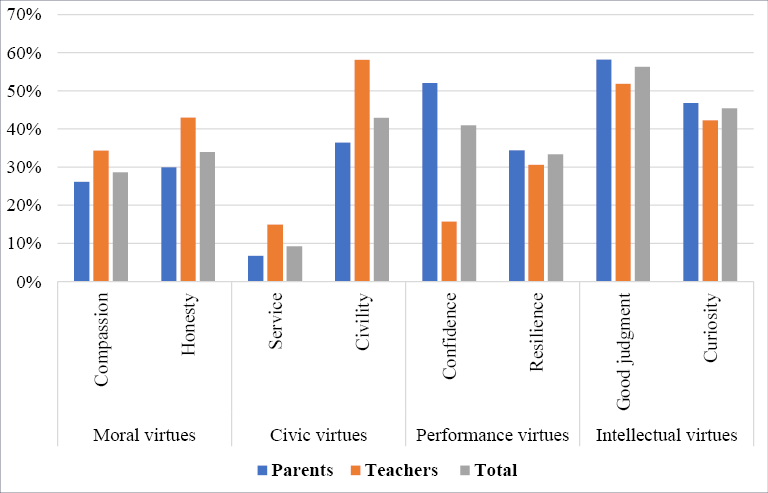
The analysis of the data (Table 3 and Figure 1) reveals important insights into the virtues that parents and teachers consider most crucial in the development of children. When examining the overall tendencies of both groups together, it is evident that certain virtues are prioritised more highly than others. Specifically, good judgment (56.3%), curiosity (45.4%), civility (42.9%), and confidence (40.9%) emerge as the most valued virtues. These priorities span across different virtue clusters – intellectual, civic, and performance – indicating a broad-based emphasis on cultivating a well-balanced character in children (pupils).
Focusing specifically on parents’ priorities, the data shows that they place the highest importance on good judgment, with 58.2% of parents selecting it as one of the top three virtues. This strong emphasis on an intellectual virtue suggests that parents highly value their children’s ability to make sound decisions. Confidence follows closely at 52.0%, reflecting a significant concern for their children’s self-assurance and ability to face challenges. Curiosity is also highly regarded, with 46.8% of parents choosing it, indicating that intellectual engagement and a desire for learning are crucial for them. However, parents place relatively less importance on civic virtues, with service being the least prioritised virtue (6.7%).
|
Virtue cluster |
Virtue |
Respondent group |
Total N (%) |
|
|
Parents n (%) |
Teachers n (%) |
|||
|
Moral virtues |
Compassion |
324 (26.1) |
186 (34.3) |
510 (28.6) |
|
Honesty |
371 (29.9) |
233 (43.0) |
604 (33.9) |
|
|
Civic virtues |
Service |
83 (6.7) |
81 (14.9) |
164 (9.2) |
|
Civility |
451 (36.4) |
315 (58.1) |
766 (42.9) |
|
|
Performance virtues |
Confidence |
645 (52.0) |
85 (15.7) |
730 (40.9) |
|
Resilience |
427 (34.4) |
166 (30.6) |
593 (33.3) |
|
|
Intellectual virtues |
Good judgment |
722 (58.2) |
281 (51.8) |
1003 (56.3) |
|
Curiosity |
580 (46.8) |
229 (42.3) |
809 (45.4) |
|
However, some parents stressed: “Moral education in schools should eliminate all forms of discrimination and develop pupils’ critical thinking and moral judgment. It should motivate pupils towards ethical behaviour, collaboration, mutual respect, tolerance, empathy, and support for one another” (Parent F), “The school’s primary aim is to develop pupils’ desire for knowledge, their judgment, and their ability to collaborate in any group. Honesty, politeness, respect, and civic-mindedness mostly come from the family!” (Parent J).
Teachers, on the other hand, prioritise virtues differently. The virtue of civility is considered the most important by teachers, with 58.1% selecting it as a top priority. This emphasis suggests that teachers value respectful and orderly behaviour in the classroom, which is essential for maintaining a conducive learning environment. Good judgment is also highly valued by teachers (51.8%), indicating a shared concern with parents for pupils’ decision-making abilities. Curiosity is another intellectual virtue that teachers prioritise, with 42.3% of them recognising its importance. Additionally, teachers place a greater emphasis on honesty (43.0%) compared to parents, highlighting the value they place on moral virtues in educational settings. Interestingly, confidence is significantly less prioritised by teachers (15.7%) than by parents, suggesting a divergence in how each group views the importance of self-assurance. While service remains relatively low in priority, teachers still value it more (14.9%) than parents do.
Comparing the priorities of parents and teachers reveals both similarities and differences. Parents and teachers differ significantly in the virtues they prioritise. Parents value good judgment (58.2%), confidence (52%), curiosity (46.8%), and civility (36.4%) more, while teachers emphasise civility (58.1%), good judgment (51.8%), honesty (43.0%), and curiosity (42.3%). Both groups share a strong commitment to fostering good judgment, curiosity, and civility, indicating a common value placed on intellectual and civic virtues. However, clear differences emerge in the emphasis placed on other virtues. Parents prioritise confidence far more than teachers, reflecting their concern for their children’s self-esteem and ability to navigate through life’s challenges. Conversely, teachers place greater importance on honesty and service, likely due to their roles in maintaining a positive and cooperative classroom environment. These differences suggest that parents and teachers, while aligned in certain areas, also bring distinct perspectives to the virtues they consider most essential for children’s development, influenced by their unique roles in a child’s life. Resilience is a moderately prioritised virtue by both parents and teachers, but it is not among the top virtues for either group. The relatively close percentage between parents (34.3%) and teachers (30.6%) suggests a shared acknowledgment of resilience’s importance, though it does not dominate their priorities. The similar ranking between the two groups reflects a consensus that while resilience is necessary, it is perhaps viewed as a supporting trait that complements other virtues, rather than being central to character development.
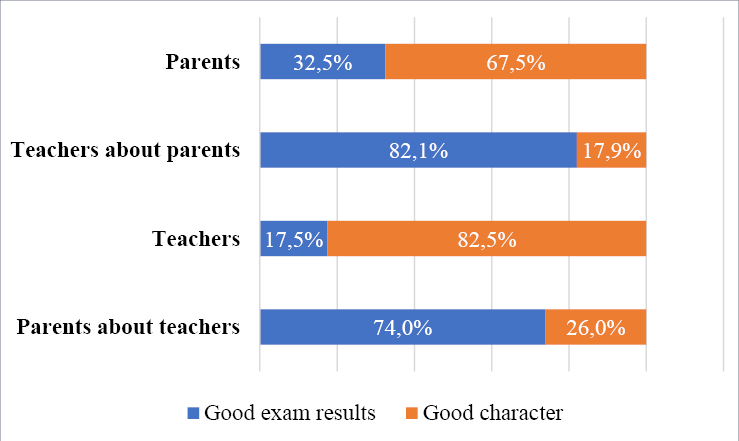
This section explores the relative importance that parents and teachers place on character development versus academic achievement, as well as their perceptions of the priorities held by the other group. In response to a dichotomous scale question (Table 4), a majority of parents (67.5%) and teachers (82.5%) prioritise character development over good exam results. This is underscored by statements such as, “Teachers and parents should not focus solely on academic achievement” (Teacher E), “Exam results show what knowledge a child has acquired, but it is important to me that a child also develops good moral character” (Parent H), “It is important for a child to become an empathetic member of society with self-respect and values. Focusing solely on academic achievements risks turning the child into a clever, yet callous individual, with a motto ‘the end justifies the means’!” (Teacher F). Conversely, 32.5% of parents and 17.5% of teachers place a higher priority on good exam results than on character development.
|
Answer |
Respondent group |
Total N (%) |
|
|
Parents n (%) |
Teachers n (%) |
||
|
1= That your pupils (children) obtain good exam results. |
403 (32.5) |
95 (17.5) |
498 (27.9) |
|
2= That your pupils (children) develop a good character. |
837 (67.5) |
447 (82.5) |
1284 (72.1) |
Moreover, 74.0% of parents believe that teachers prioritise good exam results, which is similar to the 82.1% of teachers who believe that parents prioritise exam results. Additionally, 26.0% of parents think that teachers prioritise character development, while only 17.9% of teachers believe that parents prioritise character development (Table 5).
|
Answer |
Respondent group |
Total N (%) |
|
|
Teachers about parents n (%) |
Parents about teachers n (%) |
||
|
1= That your pupils (children) obtain good exam results. |
445 (82.1) |
917 (74.0) |
1362 (76.4) |
|
2= That your pupils (children) develop a good character. |
97 (17.9) |
323 (26.0) |
420 (23.6) |
Parents (67.5%) perceive character development as more important, while teachers (82.1%) think parents prioritise good exam results (see Figure 2). Similarly, teachers (82.5%) value character development more highly, yet parents (74.0%) believe that teachers prioritise good exam results.
According to the results of the Chi-square Test, there was a statistically significant association in the following aspects: firstly, between the respondent group (parents or teachers) and whether respondents prioritise good character over good exam results (χ²(1, N = 1782) = 41.987, φ = .153, p < .001); secondly, between the respondent group and their perception of the other group’s priorities (χ²(1, N = 1782) = 13.912, φ = -.088, p < .001); thirdly, between teachers’ own priorities and parents’ perception of teachers’ prioritisation (χ²(1, N = 1782) = 489.310, φ = .524, p < .001); and finally, between parents’ own priorities and teachers’ perception of parents’ prioritisation (χ²(1, N = 1782) = 372.055, φ = -.457, p < .001).
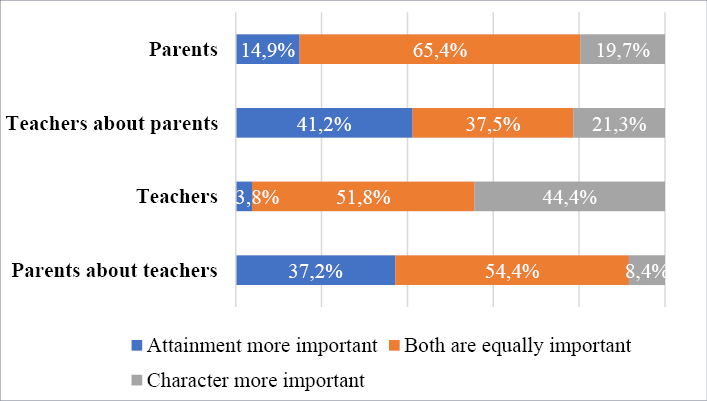
In response to an 11-point scale question (Table 6), both respondent groups predominantly consider character development and academic achievement to be equally important, with 65.4% of parents and 51.8% of teachers sharing this view. However, teachers (44.4%) lean more towards character development compared to parents (19.7%), with varying degrees of importance. According to the results of the Mann-Whitney U Test, there was a statistically significant difference with a moderate effect size between the opinions of parents and teachers. Teachers rated higher than parents (U = 242,582.500, p < .001, η² = .049), with a mean rank of 1063.93 for teachers and 816.13 for parents.
Parents (54.4%) believe that both character development and academic achievement are equally important to teachers, but only 37.5% of teachers think parents hold the same view. Similarly, 37.2% of parents think teachers prioritise academic achievement, closely matching the 41.2% of teachers who believe parents prioritise academic achievement. Additionally, 21.3% of teachers believe parents prioritise character development, whereas only 8.4% of parents think the same about teachers (Table 7). According to the results of the Mann-Whitney U Test, there was a statistically significant difference with a small effect size between parents’ and teachers’ opinions regarding the other group’s priorities. Teachers rated higher than parents (U = 300,829.500, p < .001, η² = .007), with a mean rank of 956.46 for teachers and 863.10 for parents.
|
Answer |
Respondent group |
Total N (%) |
|
|
Parents n (%) |
Teachers n (%) |
||
|
1= Attainment more important (+5) |
61 (4.9) |
61 (3.4) |
|
|
2= Attainment more important (+4) |
51 (4.2) |
51 (2.9) |
|
|
3= Attainment more important (+3) |
34 (2.7) |
2 (0.4) |
36 (2.0) |
|
4= Attainment more important (+2) |
20 (1.6) |
3 (0.6) |
23 (1.3) |
|
5= Attainment more important (+1) |
19 (1.5) |
15 (2.8) |
34 (1.9) |
|
6= Both are equally important |
811 (65.4) |
281 (51.8) |
1092 (61.3) |
|
7= Character more important (+1) |
40 (3.2) |
63 (11.6) |
103 (5.8) |
|
8= Character more important (+2) |
32 (2.6) |
68 (12.5) |
100 (5.6) |
|
9= Character more important (+3) |
54 (4.4) |
63 (11.6) |
117 (6.6) |
|
10= Character more important (+4) |
45 (3.6) |
15 (2.8) |
60 (3.3) |
|
11= Character more important (+5) |
73 (5.9) |
32 (5.9) |
105 (5.9) |
|
Answer |
Respondent group |
Total N (%) |
|
|
Teachers about parents n (%) |
Parents about teachers n (%) |
||
|
1= Attainment more important (+5) |
11 (2.0) |
116 (9.4) |
127 (7.1) |
|
2= Attainment more important (+4) |
18 (3.4) |
115 (9.3) |
133 (7.5) |
|
3= Attainment more important (+3) |
59 (10.9) |
113 (9.1) |
172 (9.7) |
|
4= Attainment more important (+2) |
85 (15.7) |
56 (4.5) |
141 (7.9) |
|
5= Attainment more important (+1) |
50 (9.2) |
61 (4.9) |
111 (6.2) |
|
6= Both are equally important |
203 (37.5) |
675 (54.4) |
878 (49.3) |
|
7= Character more important (+1) |
41 (7.6) |
17 (1.4) |
58 (3.3) |
|
8= Character more important (+2) |
36 (6.6) |
14 (1.1) |
50 (2.8) |
|
9= Character more important (+3) |
24 (4.4) |
25 (2.0) |
49 (2.7) |
|
10= Character more important (+4) |
4 (0.7) |
20 (1.6) |
24 (1.3) |
|
11= Character more important (+5) |
11 (2.0) |
28 (2.3) |
39 (2.2) |
While 65.4% of parents agree that both character development and academic achievement are equally important, only 37.5% of teachers believe parents hold this view (see Figure 3). Teachers (41.2%) perceive parents as valuing attainment more, whereas only 14.8% of parents believe attainment is more important. Teachers (51.8%) agree that both character development and academic achievement are equally important, whereas 54.4% of parents believe the same about teachers. However, 37.2% of parents perceive teachers as valuing attainment more, while only 3.8% of teachers believe that attainment is more important. Furthermore, 44.4% of teachers believe that character development is more important, but only 8.4% of parents think that teachers prioritise character development.
According to the results of the Mann-Whitney U Test, there was a statistically significant difference with a large effect size between teachers’ own priorities and parents’ perception of teachers’ prioritisation. Teachers rated their priorities higher than parents perceived (U = 156,999.000, p < .001, η² = .180), with a mean rank of 1221.83 for teachers and 747.11 for parents. Additionally, there was a statistically significant difference with a small effect size between parents’ own priorities and teachers’ perception of parents’ prioritisation. In this case, parents rated their priorities higher than teachers perceived (U = 275,034.500, p < .001, η² = .021), with a mean rank of 940.70 for parents and 778.94 for teachers.
The current study provides significant insights into the perceptions of parents and teachers regarding character education in schools. The results align with, and also diverge from, findings in other studies, offering a comprehensive view of the role and impact of character education.
The current study indicates a strong consensus among both parents and teachers regarding the importance of character education in schools in Latvia. A significant majority of respondents, specifically, 53.7% of parents and 54.6% of teachers, strongly agree on its importance, with a further 37.3% of parents and 37.8% of teachers slightly agreeing. This aligns with findings from Surikova and Fernández González (2021), where a majority of school leaders (88.4%), teachers (80.5%), and parents (66.2%) similarly supported the development of pupils’ character in schools. These consistent results underscore a shared recognition across different stakeholders that character education plays a crucial role in the holistic development of pupils, beyond mere academic success.
The study reveals that a vast majority of both parents (89.5%) and teachers (93.7%) in Latvia believe that an increased emphasis on character education would positively impact pupils’ attainment. This finding is corroborated by previous studies, such as Wagner and Ruch (2015), which demonstrated that certain character strengths are linked to improved classroom behaviour and school achievement. Additionally, Phillips (2018) found that 80% of UK teachers shared the belief that a greater focus on character education would enhance pupil attainment. Similarly, Kropfreiter et al. (2024) reported that 95.6% of Austrian teachers agreed on the positive impact of character development on academic performance. The consensus across these studies suggests a widely held view that character education contributes significantly to both academic and behavioural outcomes in pupils.
The current study’s findings on the prioritisation of virtues reveal a nuanced difference between parents and teachers. Parents place higher value on virtues such as good judgment (58.2%), confidence (52%), curiosity (46.8%), and civility (36.4%), while teachers emphasise civility (58.1%), good judgment (51.8%), honesty (43.0%), and curiosity (42.3%). The overlap in valuing good judgment, curiosity, and civility indicates a shared emphasis on intellectual and civic virtues. According to Harrison et al. (2018, 2022), both UK parents and teachers ranked moral virtues and performance virtues the most important. Parents’ top three virtues to develop in their children were honesty (22%), compassion (18%) and confidence (16%), whilst teachers’ top three virtues to develop in their pupils were resilience (23%), honesty (21%) and compassion (20%). According to Duran and Sariçam (2016), the perceptions of parents and teachers about character traits are critical to determine the aims of character education.
When considering the balance between character development and academic achievement, 65.4% of parents and 51.8% of teachers regard them as equally important. In response to a dichotomous scale question, a majority of parents (67.5%) and teachers (82.5%) prioritise character development over academic achievement. Kropfreiter et al. (2024) support these findings, by noting that 94.6% of Austrian teachers prioritise character development over exam results.
While both parents and teachers in Latvia value character development highly, there is a notable discrepancy in how they perceive the other group’s priorities. While 74.0% of parents believe that teachers prioritise academic achievement, 82.1% of teachers think that parents do. Similarly, Harrison et al. (2018, 2022) reported that while both groups prioritise character over attainment, they incorrectly perceive the other group as prioritising the opposite. This mutual distorted perception divergence in perception highlights the need for better communication and understanding between parents and teachers regarding their shared educational goals. It is necessary to explore both teachers’ and parents’ views to ensure a cohesive approach to character education. Effective character education depends on a strong partnership between home and school (Harrison et al. 2018; Surikova & Fernández González, 2022, 2023; Yaşaroğlu, 2016). Understanding and aligning the priorities of both teachers and parents can bridge communication gaps and enhance the effectiveness of character education, benefiting the overall development of children.
Moreover, the distorted perception may be attributed to societal and institutional pressures, as well as cultural narratives and stereotypes. Parents often feel societal pressure for their children to excel academically, driven by competition for university placements or future career prospects. Even if they prioritise character development at home, this pressure may lead teachers to perceive them as more focused on academic outcomes. Similarly, parents might stereotype teachers as being primarily concerned with the curriculum and academic performance metrics. Both groups may internalise wider societal norms that glorify academic success, assuming the other group adheres to these norms. This can result in a misperception that character development is of lesser importance.
This comparative study reveals that both parents and teachers in Latvia highly value character education, with significant agreement on its importance and its perceived positive impact on pupil attainment. However, there are differences in the specific virtues prioritised by each group. Despite this alignment on character education’s significance, a perception gap exists between the groups regarding each other’s priorities. Parents believe that teachers prioritise academic results more than they do, and vice versa, which suggests a need for improved communication.
The findings imply that fostering better dialogue and mutual understanding between parents and teachers is essential to bridge these perception gaps. Such efforts could lead to more cohesive and effective character education strategies that align the educational goals of both groups. By enhancing collaboration, schools can create a more supportive environment that balances academic success with the holistic development of pupils, ultimately benefiting their overall growth and well-being.
Author contributions
Svetlana Surikova: conceptualisation, methodology, investigation, data curation, formal analysis, visualisation, writing – original draft, writing – review and editing.
Tamāra Pīgozne: project administration, funding acquisition, conceptualisation, methodology, investigation, writing – review and editing.
Acknowledgements
This research was supported by the University of Latvia under Grant No. ZD2010/AZ22 (research project “Human, Technologies, and Quality of Education”). The authors extend their gratitude to Master’s student Inga Krišāne for initiating the data collection process by distributing electronic invitations to general education institutions across Latvia. Special thanks are due to the TEPACE project colleagues for providing complimentary access to the Qualtrics platform and offering valuable methodological guidance on data collection and preparation for analysis.
Disclosure statement
Authors have no potential conflict of interest to report.
References
Arthur, J., Kristjánsson, K., Walker, D., Sanderse, W., Jones, C., Thoma, S., Curren, R., & Roberts, M. (2015). Character education in UK schools. Research report. University of Birmingham. http://epapers.bham.ac.uk/1969/1/Character_Education_in_UK_Schools.pdf
Berkowitz, M. W. (2021). PRIMED for character education: Six design principles for school improvement. New York: Routledge.
Chairunnisa, C., Istaryatiningtias, I. (2022). Character education and teacher’s attitudes in preventing radicalization in junior high school students in Indonesia. Eurasian Journal of Educational Research, 97, 252–270. https://doi.org/10.14689/ejer.2022.97.15
Crow, T. L. (1997). A comparison of teacher and parent attitudes toward character education in the public school (Publication No. 2172) [Graduate Theses and Dissertations]. https://ecommons.udayton.edu/graduate_theses/2172
Duran, A., Sariçam, H. (2016). The comparison of parents and preschool teachers’ views about character and character traits in children. The International Journal of Research in Teacher Education, 7(3), 13–27. https://ijrte.inased.org/files/5/manuscript/manuscript_196/ijrte-196-manuscript-131910.pdf
Epçaçan, C., Sevgi, B. (2021). Opinions of parents and teachers on character education of secondary school students. Journal of Social, Humanities and Administrative Sciences, 7(47), 2381–2400.
Gündoğdu, K., Bay, E., & Mert, O. (2022). American, German and Turkish classroom teachers’ opinions about character education: A cross-cultural study. Psycho-Educational Research Reviews, 11(3), 530–552. https://doi.org/10.52963/PERR_Biruni_V11.N3.1
Gündoğdu, K., Üstündağ, N., Altın, M., Eken, M., Yolcu, O., & Çırakoğlu, M. (2019). Teachers’ views on character/values education in schools. Psycho-Educational Research Reviews, 8(3), 14–28. https://perrjournal.com/index.php/perrjournal/article/view/151/94
Harrison, T., Burn, E., & Moller, F. (2020). Teaching character; cultivating virtue perception and virtue reasoning through the curriculum. Educational Review, 72(5), 617–634. https://doi.org/10.1080/00131911.2018.1538937
Harrison, T., Dineen, K., & Moller, F. (2018). Parent-teacher partnerships: Barriers and enablers to collaborative character education. Initial insights. University of Birmingham. https://www.jubileecentre.ac.uk/wp-content/uploads/2023/07/PARENT-TEACHER-PARTNERSHIPS.pdf
Harrison, T., Dineen, K., & Moller, F. (2022). Tests of life or life of tests? Similarities and differences in parents’ and teachers’ prioritisation of character, academic attainment, the virtues and moral theories. Journal of Beliefs & Values, 43(2), 137–158. https://doi.org/10.1080/13617672.2021.1920233
Kropfreiter, E., Bernhard, R., & McDermott, T. (2024). Austrian secondary school teachers’ views on character education: Quantitative insights from a mixed-methods study. Journal of Moral Education, 1–21. https://doi.org/10.1080/03057240.2024.2373167
Mandich, G. (2023). Turning to character: Teachers’ narratives of youth futurity and educational responsibility. Discourse: Studies in the Cultural Politics of Education, 44(4), 495–508. https://doi.org/10.1080/01596306.2021.2012425
Mathison, C. (1999). How teachers feel about character education: A descriptive study. Action in Teacher Education, 20(4), 29–38. https://doi.org/10.1080/01626620.1999.10462932
McGrath, R. E. (2018). What is character education? Development of a prototype. Journal of Character Education, 14(2), 23–35.
McGrath, R. E., Han, H., Brown, M., & Meindl, P. (2022). What does character education mean to character education experts? A prototype analysis of expert opinions. Journal of Moral Education, 51(2), 219–237. https://doi.org/10.1080/03057240.2020.1862073
Metcalfe, J., Moulin-Stożek, D. (2020). Religious education teachers’ perspectives on character education. British Journal of Religious Education, 42(4), 348–356. https://doi.org/10.1080/01416200.2020.1713049
Metcalfe, J., Kristjánsson, K., & Peterson, A. (2023). Exploring religious education teachers’ perspectives on character development and moral virtues in state-funded, non-faith schools in England. Journal of Beliefs & Values, 45(4), 518–535. https://doi.org/10.1080/13617672.2023.2186644
Paul, S. A.-S., Hart, P., Augustin, L., Clarke, P., & Pike, M. (2022). Parents’ perspectives on home-based character education activities. Journal of Family Studies, 28(3), 1158–1180. https://doi.org/10.1080/13229400.2020.1806097
Phillips, E. (2018). Survey of teachers. University of Birmingham, Jubilee Centre for Character and Virtues. Populus. https://www.jubileecentre.ac.uk/wp-content/uploads/2023/07/PopulusPollTeachersVirtuesExecSummaryFinal.pdf
Surikova, S., Fernández González, M. J. (2021). School staff and parents’ beliefs about the role of school for pupils’ character education in Latvia. In L. Daniela (Ed.), Human, technologies and quality of education, 2021 (pp. 545–558). The University of Latvia Press. https://doi.org/10.22364/htqe.2021.42
Surikova, S., Fernández González, M. J. (2022). Theoretical insights and parents’ views about family-school collaboration for character education in Latvia. In L. Daniela (Ed.), Human, technologies and quality of education, 2022 (pp. 897–914). The University of Latvia Press. https://doi.org/10.22364/htqe.2022.64
Surikova, S., & Fernández González, M. J. (2023). Toward effective family-school partnerships for implementing character education at school in Latvia: A multifactorial model. Pedagogika, 147(3), 81–106. https://doi.org/10.15823/p.2022.147.4
Tay, B., Yıldırım, K. (2009). Parents’ views regarding the values aimed to be taught in social studies lessons. Educational Sciences: Theory & Practice, 9(3), 1529–1542.
Tutkun, E., Görgüt, İ., & Erdemir, İ. (2017). Physical education teachers’ views about character education. International Education Studies, 10(11), 86–99. https://doi.org/10.5539/ies.v10n11p86
Wagner, L., Ruch, W. (2015). Good character at school: Positive classroom behavior mediates the link between character strengths and school achievement. Frontiers in Psychology, 6, Article 610. https://doi.org/10.3389/fpsyg.2015.00610
Yaşaroğlu, C. (2016). Cooperation and importance of school and family on values education. European Journal of Multidisciplinary Studies, 1(2), 66–70. https://doi.org/10.26417/ejms.v1i2.p66-71
Yıldırım, H., Gürpınar, B. (2023). Physical education teachers’ opinions on character education and its practices. Education and Science, 48(214), 219–248. https://doi.org/10.15390/EB.2023.11749