Acta Paedagogica Vilnensia ISSN 1392-5016 eISSN 1648-665X
2026, vol. 56, pp. 112–127 DOI: https://doi.org/10.15388/ActPaed.2026.56.7
Inese Barone
Faculty of Education, Psychology and Art, University of Latvia
inese.barone@lu.lv
https://orcid.org/0000-0001-6753-1816
https://ror.org/05g3mes96
Baiba Kaļķe
Faculty of Education, Psychology and Art, University of Latvia
baiba.kalke@lu.lv
https://orcid.org/0000-0002-4086-4490
https://ror.org/05g3mes96
Abstract. In the realm of primary education, the relationship between schools and families is fundamental to the holistic development and academic success of children. This research study investigates the perspectives of school-family cooperation and its significance in achieving education objectives while addressing parental expectations, which leads to answering the question of the study – What are the opportunities for school and family collaboration?
The objectives of this study encompass understanding parental expectations, evaluating the impact of cooperation on student outcomes, identifying barriers to cooperation, examining effective communication channels, and studying conflict resolution mechanisms. By conducting theoretical literature analysis, document analysis, and survey for parents, this research aims to shed light on the intricate dynamics at play in the collaboration between schools and families.
The theoretical framework of the study consists of theories describing the importance of cooperation between educational actors in a successful educational process (U. Brofenbrenner’s Ecological Systems Theory, 1979; L. Epstein’s Model for Parental Involvement, 1995, 2001, 2011; Hoover-Dempsey & Sandler’s theory of parental involvement, 1995, 1997, 2005; Christenson & Sheridan’s Families and Schools Partnership, 2011; and Garbacz et al.’s Family – School – Community Partnership Model, 2017), and describes parent-school partnerships by analyzing research by John Dewey and other authors on the crucial role of collaboration in a successful learning process.
The case study of mixed methods evaluates the philosophical assumptions and stances, guidelines for practice, and socio-political commitment of the study question: (1) data collection method – document, literature and source analysis and survey for parents, evaluating theory concerning practice using the mapping review strategy (Petticrew & Roberts, 2006); (2) data analysis method, survey analysis using the factor analysis system, analyzing parental expectations from predefined criteria; (3) data synthesis method merging and interacting results, learning for data contradictions, synthesis of documents, literature and source analysis, and factor analysis (McCloy, 2013).
This research contributes to the ongoing discourse on improving education by illuminating the importance of school-family cooperation, which, when effectively nurtured, creates a conducive environment for students to thrive academically, socially, and emotionally.
The results of the study reveal a significant contradiction between a parent’s scrutiny of educational goals, as well as a lack of school-parent collaboration and problems. This issue is important at the international level, as it is only through a single stream of collaboration between education actors that the objectives of education can be achieved in a changing modern world.
Keywords: cooperation, educational partners, educational actors, educational targets, parental expectations.
Santrauka. Mokyklos ir šeimos santykiai pradiniame ugdyme yra vaikų visapusiško vystymosi ir akademinės sėkmės pagrindas. Šiame tyrime nagrinėjamos mokyklos ir šeimos bendradarbiavimo perspektyvos bei reikšmė siekiant švietimo tikslų; atsižvelgiama į tėvų lūkesčius ir keliamas tyrimo klausimas – kokios yra mokyklos ir šeimos bendradarbiavimo galimybės?
Tyrimo tikslai apima tėvų lūkesčių supratimą, bendradarbiavimo poveikio mokinių pasiekimams įvertinimą, bendradarbiavimo kliūčių nustatymą, veiksmingų komunikacijos priemonių tyrimą ir konfliktų sprendimo būdų analizę. Atlikta teorinė literatūros analizė, dokumentų analizė ir tėvų apklausa padėjo tyrimo autoriams išsiaiškinti sudėtingą mokyklos ir šeimos bendradarbiavimo procese pasireiškiančią dinamiką.
Teorinį tyrimo pagrindą sudaro teorijos apie ugdymo proceso dalyvių bendradarbiavimo svarbą sėkmingam ugdymo procesui (U. Brofenbrennerio ekologinių sistemų teorija, 1979; L. Epsteino tėvų įsitraukimo modelis, 1995, 2001, 2011; Hoover-Dempsey ir Sandlerio tėvų įsitraukimo teorija, 1995, 1997, 2005; Christenson ir Sheridan šeimų ir mokyklų partnerystės modelis, 2011; Garbacz ir kt. šeimos – mokyklos – bendruomenės partnerystės modelis, 2017). Be to, tėvų ir mokyklos partnerystė apibūdinama remiantis Johno Dewey ir kitų autorių tyrimais apie lemiamą bendradarbiavimo vaidmenį sėkmingame mokymosi procese.
Mišrių metodų atvejo studijoje analizuojamos su tyrimo klausimu susijusios filosofinės prielaidos ir pozicijos, praktikos gairės bei sociopolitinis įsitraukimas: (1) duomenų rinkimo metodas – dokumentų, literatūros ir šaltinių analizė bei tėvų apklausa, praktikos teorijos vertinimas naudojant sisteminio žemėlapio strategiją (angl. mapping review strategy) (Petticrew & Roberts, 2006); (2) duomenų analizės metodas – apklausos duomenų analizė, taikant faktorinę tėvų lūkesčių pagal nustatytus kriterijus analizę; (3) duomenų sintezės metodas, apimantis rezultatų susiejimą ir sąveikas, mokymosi iš duomenų prieštaravimus, dokumentų, literatūros ir šaltinių sintezę bei faktorinę analizę (McCloy, 2013).
Šis tyrimas prisideda prie šiandienos diskusijų apie ugdymo tobulinimą ir rodo mokyklos bendradarbiavimo su šeima svarbą, nes veiksmingai puoselėjamas bendradarbiavimas sukuria palankią aplinką, kurioje mokiniai gali sėkmingai tobulėti akademiniu, socialiniu ir emociniu požiūriu.
Tyrimo rezultatai atskleidžia akivaizdų prieštaravimą tarp tėvų požiūrio į ugdymo tikslus ir mokyklos bei tėvų bendradarbiavimo trūkumo ir iš to kylančias problemas. Šis klausimas svarbus tarptautiniu mastu, nes tik bendradarbiaujant visiems ugdymo proceso dalyviams galima siekti ugdymo tikslų šiuolaikiniame besikeičiančiame pasaulyje.
Pagrindiniai žodžiai: bendradarbiavimas, ugdymo partneriai, ugdymo proceso dalyviai, ugdymo tikslai, tėvų lūkesčiai
__________
Received: 22/02/2024. Accepted: 02/06/2026
Copyright © Inese Barone, Baiba Kaļķe, 2026. Published by Vilnius University Press. This is an Open Access article distributed under the terms of the Creative Commons Attribution Licence (CC BY), which permits unrestricted use, distribution, and reproduction in any medium, provided the original author and source are credited.
Teachers and schools, pupils, and parents (family) are key educational collaborators or actors, each with their expectations on educational goals that can be similar, coherent, and unified, or, vice versa, different, and unacceptable to one of the educational collaborators. The three actors set out the principles and rules of cooperation, along with the result of successful cooperation: uniform educational objectives are one of the cornerstones of effective learning, contributing to the learning achievements and the merits of pupils, not only in school but in society as a whole (Imants & Van der Wal, 2020). Cooperation between all partners involved in the education process is a keyword, through which, common educational objectives should be established for all education partners (Gonzalez-Mena, 2011). The school and parents share responsibility among themselves for socializing, raising, and educating a child by setting common educational goals (Daniel, 2019). Involvement of the parent in the child’s school life, school activities, and education-related decision-making in setting goals and in a single and supportive collaboration is one of the prerequisites for the child’s academic achievement (Fantuzzo et al., 2000; Hallgarten, 2000).
Cooperation in education is described as a concerted action between the actors involved intended to achieve the stated learning objective by promoting support, sharing experiences, assisting each other, and building a positive and respectful working climate. Cooperation is to be implemented at different levels between different stakeholders: pupils, teachers, parents, educational institution management, educational institutions, and society (Oganisyana & Ozols, 2019). Respectful communication in education is a social skill based on empathetic, non-violent, and respectful social action, as well as cooperation, participation, active support culture, and honesty in decision-making processes. The basic elements of respectful communication are the expression of observations without any verbal judgments, diagnoses, or opinions; understanding and expressing your feelings and other feelings; respect for universal human needs; and making requests without making requests (Van Voorhis, 2003).
The teachers’ perspective reveals a number of key elements, in cooperation with parents in setting and realising educational objectives: (1) regular, open communication that makes it possible to understand family interests, objectives, provenance and possible problems that enable teachers to adapt learning methods and strategies to the individual needs of pupils; (2) support in teaching – parents actively participate in the education of a child, in addition to school education; (3) support for child behavioral control (Insight) – in collaboration with parents, a teacher can understand a child’s behavior and social interaction by controlling behavioral and emotional issues that may affect a child’s learning; (4) common educational objectives: through teacher-parent cooperation, it is possible to set common educational objectives, while ensuring that all educational actors work towards achieving the same objectives by promoting a supportive and unified learning environment (Christenson, 2004).
The perspective of educators and cooperation with parents in the context of the parents’ educational goals is essential for the holistic development of children. Parents’ educational goals relate to the goals and aspirations that parents have when it comes to the learning process and development of children. Effective collaboration between teachers and parents can have a significant impact on the acquisition of a child’s education. From the perspective of parents and teachers, this collaboration may differ (Balan et al., 2017).
The parents’ perspective, in cooperation with teachers in setting and achieving educational objectives, reveals the parents’ cooperation as an educational actor, which is characterized by: (1) a better understanding of the school curriculum: parents working with teachers gain a broader understanding of what their child is learning at school, thereby allowing for more effective support at home; (2) involvement in the education of the child, which allows parents to participate actively in the growth and development of their child and promotes a sense of responsibility and susceptibility to the learning of their child; (3) proactive action – parents may be the first to notice academic, behavioral or emotional problems affecting the learning of the child and to address the problem in a timely manner in co-operation with the teacher; (4) support for home learning: cooperation with teachers provides parents with guidance on how to assist a child in homework, projects and other academic tasks by creating a favorable learning environment at home; (5) positive role (role)-modelling: in active collaboration with teachers, parents show a positive example of collaboration for a child, children learn the value of work, communication and collaboration in general from this specific type of collaboration (Hwang, 2010).
Over the last decade in Europe, the cooperation and involvement of parents in the child’s education process have received an increased attention from education policymakers and scientists, which is justified by the child’s educational achievements and well-being at school if the parent is actively involved in the education process (An & Palisano, 2002, 2014; Anderman, 2011; Barr & Saltmarsh, 2014; Karlsen Bæck, 2005; Christenson, 2004; Cole, 2007; Esler et al., 2008; Frey et al., 2013; Gonzalez-DeHass et al., 2005; Herrold & O’Donnell, 2008; Hill et al., 2008; Hill & Taylor, 2004; Illeris, 2018; Jones, 2014; Lareau, 1987; Mahwah, et al., 2004; McCrory Calarco, 2016; McWayne et al., 2004; Newland et al., 2013; Parke, 2002; Rawsley, 2000; Reynolds & Miller, 2013; Santrock, 2011; Sheridan et al., 2012; Sheridan & Gutkin, 2000; Simon, 2004; Vickers & Minke, 1995, and others).
This study aims to assess the opportunities for school and family cooperation in setting educational objectives by assessing parental expectations.
There are several theories describing the importance of collaboration between educational actors in a successful educational process – these are Brofenbrenner’s theory of ecological system (Brofenbrenner, 1977, 1979, 1986, 1994, 2001; Brofenbrenner et al., 2006), Epstein’s Model for Parental Involvement (Epstein, 1995, 2001, 2002, 2005, 2010; Epstein et al., 2011), Hoover-Dempsey and Sandler’s parental engagement motivation model (Hoover-Dempsey & Sandler, 1995, 2005; Hoover-Dempsey et al., 2001, 2005), Christenson and Sheridan’s theory of family and school collaboration (Christenson & Sheridan, 2011), model for inclusion of parents, school and society in education of Garbacz and partners (Garbacz et al., 2017). These theories describe the importance of parental involvement in the development of a child as an effective, capable, and robust learning process, revealing distinct and important spheres for the development of the child and areas of influence of each educational partner, thereby revealing the importance of parental expectations in achieving educational goals (Reynolds & Miller, 2013).
|
Theory |
Theory key insights |
|
|
|
|
|
|
|
|
|
|
|
|
|
|
|
In educational science research and school practice, the role of the parent has been systematically changing and developing; today, parents have become teachers, researchers, lawyers, and education activists. Parent-teacher or school cooperation and the resulting relationships involve credibility, belonging, shared values and educational goals, as well as attitudes towards each other and the child (Vickers & Minke, 1995).
The idea of parent-school cooperation and partnership in education sciences has been raised, while stressing the need for a common approach to education involving not only teachers and pupils but also parents and cooperation embracing wider society. Several key factors confirm the crucial importance of cooperation (Dewey, 1916): (1) shared responsibility where both parents and teachers assume responsibility for the child; (2) common educational objectives common to parents and teachers; (3) open and continuous communication between parents and teachers is necessary; (4) participation in child learning, which includes attending school meetings and other events, engaging in discussions on curriculum and educational objectives; (5) respect for individual differences that involve respect and care for the individual differences and needs of each child.
Teachers should work with parents on common strategies offered by the school to strengthen their partnerships with parents; the school, educators, and parents can work together effectively with the objective to promote positive student outcomes with perseverance, patience, and goals in mind (Emeagwali, 2009). It is the responsibility of teachers and schools to do their utmost to promote parental participation and cooperation in the education of children. Trust in building cooperation is an essential dimension in the involvement of parents in achieving educational goals (Santiago et al., 2016).
Research on successful partnerships between schools and parents identified 6 important elements of cooperation: communication, trust, equality, skills, respect, and certain commitments (Kaiser & Rasminsky, 2017). Parents state that they want communication with the school to be regular, open, honest, with no concealed intent, where no information should be undisclosed, and so they expect that privacy-respecting professionals are working at school (Olmstead, 2013).
Elements essential for a successful relationship between a parent and an educational institution involve strong relationships, welcoming environments, multidirectional communication, and mutual understanding (Miller et al., 2022). Such cooperation is based on multi-directional communication based on deep listening, arrangements for the facilitative approaches during meetings, and handling conflicts. Mutual understanding builds upon the development of targeted cooperation: (1) teachers, parents, and families are educational actors and share responsibility to promote student development; (2) there are expectations of shared responsibility for all parties involved in the cooperation; (3) cooperation is based on interaction, and cooperation style is not dictatorial; (4) the intervention activity focuses on learning objectives equally at school and at home; (5) communication provides a single multi-directional flow of information from all actors (Miller et al., 2022).
The possibilities for actor collaboration and partnerships are varied; parents have expanded their knowledge and understanding of what their children should do, and express concrete expectations about the child’s educational goals. Research reveals that, for family-school cooperation and partnership to succeed, the parent responsible for the child’s education needs to learn and improve so that they could provide their support for the pupil’s education and contribute to the growth path towards the educational goal (Mapp & Kuttner, 2013). The link with cooperation is essential when assessing partnerships: (1) the level of trust between parents and school staff has increased; (2) the involvement of the parent has increased; and (3) there has been an increase in intercultural networks between the school staff and parents (in terms of socio-economic status, level of education, etc.), reliability of cooperation: parents and school staff point out that engagement in in school-parent partnership activities increases their satisfaction with cooperation and self-effectiveness, as well as cooperative cognition: parents’ views on their role in raising a child have expanded to include a wider role as actors (Mapp & Kuttner, 2013).
Parent-school cooperation is important for family engagement, where family, school, and community work together in a coordinated way, and the cooperation is systemic, integrated in a long-term perspective, continuous, and sustained (Frey et al., 2013). Such cooperation is based on shared values and ethical considerations: social justice, human dignity, and value, the importance of human relationships, honesty, and competence (NASW Code of Ethics, 1996, revised in 2008).
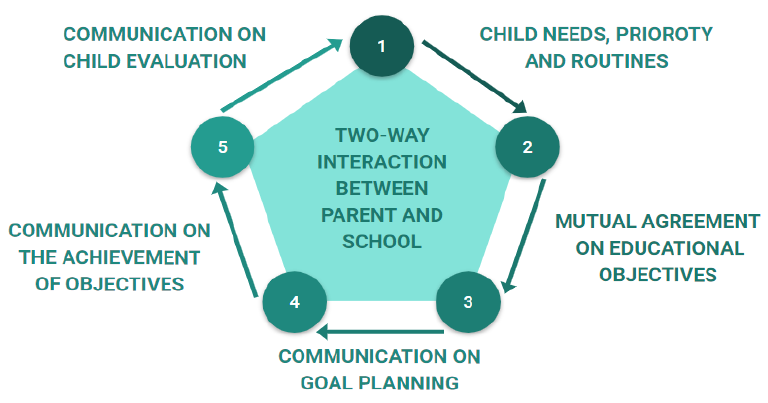
Successful cooperation between the parent and the school is therefore a two-way communication on the planning, implementation, and evaluation of objectives, defining the needs of the child and agreeing on educational objectives.
A mixed-methods design was implemented, in which, systematic literature analysis and quantitative data collection were conducted (parents, n = 240), followed by a separate data analysis, after which, the results of the studies were merged and summarized.
In this study, all relevant ethical norms were adhered to. Informed consent was received from the survey participants, and the respondents were informed about the nature, purpose, and progress of the study; whereas, the anonymity of the respondents was guaranteed. The results of the survey were analyzed and will be used in an aggregated way.
Research was done in 5 stages, and several methods were employed so that to achieve the results of this research (see Table 2):
|
Method |
Details |
Results |
|---|---|---|
|
Data collection methods |
||
|
|
|
|
|
|
|
|
|
Data analysis methods |
||
|
|
|
|
|
|
|
|
|
Data synthesis method |
||
|
|
|
|
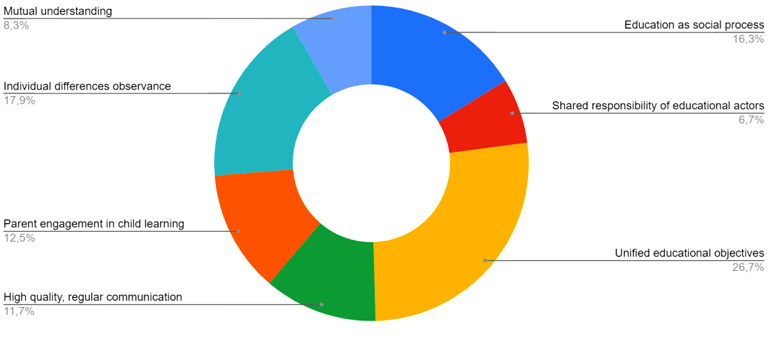
Research in education sciences reveals exploration of the value of school and family cooperation in education, in particular, by assessing parental expectations and educational objectives, while highlighting several key elements analyzed in the survey on parental expectations – education as a social process, shared responsibility of education actors, unified educational goals, regular communication, parent engagement in child learning, adherence to a child’s differences, and mutual understanding to achieve educational goals. Table 3 summarizes and explains the 7 criteria that were set out in the analysis of documents and sources using the mapping review strategy, which describes parent-school cooperation from the perspective of parents along with educational objectives.
|
Criteria |
Explanation |
|---|---|
|
|
|
|
|
|
|
|
|
|
|
|
|
|
|
|
|
|
|
|
|
240 respondents participated in the survey, of whom, 87% of respondents were women, 13% were men, and the gender of the children was 45% girls, and 55% boys. Educational levels – primary school (grades 1–3) – 46%, elementary school (grades 4–9) – 51%, and secondary school (grades 10–12) – 3%.
|
A common approach for actors in education when assessing the parental expectations of the children’s educational objectives |
PARENTAL EXPECTATIONS (n=240) |
|||
|
Primary school (n=107) |
Elementary school (n=122) |
Secondary school (n=11) |
Total (n=240) |
|
|
|
|
|
|
|
|
|
|
|
|
|
|
|
|
|
|
|
|
|
|
|
|
|
|
|
|
|
|
|
|
|
|
|
|
|
|
|
|
|
|
|
When assessing the defined criteria characterizing parent-school cooperation from the perspective of parental expectations and educational objectives (see Figure 2), parents point out that uniform educational objectives are an element of cooperation; this is essential for more than 26.7% of respondents; respect for individual differences of a child is significant for 17.9% of parents; education as a social process is valued by 16.3%; participation of a parent in the study of a child – by 12.5%; communication – by 11.7%; mutual understanding – by 8.3%; and shared co-operation of actors – by 6.7%.
The survey asked parents an open question, “What do you expect for your child’s educational targets?” that describes parental expectations about a child’s educational objectives. Table 4 summarizes the responses of several parents for each of the criteria that have been set for parent-school cooperation from the perspective of parents and educational objectives.
|
Specified criterion |
Parental expectation examples1 |
|---|---|
|
|
|
|
|
|
|
|
|
|
|
|
|
|
|
|
|
|
|
|
|
Parent-school successful collaboration is shaped by collaborative relationships, they are independent and balanced, and actors have their responsibilities and roles. The responsibility of parents and schools in the process of education and socialization of children is shared by setting common educational objectives, and maintaining them to achieve educational goals and respect each other is one of the priorities of positive cooperation. Each actor’s actions in collaboration are flexible, responsive, and proactive, whereas different perceptions and perspectives are seen as opportunities. Cooperation has to be connected with cultural competence, values, and traditions that characterize family and school. The importance of cooperation is based on the student’s learning achievements and achievement of learning objectives.
Higher levels of school-family cooperation correlate positively with students’ academic achievements, social skills, and emotional well-being. By contrast, parental expectations are different from cultural, socioeconomic status, and other individual circumstances. A common understanding of school and family is essential for achieving educational goals.
The perspective of teachers and cooperation between teachers and parents is essential for the parents’ expectations of the achievement of educational objectives. It creates a supportive and harmonious educational ecosystem that contributes to the child’s overall development. Teachers and parents need to be aware of their roles as education actors and communicate openly to ensure that children get the best education and support possible.
Parental cooperation with the school contributes to the student’s level of academic success and achievements as well as the overall well-being in school, and society as a whole. Through parent-school collaboration, a supportive environment is built that is valuable not only for the student and teachers but also for school development – for building a holistic support system that enhances positive educational experiences for the student and the school culture which would be based on unified values and school ETOs.
Valuing a parent as an educational actor reveals the contradiction that a parent is an important educational actor whose actions, and cooperation affect a student’s learning achievements, but cooperation with the school is often complex, one-way from both the parent and the school. Thus, the achievement of the educational objectives through such cooperation (school-parent and parent-school) is negatively assessed and does not contribute to the student’s learning.
Inese Barone: conceptualization, methodology, investigation, formal analysis, writing – original draft, writing – review and editing, visualization.
Baiba Kaļķe: conceptualization, methodology, investigation, data curation, validation, writing – review and editing, supervision.
References
An, M. & Palisano, R. J. (2002). Professional collaboration in pediatric rehabilitation: A practice model. PubMed.
An, M., & Palisano, R. J. (2014). Family–professional collaboration in pediatric rehabilitation: A practice model. Disability and Rehabilitation, 36(5), 434–440. https://doi.org/10.3109/09638288.2013.797510
Anderman, E. M. (2011). Educational Psychology in the Twenty-First Century: Challenges for Our Community. Educational Psychologist, 46(3), 185–196. https://doi.org/10.1080/00461520.2011.587724
Karlsen Bæck, U.-D. (2005). School as an arena for activating cultural capital – Understanding differences in parental involvement in school. Nordic Studies in Education, 25(3), 217–229. https://doi.org/10.18261/ISSN1891-5949-2005-03-04
Balan, R., Dobrean, A., Roman, G. D., & Balazsi, R. (2017). Indirect Effects of Parenting Practices on Internalizing Problems among Adolescents: The Role of Expressive Suppression. Journal of Child and Family Studies, 26(1), 40–47. https://doi.org/10.1007/s10826-016-0532-4
Barr, J., & Saltmarsh, S. (2014). “It all comes down to the leadership”: The role of the school principal in fostering parent-school engagement. Educational Management Administration & Leadership, 42(4), 491–505. https://doi.org/10.1177/1741143213502189
Bronfenbrenner, U. (1977). Toward an experimental ecology of human development. American Psychologist, 32(7), 513–531. https://doi.org/10.1037/0003-066X.32.7.513
Bronfenbrenner, U. (1979). The ecology of human development. Harvard University Press.
Bronfenbrenner, U. (1986). Ecology of the family as a context for human development: Research perspectives. Developmental Psychology, 22(6), 723–742. https://doi.org/10.1037/0012-1649.22.6.723
Bronfenbrenner, U. (1994). Ecological models of human development. In International encyclopedia of education (Vol. 3, 2nd ed., pp. 1643–1647). Elsevier.
Bronfenbrenner, U. (2001). The bioecological theory of human development. In N. J. Smelser & P. B. Baltes (Eds.), International encyclopedia of the social and behavioral sciences (pp. 6963–6970). Elsevier Sciences.
Bronfenbrenner, U., & Morris, P. A. (2006). The bioecological model of human development. In R. M. Lerner & W. Damon (Eds.), Handbook of child psychology: Theoretical models of human development (6th ed., Vol. 1, pp. 793–828). John Wiley & Sons Inc.
Christenson, S. L. (2004). The Family-School Partnership: An Opportunity to Promote the Learning Competence of All Students. School Psychology Review, 33(1), 83–104. https://doi.org/10.1080/02796015.2004.12086233
Christenson, S. L., & Sheridan, S. M. (2001). Schools and families: Building connections within diverse communities. Sage Publications.
Cohen, L., Manion, L., & Morrison, K. (2018). Research methods in education (8th ed.). Routledge.
Cole, B. (2007). Mothers, gender, and inclusion in the context of home-school relations. Support for Learning, 22(4), 165–173. https://doi.org/10.1111/j.1467-9604.2007.00467.x-
Daniel, H. (2019). Generational differences and its impact on teaching and learning. University of Mississippi Medical Center.
Dewey, J. (1916). Democracy and education: An introduction to the philosophy of education. MacMillan.
Đurišić, M., & Bunijevac, M. (2017). Parental Involvement as a Important Factor for Successful Education. CEPS Journal: Center for Educational Policy Studies Journal, 7(3), 137–153. https://doi.org/10.26529/cepsj.291
Emeagwali, N. S. (2009). Fostering parent-teacher collaboration in the classroom (Classroom Connection). Techniques: Making Education and Career Connections, 84(5), 8–9. https://www.proquest.com/trade-journals/filtering-parent-teacher-collaboration-classroom/docview/1933098289/se-2
Epstein, J. L. (1995). School/family/community partnerships: Caring for the children we share. Phi Delta Kappan, 76(9), 701–712.
Epstein, J. L. (2001). School, family, and community partnerships: Preparing educators and improving schools. Westview Press.
Epstein, J. L. (2002). Six types of involvement: Keys to successful partnerships. National Network of Partnership Schools, Johns Hopkins University.
Epstein, J. L. (2005). School-initiated family and community partnerships. In T. Erb (Ed.), This we believe in action: Implementing successful middle level schools (pp. 77–96). National Middle School Association.
Epstein, J. L. (2010). School/family/community partnerships: Caring for the children we share. Phi Delta Kappan, 92(3), 81–96. https://doi.org/10.1177/003172171009200326
Epstein, J. L., Galindo, C. L., & Sheldon, S. B. (2011). Levels of Leadership: Effects of District and School Leaders on the Quality of School Programs of Family and Community Involvement. Educational Administration Quarterly, 47(3), 462–495. https://doi.org/10.1177/0013161X10396929
Esler, A. N., Godber, Y., & Christenson, S. L. (2008). Best practices in supporting school-family collaboration. In A. Thomas & J. Grimes (Eds.), Best practices in school psychology V (pp. 917–936). National Association of School Psychologists.
Fantuzzo, J., Tighe, E., & Childs, S. (2000). Family Involvement Questionnaire: A multivariate assessment of family participation in early childhood education. Journal of Educational Psychology, 92(2), 367–376. https://doi.org/10.1037/0022-0663.92.2.367
Frey, A. J., Alvarez, M. E., Sabatino, C. A., Lindsey, B. C., Dupper, D. R., Raines, J. C., Streeck, F., McInerney, A., & Norris, M. P. (2012). The Development of a National School Social Work Practice Model. Children & Schools, 34(3), 131–134. https://doi.org/10.1093/cs/cds025
Garbacz, S. A., Herman, K. C., Thompson, A. M., & Reinke, W. M. (2017). Family engagement in education and intervention: Implementation and evaluation to maximize family, school, and student outcomes. Journal of School Psychology, 62, 1–10. https://doi.org/10.1016/j.jsp.2017.04.002
Gonzalez-DeHass, A. R., Willems, P. P., & Holbein, M. F. D. (2005). Examining the Relationship Between Parental Involvement and Student Motivation. Educational Psychology Review, 17(2), 99–123. https://doi.org/10.1007/s10648-005-3949-7
Gonzalez-Mena, J. (2011). Family, school, and community: Partners in children’s development. Pearson.
Gwyer, J., & Hack, L. (2012). Education is a social process. Journal of Physical Therapy Education, 26(3), 3–4.
Hallgarten, J. (2000). Parents exist, OK!?: Issues and visions for parent-school relationships. Institute for Public Policy Research.
Herrold, K., & O’Donnell, K. (2008). Parent and family involvement in education: 2006–07 school year – National Household Education Surveys Program of 2007 (NCES 2008–050). National Center for Education Statistics, Institute of Education Sciences, U.S. Department of Education.
Hill, N. E., Castellino, D. R., Lansford, J. E., Nowlin, P., Dodge, K. A., Bates, J. E., & Pettit, G. S. (2004). Parent Academic Involvement as Related to School Behavior, Achievement, and Aspirations: Demographic Variations Across Adolescence. Child Development, 75(5), 1491–1509. https://doi.org/10.1111/j.1467-8624.2004.00753.x
Hill, N. E., & Taylor, L. C. (2004). Parental School Involvement and Children’s Academic Achievement: Pragmatics and Issues. Current Directions in Psychological Science, 13(4), 161–164. https://doi.org/10.1111/j.0963-7214.2004.00298.x
Hoover-Dempsey, K. V., Battiato, A. C., Walker, J. M. T., Reed, R. P., DeJong, J. M., & Jones, K. P. (2001). Parental Involvement in Homework. Educational Psychologist, 36(3), 195–209. https://doi.org/10.1207/S15326985EP3603_5
Hoover-Dempsey, K. V., & Sandler, H. M. (1995). Parental Involvement in Children’s Education: Why Does it Make a Difference? Teachers College Record: The Voice of Scholarship in Education, 97(2), 310–331. https://doi.org/10.1177/016146819509700202
Hoover-Dempsey, K. V., & Sandler, H. M. (2005). The social context of parental involvement: A path to enhanced achievement. U.S. Department of Education, Institute of Education Sciences.
Hoover‐Dempsey Kathleen V., Walker Joan M. T., Sandler Howard M., Whetsel Darlene, Green Christa L., Wilkins Andrew S., & Closson Kristen. (2005). Why Do Parents Become Involved? Research Findings and Implications. The Elementary School Journal, 106(2), 105–130. https://doi.org/10.1086/499194
Hwang, Y. S. (2010). Attitudes towards inclusion: Gaps between belief and practice. International Journal of Special Education, 25(1), 136–146. https://files.eric.ed.gov/fulltext/EJ921198.pdf
Imants, J., & Van Der Wal, M. M. (2020). A model of teacher agency in professional development and school reform. Journal of Curriculum Studies, 52(1), 1–14. https://doi.org/10.1080/00220272.2019.1604809
Illeris, K. (Ed.). (2018). Contemporary theories of learning: Learning theorists - in their own words (2nd ed.). Routledge.
Jones, J. (2014). Best practices in providing culturally responsive interventions. In P. L. Harrison & A. Thomas (Eds.), Best practices in school psychology: Foundations (pp. 49–60). National Association of School Psychologists.
Kaiser, B., & Rasminsky, J. S. (2017). Challenging behavior in young children: Understanding, preventing, and responding effectively (4th ed.). Pearson.
Kapur, R. (2022). Understanding the concept of mutual understanding among instructors and students in educational institutions of all levels. ResearchGate.
Lareau, A. (1987). Social class differences in family-school relationships: The importance of cultural capital. Sociology of Education, 60(2), 73–85.
López-Alvarado, J. (2016). Educational research: Educational purposes, the nature of knowledge and ethical issues. International Journal of Educational Research and Review, 4(5), 72–77.
Mapp, K. L., & Kuttner, P. J. (2013). Partners in education: A dual capacity-building framework for family-school partnerships. SEDL. U.S. Department of Education. https://www.ed.gov/sites/ed/files/documents/family-community/partners-education.pdf
McCloy, C. H. (1941). The Factor Analysis as a Research Technique. Research Quarterly. American Association for Health, Physical Education and Recreation, 12(1), 22–33. https://doi.org/10.1080/10671188.1941.10761876
McCrory Calarco, J. (2016). The Broken Compass: Parental Involvement with Children’s Education, by Keith Robinson and Angel L. Harris, Harvard University Press. 2014. 322 pages. $45 hardcover. Social Forces, 94(4), Article e106. https://doi.org/10.1093/sf/sou126
McWayne, C., Hampton, V., Fantuzzo, J., Cohen, H. L., & Sekino, Y. (2004). A multivariate examination of parent involvement and the social and academic competencies of urban kindergarten children. Psychology in the Schools, 41(3), 363–377. https://doi.org/10.1002/pits.10163
Miller, G. E., Arthur-Stanley, A., & Banerjee, R. (2022). Advances in family-school-community partnering. Routledge.
Nash, R. A., & Winstone, N. E. (2017). Responsibility-Sharing in the Giving and Receiving of Assessment Feedback. Frontiers in Psychology, 8, Article 1519. https://doi.org/10.3389/fpsyg.2017.01519
National Association of Social Workers (NASW). (1996). Code of ethics of the National Association of Social Workers. NASW Press.
Newland, L. A., Coyl-Shepherd, D. D., & Paquette, D. (2013). Implications of mothering and fathering for children’s development. Early Child Development and Care, 183(3–4), 337–342. https://doi.org/10.1080/03004430.2012.711586
Oganisjana, K., & Ozols, R. (2019). Metakognitvitāte, domāšanas astoņi pīlāri un to ietekme uz indivīda rīcību. Rekomendācijas konfliktu un problēmsituāciju risināšanai. Izglītības kvalitātes valsts dienests.
Olmstead, C. (2013). Using Technology to Increase Parent Involvement in Schools. TechTrends, 57(6), 28–37. https://doi.org/10.1007/s11528-013-0699-0
Onwuegbuzie, A. J., & Frels, R. (2016). Seven steps to a comprehensive literature review. Sage Publications.
Paquette, D. (2004). Theorizing the Father-Child Relationship: Mechanisms and Developmental Outcomes. Human Development, 47(4), 193–219. https://doi.org/10.1159/000078723
Parke, R. D. (2002). Fathers and families. In M. H. Bornstein (Ed.), Handbook of parenting: Volume 3: Being and becoming a parent (2nd ed., pp. 27–74). Lawrence Erlbaum Associates.
Petticrew, M. & Roberts, H. (2006). Systematic reviews in the social sciences: A practical guide. Blackwell Publishing.
Rawsley, A. (2000). A future perspective in the school curriculum. Journal of Educational Enquiry, 1(2), 65–78.
Reynolds, W. M., & Miller, G. E. (Eds.). (2013). Handbook of psychology: Volume 7: Educational psychology (2nd ed.). John Wiley & Sons.
Salamondra, T. (2021). Effective communication in schools. BU Journal of Graduate Studies in Education, 13(1), 22–26.
Santiago, R. T., Garbacz, S. A., Beattie, T., & Moore, C. L. (2016). Parent-teacher relationships in elementary school: An examination of parent-teacher trust. Psychology in the Schools, 53(10), 1003–1017. https://doi.org/10.1002/pits.21971
Santrock, J. W. (2011). Educational psychology (5th ed.). McGraw-Hill.
Sheridan, S. M., Bovaird, J. A., Glover, T. A., Garbacz, S. A., Witte, A., & Kwon, K. (2012). A randomized trial examining the effects of conjoint behavioral consultation and the mediating role of the parent-teacher relationship. School Psychology Review, 41(1), 23–46. https://doi.org/10.1080/02796015.2012.12087374
Sheridan, S. M., & Gutkin, T. B. (2000). The ecology of school psychology: Examining and changing our paradigm for the 21st century. School Psychology Review, 29(4), 485–502.
Simon, B. S. (2004). High school outreach and family involvement. Social Psychology of Education, 7(2), 185–209. https://doi.org/10.1080/02796015.2000.12086032
Van Voorhis, F. L. (2003). Interactive Homework in Middle School: Effects on Family Involvement and Science Achievement. The Journal of Educational Research, 96(6), 323–338. https://doi.org/10.1080/00220670309596616
Vickers, H. S., Minke, K. M. (1995). Exploring parent-teacher relationships: Joining and communication to others. School Psychology Quarterly, 10(2), 133–150. https://doi.org/10.1037/h0088300
Yadav, B. S. (2019). Individual differences: Role of parents, society and teachers. Cosmos An International Journal of Art & Higher Education, 8(1), 4–6.
1 Parents’ answers from Survey parents, May 2022