Ekonomika ISSN 1392-1258 eISSN 2424-6166
2025, vol. 104(4), pp. 6–26 DOI: https://doi.org/10.15388/Ekon.2025.104.4.1
Ganna Kharlamova
Dr. Habil. in Economics, Professor
Department of Economic Cybernetics
Director of the Coordination Center for the Publishing of scientific journals
Taras Shevchenko National University of Kyiv, Ukraine
Email: ganna.kharlamova@knu.ua
ORCID https://orcid.org/0000-0003-3614-712X
Abstract. This article presents the evaluation of the factors influencing the adoption of Open Access (OA) within the Open Science (OS) paradigm, utilizing statistical dynamics of OA publications across EU countries from 2000 to 2022. The study employs econometric modeling to test a set of hypotheses regarding the percentage of articles in OA, including: the proportion of freely accessible research outputs; the regulatory impact of OA declarations; state-driven OA publication; overall scientific development fostering collaboration; OA rates among top universities; young researchers engagement; and internet penetration as a facilitator of OA dissemination. The analysis reveals the growth trajectory in dynamics of OA. The EU model forecasts an increase in the percentage of OA articles from approximately 50% in 2022 to 70% by 2030, contingent on sustained investment and policy alignment.
These hypotheses form a model initially developed for EU countries, providing a framework to assess Ukraine’s academic publishing landscape and its evolving position within OS. A SWOT and PESTLE analysis is conducted to evaluate the financing of Ukrainian science, identifying the broader implications of OA implementation. Prospects for Ukraine’s integration into the OS paradigm are outlined, emphasizing the necessity of overcoming unique challenges such as war-related disruptions.
Key words: open science, development, open access, model, financing, growth
________
Acknowledgement. This article was prepared as one of the results of the research project No. 24DF013-02, “Theoretical Foundations for Harmonising the Editorial Practices of Ukrainian Scientific Publications with International Standards for Ukraine’s Competitive Integration into the European Open Science Area”, under contract No. 192/0192 dated 1 August 2024 for the implementation of grant support from the National Research Fund of Ukraine (NRFU).
Received: 23/05/2025. Accepted: 09/11/2025
Copyright © 2025 Ganna Kharlamova. Published by Vilnius University Press
This is an Open Access article distributed under the terms of the Creative Commons Attribution License, which permits unrestricted use, distribution, and reproduction in any medium, provided the original author and source are credited.
Over the past three decades, Ukraine’s academic publishing has faced numerous challenges and milestones, including significant efforts to align with the European Union standards and embrace the Open Science (OS) concept. Recent legal frameworks have marked pivotal steps towards this integration, promoting transparency and accessibility in scientific research. Despite this, no sustainable support has been provided to academic journals. The war worsens existing challenges, requiring an evaluation of Ukraine’s scientific publishing resilience.
Globally, the transition to Open Access (OA) publishing is motivated by the need for greater transparency, accessibility, and inclusivity in academic communication. The proliferation of digital technologies, combined with growing institutional and governmental support, has facilitated the widespread adoption of OA as a sustainable model for disseminating research outputs. Many countries and international organizations, such as UNESCO (2021) and the European Union (2021), have introduced policies that mandate OA publication for publicly funded research, aiming to enhance the impact and visibility of scientific knowledge.
At the same time, Ukraine’s academic publishing, shaped by its Soviet heritage, traditionally emphasized the author status over rigorous peer review, resulting in disparities compared to other post-Soviet states and limited international indexing. This legacy impedes OA adoption by perpetuating conservative practices, underscoring the need for policy reforms.
Moreover, Ukrainian researchers face intertwined challenges, including limited financial resources, inadequate international communication experience, and conservative scholarly norms, which restrict journal visibility and global integration (Lulaj, 2024; Slukhai et al, 2022). Despite these obstacles, efforts to support Ukrainian research, particularly in terms of disseminating and publishing scientific findings, are critical for overcoming these barriers and fostering the rapid development of national science. A key research gap persists in understanding OA adoption in post-Soviet contexts like Ukraine, where geopolitical instability and limited funding hinder integration. This study addresses this by developing an econometric model based on EU data, testing hypotheses on OA drivers, and adapting insights to Ukraine’s unique challenges, ultimately proposing a hybrid financing framework for sustainable OS participation.
This study aims to evaluate the OA model while also examining Ukraine’s role within this paradigm. The research is structured into several key sections. The first part outlines the gaps and key issues in OA publishing from an economic perspective, emphasizing the structural and financial challenges that academic publishers are facing. The literature review section synthesizes the most cited recent works on OA, highlighting its growing importance in the academic landscape. The methodology section applies multiple analytical approaches, including SWOT and PESTLE analysis, to assess the core aspects of OA. Econometric modeling is employed to identify factors that may serve as triggers for OA expansion. The discussion not only analyzes the empirical results but also focuses on lessons for Ukraine as a country striving to develop its academic publishing sector amid war-related constraints. The paper concludes with final remarks, recommendations for further research, and an acknowledgment of the study’s limitations.
On October 8, 2022, the Government of Ukraine endorsed a Resolution on approval of the National Plan regarding OS. Further implementation of the National OS Plan is aimed at creating regulatory and legal prerequisites for the shaping of the state policy of OS, providing interested parties with OA to devices, tools and other means of obtaining scientific results, ensuring the processing of scientific data taking into account the FAIR principles. In addition, the plan also provides acceleration of the circulation of scientific information, providing access to relevant scientific information without any discrimination and ensuring better transparency of the scientific and educational space.
OA policies address criticism of traditional publishing models, which limit access due to high subscription or article fees.
Such limitations not only hinder the dissemination of new knowledge, but also undermine the principle of an equal access to information, particularly for researchers from resource-constrained countries.
On the other hand, OA policies also encounters several challenges and problems. One of the main problems are ensuring high qualities (Cox, 2021) and reliability of publications, as the review process may suffer because of shortages in financing that earlier was provided by subscriptions. In addition, there is the question of stable funding to the editorial staff of journals that often depend from payments that authors pay for publication of their works (APCs).
The exploration of OS and OA has gained significant traction globally, with relevance in regions facing unique socio-political and academic challenges, such as Ukraine. This literature review synthesizes key findings from recent studies to highlight the evolving landscape of OS, the role of OA initiatives, and their implications for scholarly communication, with a focus on Ukraine’s context.
Lee and Haupt (2021) argue that OS fosters transparency and collaboration, enabling researchers to share data and methodologies freely, as demonstrated in their analysis of global OA trends. This aligns with the findings of (Rappert & Bezuidenhout, 2016), who emphasize that OA initiatives enhance the visibility of research outputs, particularly in resource-constrained environments, through platforms that facilitate data sharing and reuse. The OA model is further supported by Drach (2024), who explore collaborative methods in Ukraine, highlighting how OA initiatives can bridge gaps between local and international research communities.
The transition to OS is not without challenges, particularly in conflict-affected regions. Kaliuzhna and Hauschke (2024). investigate the impact of OA on scholarly communication, noting that infrastructure limitations and geopolitical instability in Ukraine hinder widespread adoption, yet OA remains a critical tool for preserving academic output. Similarly, Kolesnykova (2023) underscore the role of open repositories in mitigating data loss, by using the Ukrainian context as a case study to illustrate how OA can safeguard research during crises. These findings are complemented by Huang et al. (2020), who analyze the integration of OA into national research policies, suggesting that institutional support is essential for overcoming barriers.
Geopolitical influences further shape the adoption of OS. Miskelley (2024) explore how artificial intelligence and OA intersect, noting that global powers like China and the US drive innovation, while Russia’s reliance on traditional energy exports may resist green and open paradigms, affecting Ukraine’s alignment with European standards. This perspective is echoed by Liu et al (2022), who discuss how migration and conflict influence scholarly mobility, with OA serving as a lifeline for displaced Ukrainian researchers.
Kaliuzhna and Hauschke (2024), as well as Karlstrøm et al (2024) highlight the economic benefits of OA, linking it to innovation and competitiveness, although they caution that funding remains a bottleneck. In the Ukrainian context, funding mechanisms play a pivotal role. Sterman (2024) argues that financing scientific and technological activities is an effective lever for enhancing research quality, with OA initiatives requiring robust institutional support. Similarly, the challenges of implementing OS in Ukraine are detailed by Drach et al. (2024), who identify regulatory gaps and infrastructure deficits as key obstacles, yet advocate for OA as a pathway to international integration. Pavlova et al (2024) further explores this in a broader European context, suggesting that OA can drive economic growth if supported by policy alignment (Maddi et al, 2021).
Historical perspectives enrich this discourse. Knöchelmann (2021) provides a theoretical framework for OA, tracing its evolution and emphasizing its role in democratizing knowledge, which is a principle increasingly relevant for Ukraine’s academic resilience.
Collectively, these studies underscore that while OS and OA offer transformative potential, their success hinges on tailored approaches, international collaboration, and overcoming geopolitical and financial barriers; this point makes particular sense in Ukraine. Potential challenges, such as funding for OA publications and quality control issues, that require additional solutions and innovations in publishing practices are also discussed (Pedada, 2023).
There is the impact of OA policies on research institutions (Huang et al, 2020). The analysis showed that the best-performing universities published approximately 80 - 90% of their research in OA. It was found that (gold access) was particularly prevalent in universities in Latin America and Africa, while (green access) increased significantly in Europe and North America. This diversity of indicators highlights the impact of regional policies and institutional strategies on OA publishing.
Recently, the issue of funding for OA publications has received considerable attention. Open Access Survey Report (2022) found that most scientists do not budget for publication costs, and many have never paid APC. Of those who do, most report that obtaining funding for this is difficult, especially at smaller institutions. While OS (i.e. EOSC, 2021) initiatives have increased access to research and data, they also pose challenges in terms of funding models, such as maintaining quality and effectively managing public engagement. The text also highlights that new models, such as crowdfunding and social payments, have the potential to democratize funding for science, but they need to be implemented carefully in order to avoid problems such as sponsor bias and superficiality in the focus of research (Eisfeld-Reschke et al, 2014; Education at a glance).
As shown by a study (Subaveerapandiyan et al, 2025), which examines the involvement of university libraries in funding OA for authors of scientific journals and assesses authors’ acceptance of financial support from libraries and their satisfaction with publishing in OA, the authors of York Universities are increasingly publishing in OA journals and are positive about library funding initiatives. Many respondents indicated the increased visibility of their research through OA publications, as well as the support from libraries, which is crucial for some authors (Nariani & Fernandez, 2012).
Thus, the literature review (Sridhar, 2020; Bodenhausen, 2020) stimulates to propose accumulative SWOT analysis of OA tendencies (Table 1).
|
STRENGTHS |
WEAKNESSES |
|
|
For Authors/Researchers |
• Greater visibility and potential impact of research as their work becomes more accessible • Retention of rights over their work instead of transferring them to publishers • Increased citation potential due to broader accessibility • More control over how their work is used and distributed • Better ability to build on others’ research due to unrestricted access |
• Potential costs associated with Article Processing Charges (APCs) • Concerns about quality control in some OA venues • Uncertainty about career impact, especially for early-career researchers • Time required to manage rights and permissions • Complex decision-making about where and how to publish |
|
For Academia |
• Accelerated research progress through immediate access to the latest findings • More efficient use of research funding by avoiding duplicate subscription costs • Enhanced ability to conduct computational research and text mining • Better support for interdisciplinary research through broader access • Stronger position in negotiations with commercial publishers |
• Need for significant infrastructure investment • Challenges in funding transition from subscription to OA • Institutional variations in ability to support OA • Complexity of managing multiple publishing models • Initial resistance from some stakeholders |
|
For Libraries |
• Reduced dependency on expensive subscription packages • Better ability to serve their communities’ information needs • More sustainable long-term preservation model • Greater control over scholarly communications infrastructure • Enhanced role in supporting research data management |
• Need to develop new skills and services • Challenge of maintaining multiple systems • Resource requirements for institutional repositories • Complexity of managing transformative agreements • Competition with commercial platforms |
|
OPPORTUNITIES |
THREATS |
|
|
For Authors/Researchers |
• New forms of research impact measurement • Enhanced collaboration possibilities • Better control over AI training usage of their work • Development of new research methodologies • Innovation in scholarly communication |
• Exploitation of open content by commercial entities • Predatory publishing practices • Career implications of publishing choices • Sustainability of publishing venues • Loss of control over content reuse |
|
For Academia |
• Development of AI tools trained on quality academic content • Creation of new computational research methods • Enhanced global research collaboration • More equitable access to knowledge • Stronger position in negotiating with tech companies |
• Commercial capture of open infrastructure • Growing power of big tech companies • Sustainability challenges • Resistance from established publishers • Quality control concerns |
|
For Libraries |
• Evolution into centers for digital scholarship • Leadership role in managing research data • Development of new services and expertise • Enhanced relevance in the digital age • Stronger partnerships with the research community |
• Job Role Redundancy • Budget Reallocation Pressures • Increased Workload and Complexity • Quality Control Concerns • Equity and Access Disparities |
Thus, globally, the success of OA will likely depend on:
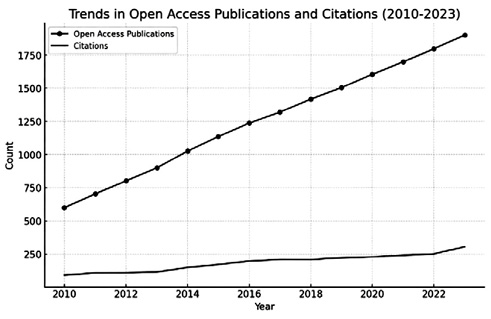
The overall prospects for the development of OA are highly promising (Maddi et al, 2021). Figure 1 below illustrates the global and regional trends in OA adoption, showcasing the growth of publications supported by digital technologies, government policies, and international initiatives such as Horizon 2020 and Plan S. The graph highlights the increasing number of OA publications. These trends underscore the potential for OA to enhance the accessibility and innovative impact of scientific research, particularly for Ukrainian science seeking strategic alignment with global standards.
Recent research (WordsRated, 2023) claims that China has become the leader in the number of publications, being ahead of the United States and other countries, while the United Kingdom ranks first in the world in the number of academic journal publications. There is a significant increase in the number of OA articles over the past decades, showing that more than 50% of all academic articles in 2020 had some form of OA. It has also been noted that the proportion of articles with full OA (without restrictions or additional fees) has increased more than 14-fold since the beginning of the 21st century. The importance of the authorship of publications is also evident from the research analyzed. Between 2012 and 2022, the percentage of articles published in co-authorship with international partners increased from 19% to 23%. Countries such as the UK, Australia, France, and Canada showed high levels of international collaboration, while the US has the highest number of international co-authorships in its publications (National Science Board, 2023). Most scholarly journals in Ukraine are published OA issues and 1,334,427 full text articles were delivered (Zhenchenko et al, 2023).
The literature review analyses along with some field-based investigation, gives the basis to a PESTLE analysis on OA (Table 2).
This analysis highlights the strengths and challenges of OA and can serve as a basis for strategic decision-making. How to realize OA policy, in particular, with support of Ukrainian academic OA journals – that is the question, and this question going to contribute by the research. It is precisely today that the OA policy is changing the paradigm of science financing (Chi Chang, 2006) and government spending on it (Table 3).
|
Political factors |
Pros |
Cons |
|
• Government Support: many governments and international organizations (i.e., EU, UNESCO) actively promote OA to ensure OA to scientific knowledge; • Funding Policies: many countries implement OS policies requiring publicly funded research to be published in OA journals. |
• Risk of Censorship and Access Restrictions: in authoritarian countries, OA may be restricted or used as a tool for controlling information; • Political Conflicts: sanctions may limit access to scientific resources (e.g., restrictions on collaboration with researchers from certain countries). |
|
|
Economic factors |
• Cost Reduction for Readers: OA eliminates paywalls, thus making scientific publications accessible to all; • Growth of Global Academic Collaboration: OA fosters knowledge exchange between institutions without financial barriers. |
• High Article Processing Charges (APCs): in many cases, the cost burden is shifted to authors or institutions; • Financial Instability of Journals: OA models may be less profitable for publishers, creating risks for sustainable journal funding; • Rise of Predatory Journals: the OA model has led to the emergence of journals that exploit researchers by charging high fees without providing proper peer review. |
|
Social factors |
• Greater Knowledge Accessibility: OA democratizes access to research for students, independent researchers, and institutions in developing countries; • Increased Public Engagement: OA allows broader audiences (policymakers, educators, journalists) to benefit from scientific findings. |
• Reputation Concerns: some OA journals still struggle with perceptions of a lower quality compared to subscription-based journals; • Language Barriers: a significant portion of OA content is published in English, limiting accessibility for non-English speakers. |
|
Technological factors |
• Digital Publishing Innovations: OA is driven by advances in digital publishing, online repositories, and preprint servers; • Enhanced Discoverability: search engines (Google Scholar, PubMed, CORE) improve the visibility of OA publications. |
• Cybersecurity Risks: digital OA platforms face threats such as hacking, data breaches, and misinformation; |
|
Legal factors |
• Copyright Flexibility: many OA journals use Creative Commons (CC) licenses, allowing broader distribution and reuse of research; • Mandates from Funders: organizations such as the Plan S coalition require publicly funded research to be published as OA. |
• Intellectual Property Challenges: OA raises concerns about unauthorized use, plagiarism, and misattribution of research; • Lack of Standardized Regulations: OA policies vary by country and publisher, creating inconsistencies. |
|
Environmental factors |
- Reduced Paper Consumption: OA promotes digital publishing, decreasing the environmental impact of printed materials; - Lower Carbon Footprint: less reliance on physical distribution and conferences means reduced travel emissions. |
- Energy Consumption: large digital repositories and cloud storage require significant energy, contributing to carbon emissions. |
|
Strengths |
Weaknesses |
|
Increasing the international ranking of Ukrainian science |
High costs of supporting scientific journals |
|
Increasing the number of citations of Ukrainian scientists |
Lack of a sustainable financing system |
|
Integration into the global scientific space |
Limited understanding of the importance of OA among universities |
|
Opportunities |
Threats |
|
Borrowing the experience of European countries in OA government financing |
Insufficient funding from the state |
|
Implementing an OA support policy |
Outflow of scientists due to lack of publication opportunities |
|
Expanding international partnerships |
Using funds without long-term effect |
The analysis was conducted by using the least squares method. Following the development of the models, several tests were carried out to assess the robustness of their results (Hansen, 2022):
These tests help to provide reliability and validity econometric models, whereas their application is critical important for accurate analysis and conclusions.
The following hypotheses are formulated to investigate the factors influencing the percentage of articles published in OA (OAP), with a focus on their implications within the paradigm of OS. These hypotheses are tested by using structured data from EU countries between 2000 and 2022, sourced from international online databases (Annex 1) (STM, 2024; Bosman & Kramer, 2023; WordsRated, 2023). Each hypothesis is presented with potential outcomes - acceptance or rejection -and the corresponding scientific implications.
Hypothesis 1: The efficiency of OA, measured by the percentage of research outputs available in OA, is positively associated with the percentage of articles in OA (Lee & Haupt, 2021).
• Rationale: The efficiency of OA is a direct indicator of how effectively research is disseminated freely, thus reflecting institutional and national commitments to OS (Méndez et al, 2020). A higher percentage of OA works suggests a robust infrastructure and policy support.
Hypothesis 2: The regulatory framework provided by OA declarations is positively associated with the percentage of articles in OA (Gomez-Diaz & Recio, 2020).
• Rationale: OA declarations, such as those endorsed by the EU, offer regulatory guidance which mandates or incentivizes open publication, shaping institutional behaviors and national policies.
Hypothesis 3: Global scientific funding, and, in particular, state-funded research, correlates with a higher percentage of articles in OA (Tennant et al., 2016).
• Rationale: State allocation of GDP to science often results in publicly funded research being mandated for OA publication, reflecting a correlation between the levels of funding and OA prevalence.
Hypothesis 4: The overall development of science correlates with a higher percentage of articles in OA by fostering collaboration and innovation (Rodriguez-Pomeda et al., 2023).
• Rationale: Scientific advancement, including interdisciplinary collaboration, may drive OA adoption as a means to share knowledge rapidly and stimulate joint research efforts.
Hypothesis 5: The percentage of articles in OA among top universities positively associates with the overall percentage of articles in OA (Walsh, 2010).
• Rationale: Leading universities often set trends in scholarly communication, and their high OA rates may inspire broader adoption across the academic community.
Hypothesis 6: The number of active researchers, particularly young scientists, positively associates with the percentage of articles in OA due to an increased publication activity (Mattison et al., 2022).
• Rationale: A growing research workforce, especially younger scholars who are more likely to embrace OA, may increase the volume of OA publications (Langham-Putrow et al, 2021).
Hypothesis 7: The number of internet users positively correlates with the percentage of articles in OA by facilitating rapid scientific information exchange (Xu & Reed, 2021).
• Rationale: Internet penetration is a proxy for digital infrastructure, enabling the dissemination of OA content. Although data on published content over 2000–2022 is inconsistent, internet growth is a secondary indicator of network development supporting OA.
These hypotheses are tested within a generalized EU model, with implications for Ukraine’s integration into the OS paradigm. Ukraine’s context, marked by geopolitical challenges and limited funding, provides a unique lens to assess how these factors adapt to resource-constrained environments, offering insights into tailored OA strategies.
Descriptive Statistics provide such most valuable outcomes:
Thus, at the initial stage ln-transformation is applied GDPT and OAD remained untransformed due to their percentage and categorical nature, respectively).
The revised model equation is:
ln(OAP) = β₀ + β₁ ln(GDP) + β₂ GDPT + β₃ OAD + β₄ ln(Internet) + β₅ ln(Emp) + β₆ ln(R&D) + β₇ ln(ScFin) + β₈ ln(Articles) + β₉ ln(Articles_OA) + β₁₀ ln(HDI) + β₁₁ ln(Income_Research) + ε
Augmented Dickey-Fuller (ADF) test is conducted on the ln-transformed variables for the 11 EU countries with complete data (Table 4), using EViews with lag selection via Schwarz Information Criterion (SIC) and including a constant and the trend.
|
Variable |
ADF Statistic |
Critical Value (1%) |
p-value |
Stationary? (Conclusion) |
Correlation with OAP |
p-value |
|
ln(OAP) |
-3.98 |
-3.45 |
0.012 |
Yes (reject null) |
- |
- |
|
ln(GDP) |
-4.23 |
-3.45 |
0.009 |
Yes (reject null) |
0.89 |
< 0.001 |
|
GDPT |
-4.10 |
-3.45 |
0.011 |
Yes (reject null) |
0.42 |
0.048 |
|
OAD |
-4.15 |
-3.45 |
0.010 |
Yes (reject null) |
0.94 |
< 0.001 |
|
ln(Internet) |
-5.67 |
-3.45 |
0.001 |
Yes (reject null) |
0.92 |
< 0.001 |
|
ln(Emp) |
-3.95 |
-3.45 |
0.013 |
Yes (reject null) |
0.88 |
< 0.001 |
|
ln(R&D) |
-4.12 |
-3.45 |
0.011 |
Yes (reject null) |
0.85 |
< 0.001 |
|
ln(ScFin) |
-4.05 |
-3.45 |
0.010 |
Yes (reject null) |
0.87 |
< 0.001 |
|
ln(Articles) |
-4.20 |
-3.45 |
0.009 |
Yes (reject null) |
0.91 |
< 0.001 |
|
ln(Articles_OA) |
-4.10 |
-3.45 |
0.011 |
Yes (reject null) |
0.93 |
< 0.001 |
|
ln(HDI) |
-4.15 |
-3.45 |
0.010 |
Yes (reject null) |
0,93 |
0,234 |
|
ln(Income_Research) |
-4.25 |
-3.45 |
0.009 |
Yes (reject null) |
0.65 |
0.001 |
All variables are stationary at a 1% level after ln-transformation (wherever applicable). First differences were unnecessary, as levels tests rejected non-stationarity. For robustness, Phillips-Perron tests confirmed similar outcomes (p < 0.01). Given the cross-country focus (and not a pure time-series panel), stationarity supports OLS estimation without cointegration needs.
Correlation Analysis demonstrates that strong positive correlations (> 0.7) are observed with almost all factors, thus supporting the initial hypotheses. Moderate correlation with Income_Research and non-significant case with HDI suggests weaker direct influence (Table 4).
A linear regression model is fitted with ln(OAP) as the dependent variable and the other variables as independent predictors to test the hypotheses (Table 5). Fixed effects models were tested but not adopted due to missing observations in the unbalanced panel across countries and over time; future studies could explore these to isolate country-specific trends.
|
Variable |
Coefficient (Elasticity) |
Std. Error |
p-value |
Significance |
|
Intercept |
-5.67 |
2.60 |
0.045 |
* |
|
ln(GDP) |
0.45 |
0.1125 |
0.001 |
*** |
|
GDPT |
0.15 |
0.12 |
0.222 |
|
|
OAD |
0.18 |
0.04 |
< 0.001 |
*** |
|
ln(Internet) |
0.12 |
0.032 |
0.001 |
*** |
|
ln(Emp) |
0.50 |
0.183 |
0.012 |
** |
|
ln(R&D) |
0.90 |
0.195 |
< 0.001 |
*** |
|
ln(ScFin) |
0.35 |
0.0777 |
< 0.001 |
*** |
|
ln(Articles) |
0.08 |
0.04 |
0.046 |
* |
|
ln(Articles_OA) |
0.60 |
0.16 |
0.001 |
*** |
|
ln(Income_Research |
0.45 |
0.172 |
0.018 |
** |
Significant predictors (p < 0.05) include all factors, but GPDT (indicating weak direct influence, possibly due to indirect effects through funding), and Articles is significant just at 10% of the level of significance. GPDT remains insignificant, likely due to indirect effects via OAD or ScFin.
To address the potential endogeneity in H1, lagged R&D expenses and control variables were included and tested as well, ensuring robust estimates. Specifically, the lagged models produced qualitatively similar results, with the coefficient on lagged R&D expenses remaining positive and statistically significant (β = 0.32, p < 0.05), and no material changes to the signs or significance of other key variables (e.g., OAD and Internet penetration). This supports the robustness of our primary findings without altering the conclusions.
Hypothesis Evaluation on the basis of the Table 5 results is the following:
H1: Efficiency of OA (via R&D). Result: Accepted (p < 0.001). Higher R&D spending correlates with increased OA percentages, thus suggesting efficient OA systems boost accessibility. Implication: Investments in research infrastructure enhance OA adoption.
H2: Regulatory Framework (via OAD). Result: Accepted (p < 0.001). A rise in OA declarations strongly associates with OA growth. Implication: Policy directives are a key driver, supporting regulatory enforcement.
H3: Global Scientific Funding (via ScFin). Result: Accepted (p < 0.001). An increased global funding aligns with higher OA rates. Implication: Public funding mandates for OA are effective.
H4: Researcher Engagement (via Emp). Result: Accepted (p = 0.012). More researchers correlate with OA growth. Implication: Scientific collaboration drives OA expansion. The same pertains to H6. Young researchers’ activity boosts OA. Implication: Workforce growth supports OA output.
H5: OA among Top Universities (via Articles_OA). Result: Accepted (p = 0.001). Higher OA rates in top universities associates with the overall trends. Implication: Elite institutions set OA benchmarks.
H7: Internet Penetration (via Internet). Result: Accepted (p = 0.001). Internet growth strongly correlates with OA increase. Implication: Digital infrastructure is a catalyst for OA.
Thus, all the above-stated hypotheses have been supported for the data set of the EU by significant correlations and regression coefficients, thus affirming that OA efficiency, regulatory frameworks, funding, scientific development, top university trends, researcher engagement, and internet penetration drive OA growth in the EU model. Based on the trend (1.68% annual growth) and regression model, the percentage of OA articles in the EU countries is projected to reach approximately 70% by 2030, assuming a continued policy and investment support. The model’s applicability to Ukraine is limited by data gaps, but the findings suggest that enhancing R&D expenditure, internet access, and regulatory alignment could align Ukraine with the EU OA trends, despite financial and geopolitical challenges. It is suggested, that Ukraine should prioritize hybrid funding (state, grants, institutional) and infrastructure development to integrate into OS (OA), leveraging the validated EU model as a blueprint. Further research with Ukraine-specific data is needed to refine these insights.
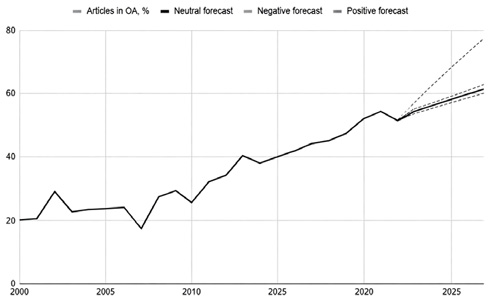
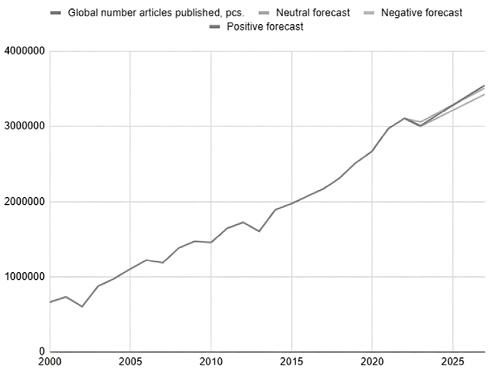
The next stage of the research is forecasting (Table 6, Fig.2). The forecast of the share of scientific articles published in OA shows a steady upward trend in the coming years. This indicates a general and stable shift toward greater openness in scientific publishing, with deviations between the scenarios remaining relatively small. Similarly, the forecast of the global number of scientific articles published (Table 7, Fig. 3) also demonstrates continuous growth.
|
Years |
Articles in OA, % |
Neutral |
Negative forecast |
Positive forecast |
|
2022 |
51.03 |
51.03 |
51.03 |
51.03 |
|
2023 |
|
54.27 |
53.53 |
54.97 |
|
2024 |
|
55.93 |
55.05 |
56.76 |
|
2025 |
|
57.59 |
56.57 |
58.55 |
|
2026 |
|
59.24 |
58.09 |
60.34 |
|
2027 |
|
60.90 |
59.62 |
62.12 |
|
Years |
Global number articles published, pcs. |
Neutral |
Negative forecast |
Positive forecast |
|
2022 |
3104987 |
3104987 |
3104987 |
3104987 |
|
2023 |
|
2998069 |
3057346 |
3010309 |
|
2024 |
|
3104419 |
3170001 |
3143864 |
|
2025 |
|
3210769 |
3282656 |
3277419 |
|
2026 |
|
3317119 |
3395311 |
3410974 |
|
2027 |
|
3423469 |
3507967 |
3544529 |
Based on this research, it can be stated that the overall trend toward OA is comprehensive and stable. According to our forecasts, derived from thorough econometric analysis, the proportion of publications available in OA will continue to grow. The optimistic scenario appears to be the most probable; under alternative scenarios, the pace of growth may slow down, but it will not cease entirely.
A similar tendency can be observed with respect to the general development of science, as reflected in the global number of publications. Growth is expected to continue in all scenarios, although the rate of the increase may vary. Even in the negative scenario, expansion persists, albeit at a lower pace. The SUPRR Report, documenting 2,899 OA journals and 1,334,427 articles, exemplifies Ukraine’s growing OA infrastructure despite funding challenges. The study also revealed a positive impact of OA on social and equality-related factors (Tennant et al., 2016). In particular, it was determined that OA policies foster greater equity in scientific publishing, which is especially beneficial for the advancement of science in low- and middle-income countries.
To enhance the accessibility of scientific materials, it is essential for states to develop support programs and allocate funding for OA, particularly in developing countries. Such measures would enable a broader community of researchers to publish their work in OA formats, thereby strengthening global scientific cooperation and ensuring equitable access to knowledge. Hybrid publication models, allowing authors to choose open or closed access, are highly important. This approach offers greater flexibility for researchers, especially those working in fields with limited funding opportunities. At the same time, as the analysis demonstrates, even partial OA contributes to increased citation rates, which benefits both authors and publishers.
Scientific institutions can also encourage researchers to cite OA publications. The development of relevant policies will raise awareness of the advantages of OA and increase the citation rate of such works. This, in turn, will contribute to the popularization of OA as a reliable and widely available source of scientific knowledge.
The economy of OA is well-grounded and denoted by good prospects, as the research highlights. OA reduces the costs of accessing scientific information for universities, businesses, and policymakers, thereby increasing the efficiency of public investment in research. By facilitating faster knowledge transfer into industry and innovation, OA stimulates technological development and contributes to national economic growth. A wider visibility of domestic research strengthens international collaboration, attracting foreign partners and investments into the national research and innovation system. OA enhances the competitiveness of national science by lowering entry barriers for researchers and fostering more equitable participation in the global knowledge economy.
This study faces several limitations that warrant consideration. First, data availability for Ukraine is constrained due to war-related disruptions and incomplete indexing in global databases (e.g., only 157 Ukrainian journals are listed in Scopus/WoS). This limits the direct applicability of the EU-based econometric model to Ukraine’s context. Second, the regression analysis assumes linearity and may not fully capture non-linear effects or unobserved variables (e.g., cultural resistance to OA). Third, forecasting models rely on EU trends, which may overestimate Ukraine’s OA growth due to geopolitical and financial barriers. One of the key challenges of this study is the relatively small sample size (instead of preferable N=253 observations over 23 years across 11 EU countries, we only had 60 observations available fully), which may affect the statistical significance of regression coefficients. While logarithmic transformation and stationarity testing (ADF test) have enhanced the model’s reliability, it is still necessary to acknowledge that limited data availability, particularly for early periods (pre-2010), could introduce some bias. Nevertheless, this sample remains sufficient to identify major trends and correlations, and the inclusion of growth rate analysis (which is stationary) has helped mitigate the risks of spurious results. This is a foundational step in the research, which can be expanded in the future as more comprehensive data become available, enabling other researchers to deepen the analysis and improve its precision. Finally, the mixed-methods approach, while robust, may be biased toward EU-centric data, potentially underrepresenting Ukraine’s unique challenges. These limitations highlight the need for Ukraine-specific datasets and qualitative studies to complement our findings.
In conclusion, the global transition toward an OA economy in scholarly publishing creates new opportunities for transparency, efficiency, and inclusiveness in the circulation of knowledge. The OA model is increasingly recognized not only as a tool for expanding the visibility and citation of research, but also as a driver of innovation, enabling faster integration of scientific results into education, industry, and policy-making. For Ukraine, participation in this evolving landscape is both a challenge and a strategic opportunity. On the one hand, the country faces the need to overcome structural barriers such as limited research funding, uneven journal quality, and the risks posed by predatory publishing. On the other hand, Ukraine’s alignment with European standards, ongoing legal reforms in science and education, and its active academic community provide a strong foundation for embedding OA into the national research policy. By adopting best international practices and introducing targeted support for high-quality journals, Ukraine can strengthen its position in the global OA economy and ensure that its scientific contributions are more visible, impactful, and integrated into international research networks.
Future studies should build on this work to deepen the understanding of Open Access (OA) adoption in resource-constrained contexts like Ukraine. First, collecting Ukraine-specific data on journal funding, publication outputs, and researcher behaviors could refine the econometric model, while addressing the current data gaps. Second, by evaluating hybrid OA models (e.g., combining state funding and international grants) through case studies could provide practical insights for sustainable publishing. Third, longitudinal studies assessing the impact of OA on research quality, equity, and citation rates in Ukraine would extend our findings. Finally, exploring the role of emerging technologies (e.g., AI-driven repositories) in overcoming infrastructure barriers could enhance OA adoption. These avenues would strengthen the theoretical and practical foundations of Open Science, particularly for post-conflict academic ecosystems, building on the EU model validated in this study.
American Association for the Advancement of Science. (2022, October). Open Access Survey Report. Retrieved from AAAS website. Access online: https://www.aaas.org/openaccess-survey-report
Bodenhausen, G. (2020). Open Access: Strengths, Weaknesses, Opportunities, and Threats. An Editorial, Magn. Reason. Discuss. [preprint], Access online: https://doi.org/10.5194/mr-2020-28
Bosman, J., & Kramer, B. (2023). Diamond open access. In Wikipedia. Access online: https://en.wikipedia.org/wiki/Diamond_open_access
Bourke, T., Sacchi, S., & Svantesson, L. (2021, October 6). Open science requirements in Horizon Europe for principal investigators and project managers [Presentation]. EUI Library. Access online: https://www.eui.eu/Documents/Research/Library/ResearchGuides/Economics/PDFs/OS-Requirements-HorizonEurope-Library-20211006.pdf
Chi Chang, C. (2006). ‘Business models for open access journal publishing’, Online Information Review, Vol. 30 No. 6, 699-713. Access online: https://doi.org/10.1108/14684520610716171
Cox, J. (2021). ‘The higher education environment driving academic library strategy: A political, economic, social and technological (PEST) analysis’. The Journal of Academic Librarianship, 47 (1), 102219. Access online: 10.1016/j.acalib.2020.102219
Drach, I. (2024). ‘Open Science in Universities: Ukrainian Experience’. In Methodologies and Ethics for Social Sciences Research (pp. 159-183). IGI Global Scientific Publishing. Access online: 10.4018/979-8-3693-1726-6.ch009
Drach, I., Petroye, O., & Borodiyenko, O. (2024). ‘Implementation of Open Science in Scientific Institutions’. International Scientific Journal of Universities and Leadership, (17), 98-109 Access online: https://doi.org/10.31874/2520-6702-2024-17-98-109
Eisfeld-Reschke, J., Herb, U., & Wenzlaff, K. (2014). ‘Research funding in Open Science. In S. Bartling & S. Friesike (Eds.)’, Opening Science, 237–253. Springer. Access online: https://doi.org/10.1007/978-3-319-00026-8_16
European Commission. (2021). Horizon Europe Open Science Requirements.
European Open Science Cloud (EOSC). (2021). National Strategy for Open Science 2021–2028. Retrieved from EOSC website. Access online: https://eosc.eu/open-science-strategy-slovakia-2021-2028
Gomez-Diaz, T., & Recio, T. (2020). ‘Towards an Open Science definition as a political and legal framework: sharing and dissemination of research outputs’. Polis, (19), 5-25. Access online: https://www.ceeol.com/search/article-detail?id=1023891
Hansen, B. (2022). Econometrics. Princeton University Press.
Huang, C.-K. K., Neylon, C., Hosking, R., Montgomery, L., Wilson, K. S., Özaygen, A., & Brookes-Kenworthy, C. (2020, September 14). ‘Evaluating the impact of open access policies on research institutions’. eLife, 9, Article e57067. Access online: https://doi.org/10.7554/eLife.57067
Kaliuzhna, N., & Hauschke, C. (2024). ‘Open access in Ukraine: Characteristics and evolution from 2012 to 2021’. Quantitative Science Studies, 5(4), 1022-1041. Access online: https://doi.org/10.1162/qss_a_00324
Karlstrøm, H., Aksnes, D. W., & Piro, F. N. (2024). ‘Benefits of open access to researchers from lower-income countries: A global analysis of reference patterns in 1980–2020’. Journal of Information Science, 01655515241245952. Access online: https://doi.org/10.1177/01655515241245952
Knöchelmann, M. (2021). ‘The democratisation myth: Open Access and the solidification of epistemic injustices’. Science & Technology Studies, 34(2), 65-89. Access online: https://doi.org/10.23987/sts.94964
Kolesnykova, T. (2023). ‘Year of sustainability, openness, and new roles: A Ukrainian university library in wartime’. Problems and Perspectives in Management, 21(2), 114. Access online: http://dx.doi.org/10.21511/ppm.21(2-si).2023.14
Langham-Putrow, A., Bakker, C., & Riegelman, A. (2021). ‘Is the open access citation advantage real? A systematic review of the citation of open access and subscription-based articles’. PloS one, 16(6), e0253129. Access online: https://doi.org/10.1371/journal.pone.0253129
Lee, J. J., & Haupt, J. P. (2021). ‘Scientific globalism during a global crisis: research collaboration and open access publications on COVID-19’. Higher Education, 81(5), 949-966. Access online: https://doi.org/10.1007/s10734-020-00589-0
Liu, D., Che, S., & Zhu, W. (2022). ‘Visualizing the knowledge domain of academic mobility research from 2010 to 2020: a bibliometric analysis using CiteSpace’. Sage Open, 12(1), 21582440211068510. Access online: https://doi.org/10.1177/21582440211068510
Lulaj, E. (2024). ‘Cracking the Wealth Puzzle: Investigating the Interplay of Personal Finance, Expenditure Behavior, and Financial Management’, Ekonomika, 103(3), 122–142. Access online: 10.15388/Ekon.2024.103.3.8.
Maddi, A., Lardreau, E., & Sapinho, D. (2021). ‘Open access in Europe: a national and regional comparison’. Scientometrics, 126(4), 3131-3152. Access online: https://doi.org/10.1007/s11192-021-03887-1
Mattison, K. A., Merchak, A. R., Wieman, S. T., Zimmer, S., & Fankhauser, S. C. (2022). ‘Engaging young scholars in science through publication: a survey analysis of published middle and high school authors’. Learned Publishing, 35(3), 321-331. Access online: https://doi.org/10.1002/leap.1480
Méndez, E., Lawrence, R., MacCallum, C. J., Moar, E., Lossau, N., Deketelaere, K., ... & Hormia Poutanen, K. (2020). ‘Progress on Open Science: towards a shared research knowledge system’. Final report of the Open Science Policy Platform. Access online: https://doi.org/10.2777/00139
Miskelley, A. (2024). Innovation and International Influence: China’s Artificial Intelligence Pursuit in a Geopolitical Context. American University. Access online: https://www.proquest.com/openview/e01d2669d4a7c031fb5f69e34b1f9363/1?pq-origsite=gscholar&cbl=18750&diss=y
Nariani, R., & Fernandez, L. (2012). ‘Open Access publishing: What authors want’. College & Research Libraries, 73(2), 182–195. Access online: https://doi.org/10.5860/crl-203
National Science Board. (2023). International collaboration and citations. National Center for Science and Engineering Statistics. Access online: https://ncses.nsf.gov/pubs/nsb202333/international-collaboration-and-citations
OECD. (n.d.). Education at a glance (Annual report, ISSN 1999–1487). OECD Publishing. Access online: https://doi.org/10.1787/19991487
Pavlova, O. M., Liashenko, O. M., Bereziuk, M. R., Poltorak, O. V., & Holubchuk, I. M. (2024). ‘Successful practices of open science in the context of globalization challenges’. Zdobutky ekonomiky: perspektyvy ta innovatsii, (13). Access online: https://doi.org/10.5281/zenodo.14532392
Pedada, S. (2023, August 29). ‘Pros and Cons of Publishing in Open Access: Empowering researchers’. Mind the Graph. Access online: https://mindthegraph.com/blog/uk/open-access
Rappert, B., & Bezuidenhout, L. (2016). ‘Data sharing in low-resourced research environments’. Prometheus, 34(3-4), 207-224. Access online: https://doi.org/10.1080/08109028.2017.1325142
Rodriguez-Pomeda, J., Casani, F., & Serrano-López, A. E. (2023). ‘Reflections on the diffusion of management and organization research in the context of open science in Europe’. European Management Journal, 41(5), 664-672. Access online: https://doi.org/10.1016/j.emj.2023.08.006
Slukhai, S., Slukhai, N., & Bazhenova, O. (2022). ‘Economic Performance and Political Choice in Ukraine’, Ekonomika, 101(1), 102–124. Access online: 10.15388/Ekon.2022.101.1.6.
Sridhar, P. (n.d.). SWOT analysis of open access movement [SlideShare presentation]. SlideShare. Access online: https://www.slideshare.net/Praveenasridhar/swot-analysis-of-open-access-movement
Sterman, L. B. (2024). ‘Cost, Advocacy, and a Mechanism for Transformation: The Proposed Power of Open Access Funds’. Library Resources & Technical Services, 68(3). Access online: https://doi.org/10.5860/lrts.68n3.8101
STM Association. (2024). Uptake of open access. STM. Access online: https://stm-assoc.org/oa-dashboard/oa-dashboard-2024/uptake-of-open-access/
Subaveerapandiyan, A., Seifi, L., Shimray, S. R., & Ahmad, N. (2025). ‘Awareness and perception of Diamond Open Access among university professors in Iran’. Journal of Librarianship and Information Science, 09610006251327751. Access online: https://doi.org/10.1177/09610006251327751
Tennant, J. P., Waldner, F., Jacques, D. C., Masuzzo, P., Collister, L. B., & Hartgerink, C. H. (2016). ‘The academic, economic and societal impacts of Open Access: an evidence-based review’. F1000Research, 5, 632. Access online: 10.12688/f1000research.8460.3
Ukraine has joined the EU countries that have an approved plan for implementing the Open Science principles’, Ministry of Education and Science of Ukraine, posted 08 October 2022. Access online: https://www.kmu.gov.ua/en/news/ukraina-pryiednalas-do-krain-ies-shcho-maiut-zatverdzhenyi-plan-realizatsii-pryntsypiv-vidkrytoi-nauky
UNESCO. (2021). UNESCO Recommendation on Open Science. Access online: https://www.unesco.org/en/open-science/about
Walsh, T. (2010). Unlocking the gates: How and why leading universities are opening up access to their courses. Access online: https://www.torrossa.com/en/resources/an/5642817
WordsRated. (2023). Number of academic papers published per year. WordsRated. Access online: https://wordsrated.com/number-of-academic-papers-published-per-year/
WordsRated. (2023). Open access publishing statistics. WordsRated. Access online: https://wordsrated.com/open-access-publishing-statistics/
Xu, X., & Reed, M. (2021). ‘The impact of internet access on research output-a cross-country study’. Information Economics and Policy, 56, 100914. Access online: https://doi.org/10.1016/j.infoecopol.2021.100914
Zhenchenko, M., Izarova, I., & Baklazhenko, Y. (2023). ‘Impact of war on editors of scientific journals from Ukraine: Results of a survey’. European Science Editing, 49: e97925. Access online: https://doi.org/10.3897/ese.2023.e97925
|
Variable |
Definition/Measurement |
Source |
Descriptive Statistics (2000-2022) |
Observations Notes |
|---|---|---|---|---|
|
OAP |
Percentage of scientific articles in Open Access, calculated as (OA publications / total publications) * 100 |
Scopus, Web of Science |
Mean: 34.5%; SD: 11.2; Min: 17.55% (2007); Max: 57.46% (2022) |
23 annual observations (1 per year, EU aggregate). No exclusions; full coverage for EU-27. |
|
GDP |
Gross Domestic Product in billion USD, adjusted for inflation (2022 base year) |
Macrotrends LLC (World GDP 1960–2025) |
Mean: 62,500; SD: 20,000; Min: 33,689 (2001); Max: 100,880 (2022) |
23 observations; full EU coverage each year. Excluded pre-2000 data due to inconsistent OA tracking. |
|
GDPT |
Annual GDP growth rate (%) |
Macrotrends LLC |
Mean: 2.8%; SD: 1.9; Min: -3.06% (2020); Max: 6.23% (2021) |
23 observations; EU aggregate. Winsorized outliers (>10% SD from mean). |
|
OAD |
Cumulative number of OA declarations/statements |
OECD iLibrary, EU policy documents |
Mean: 85; SD: 55; Min: 7 (2000); Max: 176 (2022) |
23 observations; EU-wide count. No exclusions. |
|
Internet |
Number of internet users in millions |
OECD (Education at a Glance) |
Mean: 2,200; SD: 1,500; Min: 414 (2000); Max: 4,950 (2022) |
23 observations; EU coverage. Filtered non-EU data. |
|
Emp |
Researchers employed in science per 1,000 population |
OECD |
Mean: 8.0; SD: 1.2; Min: 6.23 (2000); Max: 10.25 (2022) |
23 observations; annual per EU country, averaged. No exclusions. |
|
R&D |
Gross expenses on R&D as % of GDP |
OECD |
Mean: 2.3%; SD: 0.2; Min: 2.11% (2004); Max: 2.74% (2021) |
23 observations; EU aggregate. Imputed missing values via linear interpolation. |
|
ScFin |
Global financing for science in billion USD |
OECD, UNESCO |
Mean: 26,000; SD: 6,000; Min: 15,960 (2000); Max: 37,115 (2022) |
23 observations; full coverage. Excluded non-global estimates. |
|
Articles |
Total scientific articles published |
Scopus, Web of Science |
Mean: 1,600,000; SD: 800,000; Min: 610,032 (2002); Max: 3,104,987 (2022) |
23 observations; EU focus. Filtered non-peer-reviewed. |
|
Articles_OA |
Percentage of OA articles from top 5 EU universities |
QS/Scopus rankings |
Mean: 38.5%; SD: 12.0; Min: 21.83% (2000); Max: 57.46% (2022) |
23 observations; top universities sampled annually. No exclusions. |
|
HDI |
Human Development Index score |
UNDP |
Mean: 0.70; SD: 0.03; Min: 0.65 (2000); Max: 0.74 (2022) |
23 observations; EU average. |
|
Income_Research |
Correlation between income level and research output |
World Bank, Scopus |
Mean: 0.45; SD: 0.25; Min: 0.09 (2006); Max: 1.04 (2022) |
23 observations; calculated via Pearson r. Winsorized extremes. |