Ekonomika ISSN 1392-1258 eISSN 2424-6166
2026, vol. 105(2), pp. 124–146 DOI: https://doi.org/10.15388/Ekon.2026.105.2.7
Tetiana Zatonatska
Doctor of Economic Sciences, Professor, Department of Economic Cybernetics,
Taras Shevchenko National University of Kyiv, Ukraine
https://ror.org/02aaqv166
E-mail: tzatonatska@gmail.com
ORCiD: https://orcid.org/0000-0001-9197-0560
Yulia Forostiana
Student, Department of Economic Cybernetics,
Taras Shevchenko National University of Kyiv, Ukraine
https://ror.org/02aaqv166
E-mail: yulia.forostiana@knu.ua
ORCiD: https://orcid.org/0000-0003-0301-6617
Yana Fareniuk*
PhD in Economics, Department of Economic Cybernetics,
Taras Shevchenko National University of Kyiv, Ukraine,
https://ror.org/02aaqv166
E-mail: yfareniuk@gmail.com
ORCiD: https://orcid.org/0000-0001-6837-5042
Dmytro Zatonatskiy
PhD in Economics, State Scientific Institution "Institute of Educational Analytics", Ukraine,
https://ror.org/04df39v43
E-mail: dzatonat@gmail.com
ORCiD: https://orcid.org/0000-0002-4828-9144
Abstract. Migration processes are one of the key social-economic challenges within the European Union (EU). This article aims to analyse and model the impact of migration and macroeconomic factors on government expenditures in major EU destination countries, such as Spain, Italy, and France by using regression models. It examines the influence of these factors on the total government spending and its components, such as social support, education, and healthcare for the period from 2000 to 2023. Migration factors include the number of immigrants and emigrants, share of employed migrants, housing-burdened migrants, and educational levels. Macroeconomic factors include GDP per capita, human development index (HDI), life expectancy, inflation, and foreign investment.
The key findings reveal nonlinear relationships between government expenditures and analysed factors. GDP per capita, life expectancy, and HDI demonstrate strong positive impacts. Among the migration factors, the housing burden and low educational attainment were found to significantly increase spending, while higher migrant employment was found to reduce social costs. Based on the modelling results, governments should focus on training programmes for migrants, employer tax incentives, inflation-adjusted healthcare budgeting, and dedicated migration impact funds. The results provide empirical evidence for optimising migration integration strategies and budget planning in EU countries.
Keywords: government expenditure, migration processes, clustering, forecasting, econometrics.
________
* Correspondent author.
Received: 02/06/2025. Accepted: 16/03/2026
Copyright © 2026 Tetiana Zatonatska, Yulia Forostiana, Yana Fareniuk, Dmytro Zatonatskiy. Published by Vilnius University Press
This is an Open Access article distributed under the terms of the Creative Commons Attribution License, which permits unrestricted use, distribution, and reproduction in any medium, provided the original author and source are credited.
Migration and its economic effects have consistently been a highly scrutinized topic, particularly gaining salience in European policy debates in recent years. According to the Eurobarometer survey (Spring 2024), 25% of the respondents identified immigration as one of the two most pressing issues confronting the EU (Caselli et al., 2024). This increased salience is largely due to the sharp rise in immigration following the onset of the war in Ukraine. In 2022, the EU recorded an unprecedented influx of 6.5 million immigrants, including around 4 million Ukrainian refugees. Although net migration declined somewhat in 2023 vs. 2022, it remained significantly above the pre-pandemic level (Caselli et al., 2024).
A sudden surge in immigration constitutes, in economic terms, an exogenous population shock. The demographic and skill profiles of immigrants, relative to the native population, determine the extent to which such inflows alter the composition of the resident population. A larger population usually results in an increased higher demand for public services and the infrastructure, and an expansion of the labour force over time. The immigrants’ human capital may either complement or substitute that of native workers. The fiscal and economic effects of immigration manifest both at the macroeconomic level through impacts on GDP, productivity, and public budgets. The existing literature often categorises these effects into three domains: macroeconomic outcomes, labour market distributional impacts, and effects on the public goods and services. The latter are especially pronounced in subnational contexts.
This study focuses on three EU members – Spain, Italy, France – which were selected for their demographic significance, diverse migration experiences, comparable socioeconomic development levels, and substantial associated public spending. These countries represent established migration destinations within the EU where fiscal impacts are most pronounced and policy-relevant.
Beyond fiscal metrics, the influx of migrants exerts pressure on public service provision, especially at the local level. Regional disparities in migrant settlement patterns can lead to overcrowding in areas such as education, childcare, healthcare, and housing. For instance, local housing markets in Poland have shown signs of stress, such as rising rents. In Germany, early-stage capacity constraints in nurseries and schools were reported before personnel adjustments were made (Caselli et al., 2024). These localised pressures underscore the necessity for targeted, evidence-based public policy to maintain service quality and cohesion. Given the dual challenges of population ageing and persistent labour shortages across Europe, migration policy has the potential to serve as a strategic lever for sustaining economic dynamism.
This paper addresses the following main questions:
The primary objective of this study is to explore the influence of international migration on government expenditures in major EU destination countries with established migration management frameworks and significant migrant populations, such as Spain, Italy, and France. The analysis focuses not only on total government expenditures, but also to key functional areas that are particularly sensitive to demographic changes: social protection, education, and healthcare. The analysis uses an econometric approach to identify the main migration-related factors influencing the dynamics of government expenditures. In addition, the future state of expenditures is forecasted based on the impact.
The findings will be an important tool for understanding the role of migration processes in establishing a social support system and optimising the state’s expenditure policy. Analysing the impact of key migration factors will help adapt public financial strategies to current demographic challenges more effectively, contributing to efficient budget allocation and ensuring the sustainability of the country’s socioeconomic system.
The financial impact of migration on the state budget is one of the key aspects of migration policy debates. Studies show that the immigration’s impact on government expenditures depends on the migrants’ level of education, employment status, and age, as well as on the characteristics of the host country’s social system.
Research shows that there are significant regional variations in fiscal outcomes, with Northern European immigrants tending to be net taxpayers, while Southern European impact remains neutral or negative (Boffi et al., 2024). Lim et al. (2023) demonstrate that structural changes alter the long-term migration-remittance relationship, affecting public finances and tax policy responses. Cerqua et al. (2022) show that EU regional funding increases migrant attractiveness through enhanced job opportunities, indirectly affecting government expenditures by altering migration patterns and increasing demand for public services.
Fasina et al. (2024) found that increased tax revenues boost investments in health and education, though the effectiveness varies significantly. Gordon et al. (2024) identify fiscal externalities in which immigrants help repay pre-existing debt, creating incentives for excessive borrowing.
At the macroeconomic level, GDP per capita is the most influential predictor of public spending across the Baltic States, explaining up to 96.5% of the variation. Interest rates negatively affect expenditures, while foreign direct investment plays a positive role in Latvia and Lithuania (Filipova, 2025). In Finland, an increasing immigrant population correlates with higher per capita municipal spending, primarily due to the demand for multilingual education, interpretation services, legal aid, and social assistance – all of which are more prevalent among low-income and low-education migrant groups. Municipal health services also face indirect cost pressures linked to immigrant needs, which are partially compensated by central government transfers (Viren, 2022).
Although high inflation can temporarily boost nominal government revenues, its overall impact on public finances is negative in the long term due to rising expenditure levels. Inflation reduces the real GDP and worsens fiscal balances. Evidence from Austria shows that indexing tax brackets and family benefits to inflation amplifies these negative effects, underscoring the fiscal vulnerability associated with persistent price increases (Holler & Reiss, 2023).
Regarding the pension system in North Macedonia, the study emphasises the significant fiscal risks posed by substantial emigration. For instance, a 1% increase in the number of emigrants is associated with a 1.86% rise in central government pension expenditures (Raveni et al., 2024). The loss of skilled labour further constrains economic growth, weakens the tax base, and exacerbates budget deficits and public debt, ultimately threatening the stability of the pension system.
Healthcare expenditures demonstrate complex patterns in migration contexts. Although immigrants use healthcare services less frequently than the local populations, increases in immigration still drive up healthcare spending (Bettin et al., 2020). D’Andreamatteo et al. (2024) demonstrate that active integration programmes can optimise costs by preventing overuse of emergency services.
Educational impacts reveal significant regional variations. Zatonatska et al. (2022) show how migration processes create uneven burdens on educational systems, with high-concentration migrant areas experiencing increased school spending and depopulated regions facing underfunding challenges. Uctu et al. (2024) investigate the role of skilled migrants in shaping the creative economy. Uchida et al. (2024) demonstrate that a rising life expectancy encourages government investment in education, which could reduce long-term social welfare costs. Temsumrit (2023) shows how population ageing changes expenditure structures by increasing pension and healthcare system financing needs.
The findings of research by Artyukhov et al. (2024) reveal a positive correlation: higher shares of social spending in GDP – particularly in healthcare, education, culture, and social protection – are associated with higher HDI levels and vice versa. The study also notes time lags between public investment and HDI growth, highlighting the delayed yet lasting impact of social spending.
Su et al. (2025) found that housing prices in China both positively and negatively affect government expenditures across different periods, while government expenditures consistently positively influence housing prices.
Afonso et al. (2022) found that states with more open immigration policies have higher levels of social spending, particularly in health and education, while countries with strict migration policies experience reduced social spending due to lower tax revenues from immigrants.
Chassamboulli & Liu (2024) found that legal immigrants significantly contribute to the state budget through tax payments. In contrast, irregular migrants create additional burdens on social programmes due to limited tax contributions. The study shows that legalising immigrants can positively impact public finances by increasing tax revenues.
Samuels et al. (2023) show that, in democracies with powerful landed elites, there is systematic underinvestment in education due to concerns that education encourages rural-to-urban migration and raises agricultural labour costs.
Modelling the impact of migration processes on government expenditures was carried out by building regression models. The least squares method (OLS) was used to study this relationship. It provides unbiased and efficient parameter estimates as well as clear interpretability of coefficients, directly showing the marginal effect of each predictor on the outcome variable. Moreover, it is highly flexible and serves as a solid foundation for extending to more advanced econometric models. In addition, the study examined important issues such as multicollinearity, heteroscedasticity and autocorrelation. Data from Eurostat from 2000 to 2023 were analysed by using R-Studio.
Since EU countries differ in socioeconomic development, hierarchical clustering by the Ward method was applied to identify countries that are attractive to international migrants and have developed migration systems, including several non-EU economies (Iceland, Norway, Switzerland) to identify structurally comparable migration regimes. These countries were retained at the clustering stage to improve discrimination between migration-development profiles. Clustering criteria included the numbers of immigrants and emigrants, GDP and HDI, resulting in three country groups (Table 1).
Group 3 was selected as it met the requirements of significant migration flows and high socioeconomic development. The group comprised economically developed countries with large labour markets that attract migrants. These countries have well-developed migration legislation that covers migrants’ rights, integration opportunities, and naturalisation processes. They also have active integration policies that include language courses, professional adaptation programmes, and support in education and employment.
|
Group |
Country |
|
Group 1 |
Belgium, Denmark, Ireland, Luxembourg, Netherlands, Austria, Slovenia, Finland, Sweden, Iceland, Norway, Switzerland |
|
Group 2 |
Bulgaria, Czechia, Estonia, Greece, Croatia, Cyprus, Latvia, Lithuania, Hungary, Malta, Poland, Portugal, Romania, Slovakia |
|
Group 3 |
Germany, Spain, France, Italy |
Source: Authors’ calculations in R-Studio based on the collected data.
Between January 2021 and January 2023, Spain experienced a significant population increase, largely driven by foreign immigration. Asylum applications increased from 116,150 in 2022 to 160,470 in 2023. The foreign-born population in 2023 was estimated at 8.2 million (OECD, 2024). Notably, fiscal assessments indicate that, unlike the native population, migrants contribute positively to public finances (Fiorio et al., 2024).
In Italy, the number of asylum applications increased from 77,200 in 2022 to 130,565 in 2023. The foreign-born population reached 5.5 million in 2023 (OECD, 2024). As a result, the Italian government introduced a set of reforms aimed at tightening asylum procedures, promoting legal labour migration, and limiting irregular inflows. Similar to Spain, migrants contribute more to the fiscal system than natives who tend to receive more in benefits than they contribute in taxes (Fiorio et al., 2024).
France similarly reported high migration activity, with 137,605 new asylum claims in 2022 and 142,210 in 2023. In 2023, the foreign-born population was 8.9 million (OECD, 2024). Unlike Spain and Italy, fiscal data from the 2014–2018 period show that the native population had a positive net contribution, whereas migrants had a negative balance, reflecting differences in the migrant composition and institutional arrangements (Fiorio et al., 2024).
Germany, despite belonging to the same cluster as Spain, Italy and France, was excluded due to its distinct structural characteristics: a substantially larger economic scale, a higher share of highly skilled migrants, and markedly different migration-labour market dynamics. Including Germany would dominate the coefficient estimates and reduce comparability within the selected subgroup. Spain, Italy, and France thus represent a more homogeneous sample in terms of the migration composition and fiscal structure, enabling clearer identification of common expenditure responses.
Four dependent variables were studied and modelled: general government expenditure (GGE), social support expenditure (SGE), education expenditure (EGE), and healthcare expenditure (HGE).
The main hypothesis is that the following indicators (migration and macroeconomic) are influencing factors on dependent variables:
All government expenditures variables are measured in millions of euros at current prices, as reported by Eurostat. Inflation is captured by the annual percentage change in consumer prices.
The inclusion of inflation as an explanatory variable allows us to explicitly control for price-level effects in nominal expenditure dynamics. While the use of nominal values may mechanically amplify expenditure growth during high-inflation periods, this specification is intentionally retained to reflect actual budgetary pressures faced by governments in nominal terms, which are directly relevant for fiscal planning and policy decisions. Thus, inflation enters the models as an independent control variable, allowing the estimated coefficient of migration-related and macroeconomic factors to be interpreted as conditional effects net of general price dynamics.
GDP per capita and HDI are jointly included to capture distinct but complementary dimensions of socioeconomic development. GDP per capita reflects the income capacity and fiscal field, while HDI proxies broader structural and institutional characteristics, including health and educational outcomes, which are directly relevant for public spending composition. Alternative specifications excluding HDI were explored as robustness checks and yielded qualitatively similar results, thereby indicating that the main conclusions are not driven by index construction or variable redundancy.
Thus, the main possible migration factors that influence government expenditures were analysed, and their functional relationship was indicated. As a result, we can compare the models obtained and point out the similarities in the influence of factors or, conversely, their absence.
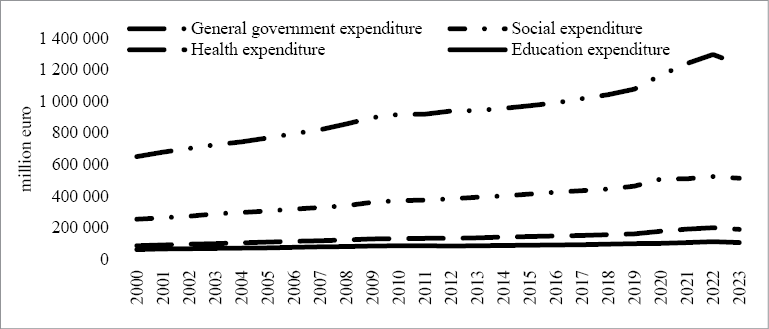
In general, there is a positive trend in government expenditures and its components (Fig. 1). However, the periods of 2019 and 2022 stand out due to the rapid growth caused by the COVID-19 pandemic (especially HGE with a 1.14-fold increase), the full-scale invasion of Ukraine and the situation in the Middle East. Social support accounts for the largest share of expenditures. The highest public expenditures across the EU are observed in Germany, France, and Italy.
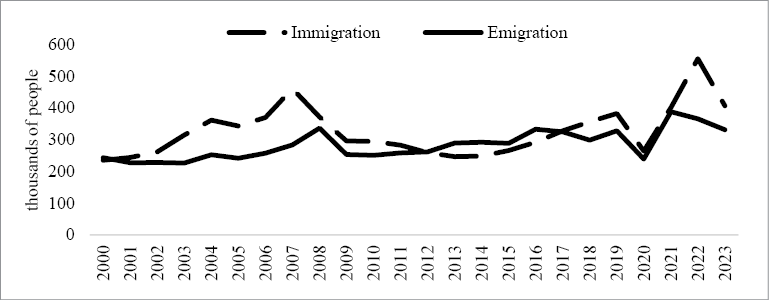
When considering the state of the migration process in the selected group of countries (Fig. 2), it is important to note the significant fluctuations in the migration balance. These processes are quite sensitive to socio-political events, including the financial crisis (2007–2009), the socio-political situation in Ukraine and the Middle East (2014–2015, 2022) and the pandemic (2020). During the analysed period, net migration ranged from 44.3 thousand to 189.3 thousand people.
On average, only 18.4% of immigrants have higher education. Meanwhile, 48.7% of migrants either have no education at all or have only completed primary school. The majority of migrants still have a low level of education, they outnumber people with higher education by 2.6 times (Eurostat, 2024). This fact is quite important when analysing the impact on government expenditures.
Source: Authors’ calculations based on Eurostat (2024).
Source: Authors’ calculations based on Eurostat (2024).
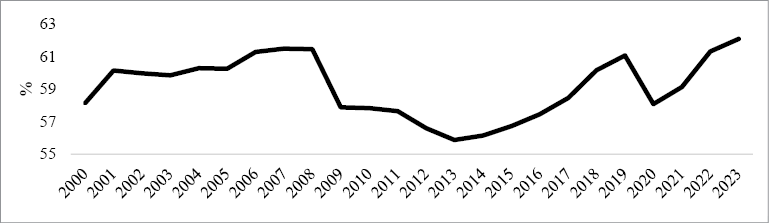
An analysis of the employed migrants’ share showed that their number varies constantly (Fig. 3). Furthermore, there is a clear sensitivity to socio-political events.
As for foreign migrants’ expenditures, according to the housing overload indicator, on average, 22% of people spend more than 40% of their disposable income on housing, including rent and expenses for housing maintenance (utilities, taxes, repairs, etc.) (Eurostat, 2024).
Let us consider the macroeconomic factors. GDP shows a positive trend with a small drop in 2009 and 2020. In 2009, there was a sharp decline of inflation to 0.2%, which was a direct result of the global financial crisis. Starting in 2020, the COVID-19 pandemic caused a temporary decline in inflation to 0.04%, but it began to rise rapidly in 2021, peaking at 7.2% in 2022 due to supply chain issues and geopolitical risks, including the war in Ukraine (Eurostat, 2024).
Source: Authors’ calculations based on Eurostat (2024).
In addition, there is a positive trend in life expectancy. However, it is worth noting that the COVID-19 pandemic has had a negative impact on this indicator, reducing the average expected age to 82 years (Eurostat, 2024).
To facilitate interpretation and cross-country comparability, in the next section, elasticity measures are reported for all estimated models. Elasticities are computed as point elasticities evaluated at sample means, following the standard practice in applied macroeconometric analysis. For linear-in-level specifications, the elasticity of government expenditures with respect to explanatory variable is calculated as:
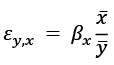
where βx is the estimated regression coefficient, and  are sample means.
For nonlinear transformations, elasticities are derived from the partial derivative of the estimated function and similarly evaluated at sample means. This approach ensures consistency across models while preserving the interpretation of elasticities as local marginal responses rather than global averages.
After constructing a series of models, it was determined that, despite the selected countries being relatively similar in terms of their level of economic development and exhibiting pronounced migration processes, they are nevertheless characterised by different sets of factors influencing government expenditures, with the nature of the impact being predominantly nonlinear.
Nonlinear specifications were explored to capture potential non-monotonic effects. Although cubic forms did not substantially improve the model’s fit, logarithmic and quadratic terms were retained, as they are commonly used in applied macroeconometrics. Sensitivity analyses using alternative specifications such as quadratic transformations and spline functions yielded qualitatively similar conclusions.
The possibility of bidirectional causality between migration and government expenditures was explicitly addressed through VAR models and Granger causality tests. The results indicated only modest effects of migration on spending patterns, with no evidence of strong reverse causality. To account for dynamic relationships, lagged migration variables were incorporated in robustness specifications. While instrumental variable approaches would be methodologically preferable, the limited sample size constrains their practical feasibility.
Comprehensive robustness checks were conducted by: examining alternative control variables (GDP, HDI), partitioning the sample into distinct sub-periods (pre- and post-2014, as well as post-2020), and verifying stability across different econometric specifications (Autoregressive Distributed Lag models, VAR). The core relationships remained statistically and economically significant across all specifications, thereby indicating that the findings are not driven by particular variable choices or sample periods.
Four regression models were built, where the dependent variables represented government expenditure indicators, while the independent variables included migration and macroeconomic factors, such as immigration, employment raised to the 3rd power, the logarithm of housing_cost, FDI, and HDI. Multiple nonlinear regression was used to evaluate the models. While some factors were transformed into nonlinear dependencies, the overall functional form of the model was reduced to linear regression and the OLS method.
The unit root test (Augmented Dickey-Fuller and Phillips-Perron) predominantly indicated non-stationarity in the levels across most series. However, Johansen cointegration procedures provided evidence of long-run equilibrium relationships in selected specifications, supporting the existence of stable associations between the variables. VAR estimates revealed that government spending exhibited strong autoregressive properties, while migration demonstrated limited predictive capacity for fiscal variables. ARDL estimations confirmed these patterns, suggesting robust long-run dynamics despite the constrained sample size.
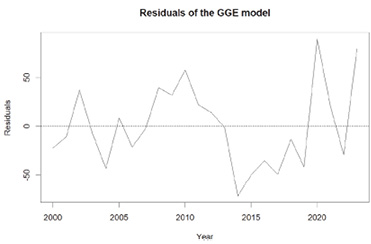
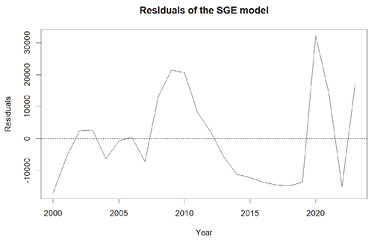
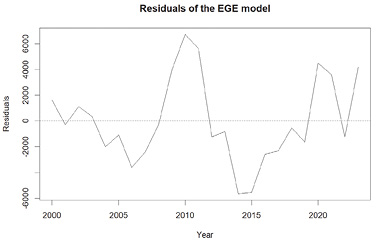
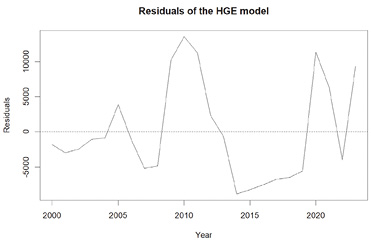
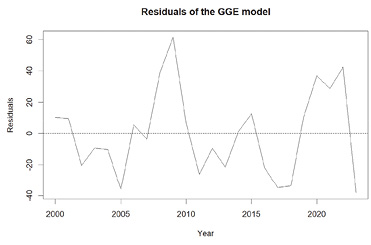
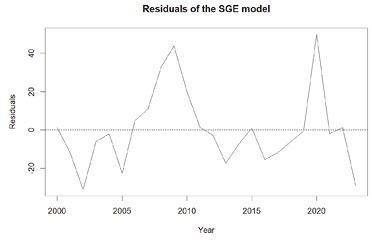
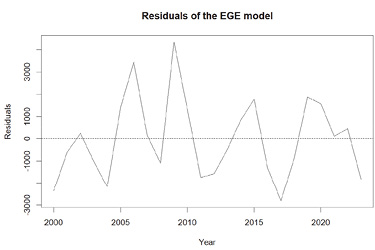
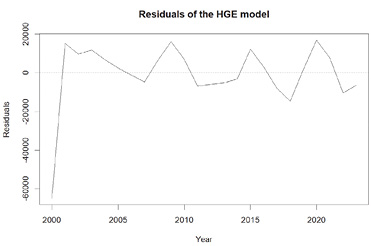
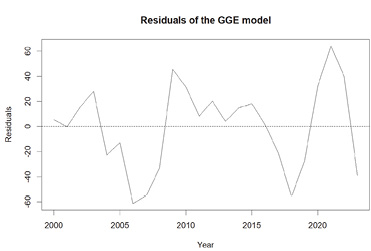
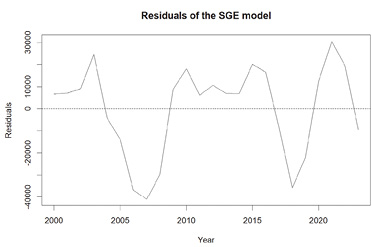
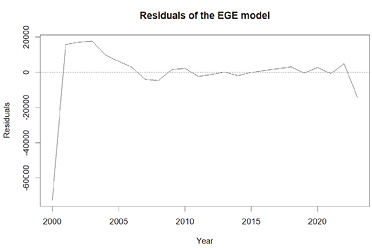
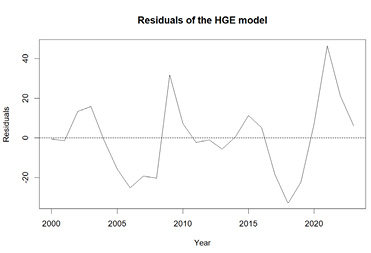
The models were tested for potential issues. The VIF criterion does not indicate multicollinearity (it is less than 5 for all variables), but heteroscedasticity tests (Goldfeld–Quandt, Glaser and White) revealed heteroscedasticity in the initial GGE model. White’s weighted least squares method was applied to address this issue. Autocorrelation problems were found in SGE, EGE, HGE models using Breusch-Godfrey and Durbin-Watson criteria. The generalised least squares method was employed to resolve this problem. Visual inspection of residual plots confirms the absence of systematic patterns or persistent trends, thereby supporting the adequacy of the chosen nonlinear specifications. Formal diagnostic test statistics are reported in the Appendix.
After applying these methods, new models were obtained.
|
GGE = –1.427e+06 + 0.1884*Immigration – 0.5269*Employment_3 * |
|||
|
std. error |
(478200) |
(0.0582) |
(0.2276) |
|
Pr(>|t|) |
(0.00) |
(0.00) |
(0.03) |
|
+ 1.421e+05*Housing_cost_log – 11680 * FDI + 1.647e+06 * HDI + e |
|||
|
std. error |
(54500) |
(4892) |
(539700) |
|
Pr(>|t|) |
(0.02) |
(0.03) |
(0.01) |
|
R2: 0.9964 |
Adjusted R2: 0.9951 |
p-value: < 2.2e-16 |
|
|
AIC: 260.07 |
BIC: 268.32 |
||
|
SGE = –8.847e+05 + 0.07218 * Immigration –0.3206 * Employment_3 + |
|||
|
std.error |
(175800) |
(0.02113) |
(0.08548) |
|
Pr(>|t|) |
(0.00) |
(0.00) |
(0.00) |
|
+1.244e+06 * HDI + e |
|||
|
std.error |
(193600) |
||
|
Pr(>|t|) |
(0.00) |
||
|
R2: 0.9964 |
Adjusted R2: 0.9957 |
p-value: < 2.2e-16 |
|
|
AIC: 534.82 |
BIC: 540.71 |
||
|
EGE = –1.477e+05 + 0.01382 * Immigration + 21620 * Housing_cost_log - |
|||
|
std.error |
(21070) |
(0.002836) |
(4955) |
|
Pr(>|t|) |
(0.00) |
(0.00) |
(0.00) |
|
– 1238 * FDI + 1.290e+05 * HDI + e |
|||
|
std.error |
(516.1) |
(34170) |
|
|
Pr(>|t|) |
(0.03) |
(0.00) |
|
|
R2: 0.9972 |
Adjusted R2: 0.9965 |
p-value: < 2.2e-16 |
|
|
AIC: 468.19 |
BIC: 475.27 |
||
|
HGE = –3.685e+05 + 0.01986 * Immigration + 35390 * Housing_cost_log + |
|||
|
std.error |
(38020) |
(0.005444) |
(9931) |
|
Pr(>|t|) |
(0.00) |
(0.00) |
(0.00) |
|
+ 3.425e+05 * HDI + e |
|||
|
std.error |
(67040) |
||
|
Pr(>|t|) |
(0.00) |
||
|
R2: 0.9947 |
Adjusted R2: 0.9936 |
p-value: < 2.2e-16 |
|
|
AIC: 501.56 |
BIC: 507.45 |
||
Source: Authors’ calculations based on the collected data.
Model parsimony is additionally assessed by using Akaike (AIC) and Bayesian (BIC) information criteria. Given the relatively small sample size, particular attention is paid to BIC, which imposes a stronger penalty for model complexity. The reported values indicate that the nonlinear specifications achieve a reasonable balance between the goodness of fit and parsimony.
According to the results presented in Table 2, we observe that, for both general and specific types of government expenditures, the same factors exhibit a consistent nature of influence. However, only the number of immigrants and the HDI affect all dependent variables, while other factors influence only specific types of expenditures (Table 3).
|
Immigration |
Employment |
Housing_cost |
FDI |
HDI |
|
|
GGE |
↑ 0.25% |
↓ 0.28% |
↑ 0.98% |
↓ 0.09% |
↑ 3.07% |
|
SGE |
↑ 0.18% |
↓ 0.34% |
↑ 7.11% |
||
|
EGE |
↑ 0.15% |
↑ 1.39% |
↓ 0.08% |
↑ 3.12% |
|
|
HGE |
↑ 0.13% |
↑ 1.38% |
↑ 5.43% |
Source: Authors’ calculations based on the collected data.
The HDI is the most significant factor affecting all categories of government expenditures, particularly SGE and HGE. Immigration levels directly influence on all expenditure types, especially GGE and SGE. The increased employed migrant share reduces government expenditures, especially social spending. Specifically, in the case of Spain, research has shown that social support programmes and employment opportunities significantly influence foreign migrants (Zatonatska et al., 2024).
The models indicate a direct impact of housing expenditures on GGE, EGE, and HGE. This suggests the need for state intervention in the housing policy. Regarding FDI, in the case of Spain, they exert a restraining effect on spending, particularly on GGE and EGE, which may indicate a positive impact of private investments on financing social sectors.
Italy’s government expenditure modelling results are characterised by different factors than those of Spain. In this case, the key macroeconomic factors were GDP per capita and life expectancy, while the migration-related factors included the employment, emigration and immigration raised to the 3rd power, as well as the share of migrants with a low level of education. The obtained regression models also exhibited nonlinearity, but, generally, the model reduces to linear regression and the OLS method.
The initial regression models revealed the presence of multicollinearity when using VIF-criterion (no problems if < 5), heteroscedasticity (models for GGE and SGE), and autocorrelation (models for EGE and HGE), which could affect the accuracy of estimates. To correct these issues, appropriate statistical methods were applied, resulting in improved models.
According to Italy’s government expenditure modelling results (Table 4), different types of expenditures are described by different factors. However, unlike in Spain, in this case, three factors are present in all Italian models: employment, Educ0_2, and GDP per capita (Table 5).
GDP per capita appears to be a key factor in increasing government expenditures, as economic development leads to an expansion of societal needs and demands. Meanwhile, life expectancy has the most significant impact on HGE, which, in turn, contributes to an increased longevity and an ageing population.
|
GGE = – 366300 – 1.67 * Employment_3 – 2.872e-11 * Emigration_3 + |
|||
|
std.error |
(248000) |
(0.274) |
(0.00) |
|
Pr(>|t|) |
0.16 |
0.00 |
0.01 |
|
+ 11660 ** Educ0_2 + 37.63 * GDP_per_capita + e |
|||
|
std.error |
(4515) |
(3.09) |
|
|
Pr(>|t|) |
0.02 |
0.00 |
|
|
R2: 0.9991 |
Adjusted R2: 0.9989 |
p-value: < 2.2e-16 |
|
|
AIC: 238.03 |
BIC: 245.1 |
||
|
SGE = 29170 – 0.8085 * Employment_3 + 2347 * Educ0_2 + |
|||
|
std.error |
(88010) |
(0.07519) |
(1428) |
|
Pr(>|t|) |
(0.74) |
(0.00) |
(0.01) |
|
+ 13.43 * GDP_per_capita + e |
|||
|
std.error |
(1.008) |
||
|
Pr(>|t|) |
(0.00) |
||
|
R2: 0.9988 |
Adjusted R2: 0.9985 |
p-value: < 2.2e-16 |
|
|
AIC: 221.25 |
BIC: 227.14 |
||
|
EGE = – 9766 – 0.05515 * Employment_3 – 1.701e-12 * Emigration_3 + |
|||
|
std.error |
(17160) |
(0.02) |
(0.00) |
|
Pr(>|t|) |
(0.58) |
(0.01) |
(0.02) |
|
+ 836.2 * Educ0_2+ 1.745 * GDP_per_capita + 5.144e-14 * Immigration_3 + e |
|||
|
std.error |
(318) |
(0.235) |
(0.00) |
|
Pr(>|t|) |
(0.02) |
(0.00) |
(0.00) |
|
R2: 0.9995 |
Adjusted R2: 0.9993 |
p-value: < 2.2e-16 |
|
|
AIC: 441.69 |
BIC: 449.93 |
||
|
HE = – 1422000 – 0.188 * Employment_3 – 1.266e-11 * Emigration_3 + |
|||
|
std.error |
(603800) |
(0.1672) |
(0.00) |
|
Pr(>|t|) |
(0.03) |
(0.28) |
(0.04) |
|
+ 4047 * Educ0_2 + 5.875 * GDP_per_capita + 15020 * Life_expect + e |
|||
|
std.error |
(2687) |
(1.665) |
(6648) |
|
Pr(>|t|) |
(0.15) |
(0.00) |
(0.04) |
|
R2: 0.9903 |
Adjusted R2: 0.987 |
p-value: < 2.2e-16 |
|
|
AIC: 547.01 |
BIC: 555.26 |
||
Source: Authors’ calculations based on the collected data.
|
Employment |
Emigration |
Educ0_2 |
GDP_per_capita |
Immigration |
Life_expect |
|
|
GGE |
↓ 0.54% |
↓ 0.07% |
↑ 0.86% |
↑ 1.31% |
||
|
SGE |
↓ 0.64% |
↑ 0.48% |
↑ 1.12% |
|||
|
EGE |
↓ 0.20% |
↓ 0.05% |
↑ 0.64% |
↑ 0.71% |
↑ 0.04% |
|
|
HGE |
↓ 0.40% |
↓ 0.10% |
↑ 0.90% |
↑ 1.08% |
↑ 4.83% |
Source: Authors’ calculations based on the collected data.
Analysing the impact of migration factors makes it noteworthy that an increase in the number of emigrants generally reduces the government expenditures. This suggests that the departure of part of the population reduces the burden on the social system. Immigration, on the other hand, does not exert a significant impact on expenditures, except in the education sector, which may be due to the weak integration of immigrants into Italy’s social programmes. A direct effect on government expenditures is observed when considering the impact of immigrants with low levels of education, particularly in the healthcare and social spheres. This effect may result from the migrants’ low financial status of and their increased demands for the quality of life.
The French government’s expenditure factors included macroeconomic variables (logarithm of GDP per capita, life expectancy, inflation, and HDI) and migration variables (emigrants and immigrants raised to the 3rd power). All models exhibited a nonlinear nature except for HGE, but, generally, the model reduces to linear regression and the OLS method.
Specifically for the French case, unit root diagnostics confirmed non-stationarity in levels across most series. Johansen tests detected at least one cointegration relationship among the government spending, migration flows, and control variables. VAR estimates highlighted significant lagged effects for both government expenditures and migration, while Granger causality tests suggested bidirectional predictive linkages. These findings indicate meaningful long-run co-movements and short-run adjustment dynamics, which reinforce the robustness of the results despite sample limitations.
The obtained models were tested for the main issues that may arise in regression models. Most tests confirmed the presence of heteroscedasticity in GGE and HGE models, while SGE and EGE models exhibited autocorrelation. After applying adjustment methods, the impact of regression issues was significantly reduced, as evidenced by the improved model quality metrics and decreased standard deviations of parameter estimates (Table 6).
According to the obtained results, we can observe that, in the case of France, both GGE and SGE with EGE are described by the same set of factors (Table 7).
Life expectancy is a key factor in the growth of expenditures, particularly SGE and HGE (as a component of the HDI), since an ageing population requires increased funding. GDP per capita also directly affects all types of expenditures (as a component of the HDI for HGE). At the same time, an increase in HGE is observed under the influence of rising inflation levels, which may indicate a dependency on the high cost of medical services.
Regarding the impact of migration factors, emigration significantly reduces the government spending, especially SGE and GGE, which may be related to a decrease in the population receiving state support. In contrast, immigration does not significantly impact expenditures, which may indicate an effective integration policy or else a limited access of immigrants to social benefits.
|
GGE = –1.210e+07 – 1.076e+05 * Emigration_log – 2.050e-12 * Immigration_3 + |
|||||
|
std.error |
(1.199e+06) |
(34100) |
(0.00) |
||
|
Pr(>|t|) |
(0.00) |
(0.01) |
(0.05) |
||
|
* Life_expect + 1.069e+06 * GDP_per_capita_log + e |
|||||
|
std.error |
(17460) |
(193400) |
|||
|
Pr(>|t|) |
(0.03) |
(0.00) |
|||
|
R2: 0.999 |
Adjusted R2: 0.9988 |
p-value: < 2.2e-16 |
|||
|
AIC: 248.09 |
BIC: 255.16 |
||||
|
SGE = –5.461e+06 – 66390 * Emigration_log + 8.879e-13 * Immigration_3 + |
|||||
|
std.error |
(573100) |
(15450) |
(0.00) |
||
|
Pr(>|t|) |
(0.00) |
(0.00) |
(0.07) |
||
|
+ 36150*Life_expect + 3.653e+05 * GDP_per_capita_log + e |
|||||
|
std.error |
(7492) |
(86850) |
|||
|
Pr(>|t|) |
(0.00) |
(0.00) |
|||
|
R2: 0.9992 |
Adjusted R2: 0.999 |
p-value: < 2.2e-16 |
|||
|
AIC: 555.57 |
BIC: 562.64 |
||||
|
EGE = – 1.601e+06 + 4368 * Emigration_log – 2.420e-13 * Immigration_3 + |
|||||
|
std.error |
(507100) |
(13680) |
(0.00) |
||
|
Pr(>|t|) |
(0.01) |
(0.75) |
(0.55) |
||
|
+ 2889 * Life_expect + 1.382e+05 * GDP_per_capita_log + e |
|||||
|
std.error |
(6671) |
(76160) |
|||
|
Pr(>|t|) |
(0.67) |
(0.09) |
|||
|
R2: 0.9866 |
Adjusted R2: 0.983 |
p-value: < 2.2e-16 |
|||
|
AIC: 546.37 |
BIC: 553.44 |
||||
|
HGE= –1.361e+06 –0.06512 *Emigration +1.743e+06 *HDI+4020 *Inflation +e |
|||||
|
std.error |
(69340) (0.03) (79740) (1535) |
||||
|
Pr(>|t|) |
(0.01) (0.07) (0.03) (0.00) |
||||
|
R2: 0.998 |
Adjusted R2: 0.9976 |
p-value: < 2.2e-16 |
|||
|
AIC: 217.42 |
BIC: 223.31 |
||||
Source: Authors’ calculations in based on the collected data.
|
Emigration |
Immigration |
Life_expect |
GDP_per_capita |
HDI |
Inflation |
|
|
GGE |
↓ 1.19% |
↑ 0.07% |
↑ 3.07% |
↑ 9.56% |
||
|
SGE |
↓ 1.70% |
↑ 0.07% |
↑ 6.13% |
↑ 7.72% |
||
|
EGE |
↓ 0.50% |
↑ 0.06% |
↑ 2.64% |
↑ 5.99% |
||
|
HGE |
↓ 0.09% |
↑ 9.38% |
↑ 0.04% |
Source: Authors’ calculations in based on the collected data.
Thus, based on the obtained results, it can be concluded that GGE and its components are characterised by a similar nature of factor influence. However, the influencing factors themselves may differ.
Now, we proceed to the practical application of the obtained results and forecast government expenditures for the years 2024–2026. To obtain factor data for future periods, the moving average method with a step of 3 was applied. The use of moving averages was a deliberate compromise: the aim was not to produce highly precise long-term forecasts but rather to identify the fundamental patterns through which migration and macroeconomic factors affect government expenditures, while ensuring clarity and reproducibility. Out-of-sample forecasts for 2024–2026 were generated and benchmarked against alternative methodological approaches, such as naïve projections, ARIMA models, and VAR specifications. Forecast accuracy was evaluated by using RMSE and MAE metrics. The results confirmed that the proposed moving-average framework performed comparably to more sophisticated econometric methods, thus supporting its validity for policy analysis and forecasting applications. In future research, more sophisticated tools such as ARIMA/VAR models, structural models with shock dummies, or machine learning approaches could be integrated in order to better capture non-linearities and structural breaks. This would improve the ability to reflect sudden changes and enhance policy relevance.
According to the forecasting results, expenditures in Spain and France are expected to increase during the 2023–2024 period, followed by a gradual decline throughout 2025. Meanwhile, a decrease in expenditures on the SGE, EGE, and HGE sectors is expected between 2024 and 2026. Regarding Italy, both GGE and the analysed components are expected to increase. The results provide empirical evidence for optimising migration integration strategies and budget planning in the EU countries. Forecast accuracy is assessed by using the Root Mean Squared Percentage Error (RMSPE), computed over a rolling out-of-sample window.
|
Country |
Year |
GGE |
SGE |
EGE |
HGE |
|
Spain |
2024 |
606 342 |
248 557 |
55 512 |
87 387 |
|
2025 |
587 600 |
241 569 |
53 917 |
84 781 |
|
|
2026 |
599 350 |
245 943 |
54 954 |
86 461 |
|
|
Errors |
6.6% |
7.3% |
5.7% |
7.5% |
|
|
Italy |
2024 |
1 048 527 |
431 383 |
76 995 |
141 437 |
|
2025 |
1 048 636 |
433 022 |
76 531 |
138 917 |
|
|
2026 |
1 044 500 |
430 893 |
76 578 |
139 977 |
|
|
Errors |
4.2% |
4.6% |
3.4% |
8.0% |
|
|
France |
2024 |
1 259 474 |
622 603 |
139 895 |
224 308 |
|
2025 |
1 290 384 |
625 565 |
142 026 |
224 449 |
|
|
2026 |
1 269 187 |
621 230 |
140 149 |
222 451 |
|
|
Errors |
16.3% |
4.3% |
7.5% |
5.4% |
Source: Authors’ calculations based on the collected data.
Evidently, the observed trends highlight both stability and fluctuations in budget allocations, reflecting the impact of economic and migration factors on the public finance dynamics.
The conducted study revealed that migration processes significantly impact government expenditures in the EU countries, particularly in Spain, Italy, and France, with active migration flows. The modelling results indicate that the influence of migration and macroeconomic factors is predominantly nonlinear, and it varies based on each country’s specific circumstances.
Macroeconomic factors play a key role in determining government expenditures. GDP per capita is the most stable factor driving expenditure growth in all three countries, thereby confirming the dependence of budgetary policy on economic development. Life expectancy significantly influences HGE in France and Italy, while the inflation rate proves significant in shaping healthcare costs in France. The Human Development Index demonstrates substantial explanatory power in Spain’s models, particularly for social expenditure (elasticity of 7.11%) reflecting the country’s emphasis on social welfare systems.
The most influential migration factor is the share of employed migrants, which is inversely related to SGE in all countries, thereby suggesting that labour market integration helps reduce the burden on social programmes. The proportion of migrants with low educational attainment significantly drives an increased government spending, especially in Italy, where it increases all expenditure categories. Additionally, migrants who spend more than 40% of their income on housing increase the overall government expenditures in Spain (elasticity of 0.98%), highlighting the link between housing conditions and the state’s financial obligations.
These results align with prior research showing that migration and macroeconomic factors exert heterogeneous and often nonlinear effects on government expenditures. For instance, the finding that higher migrant employment reduces SGE confirms the fiscal benefits of integration, as highlighted by Chassamboulli & Liu (2024). The impact of low-educated migrants on increased HGE and SGE echoes the conclusions of Bettin and Sacchi (2020) regarding Italy and D’Andreamatteo et al. (2024) regarding healthcare pressures. Similarly, the consistent role of GDP per capita supports Filipova et al. (2025), while the relationship between the housing cost overburden and expenditures aligns with Su et al. (2025). The cross-country differences observed in the role of life expectancy, particularly in Italy and France, mirror the findings of Uchida & Ono (2024), who argue that demographic ageing reshapes fiscal structures. Situating our findings within these studies strengthens the robustness of the results and shows their broader relevance in the literature.
Furthermore, our results highlight divergent migration-expenditure dynamics across the three countries. In Spain, immigration consistently increases all expenditure categories (with elasticities ranging from 0.13% to 0.25%), whereas, in Italy, immigration shows a minimal direct impact, except in education (0.04% elasticity), while emigration reduces spending. In France, emigration significantly decreases expenditures (1.19% to 1.70% elasticity for GGE and SGE), while the effects of immigration remain modest.
The aforementioned aspects are key levers influencing migration processes and government expenditures. The issue of migrant integration into society will ultimately shape the structure of public spending, and thus it requires significant government attention.
This study may be of interest to EU governments when shaping migration and fiscal policies. The study showed the interdependence of different types of migrants and government spending, which is quite relevant when shaping political decisions regarding migration flows in certain countries. Governments should establish mandatory vocational training programmes for low-skilled migrants with direct pathways to employment authorisation. Our models show that an increase of migrant employment rates by 10% could reduce social expenditures by 3.4% in Spain and 6.4% in Italy. It is necessary to create tax incentives for employers who hire migrants, as higher employment rates consistently reduce fiscal pressure across all three countries. Also, it is needed to implement affordable housing quotas in public construction projects, particularly in Spain, where the housing cost burden shows elasticities exceeding 1% for education and healthcare expenditures. Healthcare systems require inflation-adjusted budgeting mechanisms, especially in France where inflation elasticity for HGE reaches 0.04% to prevent real-term service deterioration. Finally, it is required to establish dedicated migration impact funds to manage budget volatility, particularly for countries like Italy, where low-educated migrants significantly increase all expenditures.
Forecasts for 2024–2026 suggest potential increases in GGE in the analysed countries. Spain and France expect declining growth rates of SGE in 2025, followed by stabilisation in 2026. In contrast, Italy anticipates increases in all expenditure components driven by growing shares of low-educated migrants and economic dynamics. The forecast errors range from 3.4% to 16.3%, with France showing the highest uncertainty in GGE projections, likely reflecting greater sensitivity to macroeconomic volatility. The results provide empirical evidence for optimising migration integration strategies and budget planning in the EU countries, which is the main direction of practical application of the study.
However, traditional trend-based forecasting models cannot adequately capture potential exponential increases in refugees or sudden changes from conflicts and policy shifts. The moving average methodology, while useful for identifying fundamental patterns, may underestimate structural breaks. Second, the relatively small sample size (2000–2023) constrains the application of more sophisticated instrumental variable approaches that could better address potential endogeneity concerns. Third, our analysis focuses on three countries, which limits the generalisability of findings to other EU member states with different migration profiles and fiscal structures.
Therefore, future research should focus on developing sophisticated forecasting frameworks that would incorporate structural breaks, scenario analysis, and exogenous shock variables to enhance the policy relevance and predictive accuracy.
Tetiana Zatonatska: conceptualization, methodology, investigation, project administration, supervision, writing – original draft, writing – review & editing, validation, visualization.
Yulia Forostiana: conceptualization, data curation, methodology, formal analysis, software, investigation, writing – original draft, writing – review & editing, visualization.
Yana Fareniuk: conceptualization, data curation, methodology, formal analysis, software, investigation, project administration, supervision, writing – original draft, writing – review & editing, visualization.
Dmytro Zatonatskiy: conceptualization, data curation, methodology, formal analysis, investigation, supervision, writing – original draft, writing – review & editing, validation.
Afonso, A., Negash, S. & Wolff, E. (2022). Migration and Welfare States. https://doi.org/10.31219/osf.io/my64b
Artyukhov A., Hrytsenko L., Dekhtyar N., et al. (2024). Relationship between the Human Development Index and public social spending: European experience for Ukraine. Problems and Perspectives in Management, 22(4), 25-38. doi:10.21511/ppm.22(4).2024.03
Bettin, G., & Sacchi, A. (2020). Health spending in Italy: The impact of immigrants. European Journal of Political Economy, 65, 101932. https://doi.org/10.1016/j.ejpoleco.2020.101932
Boffi, G., Suari-Andreuiii, E., & van Vliet, O. (2024). The Net Fiscal Positition of Migrants in Europe: Trends and Insights. TransEuroWorkS. https://transeuroworks.eu/wp-content/uploads/2024/05/The-net-fiscal-position-of-migrants-in-Europe_WP.pdf
Caselli, F., Lin, H. H., Toscani, F. G., & Yao, J. (2024). Migration into the EU: Stocktaking of Recent Developments and Macroeconomic Implications. IMF Working Papers, 2024(211). Retrieved Aug 3, 2025, from https://doi.org/10.5089/9798400289552.001
Cerqua, A., Pellegrini, G., & Tarola, O. (2022). Can regional policies shape migration flows? Papers in Regional Science, 101(3), 515-537. https://doi.org/10.1111/pirs.12670
Chassamboulli, A., & Liu, X. (2024). Immigration, legal status and fiscal impact. Review of Economic Dynamics, 54, 101238. https://doi.org/10.1016/j.red.2024.101238
D’Andreamatteo, A., Neri, F., Antonucci, G., & Sargiacomo, M. (2024). Immigration, policies of integration and healthcare expenditure: A longitudinal analysis of the INHS (2002‒2018). Health Policy, 142, 104960. https://doi.org/10.1016/j.healthpol.2023.104960
Gordon, G., & Guerron-Quintana, P. (2024). On regional borrowing, default, and migration. Journal of International Economics, 150, 103916. https://doi.org/10.1016/j.jinteco.2024.103916
Holler, J. & Reiss, L. (2023). Quantifying the impact of the 2021-2022 inflation shock on Austria’s public finances. Monetary Policy & the Economy, Q4/22-Q1/23, 117-130. Oesterreichische Nationalbank. https://www.oenb.at
Fasina H., Adekunle O., & Oyeleye K. (2024). Effect of tax revenue on expenditure allocation of government sectors in southwest state, Nigeria. International Journal of Financial Research and Business Development, 6(7). https://doi.org/10.70382/mejfrbd.v6i7.001
Filipova, M. & Djakona, A. & Haram, V. (2025). Determinants of Government Expenditures in the Baltic States. Financial Markets, Institutions and Risks. 9. 66-89. 10.61093/fmir.9(2).66-89.2025
Fiorio, C.V., Frattini, T., Riganti, A. et al. Migration and public finances in the EU. Int Tax Public Finance 31, 635–684 (2024). https://doi.org/10.1007/s10797-023-09787-9
Lim, S., Morshed, A. M., & Turnovsky, S. J. (2023). Endogenous labour migration and remittances: Macroeconomic and welfare consequences. Journal of Development Economics, 163, 103110. https://doi.org/10.1016/j.jdeveco.2023.103110
OECD (2024), International Migration Outlook 2024, OECD Publishing, Paris, https://doi.org/10.1787/50b0353e-en
Raveni, A. & Ismaili, D. & Ollogu, E. (2024). The effects of emigration on the sustainability of the Pension system in North Macedonia. 8. 19-28
Samuels, D., & Vargas, T. R. (2023). Democracy, rural inequality, and education spending. World Development, 162, 106136. https://doi.org/10.1016/j.worlddev.2022.106136
Su, C.-W., Sun, M., & Qin, M. (2025). Does Government Expenditure Help Stabilize the Real Estate Market? Buildings, 15(5), 696. https://doi.org/10.3390/buildings15050696
Temsumrit, N. (2023). Can ageing population affect economic growth through the channel of government spending? Heliyon, 9(9), e19521. https://doi.org/10.1016/j.heliyon.2023.e19521
Uchida, Y., & Ono, T. (2024). Life expectancy and politics of public education and pension with endogenous fertility
Uctu, R., Koç, Şerife ., & Mercan, B. (2025). Unveiling the Impact Skilled Migration has on the Creative Class: Panel Data Analysis for EU Countries. Ekonomika, 103(4), 22-38. https://doi.org/10.15388/Ekon.2024.103.4.2
Viren, M. (2022). The fiscal consequences of immigration: a study of local governments’ expenditures. Rev Reg Res 42, 75–94. https://doi.org/10.1007/s10037-022-00168-z
Zatonatska, T., Liashenko, O., Fareniuk, Y., Skowron, Ł., Wołowiec, T., & Dluhopolskyi, O. (2022). The Impact of Migration on Forecasting Budget Expenditures on Education: The Sustainability Context. Sustainability, 15(21), 15473. https://doi.org/10.3390/su152115473
Zatonatska T., Forostiana Yu., Giedraitis VR., Fareniuk Ya. and Zatonatskiy D. (2024). Impact Factors for Immigration to Spain 7(1) Access to Justice in Eastern Europe, 264-84. https://doi.org/10.33327/AJEE-18-7.1-a000119
|
ADF_Stat |
ADF_p |
PP_Stat |
PP_p |
|
|
GGE_sp |
-2.7163 |
0.2995 |
-5.6345 |
0.7677 |
|
SGE |
-2.9285 |
0.2187 |
-7.7774 |
0.6241 |
|
EGE |
-2.3941 |
0.4222 |
-5.9612 |
0.7458 |
|
HGE |
-3.4498 |
0.0709 |
-5.8863 |
0.7508 |
|
Immigration_sp |
-1.1202 |
0.9029 |
-7.3209 |
0.6547 |
|
Employment_sp_3 |
-1.5829 |
0.7313 |
-6.6906 |
0.6969 |
|
Housing_cost_sp_log |
-1.5927 |
0.7275 |
-7.8792 |
0.6173 |
|
FDI_sp |
-3.1746 |
0.1249 |
-15.8679 |
0.0942 |
|
HDI_sp |
0.0866 |
0.9900 |
-6.1772 |
0.7313 |
Source: Authors’ calculations based on the collected data.
|
ADF_Stat |
ADF_p |
PP_Stat |
PP_p |
|
|
GGE_it |
-3.0879 |
0.1579 |
-8.3941 |
0.5828 |
|
SGE_it |
-3.0951 |
0.1552 |
-11.3697 |
0.3834 |
|
EGE_it |
-2.1952 |
0.4980 |
-7.4805 |
0.6440 |
|
HGE_it |
-2.4408 |
0.4045 |
-5.6836 |
0.7644 |
|
Emigration_it |
-1.2955 |
0.8408 |
-7.7454 |
0.6263 |
|
Employment_it |
-1.5338 |
0.7500 |
-7.0455 |
0.6732 |
|
Educ0_2_it |
-2.2046 |
0.4945 |
-6.8706 |
0.6849 |
|
GDP_per_capita_it |
-1.0732 |
0.9098 |
-6.3286 |
0.7212 |
|
Immigration_it |
-3.0618 |
0.1679 |
-9.7404 |
0.4926 |
|
Life_expectation_it |
0.1078 |
0.9900 |
-5.6925 |
0.7638 |
Source: Authors’ calculations based on the collected data.
|
ADF_Stat |
ADF_p |
PP_Stat |
PP_p |
|
|
GGE_fr |
-2.5043 |
0.3803 |
-10.0998 |
0.4685 |
|
SGE_fr |
-1.3646 |
0.8144 |
-6.1409 |
0.7338 |
|
EGE_fr |
-1.8361 |
0.6348 |
-11.9747 |
0.3429 |
|
HGE_fr |
-1.9737 |
0.5824 |
-10.5142 |
0.4408 |
|
Emigration_fr |
-1.1238 |
0.9024 |
-12.7365 |
0.2919 |
|
Inflation_fr |
-0.7669 |
0.9528 |
-8.2881 |
0.5899 |
|
HDI_fr |
-0.8231 |
0.9466 |
-6.0295 |
0.7412 |
|
GDP_per_capita_fr |
-1.7454 |
0.6694 |
-9.6730 |
0.4971 |
|
Immigration_fr |
-1.4577 |
0.7790 |
-18.9990 |
0.0363 |
|
Life_expectation_fr |
0.0103 |
0.9900 |
-0.8713 |
0.9840 |
Source: Authors’ calculations based on the collected data.
|
Spain |
Italy |
France |
|
|
GGE |
0.1635 |
0.0616 |
0.0135 |
|
SGE |
0.0427 |
0.0408 |
0.0015 |
|
EGE |
0.0084 |
0.3502 |
0.7681 |
|
HGE |
0.0124 |
0.8616 |
0.0052 |
Source: Authors’ calculations based on the collected data.