Ekonomika ISSN 1392-1258 eISSN 2424-6166
2026, vol. 105(4), pp. 6–23 DOI: https://doi.org/10.15388/Ekon.2026.105.4.1
Ceyda Bayraktar Dastan
Assist. Prof.
Gümüşhane University,
Faculty of Economic and Administrative Sciences, Department of Public Finance
ceyda.bdastan@gumushane.edu.tr
https://orcid.org/0000-0001-7975-2333
Ugur Bellikli*
Assoc. Prof.
Giresun University,
Alucra Turan Bulutcu Vocational High School, Department of Management and Organization
ugur.bellikli@giresun.edu.tr
https://orcid.org/0000-0002-4571-6200
Abstract. Understanding how monetary conditions and credit dynamics shape business lending is essential for evaluating firm financing and macroeconomic performance in bank-based economies such as Türkiye. This study investigates the effects of money supply (M2), credit expansion, and selected macroeconomic and financial variables on business loans in Türkiye by using quarterly data for the period of 2006Q1–2025Q3. On the grounds of using an ARDL cointegration framework, the analysis finds evidence of a long-run equilibrium relationship among the variables. The results show that credit expansion has the strongest and most statistically robust association with business loans in both the long run and the short run, whereas the effect of money supply appears to be more indirect; it also appears to operate through broader credit conditions. The findings also indicate that business lending is influenced not only by monetary conditions, but by the wider macroeconomic environment as well, including real economic activity, exchange rate conditions, and borrowing costs. Overall, the study provides updated evidence on the dynamics of business lending in Türkiye and highlights the importance of the credit channel in shaping firm financing conditions. From a policy perspective, the results suggest that sustaining productive business lending requires a coordinated policy framework that considers monetary, credit, and macroprudential conditions together.
Keywords: business loans; money supply; credit expansion; ARDL Model; Türkiye.
_________
* Correspondent author.
Received: 17/02/2026. Accepted: 09/10/2026
Copyright © 2026 Ceyda Bayraktar Dastan, Ugur Bellikli. Published by Vilnius University Press
This is an Open Access article distributed under the terms of the Creative Commons Attribution License, which permits unrestricted use, distribution, and reproduction in any medium, provided the original author and source are credited.
The level of financial development can be regarded as one of the fundamental factors that directly shape a society’s economic growth and social welfare. The effective functioning of the financial system accelerates capital accumulation, which is one of the key determinants of economic growth, and supports economic development by facilitating bank-mediated credit to businesses (Demirhan, 2025, p. 50; Kurt, 2024, p. III).
The allocation of funds collected from savers to businesses in need by banks plays a critical role in transforming savings into investment. In this context, the loans extended to businesses constitute a fundamental source of financing for undertaking new investments, managing inventories, increasing production capacity, procuring raw materials, and meeting current operating expenses. The impact of business loans, which play a significant role in meeting firms’ financing needs, is not limited to the funding provided to an individual enterprise but is also valid at the macroeconomic level. This is because an increase in business loans can generate positive effects on production, investment, and employment, thereby supporting economic growth (Karahan, Yılgör, & Özekin, 2018; García-Posada Gómez, 2018; Acar Ünlü & Dursun Güvenbaş, 2020).
The loans provided by banks within the financial system can be classified from various perspectives. For example, in terms of their intended use and the characteristics of the borrower, they may be categorized into four main groups: corporate loans, commercial loans, small and medium-sized enterprise (SME) loans, and personal loans (Kurt, 2025, p. 138; Şenel, 2020, p. 812). Among these loans, corporate, commercial, and SME loans are utilized to meet firms’ needs for production, investment, inventory management, and working capital, and they vary according to the scale, sector of activity, and financial capacity of the enterprises. In contrast, personal loans are used by individuals or households to finance their consumption expenditures and are classified into subcategories such as housing loans, vehicle loans, consumer loans, and credit card debt.
According to the data released by the Banking Regulation and Supervision Agency of Türkiye (BRSA) for the period of Dec 2025, total loans are reported as TRY 23.13 trillion, while business loans (classified directly under this name) amount to TRY 3.52 trillion (BRSA, https://www.bddk.org.tr/BultenAylik/). It may be noted that, in this reporting framework, the definition of business loans is considered in a narrow sense, referring specifically to loans provided directly for business-related activities.
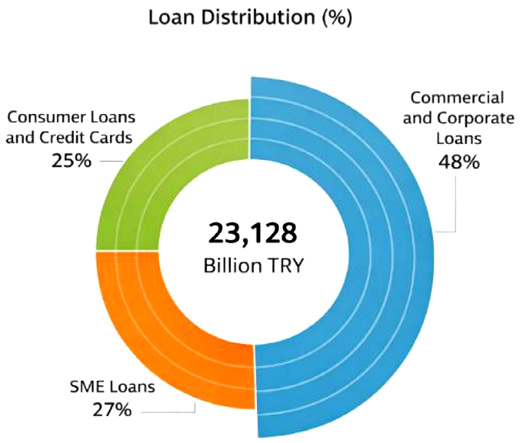
In a broader context, considering the above classification (corporate, commercial, SME, and personal loans), the distribution of loan types based on the data for the Dec 2025 period is presented in Figure 1. The figure is included only to provide a current descriptive snapshot of the composition of bank lending in Türkiye and to offer contextual background on the structure of the banking sector.
As can be seen in Figure 1, as of the Dec 2025 period, 48% of the loans extended by banks consist of commercial and corporate loans, 27% of SME loans, and the remaining 25% of consumer loans, including the debt accumulated by credit card use. In this regard, it can be stated that 75% of the loans extended by banks consist of credit categories that directly concern businesses and their various operational activities. Overall, this distribution highlights the central role of business-related credit in the structure of the Turkish banking system.
Source: BRSA, 2025, p. 14.
Beyond their microeconomic role, loans also constitute one of the key monetary components on the central bank’s balance sheet, thereby playing a critical role in the formulation of monetary policy and in the analysis of economic activity (Bakır Yiğitbaş, 2015, p. 287). Through this policy instrument, the direction of macroeconomic indicators such as production, national income, and employment is determined indirectly (Mateju, 2019, p. 59). The impact on these macroeconomic indicators occurs through the monetary transmission mechanism, which ensures the transfer of central bank decisions from financial markets to the real economy. Monetary transmission is the mechanism that influences aggregate demand through various channels such as the interest rate, exchange rate, asset prices, expectations, and, particularly, the credit channel (Rossi, Delmondes de Carvalho, & Carvalho Cunha, 2019; Berber & Bayraktar Daştan, 2020).
Among the channels of the monetary transmission mechanism, the credit channel functions as a complementary transmission path operating through the balance sheets of financial intermediaries and borrowing firms, and it is examined under two components: the ‘bank lending channel’ and the ‘balance sheet channel’ (Özyurt, 2015, p. 345). The bank lending channel operates through the expansion of credit supply as bank reserves increase following the central bank’s implementation of expansionary monetary policies. This increase in reserves enhances the lending capacity of banks, thereby stimulating investment and consumption expenditures; in turn, this facilitates the transmission of the monetary expansion process to the real sector (Kasapoğlu, 2007, p. 27). In this context, firms – particularly SMEs – that exhibit a high dependence on credit can directly benefit from monetary policy easing, and thereby contribute to economic growth (Paya, 2013, p. 127).
On the other hand, the balance sheet channel, classified as the broader credit channel, is a form of transmission that operates through firms’ net worth and collateral positions. As a result of expansionary monetary policy, the decline in interest rates and the increase in the value of financial assets strengthen firms’ balance sheets and improve their access to credit (ECB, 2008, p. 87). This development reduces adverse selection and moral hazard risks, thereby increasing credit supply and investment demand. Consequently, the operation of the credit channel through both bank lending and balance sheet mechanisms assumes a central role in the transmission of monetary expansion to the real economy. From a different perspective, Xiao (2025, p. 1) emphasizes that credit markets constitute an important driving force of economic growth by facilitating consumption, investment, and public borrowing, and notes that credits play a critical role in the efficient allocation of resources within the economy. However, the study specifically highlights that historical evidence shows periods of excessive credit expansion typically occurring immediately before financial crises.
The aim of this study, which is grounded in the principles outlined above, is to analyze the dynamic relationship between business loans and key macroeconomic variables in Türkiye using quarterly data for the period of 2006Q1–2025Q3. In the study, business loans constitute the dependent variable, while money supply, credit expansion, and the real GDP are included as the main explanatory variables, and the real interest rate as well as the CPI-based real effective exchange rate are incorporated as control variables. The analysis of the data pertaining to the variables was conducted by using time-series econometric methods within the framework of the research model and implemented in the EViews 10 econometric software. Accordingly, following the introduction, the study is structured under the subsequent sections of literature review and research, which encompass the aim, scope, data set, methodology, findings, and the evaluation of findings.
Understanding how money supply, credit expansion, and macroeconomic conditions influence business lending is essential for evaluating both the growth dynamics of the Turkish economy and the effectiveness of monetary policy transmission. In Türkiye, where bank-based financial intermediation dominates the allocation of resources, the interaction between monetary aggregates, credit supply, and firms’ access to financing plays a crucial role in shaping investment behavior, production capacity, and employment outcomes. By focusing specifically on business loans as the primary channel linking financial conditions to real-sector activity, this study aims to provide empirical evidence on how macroeconomic forces translate into firm-level financing conditions. In doing so, the study contributes to the literature by offering a comprehensive time-series analysis that jointly considers monetary expansion, credit dynamics, and real economic performance within a single empirical framework, thereby providing policy-relevant insights for both monetary authorities and financial regulators.
The relationship between credit markets and macroeconomic dynamics has long been a central topic in the empirical finance and macroeconomic literature. A large body of research has examined how monetary policy, credit expansion, and financial conditions influence economic growth, investment, and financial stability. However, most existing studies focus either on aggregate credit or on broader financial indicators, while the specific role of business loans as a transmission variable between macroeconomic conditions and firm-level financing remains relatively underexplored, particularly in emerging market economies.
In the specific case of Türkiye, where the banking sector constitutes the dominant channel of financial intermediation, understanding how monetary expansion and credit supply translate into business lending is crucial for evaluating both economic growth dynamics and policy effectiveness. Motivated by this gap, the present study focuses on the interaction between money supply, credit expansion, and business loans, while controlling for key macroeconomic indicators, thereby contributing to the literature by providing a comprehensive and dynamic empirical assessment within a single analytical framework.
Within the framework of money supply and credit expansion, the discussion is shaped between the classical and monetarist approaches – which argue that money supply is exogenous and under the control of central banks – and the Post-Keynesian perspective, which maintains that money supply is endogenous and expands in response to credit demand (Mazibaş & Tuna, 2017; Çepni & Güney, 2017; Tiryaki & Hasanov, 2022; Buthelezi, 2024; Tabet, Tabet, & Chakchouk, 2025). These differing approaches constitute the fundamental theoretical framework regarding the nature of the monetary transmission process and can guide empirical analyses.
Studies examining the impact of the financial system on the real economy also reveal a particular emphasis on the effectiveness of the monetary transmission mechanism based on the credit channel. In this context, Demirhan (2025) analyzes the impact of financial development on economic growth in Türkiye by using data for the period of 1974–2023 and finds that financial development supports long-run growth. The results further indicate that credit expansion through the banking system constitutes a key transmission channel in the growth process, while increases in the money supply stimulate the credit volume and, consequently, real production. Similarly, Eton et al. (2021) examine the effects of financial inclusion and access to credit on SME growth, reporting that financial inclusion has a positive but limited effect, whereas high borrowing costs constrain business expansion. Overall, these findings suggest that both credit availability and its cost play a crucial role in shaping investment and employment dynamics. For emerging markets, it is argued that, although credit expansion stimulates economic activity in the short run, it may increase financial vulnerabilities in the long run. Indeed, Checo, Grigoli, and Sandri (2024) examine the effects of monetary policy shocks on investment and the real economy, showing that while easing credit conditions supports growth, it may also increase financial stability risks for highly leveraged firms. Similarly, Suárez Mayorga, Melgarejo, and Oliveros (2024) find that financial inclusion and access to credit promote growth at the micro-enterprise level by stimulating investment and employment, although high interest rates tend to limit this effect. Overall, these findings suggest that while credit expansion can foster economic growth, it should be implemented in a manner that is consistent with financial stability considerations.
Sıklar and Akça (2020) examine the interaction among domestic credit expansion, interest rate differentials, and money supply by using the exchange market pressure index, finding that credit expansion increases exchange market pressure, to which the central bank responds by adjusting interest rates. Similarly, Omodero (2024) analyzes the effects of monetary policy variables – particularly, central bank and commercial bank credits – on tax revenues and private sector performance, concluding that financial constraints weaken the linkage between economic growth and fiscal revenues through the channels of business loans and money supply. Overall, these findings highlight the broader macro-financial implications of credit dynamics, extending beyond growth to include exchange rate pressures and fiscal outcomes.
Similar findings have also been obtained in studies conducted specifically for Türkiye. For example, Yetiz and Ergin Ünal (2021) examine the relationship between the money supply, bank loans, and economic growth on the basis of using monthly data for the period of 2005–2020, finding that increases in bank loans positively affect economic growth in both the short and long run, while the impact of the money supply remains limited. Similarly, Kamacı, Ceyhan, and Peçe (2017) and Çeştepe and Yıldırım (2016) identify a long-run cointegration relationship and bidirectional causality among the money supply, credit expansion, and real GDP. In a related study, Karamelikli and Kesgingöz (2017) find no clear direct relationship between financial development and growth in Türkiye, but report bidirectional causality between the credit volume and economic growth. Focusing on cyclical dynamics, Bakır Yiğitbaş (2014) identifies a long-run equilibrium relationship between real bank loans and key macroeconomic variables, including the real GDP, CPI based real effective exchange rate, and credit risk, while also showing that loans exhibit procyclical behavior and are affected by the money supply and crisis periods in the short run. More recently, Kurt (2025) finds a unidirectional causality running from bank loans to economic growth in Türkiye, alongside bidirectional causality between commercial loans and GDP. Overall, the literature consistently indicates that credit expansion is a key driver of real economic activity and investment decisions, while highlighting the importance of directing loans toward productive sectors to ensure sustainable economic growth.
In addition to these general findings, the literature also includes studies that focus on the sectoral and scale-based effects of credit expansion. With respect to studies focusing on the sectoral dimension of the relationship between credit expansion and growth – particularly those highlighting the role of SME loans – the study conducted by Eryılmaz, Öksüz, and Zeren (2021) examines the effects of SME loans on GDP and employment in Türkiye, and reports that medium- and large-scale business loans significantly support economic growth. In contrast, Demirci (2016) shows, based on a scale-based analysis, that micro and small enterprise loans have a positive short-run relationship with economic growth, whereas no significant relationship is identified for medium-sized enterprises. These findings suggest that the impact of the credit channel on real-sector dynamics varies depending on the firm size.
Vurur and Yıldız (2023) examine the determinants of business loans in Türkiye and find that the exchange rate, commercial loan interest rate, and producer price index have statistically significant effects on business lending. Their results highlight the sensitivity of business loans to changes in exchange rates and price levels, indicating a close link between credit markets and real economic conditions. Similarly, Bakır Yiğitbaş (2015) shows that loan interest rates and economic activity significantly influence the volume of private-sector business loans in Türkiye, whereas the real sector confidence index does not have a statistically significant effect. Overall, these findings suggest that business lending is strongly driven by macroeconomic conditions, and particularly by interest rates and production dynamics.
Overall, the literature reviewed above demonstrates that the credit channel constitutes a central mechanism through which the monetary policy and financial conditions influence real economic activity. Existing studies largely confirm that credit expansion supports growth, investment, and employment; yet, it may also generate financial vulnerabilities when excessive. However, most empirical research focuses on aggregate credit indicators or examines the effects of monetary variables on growth without explicitly distinguishing the role of business loans as a distinct transmission variable. In the case of Türkiye, although a number of studies analyze the relationships among money supply, credit volume, and economic growth, comprehensive empirical analyses that jointly examine the dynamic interaction between the money supply, credit expansion, and business loans remain limited.
By directly focusing on business loans as the key intermediary between macroeconomic conditions and real-sector financing, the present study seeks to fill this gap. In doing so, it provides a dynamic time-series assessment of how monetary expansion and credit supply are transmitted to firms through the banking system, thereby offering policy-relevant insights into the functioning of the credit channel and its implications for growth and financial stability in the Turkish economy.
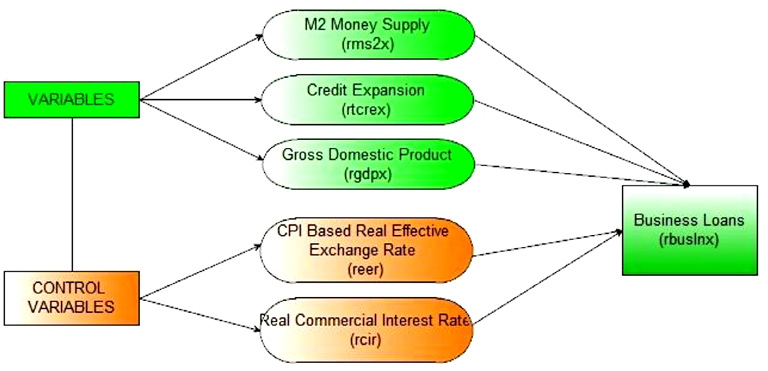
Since this study analyzes the effects of macroeconomic variables and various financial indicators (M2 money supply, credit expansion, the real effective exchange rate, and the real commercial interest rate) on business loans in Türkiye by using quarterly data for the period of 2006Q1–2025Q3, a time series analysis approach was adopted. In the study, business loans were designated as the dependent variable, while M2 money supply, credit expansion, and the gross domestic product were specified as independent variables; the real effective exchange rate and the real commercial interest rate were included as control variables. Accordingly, a total of 79 quarterly observations were obtained for the study period. The sample period represents the longest span for which all variables are jointly available in a continuous, comparable, and quarterly format for Türkiye. Beginning in 2006, the reporting and classification of these variables became more standardized, thereby ensuring the consistency and definitional integrity of the data series throughout the analysis period.
The conceptual framework of the study, including the relationships between the dependent variable, explanatory variables, and control variables, is illustrated in Figure 2. The figure provides a schematic representation of the econometric structure and summarizes the expected interactions among the variables considered in the analysis.
In the study, nominal variables were deflated by using the Consumer Price Index (CPI) published by the Turkish Statistical Institute, and thus series (excluding control variables) were converted into real terms. All series were deflated by using the CPI in order to eliminate the effects of inflation, ensure that the variables reflect the real purchasing power, and allow the relationships among them to be analyzed independently of changes in the general price level.
For clarity and consistency, standardized abbreviations were assigned to each variable used in the analysis. The variables, their abbreviations, and data sources are presented in Table 1. Research variables were obtained from the Banking Regulation and Supervision Agency (BRSA) and the Central Bank of the Republic of Türkiye (CBRT) Electronic Data Delivery System (EVDS).
|
Variable |
Abbreviation |
Definition |
Data Frequency |
Source |
|
Business Loans (deflated) |
rbuslnx |
Loans provided to firms for production, investment, working capital, and operational needs. |
Quarterly (2006Q1–2025Q3) |
BRSA |
|
Money Supply (M2) (deflated) |
rms2x |
Broad money aggregate used to represent money supply in Türkiye. |
Quarterly (2006Q1–2025Q3) |
CBRT-EVDS |
|
Total Banking Sector Loans (Credit Expansion) (deflated) |
rtcrex |
Total loans issued by the banking sector, representing overall credit expansion. |
Quarterly (2006Q1–2025Q3) |
CBRT-EVDS |
|
Gross Domestic Product (deflated) |
rgdpx |
Gross Domestic Product (GDP), Chain-Linked Volume Index (Expenditure Approach) |
Quarterly (2006Q1–2025Q3) |
CBRT-EVDS |
|
CPI Based Real Effective Exchange Rate |
reer |
Consumer Price Index (CPI)-Based Real Effective Exchange Rate (Level) |
Quarterly (2006Q1–2025Q3) |
CBRT-EVDS |
|
Real Commercial Interest Rate |
rcir |
Real Commercial Interest Rate calculated using the Fisher Equation* |
Quarterly (2006Q1–2025Q3) |
CBRT-EVDS |
Note. *: The real commercial interest rate was calculated by using the Fisher equation as  , where i denotes the nominal commercial lending rate, and π denotes inflation.
Based on the variables described in Section 3.1, the econometric framework of the study is specified to examine the effects of the money supply, credit expansion, and selected macroeconomic control variables on business loans in Türkiye. In this framework, business loans are considered the dependent variable, while M2 money supply, credit expansion, and the gross domestic product are included as the main explanatory variables. In addition, the CPI-based real effective exchange rate and the real commercial interest rate are incorporated as control variables. Accordingly, the long-run relationship can be expressed in Equation 1:
rbuslnxt = β0 + β1rms2xt + β2rtecrext + β3rgdpxt + β4reert + β4rcirt + εt (1)
Although business loans are a component of the total credit, the purpose of the model is not to establish a purely mechanical relationship, but, rather, to examine the dynamic transmission of the overall credit conditions to business lending. In this context, credit expansion reflects the general liquidity and lending environment of the banking sector, while business loans represent the allocation of this credit to the real sector. Therefore, the estimated relationship captures the responsiveness of business lending to changes in aggregate credit conditions rather than a definitional overlap.
To estimate both the short-run and long-run dynamics among these variables, the ARDL approach is employed. Compared with alternative regression techniques, the ARDL model offers several advantages. First, it allows the simultaneous estimation of short-run adjustments and long-run relationships within a single framework. Second, it can be applied when variables are integrated at different orders, provided that none is integrated of order two. Third, it performs effectively in small samples and provides flexible lag structures for capturing dynamic relationships among macroeconomic variables. For these reasons, the ARDL methodology is considered appropriate for the objectives of this study.
The descriptive statistics presented in Table 2 indicate that the logarithmic variables exhibit relatively symmetric distributions, as reflected by the close proximity of their mean and median values. The standard deviation values reveal that the real commercial interest rate has the highest volatility, while the real GDP shows the lowest volatility. Skewness and kurtosis values indicate more notable deviations, particularly for the real commercial interest rate. According to the Jarque–Bera test results, all variables except for the real effective exchange rate and the real commercial interest rate do not reject the null hypothesis of normality at the 5% significance level. For the variables that do not satisfy the normality assumption, HAC (Newey–West) standard errors were employed to account for potential autocorrelation and heteroskedasticity, and this approach will be utilized in the subsequent analyses.
|
Value |
Obs. |
Mean |
Median |
Max. |
Min. |
Std. Dev. |
Skewness |
Kurtosis |
Jarque-Bera |
|
l_rbuslnx |
79 |
11,255 |
11,446 |
13,061 |
9,283 |
0,924 |
-0,579 |
2,465 |
5,361 (0,069) |
|
l_rsm2x |
79 |
11,647 |
11,664 |
13,432 |
10,160 |
0,716 |
-0,080 |
2,859 |
0,150 (0,927) |
|
l_tcrex |
79 |
11,588 |
11,764 |
13,339 |
9,717 |
0,852 |
-0,573 |
2,618 |
4,802 (0,091) |
|
l_gdpxsa |
79 |
12,849 |
12,858 |
13,314 |
12,388 |
0,287 |
-0,015 |
1,732 |
5,294 (0,071) |
|
rcir |
79 |
2,397 |
4,360 |
19,339 |
-34,333 |
9,750 |
-2,152 |
7,787 |
139,282 (0,000) |
|
reer |
79 |
92,202 |
99,630 |
127,710 |
50,280 |
22,013 |
-0,277 |
1,688 |
6,677 (0,035) |
After presenting the descriptive statistics, it is necessary to examine the stationarity properties of the series used in the study, since verifying the stationarity is one of the fundamental requirements of time-series econometric analysis. For the empirical analysis, most variables were converted into a logarithmic form, while the control variables measured as rates or indices were left untransformed in order to preserve their original measurement properties. The logarithmic specification was adopted because it helps stabilize the variance, mitigates scale differences across the variables, and enables coefficient interpretation in elasticity terms for the variables expressed in a logarithmic form (Gujarati & Porter, 2018). In addition to conventional unit root tests, the Zivot–Andrews test, which accounts for structural breaks, was also employed. Furthermore, seasonal adjustment was applied to the Gross Domestic Product series due to its seasonal characteristics. The results of the stationarity analysis are presented in Tables 3 and 4.
|
Level Form |
I(1) |
|||||||||
|
Value |
Test |
Model |
SIC |
t-Statistic |
p-value |
Test |
Model |
SIC |
t-Statistic |
p-value |
|
l_rbuslnx |
ADF |
C |
-0,225 |
-1,075 |
0,722 |
ADF |
C+T |
-0,195 |
-6,886 |
0,000 |
|
PP |
C |
-0,225 |
-1,188 |
0,676 |
PP |
C+T |
-0,180 |
-6,911 |
0,000 |
|
|
l_rsm2x |
ADF |
C |
-0,220 |
-0,644 |
0,853 |
ADF |
C+T |
-0,214 |
-7,250 |
0,000 |
|
PP |
C |
-0,186 |
-0,995 |
0,752 |
PP |
C+T |
-0,159 |
-6,743 |
0,000 |
|
|
l_tcrex |
ADF |
C |
-0,198 |
-1,482 |
0,538 |
ADF |
C+T |
-0,176 |
-6,802 |
0,000 |
|
PP |
C |
-0,207 |
-1,278 |
0,636 |
PP |
C+T |
-0,169 |
-6,728 |
0,000 |
|
|
l_gdpxsa |
ADF |
C |
-3,833 |
-0,057 |
0,950 |
ADF |
C+T |
-3,812 |
-8,074 |
0,000 |
|
PP |
C |
-3,822 |
-0,181 |
0,936 |
PP |
C+T |
-3,835 |
-11,862 |
0,000 |
|
|
rcir |
ADF |
C |
5,147 |
-2,688 |
0,081 |
ADF |
C+T |
5,219 |
-5,282 |
0,000 |
|
PP |
C |
5,438 |
-2,166 |
0,220 |
PP |
C+T |
5,236 |
-5,113 |
0,000 |
|
|
reer |
ADF |
C |
6,473 |
-1,325 |
0,614 |
ADF |
C+T |
6,368 |
-11,009 |
0,000 |
|
PP |
C |
6,473 |
-1,325 |
0,614 |
PP |
C+T |
6,368 |
-10,956 |
0,000 |
|
Note. Abbreviations in use: C: Constant; C+T: Constant+Trend
|
Level Form |
I(1) |
|||||||
|
Value |
t-Statistic |
p-value |
Breakpoint |
Unit-Root |
t-Statistic |
p-value |
Breakpoint |
Unit-Root |
|
l_rbuslnx |
-2,785 |
0,060 |
2018Q2 |
Yes |
-6,320 |
0,004 |
2021Q4 |
No |
|
l_rsm2x |
-2,601 |
0,117 |
2017Q4 |
Yes |
-6,068 |
0,007 |
2021Q4 |
No |
|
l_tcrex |
-2,858 |
0,062 |
2018Q2 |
Yes |
-6,362 |
0,003 |
2021Q4 |
No |
|
l_gdpxsa |
-3,692 |
0,238 |
2012Q4 |
Yes |
* |
|||
|
rcir |
-2,791 |
0,043 |
2021Q1 |
Yes |
-6,182 |
0,001 |
2021Q4 |
No |
|
reer |
-4,092 |
0,020 |
2017Q4 |
Yes |
-11,479 |
0,181 |
2018Q4 |
No |
Note. *Zivot–Andrews test was not applied to l_gdpxsa due to collinearity after seasonal adjustment.
As can be seen from Tables 3 and 4, all series are non-stationary in levels according to the ADF, PP, and Zivot–Andrews tests, whereas they become stationary after first differencing. This finding indicates that the stochastic trend is removed after first differencing, and that the transformed series satisfy the stationarity requirement for subsequent time-series analysis. Therefore, the integration properties of the variables support the use of a cointegration framework and justify the subsequent ARDL bounds testing procedure.
The Zivot–Andrews unit-root test results in Table 4 suggest that the series remain non-stationary in levels even when a single endogenous structural break is allowed for, but become stationary after first differencing. The concentration of break dates around 2017–2018 and 2021 is consistent with Türkiye’s major macro-financial turning points during the sample period. The year 2018 episode coincides with the well-documented currency and financial stress period, during which, the exchange-rate volatility along with tightening financial conditions affected monetary aggregates and credit dynamics (International Monetary Fund, 2024). Although the Zivot–Andrews test points to endogenous break dates, break dummies were not incorporated into the baseline specification in order to preserve parsimony and avoid an excessive loss of degrees of freedom. Instead, model adequacy was assessed through diagnostic and stability tests, which suggested that the main estimates are not driven by parameter instability.
The year 2021 cluster is similarly interpretable as reflecting a policy and financial regime shift. In particular, the CBRT cut the policy rate from 19% to 14% between September and December 2021, which is a period associated with heightened exchange-rate pressures and an increased macro-financial volatility (Central Bank of the Republic of Türkiye, 2025). In parallel, the broader literature emphasizes that deviations from conventional monetary policy frameworks can generate sharp changes in inflation–exchange-rate dynamics, which is consistent with break-type behavior in macro-financial time series (Gürkaynak, Kısacıkoğlu, & Lee, 2023; Sunal & Yağcı, 2024).
Following the stationarity analysis and descriptive statistics, the long-run equilibrium relationship among the variables was examined by using the ARDL bounds testing approach. The ARDL framework is appropriate in a single-equation setting and enables the joint estimation of short-run and long-run dynamics. Moreover, it can be applied provided that the variables are integrated of order zero or one, and none is integrated of order two. Since the unit root results indicate that the variables are integrated of order one, the ARDL bounds testing procedure was considered suitable for the analysis. Table 5 reports the results of the ARDL bounds test.
According to the ARDL Bounds Test results, the calculated F-statistic (5.7994) exceeds the upper bound critical values at both the 10% and even the 5% significance levels. This indicates that the null hypothesis of no levels relationship has been rejected. It can be concluded that a long-run cointegration relationship exists among the variables. The Breusch–Pagan–Godfrey test results (p-value=0.0927) indicate that the null hypothesis of homoskedasticity cannot be rejected, thus implying the absence of heteroskedasticity in the model. This finding supports the reliability and efficiency of the estimated regression coefficients. As emphasized in the econometric literature, testing for heteroskedasticity is crucial for ensuring the stability and consistency of parameter estimates (Wooldridge, 2013).
|
Model Dependent Variable Knowledge Criteria Case 3 Breusch-Godfrey LM Breusch-Pagan-Godfrey Jarque-Bera (Residuals) Ramsey RESET Included Observation |
ARDL (1,0,2,0,1,1) l_rbuslnx Schwarz Criterion (SC) Unrestricted Constant, No Trend 1,2685 (0,2882) No serial correlation 1,7282 (0,0927) No heteroskedasticity 0,0850 (0,9584) Residuals are normally distributed 0,0055 (0,9418) No specification error 77 after adjustment |
|||||
|
ARDL Bounds Test for Cointegration |
||||||
|
F Bounds Test |
Value |
10% I(0) |
10% I(1) |
5% I(0) |
5% I(1) |
Coint. |
|
F-statistic |
5,7994 |
2,38 |
3,52 |
2,80 |
4,07 |
Yes |
|
Long-Run Coefficients (ARDL Model) |
||||||
|
Variables |
Coefficient |
Std. Error |
t-Statistic |
Prob. |
Impulse |
+/- |
|
l_rms2x |
-0,1916 |
0,0649 |
-2,9516 |
0,0044 |
Yes |
- |
|
l_tcrex |
1,2103 |
0,0548 |
22,0777 |
0,0000 |
Yes |
+ |
|
l_gdpxsa |
0,0974 |
0,1155 |
0,8436 |
0,4020 |
No |
+ |
|
rcir |
0,0003 |
0,0011 |
0,2249 |
0,8227 |
No |
+ |
|
reer |
-0,0009 |
0,0013 |
-0,6615 |
0,5106 |
No |
- |
The long-run coefficients indicate that credit expansion (𝑙_𝑡𝑐𝑟𝑒𝑥) has a positive and statistically significant effect on business loans (𝑙_𝑟𝑏𝑢𝑠𝑙𝑛𝑥). Specifically, a 1% increase in credit expansion leads to approximately a 1.21% increase in business loans in the long run. This result suggests that credit supply constitutes a key transmission channel through which financial conditions are translated into firm-level financing. The finding is consistent with previous empirical evidence emphasizing the central role of credit dynamics in supporting economic activity, such as Demirhan (2025) and Yetiz and Ergin Ünal (2021), who highlight the importance of bank-based lending in driving real-sector outcomes. From an economic perspective, this result indicates that firms in Türkiye rely heavily on bank credit as a primary source of financing, which makes credit expansion a critical determinant of investment and production decisions.
In contrast, the M2 money supply variable has been found to be negative and statistically significant, which suggesting that an increase in the money supply is associated with a decline in business loans in the long run. This seemingly counterintuitive result may indicate that the effect of the money supply on lending does not operate through a direct channel, but, rather, indirectly through the credit creation process. In this context, the finding aligns with the credit channel view of monetary transmission, as emphasized by Ben Bernanke and Alan Blinder (1988), which posits that monetary policy primarily influences the real economy through its impact on the bank lending behavior. Moreover, this result may reflect structural characteristics of the Turkish financial system, where increases in liquidity do not automatically translate into higher business lending, unless supported by favorable credit conditions. Finally, the real GDP, the CPI-based real effective exchange rate, and the real commercial interest rate are not found to be statistically significant in the long run. This suggests that, over longer horizons, business lending dynamics are driven more by the credit supply conditions than by contemporaneous macroeconomic fluctuations. From an economic standpoint, this may imply that structural and financial factors dominate cyclical variables in shaping the long-term lending behavior.
The diagnostic test results indicate that the model is econometrically reliable. The Breusch–Godfrey LM test suggests that there is no serial correlation in the model. The Breusch–Pagan–Godfrey test confirms the absence of heteroskedasticity. The Jarque–Bera test shows that the residuals are normally distributed, while the Ramsey RESET test indicates no specification error. These findings support the statistical validity and robustness of the ARDL model. Based on the ARDL estimation results, the model specification is provided in Equation (2).
EC = l_rbuslnx – (–0.1916 × l_rms2x + 1.2103 × l_rtcrex + 0.0974 × l_rgdpxsa + 0.0003 × rtfofd – 0.0009 × tbrkr) (2)
Subsequent to confirming the long-run equilibrium relationship, attention should be directed to the short-run dynamics. The short-run dynamics were analyzed with particular emphasis on the error correction coefficient. Table 6 reports the estimation results related to the short-run dynamics of the model.
|
t-Bounds Test Results |
||||||
|
t Bounds Test |
Value |
10% I(0) |
10% I(1) |
5% I(0) |
5% I(1) |
|
|
t-statistic |
-4,9521 |
-2,57 |
-3,86 |
-2,86 |
-4,19 |
|
|
Short-Run Coefficients (Error Correction Term) |
||||||
|
Variables |
Coefficient |
Std. Error |
t-Statistic |
Prob. |
Impulse |
+/- |
|
c |
-0,1772 |
0,0363 |
-4,8845 |
0,0000 |
Yes |
- |
|
d(l_tcrex) |
1,0171 |
0,0064 |
157,7017 |
0,0000 |
Yes |
+ |
|
d(l_tcrex(-1)) |
-0,0097 |
0,0038 |
-2,5185 |
0,0142 |
Yes |
- |
|
d(rcir) |
-0,0007 |
0,0002 |
-2,9486 |
0,0044 |
Yes |
- |
|
d(reer) |
-0,0008 |
0,0001 |
-5,6366 |
0,0000 |
Yes |
- |
|
CointEq(-1) |
-0,1049 |
0,0211 |
-4,9521 |
0,0000 |
Yes |
- |
|
R-Square Adj. R-Square |
0,9990 0,9989 |
|||||
The error correction coefficient (CointEq(-1)) is -0.1049; it is negative and statistically significant. The negative sign of the coefficient indicates that the long-run equilibrium adjustment mechanism of the model is functioning properly. Accordingly, approximately 11% of deviations from the long-run equilibrium are corrected each quarter. This implies that the system returns to its long-run equilibrium in approximately nine quarters. The adjustment process is not abrupt but occurs gradually over time. Furthermore, according to the t-bounds test results, the fact that the t-statistic exceeds the critical bound values indicates that the error correction coefficient results are reliable.
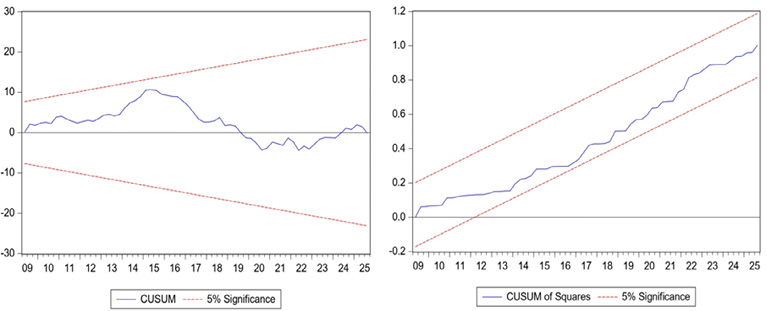
The CUSUM and CUSUM of Squares tests, as shown in Figure 3, indicate that the cumulative sums remain within the 5% significance bounds throughout the sample period. This finding suggests that the model parameters are stable over time, and that no structural break has been detected. Therefore, the dynamic specification and parameter stability of the ARDL model are confirmed.
Although the Zivot–Andrews unit-root tests, as reported above, indicate potential structural breaks in some individual series, the CUSUM and CUSUMSQ statistics remain within the 5% critical bounds throughout the sample period. This suggests that these breaks do not translate into instability in the estimated ARDL parameters. Therefore, the model appears robust to temporary shocks affecting individual variables. In order to preserve degrees of freedom and maintain parsimony, additional dummy variables were not included in the final specification.
This study examined the dynamic relationship between business loans and selected macroeconomic variables in Türkiye by using quarterly data for the period of 2006Q1–2025Q3 within an ARDL framework. The empirical results indicate the existence of a long-run equilibrium relationship among business loans, money supply, credit expansion, real GDP, the real effective exchange rate, and the real commercial interest rate.
The findings show that credit expansion has the most visible and statistically robust association with business loans, both in the long run and in the short run. This result suggests that business lending in Türkiye is closely linked to the overall lending conditions in the banking sector. By contrast, the effect of the money supply does not appear to be direct, but, rather, it seems to operate through broader credit conditions and the transmission process within the banking system. The error-correction mechanism is statistically significant and confirms that short-run deviations tend to converge toward the long-run equilibrium path over time.
These results indicate that business lending is shaped not only by the general monetary conditions, but also by the broader macroeconomic and financial environment, including the real economic activity, exchange rate conditions, and borrowing costs. In a bank-based economy such as Türkiye, this pattern underscores the importance of the credit channel in the transmission of macroeconomic conditions to the real sector. In this respect, the sustainability of business lending depends on a balanced interaction between the monetary policy, credit conditions, and the real economic activity.
From a policy perspective, the findings imply that evaluating firm financing conditions requires a broader framework that goes beyond monetary aggregates alone. Monitoring aggregate credit developments together with macroeconomic indicators may provide a more accurate basis for assessing the financing environment faced by firms. Accordingly, policies intended to support productive business lending may be more effective when monetary and macroprudential tools are designed in a coordinated and complementary manner.
This study contributes to the literature by analyzing business loans in relation to the money supply, credit expansion, and selected macroeconomic and financial indicators within a unified empirical framework, thereby offering a broader perspective on the firm financing conditions in Türkiye. Within this framework, the total credit is used to capture the general lending conditions in the banking sector, whereas business loans reflect the extent to which these conditions are transmitted to the real sector. Accordingly, the model is intended to assess transmission dynamics within the credit environment rather than to reflect a merely definitional relationship between overlapping aggregates. Even so, the findings should be interpreted with caution, since business loans remain a component of the total credit, and this structural proximity may partly affect the estimated coefficients. In addition, the analysis is limited to Türkiye and to the selected set of variables included in the model. Future research may build on this framework by employing alternative credit indicators, incorporating structural shifts more explicitly, and extending the analysis across countries or across different categories of lending.
Acar Ünlü, F., & Dursun Güvenbaş, S. (2020). Kredi türleri ve ekonomik büyüme arasındaki ilişki: Türkiye örneği. International Journal of Disciplines Economics & Administrative Sciences Studies, 6(24), 1180–1190. https://doi.org/10.26728/ideas.384
Bakır Yiğitbaş, Ş. B. (2014). Türkiye’de banka kredileri ve konjonktür dalgalanmaları arasındaki ilişkinin analizi. Bankacılar Dergisi, (90), 19–31.
Bakır Yiğitbaş, Ş. B. (2015). Türkiye’de özel sektör işletme kredilerinin belirleyicileri. Akademik Bakış Dergisi, 47, 287–297. http://www.akademikbakis.org
Banking Regulation and Supervision Agency (BRSA). (2025). Türk bankacılık sektörü temel göstergeler. [Core indicators of the Turkish banking sector]. Retrieved October 30, 2025, from https://www.bddk.org.tr/Veri/EkGetir/8?ekId=506
BRSA. (2026a). Monthly Banking Statistics Bulletin. Retrieved February 14, 2026, from https://www.bddk.org.tr/BultenAylik/
BRSA. (2026b). Core Indicators of the Turkish Banking Sector – December 2025. Retrieved February 14, 2026, from https://www.bddk.org.tr/
Berber, M., & Bayraktar Daştan, C. (2020). Parasal aktarım mekanizmasının işleyişi ve etkinliği. Karadeniz Ekonomi Araştırmaları Dergisi, 1(1), 1–19.
Bernanke, B. S., & Blinder, A. S. (1988). Credit, money, and aggregate demand. American Economic Review, 78(2), 435–439. https://www.jstor.org/stable/1818164
Buthelezi, E. (2024). Is money supply endogenous? A Markov-switch exploration in the zero lower bound interest rate in the USA. Review of Economics, 75(3), 193–213. https://doi.org/10.1515/roe-2024-0026
Central Bank of the Republic of Türkiye. (2025). Electronic Data Delivery System (EVDS): Policy rate series. Retrieved November 7, 2025, from https://evds2.tcmb.gov.tr/index.php?/evds/dashboard/1441
Central Bank of the Republic of Türkiye Electronic Data Delivery System [CBRT-EDDS]. (2025). Data portal. Retrieved November 22, 2025, from https://evds2.tcmb.gov.tr
Checo, A., Grigoli, F., & Sandri, D. (2024). Monetary policy transmission in emerging markets: proverbial concerns, novel evidence. BIS Working Paper No. 1170. Bank for International Settlements.
Çepni, O., & Güney, İ. E. (2017). Endogeneity of money supply: Evidence from Turkey. Journal of Finance & Banking Studies 6(1), 1-10. https://doi.org/10.20525/ijfbs.v6i1.680
Çeştepe, H., & Yıldırım, E. (2016). Türkiye’de finansal gelişme ve ekonomik büyüme ilişkisi. Uluslararası Yönetim İktisat ve İşletme Dergisi (ICAFR 16 Özel Sayısı), 12–26.
Demirci, N. S. (2016). Türkiye’de ölçek bazında KOBİ kredileri ve ekonomik büyüme ilişkisi: Eşbütünleşme ve nedensellik analizi (2006–2016). Anadolu Üniversitesi Sosyal Bilimler Dergisi, 18(1), 113–128. https://dergipark.org.tr/tr/pub/ausbd
Demirhan, B. (2025). Examining the financial development channels affecting economic growth in Turkey. Ekonomika, 104(1), 48–69. https://doi.org/10.15388/Ekon.2025.104.1.3
Eryılmaz, S., Öksüz, M. S., & Zeren, F. (2021). KOBİ kredilerinin ekonomik büyüme ve istihdam üzerine etkisi: Türkiye örneği. Dokuz Eylül Üniversitesi İşletme Fakültesi Dergisi, 22(1), 75–93. https://doi.org/10.24889/ifede.929855
Eton, M., Mwosi, F., Okello-Obura, C., Turyehebwa, A., & Uwonda, G. (2021). Financial inclusion and the growth of small medium enterprises in Uganda: Empirical evidence from selected districts in Lango sub-region. Journal of Innovation and Entrepreneurship, 10(23). https://doi.org/10.1186/s13731-021-00168-2
European Central Bank [ECB]. (2008). The role of banks in the monetary policy transmission mechanism. Monthly Bulletin, August, 85–98.
García-Posada Gómez, M. (2018). Credit constraints, firm investment and growth: Evidence from survey data (ECB Working Paper No. 2126). European Central Bank. https://www.ecb.europa.eu/pub/pdf/scpwps/ecb.wp2126.en.pdf
Gujarati, D. N., & Porter, D. C. (2018). Temel Ekonometri (Ü. Şenesen & G. G. Şenesen, Çev.). Literatür Yayıncılık.
Gürkaynak, R. S., Kısacıkoğlu, B., & Lee, S. S. (2023). Exchange rate and inflation under weak monetary policy: Turkey verifies theory. Economic Policy, 38(115), 519–560. https://doi.org/10.1093/epolic/eiad020
International Monetary Fund. (2024). Republic of Türkiye: 2024 Article IV consultation—Press release; staff report (IMF Country Report No. 24/312). https://doi.org/10.5089/9798400290848.002
Kamacı, A. C., Ceyhan, M. S., & Peçe, M. A. (2017). Kredi hacminin para arzı ve ekonomik büyüme üzerine etkisi. Uluslararası Yönetim İktisat ve İşletme Dergisi, 13(13), 400–409.
Karahan, Ö., Yılgör, M., & Özekin, A. A. (2018). Türkiye’de banka kredilerindeki genişleme ile ekonomik büyüme arasındaki ilişki. Finans Politik & Ekonomik Yorumlar, 55(636), 25–36. https://dergipark.org.tr/tr/pub/fpeyd/issue/47987/607071
Karamelikli, H., & Keskingöz, H. (2017). Finansal gelişme bileşenlerinin ekonomik büyüme üzerindeki etkisi: Türkiye örneği. İnsan ve Toplum Bilimleri Araştırmaları Dergisi, 6(1), 683–701. https://doi.org/10.15869/itobiad.304378
Kasapoğlu, Ö. (2007). Parasal aktarım mekanizmaları: Türkiye için uygulama [Uzmanlık yeterlik tezi]. Türkiye Cumhuriyet Merkez Bankası, Piyasalar Genel Müdürlüğü, Ankara, Türkiye.
Kurt, C. (2025). Türkiye’de banka kredileri ile iktisadi büyüme arasındaki nedensellik ilişkisinin analizi [Doktora tezi, İstanbul Üniversitesi]. İktisadî Araştırmalar Vakfı Yayınları.
Mateju, J. (2019). What drives the strength of monetary policy transmission? International Journal of Central Banking, 15(3), 59–87.
Mazibaş, M., & Tuna, Y. (2017). Understanding the recent growth in consumer loans and credit cards in emerging markets: Evidence from Turkey. Emerging Markets Finance and Trade, 53(9), 2052–2069. https://doi.org/10.1080/1540496X.2016.1196895
Omodero, C. O. (2024). Central Bank Financial Policy Mechanism and Taxation Earning in Sub-Saharan Africa. Ekonomika, 103(4), 112–128. https://doi.org/10.15388/Ekon.2024.103.4.7
Özyurt, H. (2015). Para teorisi ve politikası. Trabzon, Türkiye: Celepler Matbaacılık.
Paya, M. M. (2013). Para teorisi ve para politikası. İstanbul, Türkiye: Türkmen Kitabevi.
Rossi, J. L., Delmondes de Carvalho Rossi, M., & Carvalho Cunha, D. (2019). Transmission of monetary policy through the wealth channel in Brazil: Does the type of asset matter? Research in International Business and Finance, 50(C), 279-293. https://doi.org/10.1016/j.ribaf.2019.06.009
Suárez Mayorga, D. F., Melgarejo, Z., & Oliveros, D. (2024). Financial inclusion and its relationship with business growth of microenterprises in the manufacturing industry in Bogotá during 2012–2016. Cogent Business & Management, 11(1), 2338226. https://doi.org/10.1080/23311975.2024.2338226
Sunal, O. & Yağcı, F. (2024). The determinants of Turkish CDS volatility: An ARDL approach covering COVID period. The Quarterly Review of Economics and Finance, 97, 101887. https://doi.org/10.1016/j.qref.2024.101887
Şenel, C. (2020). Banka kredileri ve Türk bankacılık sektöründe kredilerin uluslararası karşılaştırmalı analizi. İşletme Araştırmaları Dergisi, 12(1), 810–825. https://doi.org/10.20491/isarder.2020.879
Şıklar, İ., & Akça, A. (2020). Exchange Market Pressure and Monetary Policy: The Turkish Case. Ekonomika, 99(1), 110–130. https://doi.org/10.15388/Ekon.2020.1.7
Tabet, C., Tabet, C., & Chakchouk, F. E. (2025). Money supply, inflation, and economic growth: The case of the Eurozone (1990–2022). Computational Economics. https://doi.org/10.1007/s10614-025-11125-6
Tiryaki, G., & Hasanov, M. (2022). Do credits affect money supply and deposits, or vice versa, or interconnected? Journal of BRSA Banking and Financial Markets, 16(2), 217–245. https://doi.org/10.46520/bddkdergisi.1178353
Vurur, N. S., & Yıldız, M. (2023). İşletme kredilerinin ekonomik belirleyicilerinin parametrik olmayan bir yaklaşımla analizi. Finans Ekonomi ve Sosyal Araştırmalar Dergisi, 8(1), 176–189. https://doi.org/10.29106/fesa.1227639
Wooldridge, J. M. (2013). Introductory econometrics: A modern approach (5th ed.). South-Western Cengage Learning.
Xiao, L. (2025). Quantifying the effects of sentiment and expectations on the United States credit growth [Doctoral dissertation, Claremont Graduate University]. Claremont Graduate University Repository.
Yetiz, F., & Ergin Ünal, A. (2021). Banka kredileri, para arzı ve ekonomik büyüme arasındaki ilişki: Türkiye örneği. OPUS – Uluslararası Toplum Araştırmaları Dergisi, 17(37), 4487–4509. https://doi.org/10.26466/opus.873635