Kalbotyra ISSN 1392-1517 eISSN 2029-8315
2026 (79) 7–34 DOI: https://doi.org/10.15388/Kalbotyra.2026.79.1
Papers
Evaldas Švageris
Institute of Applied Linguistics
Faculty of Philology
Vilnius University
Universiteto g. 5
LT-01131 Vilnius, Lithuania
E-mail: evaldas.svageris@flf.vu.lt
ORCID iD: https://orcid.org/0009-0002-5624-7275
https://ror.org/03nadee84
Gintautas Tamulevičius
Institute of Data Science and Digital Technologies
Vilnius University
Akademijos g. 4
LT-08412 Vilnius, Lithuania
E-mail: gintautas.tamulevicius@mif.vu.lt
ORCID iD: https://orcid.org/0000-0001-9175-3726
https://ror.org/03nadee84
Abstract. This study investigates the phonetic realization of pitch accents, namely, acute and circumflex, in Standard Lithuanian, focusing on their dynamic F0 profiles and interaction with other prosodic elements. Using MANOVA, the study examined how pitch accents, emphasis, word stress, and intonation types (declarative vs. interrogative) influence the distribution of acoustic parameters, specifically duration, F0 acceleration, and F0 jerk. The results reveal that word stress and phrase focus, along with intonation, are the dominant factors in both phonation activation and control. In contrast, pitch accents exhibit minimal effect size and high sensitivity to phonetic context in this regard. In natural speech, phonational effort is prioritized at the phrase level, leaving other elements, such as pitch accents, with reduced and statistically irregular phonetic bases. These findings challenge the stability of pitch accents and the acute-circumflex distinction in Lithuanian and suggest their dephonologization in the current prosodic system.
Keywords: pitch accent, F0 dynamics, prosodic hierarchy, Standard Lithuanian, stress, phonation activation
Santrauka. Šiame straipsnyje nagrinėjami fonetinė bendrinės lietuvių kalbos priegaidžių požymiai, daugiausia dėmesio skiriant dinaminiams jų F0 profiliams ir sąveikai su kitais prozodiniais elementais. Taikant MANOVA metodą, nagrinėta, kaip priegaidės, frazės ir žodžio kirčiai bei intonaciniai tipai (tvirtinamoji ir klausiamoji intonacijos) veikia akustinių parametrų – trukmės, F0 pagreičio bei F0 džerko – pasiskirstymą. Rezultatai atskleidė, kad abiejų tipų kirčiai ir intonacija yra dominuojantys veiksniai – jie tiesiogiai lemia tiek fonacijos aktyvaciją, tiek jos kontrolę. Tuo tarpu priegaidžių poveikis šiuo požiūriu yra minimalus ir pernelyg priklausomas nuo fonetinio konteksto. Darytina išvada, kad įprastinėmis kalbinėmis sąlygomis fonacinės pastangos pirmiausia yra išdiferencijuojamos frazės lygmens elementų ir kirčio, o priegaidėms paliekama itin nereguliari ir statistinio pagrindo neturinti fonetinė bazė. Šie rezultatai kelia pagrįstų abejonių dėl priegaidžių savarankiškumo ir byloja apie galimą jų defonologizaciją dabartinėje prozodinėje sistemoje.
Raktiniai žodžiai: priegaidė, F0 dinamika, prozodinė hierarchija, bendrinė lietuvių kalba, kirtis, fonacijos aktyvacija
________
Submitted: 19/02/2026. Accepted: 25/06/2026
Copyright © 2026 Evaldas Švageris, Gintautas Tamulevičius. Published by Vilnius University Press
This is an Open Access article distributed under the terms of the Creative Commons Attribution License, which permits unrestricted use, distribution, and reproduction in any medium, provided the original author and source are credited.
1 Introduction
The functional status of pitch accents (Lith. priegaidės) in Standard Lithuanian has long been a subject of scholarly debate (Pakerys 1982, 144–182; Vaitkevičiūtė 1995, 5–26; Girdenis 2003, 276; Kudirka 2005, 1–21; also cf. Bacevičiūtė 2011, 13–26; Bakšienė 2016). In practice, there is little doubt only about the circumflex and acute opposition in diphthongs containing open, low vowels (i.e., /ai, au/). However, in such cases, the differential function is performed by stress rather than by the prosodic element in question (Kardelis 2017, 8–12). Logically, prosodic opposition should not be restricted to long syllables of only a specific segmental structure. For the sake of system simplicity, it has therefore been argued that the notion of pitch accent could be abandoned altogether (Kazlauskas 1966, 119–131; 1968, 5; Pakerys 1982, 147; Kardelis 2017, 8–12).
Although the earlier autonomy of these prosodic elements is indicated by the well-known historical phonetic and accentology laws formulated by Leskien and Saussure at the end of the 19th century, even the Indo-Europeanists of that time admitted that “pitch accent in an unstressed syllable remains hidden; it becomes visible (directly) only because it is intensified by stress” (Saussure 1894 ibid. 2012, 15–16; emphasis added). To date, it has not been possible to clearly distinguish these prosodic elements phonetically; therefore, the prevailing approach is that the acoustic correlates of both are complex (Pakerys 1982). Recently, a new methodological approach has been proposed, which attempts to address this problem by focusing more on the biomechanical aspects of phonation (Švageris 2020, 119–157; 2021, 271–305; 2022a, 341–362; 2022b, 71–96; 2023, 195–224; 2025, 323–354). The key question is whether this method can phonetically distinguish these prosodic elements. If this proves unsuccessful, it would serve as yet another argument that pitch accent opposition is no longer retained in Standard Lithuanian (for a fuller overview of research on Lithuanian pitch accents, see Laigonaitė 1958, 71–100; Pakerys 1982, 144–182; Vaitkevičiūtė 1995; Bakšienė 2016, 41–55).
2 Research problem and goal
If one adopts the position that, in principle, pitch accents can no longer be distinguished by empirical methods (Kudirka 2005, 1–21; Švageris 2013, 77–90; Kazlauskienė & Sabonytė 2018, 55–62), then it would be natural to conclude that there is no basis for discussing their phonetic interaction with other prosodic elements. However, as long as the dephonologization of pitch accents remains an open question, it is premature to ignore them completely. Moreover, there is still a lack of studies that examine these elements from an interactional perspective. At present, it can be stated more firmly that overall fundamental frequency (F0) levels and peak positions are properties of phrase intonation (Kazlauskienė & Sabonytė 2018, 61; Sabonytė & Goldstein 2021, 127; Sabonytė 2022, 163; Kazlauskienė, Dereškevičiūtė & Sabonytė 2023, 177). This would imply that neither word stress nor pitch accent significantly correlates with F0. For a long time, however, the opposite was assumed, namely, the phonetic complexity of prosodic units – especially word stress. This approach has been dominant since roughly the mid-20th century and remains popular nowadays1 (Lehiste 1970, 142–146; van Heuven 2018, 15–59; Erickson & Niebuhr 2023, 2–3). In Lithuanian prosody studies, this idea was articulated somewhat later (Pakerys 1982, 144, 189; Girdenis 2003, 252–253) and then spread widely, especially among dialect researchers (e.g., Atkočaitytė 2002, 187–189; Bacevičiūtė 2004, 201–204; Leskauskaitė 2004, 236–238). However, this interpretation is quite general and often serves as a compromise for summarizing ambiguous empirical data. The paradox is that as analytical tools improved, understanding interaction phenomena became more difficult.
A possible way forward is to shift the experimental methodology slightly in a different direction. It is a classic insight that the dynamic domain of speech is shaped by two competing intentions: making articulation easier and increasing its distinctiveness (Passy 1890; Lindblom 1990a, 66). According to H&H theory (hyper- and hypo-articulation; Lindblom 1990b), phonetic clarity and precision are determined by the participants of the speech act. In terms of information structure, new and focal information (rheme) is emphasized, produced more clearly, and hyper-articulated, whereas given information (theme) receives less articulatory effort. This suggests that acoustic parameters can be treated, in the broadest sense, as measures of the time-varying efficiency of the speech apparatus: the faster the speaking rate, the lower the achievable precision. Increased syllables per time unit can thus be one way to convey low-value (contextually predictable) information2. Physiological considerations readily support these ideas. Reaching target articulatory positions (relative to the neutral posture) requires sufficient time. If time is not available, the characteristic features of sounds are under realized (muscular contraction becomes only partial). Some phoneticians propose that the distribution of vowel quality can be viewed as a function of time: the shorter the vowel, the more centralized it becomes (closer to schwa; Lindblom 1963, 1773–1781). While this cannot be generalized because phonological factors are often crucial (e.g., phonemic short/long contrasts), it remains true that physical and physiological constraints (such as inertia) are sometimes overlooked (Xu, Prom-On & Liu 2022, 377–407). It is doubtful that human physiology allows for deliberate, independent fine-tuning of multiple groups of acoustic parameters (as separate, distinctive features), the precise balancing of their ratios, or the maintenance of tiny differences (tens of milliseconds, semitones, or decibels) between categories such as stressed vs. unstressed syllables in rapid speech.
In experimental prosody, however, this logic is applied only partially. Linguists typically use acoustic measures while paying little attention to the articulatory and phonatory processes that generate them. This can be an obstacle to interpreting interactional phenomena – or even the phonetic correlates themselves. For instance, in stress studies, it is widely noted that unstressed syllables (especially word-final ones) are often reduced (van Heuven 2018, 15–59). In articulatory terms, this means weaker muscular contraction in the vocal tract and less deviation from neutral posture. Conversely, stressed syllables are articulated more actively and efficiently (vowels are more decentralized). It is important to recall that the distinctive correlates of prosodic elements – stress, pitch accents, and intonation – are usually linked to phonation, i.e., vocal fold activity (Titze 2000; Xu 2019). If a criterion of articulatory efficiency is meaningful for articulation, it is reasonable to apply an analogous criterion to phonation: to quantify, via acoustic parameters, the efficiency of the vocal fold vibration in syllables of different prosodic weight. In other words, the distribution of acoustic parameters can be more simply regarded as a measure of the efficiency of both phonation and articulation in speech sounds: the greater the linguistic motivation, the more actively and efficiently the speaker utilizes their physiological energy, and moreover, in the simplest possible way (see Lindblom 1990b, 403–439; de Jong, Beckman & Edwards 1993, 197–212). This logic implies that, for instance, acoustic F0 stability (F0 linearity) could be interpreted as a result of higher motor control of the vocal folds, a reduction in biomechanical system entropy, and an increase in phonational efficiency (see van den Berg 1958, 227–244; Titze 2000; Zhang 2016, 2614–2635; for a neurobiological perspective, see Todorov & Jordan 2002, 1226–1235). Put simply, one may expect that weak-position syllables are not only less actively articulated, but also less actively (and less effectively) phonated.
This line of reasoning underlies a recently proposed principle for the interaction of Lithuanian prosodic elements (Švageris 2020, 119–157; 2021, 271–305; 2022a, 341–362; 2022b, 71–96; 2023, 195–224; 2025, 323–354). The model assumes that prosodic structure is a dynamical system in which different elements (intonation, stress, and pitch accent) modify the F0 trajectory through different time derivatives: F0 acceleration (a) and F0 jerk (j) (for the physical meaning of jerk, see Eager 2016). Phrase intonation functions as a baseline F0 acceleration (positive, negative, or near-zero) that determines the global direction of the tonal contour (phonation activation). Stress and pitch accent modulate the local temporal distribution of that acceleration (the F0 jerk; phonation control). In this respect, stress differentiates syllables syntagmatically, whereas pitch accent differentiates them paradigmatically. Syllable duration serves as the physical medium through which these dynamic F0 profiles are realized. In classical-mechanical terms, intonation regulates the overall force vector (global F0 change), while stress and pitch accent regulate local impulses; thus, the overall prosodic contour is the time integral of their combined effects. Prosodically weaker syllables, for instance, may have static (inertial) phonation (constant zero F0 acceleration) or may even turn into noise (F0 perturbation). These properties reflect a universal biomotor ability to deploy physical force to different extents and in different ways; speech behavior is no exception. The innervation of the vocal folds provides physiological preconditions for differentiated F0 control (Titze 2000, 211–238; Zhang 2016, 2614–2635)3.
Because phonetic differentiation of acute and circumflex is the last missing part of the interaction model, this article sets two aims:
1) to determine whether Standard Lithuanian pitch accents can be reliably distinguished on the basis of dynamic F0 profiles;
2) and if so, what phonetic interactions exist between pitch accents and other prosodic elements.
The primary hypothesis of this study could be formulated as follows: from an interactional perspective, the phonetic distinction between acute and circumflex accents is excessively influenced by other prosodic elements, making it impossible to objectively prove their autonomy in Standard Lithuanian.
3 Research method and material
The direction of analysis is dictated by the logic outlined above. In the proposed model, the phonetic realization of all prosodic elements is inseparable from phonation and dynamic F0 parameters. Intonational contours reflect general F0 vectors, while stress and pitch accent reflect syllable-level differences in the temporal distribution of F0, determined in syntagmatic and paradigmatic directions, respectively. If the overall F0 trajectory across a word is not modified by salient phonatory impulses, stress is associated with the first word syllable. This motivates the claim that, under equal phonetic conditions, the first syllable has more prosodic weight. Shifting the perception of stress to other syllables requires a phonatory contrast: static or deactivated (perturbed) pre-stress syllable tone must be followed by a more active and more clearly changing F0. Interactionally, the key point is that stress is always linked to an active phonation phase, whereas the exact dynamic pattern (e.g., rising vs. rising-falling) is not, in itself, crucial. This is the dynamic domain in which differences associated with pitch accent may emerge. The active phonation phase can be differentiated by its time distribution. Extremely rapid F0 change produces an auditory impression of sharpness, abruptness, fall, or breaking while extended and more linear dynamics yield associations with pitch stretching, rise, or extendedness. Acoustically, the stronger the phonatory impulse (i.e., the larger the change in F0 acceleration and F0 jerk), the sharper and less stable the pitch accent. A classic example in speech acoustics is the so-called broken tones (known in some Lithuanian and Latvian dialects), i.e., glottalization producing an impression of a strike, physiologically caused by spasmodic vocal fold contraction. By contrast, the smooth (continuous) tone is characterized by stable, temporally distributed, controlled F0 dynamics (by low F0 acceleration and F0 jerk).
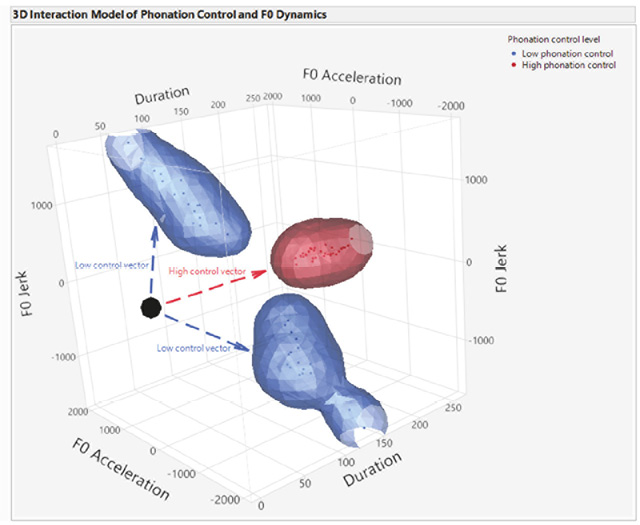
These potentially distinctive correlates can be tested by calculating and comparing the distribution of three acoustic parameters: F0 acceleration, F0 jerk, and duration. If the opposition between smooth and abrupt tone reflects phonation control, the data should cluster in two directions. In principle scheme, the relationship can be expressed as follows:
Figure 1. Theoretical distribution of dynamic F0 parameters according to the level of phonation control
In control terms, duration is inversely proportional to the phonatory impulse. The stronger the impulse (higher F0 acceleration and F0 jerk), the more compressed the active phonation phase; conversely, a smooth, stable tone requires more time and less dynamic noise. If the degree of F0 change (acceleration) is treated as roughly constant, then control can be operationalized by the ratio of duration to F0 jerk: the longer the time interval (t) for a smaller jerk value (Hz/s³), the higher the control.
Because the hypothesis relies on a combination of parameters rather than a single measure, the choice of statistical models is narrower. A well-established alternative is multivariate analysis of variance (MANOVA), commonly used for such tasks (Rietveld & van Hout 2005; also cf. Sonderegger & Sóskuthy 2025, 1–30). To reduce the influence of random factors (e.g., speakers), this study uses speaker-based standardization (Adank et al. 2004): MANOVA compares standardized deviations from each speaker’s mean rather than absolute values. To mitigate potential differences in sample dispersion and covariance, Pillai’s Trace (rather than Wilks’ Lambda) is chosen (Johnson 2008).
MANOVA is applied here from several angles. First, we test whether all prosodic elements – stress, pitch accent, and intonation – can be distinguished (p<0.05) using the same set of acoustic parameters; if so, this would constitute objective validation of the interaction principle. Second, interaction probabilities are examined (a significant advantage of MANOVA). A fundamental goal is to infer statistical hierarchy: the more strongly a prosodic factor separates the acoustic data, the more autonomous it is and the greater its power to affect other factors. This multi-perspective approach can also indirectly inform the debated question of distinctiveness between acute and circumflex. One may hypothesize that very weak accent properties reflect a low hierarchical position. Nevertheless, some degree of functional relevance might be revealed via interactions. For example, a statistically reliable interaction between intonation type and accent factor would suggest that changing pitch accent affects the realization of interrogative vs. declarative intonation (and vice versa). In short, the central methodological commitment of this study is to use MANOVA comprehensively to evaluate both the interaction principle and the specificity of prosodic elements.
To confirm or refute these assumptions, recordings of four professional male actors (D1–D4; mean age 30) with substantial stage experience were used. Their dialect backgrounds vary (southern Aukštaitian D1, western Aukštaitian Kauniškiai D2, Šiauliai D3, and eastern Aukštaitian Uteniškiai D4), but no salient dialectal features were observed in the recordings. Conservatively, they can be treated as speakers of a substandard form of Standard Lithuanian (Miliūnaitė 2018). In any case, ideal standard speech is best seen as a narrative rather than a fully existing variety; if pitch accents are not consistently distinguished even by users who study public speaking as a discipline, it is unrealistic to expect a different situation in the broader community of standard-language speakers. It should also be noted that pitch accent is hardly distinguished in the dialect (western Aukštaitian Kauniškiai) that serves as the background for Standard Lithuanian (Bakšienė 2016).
All recordings were made in the Phonetics Laboratory at Vilnius University, in accordance with standard experimental requirements. The target word set comprised five minimal pairs: [1ˈkoːʃʲeː] ʻto strainʼ and [2ˈkoːʃʲeː] ʻporridgeʼ, [1ˈkoːʋɑː] ʻMarchʼ and [2ˈkoːʋɑː] ʻfight, battleʼ, [1ˈlɑˑɪdɐɪ] ʻthrowsʼ and [2ˈlɐɪˑdɐɪ] ʻtv showʼ, [1ˈlɑˑɪdoː] ʻis throwingʼ and [2ˈlɐɪˑdoː] ʻwire, cableʼ, [1ˈmʲɪnʲtʲɪ] ʻto pedalʼ and [2ˈmɪnʲˑtʲɪ] ʻto guess a riddleʼ4. The words were embedded in short three-word phrases, with the target word always occupying the central position. When constructing sentences, the rhythmic structure was controlled by ensuring equal stress placement and choosing initial and final words with stress on the penultimate syllable. The data were classified by intonation type (question vs. statement) and by focus (whether the target word was produced with or without phrase-level prominence). Each phrase was repeated ten times (in two batches of five), yielding 2400 tokens in total. To ensure unambiguous stress placement, the syllables to be stressed were marked in red on the presentation slides, and the phrase-prominent word was underlined; unclear or inaccurate utterances were repeated upon request.
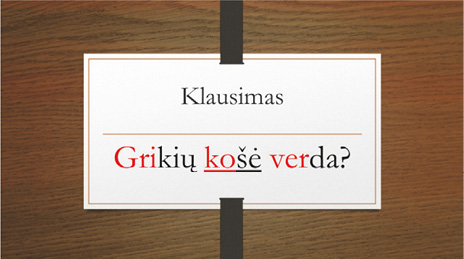
Figure 2. Example of a slide with a research word
All tokens were annotated in Praat, and a dataset of the relevant acoustic parameters was extracted using scripts. All statistical calculations were performed in JMP (using a free academic license). The same software was used to produce 3D scatterplots showing likely parameter distributions for each pitch accent. To guard against possible word-specific variation, each minimal pair was analyzed separately. First, acute-circumflex distinctiveness and its phonetic aspects were tested statistically; then, hierarchical positions among other prosodic elements were inferred, and interactions were discussed. For illustration, several F0 contours were plotted in Praat. Normalization of time was intentionally avoided because equalizing duration can distort the visual impression of F0 dynamics. The overall picture is expected to be clearer in 3D scatterplots, which avoid parameter averaging. If two accentual categories can distinguish the acoustic parameters sufficiently, the data should form separate clusters in these spaces (as in Fig. 1).
4 Interaction of pitch accents with word stress and intonation
We begin with the textbook minimal pair, which is often used to demonstrate pitch accents in Lithuanian (see Fig. 3). It is worth recalling that these prosodic elements, or rather the acoustic parameters that represent them, are compared according to the paradigmatic vector. Such a direction of phonetic interpretation is motivated by the fact that these prosodic elements can also be distinguished in monosyllabic words (they do not require syntagmatic syllable contrast).
4.1 [1ˈkoːʃʲeː] ʻto strainʼ and [2ˈkoːʃʲeː] ʻporridgeʼ
![Two stacked pitch contour plots displaying Fundamental Frequency (F0 in Hz) on the y-axis against Time (in seconds) on the x-axis for the Lithuanian word “košė”. The top plot shows the acute pitch accent ([1ˈkoːʃʲeː]) featuring a fairly flat F0 trajectory around 130–150 Hz over the stressed vowel before falling in the final syllable. The bottom plot shows the circumflex pitch accent ([1ˈkoːʃʲeː]) displaying a similarly linear F0 contour around 120–130 Hz over the stressed vowel, followed by a lower pitch step in the final vowel.](https://www.journals.vu.lt/kalbotyra/lt/article/download/45507/version/41651/43207/144556/Svageris-3_pav.jpg)
Figure 3. Illustrative F0 contours for [1ˈkoːʃʲeː] (acute; above) and [1ˈkoːʃʲeː] (circumflex; below) (D1, declarative intonation, +focus)
As far as can be judged from the F0 dynamics of the illustrative examples, such differences in these two accentual categories are minimal. It is obvious that in both cases, the F0 trajectories of the stressed first syllables are fairly linear and without phonational impulses.
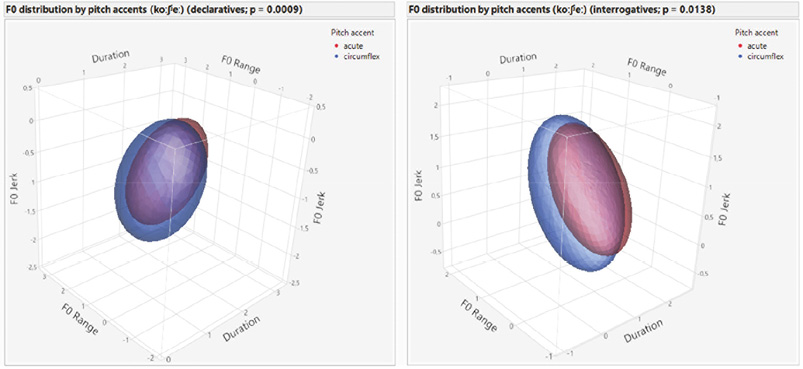
Figure 4. Dependence of dynamic F0 parameters of [1ˈkoːʃʲeː] and [2ˈkoːʃʲeː] on pitch accents in different intonation conditions (left graph – declarative intonation, right – interrogative; +focus, examples D1–D4)
This picture does not change when the data are grouped by intonation type, and all tokens from strong prosodic positions are plotted in a three-dimensional acoustic space (Fig. 4). Although p-values in some conditions pass the conventional threshold (p<0.05), the confidence ellipses nearly overlap. At most, one might observe a weak tendency for acute vowels to have slightly larger quantities. Because statistical significance does not, by itself, guarantee perceptual relevance, it remains unclear whether such minor distributional differences would be meaningful in real communicative contexts. In short, the data do not form two clearly separated clusters and thus do not yield two stable dynamic F0 profiles that could be straightforwardly attributed to the prosodic elements in question. In other words, there is no clear distinction between pitch accents.
|
Factor/interaction |
MANOVA (Pillaiʼs Trace) |
Duration |
F0 Slope |
F0 Jerk |
|---|---|---|---|---|
|
Pitch accent (acu.) |
p=0.0008 |
+0.102 |
–0.006 |
+0.046 |
|
Intonation type (inter.) |
p=5.3e–48 |
+0.045 |
+0.175 |
+0.446 |
|
Focus (–) |
p=9.9e–67 |
–0.833 |
–0.143 |
–0.120 |
|
Word stress (acu.+circ.)(str.) |
p=4.5e–103 |
+0.537 |
+0.283 |
+0.1 |
|
Pitch accent (acu.)*Intonation type (inter.) |
p=0.067 |
–0.033 |
–0.066 |
+0.019 |
|
Pitch accent (acu.)*Phrasal stress (–) |
p=0.51 |
–0.072 |
+0.005 |
+0.006 |
|
Focus (+)*Intonation type (inter.) |
p=2.6e–23 |
–0.055 |
+0.029 |
+0.193 |
|
Word stress (str.)*Intonation type (inter.) |
p=3.4e–7 |
–0.472 |
–0.005 |
+0.236 |
|
Word stress (str.)*Focus (–) |
p=2.8e–62 |
–0.180 |
+0.291 |
–0.308 |
Table 1. Summary of the influence of prosodic factors on acoustic parameters for [1ˈkoːʃʲeː] and [2ˈkoːʃʲeː]
MANOVA results shows that the independent variables (pitch accent, stress, intonation) and their interactions explain variation in the acoustic parameters with very high statistical significance (Pillai’s Trace, p=7e–113; Tab. 1). However, acute and circumflex opposition ranks lowest in effect strength (p=0.0008): it is far weaker than word stress (p=4.5e–103), focus (p=9.9e–67), or intonation type (p=5.3e–48). Statistically insignificant interactions further evidence the low independence of pitch accents. Analysis of F0 dynamics shows that acute and circumflex are indistinguishable if phrase stress (p=0.51) and intonation type (p=0.067) are ignored. Effectively, intonation factors negate the influence of F0 dynamics on accent differentiation. The data, expressed as standard deviations from the MANOVA intercept (standardized by speaker), indicate directionality through their signs: negative values denote a decrease relative to the mean (e.g., shorter duration or lower F0 acceleration), while positive values indicate an increase. The emphasis factor reveals that F0 dynamics in prosodically weak positions (–) are substantially suppressed across all pitch accents. In this position, the duration of long vowel [oː], F0 acceleration, and F0 jerk are drastically reduced (deviations of –0.833, –0.143, and –0.120, respectively). Conversely, all these values increase by a corresponding amount in emphasized positions (+). Since sentence focus and word stress redistribute phonetic properties in the same direction, they are clearly the primary drivers of phonation activation. Notably, interrogative intonation provides a more favorable medium for both word and phrase stress to intensify F0 change (p=3.4e–7 and p=2.6e–23, respectively). The significant increase in F0 jerk under these conditions suggests that interrogation generates a pronounced phonatory impulse. Ultimately, the phonetic expression of pitch accents within this dynamic space is too compressed for any noticeable autonomy.
4.2 [1ˈkoːʋɑː] ʻMarchʼ and [2ˈkoːʋɑː] ʻfight, battleʼ
The second minimal pair, with the same long vowel [oː] in the syllable nucleus, yields a similar conclusion: the illustrative F0 trajectories for the pitch accents are highly similar and show little evidence of dynamic impulses (Fig. 5). An apparent effect is seen mainly in the weakening of unstressed final syllables, which is especially visible as F0 breaks.
The potential for two accentual categories to generate independent dynamic F0 profiles is not supported by the 3D distribution of data (Fig. 6). The ellipses exhibit significant overlap, and their differential fluctuation is too high to be conclusive. In declarative intonation contexts (left graph), the statistical significance only marginally approaches the p<0.05 threshold. The interpretation of such a distribution largely depends on the chosen reference point. While marginally positive probability estimates suggest that a distinction between acute and circumflex persists, the actual distribution of parameters is too ambiguous to isolate two separate F0 patterns (compare with the principal scheme in Fig. 1). This ambiguity is compounded by inconsistencies across word pairs: for instance, in the pair [1ˈkoːʃʲeː] and [2ˈkoːʃʲeː], the relationship between pitch accents and acoustic parameters shifts, with circumflexed vowels appearing slightly longer than acute ones – reversing the expected trend.
![Two stacked pitch contour plots displaying Fundamental Frequency (F0 in Hz) on the y-axis against Time (in seconds) on the x-axis for the Lithuanian word „kovą“. The top plot shows the acute pitch accent ([1ˈkoːʋɑː]) featuring a relatively flat F0 trajectory around 140–150 Hz over the stressed vowel before slightly falling towards 100 Hz in the final syllable. The bottom plot shows the circumflex pitch accent ([2ˈkoːʋɑː]) displaying a similarly flat F0 contour around 130–140 Hz over the stressed vowel, followed by a gentle decline to around 90–100 Hz in the final vowel.](https://www.journals.vu.lt/kalbotyra/lt/article/download/45507/version/41651/43207/144558/Svageris-5_pav.jpg)
![Two stacked pitch contour plots displaying Fundamental Frequency (F0 in Hz) on the y-axis against Time (in seconds) on the x-axis for the Lithuanian word „kovą“. The top plot shows the acute pitch accent ([1ˈkoːʋɑː]) featuring a relatively flat F0 trajectory around 140–150 Hz over the stressed vowel before slightly falling towards 100 Hz in the final syllable. The bottom plot shows the circumflex pitch accent ([2ˈkoːʋɑː]) displaying a similarly flat F0 contour around 130–140 Hz over the stressed vowel, followed by a gentle decline to around 90–100 Hz in the final vowel.](https://www.journals.vu.lt/kalbotyra/lt/article/download/45507/version/41651/43207/144559/Svageris-5_pav1.jpg)
Figure 5. Illustrative F0 contours for [1ˈkoːʋɑː] (acute; above) and [2ˈkoːʋɑː] (circumflex; below) (D1, declarative intonation, +focus)
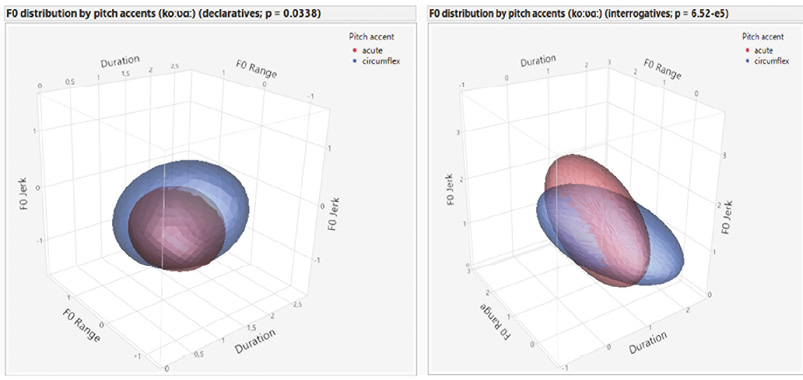
Figure 6. Dependence of dynamic F0 parameters of [1ˈkoːʋɑː] and [2ˈkoːʋɑː] on pitch accents in different intonation conditions (left graph – declarative intonation, right – interrogative; +focus, examples D1–D4)
|
Factor/interaction |
MANOVA (Pillaiʼs Trace) |
Duration |
F0 Slope |
F0 Jerk |
|---|---|---|---|---|
|
Pitch accent (acu.) |
p=0.00003 |
–0.121 |
+0.009 |
+0.081 |
|
Intonation type (inter.) |
p=1.32e–46 |
–0.051 |
+0.205 |
+0.523 |
|
Focus (–) |
p=1.51–e79 |
–1.027 |
–0.333 |
–0.061 |
|
Word stress (acu.+circ.)(str.) |
p=2.5e–129 |
+0.644 |
+0.159 |
+0.381 |
|
Pitch accent (acu.)*Intonation type (inter.) |
p=0.000039 |
–0.045 |
+0.148 |
+0.052 |
|
Pitch accent (acu.)*Phrasal stress (–) |
p=4.48e–6 |
+0.204 |
–0.030 |
–0.077 |
|
Focus (–)*Intonation type (inter.) |
p=3.5e–26 |
–0.004 |
–0.183 |
–0.523 |
|
Word stress (str.)*Intonation type (inter.) |
p=5.05e–33 |
–0.095 |
–0.214 |
+0.441 |
|
Word stress (str.)*Focus (–) |
p=1.22e–33 |
–0.280 |
–0.136 |
–0.241 |
Table 2. Summary of the influence of prosodic factors on acoustic parameters [1ˈkoːʋɑː] and [2ˈkoːʋɑː]
A broader statistical assessment of the phonetic basis of syllable-level accentual categories reveals a more apparent structural logic. The model remains highly robust in explaining this dynamic space (p=1.8e–119), with word stress (p=2.5e–129), emphasis (p=1.51e–79), and intonation (p=1.32e–46) maintaining their dominant roles (Tab. 2). These results reinforce the conclusion that the phonetic instability of pitch accents correlates with their low hierarchical position within the prosodic system. The universal power of stress to activate syllable phonation is unequivocal. As shown in the data, the F0 dynamics of unstressed syllables are completely suppressed (duration –1.207, F0 acceleration –0.333, F0 jerk –0.061), while stressed ones exhibit a corresponding activation. Furthermore, interrogative intonation consistently intensifies phonational impulses. Notably, while both stress and intonation drive phonation, the interrogation factor has a negligible effect on vowel quantity, whereas the impact of stress on duration is substantial. The distinctiveness of pitch accents remains problematic. Although some statistically significant interactions are indicated, their phonetic implications are ambiguous. For example, while acute accent and interrogative intonation generally trend toward more pronounced F0 dynamics, this contradicts findings from previous pairs. Furthermore, it is unlikely that accents maintain distinct profiles in positions lacking emphasis. The observed quantitative advantage of acute in these positions (+0.204) is inconsistent with the expected power of phrase-level prominence to suppress such distinctions. Given that these numbers diverge radically from previously analyzed minimal pairs, it is more objective to conclude that such fluctuations are further evidence of the phonetic dependence and instability of accentual categories under investigation.
4.3 [1ˈ lɑˑɪdɐɪ] ʻthrowsʼ and [2ˈ lɐɪˑdɐɪ] ʻtv showʼ
![Two stacked pitch contour plots displaying Fundamental Frequency (F0 in Hz) on the y-axis against Time (in seconds) on the x-axis for the Lithuanian word „laidai“. The top plot shows the acute pitch accent ([1ˈlɑˑɪdɐɪ]) featuring a slightly rising F0 trajectory from around 110 Hz to 140 Hz over the initial consonant and stressed diphthong, before falling in the final syllable. The bottom plot shows the circumflex pitch accent ([2ˈlɐɪˑdɐɪ]) displaying a remarkably similar low-rising F0 contour reaching around 150 Hz over the diphthong, followed by a gradual drop to 90 Hz in the final syllable.](https://www.journals.vu.lt/kalbotyra/lt/article/download/45507/version/41651/43207/144561/Svageris-7_pav.jpg)
Figure 7. Illustrative F0 contours for [1ˈlɑˑɪdɐɪ] (acute; above) and [2ˈlɐɪˑdɐɪ] (circumflex; below) (D1, declarative intonation, +focus)
The third minimal pair differs from the previous two in the phonemic structure of the stressed syllable. Here, the phonetic domain of the accentual contrast is a diphthong containing a low-rising open back vowel [ɑ/ɐ]. In such syllables, accents are primarily distinguished by the quality of the first component. In acute diphthongs, the first component is more clearly emphasized (stressed), whereas in circumflex diphthongs, the second one is. Beyond these qualitative cues, it is essential to determine if dynamic F0 differences persist. As illustrated in Fig. 7, acute diphthongs possess a clear quantitative advantage in duration, yet the F0 trajectories remain remarkably similar (both slightly rising). This tendency aligns with established phonetic laws (Lehiste 1970): low-rising open back vowels are typically longer under all else being equal conditions due to the greater mandibular displacement and wider oral opening required for their articulation compared to high-rising vowels. The universal logic suggests that the greater the distance muscle groups must travel to reach and return from target articulatory positions, the more time is required. From a dynamic perspective, this results in more continuous phonation, as the same degree of F0 change is distributed over a longer time interval. Notably, this set of properties once again reverses the phonetic interpretation of pitch accents. At the same time, acute diphthongs are longer in this case, circumflexed vowels were the longer elements in the previously analyzed pair.
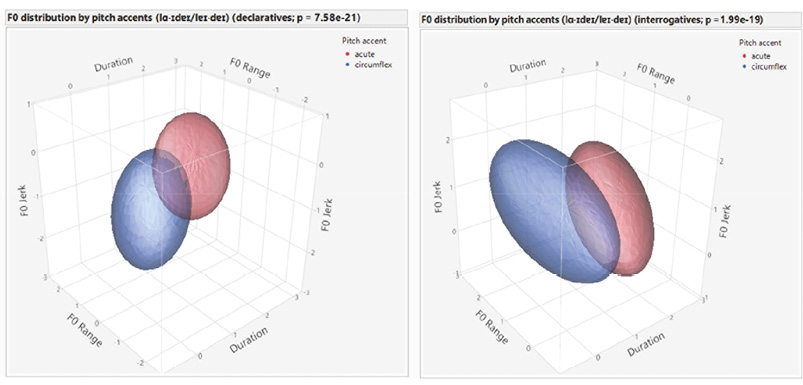
Figure 8. Dependence of dynamic F0 parameters of [1ˈlɑˑɪdɐɪ] and [2ˈlɐɪˑdɐɪ] on pitch accents in different intonation conditions (left graph – declarative intonation, right – interrogative; +focus, examples D1–D4)
In the 3D space, the duration scale remains the primary separator for the data (Fig. 8). These trends appear entirely unaffected by the grouping of intonation types. The red ellipses, representing acute diphthongs, are shifted upward along the temporal axis, creating a distinct visual separation. Significantly higher statistical values corroborate this observation. However, it remains challenging to determine from the graphical data alone whether corresponding distributions in F0 acceleration and F0 jerk mark these quantitative differences in diphthongs.
As accent distinction increases, the model‘s overall explanatory power rises significantly (Pillai’s Trace, p=4.2e–202), confirming that all independent variables and their interactions account for the majority of the variation in the data. While the influence of word stress and focus on dynamic F0 parameters remains unsurpassed and unidirectional (p=4.7e–118 and p=4.6e–102, respectively), it is noteworthy that the accent factor (p=2.65e–73) slightly exceeds intonation type (p=3.81e–59) in this domain (Tab. 3). However, the statistical significance of direct prosodic element interaction is considerably lower. Despite the visual impressions in 3D graphs, the probability of distinguishing pitch accents without accounting for intonation remains relatively low (p=0.00018). This reinforces the pervasive leveling effect of intonation on accentual opposition in question. Furthermore, the relationship between acute and circumflex diphthongs and sentence focus is ambiguous. While emphasis independently dominates the F0 dynamics in stressed syllables (deviations: duration –0.881, F0 acceleration –0.288, and F0 jerk –0.020), its interaction with accents appears to allow for some degree of differentiation (p=8.278e–7). These numbers cast doubt on the inverted properties of pitch accents. If these MANOVA results are accurate, they suggest that in prosodically weak phrase positions, acute diphthongs are shorter and weaklier phonated than circumflexed (deviations: duration –0.101, F0 acceleration +0.080, F0 jerk –0.114), contradicting recent statements. If emphasis can suppress the F0 dynamics of intonational types, pitch accents are unlikely to be an exception. These variations in F0 patterns suggest once again that pitch accents have unstable prosodic weight. Consequently, greater evidential value is assigned to tendencies that remain resistant to changes in phonemic syllable structure. These include the primary power of stress to generate phonational impulses and the capacity of interrogative intonation to trigger more active phonation in stressed syllables without altering vowel quantity.
|
Factor/interaction |
MANOVA (Pillaiʼs Trace) |
Duration |
F0 Slope |
F0 Jerk |
|---|---|---|---|---|
|
Pitch accent (acu.) |
p = 2.65e–73 |
+0.477 |
–0.154 |
+0.140 |
|
Intonation type (inter.) |
p=3.81e–59 |
–0.098 |
+0.288 |
+0.541 |
|
Focus (–) |
p=4.6e–102 |
–0.881 |
–0.288 |
–0.020 |
|
Word stress (acu.+circ.)(str.) |
p=4.7e–118 |
+0.521 |
+0.282 |
+0.138 |
|
Pitch accent (acu.)*Intonation type (inter.) |
p=0.00018 |
+0.021 |
–0.091 |
–0.115 |
|
Pitch accent (acu.)*Phrasal stress (–) |
p=8.278e–7 |
–0.101 |
+0.080 |
–0.114 |
|
Focus (–)*Intonation type (inter.) |
p=7.12e–36 |
–0.0003 |
–0.151 |
–0.559 |
|
Word stress (str.)*Intonation type (inter.) |
p=5.12e–55 |
–0.058 |
–0.081 |
+0.446 |
|
Word stress (str.)*Focus (–) |
p=1.64e–41 |
–0.236 |
+0.013 |
–0.182 |
Table 3. Summary of the influence of prosodic factors on acoustic parameters [1ˈlɑˑɪdɐɪ] and [2ˈlɐɪˑdɐɪ]
4.4 [1ˈlɑˑɪdoː] ʻis throwingʼ and [2ˈlɐɪˑdoː] ʻwire, cableʼ
Replacing the final syllable in the minimal pair [ɐɪ] with [oː] does not fundamentally alter the results. The previous scenario repeats: the dynamic F0 profiles in the illustrative examples remain strikingly similar, while the quantitative non-identity of the diphthongs primarily drives the visual impression of distinctiveness (Fig. 9). Acute diphthongs are consistently longer, supporting the assumption of a more continuous tonal trajectory for these pitch accents. However, as previously noted, drawing broader conclusions from isolated examples is inherently risky. It is essential to determine whether these observed correlates remain robust when other prosodic elements are taken into account.
![Two stacked pitch contour plots displaying Fundamental Frequency (F0 in Hz) on the y-axis against Time (in seconds) on the x-axis for the Lithuanian word “laido”. The top plot shows the acute pitch accent ([1ˈlɑˑɪdoː]) featuring a low-rising F0 trajectory from around 100 Hz to 140 Hz over the initial consonant and stressed diphthong, followed by a fall in the final syllable. The bottom plot shows the circumflex pitch accent ([2ˈlɐɪˑdoː]) displaying a strikingly similar rising-falling F0 contour reaching around 150 Hz over the diphthong before declining to 90 Hz in the final vowel.](https://www.journals.vu.lt/kalbotyra/lt/article/download/45507/version/41651/43207/144563/Svageris-9_pav.jpg)
Figure 9. Illustrative F0 contours for [1ˈlɑˑɪdoː] (acute; above) and [2ˈlɐɪˑdoː] (circumflex; below) (D1, declarative intonation, +focus)
The three-dimensional scatter plots presented below (Fig. 10) serve as visual replicas of the graphs in the preceding subsection. Both high statistical significance and the minimal overlap of the confidence ellipses clearly evidence the quantitative disparity between acute and circumflex diphthongs. If this analysis were restricted solely to duration measurements for these specific diphthongs, one could firmly conclude that the phonetic basis of Lithuanian pitch accents is exclusively quantitative. However, any dependence of dynamic F0 variation on both acute and circumflex remains imperceptible in these graphs, as observed in all previous examples. Had an alternative trend existed, it would have manifested as a distinct displacement of the data arrays along the F0 acceleration and F0 jerk axes (compare once again with Fig. 1).
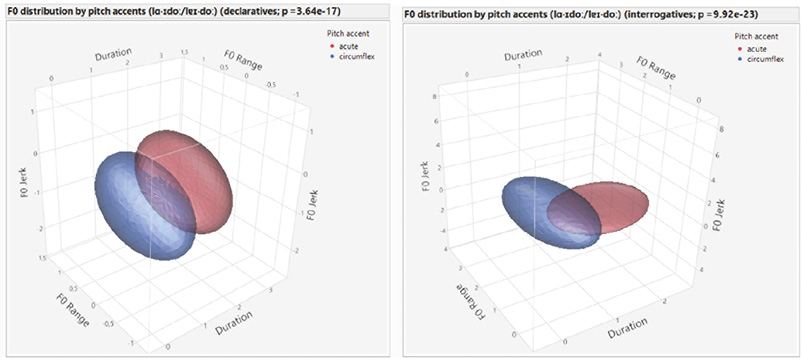
Figure 10. Dependence of dynamic F0 parameters of [1ˈlɑˑɪdoː] and [2ˈlɐɪˑdoː] on pitch accents in different intonation conditions (left graph – declarative intonation, right – interrogative; +focus, examples D1–D4)
|
Factor/interaction |
MANOVA |
Duration |
F0 Slope |
F0 Jerk |
|---|---|---|---|---|
|
Pitch accent (acu.) |
p=3.18e–82 |
+0.447 |
–0.076 |
+0.117 |
|
Intonation type (inter.) |
p=3.72e–61 |
–0.132 |
+0.458 |
+0.452 |
|
Focus (–) |
p=5e–112 |
–0.978 |
–0.384 |
–0.077 |
|
Word stress (acu.+circ.)(str.) |
p=2.41e–151 |
+0.586 |
+0.290 |
+0.118 |
|
Pitch accent (acu.)*Intonation type (inter.) |
p=0.784 |
+0.002 |
–0.027 |
–0.021 |
|
Pitch accent (acu.)*Phrasal stress (–) |
p=3.78e–7 |
–0.049 |
+0.158 |
–0.110 |
|
Focus (+)*Intonation type (inter.) |
p=2.8e–45 |
+0.055 |
–0.072 |
+0.339 |
|
Word stress (str.)*Intonation type (inter.) |
p=6.52e–22 |
–0.087 |
+0.102 |
+0.311 |
|
Word stress (str.)*Focus (–) |
p=2.41e–43 |
–0.299 |
+0.017 |
–0.249 |
Table 4. Summary of the influence of prosodic factors on acoustic parameters [1ˈlɑˑɪdoː] and [2ˈlɐɪˑdoː]
The statistical results reinforce the established hierarchical pattern. Although the MANOVA model demonstrates high overall explanatory power (Pillai’s Trace p=3.7e–193), the categorical distinctiveness of pitch accents remains unresolved. While the statistical probability of a difference between acute and circumflex appears significant in a general sense (p=3.18e–82), this factor fails to reach the higher hierarchical status of word stress and emphasis (p=5e–112 and p=2.41e–151, respectively; Tab. 4). Crucially, the interaction between these factors is not statistically significant (p=0.784), suggesting that the visual separation observed in graphs would vanish if the data were integrated into a single space. This is largely due to interrogative intonation, which triggers such high phonational activation (duration –0.132, F0 acceleration +0.458, and F0 jerk +0.452 p=3.72e-61) that it overshadows the quantitative contribution of accents. Paradoxically, they appear most distinguishable in weak phrase positions, yet only when their acoustic parameters reverse – specifically, when acute diphthongs lose their quantitative advantage. Such instability suggests that these correlates are symptoms of phonetic pitch accent dependence on other prosodic elements rather than their acoustic specificity. The statistically non-significant interaction between pitch accent and intonation type (p=0.784) clearly indicates that the influence of intonation is uniform across accent types, suggesting that acute-circumflex opposition undergoes neutralization within the broader intonational context. Distinctive properties must remain invariant in prosodically strong positions to be considered relevant. The robust power of stress to (de)activate phonation persists across intonation and pitch accents, providing stable statistical numbers and a reliable phonetic interpretation. Overall, the statistical distribution of data suggests a broader conclusion: in natural speech, phonational effort is prioritized at the phrase level, then at the word level, and finally at the syllable level. Because the functional spectrum of intonation spans pragmatic and emotional aspects of the speech, its phonational cost is higher, leading to a reduced concentration of effort on lower-ranking elements such as syllable-level accents. While alternative statistical models might offer different perspectives, the current empirical evidence suggests that the distinctiveness of pitch accents lacks a stable phonetic basis in the dynamic F0 space.
4.5 [1ˈmʲɪnʲtʲɪ] ʻto pedalʼ and [2ˈmʲɪnʲˑtʲɪ] ʻto guess a riddleʼ
The distribution of acoustic parameters in the final minimal pair remains consistent with the preceding arguments. Although the illustrative F0 curves might suggest a slightly more substantial phonational effort in acute diphthongs, it is important to note that the break in the F0 contour is primarily influenced by the unequal sonority of the adjacent high front vowel [ɪ] and the nasal sonant [n] (Fig. 11). As articulation shifts to the nasal consonant, the energy spectrum weakens noticeably. A closer examination of the illustrations reveals that this F0 break is present in both cases; the visual distinction arises primarily from the wider tonal range of the acute diphthong. This raises the question of whether such variation is a phonetic marker of phrase prominence – intended to highlight the stressed syllable – or a property of the pitch accent itself. Given that the general rising-falling F0 contour is consistent across both types, it is more likely that the increased F0 acceleration is intonational in nature rather than a specific cue of the syllable accentuation.
![Two stacked pitch contour plots displaying Fundamental Frequency (F0 in Hz) on the y-axis against Time (in seconds) on the x-axis for the Lithuanian word „minti“. The top plot shows the acute pitch accent ([1ˈmʲɪnʲtʲɪ]) featuring a pronounced rising F0 trajectory from around 100 Hz to a peak near 200 Hz over the initial consonant and stressed diphthong, followed by a steep fall in the final syllable. The bottom plot shows the circumflex pitch accent [2ˈmʲɪnʲˑtʲɪ]) displaying a lower-rising F0 contour peaking at around 140 Hz over the stressed sequence before declining to 90 Hz in the final syllable.](https://www.journals.vu.lt/kalbotyra/lt/article/download/45507/version/41651/43207/144565/Svageris-11_pav.jpg)
Figure 11. Illustrative F0 contours for [1ˈmʲɪnʲtʲɪ] (acute; above) and [2ˈmʲɪnʲˑtʲɪ] (circumflex; below) (D1, declarative intonation, +focus)
The 3D data distribution confirms these assumptions (Fig. 12). Without the quantitative differences characteristic of open-vowel diphthongs, the phonetic space for the distinct expression of pitch accents is significantly reduced. Even in focused positions, the acute and circumflexed diphthongs do not differ substantially: for declarative intonation, p=0.026, and for interrogative intonation, p=0.1273. The confidence ellipses overlap heavily, and the data fail to cluster into separate dynamic F0 patterns. Because this distribution fundamentally mirrors the profiles observed in the first two minimal pairs [1ˈkoːʃʲeː]/[2ˈkoːʃʲeː] and [1ˈkoːʋɑː]/[2ˈkoːʋɑː], it provides additional grounds for a more critical assessment of the phonetic properties implied by the statistical numbers in the [1ˈlɑˑɪdoː]/[2ˈlɐɪˑdoː] and [1ˈlɑˑɪdɐɪ]/[2ˈlɐɪˑdɐɪ] pairs.
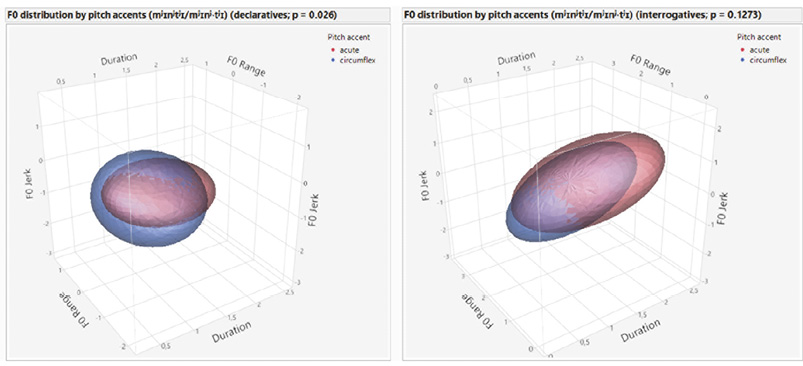
Figure 12. Dependence of dynamic F0 parameters of [1ˈmʲɪnʲtʲɪː] and [2ˈmʲɪnʲˑtʲɪ] on pitch accents in different intonation conditions (left graph – declarative intonation, right – interrogative; +focus, examples D1–D4)
|
Factor/interaction |
MANOVA (Pillaiʼs Trace) |
Duration |
F0 Slope |
F0 Jerk |
|---|---|---|---|---|
|
Pitch accent (acu.) |
p=1.613e–7 |
–0.044 |
–0.028 |
+0.166 |
|
Intonation type (inter.) |
p=6.3e–65 |
–0.033 |
+0.498 |
+0.289 |
|
Focus (–) |
p=6.4e–139 |
–0.710 |
–0.334 |
+0.397 |
|
Word stress (acu.+circ.)(str.) |
p=1.1e–260 |
+0.796 |
+0.452 |
–0.085 |
|
Pitch accent (acu.)*Intonation type (inter.) |
p=0.979 |
–0.004 |
–0.009 |
–0.003 |
|
Pitch accent (acu.)*Phrasal stress (–) |
p=0.004 |
–0.056 |
–0.006 |
+0.123 |
|
Focus (+)*Intonation type (inter.) |
p=1.7e–42 |
0.001 |
–0.447 |
–0.336 |
|
Word stress (str.)*Intonation type (inter.) |
p=1.74e–15 |
–0.027 |
+0.309 |
+0.082 |
|
Word stress (str.)*Focus (–) |
p=6.19e–51 |
–0.201 |
–0.145 |
+0.104 |
Table 5. Summary of the influence of prosodic factors on acoustic parameters [1ˈmʲɪnʲtʲɪ] and [2ˈmʲɪnʲˑtʲɪ])
The general MANOVA results further diminish the relevance of the pitch accent factor (Tab. 5). While the overall model successfully accounts for the variation in the data (Pillai‘s Trace p=4.6e–218), justifying the association of dynamic F0 parameters with prosodic elements, the change in syllable structure has caused the acute-circumflex factor to revert to the lowest hierarchical position (p=1.613e–7). As previously observed, the interpretation issues regarding the phonetic basis follow directly from this hierarchical subordination. Although a general statistical probability for distinguishing acute from circumflex diphthongs persists, this distinction disappears when examining their interaction with intonation type (p=0.979). The logic is straightforward: properties identified in isolated positions are leveled as soon as the prosodic environment varies according to other factors. Consequently, such correlates lack the universality required for distinctive status. In contrast, the remaining group of dominant factors – specifically word stress and focus – retains effect size on the phonetic distribution that requires no further proof. Since the trends in this data set remain consistent with previous observations, further detailed commentary is unnecessary. Phrase emphasis and word stress (p=6.4e–139 and p=1.1e–260, respectively) are confirmed as the primary drivers of phonational activation. Interrogative intonation operates in the same phonetic direction and, notably, exhibits significant interplay of factors: stressed syllables produced with interrogative intonation receive additional phonational reinforcement. In summary, the dominant stress and intonation factors within the prosodic hierarchy establish a phonetic space, within which the expression of pitch accents appears only as a secondary, context-dependent, and statistically irregular phenomenon. In other words, from the perspective of the F0 dynamics, the pitch accents in Standard Lithuanian appear to be neutralized.
5 Conclusions
The empirical data, analyzed using a multivariate analysis of variance (MANOVA) and interpreted in terms of F0 dynamicity, provide evidence for the phonetic neutralization of pitch accents in Standard Lithuanian. This conclusion is supported by several key arguments:
1. Low hierarchical positioning and statistical insignificance. From a statistical standpoint, pitch accents in most cases occupy the lowest position within the prosodic hierarchy. Multivariate analysis of variance reveals that word stress and focus, alongside intonation, are the statistically dominant factors governing the distribution of acoustic parameters (duration, F0 acceleration, and F0 jerk) – i.e., effectively controlling the (de)activation of phonation. In this regard, the effect size of pitch accents is the weakest, frequently failing to reach statistical significance (p>0.05).
2. Weakness and instability of interaction with other prosodic elements: The interaction between pitch accents and other prosodic elements is characterized by a lack of stability. More importantly, the statistically non-significant interaction between pitch accent and intonation type demonstrates that the acute-circumflex distinction lacks autonomous phonetic correlates. Instead, pitch accent properties are suppressed or modified by the intonational contours, failing to maintain invariance even in prosodically prominent positions.
3. Inconsistent acoustic correlates: The dependency of acoustic correlates (duration, F0 acceleration, and F0 jerk) on pitch accent type lacks clarity and consistency. The dynamic F0 profiles do not exhibit stable, invariant patterns across different prosodic environments, suggesting that the perceived distinctiveness of accents is often an artifact of inherent vowel quantity or stress rather than a systematic and independent tonal opposition.
Author contributions
Gintautas Tamulevičius: software, data curation.
Evaldas Švageris: conceptualization, methodology, formal analysis, investigation, writing – original draft, writing – review & editing.
Abbreviations and symbols
acu. – acute accent
circ. – circumflex accent
+ – focused
inter. – interrogative intonation
str. – stressed syllable
– – unfocused
References
Adank, Patti, Roel Smits & Roeland van Hout. 2004. A comparison of vowel normalization procedures for language variation research. The Journal of the Acoustical Society of America 116 (5), 3099–3107. https://doi.org/10.1121/1.1795335
Atkočaitytė, Daiva. 2002. Pietų žemaičių raseiniškių prozodija ir vokalizmas. [Prosody and vocalism in Southern Žemaitian]. Vilnius: Lietuvių kalbos institutas.
Bacevičiūtė, Rima. 2004. Šakių šnektos prozodija ir vokalizmas. [Prosody and vocalism of Šakiai subdialect]. Vilnius: Lietuvių kalbos institutas.
Bacevičiūtė, Rima. 2011. Vakarų aukštaičių kauniškių monoftongų priegaidžių fonetiniai požymiai. [Phonetic features of the monophthongal pitch accents in Western Aukštaitian subdialect of Kaunas dialect]. Baltistica 46, 13–26. http://dx.doi.org/10.15388/baltistica.0.7.30
Bakšienė, Rima. 2016. Vakarų aukštaičių kauniškių priegaidės: Marijampolės šnekta. [Pitch accents of Western Higher Lithuanians of Kaunas region: The subdialect of Marijampolė]. Vilnius: Lietuvių kalbos institutas.
Bezzenberger, Adalbert. 1885. Lettische Dialekt Studien. Göttingen: Vandenhoeck & Ruprecht’s Verlag.
Bielenstein, August. 1863. Die Lettische Sprache nach ihren Lauten und Formen. Berlin: Ferd. Dümmler’s Verlagsbuchhandlung (Harrwitz und Gossmann).
Boersma, Paul. 2018. The history of the Franconian tone contrast. Segmental structure and tone. Wolfgang Kehrein, Björn Köhnlein, Paul Boersma & Marc Oostendorp, eds. Berlin, Boston: De Gruyter. 27–97. https://doi.org/10.1515/9783110341263-003
De Jong, Kenneth, Mary E. Beckman & Jan Edwards. 1993. The interplay between prosodic structure and coarticulation. Language and Speech 36 (2, 3), 197–212. https://doi.org/10.1177/002383099303600305
Eager, David. 2016. Beyond velocity and acceleration: jerk, snap, and higher derivatives. European Journal of Physics 37, 1–11. http://dx.doi.org/10.1088/0143-0807/37/6/065008
Endzelīns, Jānis. 1938. Latviešu valodas skaņas un formas. Rīga: Valsts papīru spiestuve un naudas kaltuve.
Erickson, Donna & Oliver Niebuhr. 2023. Articulation of prosody and rhythm: Some possible applications to language teaching. Proceedings of the 13th International Conference of Nordic Prosody. Denmark: Sonderborg. 1–45. https://doi.org/10.2478/9788366675728-001
Eriksson, Anders. 2012. Aural/acoustic vs. automatic methods in forensic phonetic case work. Forensic Speaker Recognition. Amy Neustein & Hemant A. Patil, eds. New York: Springer. 41–69. https://doi.org/10.1007/978-1-4614-0263-3_3
Frings, Theodor. 1934. Der rheinische und der litauische accent. Beiträge zur Geschichte der deutschen Sprache und Literatur (PBB) 58, 110–149. https://doi.org/10.1515/bgsl.1934.1934.58.110
Gerullis, Georg. 1930. Litauische Dialektstudien. Leipzig: Markert & Petters Verlag.
Girdenis, Aleksas. 2003. Teoriniai lietuvių fonologijos pagrindai. [Theoretical Foundations of Lithuanian Phonology]. Vilnius: Mokslo ir enciklopedijų leidybos institutas.
Girdenis, Aleksas. 2008. Frydricho Kuršaičio priegaidės (akustinė rekonstrukcija). [Pitch accents of Friedrich Kurschat (acoustic reconstruction)]. Baltistica 43 (3), 381–404. https://doi.org/10.15388/Baltistica.43.3.1394
Grigorjevs Juris & Andris Remerts. 2004. Latviešu literārās valodas intonāciju funkcionalitāte mūsdienās. [Functionality of Syllable Tones in the Latvian Literary Language Nowadays]. Baltu filoloģija 8 (2), 33–50.
Johnson, Keith. 2008. Quantitative Methods in Linguistics. Malden: Blackwell Publishing.
Kardelis, Vytautas. 2017. Trys klausimai dėl lietuvių kalbos prozodinės sistemos. [Three issues concerning the Lithuanian prosodic system]. Lietuvių kalba 11, 1–12. https://doi.org/10.15388/LK.2017.22546
Kazlauskas, Jonas. 1966. Fonologinės kirčio raidos baltų kalbose interpretacija. [Interpretation of phonological word stress development in the Baltic languages]. Baltistica 2 (2), 119–131. https://doi.org/10.15388/baltistica.2.2.855
Kazlauskas, Jonas. 1968. Lietuvių kalbos istorinė gramatika. [A historical grammar of Lithuanian language]. Vilnius: Mintis.
Kazlauskienė, Asta & Regina Sabonytė. 2018. F0 in Lithuanian: The indicator of stress, syllable accent, or intonation? Human Language Technologies – The Baltic Perspective: Proceedings of the Eighth International Conference Baltic HLT 2018. Kadri Muischnek & Kaili Müürisep, eds. (Frontiers in Artificial Intelligence and Applications 307.) Amsterdam: IOS Press. 55–62. https://doi.org/10.3233/978-1-61499-912-6-55
Kazlauskienė, Asta, Sigita Dereškevičiūtė & Regina Sabonytė. 2023. Bendrinės lietuvių kalbos intonacija: frazės centras, ribos ir žymėjimas. [Standard Lithuanian intonation: Phrase center, boundaries, and marking]. Kaunas: Vytauto Didžiojo universitetas.
Kudirka, Robertas. 2005. Lietuvių bendrinės kalbos monoftongų priegaidžių akustiniai požymiai. [Acoustic features of monophthong pitch accents in Standard Lithuanian]. Acta linguistica Lithuanica 52, 1–21.
Kurschat, Friedrich. 1849. Beiträge zur Kunde der littauischen Sprache. 2. Heft. Laut– und Tonlehre der littauischen Sprache. Königsberg.
Kurschat, Friedrich. 1876. Grammatik der Littauischen Sprache. Halle: Verlag der Buchhandlung des Waisenhauses.
Laigonaitė, Adelė. 1958. Dėl lietuvių kalbos kirčio ir priegaidės supratimo. [Understanding word stress and pitch accents in the Lithuanian Language]. Kalbotyra 1, 71–100. https://doi.org/10.15388/Knygotyra.1958.18489
Lehiste, Ilse. 1970. Suprasegmentals. Cambridge: The M.I.T. Press.
Lehiste, Ilse & Pavle Ivić. 1986. Word and sentence prosody in Serbocroatian. London: Cambridge.
Leskauskaitė, Asta. 2004. Pietų aukštaičių vokalizmo ir prozodijos bruožai. [Vocalic and prosodic features of the Southern Aukštaitian dialects]. Vilnius: Lietuvių kalbos institutas.
Lindblom, Björn. 1963. Spectrographic study of vowel reduction. Journal of the Acoustic Society of America 33, 1773–1781. https://doi.org/10.1121/1.1918816
Lindblom, Björn. 1990a. Models of phonetic variation and selection. Perilus 11, 65–100.
Lindblom, Björn. 1990b. Explaining phonetic variation: A sketch of the H&H theory. Speech Production and Speech Modelling. William J. Hardcastle and Alain Marchal, eds. Dordrecht: Kluwer Academic Publishers. 403–439. https://doi.org/10.1007/978-94-009-2037-8_16
Miliūnaitė, Rita. 2018. Kalbos normos ir jų savireguliacija interneto bendruomenėje. [Language norms and their self–regulation in the internet community]. Vilnius: Lietuvių kalbos institutas.
Pakerys, Antanas. 1982. Lietuvių bendrinės kalbos prozodija. [The prosody of Standard Lithuanian]. Vilnius: Mokslas.
Passy, Paul. 1890. Étude sur les changements phonétiques et leurs caractères généraux: thèse pour le doctorat, présentée à la Faculté des lettres de Paris. Paris: Firmin-Didot.
Rietveld, Toni & Roland van Hout. 2005. Statistics in Language Research: Analysis of Variance. Berlin, New York: Mouton de Gruyter.
Sabonytė, Regina. 2022. Būdingieji bendrinės lietuvių kalbos intonacijos modeliai. [The typical intonation patterns of standard Lithuanian], (ms.). Humanitarinių mokslų daktaro disertacija. Kaunas: Vytauto Didžiojo universitetas.
Sabonytė, Regina & Yonatan Goldstein. 2021. F0 and duration changes in unstressed vs. stressed syllables connected to postlexical stress and sentence type in Standard Lithuanian. Perspectives on Nordic Phonology: Selected Papers from the Fifth Fonologi i Norden Meeting 45 (1), 119–128.
Saussure, Ferdinand de. 2012. Baltistikos raštai. Travaux baltistiques. Daniel Petit & Bonifacas Stundžia, eds. Vilnius: Vilniaus universiteto leidykla.
Sonderegger, Morgan & Márton Sóskuthy. 2025. Advancements of phonetics in the 21st century: Quantitative data analysis. Journal of Phonetics 111, 1–30. https://doi.org/10.1016/j.wocn.2025.101415
Švageris, Evaldas. 2013. Monoftongų priegaidžių skirtumai jaunimo kalboje. [Distinctive features of syllable tones in monophthongs: An investigation of the language of the younger generation]. Jaunimo kirčiavimo polinkiai: bendrinės kalbos normos ir vartosenos tendencijos. Straipsnių leidinys. Asta Kazlauskienė, red. Kaunas: Vytauto Didžiojo universiteto leidykla. 77–90.
Švageris, Evaldas. 2020. Intonacijos įtaka akustinei priegaidžių raiškai: eksperimentinis latvių bendrinės kalbos tyrimas. [Effect of intonation on phonetic realization of lexical tones: Experimental investigation of standard Latvian]. Baltistica 55 (1), 119–157. https://doi.org/10.15388/Baltistica.55.1.2414
Švageris, Evaldas. 2021. Prozodinių baltų kalbų elementų interakcijos tyrimo tęsinys: audicinė latvių kalbos priegaidžių analizė. [Further investigation of the interaction of prosodic elements in the Baltic languages: A perception-based analysis of Latvian lexical tones]. Baltistica 56 (2), 271–305. https://doi.org/10.15388/Baltistica.56.2.2435
Švageris, Evaldas. 2022a. Kirčio ir intonacijos fonetinė interakcija: bendrinės lietuvių kalbos tyrimas. [The phonetic interaction of stress and intonation: A study of Standard Lithuanian], Baltistikos platybėse. Baltų kalbotyros straipsnių rinkinys, skirtas prof. Bonifaco Stundžios 70 metų jubiliejui 341–362. https://doi.org/10.15388/Baltistikos_platybese.2022.21
Švageris, Evaldas. 2022b. Akustinė lietuvių ir latvių kalbų kirčio struktūra: žvalgomasis tyrimas. [Acoustic correlates of word stress in standard Lithuanian and Latvian: A pilot study]. Baltu filoloģija 31 (2), 71–96. https://doi.org/10.22364/bf.31.2.03
Švageris, Evaldas. 2023. The phonetic interaction of prosodic elements in the Baltic languages: A tentative theoretical model. Baltistica 58 (2), 195–224. https://doi.org/10.15388/Baltistica.58.2.2517
Švageris, Evaldas. 2025. A multifactorial analysis of phonetic word stress correlates in Standard Lithuanian: Verification of the prosodic element interaction model. Baltistica 60 (2), 323–354. https://doi.org/10.15388/baltistica.60.2.2576
Titze, Ingo. 2000. Principles of Voice Production. Iowa City: National Center for Voice and Speech.
Todorov, Emanuel & Michael I. Jordan. 2002. Optimal feedback control as a theory of motor coordination. Nature Neuroscience 5, 1226–1235. https://doi.org/10.1038/nn963
Vaitkevičiūtė, Valerija. 1995. Bendrinės lietuvių kalbos priegaidės. [Pitch accent in Standard Lithuanian]. Vilnius: Enciklopedija.
Van den Berg, Janwillem. 1958. Myoelastic–Aerodynamic Theory of Voice Production. Journal of Speech and Hearing Research 1 (3), 227–244. https://doi.org/10.1044/jshr.0103.227
Van Heuven, Vincent. 2018. Acoustic Correlates and Perceptual Cues of Word and Sentence Stress: Towards a Cross-Linguistic Perspective. The Study of Word Stress and Accent: Theories, Methods and Data. Rob Goedemans, Jeffrey Heinz & Harry van der Hulst, eds. Cambridge: Cambridge University Press. 15–59. https://doi.org/10.1017/9781316683101.002
Xu, Yi. 2019. Prosody, Tone and Intonation. The Routledge Handbook of Phonetics. 1st edn. William F. Katz & Peter F. Assmann, eds. New York: Routledge. 314–356. https://doi.org/10.4324/9780429056253
Xu, Yi, Santitham Prom-on & Fang Liu. 2022. The PENTA Model: Concepts, Use, and Implications. Prosodic Theory and Practice. Johanthan Barnes & Stefanie Shattuck, eds. Cambridge: The MIT Press. 307–407. https://doi.org/10.7551/mitpress/10413.003.0014
Zhang, Zhaoyan. 2016. Mechanics of human voice production and control. Acoustic Society of America 140 (4), 2614–2635. https://doi.org/10.1121/1.4964509
1 “There is no one-to-one correspondence between stress and any single acoustic parameter. Thus, there is also no automatic way to identify stressed syllables.” (Lehiste 1970, 110)
2 A tempo of 5–7 syllables per second is usually considered normal (Eriksson 2012, 41–69).
3 A return to dynamic F0 profiles also connects naturally to earlier descriptions of pitch accents. In 19th and early 20th century literature on Lithuanian, Latvian, Serbo-Croatian, and some Germanic languages, pitch accents were often characterized using dynamic categories such as stretching, falling, rising, breaking, sharpness, non-extendedness (Kurschat 1849, 38–44; 1876, 58–64; Bielenstein 1863, 228; Bezzenberger 1885; Gerullis 1930, 21–55; Frings 1934, 128; Endzelīns 1938, 18–19; Lehiste & Ivić 1986, 3–27; Grigorjevs & Remerts 2004, 33–50; Girdenis 2008, 381–404; Boersma 2018, 28–29).
4 The examples are transcribed according to the IPA symbols adapted to the Lithuanian language (see https://www.internationalphoneticassociation.org/IPAcharts/IPA_charts_T/IPA_charts_T.html).