Knygotyra ISSN 0204–2061 eISSN 2345-0053
2026, vol. 86, pp. 102–146 DOI: https://doi.org/10.15388/Knygotyra.2026.86.6
Individuality Recorded in the Early Modern Polish-Lithuanian Calendars
Arvydas Pacevičius
Vilnius University, Faculty of Communication
Department of Book, Media and Publishing Studies
Saulėtekio 9, building I, LT-10222, Vilnius, Lithuania
E-mail: arvydas.pacevicius@kf.vu.lt
ORCID: https://orcid.org/0009-0006-3657-2483
Waldemar Chorążyczewski
Nicolaus Copernicus University in Toruń,
Department of Archive Studies and Records Management
Institute of History and Archival Studies, Faculty of History
Gagarina 11, 87-100, Toruń, Poland
E-mail: wch@umk.pl
ORCID: https://orcid.org/0000-0002-0063-0032
Summary. This article examines Polish-Lithuanian calendars from the early modern period as egodocumentary sources. The aim of this research is to determine what methodology should be applied so that to more accurately identify a person’s individuality, identity, and private life as recorded in the owners’ handwritten notes (marginalia). Having spread in the second half of the 15th century as mass-printed books, calendars occupied a unique hybrid position – by combining printed astronomical and encyclopedic content with highly personal handwritten notes. Over time, calendars ‘broke free’ from the network of the academic elite and became a widely accessible means of communication used among the nobility, the clergy, and, ultimately, the broader literate public. They became an important medium for recording both public events and intimate personal experiences.
This article identifies three layers of information in calendars: the astronomical-calendrical layer, created by scientists, mathematicians, astrologers, and theologians; accompanying printed texts covering household management, politics, and collections of encyclopedic knowledge; and the layer of handwritten marginalia – which is the most distinctive and, from an egodocumentary perspective, the most significant layer, as these units of content were continuously created by the owners themselves. It is precisely this third layer that constitutes the main subject of the study. By using a comparative methodology which combines critical source analysis and historical contextualization, the authors analyze selected collections of calendars held by Polish and Lithuanian memory institutions, including the Jagiellonian Library in Kraków, the Czartoryski Library, and M. Mažvydas National Library of Lithuania.
Two case studies serve as the empirical core of the article. The first concerns an anonymous calendar from 1679, whose handwritten entries – recording weather observations, political events, financial dealings, and travel itineraries – allow the reader to reconstruct a detailed portrait of the author despite him remaining unidentified. A comparative analysis of these entries against the known diary of Jan Antoni Chrapowicki both confirms the credibility of the calendar record and illustrates the distinctive expressive habits of individual writers. The second case study examines the liturgical calendar of Jurgis Ambraziejus Pabrėža (1771–1849), the future Samogitian naturalist and Bernardine tertiary, whose 1815-dated entries blend economic records, regional historical chronicles, and concise autobiographical notes, revealing a complex intellectual and spiritual identity shaped by the turbulent history of the region.
The article situates these findings within the broader framework of egodocument studies, emphasizing that calendar entries – unlike diaries or memoirs – are spontaneous, unpolished, and therefore particularly candid records of personality. A set of calendars, maintained by one person across many years, constitutes an unintentional autobiography, capturing shifts in intellectual interests, emotional states, and worldview. The study also addresses key methodological challenges: the dispersed preservation of calendars across archival and library collections, the difficulties of establishing authorship and provenance, and the need for systematic critical editions of handwritten calendar records. The authors argue that calendars represent a prototype of modern personal recording devices and call for a more systematic scholarly engagement with this underutilized category of historical sources.
Keywords: calendars, handwritten notes, weather phenomena, egodocuments, privacy, personality, identity, autobiography.
Individualumas, užfiksuotas ankstyvųjų naujųjų laikų Lenkijos ir Lietuvos kalendoriuose
Santrauka. Straipsnyje nagrinėjami ankstyvųjų naujųjų laikų Lenkijos ir Lietuvos kalendoriai kaip egodokumentiniai šaltiniai. Siekiama nustatyti, kokią metodiką reikėtų taikyti, kad būtų galima tiksliau atpažinti žmogaus individualumą, tapatumą, kasdienybę ir privatų gyvenimą, užfiksuotą rankraštiniuose savininkų įrašuose (marginalijose). XV a. antrojoje pusėje išplitę kaip masiškai spausdinamos knygos, kalendoriai užėmė unikalią hibridinę padėtį – jungdami spausdintą astronominio ir enciklopedinio pobūdžio turinį su itin asmeniškomis rankraštinėmis pastabomis. Ilgainiui kalendoriai „išsivadavo“ iš elitinių akademikų tinklo ir tapo plačiai prieinama komunikacijos priemone, naudojama tarp bajorų, dvasininkų ir galiausiai platesnės raštingos visuomenės. Jie tapo svarbia medija fiksuoti tiek viešiems įvykiams, tiek intymiai asmeninei patirčiai.
Straipsnyje išskiriami trys informaciniai kalendorių sluoksniai: astronominis-kalendorinis, sukurtas mokslininkų, matematikų, astrologų ir teologų; lydimieji spausdinti tekstai, apimantys ūkio tvarkymą, politiką ir enciklopedinių žinių rinkinius; bei rankraštinis marginalijų sluoksnis – savičiausias ir egodokumentiniu požiūriu reikšmingiausias, nes jį kūrė patys savininkai. Būtent šis trečiasis sluoksnis ir sudaro pagrindinį tyrimo objektą. Pasitelkę lyginamąją metodologiją, jungiančią kritinę šaltinių analizę ir istorinį kontekstualizavimą, autoriai analizuoja atrinktus kalendorių rinkinius, saugomus Lenkijos ir Lietuvos atminties institucijose, tarp jų – Jogailaičių universiteto ir Čartoriskių bibliotekose Krokuvoje bei Lietuvos nacionalinėje Martyno Mažvydo bibliotekoje.
Du atvejų tyrimai sudaro empirinį straipsnio pagrindą. Pirmasis susijęs su anoniminiu 1679 metų kalendoriumi, kurio rankraštiniai įrašai, fiksuojantys oro stebėjimus, politinius įvykius, finansinius reikalus ir kelionių maršrutus, leidžia atkurti išsamų autoriaus portretą, nors pats jis lieka neatpažintas. Lyginamoji šių įrašų analizė, sugretinus juos su žinomu Jano Antonio Chrapovickio dienoraščiu, patvirtina kalendoriaus įrašų patikimumą ir kartu iliustruoja skirtingus atskirų autorių „kalendorinės“ raiškos įpročius. Antrasis atvejo tyrimas skirtas žemaičių mąstytojo, būsimojo gamtininko ir bernardinų tretininko Jurgio Ambraziejaus Pabrėžos (1771–1849) liturginio kalendoriaus 1815 metų įrašams. Jie jungia ekonominius užrašus, regioninę žemaičių savimonę atspindinčius istorinius įrašus ir glaustas autobiografines pastabas, atskleidžiančias sudėtingą intelektualinę ir dvasinę tapatybę, kurią formavo permaininga XVIII–XIX a. sandūros istorija.
Straipsnyje tyrimo rezultatai įtraukiami į platesnį egodokumentų studijų kontekstą, pabrėžiant, kad kalendorių įrašai – skirtingai nei dienoraščiai ar atsiminimai – yra spontaniški ir nenušlifuoti įrašai, todėl itin adekvačiai atspindi rašančiojo asmenybę. Vieno žmogaus per daugelį metų pildytas kalendorių rinkinys tampa netyčine autobiografija, fiksuojančia intelektualinių interesų, emocinių būsenų ir pasaulėžiūros pokyčius. Straipsnyje taip pat aptariami pagrindiniai metodologiniai iššūkiai: išsibarsčiusi kalendorių saugojimo geografija archyvų ir bibliotekų fonduose, autorystės ir kilmės nustatymo sunkumai bei poreikis sistemingai rengti kritinius rankraštinių kalendorių įrašų leidimus. Autoriai teigia, kad kalendoriai yra šiuolaikinių asmeninių įrašymo priemonių prototipas, ir ragina sistemiškiau moksliškai tirti šią nepakankamai išnagrinėtą istorinių šaltinių kategoriją.
Reikšminiai žodžiai: kalendoriai, rankraštiniai užrašai, privatumas, oro reiškiniai, egodokumentai, asmenybė, tapatybė, autobiografija.
Received: 2026 02 07. Accepted: 2026 06 30.
Copyright © 2026 Waldemar Chorążyczewski, Arvydas Pacevičius. Published by Vilnius University Press. This is an Open Access journal distributed under the terms of the Creative Commons Attribution Licence, which permits unrestricted use, distribution, and reproduction in any medium, provided the original author and source are credited.
Introduction
In the early modern period, calendars became a symbol of human control over time. The renowned creator of astrological horoscopes (genitures), mathematician, and physician Girolamo Cardano (1501–1576) wrote the following about time in his work “On Subtlety” (De Subtilitate, 1550): “While nothing ever belongs to it, everything is still in it, and it is omnipresent. It both generates everything and kills everything. It is the author of life and death. As the expectation of it is very long, so the memory of it is very short. Though it always accompanies us, we never recognize it. And though there is so much of it, it can never be repaired. Hence its loss is more serious and more trivial than that of any other thing”1. Cardano knew better than anyone else how difficult it is to understand and, by combining astrological predictions and natural phenomena, to control time. Calendars became a tool for time management and for planning one’s personal and public life. Also known as almanacs, they became firmly established as one of the most popular hybrid (printed and handwritten) media alongside the Bible and the Catechism, thanks to the opportunity they offered to write about oneself and for oneself2. Once printed, and taking horoscope predictions into account, the calendar served its owner as an advisor in planning economic activities, travels, starting a family, and maintaining good health. Marginalia left in these calendars bear witness to these and other aspects of personal and social life, reflecting their owners’ individuality, daily routines, and private lives3. It is believed that calendar entries, as ‘microhistorical clues’, can serve as “mediators between the past and the present”4. In the context of the digitization of cultural and historical heritage, calendars are regarded as “repositories of observations and records of everyday public and private life”5. From this perspective, the old calendars used for note-taking – which faced competition in the mid-18th century from The New Memoranda Book6, a more convenient pocket-sized calendar-notebook launched by Robert Dodsley – can be considered a prototype of the modern cell phone.
Subject and Methodology. This article discusses the possibilities of researching early modern calendars based on personal documents, highlighting the similarities in Polish and Lithuanian marginal writing within the Polish-Lithuanian Commonwealth and its continuity into the 19th century. The case study employs a comparative analysis of the content of calendar entries (an anonymous work from 16797; Jurgis Ambraziejus Pabrėža’s work from 18158) and diaries (Jan Antan Chrapovicki’s from the 17th century9). The egodocumentary aspect of the research refers to the individuality and self-expression of the authors of the calendar entries mentioned in the article’s title, which Jacob Presser associated with “those documents in which an ego deliberately or accidentally discloses or hides itself”10. This article, after reviewing the evolution of the calendar, changes in its structure, and the most important repositories of calendars, discusses their content by identifying three layers of information: 1. the calendar layer, created by astronomers, astrologers, mathematicians, and theologians, which divides time into years, months, and days; 2. the accompanying texts on the social and political world, household management practices, and encyclopedic scientific knowledge; and 3. the marginal layer, which, unlike the previous two, is repetitive and was specifically created by the owner after the calendar had been printed. This unique, handwritten content is analyzed by using a mixed methodology of critical source analysis and historical contextualization, which allows for the identification of the entries’ authorship, location, and intentions. From the perspective of book history and egodocument studies, the hybrid nature and intertextuality of the handwritten calendar entries – revealed through the connections between content and form – are of particular significance. This is a perspective in cultural history research that enables the analysis of the morphology and materiality of texts, based on the idea that the form chosen by the writer influences the content11. For example, a relevant question is how and when brief daily entries in calendars evolved into more extensive diaries or memoirs (as in the cases of the family of Radziwiłł, Teodoras Jevlašauskis (Fiodor Jevlašovskij), Michał Kossakowski, Motiejus Valančius, and others). In other words, handwritten entries in calendars should be analyzed not only in terms of authorship, identity, and the expression of personality, but also in terms of the migration of texts from one form to another and their materiality. With this perspective in mind, this article seeks to answer the question: What is the egodocumentary nature of calendars?
Sources. Identifying and utilizing calendars as historical sources for research is a problematic undertaking due to their aforementioned hybrid nature (they are both printed and manuscript media), which – regardless of the principle of provenance – has largely contributed to their dispersion. This problem is not limited to calendars alone but, instead, relates to the general conditions for the preservation of and access to personal documentary heritage in memory institutions. To address this issue, exploratory research was conducted to identify potential collections of calendars with marginalia based on bibliographic sources. The selection and analysis were carried out at: the Jagiellonian University Library in Kraków, which has been collecting the legacies of its professors since the 15th century; these are found in collections of old printed works12 or (less frequently) manuscripts13; the Czartoryski Library in Kraków, where calendars form a separate collection14; the Potocki15 and Sanguszko16 fonds at the National Archives of Kraków; the Ossoliński Library in Wrocław17; M. Mažvydas National Library of Lithuania18, and the Wroblewski Library of the Lithuanian Academy of Sciences19. In identifying individual copies and collections of calendars, secondary sources were consulted – including descriptions of calendars compiled by Józef Muczkowski20, Ludwik Birkenmajer21, Ananiasz Rojecki2222, and Żegota Pauli2323 – as well as excerpts from their marginalia, notes on the calendars’ owners, and other relevant information.
Research on the manuscript layer of calendars
Old calendars, including their manuscript layer became the subject of interest for researchers in the 19th century. Chronological priority belongs to Józef Muczkowski (1795–1858). The Jagiellonian Library preserves a manuscript historical treatise on the calendar24. In his work, J. Muczkowski addressed issues such as: the concept of time and its divisions, weeks, months and lunar years, free solar years, bound lunar years, time cycles used by the ancient Greeks, the Roman calendar, including the year of Romulus, the Numa year, the decemvirs’ year, the Julius Caesar year, movable feasts, various names for Sundays, the need for accurate marking of Easter time, the solar cycle, the division of months among the Romans, the method of marking the day of the month, the day of the week, the method of determining Easter time, the beginning of the year, the method of marking dates among Christians, and the Julian period.
Muczkowski based his knowledge, among other things, on the study of preserved calendars from previous years. On the title page of one of the manuscripts preserved to this day, we read: “The Krakow calendars, as a supplement to the knowledge of astronomy and astrology at the University of Krakow, were collected by Józef Muczkowski in August 1842” 25. These are index cards and rough drafts on the subject.
Secondly, we should mention Żegota Pauli (1814–1895), a historian, archaeologist and ethnographer. The copies of marginalia from old prints, which he painstakingly collected, have been preserved in a manuscript26. Żegota Pauli was able to use some of the materials collected by J. Muczkowski27 .
The third person worth mentioning is Ludwik Antoni Birkenmajer (1855–1929), who, at the turn of the 19th and 20th centuries, made handwritten notes from Kraków calendars dating back centuries28. Birkenmajer also collected biographical materials on Marcin Biem from Olkusz, the most famous observer of atmospheric phenomena in the 16th century29, and even attempted to write about him. One of the dust covers is entitled: “To M. Biem / The matter of calendar reform (general matters)”30.
Finally, Ananiasz Rojecki (1896–1978)31 left behind typewritten copies of his calendar entries. They are contained in six archival units that make up the Corpus Inscriptionum meteorologicarum Cracoviensium Saeculorum XV et XVI32. Rojecki was assisted in his work by Maria Kowalczyk (1925–2015), an employee of the manuscript department of the Jagiellonian Library, as evidenced by correspondence from 1967–1973 scattered throughout the aforementioned units of Rojecki’s legacy. At that time, she was not yet able to point out to the Warsaw researcher the copies of calendar entries made at the turn of the 19th and 20th centuries by Ludwik Antoni Birkenmajer, because they were not transferred to the Jagiellonian Library with the scholar’s entire legacy until 1973. It is of interest that Marian Biskup had already referred to Birkenmajer in a letter dated 4 April 1970 in Toruń33. He wrote to Rojecki: “as far as I remember, there are no mentions of the weather in Copernicus’ marginalia”. However, he advised him to look at two of Birkenmajer’s works on Copernicus34. Criticism of the authenticity and reliability of calendars as historical sources must be carried out separately for each layer, and, at the same time, calendars as a whole must not be lost – as they are specific cultural facts, objects whose final form was ultimately shaped by many authors.
At the end of 20th century and in the beginning of the 21st century, in literary and historical-cultural studies, the topic of handwritten additions to calendars appears less frequently. Maciej Janik, upon proposing a typology of calendars, mentions the criterion of commemorative capacity, which allows calendars to be divided into interleaved and non-interleaved ones35. Elsewhere, Janik notes that an interleaved calendar allows the reader to become a co-creator of the calendar as a book. This increases its attractiveness. Thanks to this potential, calendars are filled with family information, but also with information about nature, including the weather. Sometimes, the handwritten description of the travels of the Ruthenian voivode Jan Stanisław Jabłonowski prevailed over the printed text of the calendar36. Jabłonowski’s case was not unique; Janusz Wiśniowiecki will be discussed below, and future research will certainly add Michał Kazimierz Radziwiłł-Rybeńko (1702–1762) and other ‘Sarmatians’ to this list. Helena Bogdanow’s comment is highly relevant to this point: “An interesting source here could be the notes made by the reader on their pages. As we know, the existence of such notes is mentioned in one of the inventories discussed”37. The existence of such notes in calendars is evident from reading the calendars themselves, which are so numerous and scattered throughout archival and library collections.
The origin and evolution of calendars
Printed calendars appeared in the second half of the 15th century. They typically reached representatives of the intellectual elite, thereby becoming an indispensable element of their work. The level of education of the authors of calendar entries, their daily scientific activities, and interests guarantee a high degree of reliability of observations. These sources still exist today in the form of handwritten additions to old prints, their copies from the 19th or 20th century, and only a few of them have been published in print38. Printing and distributing calendars became a profitable business. The 18th-century calendars, edited by Jan Poszakowski and Marcin Poczobutt, could replace encyclopedias for most readers of the time, serving as sources of historical, astronomical, geographical, and other knowledge. Calendars partially served as magazines. For most residents, they were the only means of communication with the general public. Calendars reflected all the changes taking place in the political, cultural, spiritual, and economic life of the country, they influenced society, and played an important educational role39. Starting with the 16th century, calendars became an important printed social medium, and their blank pages provided a convenient way to mark important events, travel impressions, and notes on observed weather changes40.
The origin of calendars and their evolution to the present day has a special cultural dimension. The calendar itself can be considered a form of human control over time. The movement of the Moon and its phases are easily observable by everyone. These observations gave rise to the week, and to the month consisting of four weeks – a month passes from new moon to new moon, from new moon to full moon, i.e., half a month, or two weeks, which can be easily divided into weeks, with the dividing line being halfway between the Moon’s full moon and new moon. Counting weeks, combining them into larger wholes, calculating the year, and then the key moments of solstices and equinoxes requires in-depth knowledge and techniques for collecting and processing data. The calculation of time in the pre-literate period was a matter for chiefs and priests. Handwritten calendars remained a tool of an elite group of initiates. It was only printing, understood as the use of movable type for reproduction, and, consequently, the mass production of calendars, that transformed calendars from elite tools into egalitarian ones. Power over time passed from the hands of learned academics to the numerous hands of the educated elite (16th century), the literate masses of the nobility and bourgeoisie (17th–18th centuries), representatives of the clergy, and, finally, to the peasantry (19th century). The centuries mentioned here are, of course, approximate dates with blurred ‘edges’, and it would be easy to find deviations from them.
It should be remembered that printed books were initially expensive and struggled to replace handwritten books. Like any new technology, printing became cheaper over time. More and more paper mills were getting established, and paper became cheaper, but, at the same time, its quality deteriorated. Meanwhile, demand for calendars and printed materials in general increased as a result of the 16th-century school revolution and the progressive literacy of the entire population. From a pragmatic point of view, calendars were essential for travel planning, as they were linked to favorable astronomical alignments and weather forecasts. Prognostic calendars were called minutiae (pol. minucje)41. It is worth noting that their predictions were trusted more by reliable, and less critical recipients. For example, Wacław Potocki (1621–1696) wrote that we believe in minucje “despite the fear of annual solar eclipses”, and Andrzej Maksymilian Fredro (1620–1679) argued that “it is better to travel with a cloak [sleeveless coat]42 than with minutiae”43. Despite common-sense criticism, the calendar was recommended by, among others, David Frölich (1595–1648), author of a guide for travelers to be taken on their journeys, along with a notebook (Latin: pugillaris) 44.
The quantitative breakthrough can be traced back to the mid-17th century, whereas the 18th century saw a real boom in printed calendars. A chronological overview of calendars shows their rapid growth over time. In the Czartoryski Library, 19 calendars come from the 16th century, 29 from the 17th century, and as many as 454 from the 18th century45. Calendars were published in large print runs at an affordable price46. At that time, several tens of thousands of calendars were distributed throughout the country each year. Most of them have been lost, but fortunately, the more enlightened owners, who used them more intensively as a source of knowledge, but also as records of their own or their ancestors’ lives, tended to keep them. What remains is only a fraction of the whole, and yet an unimaginable number of calendars have survived.
Continuous entries in calendars – library or archival materials?
Even a preliminary analysis of the distribution of old calendars in the collections of libraries and archives indicated their considerable dispersion. However, it was decided that Kraków-based institutions deserved special attention. This is not surprising, given that Kraków was long a leading center for calendar production, and their use was extensively adopted by members of the university and court elite. The Jagiellonian Library has collected the largest number of calendars from the 15th and 16th centuries in the former Polish-Lithuanian Commonwealth. The Czartoryski Library, in turn, possesses a rich collection of calendars from the 17th and 18th centuries. Their exceptionally good condition was crucial for their use.
The results of the research into the Jagiellonian Library’s collections yielded the following list, which is presented in Table 1 below.
However, the provenance of most calendars, understood in the sense of the attribution to the the person who used them on a daily basis, rather than their later owners – collectors – remains unknown47. For example, out of 558 calendar items stored in the Czartoryski Library, we know the provenance of 68, which is as little as 12%48.
Table 1. Multi-year calendars from the Jagiellonian Library
|
Year |
Signature |
Author of the notes |
|---|---|---|
|
1461–1506 |
BJ Inc. 2614-2615 |
Anonymous |
|
1484–1498 |
BJ Inc. 2271 |
Leonard Vitreator, Stanisław Aurifaber |
|
1496–1531 |
BJ Inc. 2699 |
Mikołaj from Wieliczka, and Anonymous |
|
1499–1508 |
BJ Inc. 2704 |
Erazm Ciołek |
|
1499–1531 |
BJ Inc. 2272 |
Stanisław Aurifaber |
|
1499–1531 |
BJ Inc. 2697 |
Marcin Biem from Olkusz |
|
1501–1530 |
BJ Inc. 2702 |
Michał from Wrocław |
|
1506–1531 |
BJ Cim. 5516 |
Łukasz Noskowski |
|
1507–1531 |
BJ Cim. 5513 |
Kasper from Warsaw |
|
1507–1531 |
BJ Cim. 5514 |
Mikołaj Sokolnicki |
|
1507–1531 |
BJ Cim. 5515 |
Bernard from Biskupi |
|
1507–1531 |
BJ Cim. 5921 |
Anonymous |
|
1512–1519 |
BJ Cim. 5512 |
Valentine (Walenty), physician of Paweł Holszański, Bishop of Lutsk |
|
1518–1546 |
BJ Cim. 5526 |
Michał from Wiślica |
|
1519 |
BJ Cim. 4735 |
Marcin Biem from Olkusz |
|
1523–1524 |
BJ manuscript 2482 |
Mikołaj from Wieliczka |
|
1526–1528 |
BJ manuscript 813 |
Anonymous |
|
1532–1536 |
BJ Cim. 174 |
Filip Padniewski |
|
1532–1551 |
BJ Cim. 5527 |
Michał from Wiślica |
|
1534–1551 |
BJ Cim. 5521 |
Marcin Biem from Olkusz |
|
1534–1551 |
BJ Cim. 5530 |
Anonymous |
|
1544–1556 |
BJ Cim. 5528 |
Mgr Ravensis, Michał from Wiślica |
|
1544–1556 |
BJ Cim. 5925 |
Jan Lubocki (?) |
|
1554–1568 |
BJ Cim. 5520 |
Piotr Myszkowski |
|
1554–1568 |
BJ Cim. 5523 |
Stanisław Jakobejus, and Stanisław (Jan?) Muscenius |
|
1554–1570 |
BJ Cim. 5517 |
Anzelm Ephorinus |
|
1554–1600 |
BJ Cim. 5944 |
Stanisław Jakobejus |
|
1556–1606 |
BJ Cim. 8420 |
Mikołaj from Szadek, and Marcin Glicjusz from Pilzno |
|
1556–1606 |
BJ Cim. 8421 |
Jan Musceniusz, Jan Krzysztoporski, Stanisław Krzysztoporski |
|
1557–1575 |
BJ Cim. 5522 |
Marcin from Raciąż |
|
1564–1580 |
BJ Cim. 5531 |
Anzelm Ephorinus, Marcin Fox |
|
1569–1577 |
BJ Cim. 5525 |
Jan Ponętowski |
|
1595–1651 |
BJ manuscript 3047 i 3048 |
Jan Brożek |
Source: items listed in the table from the collections of the Jagiellonian Library, copies by Żegota Pauli (BJ, manuscript 5358), copies by Ludwik Antoni Birkenmajer (BJ, accession 506/73, accession 510/73, accession 511/73), copies by Ananiasz Rojecki (Polish Academy of Sciences Archives, Materials by Ananiasz Rojecki, ref. nos. 11–16).
A special phenomenon is those calendars that form compact collections thanks to consistent daily entries made by one and the same person over many years of successive editions of annual calendars. One such person was Janusz Antoni Wiśniowiecki (1678–1741), Castellan of Kraków. The Czartoryski Library holds his calendars from 1704, 1707, 1708, 1709, 1710, 1712, 1713, 1715, 1716, 1717, 1718, 1719, 1720, 1721, 1722, 1723, 1724, 1725, 1726, 1727, 1728, 1729, 1730, 1731, 1732, 1733, 1734, 1735, 1737, 1738, and 174049. Wiśniowiecki was not satisfied with the blank pages left between those printed by publishers. In order to express everything he wanted to say, he even glued several new pages in the appropriate places, which he painstakingly filled with handwritten text. Years particularly rich in notes alternate with years poorer in notes. A study of the life of the Castellan of Kraków may indicate a possible correlation between less literate years and some crises in Wiśniowiecki’s life, perhaps health-related? Regardless of this aspect, the handwritten layer of Wiśniowiecki’s calendars is so extensive that it is difficult to decide whether to classify them as library or archival materials. In the Czartoryski Library, calendars constitute a separate section alongside manuscripts and old prints. Wiśniowiecki himself or his heirs considered them to be part of the castellan’s archive and catalogued them as such.
Many calendars were found in the family and property files stored in the archives. Full registration of the calendars requires careful research. For example, in the National Archives in Kraków, calendars were found in the Potocki Archives from Krzeszowice50, but most of them were found in the Sanguszko Archives51. The latter can be treated as a kind of collection of calendars, similar to Wiśniowiecki’s, except that they were created by different authors from the same family. Similarly, calendar collections were formed in Lithuanian memory institutions. For example, the documents of the Kossakowski family were initially collected in the archives of the Vaitkuškis (Wojtkuszki) and Lyduokiai (Nidoki) manors, and, after the First World War, they gradually, in parts, ended up in the Lithuanian National M. Mažvydas Library52. The calendars of the first half of the 19th century, handwritten by Michał Kossakowski, the owner of Žeimiai Manor, are kept there53. Thus, calendars as a mixed – printed and handwritten – medium over time became part of the personal archives and libraries of the Polish-Lithuanian nobility. They were used not only as a means of time control and a source of information about natural phenomena, reflected in the printed content. The convenient form allowed to record more important events and personal impressions. Therefore, calendars as a historical source are a complex type of document with a multi-layered structure.
Calendar structure and the year 1582 reform
The first layer of information is the actual calendar, created by astronomers/ astrologers/ mathematicians, dividing time into years, months and days, assigning them predictable and essentially unchanging astronomical data on sunrises and sunsets, the moon, the positions of stars and other celestial bodies, and eclipses. The reliability of the astrological-astronomical layer is high, because the data provided within it are quantifiable, repeatable and mathematically verifiable. At the same time, however, these data reflect the astronomical knowledge of the time, and the problem is therefore the incompatibility of the Julian calendar with natural reality, which was eliminated by the Gregorian calendar reform. However, this reform, without reference to Pope Gregory, was introduced in various parts of the world over the following centuries.
Calendars from before 1582 contain astronomical observations indicating dates of phenomena such as solstices and equinoxes that differ from those calculated and printed in the calendars. The discrepancy between the Julian calendar and natural reality was observed by some scholars. An example can be found in one of the calendars, where ‘autumnus’ was recorded under the date 13 September 155354. There are many more such cases, which prove that both the creators of the calendars and some of their recipients belonged to the same academic community, and that the calendar was part of their research tools.
The reform of 1582 was intended to prevent this inconvenient inaccuracy. Preparations for it took many decades. Many scholars were involved in observations and calculations, including Nicolaus Copernicus. The introduction of the reform in 1582, when 4 October was followed by 15 October, carried out on the orders of the head of the Catholic Church, could not be easily accepted by Protestants and Orthodox Christians. From then on, knowledge about the place of origin of a given calendar, the environment in which it was created, the calculation of time in a given place, and the time used became extremely important.
The Polish-Lithuanian Commonwealth, by introducing the Gregorian calendar immediately, was ahead of the Habsburg countries, where the implementation of Gregory XIII’s decision expressed in the bull “Inter gravissimas” of 24 February 1582 was ordered by Emperor Rudolf II in 158355. The Protestant countries of the Reich decided to reform the calendar only in 1699, and this was done in such a way that, after 18 February 1700, 1 March immediately followed56.
The introduction of the Gregorian calendar in in the Polish-Lithuanian Commonwealth was a matter of the highest state importance. It was carried out through royal mandates sent throughout the country. Let us refer to one of them, intended for the city of Poznań57. The royal chancellery briefly and clearly explained what should be done in terms of time calculation – after 4 October, 15 October was to follow, thus skipping ten days. From the dorsal note of this act, we learn that the royal mandate, dated in Warsaw as of 17 August 1582, was brought to Poznań and handed over to the city authorities on 8 September 1582 by Jan Piotrowski, the royal secretary from Greater Poland, who was well known there. The city authorities therefore had almost four weeks to disseminate the royal order, which was an implementation of the papal order.
The Catholic nature of the calendar reform was one of its weaknesses. Although the legitimacy and excellence of this reform could not be denied, there was no question of it being accepted not only by non-Christians, but also by Christians of denominations other than Roman Catholicism. Therefore, the adoption of the Gregorian calendar by the non-Catholic world stretched into the 20th century. For the time being, two calendars were used in Europe – the Gregorian version and the Julian one, which could cause misunderstandings. The use of two calendars also causes research complications to this day. A ten-day difference in the dating of meteorological phenomena can be significant for assessing the weather conditions of a month or a season, which prompts the conversion of dates from the Julian calendar to the Gregorian calendar, which better corresponds to natural realities.
The introduction of the reformed calendar was not only achieved through papal bulls and royal decrees. It was also necessary to explain the idea of the calendar reform and how it would be implemented. October 1582 may have seemed particularly difficult from a technical point of view, as, after St. Francis’ Day on 4 October, 15 October followed, on which, exceptionally in that one year, the saints from the omitted days were to be commemorated58.
Texts accompanying the actual calendar – paratexts or metatexts?
The second layer of information in calendars consists of accompanying texts that are more or less closely related to the actual calendar, or not related to it at all. They may forecast the weather for specific seasons, months or even days with a degree of accuracy that amazes us today. They may provide information about the social and political world, ways of running a household, and finally, reliable, encyclopaedic scientific knowledge. This second layer of content is of greatest interest to literary scholars and cultural historians59.
Researchers of the world of calendars often come to the conclusion that calendars were bought not so much for their astronomical content as for their erudite and advisory content. Their authors were also academics, though not necessarily astrologers/astronomers. At a certain, quite precisely identifiable moment, in the middle of the Saxon period, there was a sudden shift towards serious texts popularizing particular fields of knowledge, and different ones each year. This made it possible, over many years, to compile a collection of calendars as a substitute for an encyclopaedia. The precursor of the new type of calendars – political or political-historical – was Jan Poszakowski (lit. Pašakauskis) in 173760. This marked a break with astrological predictions61. The new type of calendars promoted knowledge of agriculture, medicine, veterinary science, astronomy, geography, natural sciences, history and politics, but also attitudes to life and models of behavior62.
Handwritten notes in calendars – from notes to diaries
The third layer, unlike the previous two, which are repetitive, especially after using printing to create calendars in multiple copies, is unique. It is potentially created by every owner – the user of the calendar – by noting down memorable events. In the 16th century, based on calendar inscriptions (known as minucje), memoirs were written by the Navahrudak sub-judge Teodor Jewłaszewski (lith. Jevlašauskis, 1546–1619). He noted when lightning struck during his travels, or how, on 5 March 1586, while travelling to Kaunas and spending the night in Rykanty, “robbers almost killed me”63. Teofila Konstancja Radziwiłłówna-Morawska mentions the information recorded in the ‘Calendars’ in her diary from the trip to Western Europe in 1773–177464. The calendars in which the aforementioned M. K. Radziwiłł-Rybenko kept his diary form a large collection in the Central Archives of Historical Records in Warsaw (Archiwum Główny Akt Dawnych w Warszawie, AGAD). The original notes were made from February 1719 to the end of 1761 on the pages of the calendars which he bought each year. Later, the notes were bound together into one huge volume. Each year, the notes were transcribed into a copybook, which Rybeńko then authenticated with his signature65. M. K. Radziwiłł refers to such writing practices in his entry concerning the death of his wife in 1753, when he encourages all who read this calendar to say a triple prayer for the salvation of her soul66. In this way, calendars became popular and frequently used in everyday private life.
The form and content of these notes are unique, ranging from major political events and extreme natural phenomena to minor family and household events, or, for some unknown reason, notes about rain falling before noon and clearing up in the afternoon. Until recently, this layer has rarely been the subject of research. However, the situation is changing rapidly. Rafał Wójcik, while presenting his plan for editing calendar entries, referred to the predecessors of this interest in the persons of Antoni Karbowiak, Ludwik Antoni Birkenmajer and Henryk Barycz67. The plan was already based on some editorial experience – the first volume of the series68.
The question arises: why are calendar entries so popular? Was it our natural habit to record important events in a calendar that was always at hand? Was it the perverse and malicious desire to check the predictions? This would explain the weather notes. Or, perhaps, calendars simply met and continue to meet the need for memory? Calendars were and are always at hand, like prayer books, which also served memorial purposes even earlier.
Origin and problem of authorship
Since three layers of information have been distinguished in calendars, authorship must be equally complex. The communication (source) model suggests that the author of a text is not only the person who created the content and gave it a certain form, but also the person who is the expected addressee/recipient/reader of the message. In addition, the author is, in a sense, the entire social and cultural context in which the information process takes place.
The creators of the first and second layers of information were professors of the Kraków Academy, and later, also of the Vilnius and Zamość Academies, academic gymnasiums, Jesuit and Piarist colleges. In Kraków, the first calendar (single-sheet, wall-mounted) was published in 1473 for the following year69. The creation of calendars had a long tradition in Kraków. As early as in 1451, Marcin Król, founder of the Kraków school of mathematics and astronomy, began a series of Kraków astrological calendars. His student, Andrzej Grzymała from Poznań, was the author of a short work on compiling astrological calendars70. Also, in the 17th century, the Kraków Academy was famous for its astrological calendars, which were reprinted in many places across Europe71. When studying the egodocumentary nature and expression of individuality in calendars, it is extremely important to determine the authorship of handwritten marginal notes. Due to the nature of the source, the calendars specify the exact date of the event. Astronomical and erudite printed layers must be created in the year preceding the one for which the calendar is intended. Handwritten notes, which are of most interest to us due to their egodocumentary nature, should be created on an ongoing basis, and their dating can be precise to the month or even the day. Of course, it should be remembered that this can be a trap. Phenomena lasting many days, such as heavy winds or floods, recorded in inaccurately drawn brackets covering a series of days, sometimes have extreme dates that are difficult to determine. In addition, there is always the risk of using the first available space for notes. In general, however, the calendar format, used day after day, ensures precise dating.
The place of origin of calendars as printed works is easy to determine. It will not necessarily be Polish or Lithuanian centres. Oldest calendars used in Poland and Lithuania were published in Venice (1484)72 and Ulm (1499)73. Later, since calendars were initially produced almost exclusively by a monopoly group – professors of the Kraków Academy – it would be Kraków. With the growing demand for calendars, this monopoly became unsustainable. Calendars would also be produced in Lviv, Zamość, Vilnius, Gdańsk and an increasing number of other centres. However, the place of printing is usually easy to determine.
The situation is different when it comes to the handwritten layer of calendars. Only in the Jagiellonian era did almost all entries come from the professors of the Kraków Academy or members of the ruling elite, most often, especially in the first half of the 16th century, residing at the royal court in Kraków. Then began a period of great dispersion in the places where the entries were made. Determining the place to which an entry refers can be problematic, especially when the author led an active economic and political life, owned estates scattered across a vast country, and traveled to parliaments, regional assemblies and tribunals held in various cities. It is only easier in the case of settled scholars and monks. Often, the text of the entry itself provides geographical clues. Sometimes, thanks to the provenance of the calendar, we can guess the place where the calendar entries were made. Knowledge of the author’s life is key; as already mentioned, professors and clergy were rather ‘stationary’, while the nobility were more mobile, due to owning estates in various lands and participating in public life. Nevertheless, very often, we do not know the geography of the entries.
The case of the 1679 calendar
We will discuss and critically evaluate the calendar for the year 1679 of an unknown user about whom, however, much can be deduced from handwritten notes74. Since the calendar was compiled for the year 1679, the handwritten notes date from that year, given their nature. In terms of content, they refer to everyday human activities and do not record reflections, emotional states or maxims, for which, the first available space could have been used. The blank pages between the monthly tables allow the notes to be grouped by month. In addition, the author dated the notes on a daily basis.
The question of where the source was created can be answered as southeast of Grodno. On 19 April, there was a “departure from Grodno”. Further on, we read that “from Wasilków, a mile to Supraśl”; “Mr Spendowski took prisoners in Grodno on 16 April 1679, 1000 zlotys”; “From Białystok to Tykocin [...] from Tykocin to Zembrów, 6 miles”.
We do not know who used the calendar and who wrote the handwritten notes, but we can glean a lot of information about the author from the source. Perhaps this will allow someone to identify the specific author. He wrote in Polish, Latin and French. His knowledge of French indicates that he was a member of the wealthy nobility or magnate class. He participated in parliamentary life and diplomacy – negotiations with Moscow (4 April, “the Sejm ended”; “the Voivode of Chełmno took 400 talers to Moscow to manage affairs”; “Commisio to Toruń to review the laws”; “14 July, Russian letters with the Moscow universal translated by X. Sarnowski were handed over”; “11 September, a young receipt was issued with Tyran”). He conducted far-reaching financial ventures (“to be delivered to Venice”; “a Neapolitan horse by the prince in Rome”; “Various glass items and various items from Marseille”; “in Gdańsk, money belonging to His Majesty”; “From Gdańsk, Mr Bug will give [s] in the spring [...] ground pigiew [...] walnuts [...] Dutch gooseberries [...] jarmusz from Mr Wulf from Munsterwald”). He showed intellectual interests (“De Janina v Długosz v Paprocki [...] v Kromer lib. 2 scutum hoc concesum a Boleslai Chrobri circa annum 1000 [...]”). It must be concluded that the calendar was used and written by a representative of the magnate class. Or, perhaps, the author was Jan Antoni Chrapowicki (1612–1685)? It so happens that, in 1679, he was also in Podlasie. The table below compares the entries from March of that year from both sources.
Table 2. Comparison of entries in the 1679 calendar and in the diary of Jan Antoni Chrapowicki75
|
B. Czart., K 59 II |
Chrapowicki76 |
|
|---|---|---|
|
01.03.1679 |
Main frost clear (Mróz główny pogodny) |
Frost. Beautiful Weather (Mróz. Piękna Pogoda) |
|
02.03.1679 |
Same with the sun (Takiż z słońcem) |
Heavy frost (Mróz ciężki) |
|
03.03.1679 |
Same |
Such a day (Dzień takiż) |
|
04.03.1679 |
Same |
Frost (Mróz) |
|
05.03.1679 |
Same |
A frosty day (Dzień mroźny) |
|
06.03.1679 |
Same, it has eased up a bit (Takiż, zelżał trochę) |
Frosty day, but it was a great relief (Dzień mroźny, ulżyło jednak znacznie) |
|
07.03.1679 |
The frost has eased, but the wind was still heavy, and the snow fell in the evening and at night (Takiż zelżył, wiatr jednak przykry, śnieg z wieczora i w nocy) |
A frosty day (Dzień mroźny) |
|
08.03.1679 |
A good frost with wind and snow, then sunshine (Mróz dobry z wiatrem i z śniegiem, potem słońce) |
Snowy day (Dzień śnieżny) |
|
09.03.1679 |
Good frost, sun, then snow (Mróz dobry, słońce, potem śnieg) |
A frosty, windy day (Dzień mroźny, wietrzny) |
|
10.03.1679 |
Frost with sun (Mróz z słońcem) |
Frost, good weather (Mróz, pogoda) |
|
11.03.1679 |
Frost without sun (Mróz bez słońca) |
A cold day (Dzień zimny) |
|
12.03.1679 |
Good frost with sun and wind (Mróz dobry z słońcem i wiatrem) |
Frost, fair weather (Mróz, pogoda) |
|
13.03.1679 |
Good frost with sunshine, snow in the afternoon (Mróz dobry z słońcem, po południu śnieg) |
A frosty day (Dzień mroźny) |
|
14.03.1679 |
Good frost with sun and wind (Mróz dobry z słońcem i z wiatrem) |
Frost (Mróz) |
|
15.03.1679 |
Good frost with sun (Mróz dobry z słońcem) |
Severe frost (Mróz srogi) |
|
16.03.1679 |
Good frost with sun (Mróz dobry z słońcem) |
Such a day (Dzień takiż) |
|
17.03.1679 |
Frost with sun (Mróz z słońcem) |
A frosty day (Dzień mroźny) |
|
18.03.1679 |
mróz z słońcem, dzień piękny |
A frosty day (Dzień mroźny) |
|
19.03.1679 |
Frost with sun, very cheerful with warmth and above all cloudy, then sun (Mróz z słońcem, bardzo wesoły z ciepłem i nad inne pochmurny, potem słońce) |
The sunny day and a bit warmer (Dzień pogodny i ugrzało trochę) |
|
20.03.1679 |
Frost without sun (Mróz bez słońca) |
A cold, cloudy day (Dzień zimny, chmurny) |
|
21.03.1679 |
Frost with sun (Mróz z słońcem) |
Cloudy day (Dzień chmurny) |
|
22.03.1679 |
The same (Takiż) |
Frost (Mróz) |
|
23.03.1679 |
The same (Takiż) |
Frost with an east wind, sharp (Mróz z wiatrem wschodnim, ostry) |
|
24.03.1679 |
Cloudy with the wind (Z wiatrem pochmurny) |
Frost and a bit of warmth (Mróz i ugrzało nieco) |
|
25.03.1679 |
Frost with sun, the same (Mróz z słońcem, takiż) |
A day of beautiful weather (Dzień pięknej pogody) |
|
26.03.1679 |
The same (Takiż) |
A day of beautiful weather (Dzień pięknej pogody) |
|
27.03.1679 |
Less frost with the sun (Mróz mniejszy z słońcem) |
Good weather (Pogoda) |
|
28.03.1679 |
The same cloudy with wind, not frosty (Takiż pochmurniejszy z wiatrem niemroźny) |
Such a day (Dzień takiż) |
The comparison shows that Chrapowicki is not the author of the calendar entry. This is also contradicted by the further itineraries of both authors. However, the comparison allows us to confirm the credibility of the entry. We obtain evidence from two independent sources, although the information was obtained in both cases while using the same method of observation. For the first two decades of the month, the weather observations are essentially consistent. The benefit of a comparative analysis of both texts is that we can compare two different ways of expressing weather sensations. A sunny day is a fair day. Good frost is severe frost. The notes are similar in nature. This gives rise to a loose conjecture that Chrapowicki may also have recorded his observations in calendars, and then transcribed them or had them transcribed separately.
Entries in liturgical calendars: the case of Jurgis Ambraziejus Pabrėža
Marginal notes in calendars were made not only by nobles but also by the clergy. They used liturgical calendars (rubricella, directorium, ordo), which regulated the order of the Holy Mass and other services. From the mid-18th century onward, these calendars began to include printed reference guides (elenchus, schematismus) providing additional information about the priests who had died in the diocese, ecclesiastical and secular institutions, and other relevant matters77. Many of these church calendars are annotated with their owners’ notes, among which stand out entries related to the priest’s direct duties (ministering to parishioners, services celebrated); notes of an economic nature (lending money, prices of goods); entries reflecting the cultural and intellectual aspirations of the rubric’s owner (excerpts from books read, astronomical observations, religious reflections). As an example, Adomas Mackevičius, an alumnus of the Samogitian Priests’ Seminary, left in his 1847 calendar78 not only meaningful maxims and teachings in Latin, but also a Lithuanian text on the nine deadly sins and the seven good works for the soul (septini apweijzieimaj duszes)79. Thus, the structure of liturgical calendars and their supplements essentially corresponds to the three general levels of calendar analysis discussed above – the calendrical-astronomical, the accompanying texts, and the marginal notes80.

Title page of the 1815 Liturgical Calendar Directorium Horarum (Vilnae, 1814) belonging to Jurgis Ambraziejus Pabrėža. BCz., sign. K 227 I. (pages unnumbered)
Let us take a closer look at the existential and everyday matters that, according to marginal notes in the year 1815 calendar81, were of concern to the Samogitian intellectual, future Bernardine tertiary, naturalist, and physician Jurgis Ambraziejus Pabrėža (1771–1849)82. While serving in Kartena (1807–1817), where he established the Altar of St. Jacob, J. A. Pabrėža recorded domestic and economic matters, debts, and taxes; he noted that, in 1815, he received 90 garcy [270 liters] of vodka from Judge Vaitkevičius (Woytkiewicz) as interest for the year 1814; on April 25 of the same year, he paid one silver ruble in pillow tax for his servant Juozapas Butkus83. These records supplement the information that Pabrėža was farming in Kartena, hired a steward, a housekeeper, and a servant boy, and that his sister Barbora Kniaževičienė helped manage the farm84. On the other hand, Pabrėža took an interest in the history of the region. In his calendar, he noted how many years had passed since the religious missions in Plungė (1774), Kartena, Salantai, and Skuodas (1775), and Mosėdis (1792), as well as the time span separating 1815 from the Great Church Jubilee of 1777; elsewhere, he noted that the church in Kartena burned down on June 4, 1756. Of particular interest is the list of major ‘eras’ in Samogitia compiled by J. A. Pabrėža, which we present here along with the original text in Polish.
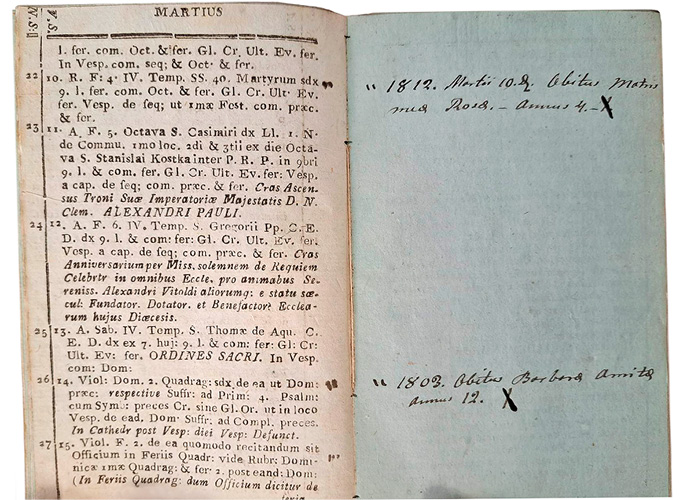
Entries about the death of mother Rožė and aunt Barbora in J. A. Pabrėža's 1815 Liturgical Calendar Directorium Horarum (Vilnae, 1814). BCz., sign. K 227 I. (pages unnumbered).
Table 3. The Most Important Periods in 18th-Century Samogitia
|
J. A. Pabrėža’s inscription |
J. A. Pabrėža’s inscription in original |
|---|---|
|
In 1710, an epidemic devastating people raged throughout Samogitia. 105 years [from the date of the entry]. |
W 1710. Powietrze na ludzi w całey Żmudzi grassowało. Rok. 105. |
|
In 1739. A cold winter, when the hils cracked from the extreme cold. 76 years. |
W 1739. Mrożna zima, kiedy od tęgości mrozów góry się rysowały. Rok 76. |
|
In 1743. An extraordinary solar eclipse on the feast day of St. Jacob the Apostle. 62 years. |
W 1743. Nadzwyczayne zaćnienie słońca w Dzień S. Jakuba Apost[oła]. Rok 62. |
|
In 1756, the Russian army, marching toward Prussia, spent the winter in Samogitia, which is why it was nicknamed the “Moskal Year”. 59 years. This war lasted 7 years. |
W 1756. Rossyiskie woyska idąc do Prus zimowały na Żmudzi, od czego przezwano Maskolu metay. Rok 59. Trwała ta woyna lat. 7. |
|
In 1765 and thereafter, Samogitia was plundered by the Confederation, which refused to accept Stanisław August Poniatowski – elected on August 7, 1764 – as king. 50 years. |
W 1765. y póżniey plądrowała na Żmudzi Konfederacya, która niechciała przyiąć za króła Stanisława Augusta Poniatowskiego obranego w 1764. Augusta 7. Dnia. Rok 50. |
|
On April 23, 1794, a revolution led by Tadeusz Kościuszko took place in Vilnius. Abazu Metaj. 21 years. Later that same year, on November 2, the Russian army occupied Warsaw, and the rulers of the neighboring empires completely destroyed the Kingdom of Poland. |
W 1794. Aprila 23 w Wilnie Rewolucya pod naczelnictwem Tadeusza Kosciuszki, Abazu Metay. Rok 21. A póżniey w tymże Roku Listopada 2. dnia wzięzie Warszawy przez woyska Rossyiskie y zniszczenie całkowite Krolestwa Polskiego od kruli somsiedzkich Mocarstw. |
The table is based on an entry by J. A. Pabrėža in the liturgical calendar Directorium Horarum Canonicarum pro Diaecesi Samogitiensi in Annum Dni MDCCCXV. Vilnae: In Typographia Diaecesana, [1814]. (Pages not numbered). Copy: BCz., sign. K 227 I.
Thus, the focus on the region’s past reflects aspects of Samogitian identity. We learn that the region’s inhabitants referred to the year 1756 as the “Year of the Muscovites” because the Muscovite army spent the winter there. Meanwhile, the year 1794, marked by the Tadeusz Kościuszko Uprising, was called the “Year of Military Camps” (Abazu Metaj). Significant events in the history of the state and society are linked to extreme natural phenomena, as evidenced both by Pabrėža’s education in the natural sciences (he studied at the Supreme School of Lithuania from 1792 to 1794), as well as the influence of ephemerides and prognostic calendars, and the systematic accumulation of knowledge in preparation for his work as a teacher – a role which Pabrėža performed excellently at Kretinga School (where he taught, among other subjects, natural sciences and geography from 1817 to 1822)85. Pabrėža’s calendar also contains autobiographical entries that reveal his concern for his family and loved ones. For example, he noted that he was baptized in 1771, and that his godmother Elžbieta died in 1797. The entries are concise but help clarify details of Pabrėža’s biography: “In 1794, I became an alumnus of Varniai Seminary; in 1796, I was ordained a priest; in 1797, my father Jonas died; in 1803, my aunt Barbora died; on March 10, 1812, my mother Rožė [Baužinskaitė] died.” Thus, Pabrėža’s individuality manifests itself at the third, marginal level of calendar analysis. This individuality is characterized by a system of measuring time linked to prayers for the living and the dead, by indicating how much time has passed since an event; attention to detail and an emotional tone to the entries, reflecting a complex period of life in Kartena that culminated in the decision to enter the Bernardine monastery in Kretinga. Compared to the calendar entries of the 19th-century clergy and nobles, Pabrėža’s notes are laconic and do not develop into a broader narrative. For example, Michał Kossakowski, a landowner from Žeimiai, wrote notes in his “Farm Calendars” for thirty years, beginning in 1812; over time, these evolved into deeper reflections and summaries covering the entire year. Similarly, the nobleman Antanas Daugirdas structured his narrative in the calendars; in his 1847 calendar, he wrote “A Reminder for the Sake of Caution” and vowed never to drink again after a severe hangover86. Meanwhile, Motiejus Valančius, Bishop of Samogitia, drawing on “daily notes”87
(as Aldona Prašmantaitė correctly surmised88), compiled works reminiscent of the Silva Rerum of the Grand Duchy of Lithuania: “Various Notes Collected by Priest Motiejus Valančius”, “My Health Diary”, “Information on the Pastoral Work of Bishop Motiejus Valančius”, and others. Research has shown that these “daily notes” are M. Valančius’s diaries, written in church calendars and reference guides (which had been published for the Diocese of Samogitia since 1758)89. Meanwhile, among the broader range of autobiographical works in Pabrėža’s documentary heritage – excluding wills, letters, sermons, retreat reflections, and autobiographical marginalia – none have been discovered to date.
Discussion
What is the egodocumentality of calendars? In the handwritten layer that interests us most, they can be treated as a valuable source for political history, but also for various other studies of the past, such as recent weather phenomena and climate change. At the same time, however, calendars are filled with spontaneous notes made by their users. They are a record of the free flow of human thought. The fleeting and intimate nature of these records means that people do not create themselves in calendars. Calendars filled with notes by the same person over the years provide an unintentional picture of their intellectual form, degree of mental activity, changing interests and worldview. The number and content of the notes depend on the personality of the writer90. A set of calendars belonging to one person becomes a unique record of their personality and its changes. An analysis of the nature of the notes in the calendars, especially their subject matter, can give a picture of the collective mentality of the nobility.
For example, Ossolineum has a solid collection of calendars from 1554–166091, acquired in the second half of the 19th century, with marginal notes in Polish. Their author was Piotr Wiesiołowski (?–1621), who converted to Catholicism in around 1579 and later became the Grand Marshal of Lithuania (1615–1619) and a client (‘servant and protégé’92) of Sigismund Augustus. Wiesiołowski began his notes with a description of his studies at Protestant universities in Western Europe; he wrote “without any pretensions, apparently only for his own memory”93. He writes about his visit to John Calvin (Calvinus, 1509–1564) in Geneva and his travels in Switzerland. Wiesiołowski’s ‘academic’ travels came to an end in 1564, when, on 11 February, he welcomed Sigismund Augustus, his patron, to Warsaw94. Subsequent entries reflect his travels indirectly – Wiesiołowski took part in military campaigns in Polotsk and other places, and the diary ends with entries about the death of his wife on 22 December 1591 and the death of Crown Marshal Opaliński on 3 March 159395.
The very fact of acquiring and using a calendar, followed by the choice of calendar editions, differing in content and form, says a lot about the personality of the owner and user. Small, pocket-sized calendars, handy and already known in the 16th century, had no chance of becoming handwritten egodocuments, because there was nowhere to write texts96. Of course, the very fact of their use and wear, as long as we know who they belonged to, is a form of self-testimony. However, it was only the third layer of content, the handwritten notes of the calendar owners, that can reveal the original personalities of the users, often identical in form and content to printed works. This individualised layer is characterized by a high degree of egodocumentality.
There is not much research on the egodocumentary nature of calendars. These are rather overview comments. For example, Anita Bokwa and Danuta Limanówka analysed the marginal notes of Michał from Wiślica in three multi-year calendars: BJ Cim. 5526 for the years 1513–1531, BJ Cim. 5527 for the years 1532–1569, and BJ Cim. 5528 for the years 1544–1556 in terms of their usefulness for research on climate history. However, Michał of Wiślica was not the only professor at the University of Kraków who showed particular sensitivity to natural phenomena, including meteorological ones. The most prominent weather observer of the 16th century was Marcin Biem of Olkusz. An interest in nature was a common feature of many Kraków scholars of the Renaissance times. However, the authors of the study make an interesting comparison between the two researchers from an egodocumentary point of view. Let us quote the result: “Michał of Wiślica was much more careful and detailed in his observations than Marcin Biem”. When comparing 17th- and 18th-century noble notes with 16th-century calendar marginalia, it should be noted that the latter belonged to the intellectual elite (doctors, professors, and church dignitaries). They were rarely interested in the weather, which was recorded in the event of major disasters (a large cart falling into a river, a flood) or in order to notice prophetic signs (rain during the coronation of Sigismund the Old).
We are currently in the process of developing a methodology for researching calendars as ego-documents in their manuscript form. We need a more complete overview of the preserved calendar resources, and not only from the earlier centuries. Editorial initiatives are of fundamental importance, although, as the experience of the few publishers of such sources shows, this is tedious and time-consuming work, with no guarantee of achieving a satisfactory level of saturation of scientific literature with critical editions of handwritten calendar records.
Conclusions
It can be stated that early modern Polish-Lithunian calendars constitute a genuinely unique category of historical source. Their hybrid nature – simultaneously printed and manuscript, public and private, standardized and deeply individual – places them at an exceptional crossroads in the history of communication, self-expression, and egodocumentary research. Rather than simple time-management tools, annotated calendars emerge as layered cultural artifacts whose manuscript stratum preserves some of the most intimate and unguarded traces of early modern personality and daily life.
The three-layer analytical framework proposed here – the astronomical-calendrical layer, the accompanying textual layer, and the handwritten marginal layer – has proven to be a productive instrument for approaching these sources. Each layer carries its own epistemological character: the first is mathematically verifiable but historically bounded by the limits of pre-Gregorian astronomical knowledge; whereas, the second layer reflects the editorial ambitions and encyclopedic ideals of calendar compilers; and finally, the third layer, and most valuable one from an egodocumentary perspective, is unrepeatable, spontaneous, and irreducibly personal. It is in this third layer that individuality is recorded – not through deliberate self-fashioning, but through the unguarded accumulation of daily observation, economic notation, meteorological sensitivity, and private memory.
The case studies examined illuminate the range of this individuality. The anonymous 1679-dated calendar, whose author reveals himself through linguistic competence, financial dealings, political engagement, and geographical mobility, demonstrates how much can be deduced about a person’s social position and inner world even in the absence of authorial identification. The comparative analysis with Jan Antoni Chrapowicki’s diary, while ruling out common authorship, simultaneously validates the calendar’s reliability as an independent source and illuminates the shared conventions governing weather observation in seventeenth-century noble culture. Meanwhile, Jurgis Ambraziejus Pabrėža’s 1815 liturgical calendar exemplifies a different mode of self-expression: laconic, regionally anchored, and structured around a deeply personal system of temporal reckoning in which historical events, natural disasters, and family losses are measured against a living present. In both cases – and across the broader array of examples discussed, from Janusz Antoni Wiśniowiecki’s decades-long calendar diaries to Piotr Wiesiołowski’s travel memories and Michał Kossakowski calendar diary – the manuscript layer reveals what printed sources cannot achieve: the texture of an individual consciousness moving through time.
Several conclusions of broader methodological significance emerge from this research. First, the dispersion of calendar collections across archival and library institutions – and the persistent confusion over their classification as archival or bibliographic materials – remains an obstacle that only systematic, cross-institutional cataloguing can address. The fact that the provenance of fewer than twelve percent of calendars in the Czartoryski Library collection is known serves as a stark reminder of the extent of the contextual information that has been lost. Second, the Gregorian calendar reform of 1582 and the uneven pace of its adoption across confessional and political boundaries introduced a layer of chronological complexity into calendar sources that requires careful attention when comparing meteorological or event-based data across regions and communities. Third, the evolution traced here – from brief daily notations toward extended diary entries and, ultimately, towards works such as the Silva Rerum compilations of the Lithuanian nobility – suggests that the calendar functioned not merely as a receptacle for memory, but as a generative form that shaped the habits of self-recording and, over time, helped give rise to the early modern diary tradition in the region.
Finally, submitted material and considerations underscores the need for a dedicated methodology for studying calendars as egodocuments. The concept of egodocumentality, as applied here, moves beyond the question of what calendars record to actually asking how they record it – how the material form of the calendar, its blank interleaved pages, its fixed chronological scaffold, and its daily rhythm shaped whatever the owners chose to write, and how they wrote it. Calendars did not simply receive the entries their owners placed in them; they structured their thoughts, invited brevity, and imposed a discipline of regular notation that distinguished calendar writing from the more reflective modes of memoir or autobiography. It is precisely this structuring function – the calendar as both a container and a constraint of self-expression – that makes these sources so valuable, and so distinct, as witnesses to individuality in the early modern Polish-Lithuanian world. Future research, including comprehensive editorial initiatives and digital cataloguing of surviving collections, will be essential to realizing the full potential of this exceptional documentary heritage.
Acknowledgements. This article was written as part of a project financed by the National Science Centre, No. 2020/37/B/ST10/00710, The Occurrence of Extreme Weather, Climate and Water Events in Poland from the 11th to 18th Centuries in the Light of Multiproxy Data.
Author Contributions
Waldemar Chorążyczewski conceptualization, validation, resources, investigation, formal analysis, writing-original draft preparation
Arvydas Pacevičius conceptualization, methodology, validation, investigation, resources, writing-original draft preparation, writing-review and editing, supervision
Archival sources
Archive of the Polish Academy of Science, Papers of Ananiasz Rojecki (APAN, Materiały Ananiasza Rojeckiego), sign. 11-16.
Central Archives of Historical Records in Warsaw (Archiwum Główne Akt Dawnych w Warszawie), section VI, sign. II-80 (Diary of M. K. Radziwiłł)
Czartoryski Library in Cracow (Biblioteka Książąt Czartoryskich w Krakowie, BCz), sign. K II 2; K II 12; K II 24; K II 41; K. 02 II; K 4 II; K. 06 II; K. 17 II; K. 22 II; K. 24 II; K. 29 II; K. 40 II; K. 41 II; K 59 II; K. 61 II; K. 64 II; K. 78 II; K. 79 II; K. 82 II; K. 88 II; K 227 I.
Jagiellonian Library in Krakow (Biblioteka Jagiellonska, BJ), sign BJ 16 22264; BJ, Cim. 5925; BJ, manuscript 2482; BJ, manuscript 5158; BJ, manuscript 5159; BJ, manuscript 5358; BJ, accession 506/73; BJ, accession 510/73, BJ, accession 511/73; BJ, accession 508/73; BJ, Cim. 1052; BJ, Cim. 1054; BJ, Cim. 1056; BJ, Cim. 1057; BJ, Cim. 1061; BJ, Cim. 1064; BJ, Cim. 1075; BJ, 1077; BJ, Cim. 1331; BJ, Cim. 1569; BJ, Cim. 5516; BJ, 590319 I; BJ, Inc. 2271; BJ, Inc. 2704; BJ Inc. 2699.
Martynas Mažvydas National Library of Lithuania (Lietuvos nacionalinė Martyno Mažvydo biblioteka, LNMMB), sign. R. XVII: B.1258; F99-1219; F99-1220.
National Archives in Cracow, The Potocki Family Archive from Krzeszowic (Archiwum Narodowe w Krakowie, Archiwum Potockich z Krzeszowic, NACAP), sign. 29/635/0/15.4/3330.
National Archives in Cracow, The Sanguszko Family Archive (Archiwum Narodowe w Krakowie, Archiwum Sanguszków, NACAS), sign. 29/637/0/1.3/11737; 29/637/0/1.3/12056; 29/637/0/1.3/12667; 29/637/0/1.3/14267; 29/637/0/7.3/17056; 29/637/0/7.3/17059; 29/637/0/7.3/17060; 29/637/0/7.3/17061; 29/637/0/7.3/17062.
National Museum in Krakow (Muzeum Narodowe w Krakowie), manuscript 169 (Diariusz wojewody witebskiego Jana Antoniego Chrapowickiego. Rok 1673–1685).
Ossoliński National Institute (Zakład Narodowy im. Ossolińskich, Ossolineum), sign. 1793/I. Access through Internet: <http://www.dbc.wroc.pl/dlibra/doccontent?id=10583>.
State Archive in Poznań, Records of the City of Poznań (Archiwum Państwowe w Poznaniu, Akta m. Poznania), sign. D 486 (53/474/D.486).
Vilnius University Library (Vilniaus univesiteto biblioteka, VUB), Rubr. 62/1847.
Wroblewski Library of the Lithuanian Academy of Sciences (Lietuvos mokslų akademijos Vrublevskių biblioteka, LMAVB), sign. 17/117, sign. P-17/363.
Old prints
1. CIEKANOWSKI, Kaper. Nowy y stary kalendarz swiąt rocznych, y biegow niebieskich, z wyborem czasow, y aspektami na rok panski MDCXCVI. Krakow: W Drukarni Akademickiey, [1695]. [18] l. Copy: LNMMB, sign. R. XVII: B.1258.
2. Directorium Horarum Canonicarum pro Diaecesi Samogitiensi in Annum Dni MDCCCXV. Vilnae: In Typographia Diaecesana, [1814]. Copy: BCz., sign. K 227 I.
3. Directorium pro dioecesi Telsensi in annum Domini MDCCCXLVII. Vilnae, 1846. Copy: Vilnius University Library (hereinafter – VUB), Rubr. 62/1847.
4. [DUŃCZEWSKI, Stanisław]. Kalendarz polski i ruski, z nabożeństwem, świątkami, biegiem planet, fazami księżyca, prognostykiem i innemi wiadomościami, na rok Pański 1730. Kraków: [Drukarnia Akademicka], [1729]. [40] p. Copy: BCz. sign. K II 2.
5. [DUŃCZEWSKI, Stanisław]. Kalendarz polski y ruski, w ktorym Swięta Roczne, y Biegi Niebieskie, Aspekty, Wybory, czas siania, szczepienia, Krwie puszczenia, Lekarstw zażywania, y inne rzeczy gospodarskie y polityczne na Rok Panski 1734. We Lwowie: [W Drukarni Brackiey S. Trójcy lub Drukarni Kolegium Jezuitów, 1733]. [48] p. Copy: BCz., sign. K II 41.
6. [DUŃCZEWSKI, Stanisław]. Kalendarz polski y ruski, w ktorym Swięta Roczne, y Biegi Niebieskie, Aspekty, Wybory, czas siania, szczepienia, Krwie puszczenia, Lekarstw zażywania, y inne rzeczy gospodarskie y polityczne na Rok Panski 1738. W Zamościu: W Drukarni Akademickiey, [1737]. [24] p. Copy: BCz. sign. K 4 II.
7. [DUŃCZEWSKI, Stanisław]. Kalendarz polski y ruski, w ktorym swięta roczne, y biegi niebieskie, aspekty, wybory, czas siania, szczepienia, krwie puszczenia, lekarstw zażywania, y inne rzeczy gospodarskie y polityczne na Rok Panski 1741 wydany. W Lwowie: [W Drukarni Brackiey S. Trójcy], [1740]. [24] p. Copy: NACAS, sign. 29/637/0/1.3/11737.
8. [DUŃCZEWSKI, Stanisław]. Kalendarz polski y ruski, w ktorym swięta roczne, y biegi niebieskie, aspekty, wybory, czas siania, szczepienia, krwie puszczenia, lekarstw zażywania, y inne rzeczy gospodarskie y polityczne na Rok Panski 1749 wydany. W Zamościu: W Drukarni Akademickiey, [1748 or 1749]. [24] p. Copy: NACAS, sign. 29/637/0/1.3/11737.
9. [DUŃCZEWSKI, Stanisław]. Kalendarz polski y ruski, w ktorym swięta roczne, y biegi niebieskie, aspekty, wybory, czas siania, szczepienia, krwie puszczenia, lekarstw zażywania, y inne rzeczy gospodarskie y polityczne na rok panski 1750 wydany. W Zamościu: W Drukarni Akademickiey, [1749]. [24] p. Copy: NACAS, sign. 29/637/0/1.3/12056.
10. FRÖLICH, David. Bibliotheca, seu Cynosura Peregrinantium, hoc est, Viatorium: omnium hactenus editionum absolutissimum, jucundissimum, utilissimumque: in duas partes digestum... Ulmae: impensis Wolfgangi Endteri, exscripsit literis Balthasar Kühne, 1643–1644. 2 pts.
11. Kalendarium Gregorianum perpetuum: cum priuelegio Summi Pontificis et aliorum principium. Romae: Ex typographia Dominici Basae, 1582. [64] p.
12. Kalendarz Gospodarski na Rok Panski 1813 Zawierający w sobie dni 365 oraz Swięta Rzymskie i Ruskie, tudzież z oznaczenie dni Galowych, Wschodu i Zachodu Słońca, Odmian Xięźyca, Powietrza, oraz innych ciekawych wiadomości. W Wilnie: W Drukarni Imperatorskiego Wilenskiego Uniwersytetu, [1812]. Copy: LNMMB, F99-1219, p. 11r-20v. Access through Internet: <https://www.epaveldas.lt/preview?id=C10001969144>.
13. Kalendarz gospodarski na rok Pański przestępny 1836 zawierający w sobie dni 366. W Wilnie i Grodnie: w drukarni Zymela Typografa i Manesa Romma, [1835]. Copy: LNMMB, F99-1220, p. 231r-258v. Access through Internet: <https://www.epaveldas.lt/preview?id=C10001969184>.
14. [Kalendarz na rok 1679 Jakuba Eustatiusa]. Gdańsk: Christian Manskarpp, [1678]. Copy: BCz., sign. K 59 II.
15. Kalendarz na rok 1747 z zapiskami o treści gospodarczej, osobistej i politycznej Stefana Benedykta Morsztyna kasztelana wiślickiego. Copy: NACAP, sign. 29/635/0/15.4/3330.
16. [MICHAŁOWSKI, Ignacy Paweł; CHMIELOWSKI, Jan Antoni]. Kalendarz Polski y Ruski, w ktorym Swięta Roczne, y Biegi Niebieskie, Aspekty, Wybory, czas siania, szczepienia, Krwie puszczenia, Lekarstw zazywania, y inne rzeczy gospodarskie y polityczne na rok Pański 1704. Kraków: Drukarnia Akademicka, [1703]. [36] p. Copy: BCz., sign. K II 12.
17. [PATER, Paulus]. Gospodarski Kalendarz na rok p. 1717 w którym Święta roczne Biegi niebieskie, Wybory Czasów i Aspekty: z przydatkiem niektórych doświadczonych Lekarstw Domowych. W Gdańsku: [Druk i nakład Paul Pater, 1716]. [44] p. Copy: BCz., sign. K II 29.
18. [PECHERZYNSKI, Adam]. Kalendarz polski y ruski swiąt rocznych, biegow niebieskich, z wyborem czasow, y aspektami, na rok Panski MDCXCIV. W Krakowie: W Drukarni Akademickiey, [1693]. Copy: LMAVB, sign. P-17/363.
19. PERLACH, Andreas. Almanach novum super anno Christi salvatoris nostri MDXVIIII. Viennae: Johannes Singrenius, [1518]. Copy: BJ, Cim. 4735.
20. REGIOMONTANUS, Johannes. Ephemerides ab a. 1484 ad a. 1506. Venetiis: Erhard Ratdolt, 4. IV. 1484. Copy: BJ, Inc. 2271.
21. [RHETZ, Jan]. Kalendarz polski y ruski, święta roczne, biegi miesięczne, signa zodiaci, aspecta, wybory, prognostyk generalny, y pertykularny w sobie zawieraiący na rok Pański 1718. Supraśl: Drukarnia Ojców Bazylianów, [1717]. [24] p. Copy: NACAS, sign. 29/637/0/1.3/11737.
22. [RYSZKOWSKI, Franciszek Ksawery]. Nowy Lwowski kalendarz Polski i Ruski na rok po narodzeniu pana i zbawiciela naszego Jezusa Chrystusa 1798, podług lwowskiego horyzontu wyrachowany. Lwów: Drukarnia Pillerów, [1797]. [40] p. Copy: NACAS, sign. 29/637/0/1.3/12667.
23. STADIUS, Johannes. Ephemerides Novae, Auctae Et Repurgatae [...] Secundum Antverpiae Longitudinem Ab Anno 1554 usque ad Annum 1600. Coloniae Agrippinae: Apud Haeredes Arnoldi Birckmanni, 1570. 2 vol. Copy: Ossolineum, sign. 1793/I. Access through Internet: <http://www.dbc.wroc.pl/dlibra/doccontent?id=10583>.
24. STÖFFLER, Johannes; and PFLAUM, Jakob. Almanach noua plurimis annis venturis inseruientia. Ulma: Johann Reger, 13. II. 1499. 520 p. Copy: BJ, Inc. 2699.
25. STÖFFLER, Johannes; and PFLAUM, Jakob. Almanach noua plurimis annis venturis inseruientia; Canon de domibus coeli fabricandis. Venetiis: Petrus Liechtensteyn, 1506. Copy: BJ, Cim. 5516.
26. STÖFFLER, Johannes, PFLAUM, Jakob. Almanach nova plurimis annis venturis inservientia: [1499– 1531]: mit Vorrede des Johannes Regiomontanus zu seinen Ephemeriden, erweitert durch Zusätze und mit dt. Erklärung der Almanache. Ulma: Johann Reger, 13 II 1499. 520 p. Copy: BJ, Inc. 2704.
27. [WARYSKI, Stanisław]. Nowy kalendarz świąt rocznych i biegów niebieskich z wyborem czasów na rok Pański 1708. Poznań: [Drukarnia Kolegium Jezuitów], [1707]. [36] p. Copy: BCz., sign. K II 24.
28. [WOLSKI, Woyciech]. Hemerologeion abo Nowy y Stary Kalendarz świąt rocznych, biegow, aspektow y wyborow niebieskich, z czasém siania y szczepienia, dobrym porządkiem są położone, na rok pański MDCXCIV. Kraków: W Drukarni Mikołaja Aleksandrá Schedlá, [1693]. Copy: LMAVB, sign. 17/117.
Literature
29. ABRAMAVIČIUS, Vladas. Vilniaus politiniai kalendoriai. In: Pacevičius, Arvydas; and Sperskienė, Rasa, eds. Bibliologijos metraštis. Vilnius: Vilniaus universitetas, 2016, p. 463–479. ISBN 978-609-459-015-3.
30. ARENDT, Ada. Archeologia zatroskana: staropolskie kalendarze w działaniu. Warszawa: Wydawnictwo Uniwersytetu Warszawskiego, 2019. 344 p. ISBN 97883235391.
31. BAGGERMAN, Arianne; DEKKER, Rudolf; and MASCUCH, Michael, eds. Controlling Time and Shaping the Self: Developments in Autobiographical Writing since the Sixteenth Century. Leiden; Boston: Brill, 2011. 541 p. ISBN 978-90-04-19500-4.
32. BALČIENĖ, Irena. XVI–XVII a. kalendoriai Vilniaus universiteto bibliotekoje. Knygotyra, 1997, vol. 33, p. 88–91. DOI: https://doi.org/10.15388/Knygotyra.1997.12
33. BIRKENMAJER, Ludwik Antoni. Stromata Copernicana: studia, poszukiwania i materiały biograficzne. Kraków: Warszawa: nakładem Polskiej Akademji Umiejętności; Skład Główny w Księgarniach Gebethnera i Wolffa, 1924. VII, [1], 402 p.
34. BOGDANOW, Hanna. Kalendarze w księgozbiorach szlachty krakowskiej w XVIII wieku jako wyraz jej zainteresowań czytelniczych. Studia o Książce, 1989, vol. 18, p. 109–118.
35. BOGUCKA, Maria. Kazimierz Jagiellończyk i jego czasy. Warszawa: Państwowy Instytut Wydawniczy, 1998. 296, [2] p., [12] leaves of plates. ISBN 83-06-02674-8
36. BUDINAITĖ, Salomėja. M. Počobuto kalendoriai. Knygotyra, 1985, vol. 20, no. 13-1, p. 59–67. Access through Internet: <https://www.zurnalai.vu.lt/knygotyra/article/view/30018>
37. BUŁA, Janina. Katalog kalendarzy od XVI do XVIII wieku w zbiorach Biblioteki Czartoryskich. Kraków: MN, 1994. XII, [II], 194, [4] p., [24] p. of facsims.
38. Chachulski, Tomasz; and Grześkowiak-Krwawicz, Anna, eds. Literatura historia, dziedzictwo: prace ofiarowane profesor Teresie Kostkiewiczowej. Warszawa: Instytut Badań Literackich PAN, 2006. 612 p. ISBN 8389348756.
39. CHODKOWSKA, Anita. Materiały Ananiasza Rojeckiego. Biuletyn APAN, 2022, no. 63, p. 13-27. Access through Internet: <https://archiwum.pan.pl/images/wydawnictwa/Biuletyn-63.pdf>
40. ČIURINSKAS, Mintautas. Jono Pašakauskio SJ (1684–1757) veiklos tyrimai ir pirmasis jo gyvenimo aprašymas (compendium vitae). Senoji Lietuvos literatura, 2022, vol. 53, p. 213–232. DOI: https://doi.org/10.51554/SLL.22.53.08
41. Dacka-Górzyńska, Iwona Monika; and Partyka, Joanna, eds. Kalendarze staropolskie. Warszawa: Wydawnictwo DiG, 2013. 271, [1] p. ISBN 9788371818110.
42. Daugirdaitė-Sruogienė, Vanda. Žemaičių bajoro ūkis XIX amžiaus pirmoje pusėje. Vilnius: Baltos lankos, 1995. 135, [1] p. ISBN 9986-403-51-1.
43. DYGDAŁA, Jerzy. Wstęp. In: Dygdała, Jerzy, ed. Podróże litewskiego magnata do Gdańska, Człuchowa, a nawet dalej...: fragmenty ‘Diariusza’ Michała Kazimierza Radziwiłła “Rybeńki” z lat 1721, 1737 i 1752. Warszawa: Instytut Historii PAN, 2013, p. 9–10. ISBN 9788363352141.
44. DIRSYTĖ, Rima. Kosakovskių šeimos archyvas Lietuvos Nacionalinėje Martyno Mažvydo bibliotekoje. Lietuvos istorijos metraštis, 1998, [vol.] 1997 metai, p. 429–439.
45. ECKERT, Lindsey; and GRANDISON, Julia. The Almanac Archive: Theorizing Marginalia and “Duplicate“ Copies in the Digital Realm. Digital Humanities Quarterly, 2016, vol. 10, no. 1, p. 1–19. DOI: https://doi.org/10.63744/3rteav8q224q
46. GIDŽIŪNAS, Viktoras. Jurgis Ambraziejus Pabrėža (1771–1849). Roma-Vilnius: Lietuvių katalikų MA, 1994. XX, 295 p., [5] leaves of plates
47. GORCZYŃSKA, Małgorzata. Polskie kalendarze z II połowy XVIII wieku jako przykład druków upowszechniających idee i ideały oświecenia w staropolskim systemie komunikacji. In: Kuźmina, Dariusz, ed. Bibliologia polityczna: praca zbiorowa. Warszawa: Wydawnictwo Stowarzyszenia Bibliotekarzy Polskich, 2011, p. 82–91. ISBN 9788361464884.
48. GRAFTON, Anthony. Cardano’s cosmos: the worlds and works of a Renaissance astrologer. Cambridge (Mass.); London: Harvard University Press, 2001. xii, 284 p. ISBN 0-674-00445-3.
49. GUT, Agnieszka. Wprowadzenie kalendarza gregoriańskiego na Pomorzu Zachodnim w 1700 roku. Przegląd Zachodniopomorski, 2016, vol. 31(60), no. 2, p. 69–88.
50. JAKUBENAS, Regina. Z historii kalendarzownictwa w Wielkim Księstwie Litewskim w XVIII wieku. Kalendarze wileńskie kp. Jana Poszakowskiego. In: Chachulski, Tomasz; and Grześkowiak-Krwawicz, Anna, eds. Literatura historia, dziedzictwo: prace ofiarowane profesor Teresie Kostkiewiczowej. Warszawa: Instytut Badań Literackich PAN, 2006, p. 398–406. ISBN 8389348756.
51. JANIK, Maciej. Kalendariografia od XVI–XVIII w. Próba typologii. In: Dacka-Górzyńska, Iwona Monika; and Partyka, Joanna, eds. Kalendarze staropolskie. Warszawa: Wydawnictwo DiG, 2013, p. 9–52. ISBN 9788371818110.
52. JANIK, Maciej. Kalendarzowe retrogresje temporalne czyli o propagandzie czasu właściwego. In: Kuźmina, Dariusz, ed. Bibliologia polityczna: praca zbiorowa. Warszawa: Wydawnictwo Stowarzyszenia Bibliotekarzy Polskich, 2011, p. 93–108. ISBN 9788361464884.
53. JANIK, Maciej. Polskie kalendarze astrologiczne epoki saskiej. Warszawa: Wydaw. DiG, 2003. 344 p. ISBN 8371812981.
54. JANIK, Maciej. Staropolski kalendarz prognostykarski jako urządzenie komunikacyjne. In: Dacka-Górzyńska, Iwona Monika; and Partyka, Joanna, eds. Kalendarze staropolskie. Warszawa: Wydawnictwo DiG, 2013, p. 117–153. ISBN 9788371818110.
55. JEVLAŠAUSKIS, Teodoras. Atsiminimai. Ed. Darius Vilimas. Vilnius: Lietuvių literatūros ir tautosakos institutas, 1998. 90, [3] p. ISBN 9986-513-28-6.
56. KŁODZIŃSKA, Kamila. Katalog kalendarzy od XVI do XVIII w. w zbiorach Biblioteki Kórnickiej. Pamiętnik Biblioteki Kórnickiej, 1963, no. 8, p. 177–297.
57. Konopka, Maria; and Zięba, Michał, eds. Bibliologia, literatura, kultura: księga pamiątkowa ofiarowana Profesor Wacławie Szelińskiej. Kraków: Wydaw. Naukowe AP, 1999. 486 p. ISBN 8387513989.
58. KRAKYTĖ, Asta. Vilniaus universiteto rubricelės. Knygotyra, 1997, vol. 33, p. 92–100. DOI: https://doi.org/10.15388/Knygotyra.1997.13
59. KRZYSZTOFIK, Małgorzata. Astrologiczne kalendarze krakowskie XVII wieku. In: Siess-Krzyszkowski, Stanisław; and Walecki, Wacław, eds. Libri recogniti: nowe inspiracje do badań nad starodrukami polskimi w bibliotekach Rosji, Białorusi, Ukrainy, Litwy i Finlandii. Kraków: Collegium Columbinum, 2013, p. 369–392. ISBN 9788376240190.
60. Kuźmina, Dariusz, ed. Bibliologia polityczna: praca zbiorowa. Warszawa: Wydawnictwo Stowarzyszenia Bibliotekarzy Polskich, 2011. 451, [1] p. ISBN 9788361464884.
61. Lepszy, Kazimierz, ed. Instrukcja wydawnicza dla źródeł historycznych od XVI w. do poł. XIX w. Wrocław: Zakład im. Ossolińskich, 1953. IX, [1], 65, [1] p.
62. LIMANÓWKA, Danuta. Rekonstrukcja warunków klimatycznych Krakowa w pierwszej połowie XVI wieku. Warszawa: IMGW, 2001. 176 p.
63. Machaj, Dawid; and Zdanek, Maciej, eds. Diariusze profesorów Uniwersytetu Krakowskiego Mikołaja z Szadka i Marcina Glicjusza z Pilzna z lat 1555–1591 (BJ Cim. 8420). Kraków: Societas Vistulana; Polskie Towarzystwo Historyczne, 2024. XXIV, 296, [1] p.
64. MANYŚ, Bernadetta. The diary of Michał Kazimierz Radziwiłł ‘Rybeńko‘ as a source for the study of the history of Vilnius. XVIII amžiaus studijos, 2024, vol. 10, p. 36–55. DOI: https://doi.org/10.33918/23516968-010002
65. MASCUCH, Michael; DEKKER, Rudolf; and BAGGERMAN, Arianne. Egodocuments and History: A Short Account of the Longue Durée. The Historian, 2016, vol. 78, p. 11–56. DOI: https://doi.org/10.1111/hisn.12080
66. MATULAITYTĖ, Stasė. Senieji Vilniaus kalendoriai (XVI–XVII a.). Knygotyra, 1998, vol. 32, p. 71–89. DOI: https://doi.org/10.15388/Knygotyra.1997.34
67. MEILUS, Elmantas. XVII a. pabaigos Lietuvos bajorų kasdienybė pagal jų dienoraščius. In: Kiaupa, Zigmantas; Kiaupienė, Jūratė; Rimša, Edmundas; and Sarcevičienė, Jolita, eds. Kultūrų sankirtos: skiriama Ingės Lukšaitės 60-mečiui. Vilnius: Diemedis, 2000, p. 309–325. ISBN 9986-23-072-1.
68. MEISE, Helga. The Limitation of Family Tradition in the Barrier Between Public and Private. Karoline von Hessen-Darmstadt’s „Schreib=Calender“ between Almanac and Diary. In: Dekker, Rudolf, ed. Egodocuments and history: autobiographical writing in its social context since the Middle Ages. Hilversum: Rotterdam: Verloren; Published in cooperation with the Faculty of History and Art Studies, Erasmus University Rotterdam, 2002, p. 107–124. ISBN 90-6550-439-7.
69. Mikołaj Kopernik. Cz. 1, Studia nad pracami Kopernika oraz materiały biograficzne. Ed. Ludwik Antoni Birkenmajer. Kraków: skład główny w Księgarni Spółki Wydawniczej Polskiej, 1900. III, [1], 711 p., [10] l. of pl.
70. [NABIELAK, Ludwik]. Zapiski Litwina, sługi i wychowanca Zygmunta Augusta. In: Biblioteka Ossolińskich: pismo historyi, literaturze, umiejętnościom i rzeczom narodowym poświęcone: poczet nowy. Lwów: W Drukarni Zakładu Narodowego im. Ossolińskich, 1868, vol. 11, p. 274–280.
71. NOWOSAD, Wiesław; PRZYBYLAK, Rajmund; MARCINIAK, Kazimierz; and SYTA, Krzysztof. Diariusz Jana Antoniego Chrapowickiego jako źródło do badań klimatu Rzeczypospolitej w drugiej połowie XVII wieku. Klio, 2007, no. 9, p. 21–60.
72. PACEVIČIUS, Arvydas. Motiejus Valančius XIX a. knygos kultūroje. Lietuvių katalikų mokslo akademijos metraštis, 2002, vol. 20, p. 49–67.
73. Pacevičius, Arvydas; and Raudytė, Nijolė. Žemaičių daktaras Faustas: Jurgio Ambraziejaus Pabrėžos bibliotekos kilmė, raida ir paveldas. Vilnius: Vilniaus universiteto leidykla, 2023. 311, [1] p. ISBN 978-609-07-0885-9.
74. Partyka, Jacek; and Malicki, Marian, eds. Diariusze z XVI wieku w druku BJ CIM. 8421: Jan Musceniusz, Jan Krzysztoporski, Stanisław Krzysztoporski. Poznań: Biblioteka Uniwersytecka, 2009. 42 p., [2] p. of plates
75. PETREIKIS, Tomas. Egodokumentai knygų paraštėse. In: Pacevičius, Arvydas, ed. Egodokumentai ir privati Lietuvos erdvė: straipsnių rinkinys. Vilnius: Vilniaus universitetas, 2013, p. 318–321. ISBN 978-609-459-198-3.
76. PETREIKIS, Tomas. Žemaičių vyskupas Motiejus Valančius – sodininkas. Lietuvių katalikų mokslo akademijos metraštis, 2012, vol. 35, p. 29–58.
77. PRAŠMANTAITĖ, Aldona. Žemaičių vyskupijos liturginiai kalendoriai-žinynai. Lietuvos istorijos metraštis, 2001, [vol.] 2000 metai, p. 164–179.
78. PRAŠMANTAITĖ, Aldona. Žemaičių vyskupo Motiejaus Valančiaus „Namų užrašai“. In: Valančius, Motiejus. Namų užrašai. Ed. Aldona Prašmantaitė. Vilnius: „Baltų lankų“ leidyba, 2003. XXX, 933, [1] p. ISBN 9955-584-05-X.
79. ROK, Bogdan. Kalendarze jako nośnik informacji i wiedzy. In: Wojtowicz, Jerzy, eds. Rozprawy z dziejów XVIII wieku: z dziejów komunikacji socjalnej epoki nowożytnej. Toruń: Wydaw. UMK, 1993. 138 p. ISBN 8323104255.
80. ROK, Bogdan. Kalendarze polskie czasów saskich. Wrocław: Wydawnictwo Uniwersytetu Wrocławskiego, 1985. 158, [1] p. ISBN 8322900090.
81. RUGGIU, François Joseph; ARNOUL, Elisabeth. Ten years of research on „Écrits du for privé“ in France: An assessment. In: Pacevičius, Arvydas, ed. Egodokumentai ir privati Lietuvos erdvė XVI–XX amžiuje: straipsnių rinkinys. Vilnius: Vilniaus universitetas, 2013, p. 97-112. ISBN 978-609-459-198-3.
82. SARCEVIČIENĖ, Jolita. Būti Europoje: Teofilės Konstancijos Radvilaitės-Moravskos 1773–1774 m. kelionių pėdsakaip. Acta Academiae Artium Vilnenesis, 2017, vol. 85, p. 46–67.
83. Siess-Krzyszkowski, Stanisław; and Walecki, Wacław, eds. Libri recogniti: nowe inspiracje do badań nad starodrukami polskimi w bibliotekach Rosji, Białorusi, Ukrainy, Litwy i Finlandii. Kraków: Collegium Columbinum, 2013. 463 p. ISBN 9788376240190.
84. SKRZYPKOWSKA, Joanna. Polskie kalendarze XIX-wieczne w zbiorach Biblioteki Publicznej m. st. Warszawy – Biblioteki Głównej. Warszawa: BP BG, 1998. 176 p. ISBN 8387407356.
85. STRZEBOŃSKA, Anna. Szesnastowieczne kalendarze krakowskie. In: Konopka, Maria; and Zięba, Michał, eds. Bibliologia, literatura, kultura: księga pamiątkowa ofiarowana Profesor Wacławie Szelińskiej. Kraków: Wydaw. Naukowe AP, 1999, p. 177–198. ISBN 8387513989.
86. ŠEDVYTIS, Laurynas. Lietuvos Didžiosios Kunigaikštystės valdančiojo elito rengimas viešajam valstybės gyvenimui XVI a.–XVII a. viduryje. Daktaro disertacija. Vytauto Didžiojo universitetas. Kaunas, 2016. 230, [1] p.
87. VELIČKAITĖ, Vika. Mykolo Kazimiero Radvilos, vadinamo Žuvele (1702–1762), dienoraštis: tarp itinerarijaus ir egodokumento. In: Pacevičius, Arvydas, ed. Privačioji raštija ir egodokumentinis paveldas. Vilnius: Akademinė leidyba, 2017, p. 105–121.
88. WÓJCIK, Rafał. Zapiski z efemeryd i almanachów XV i XVI wieku. Plan wydawniczy serii „Diariusze staropolskie“. In: Dacka-Górzyńska, Iwona Monika; and Partyka, Joanna, eds. Kalendarze staropolskie. Warszawa: Wydawnictwo DiG, 2013, p. 53–60. ISBN 9788371818110.
89. Wójcik, Rafał; and Wydra, Wiesław, eds. Jana Żdżarowskiego, kanonika poznańskiego diariusz z lat 1532–1551. Poznań: Biblioteka Uniwersytecka, 2009. 50 p. ISBN 9788360961018.
90. ŻUKOWSKA, Justyna. Kalendarze Jana Poszakowskiego jako źródło edukacji historycznej. In: ACHREMCZYK, Stanisław, ed. Między barokiem a oświeceniem: edukacja, wykształcenie, wiedza. Olsztyn: Towarzystwo Naukowe: Ośrodek Badań Naukowych im. Wojciecha Kętrzyńskiego, 2005, p. 111–121.
1 Quoted from: GRAFTON, Anthony. Cardano’s cosmos: the worlds and works of a Renaissance astrologer. Cambridge (Mass.); London, 2001, p. 2.
2 MEISE, Helga. The Limitation of Family Tradition in the Barrier Between Public and Private. Karoline von Hessen-Darmstadt’s „Schreib=Calender” between Almanac and Diary. In: Dekker, Rudolf, ed. Egodocuments and history: autobiographical writing in its social context since the Middle Ages. Hilversum: Rotterdam, 2002, p. 107.
3 For more on calendar marginalia, see: KŁODZIŃSKA, Kamila. Katalog kalendarzy od XVI do XVIII w. w zbiorach Biblioteki Kórnickiej. Pamiętnik Biblioteki Kórnickiej, 1963, no. 8, p. 178; BOGDANOW, Hanna. Kalendarze w księgozbiorach szlachty krakowskiej w XVIII wieku jako wyraz jej zainteresowań czytelniczych. Studia o Książce, 1989, vol. 18, p. 109–118; BUŁA, Janina. Katalog kalendarzy od XVI do XVIII wieku w zbiorach Biblioteki Czartoryskich. Kraków, 1994, p. 9; KRAKYTĖ, Asta. Vilniaus universiteto rubricelės. Knygotyra, 1997, vol. 33, p. 92–100; BALČIENĖ, Irena. XVI–XVII a. kalendoriai Vilniaus universiteto bibliotekoje. Knygotyra, 1997, vol. 33, p. 88–91; MEILUS, Elmantas. XVII a. pabaigos Lietuvos bajorų kasdienybė pagal jų dienoraščius. In: Kiaupa, Zigmantas; Kiaupienė, Jūratė; Rimša, Edmundas; and Sarcevičienė, Jolita, eds. Kultūrų sankirtos: skiriama Ingės Lukšaitės 60-mečiui. Vilnius, 2000, p. 309–325; PRAŠMANTAITĖ, Aldona. Žemaičių vyskupijos liturginiai kalendoriai-žinynai. Lietuvos istorijos metraštis, 2001, [vol.] 2000 metai, p. 176–177; PACEVIČIUS, Arvydas. Motiejus Valančius XIX a. knygos kultūroje. Lietuvių katalikų mokslo akademijos metraštis, 2002, vol. 20, p. 49–67; PETREIKIS, Tomas. Žemaičių vyskupas Motiejus Valančius – sodininkas. Lietuvių katalikų mokslo akademijos metraštis, 2012, vol. 35, p. 29–58; PETREIKIS, Tomas. Egodokumentai knygų paraštėse. In: Pacevičius, Arvydas, ed. Egodokumentai ir privati Lietuvos erdvė: straipsnių rinkinys. Vilnius, 2013, p. 318–321.
4 ARENDT, Ada. Archeologia zatroskana: staropolskie kalendarze w działaniu. I edition. Warszawa, 2019, p. 16–18.
5 ECKERT, Lindsey; and GRANDISON, Julia. The Almanac Archive: Theorizing Marginalia and “Duplicate” Copies in the Digital Realm. Digital Humanities Quarterly, 2016, vol. 10, no. 1, p. 5.
6 BAGGERMAN, Arianne; DEKKER, Rudolf; and MASCUCH, Michael, eds. Controlling Time and Shaping the Self: Developments in Autobiographical Writing since the Sixteenth Century. Leiden; Boston, 2011. 541 p.
7 [Kalendarz na rok 1679 Jakuba Eustatiusa]. Gdańsk, [1678]. Copy: Czartoryski Library in Cracow (hereinafter – BCz), sign. K 59 II. Copy without title page. 3 interfoliated cards after cards 17 and 25 were torn out.
8 Directorium Horarum Canonicarum pro Diaecesi Samogitiensi in Annum Dni MDCCCXV. Vilnae, [1814]. Copy: BCz, sign. K 227 I. We are thankful to Dr. Liudas Jovaiša for a copy of this document.
9 Diariusz wojewody witebskiego Jana Antoniego Chrapowickiego. Rok 1673–1685. National Museum in Krakow, manuscript 169.
10 MASCUCH, Michael, DEKKER, Rudolf, BAGGERMAN, Arianne. Egodocuments and History: A Short Account of the Longue Durée. The Historian, 2016, vol. 78, p. 11.
11 RUGGIU, François Joseph; and ARNOUL, Elisabeth. Ten years of research on “Écrits du for privé” in France: An assessment. In: Pacevičius, Arvydas. Egodokumentai ir privati Lietuvos erdvė XVI–XX amžiuje: straipsnių rinkinys. Vilnius, 2013, p. 107.
12 Incunabula calendars: REGIOMONTANUS, Johannes. Ephemerides ab a. 1484 ad a. 1506. Venetiis, 4. IV. 1484. Copy: Jagiellonian Library in Krakow (hereinafter – BJ), Inc. 2271; STÖFFLER, Johannes; and PFLAUM, Jakob. Almanach noua plurimis annis venturis inseruientia. Ulma, 13. II. 1499. Copy: BJ Inc. 2699. (Includes astronomical tables of planetary and luminary positions (ephemerides) from 1499 to 1531); STÖFFLER, Johannes, PFLAUM, Jakob. Almanach nova plurimis annis venturis inservientia: [1499– 1531]: mit Vorrede des Johannes Regiomontanus zu seinen Ephemeriden, erweitert durch Zusätze und mit dt. Erklärung der Almanache. Ulma, 13 II 1499. Copy: BJ, Inc. 2704; Calendars paleotypes: STÖFFLER, Johannes, PFLAUM, Jakob. Almanach noua plurimis annis venturis inseruientia; Canon de domibus coeli fabricandis. Venetiis, 1506. Copy: BJ, Cim. 5516 (notes by Łukasz Noskowski); A copy of the same almanac: BJ, Cim. 5512 (notes by Walenty, physician of Bishop Paweł Holszański); PERLACH, Andreas. Almanach novum super anno Christi salvatoris nostri MDXVIIII. Viennae, [1518]. Copy: BJ, Cim. 4735 (notes by Marcin Biem).
13 Nicolai de Vieliczka diarium et tractatus medici (calendar notes by Mikołaj from Wieliczka for the years 1523 and 1524). BJ, manuscript 2482.
14 [MICHAŁOWSKI, Ignacy Paweł; and CHMIELOWSKI, Jan Antoni]. Kalendarz Polski y Ruski, w ktorym Swięta Roczne, y Biegi Niebieskie, Aspekty, Wybory, czas siania, szczepienia, Krwie puszczenia, Lekarstw zazywania, y inne rzeczy gospodarskie y polityczne na rok Pański 1704. Kraków, [1703]. Copy: BCz, sign. K II 12; [WARYSKI, Stanisław]. Nowy kalendarz świąt rocznych i biegów niebieskich z wyborem czasów na rok Pański 1708. Poznań, [1707]. Copy: BCz, sign. K II 24; [PATER, Paulus]. Gospodarski Kalendarz na rok p. 1717 w którym Święta roczne Biegi niebieskie, Wybory Czasów i Aspekty: z przydatkiem niektórych doświadczonych Lekarstw Domowych. W Gdańsku, [1716]. Copy: BCz, sign. K II 29; [DUŃCZEWSKI, Stanisław]. Kalendarz polski i ruski, z nabożeństwem, świątkami, biegem planet, fazami księżyca, prognostykiem i innemi wiadomościami, na rok Pański 1730. Kraków, [1729]. Copy: BCz, sign. K II 2; [DUŃCZEWSKI, Stanisław]. Kalendarz polski y ruski, w ktorym Swięta Roczne, y Biegi Niebieskie, Aspekty, Wybory, czas siania, szczepienia, Krwie puszczenia, Lekarstw zażywania, y inne rzeczy gospodarskie y polityczne na Rok Panski 1734. We Lwowie, [1733]. Copy: BCz, sign. K II 41; [DUŃCZEWSKI, Stanisław]. Kalendarz polski y ruski, w ktorym Swięta Roczne, y Biegi Niebieskie, Aspekty, Wybory, czas siania, szczepienia, Krwie puszczenia, Lekarstw zażywania, y inne rzeczy gospodarskie y polityczne na Rok Panski 1738. W Zamościu, [1737]. Copy: BCz, sign. K 4 II. (These calendars belonged to Janusz Antoni Wiśniowiecki (1678–1741), the Voivode of Vilnius and later of Kraków).
15 Kalendarz na rok 1747 z zapiskami o treści gospodarczej, osobistej i politycznej Stefana Benedykta Morsztyna kasztelana wiślickiego. Damaged copy without title page. National Archives in Cracow, Archives of Family Potocki (hereafter – NACAP), sign. 29/635/0/15.4/3330.
16 [RHETZ, Jan]. Kalendarz polski y ruski, święta roczne, biegi miesięczne, signa zodiaci, aspecta, wybory, prognostyk generalny, y pertykularny w sobie zawieraiący na rok Pański 1718. Supraśl, [1717]. [24] p. National Archives in Cracow, Archives of Family Sanguszko (hereafter – NACAS), sign. 29/637/0/1.3/11737; [DUŃCZEWSKI, Stanisław]. Kalendarz polski y ruski, w ktorym swięta roczne, y biegi niebieskie, aspekty, wybory, czas siania, szczepienia, krwie puszczenia, lekarstw zażywania, y inne rzeczy gospodarskie y polityczne na Rok Panski 1741 wydany. W Lwowie, [1740]. [24] p. Copy: NACAS, sign. 29/637/0/1.3/11737; [DUŃCZEWSKI, Stanisław]. Kalendarz polski y ruski, w ktorym swięta roczne, y biegi niebieskie, aspekty, wybory, czas siania, szczepienia, krwie puszczenia, lekarstw zażywania, y inne rzeczy gospodarskie y polityczne na Rok Panski 1749 wydany. W Zamościu, [1748 or 1749]. NACAS, sign. 29/637/0/1.3/11737 (these calendars belonged to the Grand Marshal of the Grand Duchy of Lithuania, Paweł Karol Sanguszko, 1680–1750); [DUŃCZEWSKI, Stanisław]. Kalendarz polski y ruski, w ktorym swięta roczne, y biegi niebieskie, aspekty, wybory, czas siania, szczepienia, krwie puszczenia, lekarstw zażywania, y inne rzeczy gospodarskie y polityczne na rok panski 1750 wydany. W Zamościu, [1749]. Copy: NACAS, sign. 29/637/0/1.3/12056 (these calendars were owned by Barbara Sanguszkowa z Duninów, 1718–1791); [RYSZKOWSKI, Franciszek Ksawery]. Nowy Lwowski kalendarz Polski i Ruski na rok po narodzeniu pana i zbawiciela naszego Jezusa Chrystusa 1798, podług lwowskiego horyzontu wyrachowany. Lwów, [1797]. Copy: NACAS, sign. 29/637/0/1.3/12667 (the calendar was owned by Grand Armorer of the Grand Duchy of Lithuania Hieronim Janusz Sanguszko, 1743–1812).
17 STADIUS, Johannes. Ephemerides Novae, Auctae Et Repurgatae [...] Secundum Antverpiae Longitudinem Ab Anno 1554 usque ad Annum 1600. Coloniae Agrippinae, 1570. 2 vol. Copy: The Ossoliński National Institute in Wrocław (Zakład Narodowy im. Ossolińskich; hereafter – Ossolineum), sign. 1793/I. (with notes by Piotr Wiesiołowski).
18 CIEKANOWSKI, Kaper. Nowy y stary kalendarz swiąt rocznych, y biegow niebieskich, z wyborem czasow, y aspektami na rok panski MDCXCVI. Krakow, [1695]. Copy: Martynas Mažvydas National Library of Lithuania (Lietuvos nacionalinė Martyno Mažvydo biblioteka, hereafter – LNMMB), sign. R. XVII: B.1258 (diary from 1696 of a nobleman Jan Leon Oziębłowski); Kalendarz Gospodarski na Rok Panski 1813 Zawierający w sobie dni 365 oraz Swięta Rzymskie i Ruskie, tudzież z oznaczenie dni Galowych, Wschodu i Zachodu Słońca, Odmian Xięźyca, Powietrza, oraz innych ciekawych wiadomości. W Wilnie, [1812]. Copy: LNMMB, F99-1219, p. 11r–20v; Kalendarz godpodarski na rok Pański przestępny 1836 zawierający w sobie dni 366. W Wilnie i Grodnie, [1835]. Copy: LNMMB, F99-1220, p. 231r–258v.
19 [PECHERZYNSKI, Adam]. Kalendarz polski y ruski swiąt rocznych, biegow niebieskich, z wyborem czasow, y aspektami, na rok Panski MDCXCIV. W Krakowie, [1693]. Copy: LMAVB, sign. P-17/363 (diary from 1694 of a nobleman Jan Leon Oziębłowski); [WOLSKI, Woyciech]. Hemerologeion abo Nowy y Stary Kalendarz świąt rocznych, biegow, aspektow y wyborow niebieskich, z czasém siania y szczepienia, dobrym porządkiem są położone, na rok pański MDCXCIV. Kraków, [1693]. Copy: LMAVB, sign. 17/117 (diary from 1694 of the nobleman Christophorus Carolus Michael Butler).
20 Kalendarze Krakowskie, jako dodatek do wiadomości o nauce astronomii i astrologii w Uniwersytecie Krakowskim, zebrał Józef Muczkowski w sierpniu 1842. Copy: BJ, manuscript 5158; Varia do almanachów. BJ, manuscript 5358.
21 Papiery Ludwika Antoniego Birkenmajera. Marcin Bylica z Olkusza i inni wędrowni astrologowie polscy (Jan Stercze, Jan z Głogowa, Jakub z Zalesia, Jan de Bossis, Jerzy z Drohobycza, Marcin Król z Żurawicy, Grzegorz z Nowej Wsi, Mikołaj Wodka, Wojciech z Opatowa). BJ, accession 506/73; Papiery L. A. Birkenmajera z 1897–1914 r. Obserwacje astronomiczne i meteorologiczne krakowskie Marcina Biema i Mikołaja z Szadka. BJ, accession 510/73; Papiery L. A. Birkenmajera z 1484–1531 r. Zapiski Mikołaja Sokolnickiego na Efemerydach Jana Stoeflera (Mathesis 1863); Zapiski Erazma Ciołka na Efemerydach Jana Stoeflera (Mathesis 2999); Zapiski Bernarda z Biskupiego prof. Uniwersytetu Jagiellońskiego, dziekana kościoła kollegiackiego św. Floriana z Efemeryd astronomicznych: Almanach nova etc. per Joannem Stoefflerinum egzemplarz Biblioteki Jagiellońskiej (Mathesis 1864). BJ, accession 511/73.
22 Rojecki, Ananiasz. Chronologicznie wypisy z różnych kalendarzy. Archives of Polish Academy of Sciences (hereinafter – APAN), sign. 11-16.
23 Notaty z kalendarzy dawnych krakowskich XV, XVI, XVII w. BJ, manuscript 5358.
24 BJ, manuscript 5159.
25 BJ, manuscript 5158.
26 BJ, manuscript 5358.
27 See note BJ manuscipt 5358, p. 248: “Variety for almanacs. Also by Muczkowski” (Varia do almanachów. Także ręką Muczkowskiego).
28 BJ, accession 506/73, accession 510/73, accession 511/73.
29 LIMANÓWKA, Danuta. Rekonstrukcja warunków klimatycznych Krakowa w pierwszej połowie XVI wieku. Warszawa, 2001.
30 BJ, accession 508/73.
31 CHODKOWSKA, Anita. Materiały Ananiasza Rojeckiego. Biuletyn APAN, 2022, no. 63, p. 12–27.
32 Materials of Ananiasz Rojecki. APAN, sign. 11-16.
33 Materials of Ananiasz Rojecki. APAN, sign. 16, k. 160.
34 Mikołaj Kopernik. Cz 1, Studia nad pracami Kopernika oraz materiały biograficzne. Ed. Ludwik Antoni Birkenmajer. Kraków, 1900; BIRKENMAJER, Ludwik Antoni. Stromata Copernicana: studia, poszukiwania i materiały biograficzne. Kraków, 1924.
35 JANIK, Maciej. Kalendariografia od XVI–XVIII w. Próba typologii. In: Dacka-Górzyńska, Iwona Monika; and Partyka, Joanna, eds. Kalendarze staropolskie. Warszawa, 2013, p. 27.
36 JANIK, Maciej. Staropolski kalendarz prognostykarski jako urządzenie komunikacyjne. In: Dacka-Górzyńska, Iwona Monika; and Partyka, Joanna, eds. Kalendarze staropolskie. Warszawa, 2013, p. 141–143.
37 BOGDANOW, Hanna. Kalendarze w księgozbiorach szlachty krakowskiej w XVIII wieku jako wyraz jej zainteresowań czytelniczych, p. 117.
38 Partyka, Jacek; and Malicki, Marian, eds. Diariusze z XVI wieku w druku BJ CIM. 8421: Jan Musceniusz, Jan Krzysztoporski, Stanisław Krzysztoporski. Poznań, 2009; Wójcik, Rafał; and Wydra, Wiesław, eds. Jana Żdżarowskiego, kanonika poznańskiego diariusz z lat 1532–1551. Poznań, 2009; Machaj, Dawid; and Zdanek, Maciej, eds. Diariusze profesorów Uniwersytetu Krakowskiego Mikołaja z Szadka i Marcina Glicjusza z Pilzna z lat 1555–1591 (BJ Cim. 8420). Kraków, 2024.
39 Dacka-Górzyńska, Iwona Monika; and Partyka, Joanna, eds. Kalendarze staropolskie. Warszawa, 2013; Kuźmina, Dariusz, ed. Bibliologia polityczna: praca zbiorowa. Warszawa, 2011; Chachulski, Tomasz; and Grześkowiak-Krwawicz, Anna, eds. Literatura historia, dziedzictwo: prace ofiarowane profesor Teresie Kostkiewiczowej. Warszawa, 2006; JANIK, Maciej. Polskie kalendarze astrologiczne epoki saskiej. Warszawa, 2003; Siess-Krzyszkowski, Stanisław; and Walecki, Wacław, eds. Libri recogniti: nowe inspiracje do badań nad starodrukami polskimi w bibliotekach Rosji, Białorusi, Ukrainy, Litwy i Finlandii. Kraków, 2013; ROK, Bogdan. Kalendarze polskie czasów saskich. Wrocław, 1985; Konopka, Maria; and Zięba, Michał, eds. Bibliologia, literatura, kultura: księga pamiątkowa ofiarowana Profesor Wacławie Szelińskiej. Kraków, 1999; MATULAITYTĖ, Stasė. Senieji Vilniaus kalendoriai (XVI–XVII a.). Knygotyra, 1998, vol. 32, p. 71–89; BUDINAITĖ, Salomėja. M. Počobuto kalendoriai. Knygotyra, 1985, vol. 20, no. 13-1, p. 66; ABRAMAVIČIUS, Vladas. Vilniaus politiniai kalendoriai. In: Pacevičius, Arvydas; and Sperskienė, Rasa, eds. Bibliologijos metraštis. Vilnius, 2016, p. 463–479.
40 MEILUS, Elmantas. XVII a. pabaigos Lietuvos bajorų kasdienybė pagal jų dienoraščius, p. 309–325.
41 One of the first prognostic calendars in Polish, with a catchy title, was published in 1525 by Mikołaj Szadek (1489–1564) in Krakow: Daily marking of new months and, at the same time, good times for bloodletting, cupping, and sowing, etc. by Master Mikołaj Szadek, starting from the year of the birth of Jesus Christ, Son of God, 1525, which is the first after the leap year.
42 Cloak (pol. Opończa) – a large sleeveless coat with a hood, formerly worn as travelling attire.
43 SKRZYPKOWSKA, Joanna. Polskie kalendarze XIX-wieczne w zbiorach Biblioteki Publicznej m. st. Warszawy – Biblioteki Głównej. Warszawa, 1998, p. 23–24.
44 FRÖLICH, David. Bibliotheca, seu Cynosurae Peregrinantium, hoc est, Viatorii liber secundus, partis prioris: Proponens Peregrinationis praecepta specialissima, fructuosissima. Ulmae: Impensis Wolfgangi Endteri, 1643, p. 21.
45 Calculation based on data contained in: BUŁA, Janina. Katalog kalendarzy od XVI do XVIII wieku w zbiorach Biblioteki Czartoryskich.
46 BOGDANOW, Hanna. Kalendarze w księgozbiorach szlachty krakowskiej w XVIII wieku jako wyraz jej zainteresowań czytelniczych, p. 110.
47 See, for example, the Czartoryski Library in Kraków, which houses calendars from 1531–1535, and 1768, which belonged to Jakub Kazimierz Gieysztor (1827–1897) in the 19th century, calendars from 1565 and 1603, which, in the 18th century, were in the possession of Józef Andrzej Załuski (1702–1774), or a calendar from 1680, which contains an ownership note of Brother Angelus Byczkowski made in Lublin in 1743. The same Byczkowski also owned a calendar from 1754, signed by him in 1768. This group also includes a calendar from 1742, signed in 1854 by Józef Nadzeński. Source: BUŁA, Janina. Katalog kalendarzy od XVI do XVIII wieku w zbiorach Biblioteki Czartoryskich.
48 Calculation based on data contained in: BUŁA, Janina. Katalog kalendarzy od XVI do XVIII wieku w zbiorach Biblioteki Czartoryskich.
49 BCz, sign. K. 02 II, K. 06 II, K. 17 II, K. 22 II, K. 24 II, K. 29 II, K. 40 II, K. 41 II, K. 61 II, K. 64 II, K. 78 II, K. 79 II, K. 82 II, K. 88 II. Reaching them was possible thanks to: BUŁA, Janina. Katalog kalendarzy od XVI do XVIII wieku w zbiorach Biblioteki Czartoryskich.
50 NACAP, sign. 29/635/0/15.4/3330.
51 NACAS, sign. 29/637/0/1.3/11737; 29/637/0/1.3/12056; 29/637/0/1.3/12667; 29/637/0/1.3/14267; 29/637/0/7.3/17056; 29/637/0/7.3/17059; 29/637/0/7.3/17060; 29/637/0/7.3/17061; 29/637/0/7.3/17062.
52 DIRSYTĖ, Rima. Kosakovskių šeimos archyvas Lietuvos Nacionalinėje Martyno Mažvydo bibliotekoje. Lietuvos istorijos metraštis, 1998, [vol.] 1997 metai, p. 429.
53 For example, Kalendarz Gospodarski na Rok Panski 1813 Zawierający w sobie dni 365 oraz Swięta Rzymskie i Ruskie, tudzież z oznaczenie dni dni Galowych, Wschodu i Zachodu Słońca, Odmian Xięźyca, Powietrza, oraz innych ciekawych wiadomości. W Wilnie, [1812]; Kalendarz godpodarski na rok Pański przestępny 1836 zawierający w sobie dni 366. W Wilnie i Grodnie, [1835]. Copy: LNMMB, F99-1220, p. 231r–258v. (Both calendars have book stamp: Z księgozbioru Stan. Hr. Kossakowskiego / Wojtkuszki).
54 BJ, Cim. 5925.
55 GUT, Agnieszka. Wprowadzenie kalendarza gregoriańskiego na Pomorzu Zachodnim w 1700 roku. Przegląd Zachodniopomorski, 2016, vol. 31(60), no. 2, p. 69–70.
56 Ibid., p. 71–72.
57 State Archive in Poznań, Records of city of Poznań, sign. D 486 (53/474/D.486).
58 Kalendarium Gregorianum perpetuum: cum priuelegio Summi Pontificis et aliorum principium. Romae, 1582. Compare the old printout BJ, 16 22264.
59 See: Dacka-Górzyńska, Iwona Monika; and Partyka, Joanna, eds. Kalendarze staropolskie; BOGDANOW, Hanna. Kalendarze w księgozbiorach szlachty krakowskiej w XVIII wieku jako wyraz jej zainteresowań czytelniczych, p. 109–118; GORCZYŃSKA, Małgorzata. Polskie kalendarze z II połowy XVIII wieku jako przykład druków upowszechniających idee i ideały oświecenia w staropolskim systemie komunikacji. In: Kuźmina, Dariusz, ed. Bibliologia polityczna: praca zbiorowa. Warszawa, 2011, p. 82–91; JAKUBENAS, Regina. Z historii kalendarzownictwa w Wielkim Księstwie Litewskim w XVIII wieku. Kalendarze wileńskie kp. Jana Poszakowskiego. In: Chachulski, Tomasz; and Grześkowiak-Krwawicz, Anna, eds. Literatura historia, dziedzictwo: prace ofiarowane profesor Teresie Kostkiewiczowej. Warszawa, 2006, p. 398–406; JANIK, Maciej. Kalendarzowe retrogresje temporalne czyli o propagandzie czasu właściwego. In: Kuźmina, Dariusz, ed. Bibliologia polityczna: praca zbiorowa. Warszawa, 2011, p. 93–108; JANIK, Maciej. Polskie kalendarze astrologiczne epoki saskiej. Warszawa, 2003; KRZYSZTOFIK, Małgorzata. Astrologiczne kalendarze krakowskie XVII wieku. In: Siess-Krzyszkowski, Stanisław; and Walecki, Wacław, eds. Libri recogniti: nowe inspiracje do badań nad starodrukami polskimi w bibliotekach Rosji, Białorusi, Ukrainy, Litwy i Finlandii. Kraków, 2013, p. 369–392; ROK, Bogdan. Kalendarze jako nośnik informacji i wiedzy. In: Wojtowicz, Jerzy, eds. Rozprawy z dziejów XVIII wieku: z dziejów komunikacji socjalnej epoki nowożytnej. Toruń, 1993; ROK, Bogdan. Kalendarze polskie czasów saskich; STRZEBOŃSKA, Anna. Szesnastowieczne kalendarze krakowskie. In: Konopka, Maria; and Zięba, Michał, eds. Bibliologia, literatura, kultura: księga pamiątkowa ofiarowana Profesor Wacławie Szelińskiej. Kraków, 1999, p. 177–198; ŻUKOWSKA, Justyna. Kalendarze Jana Poszakowskiego jako źródło edukacji historycznej. In: ACHREMCZYK, Stanisław, ed. Między barokiem a oświeceniem: edukacja, wykształcenie, wiedza. Olsztyn, 2005, p. 111–121; MATULAITYTĖ, Stasė. Senieji Vilniaus kalendoriai (XVI–XVII a.), p. 71–89.
60 For more information on the biographical research of this Jesuit of Lithuanian origin, see: ČIURINSKAS, Mintautas. Jono Pašakauskio SJ (1684–1757) veiklos tyrimai ir pirmasis jo gyvenimo aprašymas (compendium vitae). Senoji Lietuvos literatura, 2022, vol. 53, p. 213–232.
61 BOGDANOW, Hanna. Kalendarze w księgozbiorach szlachty krakowskiej w XVIII wieku jako wyraz jej zainteresowań czytelniczych, p. 116; GORCZYŃSKA, Małgorzata. Polskie kalendarze z II połowy XVIII wieku jako przykład druków upowszechniających idee i ideały oświecenia w staropolskim systemie komunikacji, p. 86; ŻUKOWSKA, Justyna. Kalendarze Jana Poszakowskiego, p. 112, 114; MATULAITYTĖ, Stasė. Senieji Vilniaus kalendoriai (XVI–XVII a.), p. 87.
62 ROK, Bogdan. Kalendarze polskie czasów saskich; BUDINAITĖ, Salomėja. M. Počobuto kalendoriai, p. 59–67.
63 JEVLAŠAUSKIS, Teodoras. Atsiminimai. Ed. Darius Vilimas. Vilnius,1998, p. 21–70.
64 SARCEVIČIENĖ, Jolita. Būti Europoje: Teofilės Konstancijos Radvilaitės-Moravskos 1773–1774 m. kelionių pėdsakaip. Acta Academiae Artium Vilnenesis, 2017, vol. 85, p. 51.
65 DYGDAŁA, Jerzy. Wstęp. In: Dygdała, Jerzy, ed. Podróże litewskiego magnata do Gdańska, Człuchowa, a nawet dalej...: fragmenty ‘Diariusza’ Michała Kazimierza Radziwiłła “Rybeńki” z lat 1721, 1737 i 1752. Warszawa, 2013, p. 9–10. More about Diary and calendar notes of M. K. Radziwiłł see: VELIČKAITĖ, Vika. Mykolo Kazimiero Radvilos, vadinamo Žuvele (1702–1762), dienoraštis: tarp itinerarijaus ir egodokumento. In: Pacevičius, Arvydas, ed. Privačioji raštija ir egodokumentinis paveldas. Vilnius, 2017, p. 104–109; MANYŚ, Bernadetta. The diary of Michał Kazimierz Radziwiłł ‘Rybeńko’ as a source for the study of the history of Vilnius. XVIII amžiaus studijos, 2024, vol. 10,
p. 40.66 Diary of M. K. Radziwiłł. Central Archives of Historical Records in Warsaw, section VI, sign. II-80, p. 1913: “[My wife] [passed away] in the year 1753, in May, shortly before eleven o’clock in the morning; may she rest in peace. I implore everyone reading this to offer three Hail Marys for her soul; whoever reads this calendar, may God reward them for this act of mercy.” ([Żona] w Roku 1753 die Maj w puł do jedynastej przed południem [zmarła], niech z Bogiem odpoczywa, kazdego czytającego supplikuję o Troje Pozdrowienie za jej Duszę, kto ten Kalendarz czytac będzie, Bog mu będzie za ten milosierdny uczynek zaplatą).
67 WÓJCIK, Rafał. Zapiski z efemeryd i almanachów XV i XVI wieku. Plan wydawniczy serii „Diariusze staropolskie”. In: Dacka-Górzyńska, Iwona Monika; and Partyka, Joanna, eds. Kalendarze staropolskie. Warszawa, 2013, p. 53–54.
68 Wójcik, Rafał; and Wydra, Wiesław, eds. Jana Żdżarowskiego, kanonika poznańskiego diariusz z lat 1532–1551.
69 STRZEBOŃSKA, Anna. Szesnastowieczne kalendarze krakowskie, p. 177.
70 BOGUCKA, Maria. Kazimierz Jagiellończyk i jego czasy. Warszawa, 1998, p. 232–233.
71 KRZYSZTOFIK, Małgorzata. Astrologiczne kalendarze krakowskie XVII wieku, p. 369.
72 REGIOMONTANUS, Johannes. Ephemerides ab a. 1484 ad a. 1506.
73 STÖFFLER, Johannes, PFLAUM, Jakob. Almanach noua plurimis annis venturis inseruientia. Ulma, 1499. Copy: BJ, Inc. 2699; STÖFFLER, Johannes, PFLAUM, Jakob. Almanach nova plurimis annis venturis inservientia: [1499– 1531]. Copy: BJ, Inc. 2704.
74 BCz, sign. K 59 II.
75 When citing Polish-language sources, the spelling was modernized in accordance with: Lepszy, Kazimierz, ed. Instrukcja wydawnicza dla źródeł historycznych od XVI w. do poł. XIX w. Wrocław, 1953.
76 National Museum in Krakow, manuscript 169. See: NOWOSAD, Wiesław; PRZYBYLAK, Rajmund; MARCINIAK, Kazimierz; and SYTA, Krzysztof. Diariusz Jana Antoniego Chrapowickiego jako źródło do badań klimatu Rzeczypospolitej w drugiej połowie XVII wieku. Klio, 2007, no. 9, p. 21–60.
77 PRAŠMANTAITĖ, Aldona. Žemaičių vyskupijos liturginiai kalendoriai-žinynai, p. 164.
78 Directorium pro dioecesi Telsensi in annum Domini MDCCCXLVII. Vilnae, 1846. Copy: Vilnius University Library (hereinafter – VUB), Rubr. 62/1847. (Bibliographic information is based on the work of A. Prašmantaitė cited above).
79 Ibid.
80 1. The calendary-astronomical layer is developed by astronomers, astrologists, mathematicians, and theologians, which splits time into years, months, and days; 2. Whereas, the accompanying texts contain information on the social and political world, ways of managing the household, and encyclopedic-academic knowledge; 3. marginal, which, differently from the two layers discussed above, is reiterating and intentionally created by the owner after the calendar having been printed.
81 Directorium Horarum Canonicarum pro Diaecesi Samogitiensi in Annum Dni MDCCCXV. Vilnae, [1814]. Copy: BCz, sign. K 227 I. We express our gratitude to Dr. Liudas Jovaiša for a copy of this document.
82 For more information about J. A. Pabrėža and his personal library, see: Pacevičius, Arvydas; and Raudytė, Nijolė. Žemaičių daktaras Faustas: Jurgio Ambraziejaus Pabrėžos bibliotekos kilmė, raida ir paveldas. Vilnius, 2023.
83 Here, we continue to rely on entries in the calendar that belonged to Pabrėža; the pages are not numbered.
84 GIDŽIŪNAS, Viktoras. Jurgis Ambraziejus Pabrėža (1771–1849). Roma-Vilnius, 1994, p. 35.
85 Ibid., p. 70.
86 DAUGIRDAITĖ-SRUOGIENĖ, Vanda. Žemaičių bajoro ūkis XIX amžiaus pirmoje pusėje. Vilnius: Baltos lankos, 1995, p. 31. Confer to memoirs produced by Radziwiłłs and others.
87 For example, there is the following entry by the Bishop of Samogitia in the 1859 edition of the Diocese of Samogitia’s handbook – a liturgical calendar and guide: “On March 11, 1859, I went out to work in the garden for the first time. There was no snow at all, and the thermometer read only two degrees Celsius, but after I caught a cold, I realized I had gone out too early” (In polish: Roku 1859. Marca 11. Pierwszy raz wyszedłem pracować do ogrodu. Sniegu zupełnie nie było, termometr pokazywał tylko 2. stopnia ciepła. Po tej wycieszce dokonałem katara i przekonałem się żem zbyt wczesnie wyszedł), see PACEVIČIUS, Arvydas. Motiejus Valančius XIX a. knygos kultūroje, p. 66.
88 PRAŠMANTAITĖ, Aldona. Žemaičių vyskupo Motiejaus Valančiaus „Namų užrašai“. In: Valančius, Motiejus. Namų užrašai. Ed. Aldona Prašmantaitė. Vilnius, 2003, p. xii.
89 PACEVIČIUS, Arvydas. Motiejus Valančius XIX a. knygos kultūroje, p. 49–67; PETREIKIS, Tomas. Žemaičių vyskupas Motiejus Valančius – sodininkas, p. 29–58; PETREIKIS, Tomas. Egodokumentai knygų paraštėse, p. 318–321.
90 WÓJCIK, Rafał. Zapiski z efemeryd i almanachów XV i XVI wieku. Plan wydawniczy serii „Diariusze staropolskie”, p. 58.
91 STADIUS, Johannes. Ephemerides Novae, Auctae Et Repurgatae [...] Secundum Antverpiae Longitudinem Ab Anno 1554 usque ad Annum 1600.
92 “His [Sigismund Augustus‘] servant and protégé” (Sluga jego [Zygmunta Augusta] i wychowaniec). Ossolineum, sign. 1793/I., p. 639
93 [NABIELAK, Ludwik]. Zapiski Litwina, sługi i wychowanca Zygmunta Augusta. In: Biblioteka Ossolińskich: pismo historyi, literaturze, umiejętnościom i rzeczom narodowym poświęcone: poczet nowy. Lwów, 1868, vol. 11, p. 274. The author is not identified here; for information on Piotr Wiesiołowski’s authorship, see ŠEDVYTIS, Laurynas. Lietuvos Didžiosios Kunigaikštystės valdančiojo elito rengimas viešajam valstybės gyvenimui XVI a.–XVII a. viduryje. Daktaro disertacija. Vytauto Didžiojo universitetas. Kaunas, 2016, p. 85.
94 “This year, I traveled from Germany to Poland. I welcomed King in Warsaw on February 11”. (Tego roku prziechalem z Niemiec do Polski. Witalem Crola w Warszawie 11 Februarij). Ossolineum, sign. 1793/I, p. 413.
95 [NABIELAK, Ludwik]. Zapiski Litwina, sługi i wychowanca Zygmunta Augusta, p. 280.
96 BJ, Cim. 1052; BJ, Cim. 1054; BJ, Cim. 1056; BJ, Cim. 1057; BJ, Cim. 1061; BJ, Cim. 1064; BJ, Cim. 1075; BJ, Cim. 1077; BJ, Cim. 1331; BJ, Cim. 1569; BJ, 590319 I.