Knygotyra ISSN 0204–2061 eISSN 2345-0053
2026, vol. 86, pp. 196–220 DOI: https://doi.org/10.15388/Knygotyra.2026.86.9
The Marginal Donelaitis: Personality Traits of Kristijonas Donelaitis in the Light of his Auto-Commentaries
Vaidas Šeferis
Institute of Lithuanian Literature and Folklore
Antakalnio 6, LT-10308, Vilnius, Lithuania
Institute of Linguistics and Baltic Languages, Faculty of Arts, Masaryk University
Arna Nováka 1, CZ-602 00, Brno Czech Republic
E-mail vaidas.seferis@gmail.com
https://orcid.org/0000-0002-4366-1816
Abstract. This study examines Kristijonas Donelaitis’s marginalia and auto-commentaries as a coherent egodocumentary narrative, offering insights into his personality and intellectual context beyond his canonical poetry. The research focuses on remarks preserved in official documents, Tollmingkehmen parish baptismal registers, and the text Allerley zuverlässige Nachrichten für meinen Successor, complemented by notes in the autograph of The Seasons. By using systematic identification, chronological reconstruction, and typological analysis, the study reveals a substantial corpus of more than 200 remarks. Two chronological patterns emerge: contemporaneous comments (1743–1780), and later remarks concentrated in 1773–1774 and 1778–1779, linked to significant biographical events. The remarks expose the emotional intensity of Donelaitis, his oscillation between moral rigor and affect, and strong concern for honor and social status. Far from a secluded pastor, Donelaitis appears as a dynamic, engaged personality whose marginalia form an essential component of his written legacy.
Keywords: Lithuania, Lithuania Minor, Old Lithuanian Literature, Kristijonas Donelaitis, egodocuments, marginalia, commentaries, personality traits, 18th-century Prussia, Lutheran pastor, self-reflection.
Paraščių Donelaitis: Kristijono Donelaičio asmenybės bruožai jo autokomentarų šviesoje
Santrauka. Straipsnyje aptariami Kristijono Donelaičio komentarai ir marginalijos oficialiuose raštuose, Tolminkiemio krikšto metrikų knygose, Visokiose patikimose žiniose mano įpėdiniui bei Metų autografų paraštėse. Šie jo rašytinio palikimo elementai sudaro rišlų egodokumentinį naratyvą, iš kurio rašytojo asmenybę galima suvokti giliau, nei remiantis vien jo grožine kūryba. Straipsnyje aprašoma Donelaičio komentarų kiekybinė apimtis (jų identifikuota daugiau nei 200), tipologija ir chronologinė dinamika. Egonaratyvo struktūroje skiriami vienalaikiai Donelaičio komentarai, nuosekliai radęsi kartu su pagrindiniais tekstais tarp 1743 m. ir 1780 m., ir vėlyvieji komentarai, užrašyti dviem etapais 1773–1774 m. ir 1778–1779 m., atitinkančiais svarbius šio rašytojo gyvenimo įvykius. Komentaruose regima intensyvi emocinė Donelaičio raiška bei vidinė jo asmenybės įtampa tarp savikontrolės ir afekto, juose daug reikšmės teikiama asmeninės garbės ir socialinio statuso aspektams. Čia aptariamų komentarų šviesoje Donelaičio nebeįmanoma įsivaizduoti kaip ramaus, atsiskyrėliškai gyvenančio kaimo kunigo – rašytojo ištarmės liudija itin emocingą jo dvasinio pasaulio prigimtį ir išskirtinį jo intelektą. Iš komentarų ir marginalijų išaugantis Donelaičio egonaratyvas yra itin svarbi jo rašytinio palikimo dalis.
Reikšminiai žodžiai: Lietuva, Mažoji Lietuva, senoji lietuvių literatūra, Kristijonas Donelaitis, egodokumentai, marginalijos, komentarai, asmenybės bruožai, XVIII a. Prūsija, liuteronų pastorius, savirefleksija.
Received: 2025 11 30. Accepted: 2026 04 21.
Copyright © 2026 Vaidas Šeferis. Published by Vilnius University Press. This is an Open Access journal distributed under the terms of the Creative Commons Attribution Licence, which permits unrestricted use, distribution, and reproduction in any medium, provided the original author and source are credited.
The purpose of this article is to examine a segment of the written legacy of Kristijonas Donelaitis (1714–1780) that has so far remained largely unexplored – notably, his comments recorded in the margins of other texts. Donelaitis holds a prominent place in Lithuanian literary and cultural history;
his life and works have been the subject of sustained scholarly attention for decades1, yet many questions remain unanswered. Until now, research has focused mainly on his literary works – epic poetry, fables, and German-language verse – while the marginalia left by Donelaitis have attracted only occasional interest2. Moreover, no systematic description has been provided of the scope, chronology, and typology of this part of his writings. Filling this gap in Donelaitis studies is essential, as these remarks provide important insights into his personality, activities, values, and distinctive self-reflection, as well as into other individuals and the intellectual context of his time.
In this article, we will first define the scope of the remarks made by Donelaitis, outline their chronological relationships, and identify their types and systemic connections. All this material will be interpreted as a specific, large-scale egodocumentary narrative that reveals significant aspects of his intellectual and personal world.
Comments by Donelaitis: definition, scope, sources
In technical terms, we regard as comments all marginalia left by Donelaitis – his remarks added to the primary texts of his own writings or those of others. From earlier research, the best-known examples are his annotations in the land-division litigation (the so-called Separation case) between the Tollmingkehmen rectory and the royal estate: in the margins of these documents, 77 remarks have been identified3, with many of them offering valuable evidence of Donelaitis’s character and views. Three additional remarks occur in documents unrelated to the separation case4, and two marginal notes appear in the autographs of his Lithuanian poem The Seasons5. In all these cases, Donelaitis’s comments are marginalia strictu senso, physically written in the margins of primary documents.
In other sources, however, the relationship between a comment and the primary text becomes more complex. This is seen in Donelaitis’s Allerley zuverlässige Nachrichten für meinen Successor6 (Various Reliable Reports for My Successor – henceforth Reports) and his remarks in the Tollmingkehmen parish baptismal registers – which are cases requiring separate discussion7.
The Reports form a relatively long text – about 15 folios – whose structure and genre are difficult to define clearly. The manuscript is lost; the text survived only in printed editions prepared by Franz Tetzner (1863–1919)8. A close reading of Donelaitis’s own words at the beginning, where he calls this text a “bundle of notes”, shows that it is a collection of remarks rather than a continuous narrative9. Donelaitis also states that this collection was written over a long period and without any prior plan10. The Reports do not have a specific primary text to which they could be directly linked. Instead, they relate to the entire Tollmingkehmen rectory archive: Donelaitis here ‘collectively’ comments on the information contained in the archive – mainly, on land-tenure documents and matters concerning the construction of the widows’ house. The fact that these remarks were not written in the margins of other texts but gathered in a separate collection does not undermine their nature as comments.
Whereas, the relationship between the comment and the primary text takes another form in Donelaitis’s remarks in the Tollmingkehmen baptismal registers. Three such registers are known: the first, covering years 1725–1754 (of which, Donelaitis’s entries span from 1743 to 1754)11, the second for the years 1755–1773, and the third for 1774– [1780]12. Donelaitis’s remarks in these registers fall into two groups. The first consists of contemporaneous remarks written alongside the baptismal entries themselves. These remarks provide various kinds of information: notes on the parents of illegitimate children, unusual baptismal circumstances (e.g., baptisms of beggars or orphans), comments on participants in the rites, statistical data on the number of baptisms, and so forth. To compare, the usual template for baptismal records required only the date of the rite, the child’s birthplace, name, parents, and godparents; thus, Donelaitis’s remarks go beyond this template and constitute a distinctive feature of his record-keeping practice13. In the 1725–1754 register, 76 such contemporaneous remarks have been identified; in the 1755–1773 register, 38; and in the 1774–1780 register, 15. Strictly speaking, these are not marginalia, as they are integrated into the primary text14; nevertheless, their function is similar: they are personal observations on the individuals and events recorded.
The second group consists of later remarks inserted ex post into the baptismal registers, in spaces that remained empty. In these additions, Donelaitis explains errors in the registers, speaks about himself and others, and offers moral admonitions. Analysis shows that the 1725–1754 register contains 29 such later remarks, while the 1755–1773 register contains 19; whereas, none occur in the 1774–1780 register. Thus, at least 177 contemporaneous and later remarks in the Tollmingkehmen baptismal registers can be confirmed.
We may conclude, therefore, that Donelaitis’s annotations constitute a substantial corpus: 2 remarks in the autographs of The Seasons, 80 remarks in official documents, 177 in the baptismal registers (amounting, in total, to 259 singular comments across all known sources), as well as the extensive text of the Reports. It should be emphasized that there were undoubtedly more marginal notes. According to Tetzner, the Tollmingkehmen rectory archive contained more than 20 additional volumes of documents, all bearing, to a greater or lesser extent, notes, additions, and corrections in Donelaitis’s own hand15. These facts demonstrate that Donelaitis’s commentaries are not incidental or minor elements of his legacy but rather a large-scale, systematic component that merits separate scholarly investigation.
The chronology of Donelaitis’s remarks
The earliest attested contemporaneous remark by Donelaitis appears in the baptismal register of Tollmingkehmen for the years 1725–1754 and is dated November 24, 1743. It is a Latin note, “Verte Paginam et vide” [Turn the page and see], written next to two crossed-out baptismal entries16 (see Fig. 1).
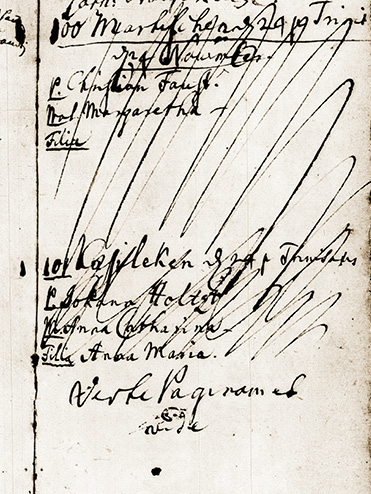
Figure 1. The earliest examples of Donelaitis’s handwriting. Tollmingkehmen. Taufen 1725–1754. Staatsarchiv Leipzig, Sonderbestände im Sächsischen Staatsarchiv, Band B 96, 358 p., f. 187r
In this way, Donelaitis comments on his own error in record-keeping: the two cancelled entries had been written in a disorderly manner, so he rewrote them on the adjacent page. It is worth noting that these two crossed-out entries and the Latin remark constitute the earliest currently attested examples of Donelaitis’s handwriting.
The latest attested contemporaneous remark by Donelaitis is dated September 19, 1779 and was entered in the baptismal register for 1774–[1780]. In this remark, Donelaitis comments on the father of an illegitimate child baptized that day: “Friedrich Baering, ein Schreiber aus Tollmingkemen; pater ejus quoque moechus fuit”17 [Friedrich Baering, a scribe from Tollmingkemen; his father was also an adulterer.]
Between these two dates lies the entire extensive corpus of Donelaitis’s remarks described above. The frequency of such contemporaneous remarks during the observed period (1743–1780) does not fluctuate significantly and is about 5–7 remarks per year. A specific feature of this layer of remarks is that their dates are precisely known: they were written together with the corresponding baptismal entries, whose dating is beyond doubt18.
The chronology of later remarks is less well attested. We know of 146 later remarks scattered across all sources of Donelaitis’s written legacy. In 63 cases, Donelaitis himself indicated the date of writing. By contrast, 83 later remarks are undated (of which, 18 in the baptismal registers, and 65 in the separation case documents). Since later remarks were added to texts already completed, the date of the primary document serves only as a terminus post quem. A more precise hypothetical dating can be suggested by considering their physical proximity to reliably dated notes: remarks located close to one another in the same document were likely written around the same time.
In the 1725–1754 baptismal register, the chronology of later remarks is framed by two precisely dated entries. At the beginning, Donelaitis wrote on November 30, 1773, commenting on a solemn prayer he had entered in the book thirty years earlier:
Anno 1773 den 30 Nov:[embris] laß ich dieses durch, und erstaunete in Rücksicht der göttlichen Führungen. Mein Nachfolger denke an mich!19 [In the year 1773, on November 30, I read through this and was astonished in consideration of the divine guidance. My successor, think of me!]
On the very last page of this register appears a brief remark dated December 20, 1773: “Ich trat mein Amt an 1743 den 1 sten Aduents : Sonntag. Scripsi 1773 d[en] 20 Dec.[ember].”20 [I assumed my office in 1743 on the 1st Sunday of Advent. Written on December 20th, 1773.]
Between these two remarks lie 13 additional comments dated only to the year 1773, without month or day – for example: “Anno 1773. Mein sehr flüchtiges Wesen hat es gemacht, daß ich sehr oft schlecht geschrieben habe.”21 [In the year 1773. My very hasty nature has caused me to write poorly very often.] Since all these remarks refer to the same year, it is highly probable that they were written between November 30 and December 20, 1773. It seems that Donelaitis spent late November and December of that year reviewing and commenting on this register. However, ten completely undated remarks remain in the same book; although their dating is uncertain, their proximity to the dated 1773 remarks suggests that at least some were written during the same period. We may therefore conclude that most later remarks in the 1725–1754 register (25 out of 29) were likely added in November–December 1773. Only four remarks fall outside these limits, dated by Donelaitis to 1768, 1769, 1770, and 177222.
Comparable evidence emerges from the chronological analysis of later remarks in the 1755–1773 baptismal register. In this volume, we identified 18 such remarks. Arranged in the order of appearance, the sequence is as follows: [1] 1773, [2] s.d.23, [3] s.d., [4] 1773, [5] 21 Dec 1773, [6] 1773, [7] s.d., [8] 21 Dec 1773, [9] s.d., [10] s.d., [11] s.d., [12] s.d., [13] 1774, [14] 1774, [15] 1774, [16] s.d., [17] s.d., [18] 1774. Particularly noteworthy are two remarks dated precisely to December 21, 177324. Let us recall that the final remark in the earlier register (1725–1754) was dated exactly one day earlier, i.e., December 20, 1773. It is therefore plausible that Donelaitis completed his annotations in the first register on that day and began reviewing the second on the next. The fact that the two remarks dated December 21, 1773 occur not at the beginning but in the first third of the 1755–1773 register suggests that Donelaitis was able to review and annotate a substantial portion of the book in a single day. It is thus likely that remarks [1–11] in this register were also written on December 21, 1773. Of the seven remaining later remarks, four are dated only to 1774, without a specific month or day. We may reasonably assume that they were written in early 1774, as Donelaitis continued the series of comments begun in late 1773. Among the remarks dated to 1774, there is also Donelaitis’s German poem Unschuld sey mein ganzes Leben25.
The chronology of later remarks in the land-separation case documents can also be interpreted with relative confidence. In the margins of these documents, Donelaitis left 77 remarks, with most of them being concentrated in two texts: 16 remarks added to the land surveyor Neubauer’s report of December 12, 177526, and 40 remarks to the letter written by Amtmann Theophil Ruig27 on December 15, 177528. The remaining 21 remarks are scattered across other documents. In Ruig’s letter, one remark is dated August 12, 1778, and another two refer to the year 1778 without a specific month or day. It is highly probable that all remarks in this letter were written around August 12, 1778. The same pattern appears in Neubauer’s report, where two precisely dated remarks occur – September 1 and September 3, 1778 – suggesting that the remaining annotations were added at around the same time. In other documents, only one remark is dated – as August 22, 1778, in Donelaitis’s note on a letter from the War and Domains Chamber in Gumbinnen29. Although 20 other remarks in the separation case remain undated, the overall pattern appears chronologically compact: since Donelaitis was demonstrably commenting on these texts on August 12, August 22, September 1, and September 3, 1778, we may reasonably conclude that he reviewed the entire land-separation file in late August and early September of that year.
Donelaitis also left abundant evidence for reconstructing the timeline of the Reports. At the outset, he states that he began recording these notes in 177330. In section 12, he writes that he is 60½ years old at that time31. Knowing his birth date (January 1, 1714), we can calculate that this section was written in July 1774. He also dates section 15 as follows:
“Soweit war ich Anno 1775, in meinem 62sten Lebensjahre, mit meinen Nachrichten gekommen; als mit einemmal ein Lärm wegen des Kirchenlandes und Amtsackers von dem damaligen Amtmann Ruhig erreget wurde, und mir viel Noth machte.”32 [By the year 1775, in my 62nd year of life, I had advanced this far with my notes; when suddenly an uproar arose about the church land and the parish field, stirred up by the then Amtmann Ruhig, and caused me much trouble.]
Since the first document in the land-separation case reached Donelaitis on July 24, 177533, section 15 was likely written before that date – probably in the summer of 1775. After this point, the text of the Reports falls silent for three years – Donelaitis did not resume his notes because he devoted much time and energy to the land dispute. This hiatus is confirmed by the dating of section 16 to April 2, 1778: “Scripsi 1778 d[en] 2. Aprilis am Donnerstag nach Mittag”34. [Written April 2, 1778, on Thursday afternoon.] Donelaitis continued writing Reports until 1779, as indicated by his note in section 1835, and by a dated remark on the entire convolute36.
General chronology of Donelaitis’s egodocumentary narrative
If we take the full corpus of Donelaitis’s comments and align it with the chronological data outlined above, an interesting pattern emerges. On the timeline, we see two distinct lines of this narrative, each moving to a different rhythm. The line of contemporaneous remarks runs steadily throughout the observed period (1743–1780), producing about 5–7 remarks per year without significant interruptions. By contrast, the rhythm of later remarks is highly uneven. Before 1773, only isolated later remarks occur in various primary sources: in documents concerning the purchase of an organ (July 21, 176637), in records related to the construction of the new church in Tollmingkehmen (July 21, 176638), in the 1725–1754 baptismal register (1768, 1769, 1770, 177239), and probably before 1773 in two remarks on the manuscript of The Seasons40. However, in November–December 1773, a wave of later remarks appears: Donelaitis intensively comments on the 1725–1754 and 1755–1773 baptismal registers (43 later remarks), begins the third baptismal register, starts writing the Reports, and, according to Tetzner, at the same time comments extensively on other documents in the rectory archive. This marks a clear surge in Donelaitis’s activity as a commentator. The wave begins to subside in mid-1774 and nearly disappears by July 1775: during this period, he writes sections 12–15 of the Reports and occasionally comments on baptisms (8 remarks are known). From mid-1775 to April 1778, no later commentaries are attested; during this time, his writings are dominated by primary texts – numerous documents related to the separation case (11 are attested41) – and also two personal letters to Johann Gottfried Jordan from 177742. A new wave of later remarks rises in April 1778 and continues into 1779: during this period, Donelaitis completes the remaining sections of the Reports, comments extensively on the separation case, and occasionally annotates baptisms in the third register.
Upon observing the interplay of contemporaneous and later remarks, it becomes clear that contemporaneous remarks represent a natural, continuous mode of reflection – a persistent feature of the mentality of Donelaitis. The two waves of later remarks, however, correspond to exceptional situations in his life. The surge of remarks in late 1773 is linked to a symbolic date of personal significance: the 30th anniversary of Donelaitis being induced as pastor of Tollmingkehmen (November 24, 1743). In addition to this jubilee, the symbolic weight of late November–December 1773 was reinforced by the beginning of a new liturgical year (November 28, 1773), which likely prompted Donelaitis to start a new (third) baptismal register. Moreover, on January 1, 1774, he turned 60. These symbolically charged events and dates probably seemed to him an appropriate occasion to reflect on his life and summarize his experience. Thus, the wave of remarks in late 1773 should be seen as a coherent narrative, whose unity lies not so much in content as in its impulse (a reflective summation of life experience) and function (ensuring the smooth transfer of parish affairs to his successor).
The wave of later remarks in 1778–1779, in turn, responds to the progress of the land-separation process. The last known legal document written by Donelaitis in this case is dated April 18, 177743. After that, the proceedings were postponed, and the tensions eased – Donelaitis interpreted this as a legal victory. Although this was not the reality (as the case actually continued long after his death), Donelaitis sincerely believed that he had successfully defended the Church’s interests and that the time had come to summarize the course of the dispute.
The overall chronological analysis of the comments clearly shows that Donelaitis’s remarks cannot be read as isolated statements scattered across documents: the compact time frame in which they were written implies strong interconnections and the coherence of the egodocumentary narrative they express.
Typology of contemporaneous remarks
Most of Donelaitis’s contemporaneous remarks are attested in the baptismal registers (177 cases), with two exceptions: an extensive comment on the process of the creation of The Seasons (located at the bottom of the so-called “Fortsetzung”44), and a brief note in the autograph of The Seasons, explaining a copying error: “Es ist aus Versehen noch einmal geschrieben”45 [It was written again by mistake.]. Within the group of contemporaneous remarks, several types can be distinguished: 1) remarks on baptisms of illegitimate children; 2) remarks on unusual baptisms; 3) remarks on local realities of the Tollmingkehmen parish.
The first type – remarks on illegitimate births – is the most numerous: 44 statements by Donelaitis on this subject are known. The earliest such remark is dated March 1, 174446, and the latest is of September 19, 177947. In the comments of this type, Donelaitis moralizes and reproaches the parents of illegitimate children, for example:
P[ater] soll seyn Gottfried Patnakit, den ich eingesegnet habe, der aber von Natur aus einem Saustall herstammt. Eheu, parentes influunt in liberos suos naturaliter. Ich habe, da ich noch zu meiner Zeit unter verderbten Menschen wandelte, allerley betrübte Exempel erlebt. O ihr guten Eltern, ihr Vieh, seyd ihr nicht Schuld, daß ihr Schande an euren Kindern erlebet? Wer glaubt aber das? – M[ater]: Catharina Pinnauin, eine Person, auch aus einem Saustall. Ihre Eltern waren elende dumme Leute und lebeten beynah ebenso als ihre Tochter. 18. Dec.[embris] [1778]48 [Father is said to be Gottfried Patnakit, whom I blessed in marriage, but who by nature comes from a pigsty. Alas, parents influence their children naturally. In those days, as I walked among depraved men, I witnessed many grievous examples. O you good parents, you beasts, are you not to blame that you suffer shame through your children? But who believes that? – Mother: Catharina Pinnauin, a person also from a pigsty. Her parents were miserable, foolish people and lived almost as badly as their daughter.]
On the one hand, Donelaitis strongly condemned illegitimate intercourse – harsh remarks of this type occur throughout the period under study. They form a recurring element of his moral narrative. On the other hand, Christiane Schiller rightly cautions against attributing these comments solely to Donelaitis’s individual character; they should be interpreted within the rhetorical context of his time, in which severe statements about illegitimate children and their parents were being widely used. In this context, Donelaitis’s rhetoric does not appear harsher than that of other pastors, and Schiller even notes clear signs of social empathy in his behavior49.
Remarks on unusual baptisms also occur frequently: 36 statements of this type are known. For example, on May 25, 1748, Donelaitis expresses satisfaction that a child is baptized in the Tollmingkehmen church by a new influential figure – one of the local Amtmanns, who had his transfer arranged from Melkehmen to Tollmingkehmen, and now counts himself among the members of this parish50. Other non-standard circumstances are also noted, for example: “P[ater] Martin Strisemann ein gewesener Knecht, der in Ostern […], vermutlich im trunckenen Muth in den Brunnen gefallen und elendiglich umgekommen.”51 [Father Martin Strisemann, a former servant, who at Easter […] apparently, in drunken recklessness, fell into a well and miserably perished.] Remarks of this type provide abundant material for the microhistory of Donelaitis’s social environment. A specific subtype of contemporaneous remarks consists of comments on local realities, in which Donelaitis records the founding of new villages in the Tollmingkehmen parish: Jodupenen, Ekkertsberg, Bergenthal, and Freyberg52. He does not fail to boast that he himself invented the names Ekkertsberg and Freyberg.
The beginning of the later egodocumentary narrative
The two initial ones of Donelaitis’s later remarks are dated July 21, 1766. They were written in the margins of two separate documents: in one remark, Donelaitis provides detailed information about the ordering and financing of the Tollmingkehmen organ in 1744–1747, and, in the other, he notes about the consecration of the new church in 1756 (emphasis mine – V. Š.):
[…] Mein lieber Leser, siehe nach, wenn ich einmahl schon lange tod bin, das Schnitzwerk auf dem hinteren Theil des Positivs nach dem Altar zu […]. Vale. Tollmingkemen den 21. Julii 1766. C[hristian] Donalitius Pf[ar]r[er] Aetatis meae cum scriberem 53.]53 [My dear reader, look when I have long been dead at the carving on the back part of the positive near the altar […]. Farewell. Tollmingkemen, July 21, 1766. Christian Donalitius, pastor. At the time of writing, I was 53 years old.]
[…] Ich habe also in der alten, als auch in der neuen Kirche just an einem Tage zum ersten Mahl die Kantzel betreten. Vale lector den 21. Julii 1766. C[hristian] Donalitius.54 [Thus, on one and the same day, I mounted the pulpit for the first time in both the old and the new church. Farewell, reader. July 21, 1766. Christian Donalitius.]
These two later remarks are significantly complemented by a long contemporaneous comment written at the end of the same liturgical year (late November–December 1766) in the baptismal register – which is the only contemporaneous remark that reflects Donelaitis’s self-awareness (emphasis mine – V. Š):
Erravi lector et successor dignissime in calculo praeteriti anni, ut conspectus ostendit. Oculi jam deficiunt et labores nimis cumulati obruunt animum. Faxit Deus, ut tua tempora leviora meis fiant. Saepe ferme exanimus sub laborum onere extorpui. Quo annorum cumulus et laborum moles augitur, eo magis exhaurimur. Iam vigesimum tertium annum officii mei finiente Novembri finio. Varia expertus sum, multa passus, semper divina gratia suffultus et erectus. Haec successor charissime in memoriam, occasione data, conscripsi. Memento monumenti mei et vale!55 [I have erred, most worthy reader and successor, in the reckoning of the past year, as the overview shows. My eyes are failing, and excessive labors overwhelm my spirit. May God grant that your times be lighter than mine. Often, almost lifeless, I have collapsed under the burden of toil. As the heap of years and the weight of labors grow, so do we become more exhausted. Now, as November ends, I complete the twenty-third year of my office. I have experienced many things, and endured great hardships, always upheld and strengthened by divine grace. These words, dearest successor, I have written for remembrance when occasion offered. Remember my monument and farewell!]
While reading these three remarks from 1766, we encounter an entirely new narrative situation: for the first time, Donelaitis specifies his addressee – an imagined reader, his future successor – who remains central in all subsequent commentaries. In these notes, Donelaitis also begins to speak directly about himself, focusing on his own actions and life. He sketches an expressive self-portrait as an aging man: his eyes are weak, he is weary, his shoulders burdened by toil and cares. This 1766-dated self-portrait bears clear traits of literary convention: the image of a man stooping under the weight of labor often appears in Donelaitis’s Lithuanian poetry. The Latin phrase in the comment – “Saepe ferme exanimus sub laborum onere extorpui” – is repeated almost verbatim twice in The Seasons, cf.: “[Túls] Pó wargú nasztà kasdën waitójă păkùmpęs.”56 [One groans, bent under the burden of toil]]; “[Bėdžius] Po baiſiôm’s Wargû Naſʒtôm’s wôs gâl ătſidwėſti.”57 [The poor man, under dreadful burdens of toil, can scarcely draw breath].
The dichotomy of shame and honor
When reading Donelaitis’s self-characterizations in later comments, the first thing we notice is his frequent apologies for mistakes in the parish registers – places where the text was written incorrectly, is illegible, or lacks data. We know of 20 such apologies. They reveal a recurring theme: Donelaitis repeatedly expressed shame and made great efforts to deny or at least partially justify his guilt, e.g.:
N[ota] B[ene] Dieser Schreibart schämte ich mich A[nn]o 1773.58 [Note well: I was ashamed of this manner of writing in the year 1773.]
Es verdreust mich, wenn ich dergleichen Lücken sehen muß; und ich bin doch unschuldig. Ich hielt diesesmal das Amt in Enzunen.59 [It vexes me when I must see such gaps; and yet I am not at fault. This time I held office in Enzunen.]
Within Donelaitis’s ego-narrative, admissions of error occur only in these 20 comments – and nowhere else. The repeated references to shame and the persistent search for justification reveal deep emotional discomfort. Significantly, Donelaitis acknowledges shortcomings only in a marginal sphere of his work: minor lapses in parish record-keeping. In contrast, in the main spheres of his activity – such as church construction or the land-separation lawsuit – he regards all his actions and decisions as entirely correct and admits no fault whatsoever. Any hint of error, inaccuracy, or lack of competence provokes a genuine storm of anger in Donelaitis. When Amtmann Ruhig reproaches him for lacking competence in the matter of land separation, Donelaitis bursts out:
Herr! gerechter Gott! soll ich hier Deine ganze Rache aufbieten? Nein! mein Gott, ich will für diesen elenden Menschen und für sein Haus beten. […] Ich habe an ihm eine solche ehrenrührige Lästerung nicht verdient. N[ota] B[ene] Verfluchte Lästerung! […]60 [Lord! righteous God! Shall I here unleash all Thy vengeance? No! my God, I will pray for this wretched man and for his house. […] I have not deserved such dishonorable slander from him. Note well: Accursed slander!]
The emotional force of Donelaitis’s remarks arises chiefly from the tension between the categories of ‘shame’ and ‘honor’. This neuralgic point of his personality is reliably attested by his frequent outbursts of anger toward his enemies in the land-separation litigation (emphasis mine – V. Š.):
Gott Lob! daß ich mit Ehren graues Haar trage, und mich gegen Niemand in der Welt schämen, nicht schämen, nicht schämen darf. […] Ich glaube, daß Du mir, wenn es Dir erlaubt würde, lieber heute als morgen den Hals brechen wolltest. – Herr siehe darein!61 [Praise be to God! that I wear gray hair with honor, and need not be ashamed, not ashamed, not ashamed before anyone in the world. […] I believe that you, if permitted, would rather break my neck today than tomorrow. – Lord, look upon this!]
What counts as shameful or honorable depends on the normative framework of the time, and the attribution of these qualities to a person’s actions is directly linked to his social status. It is evident that Donelaitis vigorously defended his honor and social authority: “Komm meine Charte, die ich in meinem 64 sten Lebensjahre gezeichnet habe, und rede, um meine Ehre zu retten! sage, ob ich mein Land kenne! […]”62 [Come, my map, which I drew in my 64th year of life, and speak to save my honor! Say whether I know my land!] Identifying the categories of honor and shame in the emotional background of the separation lawsuit enables us to better understand the essence of the conflict: Donelaitis perceived the land separation initiated by Ruhig not as a rational legal process but as an affront to his own and the church’s honor.
The contradictory Donelaitis: between noble conduct and unrestrained affect
Toward the end of his life, Donelaitis begins to complain about the decline of piety and the spread of irreligion. Four of his marginalia on this subject are recorded in the baptismal register from the years 1755–1773; they are undated, but, based on their position in the source, one may hypothesize that the first three were written on 21 December 1773, and the fourth probably at the beginning of 1774:
N[ota]B[ene]: Zu meiner Zeit nahm schon die Freygeisterey in Preußen sehr überhand; auch manche Geistlichen warens. […]63 [Note well: In my time, irreligion had already become widespread in Prussia; even some clergymen were among them.]
Alles was groß und vornehm seyn wollte, ging selten in die Kirche und zum Abendmahl.64 [All who wished to appear grand and distinguished seldom went to church or to communion.]
N[ota]B[ene]: Bey der überhand nehmenden Freygeisterei und Unglauben zu meiner Zeit habe ich oft an f[o]lg[ende] Schriftstellen gedacht […].65 [Note well: Amid the prevailing irreligion and unbelief of my time, I often reflected on the following passages of Scripture <…>]
Zu meiner Zeit verfiel die Gottseligkeit in der Art, daß auch Prediger ohne Scheu um Geld lombrierten und das Diebesgeld in die Tasche steckten. Merke dieses Nachwelt.66 [In my time, godliness declined to such an extent that even preachers shamelessly gambled for money and pocketed stolen winnings. Take note of this, posterity.]
Attention should be drawn to the contrast Donelaitis constructs between his own conduct and the surrounding moral decline. In the Reports, Donelaitis tells of a former pastor in Tollmingkehmen who held parties and gambled67; the younger generation behaves similarly: Donelaitis mentions young men in the preaching office who spoke foul words without shame in company, cursed, and gambled for money68. Thus, moral decay both precedes Donelaitis and resumes after him, while the only consistent example of proper conduct is Donelaitis himself:
Mein Temperament war natürlich munter, und ich konnte auf meinem Forte=Piano und Flügel singen und spielen, aber ich war auch im Spielen und Singen moralisch und richtete mich nach meinen Gästen, um nützlich zu seyn.69 [My temperament was naturally lively, and I could sing and play on my fortepiano and harpsichord, yet even in playing and singing I was moral and adapted myself to my guests in order to be useful.]
These remarks reveal Donelaitis’s lofty self-assessment: he never doubted that his conduct and life could serve as an example to others – in his personality, self-confidence was certainly not lacking. He shapes his self-portrait so that only honorable traits remain. Yet some comments sharply contrast with this idealized image. As noted earlier, this is evident in his attacks on Amtmann Ruhig during the separation lawsuit: upon losing patience, Donelaitis rages, threatens, curses, and calls upon God’s aid. Beneath the carefully constructed image of an exemplary pastor, explosive emotional energy seethes – energy he struggled to keep under control:
Um nicht scandaloes zu leben, habe ich oftmals Simsons Kraft annehmen müssen und wollte doch bisweilen unterliegen, aber dazu ließ ich es niemals kommen. […] Wenn mein Succ[essor] eine entsetzliche Hitze im Geblüth besitzet und sich nicht mäßigen kann, so prophezeie ich ihm, dass er in Tolm[ingkehmen] eine Fischbrücke erleben wird, wo man sich einander zum schändlichsten Spektacul an die Köpfe faßt und sich herum rauft.70 [In order not to live scandalously, I have often had to assume Samson’s strength and yet at times wished to succumb, but I never allowed it to happen. […] If my successor possesses a dreadful heat in his blood and cannot restrain himself, then I prophesy that he will witness in Tollmingkehmen a fish market where people seize each other by the head for the most shameful spectacle and brawl about.]
The mention of hot blood and an inability to restrain oneself clearly reflects Donelaitis’s own emotional temperament. Aware that the hatred erupting in his remarks clashes with the ideal of exemplary conduct, he seeks to justify himself.:
Mi Lector! wenn ich in diesen beigesetzten Anmerkungen die Worte Fluch und Verflucht manchmal gebraucht habe, so siehe die Erklärung in folgenden Schriftstellen. […] Herzenskündiger! Du weißt, daß ich diesem elenden Menschen nichts Böses, sondern Erleuchtung, Bekehrung und Beßerung wünsche. Amen.71 [My reader! If in these appended notes I have sometimes used the words curse and accursed, then see the explanation in the following passages of Scripture. […] Knower of hearts! Thou knowest that I wish this wretched man nothing evil, but enlightenment, conversion, and improvement. Amen.]
Careful reading of Donelaitis’s comments reveals frequent emotional contradictions in other contexts as well. For example, on December 15, 1743, he complains that a Reformed family failed to send godparents to the baptismal ceremony, while, in a later comment from 1773, he softens this earlier view:
[1743] Testes iussi non venerunt nomina dicturi. Pro more fere consueto Reformatorum. – Anno 1773 d[ie] 30 Nov[embris] scripsi. Unter den Reformirten giebt es gute Leute, sowie unter Lut[herischen] recht Gottlose; das hab ich in die 30 Jahre erfahren.72 [(1743) The invited witnesses did not come to state their names, almost as is customary among the Reformed. – Year 1773, 30 November, I wrote: Among the Reformed there are good people, just as among the Lutherans there are truly godless ones; this I have learned in thirty years.]
One more telling example is the peculiar bond between Donelaitis and the peasant Johann Peter Seiffert: the first child of this man (a daughter, born in 1745) was illegitimate, and Donelaitis added a very harsh comment to the register, calling the mother “Eine 3 doppelte Hure”73 [A triple double whore]. However later, the Seiffert family formalized their marriage and came to be regarded as something akin to the pastor’s ‘favorites’, since Donelaitis and his wife stood as godparents to three additional children (1747, 1750, 1753) – a unique occurrence in Donelaitis’s baptismal practice.
The interplay of severity and gentleness in Donelaitis’s thought emerges most vividly in two marginal commentaries he added in 1774, subsequently recognized as the poems Der Gott der Finsternis and Unschuld sey mein ganzes Leben74. In the former, he laments the spread of irreligion, and his harsh rhetoric recalls the curses once hurled against Ruhig: “[Der Teufel] ranzt sogleich den Unflath in ein Buch / Zum Leyd der Redlichen, und seinem eignem Fluch” 75. [The devil immediately scrawls the filth into a book / To the grief of the righteous, and to his own curse.] Whereas, in the latter, he proclaims imperatives of love and empathy: “Klugheit, – Ernst – und viel Geduld / Gott und Menschen ohne Schein zu lieben; / Niemand auch im gringsten zu betrüben, / Dieses sey nur meine Schuld.” 76 [Wisdom – earnestness – and much patience / To love God and men without pretense; / To grieve no one even in the least; / Let this alone be my guilt.] Both poems, composed around 1774, epitomize the extremes of Donelaitis’s personality under discussion.
Conclusions
The analysis of Donelaitis’s comments clearly demonstrates that the marginalia found in his documents and in Various Reliable Reports for My Successor constitute a highly significant part of his written legacy and form a coherent ego-narrative that must be read and interpreted as a whole. This analysis has clarified the actual scope of this textual production and its chronological relationships. Two chronological lines of Donelaitis’s comments have been identified: contemporaneous remarks, written alongside the primary texts, and later remarks, added ex post. The contemporaneous comments display a stable frequency of about five to seven per year; they contain relatively few traces of direct self-reflection, yet they abound in data for the microhistory of Tollmingkehmen. Within the group of later comments, two major waves emerge, dated to 1773–1774 and 1778–1779, both linked to significant events in Donelaitis’s life: the jubilee of his pastoral office (1773) and the progress of the land-separation process (1778–1779). Both blocks of commentary are symmetrically reflected in Reports – Donelaitis’s most extensive egodocument, whose first part (chapters 1–15) was written in 1773–1774, and the second part (chapters 16–19 and the supplements) was produced in 1778–1779. Thus, the chronological reconstruction of Donelaitis’s ego-narrative once again confirms its coherence, transcending the boundaries of any single text.
In seeking reflections of Donelaitis’s personality in these comments, we encounter traits that are absent from his other writings or documents. Most striking is his pronounced emotionality and tendency toward affect: his utterances are fundamentally shaped by epistemically determined concepts of ‘honor’ and ‘shame’, which rigorously guide his judgments. This cultural code differs radically from the rhetoric employed by Ruhig, grounded in Enlightenment rationality and pragmatism. The land-separation process dictated by the Prussian agrarian reform, which Ruhig was obliged to initiate, was interpreted by Donelaitis emotionally as an affront to his honor and a personal injury.
Another salient trait of Donelaitis’s personality is the inner tension between anger and gentleness. The entire ego-narrative testifies to a choleric temperament that he constantly sought to restrain through self-discipline. His comments symptomatically reveal restlessness, energy, impatience: Donelaitis is everywhere, expressing his opinion on everything; he finds it hard to leave events or people alone. He comments on other people, on himself, on others’ writings, on his own writings – even on comments themselves. This abundance of marginalia creates the impression of an intensely active, irrepressible individual – an impression further reinforced by emotional outbursts. All this energy correlates with Donelaitis’s evident ambition and considerable self-regard. When we read the ego-narrative as a whole, it becomes impossible to picture Donelaitis as a quiet, good-natured pastor and poet who never set foot outside his parsonage. The comments reveal a dynamic, talented, almost Renaissance personality, brimming with energy and powerful emotional contradictions.
In subsequent stages of research, it will be essential to determine whether the ego-narrative expression described above was an individual trait of Donelaitis’s personality, or if it actually reflected a broader behavioral model. Within his immediate environment, comparable activity in the form of commentary appears to have been absent: apart from a few remarks by other persons recorded in the Tollmingkehmen church books77, no similar practice has been attested. These remarks, however, are isolated; there is no evidence that Donelaitis’s predecessors or successors annotated the rectory documents with comparable frequency. In the portion of the 1725–1754 register preceding his tenure, no such comments occur. The primary data therefore suggest the individuality and exceptionality of Donelaitis. Nevertheless, the true degree of originality in his ego-narrative will emerge only through broader research capable of identifying tendencies toward self-reflection in the writings of his contemporaries – pastors, officials, and members of the nobility.
Acknowledgements. This article has been prepared within the framework of the long-term program of the Institute of Lithuanian Literature and Folklore, “Research and Publication of the Multilingual Writings of Old Lithuania and Prussia and Their Cultural Contexts” (2022–2026), and under the specific research project of Masaryk University, No. MUNI/A/1490/2024.
Note
The author acknowledges that language and stylistic refinement of this article was supported by Microsoft Copilot (AI language model, GPT5 architecture). Final responsibility for the content fully remains with the author.
Sources
1. DONALITIUS, Christian. Amtsbericht des Donalitius, herausgegeben von Franz Tetzner. Unsere Dichter in Wort und Bild, 1896, vol. 6, p. 17–31.
2. TETZNER, Franz. Die Tolminkemischen Taufregister des Christian Donalitius. Altpreussische Monatschrift, 1896, vol. 33, p. 18–35.
3. TETZNER, Franz. Die Tolminkemischen Kirchenbauakten aus der Zeit des Christian Donalitius. Altpreussische Monatsschrift, 1896, vol. 33, p. 190–201.
4. TETZNER, Franz. Christian Donalitius. Altpreussische Monatsschrift, 1897, vol. 34, p. 277–321, 409–441.
5. Tollmingkehmen. Taufen 1725–1754. Staatsarchiv Leipzig, Sonderbestände im Sächsischen Staatsarchiv, Band B 96, 358 p.
Referencies
1. BUDDENSIEG, Hermann. Kristijonas Donelaitis: Leben und Werk in seiner Zeit. In: Donelaitis, Kristijonas. Die Jahreszeiten. München: Wilhelm Fink Verlag, 1966, p. 121–156.
2. DONALITIUS, Christian. Nachrichten. Von Christian Donalitius, herausgegeben von Franz Tetzner. Altpreussische Monatsschrift, 1914, vol. 51, p. 171–187, 192, 250–270.
3. DONELAITIS, Kristijonas. Raštai. Vol. 1: Metai: Dokumentinis ir kritinis leidimas. Ed. Mikas Vaicekauskas. Vilnius: Lietuvių literatūros ir tautosakos institutas, 2015. cxxxv, 233, [1] p. ISBN 978-609-425-150-4.
4. DONELAITIS, Kristijonas. Raštai. Vol. 3: Egodokumentiniai tekstai. Vertimai: laiškai ir laiškų fragmentai, „Visokios patikimos žinios mano įpėdiniui“, „Gromata vieno gaspadoriaus būrams apie ganyklų perdalijimo naudą“ : dokumentiniai ir kritiniai leidimai, vertimai. Ed. Mikas Vaicekauskas. Vilnius: Lietuvių literatūros ir tautosakos institutas, 2022. CXI, 197, [1] p. ISBN 978-609-425-341-6.
5. DONELAITIS, Kristijonas. Raštai. Vol. 4: Tarnybiniai raštai ir dokumentai: dokumentiniai leidimai ir vertimai. Ed. Vaidas Šeferis. Vilnius: Lietuvių literatūros ir tautosakos institutas, 2022. CXXIII, 323, [1] p. ISBN 978-609-425-324-9.
6. DOVEIKA, Kostas. K. Donelaitis jo asmeninių užrašų ir įvairių oficialių raštų bei dokumentų šviesoje. In: Literatūra ir kalba, 1965, t. 7, p. 339–354.
7. GARLIAUSKAS, Vidas. Lietuvos katalikų bažnyčių metrikų knygų tyrimo gairės. Bibliotheca Lituana. [Vol.] II: Atminties institucijų rinkiniai. Vilnius: [Vilniaus universitetas], 2012, p. 66–105. DOI: https://doi.org/10.15388/BiblLita.2012.2.15581
8. Joachimsthaler, Jürgen. Donelaitis im literarischen Kontext seiner Zeit. Annaberger Annalen, 2014, [vol.] 22, p. 8–27.
9. JOVAIŠAS, Albinas. Kristijonas Donelaitis. Kaunas: Šviesa, 1992. 261, [3] p., [4] leaves of plates.
10. Vaicekauskas, Mikas, ed. Kristijono Donelaičio rankraščiai = The Manuscripts of Kristijonas Donelaitis = Die Handschriften von Kristijonas. A Facsimile Edition. Vilnius: Lietuvių literatūros ir tautosakos institutas, 2014. 98, [2] p. ISBN 978-609-425-123-8.
11. Vaicekauskas, Mikas ed. Kristijono Donelaičio reikšmės: straipsnių rinkinys. Vilnius: Lietuvių literatūros ir tautosakos institutas, 2016. 547, [1] p. ISBN 978-609-425-176-4.
12. Kuzborska, Alina. Deutsche Gedichte von Kristijonas Donelaitis. Annaberger Annalen, 2005, no. 13, p. 158–176.
13. Kuzborska, Alina. Kristijonas Donelaitis als literarische Figur in der deutschen Literatur. Annaberger Annalen, 2014, no. 22, p. 28–50.
14. Kuzborska, Alina. Kristijonas Donelaitis vel Christian Donalitius als deutscher Dichter und Aufklärer. In: Pfarrer – Dichter – Mechanikus: Donelaitis im kulturellen Kontext seiner Zeit: Akten der Tagung anlässlich des 300. Geburtstages von Christian Donalitius – Kristijonas Donelaitis (1714–1780). Eds. Christiane Schiller, Harald Bichlmeier, Silke Brohm. Hamburg: Baar-Verlag, p. 101–118.
15. KUZMICKAS, Vincas. Kristijonas Donelaitis. Vilnius: Vaga, 1983. 237, [3] p., [12] leaves of plates.
16. NARBUTIENĖ, Daiva, ed. Kristijonas Donelaitis: bibliografijos rodyklė. Vilnius: Lietuvos mokslų akademijos Vrublevskių biblioteka, 2015. 638, [2] p. ISBN 978-9986-498-65-0.
17. PACEVIČIUS, Arvydas. Senųjų knygos nuosavybės ženklų tipologija. Knygotyra, 2004, vol. 43, p. 50–57.
18. PASSARGE, Louis. Aus Baltischen Landen: Studien und Bilder. Glogau: Verlag von Carl Flemming, 1878. 551 [VIII] p.
19. PASSARGE, Louis. Christian Donalitius’ Leben und Dichtungen. In Donalitius’ Littauische Dichtungen, Übersetzt und erläutert von Louis Passarge. Halle a. S.: Verlag der Buchhandlung des Waisenhauses, 1894. p. 1–26.
20. PETKŪNAS, Darius. Kunigo Kristijono Donelaičio ganytojiška veikla, teologiniai motyvai „Metuose“ ir kituose raštuose. Biblija ir literatūra. Tiltai. Priedas: Mokslo darbai, 2005, no. 27, p. 61–88.
21. PETREIKIS, Tomas. Marginalijos kaip knygos istorijos šaltinis: istoriografinis aspektas. Knygotyra, 2011, no. 57, p. 67–85. DOI: https://doi.org/10.15388/kn.v57i0.1489
22. Schiller, Christiane; Bichlmeier, Harald; and Brohm Silke, eds. Pfarrer – Dichter – Mechanikus: Donelaitis im kulturellen Kontext seiner Zeit: Akten der Tagung anlässlich des 300. Geburtstages von Christian Donalitius – Kristijonas Donelaitis (1714–1780). Hamburg: Baar Verlag, 2021. 262 p. ISBN 978-3-935536-14-1.
23. SCHILLER, Christiane. Christian Donelaitis und seine Zeitgenossen: das Taufbuch von Tollmingkehmen (1725–1754) als (Auto-)Biographische Quelle. Knygotyra, 2015, vol. 64, p. 11‒30. DOI: https://doi.org/10.15388/Knygotyra.2015.64.8211
24. SCHOENBORN, Ulrich. Kristijonas Donelaitis (1714–1780): zwischen Theologie und Poesie. [München]: GRIN Verlag, 2014. 231p. ISBN 9783656646785.
25. ŠEFERIS, Vaidas. Kristijono Donelaičio „Metų“ rišlumas. Vilnius: Lietuvių literatūros ir tautosakos institutas, 2014. 338, [2] p. ISBN 978-609-425-134-4.
26. ŠEFERIS, Vaidas. The Borderland between Conflicting Canons: Kristijonas Donelaitis. In Literary Canon Formation as Nation–Building in Central Europe and the Baltics: 19th to Early 20th Century. Eds. Aistė Kučinskienė, Viktorija Šeina, Brigita Speičytė. Leiden: Brill 2021, p. 230–255. DOI: https://doi.org/10.1163/9789004457713_015
27. ŠEFERIS, Vaidas. Vokiški Kristijono Donelaičio eilėraščiai. Naujasis Židinys-Aidai, 2023, no. 1, p. 42–50.
28. ŠEFERIS, Vaidas. Von der Auferstehung des ehrlichen Amtmanns. Zur Chronologie und Gattung der deutschen Gedichte von Christian Donelaitis. Colloquia Germanica, 2024, vol. 57, no. 1, p. 51–74.
1 For recent research, see: Vaicekauskas, Mikas, ed. Kristijono Donelaičio reikšmės: straipsnių rinkinys. Vilnius, 2016. 548 p.; Schiller, Christiane; Bichlmeier, Harald; and Brohm, Silke, eds. Pfarrer – Dichter – Mechanikus: Donelaitis im kulturellen Kontext seiner Zeit: Akten der Tagung anlässlich des 300. Geburtstages von Christian Donalitius – Kristijonas Donelaitis (1714–1780). Hamburg, 2021. 262 p.; SCHOENBORN, Ulrich. Kristijonas Donelaitis (1714–1780): zwischen Theologie und Poesie. [München], 2014. 230 p.; Joachimsthaler, Jürgen. Donelaitis im literarischen Kontext seiner Zeit. Annaberger Annalen, 2014, [vol.] 22, p. 8–27; ŠEFERIS, Vaidas. The Borderland between Conflicting Canons: Kristijonas Donelaitis. In: Literary Canon Formation as Nation–Building in Central Europe and the Baltics: 19th to Early 20th Century. Eds. Aistė Kučinskienė, Viktorija Šeina, Brigita Speičytė. Leiden, 2021, p. 230–255; ŠEFERIS, Vaidas. Kristijono Donelaičio „Metų“ rišlumas. Vilnius, 2014. 338, [2] p. For the complete bibliography of Donelaitis’s texts and the scholarly production on his work and life, see NARBUTIENĖ, Daiva, ed. Kristijonas Donelaitis: bibliografijos rodyklė. Vilnius, 2015. 638, [1] p., [16] leaves of plates.
2 The marginalia produced by Donelaitis have never been subjected to a dedicated analysis. However, brief interpretative remarks on some of his commentaries can be found in various sources, see: PASSARGE, Louis. Aus Baltischen Landen: Studien und Bilder. Glogau, 1878, p. 314–325; PASSARGE, Louis. Christian Donalitius’ Leben und Dichtungen. In: Littauische Dichtungen. Übersetzt und erläutert von Louis Passarge. Halle a. S., 1894. p. 15–24; TETZNER, Franz. Die Tolminkemischen Taufregister des Christian Donalitius. Altpreussische Monatschrift, 1896, vol. 33, p. 18–19; TETZNER, Franz. Die Tolminkemischen Kirchenbauakten aus der Zeit des Christian Donalitius. Altpreussische Monatsschrift, 1896, vol. 33, p. 190–193; TETZNER, Franz. Christian Donalitius. Altpreussische Monatsschrift, 1897, vol. 34, p. 282–289; DOVEIKA, Kostas. K. Donelaitis jo asmeninių užrašų ir įvairių oficialių raštų bei dokumentų šviesoje. In: Literatūra ir kalba, 1965, vol. 7, p. 343–353; BUDDENSIEG, Hermann. Kristijonas Donelaitis: Leben und Werk in seiner Zeit. In: Donelaitis, Kristijonas. Die Jahreszeiten. München, 1966, p. 138–143; KUZMICKAS, Vincas. Kristijonas Donelaitis. Vilnius: Vaga, 1983, p. 198–205; JOVAIŠAS, Albinas. Kristijonas Donelaitis. Kaunas, 1992, p. 29–35; PETKŪNAS, Darius. Kunigo Kristijono Donelaičio ganytojiška veikla, teologiniai motyvai „Metuose“ ir kituose raštuose. Tiltai. Priedas: mokslo darbai. Nr. 27: Biblija ir literatūra, 2005, p. 61–88.
3 DONELAITIS, Kristijonas. Raštai, vol. 4: Tarnybiniai raštai ir dokumentai: dokumentiniai leidimai ir vertimai. Ed. Vaidas Šeferis. Vilnius, 2022, p. 90–301.
4 DONELAITIS, Kristijonas. Raštai, vol. 4, p. 16–17, 36–37, 86–87.
5 Vaicekauskas, Mikas, ed. Kristijono Donelaičio rankraščiai. Fotografuotinis leidimas. Vilnius, 2014, p. 29, 59.
6 DONELAITIS, Kristijonas. Raštai. Vol. 3: Egodokumentiniai tekstai. Vertimai: laiškai ir laiškų fragmentai, „Visokios patikimos žinios mano įpėdiniui“, „Gromata vieno gaspadoriaus būrams apie ganyklų perdalijimo naudą“: dokumentiniai ir kritiniai leidimai, vertimai. Ed. Mikas Vaicekauskas. Vilnius, 2022, p. 32–78. In order to facilitate reading, the German quotations from Donelaitis’ works are rendered by using a simplified orthography.
7 A more detailed discussion of the issues pertaining to additional entries and marks occurring in books can be found in: PACEVIČIUS, Arvydas. Senųjų knygos nuosavybės ženklų tipologija. Knygotyra, 2004, vol. 43, p. 50–57.
8 DONALITIUS, Christian. Amtsbericht des Donalitius, herausgegeben von Franz Tetzner. Unsere Dichter in Wort und Bild, 1896, vol. 6, p. 17–31.
9 DONELAITIS, Kristijonas. Raštai, vol. 3, p. 32.
10 Ibidem, p. 34.
11 Tollmingkehmen. Taufen 1725–1754. Staatsarchiv Leipzig, Sonderbestände im Sächsischen Staatsarchiv, Band B 96, 358 p.
12 The text of the second and third registers has survived only in printed excerpts prepared by Franz Tetzner. The terminal date of the third register remains uncertain. TETZNER, Franz. Die Tolminkemischen Taufregister, p. 18–35.
13 Comparable conclusions have been advanced by Vidas Garliauskas in his analysis of Lithuanian Catholic baptismal registers, in which, comments and other supplementary entries occur; in his assessment, such features are characteristic only of a small number of priests distinguished by exceptional intellectual capacity, cf. GARLIAUSKAS, Vidas. Lietuvos katalikų bažnyčių metrikų knygų tyrimo gairės. Bibliotheca Lituana. [Vol.] II: Atminties institucijų rinkiniai. Vilnius, 2012, p. 88.
14 A more comprehensive theoretical treatment of the typology of marginalia in European manuscript and printed sources is provided in: PETREIKIS, Tomas. Marginalijos kaip knygos istorijos šaltinis: istoriografinis aspektas. Knygotyra, 2011, vol. 57, p. 67–85.
15 TETZNER, Franz. Christian Donalitius, p. 287.
16 Tollmingkehmen. Taufen 1725–1754, f. 187r.
17 TETZNER, Franz. Die Tolminkemischen Taufregister, p. 35.
18 This, however, does not apply to the 2 known contemporary remarks preserved in the autographs of The Seasons, the dating of which remains uncertain, cf. Vaicekauskas, Mikas, ed. Kristijono Donelaičio rankraščiai, p. 29, 59.
19 Tollmingkehmen. Taufen 1725–1754, f. 187r.
20 Ibidem, f. 358r.
21 Ibidem, f. 189v.
22 Ibidem, f. 309r, 261r, 258v, ٢٤٨v.
23 Sine dato (undated).
24 TETZNER, Franz. Die Tolminkemischen Taufregister, p. 28.
25 Ibidem, p. 29.
26 DONELAITIS, Kristijonas. Raštai, vol. 4, p. 144–155.
27 Theophil Ruhig (1728–1780) served as the Amtmann in Tollmingkehmen from 1769 to 1780 and, in 1775, initiated a legal process concerning the separation of land between the royal domains and the Church.
28 DONELAITIS, Kristijonas. Raštai, vol. 4, p. 156–182.
29 Ibidem, p. 184.
30 DONELAITIS, Kristijonas. Raštai, vol. 3, p. 32.
31 Ibidem, p. 50.
32 Ibidem, p. 64.
33 DONELAITIS, Kristijonas. Raštai, vol. 4, p. 92.
34 DONELAITIS, Kristijonas. Raštai, vol. 3, p. 66.
35 Ibidem, p. 70.
36 Ibidem, p. 33.
37 DONELAITIS, Kristijonas. Raštai, vol. 4, p. 16.
38 Ibidem, p. 36
39 Tollmingkehmen. Taufen 1725–1754, f. 309r, 261r, 258v, 248v.
40 Vaicekauskas, Mikas, ed. Kristijono Donelaičio rankraščiai, p. 29, 59.
41 DONELAITIS, Kristijonas. Raštai, vol. 4, p. 94–301.
42 Vaicekauskas, Mikas, ed. Kristijono Donelaičio rankraščiai, p. 61–64.
43 DONELAITIS, Kristijonas. Raštai, vol. 4, p. 290–292.
44 Vaicekauskas, Mikas, ed. Kristijono Donelaičio rankraščiai, p. 59.
45 Ibidem, p. 29.
46 Tollmingkehmen. Taufen 1725–1754, f. 192v.
47 TETZNER, Franz. Die Tolminkemischen Taufregister, p. 35.
48 Ibidem.
49 SCHILLER, Christiane. Christian Donelaitis und seine Zeitgenossen: das Taufbuch von Tollmingkehmen (1725–1754) als (Auto-)Biographische Quelle. Knygotyra, 2015, vol. 64, p. 21–22.
50 Tollmingkehmen. Taufen 1725–1754, f. 256v.
51 Tollmingkehmen. Taufen 1725–1754, f. 355v.
52 TETZNER, Franz. Die Tolminkemischen Taufregister, p. 31, 33, 34.
53 DONELAITIS, Kristijonas. Raštai, vol. 4, p. 16.
54 Ibidem, p. 36.
55 PASSARGE, Louis. Aus Baltischen Landen, p. 321–322.
56 DONELAITIS, Kristijonas. Raštai, vol. 1, p. 182.
57 Ibidem, p. 68.
58 Tollmingkehmen. Taufen 1725–1754, f. 191v.
59 Ibidem, f. 308v.
60 DONELAITIS, Kristijonas. Raštai, vol. 4, p. 160.
61 Ibidem, p. 164.
62 Ibidem, p. 162.
63 TETZNER, Franz. Die Tolminkemischen Taufregister, p. 28.
64 Ibidem.
65 Ibidem.
66 Ibidem, p. 30.
67 DONELAITIS, Kristijonas. Raštai, vol. 3, p. 50.
68 Ibidem, p. 72.
69 Ibidem, p. 50.
70 Ibidem, p. 62.
71 DONELAITIS, Kristijonas. Raštai, vol. 4, p. 180.
72 Tollmingkehmen. Taufen 1725–1754, f. 188v.
73 Tollmingkehmen. Taufen 1725–1754, f. 215v.
74 For an in-depth discussion of Donelaitis’s German poetry, see: ŠEFERIS, Vaidas. Vokiški Kristijono Donelaičio eilėraščiai. Naujasis Židinys-Aidai, 2023, no. 1, p. 42–50; ŠEFERIS, Vaidas. Von der Auferstehung des ehrlichen Amtmanns. Zur Chronologie und Gattung der deutschen Gedichte von Christian Donelaitis. Colloquia Germanica, 2024, vol. 57, no. 1, p. 51–74; Kuzborska, Alina. Deutsche Gedichte von Kristijonas Donelaitis. Annaberger Annalen, 2005, no. 13, p. 158–176; Kuzborska, Alina. Kristijonas Donelaitis als literarische Figur in der deutschen Literatur. Annaberger Annalen, 2014, no. 22, p. 28–50; Kuzborska, Alina. Kristijonas Donelaitis vel Christian Donalitius als deutscher Dichter und Aufklärer. In: Schiller, Christiane; Bichlmeier, Harald, and Brohm, Silke, eds. Pfarrer – Dichter – Mechanikus, p. 101–118.
75 DONELAITIS, Kristijonas. Raštai, vol. 3, p. 56.
76 TETZNER, Franz. Die Tolminkemischen Taufregister, p. 29.
77 TETZNER, Franz. Die Tolminkemischen Kirchenbauakten, p. 191–192.