Lietuvos chirurgija ISSN 1392–0995 eISSN 1648–9942
2026, vol. 25(3), pp. 308–312 DOI: https://doi.org/10.15388/LietChirur.2026.25(3).10
The Managing Challenges in Recurrent Sigmoid Volvulus in High Altitude Region: A Rare Case Report
Vipin Venugopal Nair
Armed Forces Medical College, Department of Surgery, Pune, India
E-mail: vipinvenugopalnair@gmail.com
R. Saravanan
Armed Forces Medical College, Department of Surgery, Pune, India
E-mail: pdktsrv@gmail.com
Praveen Kumar Nalla
Armed Forces Medical College, Department of Anaesthesia, Pune, India
E-mail: drpraveennaalla@gmail.com
Kunal Bagul
Armed Forces Medical College, Department of Pathology, Pune, India
E-mail: drkunalbagul@gmail.com
Rajagopal Srinath
Armed Forces Medical College, Department of Medicine, Pune, India
E-mail: srinath290775@gmail.com
Abstract. Though sigmoid volvulus is a common cause of bowel obstruction, it may be challenging in decision making and management at high altitude as well in a resource limited setup. In this case report, we present a case of young male in high altitude presented with recurrent sigmoid volvulus with impending perforation, managed surgically, and have discussed about the challenges of surgical management of such cases in resource limited high altitude setup and dealing with decisional dilemma on conservative vs surgical management.
Keywords: sigmoid colon, volvulus, recurrent volvulus, high altitude.
Received: 2026-03-06. Accepted: 2026-04-05.
Copyright © 2026 Vipin Venugopal Nair, R. Saravanan, Praveen Kumar Nalla, Kunal Bagul, Rajagopal Srinath. Published by Vilnius University Press. This is an Open Access article distributed under the terms of the Creative Commons Attribution Licence, which permits unrestricted use, distribution, and reproduction in any medium, provided the original author and source are credited.
Introduction
Sigmoid volvulus is more common and recurrent at high altitudes due to hypobaric hypoxia and low pressure, which promote gas expansion and dolichosigmoid formation. Treating acute intestinal obstruction from recurrent sigmoid volvulus in these areas presents unique clinical, anesthetic, resource, and ethical challenges. This report describes a rare case of acute intestinal obstruction from recurrent sigmoid volvulus at high altitude [1, 2].
Case report/Method
A 33-year-old man from a high-altitude area (>3,500 m) presented with acute colicky pain in the left iliac fossa, progressive abdominal distension, and obstipation. He had prior similar attacks and a previous laparotomy. Examination showed a tense, tympanitic abdomen with empty left iliac fossa. Tachycardia and leukocytosis were noted. Imaging revealed massive colonic distension with a “coffee-bean” sign and “Whirlpool” sign (Figure 1). The patient was resuscitated with intravenous crystalloids and administered broad-spectrum prophylactic injectable antibiotics. An exploratory laparotomy was performed under general anesthesia. Intraoperatively, a massive sigmoid volvulus measuring 40x50 cm with a maximum luminal diameter of 12 cm and signs of impending rupture were identified. The sigmoid mesocolon appeared narrow and scarred with adhesions.
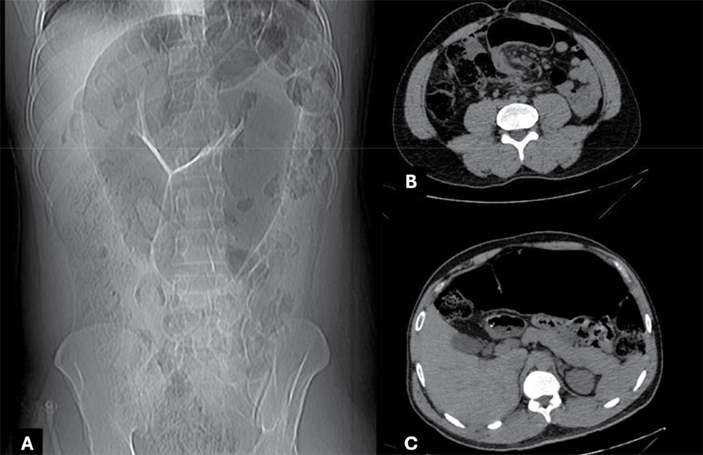
Figure 1. A – X-ray abdomen showing “coffee bean” sign; B – CECT abdomen axial section showing “whirlpool sign”; C – CECT abdomen axial section showing grossly distended sigmoid colon.
The entire colon and caecum were distended with residual impacted stool. Surgical management included excision of the bands, resection of the sigmoid colon, and end-to-end colorectal anastomosis, with a covering diverting loop ileostomy created. Copious lavage was performed, and the residual stool was evacuated through the distal colonic end. The postoperative period was complicated by a surgical site infection at the laparotomy wound. The patient is currently recovered well with functional stoma and discharged with recommendations for bowel continuity restoration after three months.
Histopathology examination of the resected specimen showed attenuation of villous epithelium with focal denudation of epithelium with edema of lamina propria with presence of plasma cell and neutrophil. These findings are suggestive of early ischemic changes (Figure 2).
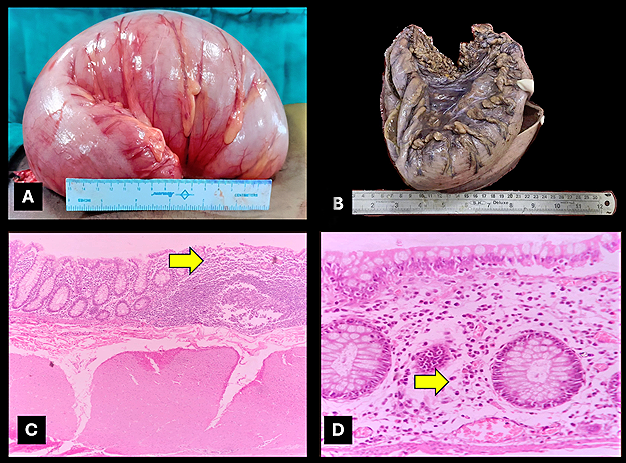
Figure 2. A – intra operative image of grossly distended sigmoid colon; B – gross specimen of excised sigmoid colon; C – 100x HP view showing attenuation of villous epithelium and focal denudation of epithelium; D – 400x oil immersion showing oedema of lamina propria with presence of plasma cell and neutrophil.
Post-operation recovery and follow up/Results
Following surgery, the patient showed improvement and was able to begin oral feeding once the ileostomy became functional. At present, his bowel functions have returned to normal. Plans are in place to close the ileostomy at a later date.
Discussion
High altitude increases the risk of sigmoid volvulus, with recurrence rates ranging from 7% to 45%, due to chronic gas buildup in the colon and the formation of dolichosigmoid. Other risk factors, including a high-fiber diet, chronic constipation, and older age, further raise the chances of recurrence and create a high-risk scenario for emergency surgery [3]. The main surgical challenge is dealing with a closed-loop obstruction of the large bowel caused by recurrent sigmoid volvulus, which can quickly lead to ischemia, bowel perforation, and widespread peritonitis if not treated promptly. Non-surgical or purely endoscopic treatments have high recurrence rates (55–90%) and may result in severe complications like gangrenous bowel and fecal peritonitis later on. Recent studies recommend definitive surgery–such as sigmoidectomy with primary anastomosis or Hartmann’s procedure–after decompression, when possible, to prevent future episodes [4, 5].
For surgeons working at high altitudes, relying only on temporary solutions, like repeated non-surgical detorsion, is especially risky because recurrence rates are naturally higher in these regions. However, choosing definitive surgery in settings where resources are limited comes with its own challenges, including greater perioperative risks, particularly if the patient is unstable, septic, or has dead bowel tissue. Emergency laparotomy for sigmoid volvulus in low-resource, high-altitude settings has poor outcomes, especially with unstable patients, peritonitis, or high ASA scores. Limited ICU and blood product access complicate choices between Hartmann’s procedure (safer but often ends in permanent stoma) and primary anastomosis (riskier in compromised patients but preserves bowel continuity). Decisions should consider patient socioeconomic factors and cultural views on stomas [6, 7].
Chronic hypobaric hypoxia at high altitudes increases anesthetic and perioperative risk by causing polycythemia, hyper-viscosity, pulmonary hypertension, right heart strain, and altered pharmacokinetics. Patients desaturate quickly during induction, and post-operative hypoxemia is often severe and prolonged, requiring proactive oxygen and ventilatory support. Anesthetic teams must tailor induction, fluid management, and analgesia for high-altitude physiology, while surgeons manage higher risks of cardiac events, thromboembolism, and delayed healing – adding complexity and emphasizing perioperative optimization and team coordination [8, 9].
Preoperative care involves correcting hypovolemia, electrolyte/acid-base disturbances and assessing for peritonitis or necrosis. High-altitude specifics include early oxygen supplementation and monitoring, and considering polycythemia, pulmonary hypertension, and right heart dysfunction in anesthesia and fluids. In stable cases, colonoscopic detorsion may allow safer elective surgery. Intraoperatively, procedure choice depends on bowel viability and patient stability; primary anastomosis is possible if decompression succeeded, but Hartmann’s is safer with gangrene, perforation, or severe illness. Technique demands adequate resection, careful hemostasis, gentle handling, and collaboration with anesthesia for safe oxygenation and fluid balance [5].
Postoperatively, focus on minimizing respiratory issues, anastomotic failure, and thrombosis–all worsened by hypoxia. Priorities include routine oxygen therapy, close monitoring, early mobilization, tailored thromboprophylaxis, hematocrit control, and vigilant surveillance for infection, sepsis, and leaks. Surgeons face key challenges such as distinguishing sigmoid volvulus from other causes of abdominal obstruction, managing polycythemia and chronic hypoxemia that impair healing, and working with limited imaging, blood products, ventilatory support, and ICU capacity typical of remote high-altitude hospitals. Rapid surgery must be weighed against the high perioperative risks associated with emergency sigmoid volvulus procedures.
Conclusion
Living at high altitudes increases the risk of sigmoid volvulus and its recurrence due to chronic intracolonic pressure and dolichosigmoid formation. Surgeons are advised to consider early definitive resection because repeated conservative treatments have high recurrence and mortality rates. Managing recurrent cases in these settings requires both technical skill and an understanding of altitude effects, ethical decision-making, and adaptation to limited resources. Applying these strategies can lower recurrence, improve safety, and enhance patient outcomes in mountain areas.
Acknowledgements. None.
Conflict of interest. None.
Informed consent. Written consent taken from patient.
Financial support. None.
Author contributions
Vipin Venugopal Nair, R. Saravanan, Praveen Kumar Nalla and Rajagopal Srinath contributed equally to the conception, clinical management, and writing of this case report.
Kunal Bagul was responsible for the histopathological examination and interpretation was primarily responsible for drafting the manuscript and compiling patient data.
Vipin Venugopal Nair and Rajagopal Srinath supervised the clinical analysis, provided critical revisions, and approved the final version of the manuscript.
All authors have read and agreed to the final manuscript.
References
1. Korkut E, Peksoz R, Disci E, Atamanalp SS. Factors affecting recurrence in sigmoid volvulus. Pak J Med Sci 2023; 39(1):150–153. DOI: 10.12669/pjms.39.1.6882.
2. Bayeh AB, Abegaz BA. The role of sigmoid colon anatomic dimensions in the development of sigmoid volvulus, North-Western Ethiopia. PLoS One 2021; 16(12): e0260708.
3. Agrawal SN, Kanwar KS. Sigmoid volvulus – an important cause of intestinal obstruction: How to deal with it? Int Surg J 2020; 7(2): 465–470.
4. Deresse T, Tesfahun E, Gebreegziabher ZA, Bogale M, Alemayehu D, Dessalegn M, Kifleyohans T, Eskandar G. Perioperative adverse outcome and its predictors after emergency laparotomy among sigmoid volvulus patients: Retrospective follow-up study. Open Access Emerg Med 2023; 15: 383–392. DOI: 10.2147/OAEM.S430193.
5. Cirocchi R, Farinella E, La Mura F, Morelli U, Trastulli S, Milani D, Di Patrizi MS, Rossetti B, Spizzirri A, Galanou I, Kopanakis K, Mecarelli V, Sciannameo F. The sigmoid volvulus: Surgical timing and mortality for different clinical types. World J Emerg Surg 2010; 5(1): 1. DOI: 10.1186/1749-7922-5-1.
6. Lee K, Oh HK, Cho JR, Kim M, Kim DW, Kang SB, Kim HJ, Park HC, Shin R, Heo SC, Ryoo SB, Park KJ; Seoul Colorectal Research Group (SECOG). Surgical management of sigmoid volvulus: A multicenter observational study. Ann Coloproctol 2020; 36(6): 403. DOI: 10.3393/ac.2020.03.23.
7. Mulugeta GA, Awlachew S. Retrospective study on pattern and outcome of management of sigmoid volvulus at district hospital in Ethiopia. BMC Surg 2019; 19(1): 1–5. DOI: 10.1186/s12893-019-0561-1.
8. Zheng H, Wei XC, Yu T, Lei Q. Anesthesia of a high-altitude area inhabitant who underwent aortic dissection emergency surgery in a low-altitude area. J Int Med Res 2020; 48(12): 300060520979871. DOI: 10.1177/0300060520979871.
9. Puri GD, Jayant A, Dorje M, Tashi M. Propofol-fentanyl anaesthesia at high altitude: Anaesthetic requirements and haemodynamic variations when compared with anaesthesia at low altitude. Acta Anaesthesiol Scand 2008; 52(3): 427–431. DOI: 10.1111/j.1399-6576.2007.01561.x.