Organizations and Markets in Emerging Economies ISSN 2029-4581 eISSN 2345-0037
2026, vol. 17, no. 1(34), pp. 170–192 DOI: https://doi.org/10.15388/omee.2026.17.8
Mechanisms of Urge: How Flow Experience and Time Pressure Shape Consumer Behaviour in Live Shopping
Ferry Jaolis (corresponding author)
School of Business and Management
Petra Christian University, Indonesia
ferry.jaolis@petra.ac.id
https://orcid.org/0000-0001-6300-7988
Serli Wijaya
School of Business and Management
Petra Christian University, Indonesia
serliw@petra.ac.id
https://orcid.org/0000-0003-3988-3157
Jessica Pingkan
School of Business and Management
Petra Christian University, Indonesia
jessicapingkanmlm@gmail.com
Abstract: Grounded in the Stimulus-Organism-Response model and contextualized in the live shopping realm, this study investigates how host credibility and social presence (S) affect consumers’ flow experience (O) and their urge to buy impulsively (R). It also explores the moderating effect of time availability on the organism-response association. The authors used SmartPLS 4.0.9.6 to analyse the 244 valid responses from Indonesian Shopee Live consumers. The results empirically demonstrate that while both host credibility and social presence had positive significant impacts on consumers’ flow experience, they cannot directly affect their urge to buy impulsively without the formation of flow experience. The results also revealed that Indonesian consumers’ impulsive buying was not always behavioural, but also situational, justifying the moderating effect of time availability. The findings of this study suggest that a pleasant and entertaining experience facilitates impulsive buying in live shopping, led by credible hosts and real-time social interactions.
Keywords: host credibility, social presence, flow experience, urge to buy impulsively, time pressure
Received: 17/5/2025. Accepted: 14/4/2026
Copyright © 2026 Ferry Jaolis, Serli Wijaya, Jessica Pingkan. Published by Vilnius University Press. This is an Open Access article distributed under the terms of the Creative Commons Attribution Licence, which permits unrestricted use, distribution, and reproduction in any medium, provided the original author and source are credited.
1. Introduction
The COVID-19 pandemic and rapid advancements in internet technology have made online shopping a new norm (Y. Jiang & Stylos, 2021). With high-speed connectivity, sophisticated e-commerce platforms, and user-friendly interfaces, digital shopping experiences are now as enjoyable as shopping in a brick-and-mortar environment (Kabadayi et al., 2020; Y. Wang et al., 2020). The experience is also more convenient thanks to secure payment gateways, AI-driven personalisation, and improved delivery systems (Y. Jiang & Stylos, 2021).
Beyond ease of access and convenience, this rapid shift gives rise to social commerce, where consumers interact with hosts and other viewers through live-streamed content (Hajli, 2020; Leong et al., 2021; Leong et al., 2024; Ooi et al., 2023). In Indonesia, the majority of consumers prefer shopping for electronics, household goods, or health products via e-commerce platforms (Tokopedia, Shopee, or Lazada) than social media or physical stores (JURNAS, 2023). With the rise of social commerce popularised by TikTok, these platforms began to integrate live shopping features. By 2023, live shopping had increasingly become more popular, with Shopee Live leading the consumers’ preferred channel, followed by TikTok Live, Tokopedia Play, and LazLive (SWA, 2023).
Live shopping, defined as an activity whereby consumers interact with sellers and other consumers through technology-enabled real-time video broadcasts (Gu et al., 2023; Pons Julián & de Luna, 2024), allows real-time interactions, turning shopping into a socially connected experience that fulfils individuals’ need for connection and sharing (C. L. Wang, 2021). In this realm, viewers can interact with hosts and other viewers in real time, enhancing what was previously unavailable in traditional online shopping (X. Dong et al., 2023). The role of the host is especially critical in this sense, as viewers rely on their presentation to assess product quality and other claims (Wongkitrungrueng et al., 2020). Hosts must compete in creating captivating content (e.g., product presentation and usage demonstration) as well as personalised interactions to build buying interests (C.-C. Chen & Lin, 2018). On the other hand, live shopping also facilitates engagement among participants, creating an environment that promotes intimacy and community (Choi et al., 2025). These interactions create social value for viewers by enhancing individual existence and influence and building the desire to own the product (Ming et al., 2021).
The instantaneous and social nature of live shopping can stimulate impulse in the stream. The instant access to and assurance of product information reduce perceived distance and information ambiguity, accelerating the urge to purchase (Ang et al., 2018; Mohan et al., 2013). Once this urge is triggered, consumers often simplify, even eliminate rational evaluation, leading to impulsive decisions (Parboteeah et al., 2009). Prior studies also highlight the critical role of social interactions in livestreaming commerce (e.g., M. Li et al., 2022; Ming et al., 2021), especially in influencing impulsive buying (e.g., X. Zhang et al., 2022; Hu & Chaudhry, 2020).
Livestreaming sessions can fully engage consumers, giving them content and satisfaction (C.-C. Chen & Lin, 2018). Ghani (1991) refers to this as a flow state, often indicated by deep emotional engagement, which can lead to impulsive purchases (Y. Li & Peng, 2021). Consumers in this state are less conscious of filtering perceptions, thus more prone to spontaneous decisions (Csikszentmihalhi, 2020). Additionally, time-limited features such as flash sales can create a rush that further stimulates the urge to buy impulsively (X. Dong et al., 2023).
Since impulsive buying is inherently spontaneous and lacking intentional consideration, research into its important underlying mechanisms (notably flow experience and time constraint) remains a continuing agenda. A recent review (Li et al., 2025) has identified several gaps that direct this agenda.
First and foremost, the literature in live streaming e-commerce shows studies that predominantly focus on external triggers of impulsive buying (e.g., platform features, host characteristics) but overlook the internal mechanisms through which such triggers form the urge to buy. Specifically, while some researchers (e.g., C.-C. Chen & Lin, 2018; Zhao et al., 2018) emphasise buyer and seller motivation to engage in livestreaming, others focus on addressing how system features affect live shopping behaviours (e.g., Yu et al., 2018; Xu et al., 2020).
Second, despite calls to incorporate more experiential constructs that translate stimuli into impulsive responses, important underlying psychological processes such as flow experience are rarely incorporated in the conceptual model and can only be seen in approximately one-third of the past studies (e.g., Cui et al., 2022; Huo et al., 2023; Li et al., 2024; Liang et al., 2024; Ming et al., 2021; Pham et al., 2023).
Third, most contextual factors that regulate impulsive purchases under time constraints are primarily externally-driven factors such as scarcity appeals (e.g., Chen et al., 2022a; Feng et al., 2024) or limited time promotions (e.g., Kong et al., 2023; Huo et al., 2023). Accordingly, our study aims to fill this gap by including more internally driven time perception, that is, the consumer’s perceived time availability to shop.
Fourth, from a managerial perspective, a parallel investigation is needed to illuminate the interaction of flow experience and time pressure in regulating live shopping impulse purchases. While these urge mechanisms have been proved effective in increasing spontaneous purchases (Baumeister, 2002; Huo et al., 2023; Luo et al., 2024), poorly regulated strategies may prompt excessive buying leading to consumption regrets that can potentially damage long-term brand trust and erode customer lifetime value. This study addresses this notable gap by illuminating their impact on spontaneous purchases while informing persuasive yet ethically responsible live shopping strategies.
We argue that consumers’ emotions such as flow state and its potential interaction with time constraints have both theoretical and managerial importance in influencing impulse purchases in live shopping. Grounded in the Stimulus-Organism-Response (SOR) model (Mehrabian & Russell, 1974; van Zeeland & Henseler, 2018; Matos & Krielow, 2019) widely applied in online retail settings (Chan et al., 2017), we examine how stimuli (host credibility and social presence) affect the organism (flow experience) and lead to the response (urge to buy impulsively), with time pressure as a contextual factor. The model is tested in Shopee Live environment, given its popularity among Indonesian consumers.
2. Literature Review
2.1 Stimulus-Organism-Response (SOR) Model
The SOR model explains how environmental stimuli influence individuals’ cognitive and emotional states (organism), leading to behaviours (response). In online retailing, it explains how stimuli such as website quality, marketing activities, and situational cues (e.g., fast-paced shopping environment) affect impulsive buying (Chan et al., 2017). In e-commerce livestreaming, the consumer–seller relational bond stimulates affective commitment, affecting in turn consumer engagement with the seller’s offering (M. Hu & Chaudhry, 2020). Similarly, host-viewer real-time interactions in live shopping create a sense of presence that shapes consumer attitude and behaviour (Gao et al., 2022). The SOR model thus clarifies how environmental triggers affect internal states and subsequent behaviours (Song et al., 2021; Shahpasandi et al., 2020).
Building on this, we propose that live shopping stimuli (i.e., host credibility and social presence) influence viewers’ flow experience—comprising both cognitive and affective elements (Sun & Zhang, 2006), which in turn drives the urge to buy impulsively. We posit that flow experience explains how live shopping stimuli trigger impulsive buying and that its effect varies with time pressure (i.e., viewers’ perceived urgency during live shopping).
2.2 The Role of Host Credibility
The source (host or streamers) credibility reflects the extent to which viewers perceive information or claims from a particular source as accurate and unbiased (Hussain et al., 2017; Visentin et al., 2019). The live shopping features empower hosts to stimulate such perceived credibility through real-time and personalised two-way communication with viewers. In this realm, hosts can therefore convey product information effectively and lead viewers into a flow experience, a psychological state marked by immersion, deep focus, and absorption in a specific activity (Csikszentmihalhi, 2020). Detailed product explanations and real-time host–viewer interactions have been shown to induce such flow experiences (e.g., Akdevelioglu & Kara, 2020; Bao & Yang, 2022; W. Dong et al., 2023; Z. Huang et al., 2023; S. J. Kim & Heo, 2021). Specifically, credible hosts induce a sense of pleasure because they reduce the time and effort consumers must spend to search, compare, and review products outside this realm (Akdevelioglu & Kara, 2020; X. Dong et al., 2023). In addition, attractive hosts or live streamers can model self-identification, therefore transferring positive attitudes towards the broadcast messages in the livestream (Yan et al., 2023) and to the endorsed products (Leite & Baptista, 2022). Real-time host–viewer interactions also increase viewers’ participation and sense of control, therefore improving perceived value and satisfaction (Bao & Yang, 2022). In other words, these host-anchored factors amplify viewers’ flow experiences, leading to the following prediction:
H1: Host credibility positively influences live shopping viewers’ flow experience.
Credible hosts also tackle the information overload consumers face when browsing online for product descriptions, promotions, or reviews, which in turn enhances consumers’ confidence in making purchases (Aladwani & Dwivedi, 2018; Dou et al., 2012). During live shopping, hosts present key product benefits while simultaneously engaging with viewers (M. Hu & Chaudhry, 2020), bridging any information gaps and reducing information asymmetry (Ang et al., 2018; C. Chen & Zhang, 2023; S. W. Wang et al., 2017). This requires them to be knowledgeable and, where possible, share personal usage experiences to reduce perceived risk and boost customer confidence in making live purchases (Cheng et al., 2021; I.-L. Wu et al., 2020). A credible host can also enhance trust, acting more as an opinion leader than a marketer (Park & Lin, 2020). By generating positive emotions during real-time interactions (Park & Lin, 2020), competent and trustworthy live-streaming hosts have been found to encourage viewers’ impulsive buying tendency (e.g., J. V. Chen et al., 2016; Y. Chen et al., 2019; Zafar et al., 2021). Taken together, we therefore propose the following:
H2: Host credibility positively influences live shopping viewers’ urge to buy impulsively.
2.3 The Role of Social Presence
The concept of “presence” in communication refers to either physical or social dimensions (Ditton & Lombard, 1997), with the former conveying the feeling of “being there” and the latter of “being there with others.” Social presence also includes psychological engagement between users in a specific medium such as virtual reality (Biocca et al., 2003; Ying et al., 2022), which allows them to enhance individual existence by conveying the sense of presence, interaction, and influence to others.
Due to its real-time interactive nature that bridges the psychological gap between hosts and viewers, live shopping is especially fit for examining social presence (Ming et al., 2021). Despite lacking in face-to-face engagement, live shopping synchronous interactions can influence consumer psychology through specific mechanisms (X. Dong et al., 2023). These interactions create pleasure from information exchange, which builds a sense of personal and social existence (Cai & Wohn, 2019; Wongkitrungrueng et al., 2020) therefore producing enjoyment and inducing flow experiences (H. Wang et al., 2021; C. Jiang et al., 2019). In other words, hosts and viewers co-create such positive emotions that reinforce flow states (Tsai et al., 2021), which led us to predict the following:
H3: Social presence positively influences live shopping viewers’ flow experience.
Brands utilise live shopping features to create real-time interactions, strengthening the perceived sense of social presence among livestream viewers and further influencing purchase decisions (Ming et al., 2021). In a traditional e-commerce shopping environment, H. Wang et al. (2021) show this effect by providing experimental evidence in which perceived social presence significantly encourages purchase behaviour. Live streaming real-time interactivity has also been shown to foster impulsive consumption intentions (Zafar et al., 2021; X. Zhang et al., 2022). This “simulated” face-to-face environment can induce purchase impulse, especially when viewers’ interests align during perceived social presence and buying is just one button click away (J. Hu et al., 2017; M. Hu, & Chaudhry, 2020; Yan et al., 2022). Others (e.g., Ming et al., 2021; X. Zhang et al., 2022) confirmed that the two-way interpersonal relationship created during live shopping drives impulsive consumption intentions. We therefore predict that:
H4: Social presence positively influences live shopping viewers’ urge to buy impulsively.
2.4 Flow Experience and Urge to Buy Impulsively
The term “flow” (or flow experience) refers to the psychological state involving a holistic sensation individuals feel when they are totally immersed in an activity (Csikszentmihalhi, 2020). It describes consumers’ emotional responses when fully engaged in shopping (Hsu et al., 2017) and has become increasingly relevant in evaluating online shopping experiences given its influence on purchase decisions (I.-L. Wu et al., 2020).
Earlier studies (e.g., Ha & Stoel, 2009; Parboteeah et al., 2009) have shown that shoppers who are emotionally engaged in online shopping tend to purchase impulsively because in such a state, they tend to explore more and are therefore more likely to make spontaneous decisions (Koufaris, 2002; Guo & Poole, 2009). Live shopping can even further arouse emotion and engagement due to its real-time interaction through chats and comments, stimulating impulse in the stream (X. Dong et al., 2023; Kühn & Petzer, 2018).
The literature provides empirical evidence that consistently supports the positive link between flow experience and impulsive buying. I.-L. Wu et al. (2020) found that flow experience and satisfaction significantly influence spontaneous purchases. Hyun et al. (2022), and H. Liu et al. (2016) further confirmed that active participation and heightened engagement during flow experiences increase consumers’ urge to buy impulsively. Huo et al. (2023) reported similar findings. We accordingly predict that:
H5: Live shopping viewers’ flow experience positively influences their urge to buy impulsively.
2.5 The Mediating Role of Flow Experience
Host credibility and social presence have been shown to influence flow experience, which subsequently affect consumers’ urge to buy impulsively in live shopping. This implies a mediating mechanism wherein expert hosts and interactive engagement explain impulsive buying through enhancing flow experiences. Hosts that deliver product information while managing interactive sessions help consumers reduce search effort thus making them more engaged and ready to make spontaneous purchases (X. Liu et al., 2022).
The excitement and entertainment inherent in live shopping can thus foster immersion, leading to higher purchase intentions (Yin et al., 2023; Wolfinbarger & Gilly, 2001; Venkatesh, 2000). X. Dong et al. (2023) noted that live shopping gives consumers some level of autonomy and control, enhancing the overall consumption experience and triggering impulsive urges. These findings are consistent with the SOR model, where flow experience (O) becomes the mechanism through which host credibility and social presence (S) affect the viewers’ urge to buy impulsively (R) (Chan et al., 2017; Mehrabian & Russell, 1974). Accordingly, we postulate the following:
H6a: Live shopping viewers’ flow experience mediates the relationship between host credibility and urge to buy impulsively.
H6b: Live shopping viewers’ flow experience mediates the relationship between social presence and urge to buy impulsively.
2.6 The Moderating Role of Time Pressure
Time pressure refers to the emotional response, including anxiety, when individuals suffer from a lack of time to make specific decision within a specific deadline (Svenson & Edland, 1987). It is one of the critical situational factors affecting consumer decision-making in specific buying contexts (Herrington & Capella, 1995; Iyer, 1989; Vermeir & Van Kenhove, 2005).
Limited shopping time heightens purchase risk and increases stress, thus affecting how or where consumers shop (Gehrt & Yan, 2004; Van Kenhove et al., 1999). Conversely, consumers with abundant time to shop can better engage with shopping stimuli, often leading to deeper immersive experiences and spontaneous purchases (Pieters & Warlop, 1999; Goel et al., 2022; M. Kim et al., 2017).
Livestreaming e-commerce studies suggest that time pressure moderates the effect of stimuli on viewers’ responses. For instance, Chang et al. (2014) found that time pressure altered the effect of individuals’ emotional or psychological state on impulse buying. N. Zhang (2023), and Hao and Huang (2025) showed that time-constrained product supply in livestreaming sessions enhanced the effect of product presentation on purchase intention. Limited-time sales also interacted with interpersonal interactions in the stream to induce impulse purchases (Ling et al., 2024).
These empirical findings, however, remain scarce and inconsistent. While X. Dong et al. (2023) reported a negative moderating effect of time pressure on the relationship between flow and purchase intention, others (L. Wu et al., 2016; Huo et al., 2023) found that a more relaxed shopping time amplified the impact of flow on impulsive buying. This study aims to further investigate how time pressure moderates the link between flow experience and urge to buy impulsively in a live shopping context, hence the following prediction:
H7: Time pressure moderates the effect of live shopping viewers’ flow experience on urge to buy impulsively.
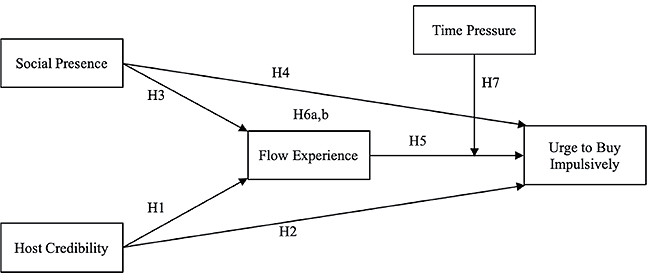
Figure 1 shows the hypothesised relationships that this study proposes, outlining the synthesis of theoretical models and empirical findings forming a conceptual model in inquiry.
Figure 1
Conceptual Model
3. Methods
3.1 Research Design
This quantitative study used primary data collected through a self-administered online survey distributed via Google Forms and Poplite (Populix market research company). A total of 244 valid responses met the screening criteria (see Table 1), which was considered sufficient for analysis using partial least squares structural equation modelling (PLS-SEM), ensuring a predictive power of 80% for detecting R2 values of at least 0.25 with a 5% probability error (Iacobucci, 2010; Cohen, 1992). PLS-SEM was chosen given this study’s exploratory focus and the complexity of the proposed model hypothesising direct relationships with the presence of mediating and moderating variables.
Table 1
Demographic Profile
|
Characteristics |
Item |
Frequency |
Percentage |
|---|---|---|---|
|
Gender |
Male Female |
84 160 |
34.43% 65.57% |
|
Age group |
Less than 25 years old 25-30 years old 31-35 years old 36-40 years old More than 40 years old |
48 88 59 25 24 |
19.67% 36.07% 24.18% 10.25% 9.84% |
|
Occupation |
Student Part-timer Freelancer Employee Entrepreneur Housewife Others |
33 15 4 131 30 21 10 |
13.25% 6.15% 1.64% 53.69% 12.30% 8.61% 4.10% |
|
Domicile |
Bali Java Kalimantan Sulawesi Sumatra West Nusa Tenggara |
4 210 3 4 22 1 |
1.64% 86.07% 1.23% 1.64% 9.02% 0.41% |
|
Live shopping experience |
Once a week 2–3 times a week More than 3 times a week Once a month Not necessarily once a month |
22 68 35 22 63 |
9.02% 27.87% 14.34% 9.02% 25.82% |
3.2 Measurement and Analysis
The five constructs in the conceptual model (Figure 1) were measured using 5-point Likert agreement scales based on empirically validated items from prior studies, with minor adaptations for contextual relevance: six items for host credibility (W. Dong et al., 2023; Yan et al., 2023), six items for social presence (Chen & Lin, 2018; Zhu et al., 2023), five items for flow experience (W. Dong et al., 2023), four items for time pressure (W. Dong et al., 2023), and five items for urge to buy impulsively (W. Dong et al., 2023; Y. Liu et al., 2013; Yan et al., 2023). The measurement items were translated into Indonesian and further refined to ensure clarity while preserving content validity. To ensure comprehension and response errors, face validity was assessed via expert review (two marketing scholars) and cognitive interviews with ten local university students representing the study’s target respondents (i.e., Shopee Live consumers).
We use PLS-SEM analysis to test both the measurement and structural model, which follows the Anderson and Gerbing (1988) two-stage approach, ensuring measurement fit prior to evaluating structural relationships. Tables 2–4 provide the details for the measurement fit test results via PLS-SEM estimation.
Table 2
Evidence of Measurement Fit
|
Construct |
Label |
Item |
Factor |
|---|---|---|---|
|
Flow Experience |
FE1 |
I feel captivated when watching Shopee Live. |
0.842 |
|
FE2 |
During Shopee Live, I sometimes ignore what is happening around me. |
0.859 |
|
|
FE3 |
During Shopee Live, I sometimes forget what I should do. |
0.849 |
|
|
FE4 |
During Shopee Live, I feel that everything is under control. |
0.752 |
|
|
FE5 |
I feel very happy when watching Shopee Live. |
0.771 |
|
|
Host Credibility |
HC1 |
I feel that Shopee Live streamers are generally trustworthy. |
0.893 |
|
HC2 |
I feel that Shopee Live streamers are well acquainted with the products they are promoting. |
0.781 |
|
|
HC3 |
I feel that Shopee Live streamers have experiences using the products. |
0.842 |
|
|
HC4 |
I feel that products recommended by Shopee Live streamers are more reliable. |
0.895 |
|
|
HC5 |
I trust Shopee Live streamers. |
0.897 |
|
|
HC6 |
In general, I think Shopee Live with influencers as streamers are more attractive to me. |
0.756 |
|
|
Social Presence |
SP1 |
I can feel the interaction with others while watching Shopee Live. |
0.859 |
|
SP2 |
Interacting in Shopee Live makes me feel closer to other viewers or the streamer. |
0.875 |
|
|
SP3 |
I can feel the presence of others when interacting in Shopee Live. |
0.880 |
|
|
SP4 |
I can feel a friendly atmosphere when interacting in Shopee Live. |
0.841 |
|
|
SP5 |
During Shopee Live, I can easily exchange and share opinions with the streamer and other viewers. |
0.796 |
|
|
SP6 |
In Shopee Live, the streamer provides sufficient opportunities to respond and ask questions. |
0.776 |
|
|
Time Pressure |
TP1 |
I have to act quickly because I’m afraid of missing the opportunity to get products during Shopee Live. |
0.747 |
|
TP2 |
I feel very pressured during the purchase deadline countdown in Shopee Live. |
0.871 |
|
|
TP3 |
I feel rushed when shopping in Shopee Live. |
0.882 |
|
|
TP4 |
I do not have enough time to participate in Shopee Live. |
0.699 |
|
|
Urge to Buy Impulsively |
UBI1 |
During Shopee Live, I had the urge to purchase items other than or in addition to my specific shopping goal. |
0.819 |
|
UBI2 |
During Shopee Live, I had a desire to buy items that did not pertain to my specific shopping goal. |
0.847 |
|
|
UBI3 |
During Shopee Live, I was inclined to purchase items outside my specific shopping goal spontaneously. |
0.868 |
|
|
UBI4 |
During Shopee Live, I still want to buy items recommended by the streamer even if they don’t align with my shopping plan. |
0.863 |
|
|
UBI5 |
During Shopee Live, I wanted to consume this product without careful consideration. |
0.753 |
Table 3
Cronbach’s Alpha, Composite Reliability, AVE, and the HTMT Criterion Results
|
Construct |
Cronbach’s alpha |
Composite reliability |
AVE |
HTMT criterion |
||||
|---|---|---|---|---|---|---|---|---|
|
FE |
HC |
SP |
TP |
UBI |
||||
|
FE |
0.873 |
0.876 |
0.665 |
|
||||
|
HC |
0.919 |
0.926 |
0.716 |
0.720 |
||||
|
SP |
0.915 |
0.918 |
0.703 |
0.715 |
0.768 |
|||
|
TP |
0.814 |
0.831 |
0.646 |
0.760 |
0.548 |
0.513 |
||
|
UBI |
0.887 |
0.888 |
0.690 |
0.777 |
0.609 |
0.534 |
0.678 |
|
Table 4
Inner Variance Inflation Factor
|
Flow |
Host |
Social Presence |
Time Pressure |
Urge to Buy Impulsively |
|
|---|---|---|---|---|---|
|
Flow Experience |
2.547 |
||||
|
Host Credibility |
1.967 |
2.287 |
|||
|
Social Presence |
1.967 |
2.254 |
|||
|
Time Pressure |
1.714 |
||||
|
Urge to Buy Impulsively |
4. Results
4.1 Measurement Model
All constructs showed acceptable validity and reliability fit based on the criteria set by respective authors (Hair et al., 2011). Cronbach’s Alpha and composite reliability for each construct exceeded 0.7, confirming internal consistency. Convergent validity was also established wherein all AVE values were above 0.5, and item loadings exceeded 0.708, except TP4 (0.699), which remains acceptable given the nature of this study. The Heterotrait-Monotrait (HTMT) ratio of correlation values was below the 0.9 threshold, establishing proof of discriminant validity. VIF values ranged from 1.714 to 2.547, indicating no multicollinearity concerns at the factor level. Detailed measurement model evaluation results are provided in the Methods section (Tables 2–4). Taken together, the measurement fit test results support the testing of the structural fit of the model.
4.2 Structural Model
We first assess the structural fit of the model through its predictive accuracy and relevance. Table 5 shows a moderate predictive accuracy, as host credibility and social presence explained 49.8% of the variance in flow experience, and together with flow experience, these predictors account for 51.8% of the variance in the urge to buy impulsively. All Q2 values exceeded zero, thus confirming the model’s predictive relevance for the endogenous constructs being estimated.
Table 5
Predictive Accuracy and Relevance of the Model
|
R-square |
R-square adjusted |
Q-Square |
|
|---|---|---|---|
|
Flow Experience |
0.498 |
0.494 |
0.482 |
|
Urge to Buy Impulsively |
0.528 |
0.518 |
0.404 |
As PLS-SEM lacks appropriate global goodness-of-fit indices (Henseler et al., 2016), structural model assessment emphasises predictive power accessible through bootstrapping and blindfolding (Hair et al., 2011). Accordingly, we assessed the structural fit of the model by estimating the path coefficients and testing their significance using 5,000 bootstrap subsamples. Table 6 presents the results, substantiating five out of seven hypothesized relationships as depicted in Figure 2.
Table 6
Path Coefficient Estimation and Bootstrapping Results
|
Hypothesis |
Structural Path |
β |
t Values |
p Values |
Result |
|---|---|---|---|---|---|
|
H1 |
HC → FE |
0.389 |
4.376 |
0.000 |
Supported |
|
H2 |
HC → UBI |
0.178 |
1.464 |
0.143 |
Not supported |
|
H3 |
SP → FE |
0.376 |
4.405 |
0.000 |
Supported |
|
H4 |
SP → UBI |
-0.024 |
0.222 |
0.824 |
Not supported |
|
H5 |
FE → UBI |
0.437 |
5.517 |
0.000 |
Supported |
|
H6a |
HC → FE → UBI |
0.170 |
3.386 |
0.001 |
Supported, full mediation |
|
H6b |
SP → FE → UBI |
0.164 |
3.292 |
0.001 |
Supported, full mediation |
|
H7 |
TP x FE → UBI |
0.084 |
2.109 |
0.035 |
Supported |
Note. N = 244.
FE = Flow Experience, HC = Host Credibility, SP = Social Presence, UBI = Urge to Buy Impulsively, TP = Time Pressure.
Figure 2
Results of the PLS-SEM Significance Test of Hypotheses
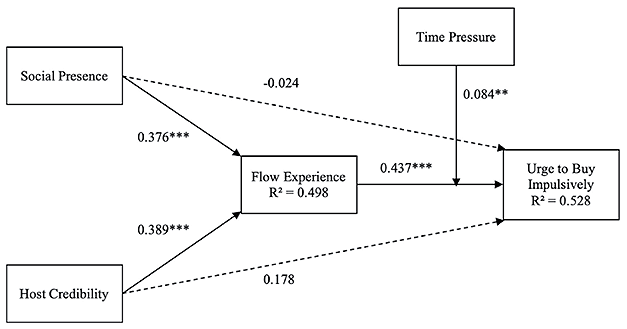
Note. **p<0.05, ***p<0.01.
5. Discussion and Implications
H1 was supported, indicating that host credibility has a significant positive effect on viewers’ flow experience (β = 0.389, p < 0.01). During Shopee Live sessions, credible and skilful hosts enhance engagement by effectively showcasing product features and benefits, thereby fostering trust and emotional involvement (Akdevelioglu & Kara, 2020). The platform’s interactive nature facilitates real-time, interactive responses, providing more personalized and seamless shopping experiences that stimulate flow experience (Kim et al., 2021; Bao & Yang, 2022; X. Dong et al., 2023).
H2 was not supported, indicating that host credibility does not directly influence viewers’ urge to buy impulsively (β = 0.178, p > 0.05). While this contradicts earlier findings (e.g., I.-L. Wu et al., 2020; H. Wang et al., 2021; Chen et al., 2019; Zafar et al., 2021), it may imply the presence of a mediating mechanism, namely flow experience. Several factors may help explain the non-significance. Impulsive buying is often emotionally driven, which may override rational evaluations of host credibility. Consequently, live shopping entertainment value and immersive nature appear to produce stronger desires for impulsive buying. In addition, viewers may perceive hosts as being more commercially motivated rather than acting as genuine opinion leaders, thus reducing their persuasive impact. Viewers’ past live shopping experiences may also reduce their reliance on host credibility when making spontaneous purchase decisions.
H3 was substantiated, showing that social presence significantly enhances viewers’ flow experience (β = 0.376, p < 0.01). The presence and real-time interactions between engaging Shopee Live participants reduce perceived distance and foster emotional closeness, affecting their psychological state (Ming et al, 2021). The platform’s engaging features enable live comments and reactions, thus promoting excitement and immersion, corroborating previous findings on the effect of social interaction during livestreaming towards positive flow experience (H. Wang et al., 2021; Jiang et al., 2019; Tsai et al., 2021).
H4 was not supported, indicating that social presence does not directly influence viewers’ urge to buy impulsively (β = –0.024, p > 0.05). This result contradicts previous findings (e.g., Zafar et al., 2021; M. Zhang & Shi, 2022; Ming et al., 2021) and suggests that flow experience may explain this relationship. Several factors may also contribute towards this result: the anonymity of viewers may reduce the need for social validation; some consumers prefer independent decision-making; and crowd-sourced suggestions in live shopping may lack the immediacy and accountability often found in offline settings. Additionally, the fast-paced flow of interactive comments and reactions may deter engagement, weakening the urge to buy. These results suggest the social presence alone is insufficient to trigger impulse purchases without deep emotional immersion in the stream.
H5 was supported, indicating that flow experience significantly increases viewers’ urge to buy impulsively (β = 0.437, p < 0.01). This confirms prior findings (e.g., L.-T. Huang, 2016; I.-L.Wu et al., 2020; Bao & Yang, 2022; Huo et al., 2023), showing that viewers who are immersed in enjoyable live shopping experiences have prolonged product exploration and reduced cognitive control, thereby stimulating spontaneous purchases (Koufaris, 2002; Guo & Poole, 2009; Q. Zhang et al., 2018; Floh & Madlberger, 2013). Enjoyable live shopping experiences provide consumers with intense pleasure and positive mood, making them more likely to act impulsively in their purchases (Shahpasandi et al., 2020; Wu et al., 2016). This suggests that an immersive live shopping experience is a key driver of impulsive buying in live shopping context.
H6a was supported, with flow experience fully mediating the effect of host credibility on the urge to buy impulsively. The indirect effect was significant (β = 0.170, p < 0.01), while the direct effect was not (β = 0.178, p > 0.05), indicating an indirect-only mediation. This supports prior findings (W. Dong et al., 2023; Fang, 2024), showing that host characteristics (credibility, professionalism, attractiveness, interactivity) enhance viewers’ immersion, which in turn stimulates impulsive buying. A credible host can make viewers stay engaged for more product information and respond spontaneously to purchase cues (e.g., X. Li et al., 2024; H. Liu et al., 2016).
H6b was supported, indicating the mediating role of flow experience in the relationship between social presence and urge to buy impulsively. The result shows an indirect-only mediation as the indirect effect was significant (β = 0.164, p < 0.01), while the direct effect was not (β = -0.024, p > 0.05). Social interactions during Shopee Live streams cannot therefore increase viewers’ spontaneous purchases without emotional immersion in the session (Ming et al., 2021). This finding corroborates prior evidence (e.g., Hsu et al., 2017; Y. Liu et al., 2013; Huo et al., 2023), showing flow experience as a key mechanism explaining the effect of social presence on spontaneous buying behaviour.
Finally, the testing for moderation effects (H7) also shows support for the hypothesised relationship. The interaction effect of time pressure and flow experience has a significant positive impact on live shopping viewers’ urge to buy impulsively (β = 0.084, p < 0.05). This result indicates that viewers in a flow state are more likely to make impulse purchases when they also perceive higher level of time pressure during live shopping sessions. Consumers’ perception of time therefore affects shopping behaviour, suggesting that time-constrained consumers who experience higher positive emotions during live sessions would be more likely to engage in impulsive buying, consistent with prior studies (e.g., Gehrt & Yan, 2004; Huo et al., 2023).
The findings of our study provide useful contribution both to the advancement of social commerce literature and to the managerial relevance in the live shopping context. In general, these results extend the generalisability of the SOR model to live shopping by confirming that consumers must first reach a flow state for stimuli to affect spontaneous purchases. Specifically, they help explain that impulse buying might not always be behavioural, but also situational (e.g., Hu & Chaudhry, 2020; Gehrt & Yan, 2004; Kim et al., 2017; Goel et al., 2022), and show that impulsive buying is more likely when consumers are in a flow state and experience higher perceived time pressure (Huo et al., 2023; Wu et al., 2016).
This study also addresses several research gaps and provides useful managerial implications, which are outlined as follows. First, most livestreaming studies focus on external triggers (e.g., host characteristics or platform features), thus overlooking the internal psychological mechanisms translating these triggers into urge to buy. Our findings address this gap by showing that neither host credibility nor social presence directly triggers urge to buy impulsively without first significantly enhancing flow experience. This empirically validates the pivotal role of internal organism components, demonstrating that external triggers alone are not sufficient in stimulating impulsive purchases. Managerially, hosts must build immersive experiences with credibility (e.g., product knowledge, live testing, or usage experiences) and authenticity (acting as opinion leaders more than marketers) as critical drivers. Brands can therefore facilitate communication training to improve persuasion, confidence, and influence of key opinion leaders more than that of sales agents.
The second research gap highlights the underutilisation of flow state in livestreaming impulse buying studies. However, our results show that flow experience is both a strong predictor of impulsive buying and a key mechanism to explain the effect of stimuli (host credibility and social presence) on response (urge to buy impulsively). This puts flow as a central organism component relatively missing in prior studies as well as ethical persuasive technique for live shopping. Unlike scarcity-driven persuasion, for instance, consumers enter a flow state given value-adding experiences through clear product demonstrations or transparent, real-time interactions, which enhance their sense of enjoyment and control, critical in reducing post-purchase regret. This makes creating immersive live shopping experiences a more responsible approach in inducing spontaneous purchases rather than the use of “coercive” or “creative” purchase urgency tactics.
The third research gap concerns the overemphasised scarcity-induced time pressure, neglecting the consumers’ internal perception of time during shopping. Our moderation analysis shows that the effect of flow on impulse purchases increases as consumers perceive themselves as having more time to shop. This makes the internally driven time factor a distinct and more ethical time factor compared to traditional time-pressured scarcity tactics (e.g., flash sales, time-limited discounts/vouchers) largely deployed in live shopping activities. Brands can therefore optimise livestream duration to follow viewers’ natural shopping pace or habits, including, but not limited to: (a) placing time-sensitive deals at shopping peaks (e.g., during the time where traffic is highest), (b) extending time-windowed deals without pressure (e.g., available all stream long and after 30 minutes post live), or (c) providing segments for customer testimonials prior to time-scarcity deals.
The fourth research gap calls for a justified managerial concern regarding the dual role of flow and time in shaping impulsive buying. Our moderation analysis findings show that the effect of flow on impulsive buying is enhanced for consumers with more time to shop. This implies that time availability may act as a condition that bounds immersed consumers from sporadically purchasing live shopping products, thus preventing them from post-purchase regrets. Brands can therefore simulate “extended time windows,” even if time scarcity deals are offered, by (a) providing live moderators to help hosts clarify product details at engagement peaks, (b) offering post-purchase free returns or size changes, or (c) curating post live replay videos for most required product demonstrations, with time-limited deals still available.
Taken together, we do not suggest that our findings and recommendations negate the generalisability of the impulsive buying or live shopping conceptual models in prior and recent studies. In contrast, we add depth to them by highlighting a more ethical, brand-building side of the model tested in many contexts as well as in the context of our study. We hope that readers in general, and particularly scholars and practitioners, can benefit from our empirical findings by addressing both orientations, selling and branding, in which live shopping strategies and tactics can maximise the well-being of both the sellers and buyers.
6. Conclusion and Directions for Future Studies
Contextualised in live shopping and based on the SOR framework, this study investigates the effects of host credibility and social presence (S) on flow experience (O) and urge to buy impulsively (R). Findings showed that both stimuli significantly enhanced flow experience yet neither had a direct effect on impulsive buying. This suggests that for stimuli to trigger impulsive purchases, consumers must first be emotionally engaged in the livestream. This non-significant direct influence implies that impulse in the livestream might be more emotional (does not focus on rational information and its sources), driven by past live shopping experiences (that override host evaluation), or less reliant on social validation (given limited social accountability as compared to in-person contexts).
Time pressure enhanced the effect of consumers’ flow experience on their urge to buy impulsively. This indicates that consumers experiencing a strong flow state are more likely to purchase spontaneously under limited decision-making time during live shopping sessions. Under such conditions, consumers’ immediate purchase impulses are arguably more affective rather than cognitive.
This study illuminates the mechanisms of urge in live shopping, providing empirical evidence on the role of flow experience and time pressure in shaping live shopping consumer behaviour. While host credibility and social presence significantly enhance the viewers’ flow experience within a live shopping environment, they do not directly trigger the live shopping impulse without first being deeply immersed in it. This accentuates the importance designing and delivering captivating live shopping experiences rather than solely relying on rational cues such as product quality or incentive attractiveness. Time pressure also serves as an important urge mechanism in live shopping, suggesting that consumers’ impulse in the stream is not always behavioural but also contextual. Overall, these findings enrich the consumer behaviour literature by validating the applicability of the SOR framework in live commerce, highlighting the organism stage as a critical mechanism behind impulse live purchases.
In essence, this study contributes to the live streaming commerce literature in three ways. First, by extending the SOR framework to live shopping realm, it empirically demonstrates that external stimuli (host credibility and social presence) cannot directly drive impulsive buying without establishing consumers’ flow experience, which therefore positions the organism stage as a critical psychological mechanism in live shopping. Second, it advances the understanding of impulse formation in digital commerce by showing that live shopping spontaneous buying is by and large experiential and situational rather than informational. Third, it illuminates the role of time pressure as an important contextual factor that amplifies the transition of immersive experience into impulsive tendency.
As with any research, this study has limitations. First, while the urge to buy impulsively is conceptually distinct from actual impulse buying (Badgaiyan & Verma, 2015), this study does not examine how the former translates into the latter. Future research can thus explore this transition. Second, situational variables in the context of live shopping can take many forms (e.g., time, quantity, or money); it would therefore be more comprehensive to include these cues in subsequent inquiries. Third, different live shopping platforms present different stimuli that potentially arouse different emotions and responses. Future studies may compare between platforms to explore differences in hypothesised relationships among respective variables. Lastly, the sample of this study is limited to Indonesian consumers, constraining generalisability to cultural factors. Cross-cultural studies are hence recommended to extend the applicability of the model and the findings.
References
Akdevelioglu, D., & Kara, S. (2020). An international investigation of opinion leadership and social media. Journal of Research in Interactive Marketing, 14(1), 71–88.
Aladwani, A. M., & Dwivedi, Y. K. (2018). Towards a theory of SocioCitizenry: Quality anticipation, trust configuration, and approved adaptation of governmental social media. International Journal of Information Management, 43, 261–272.
Anderson, J. C., & Gerbing, D. W. (1988). Structural equation modeling in practice: A review and recommended two-step approach. Psychological Bulletin, 103(3), 411.
Ang, T., Wei, S., & Anaza, N. A. (2018). Livestreaming vs pre-recorded: How social viewing strategies impact consumers’ viewing experiences and behavioral intentions. European Journal of Marketing, 52(9/10), 2075–2104.
Badgaiyan, A. J., & Verma, A. (2015). Does urge to buy impulsively differ from impulsive buying behaviour? Assessing the impact of situational factors. Journal of Retailing and Consumer Services, 22, 145–157.
Baumeister, R. F. (2002). Yielding to temptation: Self-control failure, impulsive purchasing, and consumer behavior. Journal of Consumer Research, 28(4), 670–676.
Bao, Z., & Yang, J. (2022). Why online consumers have the urge to buy impulsively: roles of serendipity, trust and flow experience. Management Decision, 60(12), 3350–3365.
Biocca, F., Harms, C., & Burgoon, J. K. (2003). Toward a more robust theory and measure of social presence: Review and suggested criteria. Presence: Teleoperators & Virtual Environments, 12(5), 456–480.
Cai, J., & Wohn, D. Y. (2019). Live streaming commerce: Uses and gratifications approach to understanding consumers’ motivations. Paper presented at the 52nd Hawaii International Conference on System Sciences.
Chan, T. K., Cheung, C. M., & Lee, Z. W. (2017). The state of online impulse-buying research: A literature analysis. Information & Management, 54(2), 204–217.
Chen, C., & Zhang, D. (2023). Understanding consumers’ live-streaming shopping from a benefit–risk perspective. Journal of Services Marketing, 37(8), 973–988.
Chen, C.-C., & Lin, Y.-C. (2018). What drives live-stream usage intention? The perspectives of flow, entertainment, social interaction, and endorsement. Telematics and Informatics, 35(1), 293–303.
Chen, J. V., Su, B.-c., & Widjaja, A. E. (2016). Facebook C2C social commerce: A study of online impulse buying. Decision Support Systems, 83, 57–69.
Chen, Y., Lu, Y., Wang, B., & Pan, Z. (2019). How do product recommendations affect impulse buying? An empirical study on WeChat social commerce. Information & Management, 56(2), 236–248.
Cheng, X., Gu, Y., Hua, Y., & Luo, X. R. (2021). The paradox of word-of-mouth in social commerce: Exploring the juxtaposed impacts of source credibility and information quality on SWOM spreading. Information & Management, 58(7), 103505.
Choi, H., Kim, J., & Park, J. (2025). Development of a viewing-purchase model for live streaming commerce: A social exchange perspective. International Journal of Human–Computer Interaction, 41(14), 9173–9190.
Cohen, J. (1992). Statistical power analysis. Current Directions in Psychological Science, 1(3), 98–101.
Csikszentmihalhi, M. (2020). Finding flow: The psychology of engagement with everyday life: Hachette UK.
Ditton, T., & Lombard, M. (1997). At the heart of it all: The concept of presence. Journal of Computer-Mediated Communication, 3(2), 321–321.
Dong, W., Wang, Y.-q., & Qin, J. (2023). An empirical study on impulse consumption intention of livestreaming e-commerce: The mediating effect of flow experience and the moderating effect of time pressure. Frontiers in Psychology, 13, 1019024.
Dong, X., Yan, M., & Kwok, A. P. K. (2023). Moderating effects of time pressure on the relationship between perceived value, flow experience, and purchase intention in e-commerce live streaming. In B. K. Kandel, A. Misra, J. Liao, & C. Valmohammadi (Eds.), Proceedings of the 2023 3rd International Conference on Business Administration and Data Science (BADS) (Vol. 19, pp. 403–411). Atlantis Press.
Dou, X., Walden, J. A., Lee, S., & Lee, J. Y. (2012). Does source matter? Examining source effects in online product reviews. Computers in Human Behavior, 28(5), 1555–1563.
Fang, C. (2024). The influence of host characteristics on impulsive online purchases by consumers: Examining the effects of flow experience and independent self-construal. Environment and Social Psychology, 9(5), 1-13.
Floh, A., & Madlberger, M. (2013). The role of atmospheric cues in online impulse-buying behavior. Electronic Commerce Research and Applications, 12(6), 425–439.
Gao, P., Zeng, Y., & Cheng, Y. (2022). The formation mechanism of impulse buying in short video scenario: Perspectives from presence and customer inspiration. Front Psychology, 13, 1–19.
Gehrt, K. C., & Yan, R. N. (2004). Situational, consumer, and retailer factors affecting Internet, catalog, and store shopping. International Journal of Retail & Distribution Management, 32(1), 5–18.
Ghani, J. (1991). The experience of Flow in computer-mediated and in face-to-face groups. Paper presented at the Proceedings of the 12th International Conference on Information Systems/The Society for Information Management.
Goel, P., Parayitam, S., Sharma, A., Rana, N. P., & Dwivedi, Y. K. (2022). A moderated mediation model for e-impulse buying tendency, customer satisfaction and intention to continue e-shopping. Journal of Business Research, 142, 1–16.
Gu, Y., Cheng, X., & Shen, J. (2023). Design shopping as an experience: Exploring the effect of the live-streaming shopping characteristics on consumers’ participation intention and memorable experience. Information & Management, 60(5), 103810.
Guo, Y. M., & Poole, M. S. (2009). Antecedents of flow in online shopping: A test of alternative models. Information Systems Journal, 19(4), 369–390.
Ha, S., & Stoel, L. (2009). Consumer e-shopping acceptance: Antecedents in a technology acceptance model. Journal of Business Research, 62(5), 565–571.
Hair, J. F., Ringle, C. M., & Sarstedt, M. (2011). PLS-SEM: Indeed a silver bullet. Journal of Marketing Theory and Practice, 19(2), 139–152.
Hajli, N. (2020). The impact of positive valence and negative valence on social commerce purchase intention. Information Technology & People, 33(2), 774–791.
Hao, S., & Huang, L. (2025). The persuasive effects of scarcity messages on impulsive buying in live-streaming e-commerce: The moderating role of time scarcity. Asia Pacific Journal of Marketing and Logistics, 37(2), 441-459.
Henseler, J., Hubona, G., & Ray, P. A. (2016). Using PLS path modeling in new technology research: Updated guidelines. Industrial Management & Data Systems, 116(1), 2–20.
Herrington, J. D., & Capella, L. M. (1995). Shopper reactions to perceived time pressure. International Journal of Retail & Distribution Management, 23(12), 13–20.
Hsu, C.-L., Chang, K.-C., Kuo, N.-T., & Cheng, Y.-S. (2017). The mediating effect of flow experience on social shopping behavior. Information Development, 33(3), 243–256.
Hu, J., Zhen, S., Yu, C., Zhang, Q., & Zhang, W. (2017). Sensation seeking and online gaming addiction in adolescents: A moderated mediation model of positive affective associations and impulsivity. Frontiers in Psychology, 8, 699.
Hu, M., & Chaudhry, S. S. (2020). Enhancing consumer engagement in e-commerce live streaming via relational bonds. Internet Research, 30(3), 1019–1041.
Huang, L.-T. (2016). Flow and social capital theory in online impulse buying. Journal of Business Research, 69(6), 2277–2283.
Huang, Z., Zhu, Y., Hao, A., & Deng, J. (2023). How social presence influences consumer purchase intention in live video commerce: the mediating role of immersive experience and the moderating role of positive emotions. Journal of Research in Interactive Marketing, 17(4), 493–509.
Huo, C., Wang, X., Sadiq, M. W., & Pang, M. (2023). Exploring factors affecting consumer’s impulse buying behavior in live-streaming shopping: An interactive research based upon SOR model. Sage Open, 13(2), 1–15.
Hussain, S., Ahmed, W., Jafar, R. M. S., Rabnawaz, A., & Jianzhou, Y. (2017). eWOM source credibility, perceived risk and food product customer’s information adoption. Computers in Human Behavior, 66, 96–102.
Hyun, H., Thavisay, T., & Lee, S. H. (2022). Enhancing the role of flow experience in social media usage and its impact on shopping. Journal of Retailing and Consumer Services, 65, 102492.
Iacobucci, D. (2010). Structural equations modeling: Fit indices, sample size, and advanced topics. Journal of Consumer Psychology, 20(1), 90–98.
Iyer, E. S. (1989). Unplanned purchasing: Knowledge of shopping environment and time pressure. Journal of Retailing, 65(1), 40.
Jiang, C., Rashid, R. M., & Wang, J. (2019). Investigating the role of social presence dimensions and information support on consumers’ trust and shopping intentions. Journal of Retailing and Consumer Services, 51, 263–270.
Jiang, Y., & Stylos, N. (2021). Triggers of consumers’ enhanced digital engagement and the role of digital technologies in transforming the retail ecosystem during COVID-19 pandemic. Technological Forecasting and Social Change, 172, 121029.
Jung Chang, H., Yan, R.-N., & Eckman, M. (2014). Moderating effects of situational characteristics on impulse buying. International Journal of Retail & Distribution Management, 42(4), 298–314.
JURNAS. (2023). Survei Populix sebut 82 persen masyarakat pilih belanja lewat e-commerce. https://www.jurnas.com/artikel/142337/Survei-Populix-Sebut-82-Persen-Masyarakat-Pilih-Belanja-Lewat-E-commerce/
Kabadayi, S., O’Connor, G. E., & Tuzovic, S. (2020). The impact of coronavirus on service ecosystems as service mega-disruptions. Journal of Services Marketing, 34(6), 809–817.
Kim, M., Kim, J., Choi, J., & Trivedi, M. (2017). Mobile shopping through applications: Understanding application possession and mobile purchase. Journal of Interactive Marketing, 39(1), 55–68.
Kim, S. J., & Heo, C. M. (2021). Effects of live commerce and show host attributes on purchase intention: Including the mediating effects of content flow. Asia-Pacific Journal of Business Venturing and Entrepreneurship, 16(3), 177–191.
Kong, D., Zhan, S., & Zhu, Y. (2025). Can time pressure promote consumers’ impulse buying in live streaming E-commerce? Moderating effect of product type and consumer regulatory focus. Electronic Commerce Research, 25(4), 3223–3259.
Koufaris, M. (2002). Applying the technology acceptance model and flow theory to online consumer behavior. Information Systems Research, 13(2), 205–223.
Kühn, S., & Petzer, D. J. (2018). Fostering purchase intentions toward online retailer websites in an emerging market: An SOR perspective. Journal of Internet Commerce, 17(3), 255–282.
Leite, F. P., & Baptista, P. d. P. (2022). Influencers’ intimate self-disclosure and its impact on consumers’ self-brand connections: Scale development, validation, and application. Journal of Research in Interactive Marketing, 16(3), 420–437.
Leong, L.-Y., Hew, T.-S., Ooi, K.-B., Chong, A. Y. L., & Lee, V.-H. (2021). Understanding trust in ms-commerce: The roles of reported experience, linguistic style, profile photo, emotional, and cognitive trust. Information & Management, 58(2), 103416.
Leong, L.-Y., Hew, T. S., Ooi, K.-B., Hajli, N., & Tan, G. W.-H. (2024). Revisiting the social commerce paradigm: The social commerce (SC) framework and a research agenda. Internet Research, 34(4), 1346–1393.
Li, M., Wang, Q., & Cao, Y. (2022). Understanding consumer online impulse buying in live streaming e-commerce: A Stimulus-Organism-Response framework. International Journal of Environmental Research and Public Health, 19(7), 1–17.
Li, X., Huang, D., Dong, G., & Wang, B. (2024). Why consumers have impulsive purchase behavior in live streaming: The role of the streamer. BMC Psychology, 12(1), 1–16.
Li, Y., García-de-Frutos, N., & Ortega-Egea, J. M. (2025). Impulse buying in live streaming e-commerce: A systematic literature review and future research agenda. Computers in Human Behavior Reports, 19, 100676.
Li, Y., & Peng, Y. (2021). What drives gift-giving intention in live streaming? The perspectives of emotional attachment and flow experience. International Journal of Human–Computer Interaction, 37(14), 1317–1329.
Liu, H., Chu, H., Huang, Q., & Chen, X. (2016). Enhancing the flow experience of consumers in China through interpersonal interaction in social commerce. Computers in Human Behavior, 58, 306–314.
Liu, X., Zhang, L., & Chen, Q. (2022). The effects of tourism e-commerce live streaming features on consumer purchase intention: The mediating roles of flow experience and trust. Frontiers in Psychology, 13, 995129.
Liu, Y., Li, H., & Hu, F. (2013). Website attributes in urging online impulse purchase: An empirical investigation on consumer perceptions. Decision Support Systems, 55(3), 829–837.
Luo, X., Cheah, J. H., Hollebeek, L. D., & Lim, X. J. (2024). Boosting customers’ impulsive buying tendency in live-streaming commerce: The role of customer engagement and deal proneness. Journal of Retailing and Consumer Services, 77, 103644.
Matos, C. A. d., & Krielow, A. (2019). The effects of environmental factors on B2B e-services purchase: perceived risk and convenience as mediators. Journal of Business & Industrial Marketing, 34(4), 767–778.
Mehrabian, A., & Russell, J. A. (1974). An Approach to Environmental Psychology. MITPress.
Ming, J., Jianqiu, Z., Bilal, M., Akram, U., & Fan, M. (2021). How social presence influences impulse buying behavior in live streaming commerce? The role of SOR theory. International Journal of Web Information Systems, 17(4), 300–320.
Mohan, G., Sivakumaran, B., & Sharma, P. (2013). Impact of store environment on impulse buying behavior. European Journal of Marketing, 47(10), 1711–1732.
Ooi, K.-B., Lee, V.-H., Hew, J.-J., Leong, L.-Y., Tan, G. W.-H., & Lim, A.-F. (2023). Social media influencers: An effective marketing approach? Journal of Business Research, 160, 113773.
Parboteeah, D. V., Valacich, J. S., & Wells, J. D. (2009). The influence of website characteristics on a consumer’s urge to buy impulsively. Information Systems Research, 20(1), 60–78.
Park, H. J., & Lin, L. M. (2020). The effects of match-ups on the consumer attitudes toward internet celebrities and their live streaming contents in the context of product endorsement. Journal of Retailing and Consumer Services, 52, 101934.
Pieters, R., & Warlop, L. (1999). Visual attention during brand choice: The impact of time pressure and task motivation. International Journal of Research in Marketing, 16(1), 1–16.
Pons Julián, M. d. C., & de Luna, I. R. (2024). Exploring live shopping dynamics: insights from purchase intention using structural equation modelling. Journal of Marketing Analytics, 1–13.
Shahpasandi, F., Zarei, A., & Nikabadi, M. S. (2020). Consumers’ impulse buying behavior on Instagram: Examining the influence flow experiences and hedonic browsing on impulse buying. Journal of Internet Commerce, 19(4), 437–465.
Song, S., Yao, X., & Wen, N. (2021). What motivates Chinese consumers to avoid information about the COVID-19 pandemic?: The perspective of the stimulus-organism-response model. Information Processing & Management, 58(1), 102407.
Sun, H., & Zhang, P. (2006). The role of affect in information systems research: A critical survey and a research model. In Human-computer interaction and management information systems: Foundations (pp. 295–329). M.E. Sharpe. Inc.
Svenson, O., & Edland, A. (1987). Change of preferences under time pressure: Choices and judgements. Scandinavian Journal of Psychology, 28(4), 322–330.
SWA. (2023, 10 June 2023). Survei Populix tentang Platform Live Streaming Paling Sering Belanja. SWA. https://swa.co.id/read/405798/survei-populix-tentang-platform-live-streaming-paling-sering-belanja
Tsai, W.-H. S., Liu, Y., & Chuan, C.-H. (2021). How chatbots’ social presence communication enhances consumer engagement: the mediating role of parasocial interaction and dialogue. Journal of Research in Interactive Marketing, 15(3), 460–482.
Van Kenhove, P., De Wulf, K., & Van Waterschoot, W. (1999). The impact of task definition on store-attribute saliences and store choice. Journal of Retailing, 75(1), 125–137.
van Zeeland, E., & Henseler, J. (2018). The behavioural response of the professional buyer on social cues from the vendor and how to measure it. Journal of Business & Industrial Marketing, 33(1), 72–83.
Venkatesh, V. (2000). Determinants of perceived ease of use: Integrating control, intrinsic motivation, and emotion into the technology acceptance model. Information Systems Research, 11(4), 342–365.
Vermeir, I., & Van Kenhove, P. (2005). The influence of need for closure and perceived time pressure on search effort for price and promotional information in a grocery shopping context. Psychology & Marketing, 22(1), 71–95.
Visentin, M., Pizzi, G., & Pichierri, M. (2019). Fake news, real problems for brands: The impact of content truthfulness and source credibility on consumers’ behavioral intentions toward the advertised brands. Journal of Interactive Marketing, 45(1), 99–112.
Wang, C. L. (2021). New frontiers and future directions in interactive marketing: Inaugural editorial. Journal of Research in Interactive Marketing, 15(1), 1–9.
Wang, H., Ding, J., Akram, U., Yue, X., & Chen, Y. (2021). An empirical study on the impact of e-commerce live features on consumers’ purchase intention: From the perspective of flow experience and social presence. Information, 12(8), 324.
Wang, S. W., Kao, G. H.-Y., & Ngamsiriudom, W. (2017). Consumers’ attitude of endorser credibility, brand and intention with respect to celebrity endorsement of the airline sector. Journal of Air Transport Management, 60, 10–17.
Wang, Y., Hong, A., Li, X., & Gao, J. (2020). Marketing innovations during a global crisis: A study of China firms’ response to COVID-19. Journal of Business Research, 116, 214–220.
Wolfinbarger, M., & Gilly, M. C. (2001). Shopping online for freedom, control, and fun. California Management Review, 43(2), 34–55.
Wongkitrungrueng, A., Dehouche, N., & Assarut, N. (2020). Live streaming commerce from the sellers’ perspective: implications for online relationship marketing. Journal of Marketing Management, 36(5–6), 488–518.
Wu, I.-L., Chiu, M.-L., & Chen, K.-W. (2020). Defining the determinants of online impulse buying through a shopping process of integrating perceived risk, expectation-confirmation model, and flow theory issues. International Journal of Information Management, 52, 1–12.
Wu, L., Chen, K.-W., & Chiu, M.-L. (2016). Defining key drivers of online impulse purchasing: A perspective of both impulse shoppers and system users. International Journal of Information Management, 36(3), 284–296.
Xu, X., Wu, J.-H., & Li, Q. (2020). What drives consumer shopping behavior in live streaming commerce? Journal of Electronic Commerce Research, 21(3), 144–167.
Yan, M., Kwok, A. P. K., Chan, A. H. S., Zhuang, Y. S., Wen, K., & Zhang, K. C. (2022). An empirical investigation of the impact of influencer live-streaming ads in e-commerce platforms on consumers’ buying impulse. Internet Research, 33(4), 1633–1663.
Yan, M., Kwok, A. P. K., Chan, A. H. S., Zhuang, Y. S., Wen, K., & Zhang, K. C. (2023). An empirical investigation of the impact of influencer live-streaming ads in e-commerce platforms on consumers’ buying impulse. Internet Research, 33(4), 1633–1663.
Yin, J., Huang, Y., & Ma, Z. (2023). Explore the feeling of presence and purchase intention in livestream shopping: A flow-based model. Journal of Theoretical and Applied Electronic Commerce Research, 18(1), 237-256.
Ying, T., Tang, J., Ye, S., Tan, X., & Wei, W. (2022). Virtual reality in destination marketing: Telepresence, social presence, and tourists’ visit intentions. Journal of Travel Research, 61(8), 1738–1756.
Yu, E., Jung, C., Kim, H., & Jung, J. (2018). Impact of viewer engagement on gift-giving in live video streaming. Telematics and Informatics, 35(5), 1450–1460.
Zafar, A. U., Qiu, J., Li, Y., Wang, J., & Shahzad, M. (2021). The impact of social media celebrities’ posts and contextual interactions on impulse buying in social commerce. Computers in Human Behavior, 115, 1-14.
Zhang, M., & Shi, G. (2022). Consumers’ impulsive buying behavior in online shopping based on the influence of social presence. Computational Intelligence and Neuroscience, 2022(1), 6794729.
Zhang, N. (2023). Product presentation in the live-streaming context: The effect of consumer perceived product value and time pressure on consumer’s purchase intention. Front Psychology, 14, 1–12.
Zhang, X., Cheng, X., Huang, X., & Li, H. (2022). Investigating impulse buying behavior in live streaming commerce: The role of social presence. Paper presented at the 55th Hawaii International Conference on System Sciences.
Zhao, Q., Chen, C.-D., Cheng, H.-W., & Wang, J.-L. (2018). Determinants of live streamers’ continuance broadcasting intentions on Twitch: A self-determination theory perspective. Telematics and Informatics, 35(2), 406–420.
Zhu, P., Liu, Z., Li, X., Jiang, X., & Zhu, M. X. (2023). The influences of livestreaming on online purchase intention: examining platform characteristics and consumer psychology. Industrial Management & Data Systems, 123(3), 862–885.