Organizations and Markets in Emerging Economies ISSN 2029-4581 eISSN 2345-0037
2026, vol. 17, no. 1(34), pp. 193–213 DOI: https://doi.org/10.15388/omee.2026.17.9
Organizational Culture and Innovative Work Behavior: The Roles of Job Satisfaction and Innovation Challenge Stressors
Hoa Dinh Nguyen (corresponding author)
Faculty of Labor Relations and Trade Unions
Ton Duc Thang University, Vietnam
nguyendinhhoa@tdtu.edu.vn
Thanh Ba Vu
Faculty of Labor Relations and Trade Unions
Ton Duc Thang University, Vietnam
Abstract. This study investigates the mechanisms through which clan culture and adhocracy culture influence employees’ innovative work behavior via the mediating role of job satisfaction and the moderating role of innovation challenge stressors in manufacturing and service firms in Ho Chi Minh City. A quantitative research design was employed, and a structural equation model (SEM) was tested using Amos with a sample of 283 employees working in manufacturing and service firms. The results indicate that both clan culture and adhocracy culture have positive effects on job satisfaction and both directly and indirectly enhance innovative work behavior through job satisfaction. Job satisfaction plays a significant mediating role in the relationships between clan culture, adhocracy culture and innovative work behavior. In addition, innovation challenge stressors appraised as challenges positively moderate the relationship between job satisfaction and innovative work behavior, suggesting that when employees are satisfied with their jobs and simultaneously experience higher levels of innovation challenge stressors, they are more likely to actively engage in behaviors that generate, champion, and implement new ideas.
Keywords: adhocracy culture, clan culture, innovation challenge stressors, innovative work behavior, job satisfaction
Received: 10/12/2025. Accepted: 8/5/2026
Copyright © 2026 Hoa Dinh Nguyen, Thanh Ba Vu. Published by Vilnius University Press. This is an Open Access article distributed under the terms of the Creative Commons Attribution Licence, which permits unrestricted use, distribution, and reproduction in any medium, provided the original author and source are credited.
1. Introduction
Organizations are increasingly concerned with encouraging employees to engage in innovative work behavior in order to respond to customer demands and rapid technological developments, thereby sustaining a durable competitive advantage (Azeem et al., 2021; George & Tarr, 2021). From a research perspective, scholars have likewise focused on innovative work behavior and the antecedents that promote it in recent years (Bos-Nehles et al., 2017). Prior studies have identified antecedents that influence employee innovative work behavior, such as individual and contextual characteristics (De Jong & Den Hartog, 2010), climate and individual and team capabilities (Mumford & Licuanan, 2004), and transformational leadership (Bos-Nehles et al., 2017). Some studies have shown that employee innovative work behavior depends not only on leadership or job characteristics but is also strongly fostered by organizational culture (Szczepańska-Woszczyna, 2014). Among these cultural forms, clan culture and adhocracy culture play a particularly important role in encouraging employees to share values of cooperation, risk-taking, and innovation that promote employee innovative work behavior (Büschgens et al., 2013).
Clan culture encourages employees to collaborate and support one another, to regard one another as close family members, and to minimize conflict, which in turn strengthens mutual trust, enhances work-related communication, and fosters innovation motivation, thereby providing an important basis for the generation of innovative work behavior (Huang et al., 2022; Li et al., 2024). In contrast, adhocracy culture encourages employees to take risks, propose new ideas, and experiment with those ideas, which promotes innovative work behavior (Naranjo-Valencia et al., 2011). These two cultural types not only have a direct impact on innovative work behavior but also help improve job satisfaction (Janićijević et al., 2018). Job satisfaction is a positive affective state that prior studies have shown to motivate employees to engage in innovative work behavior (Hrnjic et al., 2018). Furthermore, when employees are assigned innovative work behavior at a reasonable level, the resulting innovation challenge stressors to concentrate on innovative work behavior may modify the relationship between job satisfaction and innovative work behavior. When managers set innovative demands that are sufficiently challenging, these demands create motivation and encourage employees to draw on their positive psychological resources to engage more strongly in innovative work behavior. Conversely, when innovation challenge stressors are lacking, the positive effect of job satisfaction on innovative work behavior may be constrained (Xie et al., 2024).
However, prior research has not clearly identified which specific types of organizational culture exert the strongest influence on innovative work behavior (Büschgens et al., 2013), and there is a lack of empirical evidence that simultaneously explores the mediating role of job satisfaction and the moderating role of innovation challenge stressors in the relationships linking clan culture and adhocracy culture to innovative work behavior (Han et al., 2010). This academic gap highlights the need for additional studies that examine the mechanisms through which clan culture and adhocracy culture promote innovative work behavior, focusing on the mediating role of job satisfaction and the moderating role of innovation challenge stressors. Accordingly, this study investigates the effects of clan culture and adhocracy culture on innovative work behavior and tests the mediating role of job satisfaction and the moderating role of innovation challenge stressors in the relationship between job satisfaction and innovative work behavior. The expected findings are intended to contribute to theory by providing further evidence on the mechanisms through which clan culture and adhocracy culture influence innovative work behavior, while also offering managerial implications that can help leaders build a work environment that supports sustainable innovative work behavior.
2. Literature Review
2.1 Clan Culture (ClanC)
Within the Competing Values Framework, clan culture is characterized as an internally oriented and flexible type of culture in which the organization is experienced as a family with an atmosphere of trust and employee participation (Quinn & Rohrbaugh, 1983; Cameron & Quinn, 2011). Leaders are seen as mentors and sponsors who emphasize support and encouragement, and working relationships are based on teamwork and information sharing (Cameron & Quinn, 2011; Hartnell et al., 2011). Denison and Mishra (1995) likewise describe organizational contexts that emphasize participation, empowerment, and capability development built on a stable set of shared values, which is consistent with this configuration. From a person–organization fit perspective, values that stress cohesion, care, and cooperation enhance perceived cultural fit and thereby strengthen employees’ job satisfaction and organizational commitment (O’Reilly et al., 1991).
2.2 Adhocracy Culture (AdhoC)
Within the Competing Values Framework, adhocracy culture is characterized by a relatively flexible and externally oriented posture in which the organization operates through experimentation and risk-taking to capture opportunities and adapt to change (Quinn & Rohrbaugh, 1983; Cameron & Quinn, 2011). Leaders in this context are viewed as innovators and internal entrepreneurs who encourage initiative and a high degree of autonomy, while the core values emphasize innovation, learning, and growth rather than stability and control (Cameron & Quinn, 2011; Naranjo-Valencia et al., 2016). Drawing on the componential theory of innovation, adhocracy culture can be understood as a context that provides motivation, resources, and psychological freedom for employees to generate, test, and realize new ideas, where norms that encourage knowledge sharing, acceptance of reasonable mistakes, and cross-functional collaboration reflect an organizational orientation toward consistent, continuous innovative work behavior (Amabile, 1996; Büschgens et al., 2013). Synthesizing these arguments, in the present study, adhocracy culture is defined as a pattern of values and managerial practices that emphasizes learning, experimentation, and organizational support for innovative work behavior efforts.
2.3 Innovative Work Behavior (IWB)
At the individual level, innovative work behavior, abbreviated as IWB, refers to intentional actions through which employees generate, champion, and implement novel ideas that benefit their job, their team, and the organization (Scott & Bruce, 1994; Janssen, 2000). From a process perspective, Janssen (2000) conceptualizes IWB as comprising three stages: idea generation, idea promotion, and idea realization. De Jong and Den Hartog (2010) add an initial stage of opportunity exploration and problem identification, forming a four-stage model that is now widely applied. Thus, IWB is distinct from individual innovation because it emphasizes not only the creation of new ideas but also efforts to implement and apply these ideas in organizational practice (Amabile, 1996; De Jong & Den Hartog, 2010; De Spiegelaere et al., 2014).
2.4 Job Satisfaction (JobS)
Job satisfaction is one of the most important work attitudes and is defined as a positive emotional state that arises when individuals perceive that their job and related experiences satisfy their important needs and values (Locke, 1976). According to affective events theory, events that occur at work trigger emotional reactions, and the accumulation of these reactions shapes the level of satisfaction or dissatisfaction with the job (Weiss & Cropanzano, 1996). The person–environment fit approach emphasizes that job satisfaction is strongly influenced by the degree of compatibility between individual needs and values and key features of the work environment, such as job content, reward systems, and cultural norms (Kristof-Brown et al., 2005; Oh et al., 2014). In this study, job satisfaction is understood as employees’ overall positive affective evaluation of their job and work environment.
2.5 Innovation Challenge Stressors (InnoS)
In this study, innovation challenge stressors are conceptualized on the basis of the transactional theory of stress by Lazarus and Folkman (1984) and the challenge and hindrance stressor framework proposed by Cavanaugh et al. (2000) and LePine et al. (2005). The construct is derived from research on job demands related to innovative work behavior and expectations concerning employees’ innovative roles (Ohly & Fritz, 2010; Liu et al., 2021; Cai et al., 2022), and it highlights tasks that require employees to frequently generate, propose and implement new ideas. In the present study, innovation challenge stressors are defined as the extent to which employees perceive themselves as having to meet substantial innovation-related demands in their work, while primarily appraising these requirements as positive challenges. Consequently, such stressors are regarded as conduits for continuous learning, achievement, and competency development, provided that they are accompanied by job autonomy and organizational support resources (LePine et al., 2005; Ohly & Fritz, 2010; Liu et al., 2021).
Building upon this premise, the measurement of innovation challenge stressors was adapted from the original challenge stressors scale developed by Cavanaugh et al. (2000). Therefore, this scale does not represent a completely new construct, but rather an innovation-specific extension of the established challenge stressors framework. It captures a psychological state in which employees face demanding yet attainable innovation-related requirements that can create opportunities for learning, growth, and professional development. The adapted scale includes items such as: “I am assigned challenging goals regarding work innovation,” “I must dedicate a substantial amount of time to improving my work,” “I am required to execute innovative ideas at work throughout the year,” “I constantly face innovation challenge stressors to generate new ideas,” “My job necessitates continuous innovation,” and “The innovation demands of my role are challenges worth the effort”.
3. Hypotheses and Research Model
Clan culture emphasizes cohesion, respect, and mutual support among organizational members. According to social exchange theory, supportive and caring practices lead employees to perceive that the organization values their well-being, thereby evoking a felt obligation to reciprocate through positive attitudes, including job satisfaction (Blau, 1964; Rhoades & Eisenberger, 2002). Person–organization fit theory suggests that when the organizational core values of cooperation, care, and loyalty align with employees’ personal values, job satisfaction increases (O’Reilly et al., 1991; Kristof-Brown et al., 2005). Empirical studies using the Competing Values Framework show that clan culture has a strong positive relationship with job satisfaction, reinforcing the expectation that this cultural type enhances employees’ job satisfaction (Hartnell et al., 2011; Cumar et al., 2025; Georgousopoulou et al., 2025).
Hypothesis H1: Clan culture has a positive effect on job satisfaction.
Within the Competing Values Framework, flexible and innovation-oriented cultures create an environment that encourages experimentation and reasonable risk-taking, thereby nurturing positive employee attitudes (Cameron & Quinn, 2011). Within this framework, adhocracy culture has the strongest positive relationship with job satisfaction, surpassing cultures that emphasize control or market competition (Lund, 2003; Hartnell et al., 2011). Hartnell et al. (2011) also show that adhocracy culture and clan culture are the two configurations that most strongly predict satisfaction. Subsequent studies indicate that when organizations clearly value initiative, support improvement, and maintain a flexible work environment, employees report higher levels of job satisfaction (Dobni, 2008; Dimitrios, 2014; Iranzadeh, 2017). On this basis, the present study expects that higher levels of adhocracy culture will be associated with greater job satisfaction.
Hypothesis H2: Adhocracy culture has a positive effect on job satisfaction.
Job satisfaction is defined as an individual’s positive evaluative state regarding the job when the job fulfills their values and expectations (Locke, 1976). According to the theory of positive emotions, the state of satisfaction generates positive affect, broadens cognitive and behavioral resources, and thereby encourages employees to experiment with new ideas and search for innovation solutions (Fredrickson, 2001). At the same time, drawing on social exchange theory, when employees feel satisfied, they develop a felt obligation to reciprocate toward the organization through extra-role behaviors, including innovative work behavior (Blau, 1964; Janssen, 2000). Numerous empirical studies and meta-analyses have shown that job satisfaction has a significant positive relationship with innovative work behavior, although the effect size is typically in the medium range and may be mediated by organizational commitment or intrinsic motivation (Tang et al., 2019, 2021; Tjoa & Arief, 2022; Hammond et al., 2011). On this theoretical and empirical basis, the present study proposes the following hypothesis:
Hypothesis H3: Job satisfaction has a positive effect on innovative work behavior.
From a theoretical perspective, clan culture emphasizes collaboration, trust, mutual support, and open communication, and is therefore likely to have a positive influence on innovative work behavior (Cameron & Quinn, 2011). Clan culture provides abundant social resources, strong empowerment, and a psychologically safe climate factors that are among the most critical antecedents of individual innovative work behavior (Scott & Bruce, 1994; Amabile, 1996; Denison & Mishra, 1995). Empirical evidence further indicates that clan culture exhibits a clearly positive relationship with innovative work behavior, which is often more pronounced than that of other cultural types, with key mediating mechanisms including knowledge sharing, perceived organizational support, and intrinsic motivation (Hartnell et al., 2011; Büschgens et al., 2013; Lestari et al., 2024; Marampa et al., 2023). Taken together, these theoretical arguments and empirical findings lead the present study to expect that a stronger clan culture will be associated with higher levels of innovative work behavior.
Hypothesis H4: Clan culture has a positive effect on innovative work behavior.
Adhocracy culture emphasizes adaptability, risk-taking, and innovative work behavior, thereby exerting a potentially strong positive influence on employee innovative work behavior (Cameron & Quinn, 2011). Empirical studies and meta-analytic reviews show that this is the culture type most strongly associated with innovation, surpassing clan, market, and hierarchy cultures (Hartnell et al., 2011; Büschgens et al., 2013; Naranjo-Valencia et al., 2016). At the individual level, an adhocracy environment provides empowerment and innovation freedom, enabling employees to search for opportunities and to generate, champion, and implement new ideas (Scott & Bruce, 1994; De Jong & Den Hartog, 2010; Anderson et al., 2014). Recent research further confirms that adhocracy culture has a positive effect on innovative work behavior that is stronger than the effects of other culture types (Hogan & Coote, 2014; Li & Liu, 2022). On this basis, the present study proposes the following hypothesis:
Hypothesis H5: Adhocracy culture has a positive effect on innovative work behavior.
Within the competing values framework, both clan culture and adhocracy culture exhibit strong positive relationships with job satisfaction, clearly stronger than those of the remaining cultural types (Hartnell et al., 2011; Büschgens et al., 2013). According to social exchange theory, this satisfaction elicits a felt obligation to reciprocate through extra-role behaviors, including innovative work behavior (Blau, 1964; Janssen, 2000; Hammond et al., 2011). Numerous empirical studies and meta-analyses indicate that job satisfaction plays an important mediating role between positive contextual factors, including supportive culture and adhocracy culture, and innovative work behavior (Tang et al., 2019, 2021; Newman et al., 2017). Accordingly, the present study expects that the positive effects of clan culture and adhocracy culture on innovative work behavior will be transmitted in part through increased job satisfaction.
Hypothesis H6a: Job satisfaction mediates the relationship between clan culture and innovative work behavior.
Hypothesis H6b: Job satisfaction mediates the relationship between adhocracy culture and innovative work behavior.
Within the framework of the Challenge-Hindrance Stressor Model, innovation challenge stressors—derived from the fundamental concept of challenge stressors—encompass work demands characterized by high complexity and volume that are nonetheless perceived as meaningful and carry significant responsibility. Employees appraise these demands as opportunities for learning and achievement, particularly when facilitated by job autonomy and organizational support (Cavanaugh et al., 2000; LePine et al., 2005). According to job demands-resources (JD-R) theory, innovation challenge stressors can trigger a motivational process, galvanizing employees to invest effort in proactive behaviors when combined with personal resources such as job satisfaction (Bakker & Demerouti, 2007). Affective events theory (AET) further posits that positive daily work experiences accumulate into a sustained state of satisfaction, which subsequently fosters innovative work behavior (Weiss & Cropanzano, 1996; Janssen, 2000; Oldham & Cummings, 1996). Empirical evidence corroborates that job satisfaction is positively associated with innovation and functions as a mediator for the effects of positive resources (Tang et al., 2019). Consequently, an optimal level of innovation challenge stressors may amplify the relationship between job satisfaction and innovative work behavior. Based on these theoretical underpinnings, this study proposes the following hypothesis:
Hypothesis H7: Innovation challenge stressors positively moderate the relationship between job satisfaction and innovative work behavior.
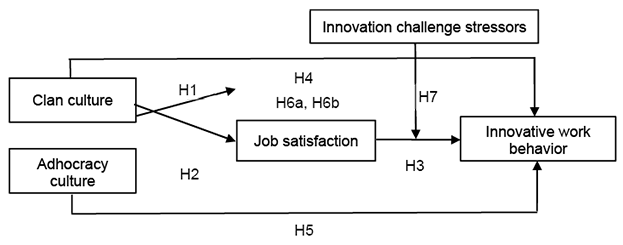
Based on the above hypotheses, the authors propose a research model that includes two independent variables (clan culture and adhocracy culture), the dependent variable (innovative work behavior), the mediating variable (job satisfaction), and the moderating variable (innovation challenge stressors). The novelty of this research lies in its theoretically grounded focus on cultural types most likely to influence innovative work behavior, namely clan culture and adhocracy culture, which have not been explicitly selected in prior studies. In addition, the study examines the mediating role of job satisfaction as a positive work attitude that supports the sustainability of innovative work behavior, an aspect that remains underexplored in existing literature. Furthermore, it introduces moderating factors through innovation challenge stressors, providing a more integrative understanding of the mechanisms shaping innovative work behavior.
Figure 1
Model Illustrating Relationships Among Key Study Variables
4. Research Method
4.1 Sample and Data Collection
This study employs a cross-sectional survey design with respondents being employees working in manufacturing and service firms in Ho Chi Minh City, Viet Nam, in 2025. The research team directly distributed 320 questionnaires to 32 firms through alumni and managers who are members of the university’s corporate and alumni partnership network and who assisted with the data collection. The target respondents were employees working in various departments such as production, sales, human resources, finance, quality, and research and development to ensure that the sample would be reasonably representative. After a data collection period of nearly one month, the research team received 296 returned questionnaires, and after eliminating those with missing information, 283 valid responses remained, corresponding to a usable response rate of approximately 88.4%.
With 283 observations, the sample size of this study meets common recommendations for structural equation modeling, which suggest a minimum of about 200 observations and require that the number of respondents be at least 5 to 10 times larger than the number of estimated parameters in the model (Hair et al., 2018; Kline, 2011). Therefore, the current sample size is considered sufficient for estimating the model and testing the hypothesized relationships among the study variables.
4.2 Measurement Scales
In this study, the measurement scales were adopted from reputable international research and then translated and adapted to fit the research context. Specifically, we invited two faculty members who teach management to jointly review the scales to ensure translation accuracy. All members validated the accuracy of the translated scales and reached a consensus on adapting Cavanaugh et al. (2000) challenge stressor scale into a context-specific innovation challenge stressors scale. We then conducted a pilot test with a small group of 7 employees to verify that respondents correctly understood the items, and the results indicated that all scales were clearly understood. All observed variables were measured using five-point Likert scales. For organizational culture, innovation challenge stressors and job satisfaction, respondents indicated their level of agreement from 1 (strongly disagree) to 5 (strongly agree). For innovative work behavior, respondents reported frequency from 1 (never) to 5 (always).
Clan culture and adhocracy culture were measured with items adapted from the OCAI instrument, capturing employee perceptions of the extent to which the organization is like a close family, people oriented and cohesive, as well as dynamic, risk-taking and innovation-oriented (Cameron & Quinn, 2011). Innovation challenge stressors were measured with 6 items derived from the challenge stressor scale and appropriately adapted to reflect innovation demands, including innovation challenge stressors regarding the number of ideas, time devoted to innovative work behavior, innovation deadlines, and the scope of responsibility for innovative work behavior at a reasonable level (Cavanaugh et al., 2000). Job satisfaction was measured with 5 items from the Short Index of Job Satisfaction (SIJS), which was developed based on the job satisfaction scale of Judge et al. (2000) and later used by Sinval and Marôco (2020). Innovative work behavior was measured with 9 items based on the Innovative Work Behaviour scale, covering behaviors related to idea generation, idea promotion, and idea realization in the workplace (Janssen, 2000).
After data collection, the scales were assessed for reliability using Cronbach’s alpha and for convergent and discriminant validity through confirmatory factor analysis before being included in the structural equation model. The assessment followed the recommended thresholds for factor loadings, composite reliability, and average variance extracted proposed by Hair et al. (2018), as well as the model fit criteria suggested by Kline (2011). This procedure ensured that the observed variables adequately captured the latent constructs and that the tested model achieved acceptable levels of reliability and validity.
4.3 Common Method Bias and Data Analysis
To assess common method bias, the study used Harman’s single-factor test with all observed variables. All observed variables were included in an exploratory factor analysis (EFA) with the extraction constrained to a single factor. The results indicated that this single factor accounted for 32.696% of the total variance, which is below the commonly recommended threshold of 50%. This result indicates that common method bias is not a serious concern in the present data set (Podsakoff et al., 2003).
Next, the reliability of the scales was assessed using corrected correlations between each item and the total score and Cronbach’s alpha. Following the recommendations of Hair et al. (2018), correlations between each item and the total score had to exceed 0.30, and Cronbach’s alpha had to be at least 0.60. Confirmatory factor analysis conducted in AMOS was then used to evaluate the measurement model. Model fit was considered acceptable when the ratio of chi-square to degrees of freedom was below 3; the comparative fit index (CFI), the goodness of fit index (GFI), and the Tucker Lewis index (TLI) were above 0.90, and the root mean square error of approximation (RMSEA) was below 0.08 (Hair et al., 2018). Convergent validity and construct reliability were further evaluated through composite reliability above 0.70 and average variance extracted above 0.50 (Hair et al., 2018).
After the measurement model satisfied these criteria, the structural equation model was estimated using the same fit thresholds, and hypotheses were regarded as statistically supported when p-values were below 0.05. Mediation and moderation were examined with the bootstrap method using 2,000 resamples. Indirect effects and interaction effects were considered significant when the 95% bootstrap confidence interval did not include zero, in line with the recommendations of Hayes (2013).
5. Research Results
5.1 Sample Characteristics
As shown in Table 1, the research sample consists of 283 employees, of whom 148 are male, accounting for 52.3%, and 135 are female, accounting for 47.7%. In terms of age, employees under 30 years old comprise 36.4%, those from 30 to under 40 account for 31.1%, while the groups from 40 to under 50 and from 50 and above make up 26.15% and 6.36%, respectively. Educational attainment is mainly at the university level, which accounts for 59.01%, followed by college at 23.67% and postgraduate level at 17.31%. Organizational tenure is relatively evenly distributed, with 33.57% being from 1 to under 3 years, 22.61% with less than 1 year, 21.55% from 3 to under 5 years and 22.26% with 5 years or more. Regarding income, employees earning under 15 million VND per month constitute 27.21%, those from 15 to under 25 million VND account for 39.93%, those from 25 to under 35 million VND make up 24.38%, and those with 35 million VND or more account for 8.48%. With respect to primary department, sales and business account for 19.08%, production and operations for 18.37%, research and development for 15.19%, quality for 16.61%, human resources for 15.19% and finance for 15.55% of the 283 respondents. Overall, the sample distribution by gender, age, educational level, tenure, income and department is relatively balanced and not concentrated in any particular group. This suggests that the survey sample can be considered as providing a reasonably good reflection of the characteristics of the workforce in firms within the research context.
Table 1
Descriptive Statistics of the Research Sample
|
No. |
Category |
Item |
Frequency |
Percentage |
|---|---|---|---|---|
|
1 |
Gender |
Male |
148 |
52.30% |
|
Female |
135 |
47.70% |
||
|
2 |
Age |
Under 30 years |
103 |
36.40% |
|
From 30 to under 40 years |
88 |
31.10% |
||
|
From 40 to under 50 years |
74 |
26.15% |
||
|
From 50 years and above |
18 |
6.36% |
||
|
3 |
Highest educational level |
College |
67 |
23.67% |
|
University |
167 |
59.01% |
||
|
Postgraduate |
49 |
17.31% |
||
|
4 |
Tenure with current organization |
Less than 1 year |
64 |
22.61% |
|
From 1 to under 3 years |
95 |
33.57% |
||
|
From 3 to under 5 years |
61 |
21.55% |
||
|
From 5 years and above |
63 |
22.26% |
||
|
5 |
Average monthly income after tax |
Under 15 million VND |
77 |
27.21% |
|
From 15 to under 25 million VND |
113 |
39.93% |
||
|
From 25 to under 35 million VND |
69 |
24.38% |
||
|
From 35 million VND and above |
24 |
8.48% |
||
|
6 |
Main working department |
Research and development |
43 |
15.19% |
|
Sales and business |
54 |
19.08% |
||
|
Production and operations |
52 |
18.37% |
||
|
Quality |
47 |
16.61% |
||
|
Human resources |
43 |
15.19% |
||
|
Finance |
44 |
15.55% |
5.2 Results of the Measurement Model Assessment
The measurement model with five latent constructs was evaluated using confirmatory factor analysis to assess model fit and measurement validity. All standardized factor loadings of the observed variables on their respective factors were greater than 0.50 and statistically significant at p < 0.01, indicating that the items represented the intended constructs well (Hair et al., 2018). The fit indices for the measurement model reached acceptable levels: chi-square was 631.526 with 334 degrees of freedom, the chi-square to degrees of freedom ratio was 1.891, CFI was 0.941, TLI was 0.934, RMSEA was 0.056 and GFI was 0.867. The values of CFI, TLI and RMSEA meet the commonly suggested thresholds of CFI and TLI greater than 0.90 and RMSEA less than 0.08 (Hair et al., 2018; Kline, 2011). Although the GFI value is lower than 0.90, it is still above 0.80, which has been considered acceptable in many behavioral studies (Baumgartner & Homburg, 1996); therefore, the model is still judged to have a good level of fit.
Table 2
Descriptive Statistics, Reliability, and Convergent Validity of the Measurement Scales
|
Constructs |
Cronbach’s α |
CR |
AVE |
MSV |
IWB |
InnoS |
JobS |
ClanC |
AdhoC |
|---|---|---|---|---|---|---|---|---|---|
|
Innovative work behavior (IWB) |
0.937 |
0.933 |
0.609 |
0.281 |
0.78 |
|
|
|
|
|
Innovation challenge stressors (InnoS) |
0.857 |
0.859 |
0.505 |
0.038 |
0.105 |
0.711 |
|
|
|
|
Job satisfaction (JobS) |
0.863 |
0.864 |
0.559 |
0.474 |
0.530*** |
0.158* |
0.748 |
|
|
|
Clan culture (ClanC) |
0.869 |
0.87 |
0.625 |
0.474 |
0.484*** |
0.065 |
0.688*** |
0.791 |
|
|
Adhocracy culture (AdhoC) |
0.913 |
0.912 |
0.722 |
0.166 |
0.407*** |
0.196** |
0.246*** |
0.180** |
0.85 |
Note. Cronbach’s α > 0.6, Composite Reliability (CR) > 0.7, Average Variance Extracted (AVE) > 0.5.
Table 2 shows that all scales achieved satisfactory reliability and validity. Cronbach’s alpha ranges from 0.857 to 0.937, with corrected item-total correlations between 0.575 and 0.825, all exceeding the recommended thresholds of 0.60 and 0.30 (Hair et al., 2018). The composite reliability of the constructs lies between 0.859 and 0.933, higher than 0.70, while the average variance extracted (AVE) ranges from 0.505 to 0.722, all above the 0.50 threshold. In addition, the AVE of each construct is greater than its maximum shared variance (MSV), indicating that the measurement model satisfies both convergent and discriminant validity (Hair et al., 2018). Accordingly, the scales for innovative work behavior, innovation challenge stressors, job satisfaction, clan culture, and adhocracy culture are reliable and appropriate for use in subsequent SEM analyses.
5.3 Descriptive Statistics and Correlations
The results in Table 3 show that clan culture has the highest mean value, with M = 4.09 and SD = 0.79, which is clearly higher than the neutral point of 3 on the five-point Likert scale. Innovative work behavior has a mean level close to neutral, with M = 3.01 and SD = 1.00, while job satisfaction is slightly below the neutral point, with M = 2.98 and SD = 0.61. In contrast, adhocracy culture has M = 2.67 and SD = 0.66, and innovation challenge stressors have M = 2.34 and SD = 0.78, both below the neutral level, suggesting that employees do not yet strongly perceive the organization as innovation-oriented, nor do they perceive a high level of challenge-oriented innovation challenge stressors in their work.
Table 3
Descriptive Statistics and Model Validity Measures
|
Constructs |
Mean |
SD |
ClanC |
AdhoC |
ChallS |
JobS |
IWB |
|
Clan culture (ClanC) |
4.09 |
0.79 |
1 |
||||
|
Adhocracy culture (AdhoC) |
2.67 |
0.66 |
0.185** |
1 |
|||
|
Innovation challenge stressors (InnoS) |
2.34 |
0.78 |
0.069 |
0.195** |
1 |
||
|
Job satisfaction (JobS) |
2.98 |
0.61 |
0.636** |
0.220** |
0.148* |
1 |
|
|
Innovative work behavior (IWB) |
3.01 |
1.00 |
0.558** |
0.378** |
0.137* |
0.517** |
1 |
Note. * Correlation is significant at 0.05; ** correlation is significant at 0.01.
The correlation matrix indicates that all relationships between the variables are positive and most of them are statistically significant. Clan culture is strongly correlated with job satisfaction, r = 0.636, p < 0.01, and with innovative work behavior, r = 0.558, p < 0.01, implying that a more family-like environment is associated with higher satisfaction and higher levels of innovation. Adhocracy culture also shows a positive and significant correlation with innovative work behavior, r = 0.378, p < 0.01, and with job satisfaction, r = 0.220, p < 0.01, and is modestly related to innovation challenge stressors, r = 0.195, p < 0.01. Innovation challenge stressors are positively but weakly correlated with job satisfaction, r = 0.148, p < 0.05, and with innovative work behavior, r = 0.137, p < 0.05. Finally, job satisfaction is moderately and positively correlated with innovative work behavior, r = 0.517, p < 0.01. All correlation coefficients are below 0.7, indicating that the variables are related yet still sufficiently distinct to proceed with SEM analyses.
5.4. Structural Equation Modeling Results and Hypotheses Testing
The results in Table 4 indicate that the structural equation model was estimated on a data set of 283 observations. As shown in Figure 2, the fit indices suggest that the theoretical model achieves an acceptable fit to the data, with χ² = 459.627, df = 197, a ratio of chi-square to degrees of freedom equal to 2.333, GFI = 0.874, CFI = 0.940, TLI = 0.930, and RMSEA = 0.069. These values meet or are close to commonly recommended thresholds in behavioral research, namely a chi-square to degrees of freedom ratio below 3, CFI and TLI greater than 0.90, and RMSEA below 0.08. Although GFI is below 0.90, it remains above 0.80 and is therefore considered acceptable (Baumgartner & Homburg, 1996; Hair et al., 2018; Kline, 2011).
Figure 2
Structural Equation Modeling Results Showing Relationships Among Study Variables
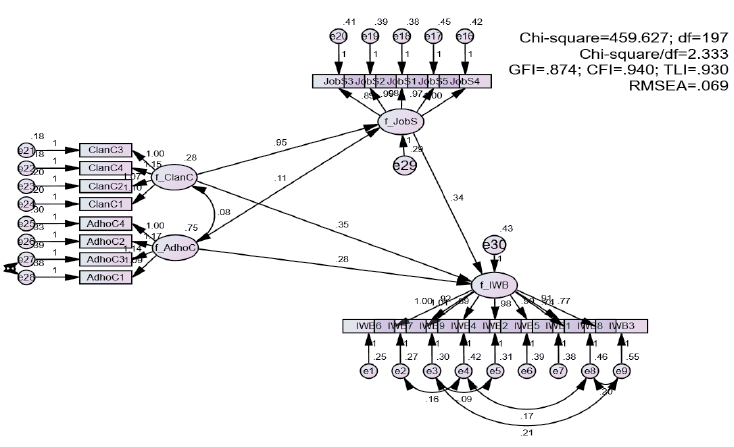
With respect to direct effects, the SEM results show that all hypotheses from H1 to H5 are supported. Clan culture has a positive and fairly strong effect on job satisfaction (H1), with β = 0.665, p < 0.001, whereas adhocracy culture also increases job satisfaction (H2), with β = 0.126, p = 0.022. Job satisfaction exerts a significant positive effect on innovative work behavior (H3), with β = 0.305, p < 0.001. At the same time, clan culture (H4) and adhocracy culture (H5) both have positive direct effects on innovative work behavior, with β = 0.221, p < 0.01 and β = 0.292, p< 0.001, respectively. Thus, both cultural types influence innovation through job satisfaction and also have direct effects on the level of innovation at work.
Regarding the mediating role, bootstrap analysis with 2,000 resamples shows that job satisfaction significantly mediates the relationship between clan culture and innovative work behavior (H6a), with an indirect effect of β = 0.203, p = 0.017, and a 95% confidence interval from 0.126 to 0.613, which does not include zero. Similarly, job satisfaction mediates the relationship between adhocracy culture and innovative work behavior (H6b), with an indirect effect of β = 0.039, p < 0.05, and a 95% confidence interval from 0.007 to 0.093. As for the moderating role, the interaction between innovation challenge stressors and job satisfaction in predicting innovative work behavior (H7) is statistically significant, with β = 0.262, p < 0.001. The 95% confidence interval of this interaction effect ranges from 0.174 to 0.351 and does not include zero, indicating that innovation challenge stressors can amplify the positive impact of job satisfaction on innovative work behavior (Hayes, 2013).
Table 4
Results of Standardized Regression Weights
|
Hypothesis |
Statement |
Estimate |
p-value |
Lower |
Upper |
Result |
|---|---|---|---|---|---|---|
|
H1 |
Clan culture → Job satisfaction |
0.665 |
*** |
Supported |
||
|
H2 |
Adhocracy culture → Job satisfaction |
0.126 |
0.022 |
Supported |
||
|
H3 |
Job satisfaction → Innovative work behavior |
0.305 |
*** |
Supported |
||
|
H4 |
Clan culture → Innovative work behavior |
0.221 |
0.008 |
Supported |
||
|
H5 |
Adhocracy culture → Innovative work behavior |
0.292 |
*** |
Supported |
||
|
H6a |
Clan culture → Job satisfaction → Innovative work behavior |
0.203 |
0.017 |
0.126 |
0.613 |
Supported |
|
H6b |
Adhocracy culture → Job satisfaction → Innovative work behavior |
0.039 |
0.026 |
0.007 |
0.093 |
Supported |
|
H7 |
Innovation challenge stressors × Job satisfaction → Innovative work behavior |
0.262 |
*** |
0.174 |
0.351 |
Supported |
6. Conclusion
The study has achieved its stated research objectives. Clan culture and adhocracy culture positively influence job satisfaction, and job satisfaction, in turn, has a positive effect on employees’ innovative work behavior. Job satisfaction acts as a mediating mechanism in the relationships of clan culture and adhocracy culture with innovative work behavior. In addition, reasonable levels of innovation challenge stressors moderate the relationship between job satisfaction and innovative work behavior. This study provides a meaningful theoretical contribution and offers practical implications for developing organizational culture to foster innovation, in a context where organizations increasingly seek to compete through innovative work behavior to sustain their competitive advantage.
6.1 Theoretical Contributions
This study enriches the literature on organizational culture, job satisfaction, and innovative work behavior by providing empirical evidence on the relationship between organizational culture and employees’ innovative work behavior through the mediating role of job satisfaction and the moderating role of innovation challenge stressors. The study contributes to testing the Competing Values Framework by Cameron and Quinn (2011) and organizational culture theory (Schein, 2010) in relation to innovation. The findings show that both clan culture and adhocracy culture have direct positive effects on employees’ innovative work behavior. This result addresses the theoretical gap noted by Büschgens et al. (2013), who argued that prior research had not clearly identified which cultural types exert the strongest influence on innovation. The present findings suggest that to compete through innovation, organizations should simultaneously develop both of these cultural types. Adhocracy culture encourages employees to take risks, remain flexible in their work, and pursue innovation. Clan culture encourages collaboration and close interpersonal bonds, which foster trust and psychological safety, thereby enabling open exchange and innovation engagement among employees.
The study also identifies the mediating role of job satisfaction in the relationships of clan culture and adhocracy culture with employees’ innovative work behavior. This empirical evidence indicates that organizational culture not only directly promotes innovative work behavior, but also operates by creating a positive emotional state that strengthens employees’ intrinsic motivation to voluntarily engage in innovation (Han et al., 2010). This finding deepens our understanding of the link between culture and innovation by explicitly incorporating job satisfaction as a mediating mechanism.
This study revised the concept and measurement scale of innovation challenge stressors into the concept and scale of rational innovation challenge stressors to ensure appropriateness for the research context. Furthermore, the study finds that reasonable levels of innovation challenge stressors positively moderate the relationship between job satisfaction and innovative work behavior. This can be interpreted as follows: job satisfaction creates the potential for innovation, but when employees also experience an appropriate level of innovation challenge stressors, this potential is more likely to be activated and translated into actual innovative work behavior (Xie et al., 2024). This result suggests that job satisfaction helps employees feel sufficiently secure and comfortable to interpret innovation challenge stressors in a positive way, viewing it as a challenge, which in turn enhances the effectiveness of efforts to stimulate innovation.
6.2 Practical Implications
The findings suggest that managers should pay close attention to applying clan culture and adhocracy culture, and to creating appropriate innovation challenge stressors for employees if they aim to enhance job satisfaction and foster innovation. For clan culture, managers should focus on building work teams to implement innovation projects. They should encourage employees to engage in cooperative behavior, develop mutual trust, support one another in their work, and actively discuss and exchange work-related ideas to stimulate innovative work behavior. Managers should also create a climate of psychological safety in which employees do not fear disciplinary action when they make mistakes during innovation projects. To develop adhocracy culture, managers should delegate decision-making authority to employees, allowing them autonomy and discretion in their work. Managers need to encourage experimentation, accept risk, and reward new initiatives even in cases of failure. In addition, they should ensure that work procedures are not overly detailed, so that employees can flexibly adapt processes and have room to propose new ideas.
Managers should also pay attention to achieving job satisfaction when developing these two cultural types, since job satisfaction is both a desired outcome of clan culture and adhocracy culture and an important input for stimulating innovative work behavior. Notably, greater emphasis should be placed on clan culture to foster job satisfaction, given that the research findings demonstrate it exerts a significantly stronger impact on job satisfaction than adhocracy culture. This phenomenon can be attributed to the core tenets of clan culture, specifically its emphasis on collaboration, mutual support, and family-like interpersonal sharing, which inherently aligns with the cultural paradigm most favored by employees in the Vietnamese context (Van Huy et al., 2020). This requires building a trustworthy work environment in which employees feel psychologically safe, empowered, who are not punished when innovation efforts entail reasonable risk, and receive fair rewards for innovative work behavior. Managers also need to set innovation demands at a reasonable level, not so high that they cause exhaustion and undermine innovation motivation. They should view innovation challenge stressors as an opportunity to challenge employees and support their development, so that such innovation challenge stressors complement job satisfaction in promoting innovative work behavior.
6.3 Limitations and Future Research Directions
Although this study has achieved its objectives and offers theoretical and practical contributions for managers, it still has several limitations. First, data were collected at a single point in time, which makes it difficult to establish causal relationships between the variables over time. Second, the study was conducted across multiple industries, so it does not allow for comparisons of how the effects of the cultural types may differ by industry. Third, all variables in the research model were measured using self-reported questionnaires, potentially introducing bias. Furthermore, although Harman’s single-factor test met the acceptable threshold, this method lacks sufficient robustness to definitively rule out the presence of common method bias. Fourth, the model includes only two independent variables, one mediating variable, and one moderating variable, whereas in practice the relationships between antecedents and innovative work behavior may be more complex, and other antecedents related to individual, group, or organizational characteristics may also play a role. Therefore, it is recommended that future research collects data at multiple time points to mitigate biases influenced by respondents’ momentary emotions. Simultaneously, data should be gathered from diverse sources, such as supervisor or coworker ratings regarding the number of generated ideas and solutions, or the extent of new idea implementation. Finally, subsequent studies should explore additional mediators, such as work engagement and psychological empowerment, along with other moderators, such as task complexity or leadership style. Conducting research in high-innovation industries such as technology and media is also suggested to examine whether the effects of the variables in the model differ across various contexts.
References
Amabile, T. M. (1996). Creativity in context. Westview Press.
Anderson, N., Potočnik, K., & Zhou, J. (2014). Innovation and creativity in organizations: A state-of-the-science review, prospective commentary, and guiding framework. Journal of Management, 40(5), 1297–1333.
Azeem, M., Ahmed, M., Haider, S., & Sajjad, M. (2021). Expanding competitive advantage through organizational culture, knowledge sharing and organizational innovation. Technology in Society, 66, 101635.
Bakker, A. B., & Demerouti, E. (2007). The job demands‐resources model: State of the art. Journal of Managerial Psychology, 22(3), 309–328.
Baumgartner, H., & Homburg, C. (1996). Applications of structural equation modeling in marketing and consumer research: A review. International Journal of Research in Marketing, 13(2), 139–161.
Blau, P. M. (1964). Exchange and power in social life. Wiley.
Bos-Nehles, A., Renkema, M., & Janssen, M. (2017). HRM and innovative work behaviour: A systematic literature review. Personnel Review, 46(7), 1228–1253.
Büschgens, T., Bausch, A., & Balkin, D. B. (2013). Organizational culture and innovation: A meta‐analytic review. Journal of Product Innovation Management, 30(4), 763–781.
Cai, W., Xu, C., Yu, S., & Gong, X. (2022). Research on the impact of challenge-hindrance stress on employees’ innovation performance: A chain mediation model. Frontiers in Psychology, 13, 745259.
Cameron, K. S., & Quinn, R. E. (2011). Diagnosing and changing organizational culture: Based on the competing values framework (3rd ed.). Jossey Bass.
Cavanaugh, M. A., Boswell, W. R., Roehling, M. V., & Boudreau, J. W. (2000). An empirical examination of self reported work stress among U.S. managers. Journal of Applied Psychology, 85(1), 65–74.
Cumar, M., Kidaneb, B. Z., Negassa, D., & Dinsa, F. (2025, September). Organizational culture and academic staff satisfaction in Somaliland higher education: Evidence from structural equation modeling. Frontiers in Education, 10, 1635607.
De Jong, J., & Den Hartog, D. (2010). Measuring innovative work behaviour. Creativity and Innovation Management, 19(1), 23–36.
De Spiegelaere, S., Van Gyes, G., & Van Hootegem, G. (2014). Innovatief Werkgedrag als concept: definiëring en oriëntering. Gedrag & Organisatie, 27(2).
Denison, D. R., & Mishra, A. K. (1995). Toward a theory of organizational culture and effectiveness. Organization Science, 6(2), 204–223.
Dimitrios, B. (2014). Organizational culture and job satisfaction, in banking sector–A review. International Journal of Human Resources Management, 3(2), 1–20.
Dobni, C. B. (2008). Measuring innovation culture in organizations: The development of a generalized innovation culture construct using exploratory factor analysis. European Journal of Innovation Management, 11(4), 539–559.
Fredrickson, B. L. (2001). The role of positive emotions in positive psychology: The broaden-and-build theory of positive emotions. American Psychologist, 56(3), 218–226.
George, A. J., & Tarr, J. A. (2021). Addressing Australia’s collaboration ‘problem’: Is there a Brave New World of innovation policy post COVID‐19?. Australian Journal of Public Administration, 80(2), 179–200.
Georgousopoulou, V., Amanatidou, M., Vlotinou, P., Lahana, E., Tsiakiri, A., Koutelekos, I., Koutra, E. & Manomenidis, G. (2025). The Role of Organizational Culture and Emotional Intelligence: Enhancing Healthcare Professionals’ Job Satisfaction. Social Sciences, 14(5), 286.
Hair, J. F., Black, W. C., Babin, B. J., & Anderson, R. E. (2018). Multivariate data analysis (8th ed.). Cengage Learning.
Hammond, M. M., Neff, N. L., Farr, J. L., Schwall, A. R., & Zhao, X. (2011). Predictors of individual-level innovation at work: A meta-analysis. Psychology of Aesthetics, Creativity, and the Arts, 5(1), 90.
Han, Y. J., Lee, S. G., & Kwon, H. J. (2010). Influence of organizational culture type and job satisfaction on nurses’ innovation behavior in a university hospital. Korea Journal of Hospital Management, 15(4), 63–77.
Hartnell, C. A., Ou, A. Y., & Kinicki, A. (2011). Organizational culture and organizational effectiveness: A meta-analytic investigation of the Competing Values Framework’s theoretical suppositions. Journal of Applied Psychology, 96(4), 677–694.
Hayes, A. F. (2013). Introduction to mediation, moderation, and conditional process analysis: A regression-based approach. New York: Guilford Press.
Hogan, S. J., & Coote, L. V. (2014). Organizational culture, innovation, and performance: A test of Schein’s model. Journal of Business Research, 67(8), 1609–1621.
Hrnjic, A., Pilav-Velic, A., Djidelija, I., & Jahic, H. (2018). Innovative behavior and employee job satisfaction in telecommunications sector. Economic Review: Journal of Economics and Business, 16(1), 19–30.
Huang, L., Ma, M., & Wang, X. (2022). Clan culture and risk-taking of Chinese enterprises. China Economic Review, 72, 101763.
Iranzadeh, S. (2017). The effect of innovation culture and job satisfaction on relation between human resources management and employees’ ownership in Shahr Bank of Tabriz. International Review of Management and Marketing, 7(1), 90–94.
Janićijević, N., Nikčević, G., & Vasić, V. (2018). The influence of organizational culture on job satisfaction. Economic Annals, 63(219), 83–114.
Janssen, O. (2000). Job demands, perceptions of effort‐reward fairness and innovative work behaviour. Journal of Occupational and Organizational Psychology, 73(3), 287–302.
Judge, T. A., Bono, J. E., & Locke, E. A. (2000). Personality and job satisfaction: The mediating role of job characteristics. Journal of Applied Psychology, 85(2), 237–249.
Kline, R. B. (2011). Principles and practice of structural equation modeling (3rd ed.). Guilford Press.
Kristof‐Brown, A. L., Zimmerman, R. D., & Johnson, E. C. (2005). Consequences of Individuals’ fit at work: A meta‐analysis OF person–job, person–organization, person–group, and person–supervisor fit. Personnel psychology, 58(2), 281–342.
Lazarus, R. S., & Folkman, S. (1984). Stress, appraisal, and coping. Springer.
LePine, J. A., Podsakoff, N. P., & LePine, M. A. (2005). A meta analytic test of the challenge stressor hindrance stressor framework: An explanation for inconsistent relationships among stressors and performance. Academy of Management Journal, 48(5), 764–775.
Lestari, S., Novandari, W., Hidayati, N. V., Pujihastuti, E., & Afuan, L. (2024). Knowledge Sharing as a Mediator between Clan Culture, Trust, and Resilience and Innovative Work Behavior in Indonesian Village-owned Enterprises. The Journal of Behavioral Science, 19(3), 90–103.
Li, C., Wang, C., & Xue, C. (2024). Clan culture and corporate innovation. Pacific-Basin Finance Journal, 83, 102229.
Li, Z., & Liu, L. (2022). The impact of organizational innovation culture on employees’ innovation behavior. Social Behavior and Personality, 50(12), 1–10.
Liu, Y., Vriend, T., & Janssen, O. (2021). To be (creative), or not to be (creative)? A sensemaking perspective to creative role expectations. Journal of Business and Psychology, 36(1), 139–153.
Locke, E. A. (1976). The nature and causes of job satisfaction. In M. D. Dunnette (Ed.), Handbook of industrial and organizational psychology (pp. 129–171). Rand McNally.
Lund, D. B. (2003). Organizational culture and job satisfaction. Journal of Business & Industrial Marketing, 18(3), 219–236.
Marampa, A. M., Garnasih, R. L., & Pariyanti, E. (2023). How to unleash innovative work behaviour of SMEs workers through clan culture? Testing the mediating role of knowledge sharing. Industrial and Commercial Training, 56(1), 1–23.
Mumford, M. D., & Licuanan, B. (2004). Leading for innovation: Conclusions, issues, and directions. The Leadership Quarterly, 15(1), 163–171.
Naranjo‐Valencia, J. C., Jiménez‐Jiménez, D., & Sanz‐Valle, R. (2011). Innovation or imitation? The role of organizational culture. Management Decision, 49(1), 55–72.
Naranjo-Valencia, J. C., Jiménez-Jiménez, D., & Sanz-Valle, R. (2016). Studying the links between organizational culture, innovation, and performance in Spanish companies. Revista latinoamericana de psicología, 48(1), 30–41.
Newman, A., Donohue, R., & Eva, N. (2017). Psychological safety: A systematic review of the literature. Human Resource Management Review, 27(3), 521–535.
Oh, I. S., Guay, R. P., Kim, K., Harold, C. M., Lee, J. H., Heo, C. G., & Shin, K. H. (2014). Fit happens globally: A meta‐analytic comparison of the relationships of person–environment fit dimensions with work attitudes and performance across East Asia, Europe, and North America. Personnel Psychology, 67(1), 99–152.
Ohly, S., & Fritz, C. (2010). Work characteristics, challenge appraisal, creativity, and proactive behavior: A multi‐level study. Journal of Organizational Behavior, 31(4), 543–565.
Oldham, G. R., & Cummings, A. (1996). Employee creativity: Personal and contextual factors at work. Academy of Management Journal, 39(3), 607–634.
O’Reilly, C. A., Chatman, J., & Caldwell, D. F. (1991). People and organizational culture: A profile comparison approach to assessing person organization fit. Academy of Management Journal, 34(3), 487–516.
Podsakoff, P. M., MacKenzie, S. B., Lee, J. Y., & Podsakoff, N. P. (2003). Common method biases in behavioral research: A critical review of the literature and recommended remedies. Journal of Applied Psychology, 88(5), 879.
Quinn, R. E., & Rohrbaugh, J. (1983). A spatial model of effectiveness criteria: Towards a competing values approach to organizational analysis. Management Science, 29(3), 363–377.
Rhoades, L., & Eisenberger, R. (2002). Perceived organizational support: A review of the literature. Journal of Applied Psychology, 87(4), 698–714.
Schein, E. H. (2010). Organizational culture and leadership (Vol. 2). John Wiley & Sons.
Scott, S. G., & Bruce, R. A. (1994). Determinants of innovative behavior: A path model of individual innovation in the workplace. Academy of Management Journal, 37(3), 580–607.
Sinval, J., & Marôco, J. (2020). Short index of job satisfaction: Validity evidence from Portugal and Brazil. PloS one, 15(4), e0231474.
Szczepańska-Woszczyna, K. (2014, September). The importance of organizational culture for innovation in the company. Forum Scientiae Oeconomia, 2(3), 27–39).
Tang, Y., Shao, Y. F., & Chen, Y. J. (2019). Assessing the mediation mechanism of job satisfaction and organizational commitment on innovative behavior: The perspective of psychological capital. Frontiers in Psychology, 10, 2699.
Tang, Y., Shao, Y. F., Chen, Y. J., & Ma, Y. (2021). How to keep sustainable development between enterprises and employees? Evaluating the impact of person–organization fit and person–job fit on innovative behavior. Frontiers in Psychology, 12, 653534.
Tjoa, Y., & Arief, M. (2022). Determinants of innovative work behavior: The role of job satisfaction as mediation and environmental dynamism as moderating variable. In 5th European International Conference on Industrial Engineering and Operations Management. https://doi.org/10.46254/EuIConference (Vol. 20220445).
Van Huy, N., Thu, N. T. H., Anh, N. L. T., Au, N. T. H., Phuong, N. T., Cham, N. T., & Minh, P. D. (2020). The validation of organisational culture assessment instrument in healthcare setting: Results from a cross-sectional study in Vietnam. BMC Public Health, 20(1), 316.
Weiss, H. M., & Cropanzano, R. (1996). Affective Events Theory: A theoretical discussion of the structure, causes and consequences of affective experiences at work. In B. M. Staw & L. L. Cummings (Eds.), Research in organizational behavior: An annual series of analytical essays and critical reviews, Vol. 18, pp. 1–74). Elsevier Science/JAI Press.
Xie, J., Wen, Z., Ma, Y., Cai, B., & Liu, X. (2024). Associations among challenge stress, hindrance stress, and employees’ innovative work behavior: Mediation effects of thriving at work and emotional exhaustion. The Journal of Creative Behavior, 58(1), 66–81.