Organizations and Markets in Emerging Economies ISSN 2029-4581 eISSN 2345-0037
2026, vol. 17, no. 1(34), pp. 214–246 DOI: https://doi.org/10.15388/omee.2026.17.10
Knowledge Sharing in Small and Medium Enterprises: A PLS-SEM Analysis of Employee Engagement, Innovation Capability and Organizational Performance
Godfred Amankwah (corresponding author)
Taiyuan University of Technology, Ghana
manambition125@gmail.com
Nathan Awelama Atigah
Taiyuan University of Technology, Ghana
awelana92@gmail.com
Alfred Attoh
Taiyuan University of Technology, Ghana
attohalfred4@gmail.com
Kennedy Amankwah
kamankwah0005@gmail.com
Abstract. The paper examines knowledge sharing roles as factors in organizational performance in Ghana. Consequently, employee engagement and innovation capability are intervening variables in the knowledge sharing–performance relationship. The study employed a PLS-SEM approach to examine data from 347 managers in Ghana’s SME sector. The results showed that knowledge sharing directly improves organizational performance in the emerging economy. Both employee engagement and innovation capability significantly mediate the relationship between knowledge sharing and performance. Knowledge sharing from its end positively impacted employee engagement and innovation capability outcomes. These mediating variables, in turn, contributed to the performance of organizations under review in the SME category. Through the dual mediation mechanism, knowledge sharing effectively creates organizational value. Henceforth, increased employee engagement and innovation capacity become essential pathways towards performance enhancement. The firm’s particular style of knowledge sharing, both tacit and explicit, is translated into performance outcomes through these intangible assets. These results will help immensely in designing a feasible knowledge management strategy in two resource-constrained milieus, where employee engagement and innovation capacity matter for transforming knowledge assets into organizational performance outcomes. The study contributes to the knowledge management literature by establishing dual pathways of mediation. It also offers SME managers practical implications to gain a competitive advantage in knowledge resources.
Keywords: knowledge sharing, organizational performance, employee engagement, innovation capacity, small and medium enterprises
Received: 22/12/2025. Accepted: 21/4/2026
Copyright © 2026 Godfred Amankwah, Nathan Awelama Atigah, Alfred Attoh, Kennedy Amankwah. Published by Vilnius University Press. This is an Open Access article distributed under the terms of the Creative Commons Attribution Licence, which permits unrestricted use, distribution, and reproduction in any medium, provided the original author and source are credited.
1. Introduction
In the contemporary business environment, digital transformation has significantly redefined organizational value creation and competitive strategies (Hu et al., 2024; Lu & Shaharudin, 2024). In today’s competitive landscape, characterized by rapid technological progress and novel business strategies, sustaining competitive advantage and profitability presents a formidable challenge for organizations (Haseeb et al., 2019). Knowledge has emerged as the most critical organizational resource, recognized as an intangible strategic asset that enables organizations to gain sustainable competitive advantages. Organizations are increasingly recognizing that knowledge and learning constitute the principal source of enduring competitive advantage in a rapidly evolving, intensely competitive landscape (Mahdi et al., 2019). Nevertheless, many organizations face challenges in realizing their knowledge assets in terms of organizational performance outcomes. This is more common among small and medium-sized enterprises in developing economies, where resource constraints hinder the implementation of knowledge management systems (Soomro et al., 2025).
Knowledge sharing, which is defined as the exchange of task-relevant information, expertise, and feedback among employees (Muhammed & Zaim, 2020), is generally considered an important driver of organizational competitiveness. Studies suggest that knowledge sharing enhances strategic, innovative, and marketing competencies across industries (Mahdi et al., 2019; Afriyie et al., 2020). However, the relationship between knowledge sharing and organizational performance is not straightforward. First, there is significant variability in the effectiveness of knowledge transfer across different parts of the organization, with some firms experiencing complete knowledge transfer and others experiencing incomplete knowledge transfer (Zan et al., 2023).
Despite this burgeoning trend in research, three specific areas of research gaps have been identified. First, most of this research has focused on the direct link between knowledge sharing and performance, without considering intermediate variables that could provide insights into the process of this conversion (Nugroho & Adie, 2022; Danko & Crhová, 2024). Second, in relation to research on intermediate variables, most of this research has been conducted in isolation, either in relation to innovation capability or employee engagement, without considering their combined or relative effects within a single framework (Fatima & Masood, 2024; Isa et al., 2024). Finally, research on SMEs in developing economies is limited, given that 90% of businesses in these economies are SMEs and that they contribute 40% of national income (Fajarika et al., 2024).
Ghana is an interesting case for studying this phenomenon. The SME sector in Ghana operates in a context of rapid technological advancement, characterized by low digital capabilities and resource constraints (Diao & Hazell, 2019; Egala et al., 2024). The digital economy in Ghana is estimated at 1 billion USD and is likely to grow to 5 billion USD by 2030, making this phenomenon more relevant in this environment. The SME sector in Ghana has limited technical capabilities, in-house R&D, and formal knowledge management systems (Ndiaye et al., 2018; Yahaya & Nadarajah, 2023). Recent research in this context has established that knowledge sharing is associated with innovation in Ghanaian SMEs. However, the mediating effect of employee engagement in this process is yet to be established (Adu Sarfo et al., 2025). Therefore, this phenomenon is theoretically and practically urgent in this environment.
This study aims to examine a comprehensive dual mediation model that explores how knowledge sharing influences organizational performance through employee engagement and innovation capacity as sequential mediating mechanisms. The primary research objective is to investigate the complex pathways through which tacit and explicit knowledge sharing, as dimensions of a higher-order knowledge sharing construct, translate into enhanced organizational performance outcomes in Ghanaian SMEs. Specifically, this research addresses three key questions: First, what are the direct effects of knowledge sharing on organizational performance, employee engagement, and innovation capacity? Second, to what extent do employee engagement and innovation capacity mediate the relationship between knowledge sharing and organizational performance? Third, how do these mediating mechanisms operate individually and collectively to explain the linkage between knowledge sharing and performance?
This study makes significant theoretical contributions by extending knowledge management literature through a dual mediation framework that clarifies how knowledge sharing creates organizational value. Practically, it provides actionable insights for SME managers seeking to leverage knowledge assets and informs policymakers designing knowledge economy initiatives in emerging markets. The findings reveal that knowledge sharing positively and significantly influences organizational performance, with innovation capacity demonstrating a stronger mediating effect than employee engagement. These results offer future scholars a tested framework for examining differential mediation pathways in knowledge–performance research across other developing economy settings. The remainder of this paper unfolds as follows: we first establish the theoretical foundation and develop testable hypotheses, then present our methodological approach and empirical findings. Then, we discuss the conclusions and ramifications of our findings, including contributions, limitations, and future research avenues.
2. Literature Review and Hypotheses
2.1 Theoretical Foundation
2.1.1 Knowledge-Based View. The knowledge-based view considers knowledge as a principal, scarce, and valuable resource in firms, with the possession of such resources being essential in dynamic business environments (Pereira & Bamel, 2021). The knowledge-based view (KBV) posits that diverse knowledge frameworks within organizational hierarchies are essential for attaining a sustainable competitive advantage rooted in knowledge, given that knowledge-centric resources are inherently difficult to convey and replicate and are fraught with social intricacies (Grant & Phene, 2021). Building on the resource-based perspective, the knowledge-centric viewpoint holds that knowledge is the paramount resource, serving as the foundation for competitive advantage. The KBV broadens the spectrum of organizational resources to include knowledge-driven resources, acknowledging knowledge as a pivotal factor in enhancing performance and securing competitive superiority for enterprises (Martin & Javalgi, 2019). Organizations offer a more efficient framework than markets for the dissemination and assimilation of knowledge among individuals, with the enterprise regarded as a “knowledge processor” tasked with generating, formulating, selecting, applying, and enhancing knowledge. Resources grounded in knowledge are vital factors influencing the organization’s ability to achieve a significant competitive advantage through the strategic utilization of knowledge.
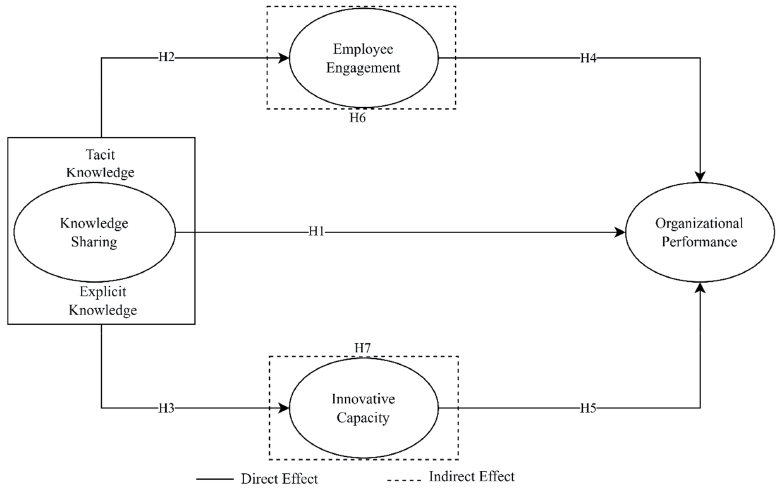
The knowledge-based perspective is the foundational theoretical underpinning for the basic propositions. KBV is based on the assumption that firms add value by integrating the knowledge bases held by individuals within the organization (Grant & Phene, 2021). This underpins H1, as the sharing of both tacit and explicit knowledge is expected to improve organizational performance. KBV is the theoretical underpinning for H2, which suggests that knowledge sharing is expected to improve employee engagement. KBV provides the theoretical foundation for H3, which suggests that knowledge sharing is the raw material for developing innovation capacity (Jordão & Novas, 2024). The mediation propositions (H6, H7) build on KBV, which suggests that knowledge alone is not sufficient to improve organizational performance. What is required is activating knowledge through the development of employee engagement and innovation capacity.
2.1.2 Dynamic Capabilities Theory. The theory of dynamic capabilities posits that organizations require specific competencies to succeed (Teece, 2007). This set of competencies allows firms to adapt to changing environmental circumstances by building, absorbing, and altering their resource configurations. Theoretically, dynamic capabilities are defined as the organization’s ability to integrate, improve, and reconfigure internal and external skills and resources (Zhang, 2022). The framework therefore bifurcates into sensing, seizing, and transforming capabilities that help organizations swiftly navigate fast-paced contexts (Osmanaj et al., 2022).
Dynamic capabilities stand as mediating mechanisms between organizational resources and performance outcomes. Innovation activities serve as the primary mediators in translating capabilities into competitive advantage (Essuman et al., 2026). Thus, this theoretical approach aligns with the current research inquiry into shifting knowledge sharing toward organizational performance. The theory suggests that the organizations with dynamic capabilities are created through a culture of knowledge sharing and employee engagement. These capabilities further develop innovative capabilities as mediators of performance outcomes. Therefore, this theory of dynamic capabilities provides the theoretical foundation for the sequential mediation processes followed in this study.
Dynamic capabilities theory underpins three major relationships in this study. First, knowledge sharing is a sensing capability that allows SMEs to recognize and utilize valuable knowledge (H1, H2, H3). The sharing of both tacit and codified knowledge enables SMEs to sense opportunities for engagement and innovation (Qader et al., 2022). Second, employee engagement is a seizing capability that allows motivated employees to utilize shared knowledge in productive activities (H4). Employees use knowledge resources to drive organizational success, linking knowledge sharing and employee engagement to organizational performance (Chaudhuri et al., 2024). Finally, innovation capacity is a transformative capability that enables SMEs to convert knowledge into new products, processes, and strategies (H5). Innovation enables SMEs to transform their resource bases to sustain competitive advantage (Wang & Zhang, 2025). The mediation effects (H6, H7) are consistent with the dynamic capabilities theory framework. Knowledge sharing is the initial process, and employee engagement and innovation are the processes that utilize knowledge for organizational success.
2.2 Knowledge Sharing
Knowledge sharing refers to the sharing of task-related information, expertise, and feedback between employees within an organization (Muhammed & Zaim, 2020). It is considered a critical process for small and medium-sized enterprises with fewer resources to capitalize on existing human resources (Soomro et al., 2025). A commonly accepted dichotomy exists between tacit and explicit knowledge (Nonaka & Takeuchi, 1995). Explicit knowledge is considered codified, structured, and easily transferable through a formal process, while tacit knowledge is considered individualized, experiential, and highly contextualized (Polanyi & Sen, 2009). However, it has been found that these modes of knowledge sharing do not function in the same way. Varghese and Rao (2024) have clearly established that both modes operate through distinct pathways to influence performance outcomes. It has been found that explicit knowledge sharing facilitates the rate of innovation, while tacit knowledge sharing facilitates the quality of innovation (Adu Sarfo et al., 2025).
The conditions for knowledge sharing vary in different organizational environments. Leadership, human resource practices, trust, and structural configurations are some factors that significantly affect knowledge sharing (Naqshbandi et al., 2024). According to Feng et al. (2025), trust is more significant for tacit knowledge sharing, whereas process standardization is more significant for explicit knowledge sharing. Similarly, structural configurations and relationship strength affect tacit knowledge sharing in firms, as noted in the study by Awada and Haj Youssef (2025). Most importantly, the amount of knowledge sharing is not significant, whereas its quality is. Dzenopoljac et al. (2025) highlighted the importance of knowledge sharing quality, noting that firms with high-quality knowledge sharing and those with low-quality knowledge sharing require entirely different configurations to ensure strong firm performance.
Knowledge sharing is affected by cultural and contextual factors. In collectivist societies, norms and power relationships may facilitate or hinder knowledge sharing (Yuan & Charoensukmongkol, 2025). In Ghana’s manufacturing industry, Aditchere et al. (2025) found that tacit knowledge acquired through partnerships helped SMEs recover from operational shocks. Fang et al. (2024) showed that both tacit and explicit knowledge sharing mediate the relationship between communication and innovation; however, this was examined in the context of high-tech industries in China. The above contextual variations raise important considerations for generalizability. Yet, relatively few studies have investigated how knowledge sharing impacts organizational outcomes via mediating factors such as innovation capacity and employee engagement, especially within SMEs of developing nations.
2.3 Organizational Performance
Organizational performance in small and medium-sized enterprises (SMEs) is often defined as a multidimensional construct that includes financial, operational, and strategic outcomes (Khalique et al., 2020). Unlike in larger corporations, SMEs often lack objective financial data, and subjective measures are more prevalent in research (Morched & Jarboui, 2021). Despite this, research has consistently and validly used subjective organizational performance indicators in emerging economies (Bodhi et al., 2025). A number of factors contribute to organizational performance in SMEs, including intellectual capital, leadership practices, and organizational learning (Khalique et al., 2020). Oh and Kim (2025) have shown that organizational learning from failures positively affects organizational recovery and performance in Korean SMEs. Another factor is organizational culture, in which employee engagement and work ethics contribute significantly to organizational performance (Morched & Jarboui, 2021). Overall, this shows that organizational performance is a function of multiple interdependent factors. A considerable body of literature has established a link between knowledge management practices and the performance of small and medium-sized enterprises (SMEs). However, the process by which this link is established has been less explored. The study by Adu Sarfo et al. (2025) found that innovation acts as a mediator in the relationship between knowledge sharing and firm performance among Ghanaian SMEs. However, little research has been done in exploring whether employee engagement and innovation act as a combined mediator in this link, a situation that is more pronounced in emerging economies.
2.4 Hypotheses Development
2.4.1 Knowledge sharing, employee engagement, innovative capacity, and organizational performance. Extensive empirical research has consistently shown that disseminating knowledge significantly improves organizational effectiveness across a wide range of sectors and settings. Raziq et al. (2024) found that knowledge sharing partially mediates the relationship between clan culture and organizational performance, whereas it fully mediates the relationship between market culture and performance outcomes. Muhammed and Zaim (2020) found that peer knowledge sharing positively influences the innovation and financial outcomes of organizations through the successful implementation of knowledge management strategies. Vătămănescu et al. (2022) found that knowledge sharing positively influences all elements of intellectual capital, with organizational performance directly dependent on innovation. These findings establish knowledge sharing as a critical driver of enhanced organizational outcomes. However, it is important to understand that the strength and nature of this relationship vary across contexts. For instance, Isa et al. (2024) found that the role of innovation capability in mediating the knowledge sharing–performance relationship is negative in the context of Indonesian batik SMEs. This is contrary to the general assumption that this relationship is positive. This implies that the nature of this relationship depends on the industry in question and the type of innovation developed.
In a different context, Erzurum et al. (2025) found that there is no direct relationship between digital knowledge sharing and performance; however, this relationship is fully mediated by innovation. This implies that knowledge sharing–performance models may be oversimplified, as the process is more complex. Qader et al. (2022) found that dynamic capabilities serve as a necessary bridge linking knowledge management practices to performance outcomes in SMEs. This implies a critical gap in understanding how knowledge sharing translates into performance outcomes. This is particularly pronounced in resource-scarce SMEs, where multiple mediating relationships may coexist. Besides mediating factors, knowledge sharing is influenced by context and culture. Yuan and Charoensukmongkol (2025) found that a collectivistic workplace moderates the relationship between political skill and knowledge sharing among faculty members. In collectivistic societies, employees are more inclined to share and are open to receiving knowledge from other members. This indicates that knowledge sharing does not occur just through structural and individual factors but also through context and culture. This supports the model by considering the context and culture of the country under consideration, especially the emerging economies with collectivistic culture.
Research demonstrates that knowledge sharing significantly enhances employee engagement through various psychological and organizational mechanisms. Atapattu and Huybers (2021) found that organizational practices, including teamwork, learning, and performance management, foster employee engagement in knowledge management. Liu et al. (2022) confirmed that organizational empowerment, leadership, and a collaborative atmosphere positively influence employee engagement in hospitality organizations. Nienaber and Martins (2020) found that organizational strategy, organizational commitment, and team commitment are significant predictors of employee engagement. Prentice et al. (2025) found significant relationships between organizational wellbeing and knowledge sharing, which, in turn, influence employee wellbeing. These studies indicate that knowledge sharing practices create conditions that enhance employee engagement levels.
Empirical evidence consistently shows that knowledge sharing enhances organizational innovation capacity through knowledge transfer and collaborative processes. Migdadi (2020) demonstrated that knowledge management processes significantly influence innovation capacity, thereby affecting organizational performance. Beltramino et al. (2020) found that knowledge management and organizational culture positively affect innovation capacity among industrial SMEs. Rumanti et al. (2022) established that innovation capacity significantly influences both financial and operational performance in Indonesian batik SMEs. Dzenopoljac et al. (2024) found that tacit knowledge sharing directly affects exploitative and exploratory capacities, and indirectly affects them through knowledge quality. These findings underscore the fundamental role of knowledge sharing in developing organizational innovation capacities. Based on the above, we thus hypothesize the following:
H1. Knowledge sharing positively affects organizational performance.
H2. Knowledge sharing positively affects employee engagement.
H3. Knowledge sharing positively affects innovation capacity.
2.4.2 Employee engagement and organizational performance. Employee engagement is a defining attribute of an organization’s strength and directly affects performance measures across industries. An investigation of the hospitality industry was undertaken by Liu et al. (2022), who observed that engagement, on the employee side, is manifested in improvements in outcomes at both the individual and organizational levels; engaged employees are found to foster cultures of innovation for organizational success. Opoku and Boateng (2024) have shown that work engagement matters significantly for job performance among medical staff, emphasizing a strong positive correlation between engagement levels and performance outcomes. Nienaber and Martins (2020) revealed that employee engagement serves as a driver of strategy implementation, closing performance gaps and increasing organizational effectiveness through higher productivity and lower costs of disengaged employees. Farzana and Charoensukmongkol (2024) and Charoensukmongkol (2024) demonstrated that transformational leadership enhances employee engagement through psychological empowerment, with this effect varying across cultural contexts. Their cross-cultural findings suggest that the mechanisms driving engagement are shaped by power distance and cultural norms, not just organizational practices. In line with Vujko et al.’s (2022) notion, employee engagement, in proportion to organizational performance, engenders feelings of belonging and gratitude among employees, which in turn increases efficiency and productivity. Employee engagement, according to Atapattu and Huybers (2021), has a significant bearing on organizational knowledge management performance and, consequently, leads to better organizational performance. Conversely, further confirmation of the assertion comes from Beltrán-Martín et al. (2022), who show that work engagement also enhances employees’ performance and the organization’s success, making it an excellent measure of workplace wellbeing and productivity. Thus, we hypothesize that:
H4. Employee engagement positively affects organizational performance.
2.4.3 Innovation capacity and organizational performance. Innovation capacity represents a fundamental organizational resource that directly influences performance outcomes across various industry contexts. Jirawuttinunt et al. (2024) examined the mediating role of organizational innovation capacity in the relationship between disruptive innovation and organizational performance among Thai-listed firms, where the former may confer competitive advantage through technological or market disruptions. Meanwhile, AlTaweel and Al-Hawary (2021) found that innovation capacity had a remarkable mediating effect on the relationship between the strategic agility pathway and performance outcomes, suggesting that, through innovation capacity, organizations remain adept at responding to environmental shifts. Similarly, Migdadi (2020) found that innovation capacity positively affects organizational performance, with knowledge management processes influencing performance through this capacity as a mediator.
Beltramino et al. (2020) found a positive and significant relationship between innovation capacity in processes and organizational performance among industrial SMEs, highlighting that enhanced innovation capacity contributes to improved competitiveness. Luna‐Arocas (2023) found that innovation serves as a full mediating variable, accounting for the entire variance in the relationship between talent management and organizational performance. Additionally, Rumanti et al. (2022) demonstrated that innovation capacity significantly influences both financial and operational performance in SMEs, particularly during challenging environments such as the COVID-19 pandemic. Thus, we hypothesize that:
H5. Innovation capacity positively affects organizational performance.
2.3.4 Mediating role of employee engagement and innovative capacity. There are several ways in which knowledge sharing creates organizational value. Absorptive capacity is a mediator between culture focused on knowledge and organizational performance (Ajmal et al., 2025), as well as between intellectual capital and organizational performance in change management (Rooney et al., 2023). Organizational learning is a mediator between knowledge sharing and organizational performance (Naqshbandi et al., 2024). Social capital is a mediator focusing on trust and network relationships in knowledge sharing (Imani et al., 2025).
Although these mechanisms are important, this research has identified employee engagement and innovation capacity as the mediating factors of interest for three primary considerations. Firstly, these mediating factors align with the logic of dynamic capabilities theory employed in this research; specifically, employee engagement represents the conversion of knowledge into action, whereas innovation capacity represents the conversion of knowledge into new forms of process and product. Secondly, for many organizations operating within SMEs in emerging economies, formalized systems necessary for absorptive capacity and/or organizational learning are absent; as such, these mediating factors are more relevant and accessible to these organizations (Fabrizio et al., 2022). Thirdly, whereas previous research has considered each of these mediating factors individually, they have not been examined within a single model. By examining these mediating factors simultaneously, it is possible to assess their potency and thereby address the need for integrated mediation models within knowledge management research.
Employee engagement is an organizational capacity that is essential for gaining and maintaining a competitive advantage in today’s marketplace (Escribá-Carda et al., 2023). Organizations use employee engagement through knowledge sharing performance to foster work dedication, motivation, and innovative behaviors to improve organizational operations and performance outcomes (Khan et al., 2024; Lee & Song, 2020). Knowledge sharing fosters employee engagement, which can positively affect organizational performance by enhancing commitment and productivity (Harshani et al., 2024). With technological upgrades occurring at a rapid pace in the ever-changing business environment, employee engagement has been considered necessary for organizational survival and competitive positioning (Naim et al., 2024). Practitioners in strategic management have made it clear that employee engagement is a foundation for sustainable competitive advantage (Khalil et al., 2021). Likewise, innovation capacity, an important organizational resource, mediates the relationship between knowledge sharing and performance (Dongling et al., 2022). Knowledge sharing stimulates innovation capacity and thereby promotes organizational performance by enhancing products and services or improving operational efficiency (Oliveira et al., 2020; Yuen & Lam, 2024). In this way, both employee engagement and innovation capacity act as key mediating mechanisms in the knowledge sharing and performance relationship.
Previous research has mainly examined each of these variables in isolation. Fatima and Masood (2024) employed a serial model in which knowledge sharing is a precursor to innovation capability, which, in turn, is a precursor to open innovation. Another study by Erzurum et al. (2025) established that innovation fully mediated the relationship between digital knowledge sharing and organizational performance, but did not test engagement as a parallel mediator. Afriyie et al. (2020) examined knowledge sharing as a singular mediator of the relationship between innovation and marketing performance in Ghana. A common limitation of these studies is that mediation is treated as a unidirectional process, with innovation and engagement treated in isolation within a single model. Therefore, it is not clear whether the two processes are independent, whether one explains more of the variance than the other, or whether they are distinct theoretical processes. The proposed model seeks to fill this research gap by considering employee engagement and innovation capacity as parallel processes that mediate the relationship between knowledge sharing (KNS) and operational performance (ORP), both of which are underpinned by the knowledge-based view (KBV) and the theory of dynamic capabilities, respectively. This is a process that has yet to be explored in the existing SME research in emerging economies. Therefore, the following hypotheses are proposed:
H6. Employee engagement mediates the relationship between knowledge sharing and organizational performance.
H7. Innovation capacity mediates the relationship between knowledge sharing and organizational performance.
2.5 Conceptual Model
Figure 1
Conceptual Framework
3. Methods
3.1 Study Design and Context
The Ghanaian context, considered an exemplary setting for understanding knowledge sharing dynamics and organizational performance relationships, is one in which SMEs operate in turbulent market conditions, with inadequate infrastructure and a complex regulatory framework (Aduhene & Osei-Assibey, 2021). There has been a significant digital transformation in Ghana, and integration into international markets is being fully realized, thereby creating new opportunities for knowledge-intensive activities (Akanyonge et al., 2023). It is in this mix of constraints and opportunities that Ghana presents a new and exciting prospect to study the mechanisms of KNS translation into ORP processes in emerging economies. Ghana’s economy is predominantly SME-based, with over 90% of businesses being classified as small and medium enterprises (Sidek et al., 2020). These organizations rely on informal knowledge management systems and may be under increasing pressure to innovate and compete. The country, through the Digital Ghana Agenda, emphasizes knowledge-based economic development. Understanding how TAK and EXK sharing enhances EEN and INC becomes crucial for organizational success. Quantitative research design in the form of a cross-sectional survey is adopted for the study. It allows one to look into the relationships of constructs of KNS for ORP variables.
3.2 Sample and Data Collection
Data were collected from SME owners and managers in Accra, Kumasi, and Takoradi — Ghana’s three major commercial hubs — through stratified random sampling. A total of 500 questionnaires were administered, out of which 347 were completed and usable for analysis. The study targeted SMEs operating for at least 3 years to enable a meaningful evaluation of KNS and ORP outcomes. This sample represented the manufacturing, retail, service, and technology sectors and characterized the diversity of Ghanaian SMEs and their knowledge management practices.
3.3 Measures
The measurement items for this study were adapted from established literature to ensure content validity. TAK was measured using a 5-item scale adapted from Williams et al. (2019) to capture knowledge embedded in experience and intuition. EXK comprised a 5-item scale from Maie and DeKeyser (2019) assessing codified and documented knowledge. EEN was operationalized using a 6-item scale adapted from Boccoli et al. (2022) and Suh et al. (2022) to measure employee involvement and dedication. INC aimed to assess organizational innovation capacity using a 7-item scale developed by Baxter and Chipulu (2023) and Kroh et al. (2024). Finally, ORP was measured using an 8-item scale adapted from Colbran et al. (2019) that captures financial and operational performance outcomes. While self-reported perceptual measures of performance may be subject to inflation and subjectivity, this approach is widely adopted in SME research where objective financial data is often unavailable or unreliable (Wallet al., 2004). Prior research has demonstrated acceptable correspondence between subjective and objective performance indicators in SME contexts. All constructs were rated on a 5-point Likert scale ranging from 1 (strongly disagree) to 5 (strongly agree).
3.4 Analytical Approach
The study model was examined using PLS-SEM (Smart PLS version 4.0) due to its predictive capabilities and its effectiveness in handling complex models with mediating relationships. PLS-SEM was chosen over covariance-based SEM (CB-SEM) for several methodological reasons. First, because of the model’s higher-order formative construct and mediation relationship, knowledge sharing is better managed by PLS-SEM (Hair et al., 2019). Second, it is better suited to prediction-oriented studies, which often involve complex models and multiple mediators (Sarstedt et al., 2022). Finally, it performs better even when sample sizes are relatively small compared to model complexity and normality is not a prerequisite (Hair & Alamer, 2022). While using PLS-SEM, it was noted that it is not completely free of limitations, including parameter bias when sample sizes are relatively small and its less effectiveness in confirmatory theory testing compared to CB-SEM (Rigdon, 2016).
A repeated indicators approach was employed, in which KNS was conceptualized as a two-dimensional construct, with TAK and EXK as formative indicators. The analysis employed a two-stage approach to validate the structural associations among KNS, EEN, INC, and ORP constructs. First, the measurement model assessment examined the reliability and validity of all constructs. Internal consistency was evaluated through Cronbach’s alpha (α > 0.7) and composite reliability (CR > 0.7) as recommended by Fornell and Larcker (1981). Convergent validity was assessed using average variance extracted (AVE > 0.5), while discriminant validity was confirmed through heterotrait-monotrait (HTMT) criterion with a threshold of 0.85 (Henseler et al., 2015). Second, the structural model assessment examined path coefficients (β) and t-statistics using bootstrapping with 10,000 resamples to test hypothesized relationships. Model quality was evaluated through predictive relevance (Q² > 0), coefficient of determination (R²), and effect sizes (f²) at thresholds of 0.02, 0.15, and 0.35 representing small, medium, and large effects, respectively (Cohen, 1988).
3.5 Common Method Bias (CMB)
Following established protocols, Harman’s single-factor test was performed by loading all variables into exploratory factor analysis. The unrotated factor solution was examined to assess CMB concerns (Podsakoff et al., 2003). The initial factor accounted for only 34.1% of the total variance explained, below the 50% threshold. This result indicates that no single factor accounts for most of the variance in the data. The finding provides evidence that CMB is not a major concern in this study (Kock, 2020). The researchers addressed this issue through ex-ante procedural remedies by using reverse-scored items during data collection. These items ensured respondents read questions carefully rather than providing automatic responses (MacKenzie & Podsakoff, 2012). Proximal and psychological separation of predictor and criterion variables was maintained in the survey design. Respondent anonymity was also preserved to reduce evaluation concerns and social desirability bias (see Appendix). Additionally, a full collinearity VIF assessment was conducted in accordance with Kock (2015). All VIF values ranged from 1.000 to 1.686, well below the 3.3 threshold, confirming that common method variance is not a concern in this study (Anipa et al., 2025; Karikari et al., 2025; Kock, 2015).
4. Results
4.1 Descriptive Statistics
Table 1 presents the descriptive statistics and correlation matrix for all study constructs. The mean scores across all variables ranged from 2.966 to 3.191 on the 5-point Likert scale, indicating moderate levels of agreement among respondents. ORP exhibited the highest mean value (M = 3.191, SD = 0.838), while tacit TAK displayed the lowest mean score (M = 2.966, SD = 0.944). EXK recorded a mean of 3.025 (SD = 0.909), EEN showed a mean of 3.113 (SD = 0.951), and INC demonstrated a mean of 3.106 (SD = 0.880). The standard deviations across all constructs were relatively consistent, ranging from 0.838 to 0.951, suggesting acceptable variability in responses. Normality assessment revealed skewness values ranging from -0.159 to -0.010, all within acceptable thresholds of ±2.0 (Pek et al., 2018). Kurtosis values ranged from -0.462 to -0.862. Correlation analysis demonstrated significant positive relationships among all study variables, with coefficients ranging from 0.345 to 0.654. The strongest relation was observed between innovation capacity and organizational performance (r = 0.654), whereas the weakest relation fell between tacit knowledge sharing and employee engagement (r = 0.345).
Table 1
Descriptive and Correlation Analysis
|
Construct |
Mean |
SD |
Skewness |
Kurtosis |
TAK |
EXK |
EEN |
INC |
ORP |
|---|---|---|---|---|---|---|---|---|---|
|
TAK |
2.966 |
0.944 |
-0.020 |
-0.696 |
1.000 |
||||
|
EXK |
3.025 |
0.909 |
-0.013 |
-0.721 |
0.482 |
1.000 |
|||
|
EEN |
3.113 |
0.951 |
-0.139 |
-0.862 |
0.345 |
0.380 |
1.000 |
||
|
INC |
3.106 |
0.88 |
-0.159 |
-0.462 |
0.375 |
0.459 |
0.575 |
1.000 |
|
|
ORP |
3.191 |
0.838 |
-0.01 |
-0.546 |
0.375 |
0.487 |
0.595 |
0.654 |
1.000 |
4.2 Measurement Model
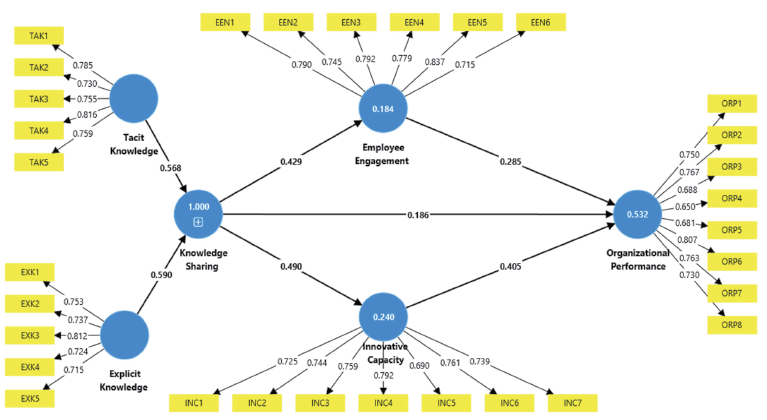
4.2.1 Indicator reliability. Indicator reliability within the measurement model was estimated through factor loading. In PLS-SEM, factor loadings are standardized regression weights, and the squared loadings serve as an estimated indicator of reliability (Hair et al., 2019). Benitez et al. (2020) assert that factor loadings must be higher than the value of 0.708 to ensure adequate reliability, which means that ideally, more than 50% of an indicator’s variance is accounted for by the latent variable to which it is associated (Hair et al., 2019).
As indicated in Figure 2, the factor loadings, generally exceeded the limit in each case. Across the entire study, factor loadings ranged from 0.601 to 0.837. For the most part, all indicators exceeded the 0.708 thresholds; however, a few items showed slightly lower values. Specifically, EXK4 (0.601), TAK2 (0.580), and TAK3 (0.609) were below the cut-off value. These items were retained because the composite reliability and average variance extracted for their corresponding constructs were both within accepted standards (Garson, 2016). Retaining these indicators maintained content validity and did not compromise the quality of the overall measurement model (Hair et al., 2019).
Figure 2
Indicator Loadings
4.2.2 Construct reliability assessment. Construct reliability was evaluated using Cronbach’s alpha and composite reliability (CR) measures (Hair et al., 2020). As shown in Table 2, all constructs demonstrated adequate reliability, exceeding the threshold of 0.70. Furthermore, Cronbach’s alphas ranged from 0.804 to 0.875, and composite reliability ranged from 0.864 to 0.901. These findings provide evidence that all constructs met an acceptable standard for inclusion as internal reliability measures.
4.2.3 Construct validity assessment. The study’s validity evaluation was conducted in two distinct phases. Initially, convergent validity was evaluated using Average Variance Extracted (AVE) values for each lower-order construct. The derived values surpassed the suggested minimum benchmark of 0.5 (Hair et al., 2020). The AVE scores, which ranged from 0.534 to 0.604 among all constructs, are reflected in Table 2. These results indicate that each construct accounts for at least 50% of the variance in its indicators (Garson, 2016). Also, the criterion of discriminant validity was checked using the heterotrait-monotrait ratio of correlations (Henseler et al., 2015). All HTMT ratios fall below the stricter 0.85 criterion, with the highest, 0.752, between INC and ORP.
Table 2
Reliability and Validity Results
|
Criteria |
EEN |
EXK |
INC |
ORP |
TAK |
|---|---|---|---|---|---|
|
Cronbach’s alpha |
0.868 |
0.804 |
0.866 |
0.875 |
0.828 |
|
Composite |
0.901 |
0.864 |
0.897 |
0.901 |
0.879 |
|
AVE |
0.604 |
0.561 |
0.555 |
0.534 |
0.592 |
|
Heterotrait-monotrait (HTMT) ratio |
|||||
|
1 |
2 |
3 |
4 |
5 |
|
|
1. EEN |
- |
- |
- |
- |
- |
|
2. EXK |
0.454 |
- |
- |
- |
- |
|
3. INC |
0.664 |
0.552 |
- |
- |
- |
|
4. ORP |
0.682 |
0.579 |
0.752 |
|
- |
|
5. TAK |
0.404 |
0.590 |
0.443 |
0.439 |
- |
|
Fornell-Lacker Criterion |
|||||
|
Constructs |
1 |
2 |
3 |
4 |
5 |
|
1. EEN |
0.777 |
- |
- |
- |
- |
|
2. EXK |
0.385 |
0.749 |
- |
- |
- |
|
3. INC |
0.579 |
0.463 |
0.745 |
- |
- |
|
4. ORP |
0.599 |
0.489 |
0.661 |
0.731 |
- |
|
5. TAK |
0.352 |
0.491 |
0.379 |
0.381 |
0.769 |
Note. Bold values indicate HTMT ratios; values in square brackets show the 95% biased corrected confidence interval bounds. Bold diagonal values (Fornell-Lacker criterion) are square roots of AVEs; off-diagonal values show construct correlations.
4.3 Structural Model
4.3.1 Collinearity assessment. Collinearity was assessed using Variance Inflation Factors (VIFs) to examine potential multicollinearity. VIF values were evaluated for all predictor constructs in relation to their respective endogenous variables. As presented in Table 3, all VIF values ranged from 1.000 to 1.686, well below the conservative threshold of 3.33 (Ringle et al., 2020). The highest VIF value was 1.686 for INC in predicting ORP. These results indicate that multicollinearity is not a concern in the structural model (Hair et al., 2019). The low VIF values confirm that the predictor constructs are sufficiently distinct and do not exhibit problematic correlations.
4.3.2 Coefficient of Determination (R2). The R² indicates the explanatory power of the structural model (Hair et al., 2019). According to Chin (1998), R² values below 0.19 signify weak explanatory power, those from 0.19 to0.33 indicate moderate power, while those above 0.33 signify great explanatory power. Table 3 shows that the R² values for the endogenous constructs were 0.532 for ORP, 0.240 for INC, and 0.184 for EEN. These values yielded explanatory power of 53.2% for organizational performance, 24.0% for innovation capacity, and 18.4% for employee engagement, respectively. The R² value for ORP exhibits substantial explanatory power, whereas INC and EEN are of moderate determination.
4.3.3 Predictive relevance (Q2). Predictive relevance was assessed using the Stone-Geisser Q² criterion through a blindfolding procedure (Stone, 1974). Q² values greater than zero indicate that the model has predictive relevance for the respective endogenous construct (Anipa et al., 2025). As presented in Table 3, all Q² values were positive, confirming predictive relevance. The Q² values were 0.251 for ORP, 0.234 for INC, and 0.177 for EEN. These results demonstrate that the structural model possesses adequate predictive power for all endogenous constructs.
4.3.4 The effect size (f2). The effect size (f²) was used to assess the practical relevance of each predictor construct for the endogenous variables (García-Milon et al., 2021). According to Cohen’s (1988) framework, f² values of 0.02, 0.15, and 0.35 indicate small, medium, and large effect sizes, respectively. As indicated in Table 3, KNS exhibited a small effect on ORP (f² = 0.054). Additionally, KNS had a medium effect on both EEN (f² = 0.225) and INC (f² = 0.315). Likewise, EEN displayed a medium effect on ORP (f² = 0.111), while INC also demonstrated a medium effect on ORP (f² = 0.208). These findings suggest that the predictor constructs possess substantial practical significance in elucidating the variance within their corresponding endogenous constructs.
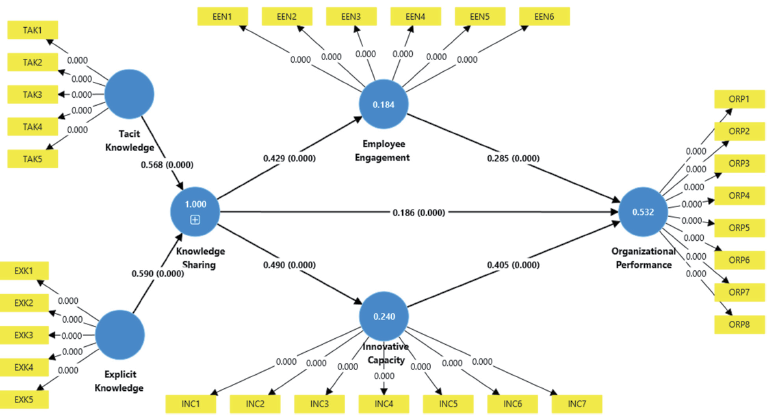
4.3.5 Hypotheses Testing. Hypotheses testing was conducted using a bootstrapping procedure with 10,000 subsamples to assess the significance of path coefficients (Hair & Alamer, 2022). The strctural model results are presented in Table 3, while Figure 3 illustrates the structural model with significance levels. All five hypotheses were supported at the p < 0.001 level. The results demonstrate that KNS has a significant positive effect on ORP (β = 0.186, t = 4.780, p < 0.001), supporting H1. KNS significantly influences EEN (β = 0.429, t = 10.089, p < 0.001), confirming H2. Similarly, KNS positively affects INC (β = 0.490, t = 12.123, p < 0.001), supporting H3. EEN shows a significant positive relationship with ORP (β = 0.285, t = 6.471, p < 0.001), supporting H4. Finally, INC significantly impacts ORP (β = 0.405, t = 8.916, p < 0.001), confirming H5. These findings validate all proposed direct relationships in the conceptual model.
Table 3
Structural Model Results
|
Hypotheses |
β |
SD |
T statistics |
Supported |
f2 |
Decision |
VIF |
|
|---|---|---|---|---|---|---|---|---|
|
H1 |
KNS -> ORP |
0.186*** |
0.039 |
4.780 |
Yes |
0.054 |
Small |
1.373 |
|
H2 |
KNS -> EEN |
0.429*** |
0.043 |
10.089 |
Yes |
0.225 |
Medium |
1.000 |
|
H3 |
KNS -> INC |
0.490*** |
0.040 |
12.123 |
Yes |
0.315 |
Medium |
1.000 |
|
H4 |
EEN -> ORP |
0.285*** |
0.044 |
6.471 |
Yes |
0.111 |
Medium |
1.570 |
|
H5 |
INC -> ORP |
0.405*** |
0.045 |
8.916 |
Yes |
0.208 |
Medium |
1.686 |
|
Constructs |
R2 |
R2 |
Q2 |
|||||
|
EEN |
0.184 |
0.181 |
0.177 |
|||||
|
INC |
0.240 |
0.238 |
0.234 |
|||||
|
ORP |
0.532 |
0.528 |
0.251 |
|||||
Note. β = Coefficient estimate; SD = Standard deviation; VIF = Variance inflation factor; *p < 0.05; **p < 0.01; ***p < 0.001.
Figure 3
Structural Diagram (Including p-values and t-statistics)
4.3.6 Mediation Analysis. A mediation analysis was conducted to examine the indirect effects of KNS on ORP via EEN and INC. The analysis employed a bootstrapping procedure with 10,000 samples to generate bias-corrected confidence intervals (Aguirre-Urreta & Rönkkö, 2018). As presented in Table 4, both mediation hypotheses were supported. The indirect effect of KNS on ORP through EEN was significant (β = 0.122, t = 5.407, p < 0.001), with confidence intervals excluding zero (CI: 0.081, 0.170), supporting H6. Similarly, the indirect effect of KNS on ORP through INC was significant (β = 0.198, t = 6.998, p < 0.001), with confidence intervals not containing zero (CI: 0.145, 0.255), confirming H7. These results demonstrate that both EEN and INC serve as significant mediators in the relationship between KNS and ORP. The mediation effects indicate that knowledge sharing enhances organizational performance through improved employee engagement and innovation capacity.
Table 4
Mediation Test Analysis Results
|
Bias-corrected 97.5% CI |
|||||||
|---|---|---|---|---|---|---|---|
|
Hypotheses |
Beta |
SD |
T statistics |
Lower |
Upper |
Decision |
|
|
H6 |
KNS → EEN → ORP |
0.122*** |
0.023 |
5.407 |
0.081 |
0.170 |
Yes |
|
H7 |
KNS → INC → ORP |
0.198*** |
0.028 |
6.998 |
0.145 |
0.255 |
Yes |
Note. CI = confidence interval, bootstrapping with 10,000 samples; *p < 0.05; **p < 0.01; ***p < 0.001.
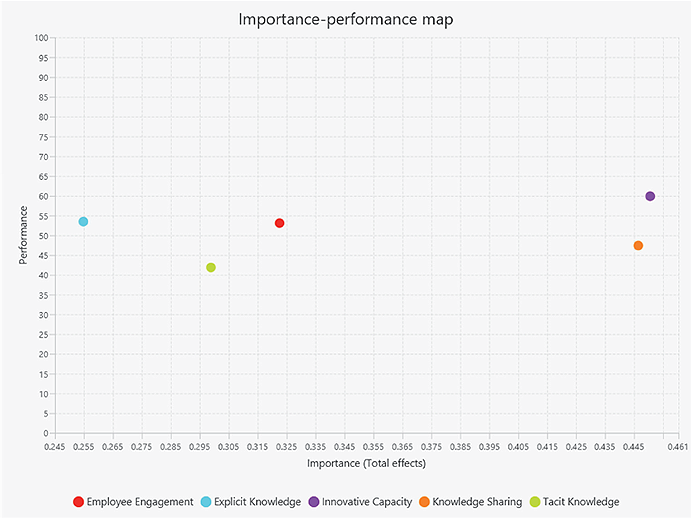
4.3.7 Performance analysis. The importance–performance map analysis (IPMA) was conducted to identify the relative importance and performance of constructs in predicting ORP. As illustrated in Figure 4, the analysis reveals the positioning of each construct based on total effects and performance scores. INC demonstrates the highest importance (0.451) with high performance (60.2), positioning it as a key ORP driver. KNS shows moderate importance (0.436) with moderate performance (47.8), indicating improvement potential. EEN exhibits moderate importance (0.323) with high performance (53.7), suggesting efficient utilization. EXK shows lower importance (0.256) and moderate performance (54.9), while TAK shows moderate importance (0.295) and lower performance (42.1). These findings suggest organizations should prioritize enhancing INC and KNS practices to maximize ORP outcomes.
Figure 4
IPMA (Constructs)
5. Discussion
Organizational excellence in emerging economies rests on an understanding of how firms use knowledge assets, employee capacities, and innovation mechanisms to achieve sustainable performance outcomes. This study investigated the relationships between KNS, EEN, INC, and ORP in Ghanaian SMEs. It further examined the dual mediating effects of EEN and INC to fill critical knowledge gaps in the dynamics of performance enhancement in resource-limited environments. The findings provide strong empirical support for establishing the direct effects of KNS on organizational outcomes. Hypothesis one (H1) is accepted, which means that KNS do, indeed, augment positively and significantly the ORP in Ghanaian SMEs. The result is consistent with other studies, indicating that KNS is critical for enhancing strategic capacities (Raziq et al., 2024). This positive link aligns with the knowledge-based view that knowledge is the most valuable strategic resource for organizations (Teece, 2007). In a similar vein, Muhammed and Zaim (2020) have shown that peer KNS positively affects innovation and financial performance. However, this direct effect should be interpreted with nuance. Erzurum et al. (2025) found no direct link between digital knowledge sharing and performance, with innovation fully mediating the relationship. This suggests that the direct KNS–ORP path observed here may partly reflect Ghana’s relational business culture, where knowledge exchange yields more immediate operational benefits. Nonetheless, the reliance on managerial self-reports for organizational performance warrants cautious interpretation of these effect sizes. The observed relationships may partly reflect perceptual consistency rather than objective performance differences.
The second hypothesis (H2) was also accepted, thus showing that KNS positively influenced EEN among SME employees. This strong association indicates that knowledge sharing practices create psychological conditions that enhance employee involvement and dedication. Such findings support the evidence presented by Atapattu and Huybers (2021), which shows that organizational practices foster employee knowledge management engagement. Liu et al. (2022) similarly established that collegial environments positively affected EEN within organizations. Farzana and Charoensukmongkol (2024) further showed that leadership-driven empowerment strengthens employee engagement, reinforcing the notion that KNS operates through psychological mechanisms.
In support of H3, it was shown that KNS has a significant positive impact on SME innovative capacities. Thus, in emerging contexts like Ghana, where SMEs face severe resource constraints and limited access to advanced technologies, knowledge sharing constitutes a primary means of building innovative capacities without requiring large capital investments. The finding aligns with Migdadi (2020), who asserts that knowledge management processes importantly affect innovative capacities. Likewise, Beltramino et al. (2020) also established the positive effects of knowledge management on INC among SMEs. Adu Sarfo et al. (2025), working within the same Ghanaian SME context, similarly confirmed that both tacit and explicit knowledge sharing enhances innovation outcomes. This cross-study consistency within Ghana strengthens the contextual validity of the present findings.
The study confirms significant positive relationships between both mediating variables and ORP in Ghanaian SMEs. H4 was supported, demonstrating that EEN significantly enhances ORP across the examined organizations. This finding validates the critical role of engaged employees in driving organizational success and competitiveness. The result aligns with Liu et al. (2022), who found that EEN improves performance outcomes at the individual and organizational levels. Opoku and Boateng (2024) similarly showed that work engagement significantly correlates with job performance among medical staff. The positive relationship supports theoretical assertions that engaged employees foster innovation cultures and organizational effectiveness. Nienaber and Martins (2020) found that EEN drives strategy implementation and organizational effectiveness. Vujko et al. (2022) demonstrated that EEN engenders feelings of belongingness, translating into increased efficiency and productivity. H5 received strong support, confirming that INC significantly influences ORP in the SME context. This relationship underscores the fundamental role of innovation as an organizational resource driving competitive advantage and performance outcomes. The finding corroborates Jirawuttinunt et al. (2024), who demonstrated INC’s vital mediating role between disruptive innovation and ORP. Notably, INC exhibited a stronger effect on ORP than EEN across the structural model. This pattern is consistent with dynamic capabilities theory, which positions innovation as the primary mechanism through which firms convert resources into competitive outcomes (Fabrizio et al., 2022). In contrast, employee engagement operates through slower, cumulative psychological processes that take time to translate into measurable performance. For resource-constrained SMEs in Ghana, innovation offers a more direct and tangible route to performance improvement than attitudinal shifts alone.
The study provides strong support for both mediation relationships proposed in the KNS–ORP linkage, thereby supporting H6, which states that EEN significantly mediates between KNS and ORP. This finding demonstrates how KNS promotes ORP through mechanisms of employee involvement and employee dedication. The mediation supports prior assumptions that knowledge sharing practices tend to develop a psychological condition within the organization that fosters effectiveness. This result serves as a confirmation of the assertion of Khan et al. (2024), where they established the mediating role of EEN between knowledge–performance relationships. So, it looks like H7 is statistically supported, implying that INC mediates the KNS–ORP relationship significantly within SME contexts. This mediation means that KNS is translated into performance outcomes through the development of organizational innovation capacities. This finding corroborates Migdadi (2020), who concluded that INC serves as a mediator between knowledge management processes and ORP. The stronger mediating effect of INC relative to EEN further supports our theoretical framing. From a KBV perspective, knowledge sharing creates value when converted into organizational-level capabilities rather than individual-level states. Innovation capacity represents such a capability, whereas engagement remains an individual psychological condition. This distinction helps explain the differential mediation strengths observed and aligns with Dzenopoljac et al. (2025), who found that capability configurations matter more than individual factors for SME performance.
6. Conclusion
The present study aims to explore the relationship between knowledge sharing and organizational performance in Ghanaian SMEs, mediated by two variables. The results of this study do not support a straightforward relationship between knowledge sharing and organizational performance; instead, employee engagement and innovation act as separate mediating variables in this process. Most notably, innovation capacity was found to be a more significant mediating factor than employee engagement. This indicates that the value added by knowledge sharing is maximized through the innovation process. This finding refutes the notion that knowledge sharing is advantageous for organizational performance through a single process. Rather, SMEs need to understand the various processes that maximize knowledge sharing. By restructuring their knowledge-based capabilities, SMEs can leverage scarce resources to enhance their competitive advantage in emerging markets.
6.1 Theoretical Implications
The study argued that productively sharing knowledge in an emerging economy strengthens the process of enrichment in the knowledge-based view debate and dynamic capabilities theory. Thus, by employing PLS-SEM to examine dual mediation mechanisms in Ghana’s SME sector, we provide nuanced insights that enrich the broader discourse on knowledge management in resource-constrained environments. The study demonstrates how knowledge sharing mechanisms interact differently with organizational capabilities to attain performance outcomes. We show that internal resources, such as tacit and explicit knowledge sharing, are critical for performance enhancement despite limited technological infrastructure and weak institutional frameworks. Furthermore, this study challenges prevailing assumptions that knowledge sharing directly contributes to performance outcomes without intermediate mechanisms. By this, we extend the knowledge-based view, highlighting that knowledge resources operate through complex pathways in emerging economies.
Additionally, our study bridges a knowledge management and organizational behavior literature gap by conceptualizing employee engagement and innovation capacity as sequential mediating mechanisms between knowledge sharing and performance outcomes. This integration is important because it responds to calls for understanding how knowledge transformation facilitates the achievement of organizational performance objectives in emerging-economy SMEs. Also, recognizing that both employee engagement and innovation capacity mediate the knowledge sharing–performance relationship deepens theoretical understanding of the contextual factors that enable the effectiveness of knowledge utilization. Again, these insights challenge the universalistic application of knowledge management theories to emerging economies and suggest important boundary conditions for existing performance management frameworks.
More particularly, the study fills a gap in the literature concerning the lack of dual mediation in SMEs in the context of emerging economies. In earlier studies, employee engagement and innovation capacity were explored in isolation, but our model shows their relative contributions to one another. In our study, innovation capacity was found to be the stronger mediator, implying its relative importance in knowledge transformation through innovation mechanisms.
6.2 Managerial and Policy Implications
Our findings provide actionable insights for SME managers to enhance organizational performance through effective knowledge management. First, business leaders in Ghana’s SME sector should prioritize establishing robust knowledge sharing mechanisms to align with best practices. For example, knowledge management committees may facilitate effective knowledge transfer by integrating employee training programs, innovation workshops, and cross-functional collaboration initiatives. More importantly, the knowledge sharing mechanisms will ensure that tacit and explicit knowledge are properly integrated into broader organizational decision-making processes rather than operating in isolation.
By establishing links between knowledge sharing and performance outcomes through employee engagement and innovation capacity, the study urges SME executives to invest in human resource practices that enhance organizational effectiveness. We suggest that SME firms prioritize employee development programs that enhance knowledge transfer capacities and foster collaborative workplace cultures. Given the resource constraints faced by SMEs in emerging economies, we propose implementing these knowledge management practices in phases, beginning with basic knowledge sharing platforms and progressing to more sophisticated innovation management systems. Before making a physical investment in knowledge management solutions, business leaders should promote workplace cultures that support knowledge sharing behaviors.
It is also noteworthy that policymakers, in designing knowledge economy strategies, should take into account the stronger mediating effect of innovation capacity. This implies that innovation infrastructure and employee development should be the focus of government interventions in SMEs to achieve the maximum return on investments in knowledge sharing in the context of emerging markets.
6.3 Limitations and Ideas for Future Research
This study, like others, is not without limitations. For example, SME managers’ self-reported measures of organizational performance may be biased. Therefore, future studies should incorporate more objective performance data from financial records to verify results. Additionally, employee perspectives should be sought to assess whether they align with managers’ viewpoints on knowledge sharing practices. Also, our study was limited to the SME sector, hence limiting the generalizability of results to larger organizations in Ghana. Future research should explore and compare data from multinational corporations and public sector organizations. This would help expand our understanding of specific contextual factors that influence knowledge management in different organizational contexts. Although this study examined employee engagement and innovation capacity as mediators, other possible mediating effects were not tested. Further studies can test other possible mediating effects such as absorptive capacity, learning capacity, and social capital.
Furthermore, the contextual and cultural influences on knowledge sharing behaviors were not tested in this study. These pathways may provide additional insights into how knowledge sharing translates into performance outcomes. Further studies can test cultural or contextual influences as moderators of the knowledge sharing model, particularly in collectivistic and emerging-economy contexts. Lastly, the cross-sectional and single-country study design limits the generalizability of our findings to emerging economies. Claims about the emerging-economy implications of our findings must therefore be viewed with caution. Future studies can use longitudinal and multi-country designs to provide stronger evidence of causal effects across contexts.
References
Aditchere, J., Zokpe, D., Dery, B. N., & Mohammad, I. (2025). Learning in silence: How tacit knowledge and alliances enable recovery among emerging market SMEs. Journal of Strategy and Management, 1–23. https://doi.org/10.1108/JSMA-10-2025-0385
Adu Sarfo, P., Zhang, J., Wauk, G., Nyantakyi, G., Amankwah, O., & Lassey, F. Ak. (2025). Exploring the mediation role of innovation in the nexus between knowledge–sharing and firm performance. Journal of Business & Industrial Marketing, 40(8), 1736–1757. https://doi.org/10.1108/JBIM-07-2023-0409
Aduhene, D. T., & Osei-Assibey, E. (2021). Socio-economic impact of COVID-19 on Ghana’s economy: challenges and prospects. International Journal of Social Economics, 48(4), 543–556.
Afriyie, S., Du, J., & Ibn Musah, A.-A. (2020). The nexus among innovation types, knowledge sharing, transformational leadership, and marketing performance in an emerging economy. Journal of Indian Business Research, 12(4), 529–548. https://doi.org/10.1108/JIBR-03-2019-0082
Aguirre-Urreta, M. I., & Rönkkö, M. (2018). Statistical inference with PLSc using bootstrap confidence intervals. MIS Quarterly, 42(3), 1001-A10.
Akanyonge, J., Obeng-Amponsah, W., & Owusu, E. L. (2023). Financial Development and SMEs in African Countries. In Finance for Sustainable Development in Africa (pp. 252–276). Routledge.
AlTaweel, I. R., & Al-Hawary, S. I. (2021). The mediating role of innovation capability on the relationship between strategic agility and organizational performance. Sustainability, 13(14), 7564. https://doi.org/https://www.mdpi.com/2071-1050/13/14/7564
Anipa, C. A. A., Karikari, F. A., Boateng, S. A., Fumey, M. P., Essuman, A. N., Baidoo, M. I., Assan, P. D., & Kusi, L. Y. (2025). Access to finance, financial management, and growth of non-traditional export firms in Ghana: Does sector difference count? Scientific African, 28, e02706. https://doi.org/10.1016/j.sciaf.2025.e02706
Argote, L. (2023). Knowledge Transfer Within Organizations: Mechanisms, Motivation, and Consideration. Annual Review of Psychology, 75(1). https://doi.org/10.1146/annurev-psych-022123-105424
Arsawan, I. W. E., Koval, V., Rajiani, I., Rustiarini, N. W., Supartha, W. G., & Suryantini, N. P. S. (2020). Leveraging Knowledge Sharing and Innovation Culture into SMEs Sustainable Competitive Advantage. International Journal of Productivity and Performance Management, 71(2), 405–428. https://doi.org/10.1108/ijppm-04-2020-0192
Atapattu, M. M., & Huybers, T. (2021). Motivational antecedents, employee engagement and knowledge management performance. Journal of Knowledge Management (ahead-of-print). https://doi.org/10.1108/jkm-12-2020-0898
Awada, H., & Haj Youssef, M. (2025). Tacit knowledge sharing in a Lebanese family business: The influence of organizational structure and tie strength. Journal of Family Business Management, 15(3), 631–654. https://doi.org/10.1108/JFBM-05-2024-0096
Azeem, M., Ahmed, M., Haider, S., & Sajjad, M. (2021). Expanding Competitive Advantage through Organizational culture, Knowledge Sharing and Organizational Innovation. Technology in Society, 66(1), 101635.
Baxter, D., & Chipulu, M. (2023). Developing a new scale for measuring sustainability-oriented innovation. Journal of Cleaner Production, 429, 139590. https://doi.org/10.1016/j.jclepro.2023.139590
Beltramino, N. S., García-Perez-de-Lema, D., & Valdez-Juárez, L. E. (2020). The structural capital, innovation, and performance of industrial SMEs. Journal of Intellectual Capital, 21(6), 913–945. https://doi.org/10.1108/jic-01-2019-0020
Beltrán-Martín, I., Guinot-Reinders, J., & Rodríguez-Sánchez, A. M. (2022). Employee psychological conditions as mediators of the relationship between human resource management and employee work engagement. The International Journal of Human Resource Management, 1–35. https://doi.org/10.1080/09585192.2022.2078990
Benitez, J., Henseler, J., Castillo, A., & Schuberth, F. (2020). How to perform and report an impactful analysis using partial least squares: Guidelines for confirmatory and explanatory IS research. Information & Management, 57(2), 103168. https://doi.org/10.1016/j.im.2019.05.003
Boccoli, G., Gastaldi, L., & Corso, M. (2022). The evolution of employee engagement: Towards a social and contextual construct for balancing individual performance and wellbeing dynamically. International Journal of Management Reviews, 25(1), 75–98. https://doi.org/10.1111/ijmr.12304
Bodhi, R., Joshi, Y., Srivastava, A. P., & Gupta, R. (2025). Sustainable Practices in Family Business: Role of Employee Green Behavior and Resource Commitment. Journal of Family and Economic Issues. https://doi.org/10.1007/s10834-025-10049-5
Chaudhuri, R., Chatterjee, S., Mariani, M. M., & Wamba, S. F. (2024). Assessing the influence of emerging technologies on organizational data driven culture and innovation capabilities: A sustainability performance perspective. Technological Forecasting and Social Change, 200, 123165. https://doi.org/10.1016/j.techfore.2023.123165
Chin, W. W. (1998). The partial least squares approach to structural equation modeling. Modern Methods for Business Research, 295(2), 295–336.
Cohen, J. (1988). Set Correlation and Contingency Tables. Applied Psychological Measurement, 12(4), 425–434. https://doi.org/10.1177/014662168801200410
Colbran, R., Ramsden, R., Stagnitti, K., & Toumbourou, J. W. (2019). Advancing towards contemporary practice: A systematic review of organisational performance measures for non-acute health charities. BMC Health Services Research, 19(1). https://doi.org/10.1186/s12913-019-3952-1
Danko, L., & Crhová, Z. (2024). Rethinking the Role of Knowledge Sharing on Organizational Performance in Knowledge-Intensive Business Services. Journal of the Knowledge Economy. https://doi.org/10.1007/s13132-024-02354-5
Diao, X., & Hazell, P. (2019). Ghana’s Economy-wide Transformation. Ghana’s Economic and Agricultural Transformation, 19–48. https://doi.org/10.1093/oso/9780198845348.003.0002
Dongling, W., Yuming, Z., Xinmin, L., Chen, J., XiaoYi, Z., & Chang, H. (2022). Can Inter-organizational Knowledge-Sharing Improve Enterprise Innovation Performance? The Mediator Effect of Innovation Capability and the Moderator Effect of Network Characteristics. Frontiers in Communication, 7. https://doi.org/10.3389/fcomm.2022.856301
Dzenopoljac, A., Dzenopoljac, V., Muhammed, S., Abidi, O., & Kraus, S. (2024). Intra-organizational knowledge sharing, ambidexterity and firm performance: Evaluating the role of knowledge quality. Journal of Knowledge Management, 28(11), 155–178. https://doi.org/10.1108/jkm-06-2023-0533
Dzenopoljac, V., Ognjanovic, J., Dzenopoljac, A., Kraus, S., Cheng, C.-F., & Puumalainen, K. (2025). Knowledge-sharing quality as a key to SME success: A configurational analysis of social networking, trust, and ambidexterity. Journal of Knowledge Management, 1–20. https://doi.org/10.1108/JKM-04-2025-0538
Egala, S. B., Amoah, J., Jibril, A. B., Opoku, R., & Bruce, E. (2024). Digital transformation in an emerging economy: Exploring organizational drivers. Cogent Social Sciences, 10(1). https://doi.org/10.1080/23311886.2024.2302217
Erzurum, E., Eryarsoy, E., Naqvi, F., Zaim, S., & Zaim, H. (2025). Linking Digital Knowledge Management Practices to Organizational Performance: A Serial Mediation Perspective. Systems, 13(12), 1073. https://doi.org/10.3390/systems13121073
Escribá-Carda, N., Canet-Giner, M. T., & Benavent, F. B. (2023). The role of engagement and knowledge-sharing in the high-performance work systems–innovative behaviour relationship. European Journal of Management and Business Economics. https://doi.org/10.1108/ejmbe-07-2022-0206
Essuman, A., Karikari, F., Boateng, S., Simplice, S., & Fumey, M. (2026). An Outlook at Corporate Environmental Performance Through the Lens of Green Supply Chain Management, Green Innovation, Sustainable Dynamic Capabilities, and Governance Quality in an Emerging Economy. Business Strategy and the Environment, 35(1), 1317–1334. https://doi.org/10.1002/bse.70236
Fabrizio, C. M., Kaczam, F., de Moura, G. L., da Silva, L. S. C. V., da Silva, W. V., & da Veiga, C. P. (2022). Competitive advantage and dynamic capability in small and medium-sized enterprises: A systematic literature review and future research directions. Review of Managerial Science, 16(3), 617–648. https://doi.org/10.1007/s11846-021-00459-8
Fajarika, D., Trapsilawati, F., & Sopha, B. M. (2024). Influential Factors of Small and medium-sized Enterprises Growth across Developed and Developing countries: A Systematic Literature Review. International Journal of Engineering Business Management, 16. https://doi.org/10.1177/18479790241258097
Fang, W., Wan, L., & Zhou, L. (2024). The impact of cooperative communication on co-innovation performance: The mediating role of knowledge sharing. Chinese Management Studies, 18(5), 1537–1558. https://doi.org/10.1108/CMS-08-2022-0284
Farzana, S., & Charoensukmongkol, P. (2024). Effects of transformational leadership on psychological empowerment and employee engagement: A comparative study of Bangladesh and Thailand. Journal of Asia Business Studies, 18(4), 1094–1113. https://doi.org/10.1108/JABS-07-2023-0256
Fatima, T., & Masood, A. (2024). Impact of digital leadership on open innovation: A moderating serial mediation model. Journal of Knowledge Management, 28(1), 161–180. https://doi.org/10.1108/JKM-11-2022-0872
Feng, N., Huang, H., Tian, X., & Wang, Y. (2025). Configurational effects of organizational context factors on knowledge sharing in CoPS development. Kybernetes. https://doi.org/10.1108/K-09-2024-2412
Fornell, C., & Larcker, D. F. (1981). Evaluating structural equation models with unobservable variables and measurement error. Journal of Marketing Research, 18, 39–50.
García-Milon, A., Olarte-Pascual, C., & Juaneda-Ayensa, E. (2021). Assessing the moderating effect of COVID-19 on intention to use smartphones on the tourist shopping journey. Tourism Management, 87, 104361. https://doi.org/https://doi.org/10.1016/j.tourman.2021.104361
Garson, G. D. (2016). Partial least squares. Regression and structural equation models. Statistical Publishing Associates.
Grant, R., & Phene, A. (2021). The knowledge based view and global strategy: Past impact and future potential. Global Strategy Journal, 12(1). https://doi.org/10.1002/gsj.1399
Hair, J., & Alamer, A. (2022). Partial Least Squares Structural Equation Modeling (PLS-SEM) in Second Language and Education research: Guidelines Using an Applied Example. Research Methods in Applied Linguistics, 1(3), 100027. https://doi.org/10.1016/j.rmal.2022.100027
Hair, J. F., Howard, M. C., & Nitzl, C. (2020). Assessing measurement model quality in PLS-SEM using confirmatory composite analysis. Journal of Business Research, 109, 101–110. https://doi.org/10.1016/j.jbusres.2019.11.069
Hair, J., Risher, J., Sarstedt, M., & Ringle, C. M. (2019). When to use and how to report the results of PLS-SEM. European Business Review, 31, 2–24. https://doi.org/doi.org/10.1108/EBR-11-2018-0203
Harshani, M. D. R., Jayawardana, A. K. L., & Atapattu, A. W. M. M. (2024). Fostering Work Engagement: The Effects of Reverse Mentoring and Knowledge Sharing. Asia Pacific Journal of Human Resources, 62(4). https://doi.org/10.1111/1744-7941.12426
Haseeb, M., Hussain, H. I., Kot, S., Androniceanu, A., & Jermsittiparsert, K. (2019). Role of social and technological challenges in achieving a sustainable competitive advantage and sustainable business performance. Sustainability, 11(14), 3811. https://www.mdpi.com/2071-1050/11/14/3811
Henseler, J. J., Ringle, C. M., & Sarstedt, M. (2015). A new criterion for assessing discriminant validity in variance-based structural equation modeling. Journal of the Academy of Marketing Science, 43(1), 115–135. https://doi.org/10.1007/s11747-014-0403-8
Hu, Y., Pan, Y., Yu, M., & Chen, P. (2024). Navigating Digital Transformation and Knowledge Structures: Insights for Small and Medium-Sized Enterprises. Journal of the Knowledge Economy. https://doi.org/10.1007/s13132-024-01754-x
Imani, S., Foroudi, P., & Marvi, R. (2025). Praise of intra-organisational social capital and knowledge sharing behaviours in MNCs: Understanding the human resource development mechanism role. European Journal of International Management, 27(4), 566–622. https://doi.org/10.1504/EJIM.2025.150038
Isa, M., Nurohman, Y. A., & Qurniawati, R. S. (2024). Innovation capabilities and performance of small and medium-sized enterprises in Indonesia. Acta Commercii, 24(1). https://doi.org/10.4102/ac.v24i1.1242
Jirawuttinunt, S., Issarapaiboon, A., Mueangjum, C., & Pataraarechachai, V. (2024). The Role of Organizational Innovation Capability in The Relationship Between Disruptive Innovation and Organizational Performance of Thai Listed Firms. ABAC Journal, 44(3). https://doi.org/10.59865/abacj.2024.27
Jordão, R. V. D., & Novas, J. C. (2024). Information and Knowledge Management, Intellectual Capital, and Sustainable Growth in Networked Small and Medium Enterprises. Journal of the Knowledge Economy, 15(1), 563–595. https://doi.org/10.1007/s13132-022-01043-5
Karikari, F. A., Boateng, S. A., Fumey, M. P., Opoku, A., & Adela, V. (2025). Digital transformation and green practices: Pathways to sustainable SME performance in Ghana. Scientific African, 30, e03026. https://doi.org/10.1016/j.sciaf.2025.e03026
Khalil, S. H., Shah, S. M. A., & Khalil, S. M. (2021). Sustaining work outcomes through human capital sustainability leadership: Knowledge sharing behaviour as an underlining mechanism. Leadership & Organization Development Journal (ahead-of-print). https://doi.org/10.1108/lodj-02-2021-0051
Khalique, M., Hina, K., Ramayah, T., & Shaari, J. A. N. bin. (2020). Intellectual capital in tourism SMEs in Azad Jammu and Kashmir, Pakistan. Journal of Intellectual Capital, 21(3), 333–355. https://doi.org/10.1108/JIC-11-2018-0206
Khan, A. N., Soomro, M. A., & Pitafi, A. H. (2024). AI in the Workplace: Driving Employee Performance Through Enhanced Knowledge Sharing and Work Engagement. International Journal of Human-Computer Interaction, 1–14. https://doi.org/10.1080/10447318.2024.2436611
Kock, N. (2015). Common method bias in PLS-SEM: A full collinearity assessment approach. International Journal of E-Collaboration, 11(4), 1–10. https://doi.org/10.4018/ijec.2015100101
Kock, N. (2020). Harman’s single factor test in PLS-SEM: Checking for common method bias. Data Analysis Perspectives Journal, 2(2), 1–6.
Kordab, M., Raudeliūnienė, J., & Meidutė-Kavaliauskienė, I. (2020). Mediating Role of Knowledge Management in the Relationship between Organizational Learning and Sustainable Organizational Performance. Sustainability, 12(23), 10061. https://doi.org/10.3390/su122310061
Kroh, J., Globocnik, D., Schultz, C., Holdhof, F., & Salomo, S. (2024). Micro-foundations of digital innovation capability – A mixed method approach to develop and validate a multidimensional measurement instrument. Technological Forecasting and Social Change, 198, 122942. https://doi.org/10.1016/j.techfore.2023.122942
Kucharska, W., & Erickson, G. S. (2023). Tacit Knowledge Acquisition & sharing, and Its Influence on innovations: A Polish/US cross-country Study. International Journal of Information Management, 71, 102647. https://doi.org/10.1016/j.ijinfomgt.2023.102647
Lee, K., & Song, H.-D. (2020). Linkages between Social Goal Orientation and Innovative Behavior: Examining the Mediating Role of Knowledge Sharing and Employee Engagement. Sustainability, 12(23), 9886. https://doi.org/10.3390/su12239886
Liu, X., Yu, J., Guo, Q., & Li, J. (2022). Employee engagement, its antecedents and effects on business performance in hospitality industry: A multilevel analysis. International Journal of Contemporary Hospitality Management, 34(12). https://doi.org/10.1108/ijchm-12-2021-1512
Lu, H., & Shaharudin, M. S. (2024). Role of digital transformation for sustainable competitive advantage of SMEs: A systematic literature review. Cogent Business & Management, 11(1). https://doi.org/10.1080/23311975.2024.2419489
Luna‐Arocas, R. (2023). The key role played by innovation in the talent management and organizational performance relationship. Employee Relations. https://doi.org/10.1108/er-09-2022-0430
MacKenzie, S. B., & Podsakoff, P. M. (2012). Common Method Bias in Marketing: Causes, Mechanisms, and Procedural Remedies. Journal of Retailing, 88(4), 542–555. https://doi.org/10.1016/j.jretai.2012.08.001
Mahdi, O. R., Nassar, I. A., & Almsafir, M. K. (2019). Knowledge Management Processes and Sustainable Competitive advantage: An Empirical Examination in Private Universities. Journal of Business Research, 94(1), 320–334. https://doi.org/10.1016/j.jbusres.2018.02.013
Maie, R., & DeKeyser, R. M. (2019). Conflicting evidence of explicit and implicit knowledge from objective and subjective measures. Studies in Second Language Acquisition, 1–24. https://doi.org/10.1017/s0272263119000615
Martin, S. L., & Javalgi, R. (Raj) G. (2019). Explaining performance determinants: A knowledge based view of international new ventures. Journal of Business Research. https://doi.org/10.1016/j.jbusres.2019.02.041
Michael, B., Michael, R., & Fuller, R. (2020). Matching learning conditions to explicit knowledge characteristics: Informing employer-supported investments in individual human capital. Human Resource Development International, 1–25. https://doi.org/10.1080/13678868.2020.1753448
Migdadi, M. M. (2020). Knowledge management processes, innovation capability and organizational performance. International Journal of Productivity and Performance Management (ahead-of-print). https://doi.org/10.1108/ijppm-04-2020-0154
Morched, S., & Jarboui, A. (2021). Is business performance linked to organizational culture? A study from Tunisian SMEs through subjective measures. Qualitative Research in Financial Markets, 13(1), 59–81. https://doi.org/10.1108/QRFM-01-2020-0005
Muhammed, S., & Zaim, H. (2020). Peer Knowledge Sharing and Organizational performance: the Role of Leadership Support and Knowledge Management Success. Journal of Knowledge Management, 24(10), 2455–2489. https://doi.org/10.1108/jkm-03-2020-0227
Naim, M. F., Shehzad, N., Nahyan, A., Jabeen, F., & Usai, A. (2024). The impact of knowledge sharing on employee engagement through the mediating role of competency development and moderating role of social climate. Journal of Knowledge Management. https://doi.org/10.1108/jkm-04-2023-0276
Naqshbandi, M. M., Meeran, S., Kim, M., & Mughal, F. (2024). The role of AMO HR practices and knowledge sharing in developing a learning organizational culture: Evidence from the United Kingdom. Journal of Knowledge Management, 28(4), 920–946. https://doi.org/10.1108/JKM-01-2023-0032
Ndiaye, N., Abdul Razak, L., Nagayev, R., & Ng, A. (2018). Demystifying small and medium enterprises’ (SMEs) performance in emerging and developing economies. Borsa Istanbul Review, 18(4), 269–281. https://doi.org/10.1016/j.bir.2018.04.003
Nienaber, H., & Martins, N. (2020). Exploratory study: Determine Which Dimensions Enhance the Levels of Employee Engagement to Improve Organisational Effectiveness. The TQM Journal, 32(3), 475–495. https://doi.org/https://doi.org/10.1108/TQM-05-2019-0151
Nonaka, I., & Takeuchi, H. (1995). The Knowledge Creating Company. Oxford University Press.
Nugroho, B. S., & Adie, S. N. (2022). Knowledge Sharing and Employee Performance: The mediating role of Organizational Learning. Admisi Dan Bisnis, 23(2), 155–164.
Oh, S., & Kim, K. (2025). Organizational learning from failures: Double moderating impact of organizational trust and owner-manager interest in human resource development. Human Resource Development International, 28(4), 492–517. https://doi.org/10.1080/13678868.2024.2351340
Oliveira, M., Curado, C., Balle, A. R., & Kianto, A. (2020). Knowledge sharing, intellectual capital and organizational results in SMES: Are they related? Journal of Intellectual Capital (ahead-of-print). https://doi.org/10.1108/jic-04-2019-0077
Opoku, F. K., & Boateng, R. K. (2024). Employee engagement, perceived organizational support, and job performance of medical staff at the Cape Coast Teaching Hospital. PLOS ONE, 19(12), e0315451. https://doi.org/10.1371/journal.pone.0315451
Osmanaj, V., Muhammed, S., Kulakli, A., & Syed, S. (2022). Knowledge Sharing and Innovative Work Behavior: The Mediating Role of Task Knowledge. Communications in Computer and Information Science, 117–136. https://doi.org/10.1007/978-3-031-14602-2_6
Pek, J., Wong, O., & Wong, A. C. M. (2018). How to Address Non-normality: A Taxonomy of Approaches, Reviewed, and Illustrated. Frontiers in Psychology, 9. https://doi.org/10.3389/fpsyg.2018.02104
Pereira, V., & Bamel, U. (2021). Extending the resource and knowledge based view: A critical analysis into its theoretical evolution and future research directions. Journal of Business Research, 132, 557–570. https://doi.org/10.1016/j.jbusres.2021.04.021
Podsakoff, P. M., MacKenzie, S. B., Lee, J.-Y., & Podsakoff, N. P. (2003). Common method biases in behavioral research: A critical review of the literature and recommended remedies. Journal of Applied Psychology, 88(5), 879.
Polanyi, M., & Sen, A. (2009). The tacit dimension. University of Chicago press.
Prentice, C., Zeidan, S., & Prentice, L. (2025). The role of knowledge sharing in organisational and individual wellbeing. Knowledge Management Research & Practice, 1–13. https://doi.org/10.1080/14778238.2024.2446509
Qader, A., Zhang, J., Ashraf, S., Syed, N., Omhand, K., & Nazir, M. (2022). Capabilities and Opportunities: Linking Knowledge Management Practices of Textile-Based SMEs on Sustainable Entrepreneurship and Organizational Performance in China. Sustainability, 14(4), 2219. https://doi.org/10.3390/su14042219
Raziq, M. M., Jabeen, Q., Saleem, S., Shamout, M. D., & Bashir, S. (2024). Organizational culture, knowledge sharing and organizational performance: A multi-country study. Business Process Management Journal. https://doi.org/10.1108/bpmj-07-2023-0549
Rigdon, E. E. (2016). Choosing PLS path modeling as analytical method in European management research: A realist perspective. European Management Journal, 34(6), 598–605. https://doi.org/10.1016/j.emj.2016.05.006
Ringle, C. M., Sarstedt, M., Mitchell, R., & Gudergan, S. P. (2020). Partial least squares structural equation modeling in HRM research. The International Journal of Human Resource Management, 31(12), 1617–1643.
Rooney, J., Kaushalya, T., & Jayawardana, A. K. L. (2023). The discovery of absorptive capacity and the practice of intellectual capital mobilization within change management processes. Journal of Organizational Change Management, 36(5), 724–737. https://doi.org/10.1108/JOCM-07-2022-0211
Rumanti, A. A., Rizana, A. F., Septiningrum, L., Reynaldo, R., & Isnaini, M. M. (2022). Innovation Capability and Open Innovation for Small and Medium Enterprises (SMEs) Performance: Response in Dealing with the COVID-19 Pandemic. Sustainability, 14(10), 5874. https://doi.org/10.3390/su14105874
Sarstedt, M., Hair, J. F., Pick, M., Liengaard, B. D., Radomir, L., & Ringle, C. M. (2022). Progress in partial least squares structural equation modeling use in marketing research in the last decade. Psychology & Marketing, 39(5), 1035–1064. https://doi.org/10.1002/mar.21640
Sidek, S., Mohd, R. M., & Hasbolah, H. (2020). An overview on criteria of Small and Medium Enterprises (SMEs) across the economies: A random selection of countries. Journal of Critical Reviews, 7(4), 1312–1321.
Singh, S. K., Gupta, S., Busso, D., & Kamboj, S. (2019). Top management knowledge value, knowledge sharing practices, open innovation and organizational performance. Journal of Business Research, 128, 788–798. https://doi.org/10.1016/j.jbusres.2019.04.040
Soomro, S. A., Soomro, S. A., Prasai, K., & Muhammad, F. (2025). Frugal innovation and sustainable leadership in resource constrained environments: The role of tacit and explicit knowledge sharing. Journal of Economic and Administrative Sciences. https://doi.org/10.1108/JEAS-02-2025-0085
Stone, M. (1974). Cross-Validatory Choice and Assessment of Statistical Predictions. Journal of the Royal Statistical Society Series B: Statistical Methodology, 36(2), 111–133. https://doi.org/10.1111/j.2517-6161.1974.tb00994.x
Suh, A., Cheung, C. M. K., & Lin, Y. (2022). Meaningful engagement with a gamified knowledge management system: Theoretical conceptualization and empirical validation. Industrial Management & Data Systems, 122(5), 1355–1383. https://doi.org/10.1108/imds-07-2021-0454
Teece, D. J. (2007). Explicating dynamic capabilities: The nature and microfoundations of (sustainable) enterprise performance. Strategic Management Journal, 28(13), 1319–1350. https://doi.org/10.1002/smj.640
Varghese, J. J., & Rao, M. K. (2024). Unlocking creativity in tech: How resonant leadership fuels creative performance through knowledge sharing in Indian IT firms. Journal of Open Innovation: Technology, Market, and Complexity, 10(4), 100432. https://doi.org/10.1016/j.joitmc.2024.100432
Vătămănescu, E.-M., Mitan, A., Cotîrleț, P. C., & Andrei, A. G. (2022). Exploring the Mediating Role of Knowledge Sharing between Informal Business Networks and Organizational Performance: An Insight into SMEs Internationalization in CEE. Sustainability, 14(7), 3915. https://doi.org/10.3390/su14073915
Vujko, A., Vuković, D., Demirović Bajrami, D., Zečević Stanojević, O., & Zečević, L. (2022). The Nexus between Employee Engagement and Performance Management Processes—Fruška Gora National Park (Serbia) Case Study. Sustainability, 14(18), 11489. https://doi.org/10.3390/su141811489
Wall, T. D., Michie, J., Patterson, M., Wood, S. J., Sheehan, M., Clegg, C. W., & West, M. (2004). On the validity of subjective measures of company performance. Personnel Psychology, 57(1), 95–118. https://doi.org/10.1111/j.1744-6570.2004.tb02485.x
Wang, S., & Zhang, H. (2025). Enhancing SMEs sustainable innovation and performance through digital transformation: Insights from strategic technology, organizational dynamics, and environmental adaptation. Socio-Economic Planning Sciences, 98, 102124. https://doi.org/10.1016/j.seps.2024.102124
Williams, R. I., Pieper, T., Kellermanns, F., & Astrachan, J. (2019). Applying an organizational effectiveness approach to measure family business performance. Journal of Family Business Management, 9(3), 349–374. https://doi.org/10.1108/jfbm-01-2019-0002
Wu, W., Li, X., & Surangkana, B. (2024). Mediation effect of knowledge management on the impact of IT capability on firm performance: Exploring the moderating role of organization culture management. Frontiers in Psychology, 15. https://doi.org/10.3389/fpsyg.2024.1344330
Yahaya, H., & Nadarajah, G. (2023). Determining key factors influencing SMEs’ performance: A systematic literature review and experts’ verification. Cogent Business & Management, 10(3). https://doi.org/10.1080/23311975.2023.2251195
Yuan, T., & Charoensukmongkol, P. (2025). The moderating effect of collectivistic workplace culture on the link between political skill and knowledge sharing among faculty members. VINE Journal of Information and Knowledge Management Systems, 55(5), 1126–1147. https://doi.org/10.1108/VJIKMS-01-2023-0006
Yuen, S. S. M., & Lam, H. Y. (2024). Enhancing competitiveness through strategic knowledge sharing as a driver of innovation capability and performance. Sustainability, 16(6), 2460.
Zan, F., Leong, Y. C., Ismail, N. A., Chu, M., Saif, M., & Islam, A. (2023). Knowledge sharing and innovation performance: The mediating role of open innovation. Global Business and Organizational Excellence, 43(3). https://doi.org/10.1002/joe.22235
Zhang, Y. (2022). Fostering Enterprise Performance Through Employee Brand Engagement and Knowledge Sharing Culture: Mediating Role of Innovative Capability. Frontiers in Psychology, 13. https://doi.org/10.3389/fpsyg.2022.921237
Appendix
Harman’s One-Factor Test Results
|
Component |
Initial |
Extraction of sums of squared |
||||
|---|---|---|---|---|---|---|
|
Total |
% |
Cumulative % |
Total |
% |
Cumulative % |
|
|
1 |
10.612 |
0.341 |
0.341 |
10.612 |
0.341 |
0.341 |
|
2 |
2.596 |
0.084 |
0.425 |
2.596 |
0.084 |
0.425 |
|
3 |
1.745 |
0.056 |
0.481 |
1.745 |
0.056 |
0.481 |
|
4 |
1.515 |
0.049 |
0.530 |
1.515 |
0.049 |
0.530 |
|
5 |
1.423 |
0.046 |
0.575 |
1.423 |
0.046 |
0.575 |
|
6 |
0.831 |
0.027 |
0.602 |
|||
|
7 |
0.790 |
0.025 |
0.628 |
|||
|
8 |
0.718 |
0.023 |
0.651 |
|||
|
9 |
0.676 |
0.022 |
0.672 |
|||
|
10 |
0.665 |
0.021 |
0.694 |
|||
|
11 |
0.643 |
0.021 |
0.715 |
|||
|
12 |
0.628 |
0.020 |
0.735 |
|||
|
13 |
0.618 |
0.020 |
0.755 |
|||
|
14 |
0.591 |
0.019 |
0.774 |
|||
|
15 |
0.558 |
0.018 |
0.792 |
|||
|
16 |
0.544 |
0.017 |
0.809 |
|||
|
17 |
0.538 |
0.017 |
0.826 |
|||
|
18 |
0.489 |
0.016 |
0.842 |
|||
|
19 |
0.465 |
0.015 |
0.857 |
|||
|
20 |
0.445 |
0.014 |
0.871 |
|||
|
21 |
0.430 |
0.014 |
0.885 |
|||
|
22 |
0.428 |
0.014 |
0.899 |
|||
|
23 |
0.403 |
0.013 |
0.912 |
|||
|
24 |
0.396 |
0.013 |
0.925 |
|||
|
25 |
0.376 |
0.012 |
0.937 |
|||
|
26 |
0.358 |
0.012 |
0.948 |
|||
|
27 |
0.347 |
0.011 |
0.959 |
|||
|
28 |
0.334 |
0.011 |
0.970 |
|||
|
29 |
0.331 |
0.011 |
0.981 |
|||
|
30 |
0.307 |
0.010 |
0.991 |
|||
|
31 |
0.290 |
0.009 |
1.000 |
|||