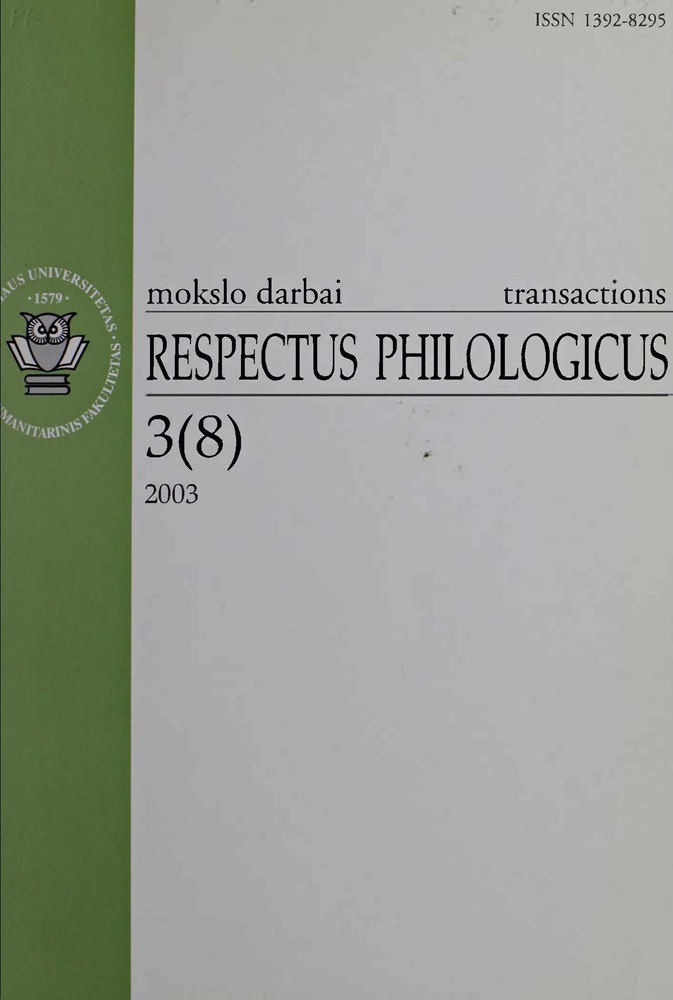
Transformational Devices of the Inner Form of a Word (Kinds of Unscientific Etymology)
Articles
Liudmila A. Vvedenskaja
Rostov University, Russia
Nikolaj P. Kolesnikov
Rostov University, Russia
Published 2003 May 28
https://doi.org/10.15388/RESPECTUS.2003.11
PDF

Keywords

lexical meaning
inner form of the word
motivation
etymology
folk etymology

How to Cite

Vvedenskaja, L.A. and Kolesnikov, N.P. (2003) “Transformational Devices of the Inner Form of a Word (Kinds of Unscientific Etymology)”, Respectus Philologicus, (3 (8), pp. 110–120. doi:10.15388/RESPECTUS.2003.11.

Abstract

Having examined various definitions of folk etymology offered by different researchers and presented in dictionaries, directories, manuals, the authors came to the conclusion that it is necessary to specify the borders of a concept and differentiate the adjacent phenomena. All phonetic changes in a word in a case of folk etymology should necessarily result in occurrence of some meaning that was absent before its transformation. Not taking into account this condition it is impossible to consider phonetic changes as folk-etymological ones. For the adjacent phenomena the concepts of pseudo-folk etymology (a deliberate distortion of a word for stylistic purposes), children's etymology, and pseudo-etymology are being introduced.

PDF

References

Creative Commons License

This work is licensed under a Creative Commons Attribution 4.0 International License.

Downloads

Download data is not yet available.