Social Welfare: Interdisciplinary Approach eISSN 2424-3876
2026, vol. 16, pp. 229–258 DOI: https://doi.org/10.15388/SW.2026.16.11
“Andere Länder, Andere Sitten”. Acculturation of War Refugees in Germany in Post-reunification Period: A Mixed Methods Literature Review
Olha Korobanova
Open International University of Human Development, Kyiv, Ukraine
E-mail: fenixolga77@gmail.com
https://orcid.org/0000-0003-3539-871X
https://ror.org/02ea7cc16
Emily-Sofie Garsleitner
Athena Institute, Vrije Universiteit, Amsterdam, Netherlands
E-mail: e.e.garsleitner@student.vu.nl
https://ror.org/008xxew50
Charlotte Steuten
Athena Institute, Vrije Universiteit, Amsterdam, Netherlands
E-mail: c.steuten@student.vu.nl
https://ror.org/008xxew50
Abstract. The article analyzes the achievements and difficulties on the acculturation path of war migrants based on literature sources from 1991 to 2022, supplemented by an updated literature search in 2025. The study group included refugees who arrived in Germany as a result of wars, armed conflicts or emergencies.
The literature review was conducted by using mixed methods (MMAT – Mixed Methods Appraisal Tool). The literature was searched in three databases: PubMed, Web of Science, and APA PsycInfo (705 articles in total). Following an initial screening, an additional update search was performed in 2025. After applying exclusion criteria, 17 articles were selected to serve as the basis for this review.
We operationalized acculturation as a multidimensional integration process consisting of psychological acceptance of the host culture while simultaneously maintaining the home culture; accordingly, we examined the achievements and complexities of acculturation of war refugees by using the conceptual framework of integration, as developed by A. Ager and A. Strang (2004; 2008).
War refugees have a number of characteristics related to their experiences of traumatic circumstances and losses, which justifiably allows them to be grouped into a separate group. Predictors and facilitators of successful acculturation related to individual characteristics and motivation of migrants and barriers to acculturation related to their fears and negative experiences have been identified.
We assume that this review may have practical relevance in terms of providing psychological help to contemporary migrants.
Keywords: migrants, war migrants, refugees, acculturation, integration, Germany.
Recieved: 2025-08-27. Accepted: 2026-10-09
Copyright © 2026 Olha Korobanova, Emily-Sofie Garsleitner, Charlotte Steuten. Published by Vilnius University Press. This is an Open Access journal distributed under the terms of the Creative Commons Attribution 4.0, which permits unrestricted use, distribution, and reproduction in any medium, provided the original author and source are credited.
Introduction
The wave of forced migration abroad, triggered by the outbreak of full-scale military actions on the territory of Ukraine, has rendered the question of how refugees adapt, reshape their identities, and overcome sociocultural challenges within host communities highly salient for European science. As bearers of their native culture due to primary inculturation in their homeland, forced migrants in a host country inevitably engage with the local culture, which possesses its own unique institutional and mental characteristics, thereby navigating a highly complex process of acculturation.
Recently, this issue has acquired particular urgency and an interdisciplinary scope due to the massive scale of migration flows caused by natural disasters and protracted military conflicts. Notably, since the beginning of the Russian military invasion on February 24, 2022, more than 6.3 million Ukrainians have been forced to flee their country. According to estimates by international institutions, the majority of Ukrainian refugees migrated to Poland, Germany, Hungary, Moldova, Slovakia, and Romania (Mancino, 2022). Due to the sudden, abrupt, and large-scale nature of the displacement, this immense volume of displaced persons triggered a phenomenon identified in the scientific literature as a massive humanitarian ‘crisis’ (Kaufman et al., 2022), demonstrating an acute need for the accelerated integration and acculturation of these groups into Western society.
The countries of the European Union (Fedyuk & Kindler, 2016), and the Federal Republic of Germany in particular (Elinder et al., 2022), have traditionally served as the most attractive destinations for refugees under temporary protection. According to data from the United Nations High Commissioner for Refugees (UNHCR), Germany firmly retains the first place within the European Union regarding the number of registered Ukrainian war refugees, whose population reached 1,227,090 individuals as of August 2025 (UNHCR, 2025). The specificity of the German legal framework allows Ukrainian refugees to integrate into German labor market programs and state employment promotion schemes immediately after crossing the border and receiving their status (Brücker, 2022). While this establishes a unique precedent for ‘rapid integration’, it simultaneously confronts a series of psychological and sociocultural barriers.
Conceptual Framework and Research Gap
Migration to Germany has been examined quite comprehensively in conventional scientific literature from economic, demographic, ethnic, intercultural, political, and medical perspectives. However, the volume of literature specifically dedicated to the psychological aspects of migration remains limited. Even fewer publications focus on the specificities of migration directly linked to the traumatic experience of wars and armed conflicts. Our review aims to address this theoretical gap. We propose a critical synthesis of the existing literature, by analyzing, on the one hand, the positive psychological determinants of war refugees’ acculturation in Germany, and, on the other hand, the systemic obstacles and institutional complexities encountered along this path.
The psychological burden experienced by migrants in an unfamiliar cultural environment (acculturation stress) drastically diminishes their psychological well-being. This contributes to the emergence of a paradoxical phenomenon: a segment of refugees who have already fled abroad decides to return to their homes despite objective physical danger and ongoing shelling (Vus & Esterlis, 2022). This fact provides empirical proof that successful integration into the host society is critically important, as refugees often value the subjective psychological safety associated with being in their native home higher than physical safety in a foreign country. The well-known metaphor “Build a bridge and get over it” captures the very essence of integration into a new culture, which requires not passive waiting, but high subjective agency and significant individual efforts on the part of the migrants themselves. Thus, integration and acculturation are linked, like a path and its goal.
Theoretical Framework: The A. Ager and A. Strang Integration model
To transcend a purely descriptive narrative of the accumulated data and to provide the review with analytical integrity, we employ the conceptual framework of core integration domains developed by A. Ager and A. Strang (2004; 2008; 2010) as the theoretical underpinning of our study. This model allows for the systematization of the acculturation process and structures the factors influencing refugee integration in Germany across four key domains. Our Markers and Means are practical indicators such as employment, housing, healthcare, and education. Social Connections are the level of social interaction and the presence of support networks, both within the refugee community (social bonds) and with the host population (social bridges). Facilitators are the core pathways of integration, including language proficiency, the mastery of local sociocultural practices, and the perception of safety (including barriers such as discrimination). Whereas, Foundation is the domain of rights and citizenship status, which defines the mutual obligations between the migrant and the state.
Acculturation indicators structured according to this framework help delineate the distinct impacts of migrants’ individual personality traits, factors within the society of origin, and the specificities of the host society (Berry, 1997). In the context of our study, it is critically important to analyze which of these four domains are successfully operationalized in Germany, and which continue to function as rigid barriers requiring systemic improvement.
The Social and Historical Context of Acculturation in Germany
It is crucial to emphasize that migration policies and social benefits within the EU, and specifically in Germany, have historically varied depending on the migrants’ country of origin, by exerting a direct differentiating effect on their adaptation trajectories (Gümüş, 2015). Germany possesses a rich and complex history of receiving migrants from various global regions who fled their homelands due to wars and humanitarian crises.
During the post-reunification period (the era following German reunification since 1991), the country granted asylum to approximately 1.5 million individuals, excluding the most recent wave of Ukrainian migrants (Federal Office for Migration and Refugees, 2022). Notably, about 67% of these migrants have already resided in Germany for more than six years (Deutscher Bundestag, 2022). Among them, a significant proportion comprises former Yugoslavian refugees (who migrated in the 1990s), as well as Middle Eastern and African war refugees.
In this review, we deliberately expand the chronological scope of our analysis so that to examine the acculturation dynamics of migrants who entered Germany between 1991 and 2022. The choice of the year 1991 as a starting point is justified by the onset of large-scale armed conflicts in the former Socialist Federal Republic of Yugoslavia (Keel & Drew, 2004). Inclusion of cohorts who migrated to Germany prior to 2000 provides an analytical understanding of the multigenerational adaptation of forced migrants within German society. Concurrently, the paper critically examines more recent displacement flows – specifically, those triggered by the Syrian civil war, which precipitated one of the largest humanitarian crises in modern history (Kaya & Orchard, 2019).
The Specifics of the Initial Acculturation Stage and Post-Migration Stress
Such an approach enables us to juxtapose the experiences of ‘historical’ waves of forced migration with the processes currently unfolding among refugees from Ukraine. Within the scope of this paper, the terms ‘refugee’ and ‘migrant’ are used interchangeably; they serve to denote individuals who, due to the compelling circumstances of war or armed conflict, were forced to undertake cross-border displacement.
Relocating to another country due to war confronts individuals with complex challenges, including forced multicultural contact, acute acculturation stress (Williams & Berry, 1991), and profound culture shock (Bochner, 2003). Concurrently, research indicates that the host population also experiences a powerful psychological impact. Specifically, the military actions in Ukraine and the media-transmitted reports of violence exerted a significant destructive influence on native German citizens, causing secondary distress, anxiety, worry, and psychosomatic symptoms. Citizens of the FRG compared the fear of war and its global consequences to the perceived impact of natural disasters (Gottschick et al., 2023). Even those local residents who did not manifest overt clinical symptoms bore a high allostatic load (chronic stress), which has the potential to negatively affect public health in the long term (Kaufman et al., 2022).
Meanwhile, the war refugees themselves confront the phenomenon of post-migration stress (Ballentine et al., 2021; Bogic et al., 2015; George, 2012; Sangalang et al., 2019). Statistics demonstrate that they integrate into the economy and society significantly slower than economic or voluntary migrants (Hunkler & Khourshed, 2019). This lag is rooted in the cumulative psychological trauma sustained prior to and during flight (Bogic et al., 2015; Hannafi & Marouani, 2022; Mouzourakis et al., 2017). Such life-threatening circumstances include shelling, the loss of loved ones, and the destruction of housing and established routines (Ballentine et al., 2021; Drury, 2018; Javanbakht, 2022).
Contemporary literature distinguishes various triggers of post-migration stress. It is frequently generated by a “rupture and search for new anchors” of identity, wherein the migrant must construct new social roles associated with belonging to a vulnerable refugee community, navigate rigid acculturation, and re-organize their life within unfamiliar institutional settings (Ballentine et al., 2021; Drury, 2018).
Studies capturing the initial stage of acculturation specifically among Ukrainian war migrants in Germany reveal profound distortions in the psycho-emotional sphere (Danilova et al., 2022; Gottschick et al., 2023; Kredentser, 2023; Oviedo et al., 2022; Pedorenko, 2022). The situation was further exacerbated because the onset of the acute phase of the war coincided with the COVID-19 pandemic, which had already caused a global rise in anxiety and depression (Bondarеnko et al., 2022), thereby multiplying the risks of psychological traumatization. Particular emotional instability has been recorded among migrant schoolchildren (Catani et al., 2023) and youth (Riad et al., 2022); consequently, issues surrounding mental health maintenance and the inclusion of young displaced persons remain highly salient in German scientific discourse (Feiterna-Sperling et al., 2023; Fert, 2023). Crucially, the factors undermining the psychological resilience of refugees are rooted in their lived experience of war, whereas successful coping strategies are more frequently oriented toward restoring a sense of belonging and maintaining continuous contact with loved ones remaining in the homeland (Oviedo et al., 2022; Rizzi et al., 2023).
On a practical level (the Markers and Means domain), the spatial settlement patterns of refugees in Germany exhibit a pronounced “ethnic network effect”. An analytical regularity has been observed: the higher the concentration of compatriots in a specific German region, the lower the cost of rental housing, and the higher the share of high-tech jobs, the more attractive that region proves to subsequent waves of displaced persons (Sauer et al., 2023). However, the actual everyday trajectories of migrants are marred by rigid infrastructure barriers: substandard living conditions in temporary reception centers, critical shortages of placement spots in German kindergartens and schools, and bureaucratic complexities required for employment (Kredentser, 2023; Sauer et al., 2023; Sydorov & Kovalska, 2022). At the level of the Facilitators domain, German language proficiency emerges as the pivotal determinant; it drastically enhances integration potential, while enabling individuals to successfully bridge sociocultural distances in daily intercultural communication (Kredentser, 2023; Petrovska, 2023; Stepanenko, 2023).
At the same time, we argue that the true psychological meaning of acculturation lies not merely in everyday behavioral adaptation, but in a profound transformation of the refugees’ social identity and the gradual assimilation of the host community’s mentality. Social identity plays a structuring role both in the dynamics of post-migration stress and in conceptualizing psychosocial well-being as a collective, rather than a purely individual, achievement (Ballentine et al., 2021). Thus, the successful acculturation of refugees must be examined in inextricable connection with the processes transforming their personal and group identities.
Research Objectives and Questions
Based on the premises outlined above, the object of this study encompasses the processes of sociocultural, institutional, and psychological integration and acculturation of war migrants within German society, alongside the barriers and facilitators of these processes.
The primary research question is formulated as follows: what are the systemic interconnections between achievements and barriers across different integration domains (according to the A. Ager and A. Strang model) among war refugees in Germany from a historical perspective (since 1991), and how is this experience projected onto the latest wave of migration?
The purpose of this study is to perform a critical analytical synthesis of contemporary scientific literature with the objective to identify the domains of the A. Ager and A. Strang integration model where forced war migrants in Germany achieve the greatest success, which domains remain critical barriers blocking acculturation, and what invariant patterns unite different waves of refugees within their shared German sociocultural space.
Methods
To design and conduct this systematic review, we employed the PICo framework (Population, Interest, Context), which is adapted for qualitative and mixed-methods evidence synthesis (Hong et al., 2018). We included literature on war refugees and persons forced to flee their homeland due to armed conflicts and humanitarian disasters who migrated to Germany. In this review, we intended to evaluate existing studies in terms of possible differences in the acculturation, coping strategies, the dynamics of post-migration stress, and identity transformations of refugees with different ethnic backgrounds in Germany. The included literature had a broad temporal range in order to compare the acculturation processes of different ethnic groups in the institutional and social environment of the Federal Republic of Germany. Literature covering a broad chronological range was included in the review, allowing for an analytical comparison of the adaptation trajectories of various ethnic groups in Germany over the past three decades. To ensure conceptual comprehensiveness and multi-perspectivity, the final selection comprised both qualitative and quantitative empirical studies.
Search Strategy and Selection Criteria
To ensure representativeness and minimize the risk of omitting relevant data, a systematic literature search was executed across three authoritative bibliographic databases: PubMed, Web of Science, and APA PsycInfo. The content of these databases closely aligns with the disciplinary scope of psychological and medical sciences.
The initial phase of the systematic search was conducted in November 2022. Subsequently, in order to incorporate the latest wave of academic publications addressing the ongoing crisis, a coordinated update search was performed in August 2025.
The search strategy relied on a combination of controlled keywords and their English synonyms, by utilizing Boolean operators (AND/OR) as follows: (“war refuge*” OR “forced migrant*”) AND (“country of origin” OR “ethnic origin”) AND (“Germany”) AND (“acculturation” OR “psychological adaptation” OR “identity transformation” OR “post-migration stress”)
The target population was strictly limited to individuals who underwent forced migration to Germany due to wars (e.g., conflicts in the former Yugoslavia, the Middle East, Africa, and Ukraine). The chronological baseline for data collection was set to 1991, as this period marked the arrival of the first refugee waves fleeing military actions in the former Yugoslavia (Keel & Drew, 2004).
Data Extraction
The extraction of empirical data was performed in a standardized manner, recording parameters within a specially developed Data Extraction Form. During the systematization phase, both general bibliographic information (study design, study type, country of publication, authors, publication year) and specific methodological and substantive parameters were coded: theoretical conceptualization of the acculturation phenomenon; Sample characteristics (sample size, inclusion/exclusion criteria, mean age, gender distribution, year of arrival in Germany, language competencies, confessional affiliation); psychological instrumentation (questionnaires, scales, or interview guides utilized); dependent and independent variables (for quantitative designs); key empirical results, conclusions, limitations, and author recommendations.
Quality Assessment and Evidence Synthesis
A critical appraisal of the methodological quality of the selected publications was conducted by two independent reviewers (EG and CS) using an adapted version of the standardized Mixed Methods Appraisal Tool (MMAT) (Hong et al., 2018). Any inter-rater discrepancies arising during the expert appraisal process were resolved through consensus-driven discussions.
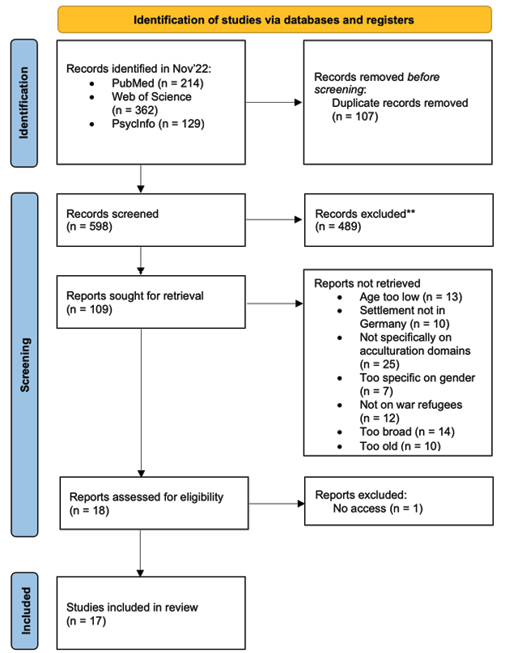
Figure 1.
PRISMA flow diagram for new systematic reviews
The empirical findings of the selected studies were extracted, deductively coded, and mapped to indicators in strict accordance with the domains of the Ager and Strang (2004) integration model. Additionally, a critical analysis of the psychological facilitators and barriers associated with each identified factor was carried out.
The initial screening phase yielded a total of 705 publications. Following duplicate removal, abstract screening, and full-text analysis, exactly 17 original peer-reviewed articles fully met the inclusion criteria (a detailed visualization of the selection procedure is presented in the PRISMA Flow Diagram in Figure 1).
General and Methodological Characteristics of the Included Studies
The chronological and geographical landscape of the analyzed papers (N=17) reflects the key stages of the migration situation in Germany over recent decades. In terms of the timeframe, the empirical baseline of the included studies spans from 2011 to early 2022, thus capturing psychological cross-sections of several large-scale humanitarian crises.
A critical appraisal of the methodological designs revealed a pronounced asymmetry that carries significant psychological limitations. Cross-sectional design was utilized in the vast majority of the papers (16 out of 17). In the context of acculturation psychology, this means that the accumulated data capture the subjective well-being, traumatization levels, and coping strategies of migrants discretely – as a static snapshot. While this approach allows for an assessment of the severity of post-migration stress at a specific stage, it limits the ability to verify long-term acculturation trends. Longitudinal design was implemented in only one long-term study (Martinovic et al., 2015). This research holds particular theoretical value, as it allows for tracking the dynamics of social identity transformation and gradual language acquisition within a genuinely temporal perspective.
Regarding the ethnocultural origin of the samples and, consequently, the magnitude of the perceived cultural distance relative to the host German society, the analyzed body of literature can be divided into three representative clusters. The Middle-Eastern Cluster (The Syrian Crisis). This is the dominant cluster in the selection, with 7 studies focusing exclusively on the acculturation of Syrian refugees (al Masry et al., 2021; Berr et al., 2019; el Khoury, 2019; Georgiadou et al., 2018; Hannafi & Marouani, 2022; Hunkler & Khourshed, 2019; Viazminsky et al., 2022). This body of literature is critically important for analyzing acculturation stress under conditions of maximum polarity between the heritage and the host cultures (specifically, across confessional, gender, and family values). The Post-Yugoslav (Balkan) Cluster. Represented by a study on refugees from the former Yugoslavia (Zepinic et al., 2012), alongside several mixed samples. The experience of this group allows for an evaluation of the long-term (exceeding 20 years) psychological consequences of forced displacement and the phenomenon of transgenerational adaptation in Germany. The African Cluster. Examined through the case of forced migrants from Eritrea (Gebresilassie et al., 2022), who confront the compounded pressure of racial barriers and linguistic isolation.
The remaining 6 papers relied on mixed multinational samples (Gürer, 2019; Haase et al., 2019; Martinovic et al., 2015; Schmitz & Schmitz, 2012; Walther et al., 2021), which included forced migrants from zones of protracted conflicts (Bosnia and Herzegovina, Kosovo, Serbia, Croatia, North Macedonia, Afghanistan, Iran, Pakistan, Palestine, Libya, Algeria, Tunisia, and Sudan). In terms of gender, a balanced approach was maintained across all empirical studies (involving both male and female participants), with the exception of one qualitative study (Berr et al., 2019) aimed at explicating the unique, specific experiences of Syrian women. This structural balance allows for a comparative evaluation of the differentiated impact of gender roles on adaptation success. Importantly, despite the heterogeneity of methods (ranging from in-depth semi-structured interviews to Berry’s multidimensional acculturation questionnaires), all 17 studies utilized psychological and sociocultural indicators that deductively and seamlessly map onto the domains of the Ager and Strang integration model (Ager & Strang, 2004, 2008). This consistency validates the choice of our theoretical framework for the subsequent critical synthesis.
Results
The Markers and Means Domain
According to the conceptual model proposed by A. Ager and A. Strang (2004; 2008; 2010), the markers and means dimension encompasses four structural indicators: employment, housing, education, and health. Within psychological science, these indicators serve not merely as objective living conditions, but as foundational external determinants that either generate acculturation stress or function as external resources for coping with it.
Employment and Professional Identity. The analyzed literature unanimously verifies employment as a pivotal psychological factor facilitating successful acculturation. Professional integration not only ensures the economic independence of a migrant but also performs essential psychotherapeutic functions: it restores social roles deformed by war, enhances personal agency, stimulates language acquisition, and expands intercultural contact networks with the native population (Ager & Strang, 2004).
However, the critical synthesis reveals a severe destructive trend: the trajectory of labor market integration in Germany is rigidly determined by time-related factors and systemic barriers. An analytical pattern was identified: the later the refugees’ year of arrival in the FRG, the more pronounced their difficulties in finding employment become (Hannafi & Marouani, 2022). Subjectively perceived discrimination based on the ethnic origin, age, or religious affiliation emerges as a significant risk factor for psychosocial well-being. For instance, a study by Feinstein et al. (2021) explicated the experiences of hijab-wearing women, for whom this ethnoconfessional marker translates into systematic employment rejections, thereby triggering marginalization.
From the perspective of personality psychology, the primary destructive factor within the German context is an institutional barrier – the state’s refusal to automatically recognize educational credentials and professional licenses obtained by refugees in their home countries (Feinstein et al., 2021). This leads to forced deprofessionalization (occupational downgrading) and a protracted identity crisis, forcing highly qualified specialists into the low-wage, unskilled labor sector.
External state support, taking the form of intensive language programs and targeted financial welfare, serves as a powerful buffer (facilitator) that mitigates this stress (Berr et al., 2019; Martinovic et al., 2015). An analysis of the historical experience of the Balkan crisis demonstrates that 44.5% of refugees from the former Yugoslavia actively relied on state assistance during employment, while 89.8% required direct material support to stabilize their initial psychological state (Zepinic et al., 2012).
The Psychological Space of Housing. Within the analyzed psychological literature, housing is conceptualized as the spatial foundation for restoring a basic trust in the world, alongside a sense of stability and security (Ager & Strang, 2004; 2008). The initial reception phase of refugees in Germany was characterized by placement in temporary collective centers, sports arenas, and town halls (Kersting, 2019), which gave rise to a specific ‘loss of privacy’ syndrome. The necessity of multiple families cohabiting in a single room and sharing sanitary zones acted as potent triggers for interpersonal conflicts and post-migration distress (Zepinic et al., 2012).
Furthermore, the transition to the secondary housing market (searching for a stable private apartment) is described by researchers as a prolonged, frustrating process characterized by high competition in major German metropolitan areas and subtle discrimination from private landlords (Feinstein et al., 2021). Nevertheless, a comparative analysis indicates heterogeneity in outcomes depending on the migration wave: for instance, a study by F. al Masry et al. (2021) recorded that, by the time of the survey, the vast majority of Syrian refugees had successfully rented individual apartments (78.1%) or houses (19.3%), with only a minimal proportion (2.6%) remaining in temporary asylum accommodation.
A synthesis of the empirical data reveals a direct causal link between the housing type and the mental health outcomes of migrants. Studies by A. Haase et al. (2019) and F. al Masry et al. (2021) demonstrate distinct differences. Migrants forced to remain in collective reception centers for extended periods display critically low indicators of psychological adaptation and a high level of perceived discrimination. Refugees who relocated to isolated, private apartments not only manifest higher psychological resilience but also form a significantly larger number of stable social ties (al Masry, 2021).
This phenomenon is explained by the fact that individual housing reduces psychological fatigue and allows migrants to construct their daily lives in accordance with their cultural, religious, and family habits, thereby minimizing the frustration caused by forced contact within the confined space of a camp.
Educational Trajectories and Segregation Risks. The education indicator performs a dual role: it determines long-term chances in the labor market and simultaneously serves as a space for the transformation of social identity (Hannafi & Marouani, 2022). However, psychological studies detect subtle risks of segregation within the German educational system. Children of forced migrants from non-Western countries are more frequently tracked into ethnically concentrated schools with a high proportion of migrant students. From the standpoint of social psychology, this drastically narrows their opportunities for meaningful intercultural interaction with native German peers, thereby perpetuating the language barrier (Martinovic et al., 2015). The low academic achievements of such students are often driven not by diminished intelligence, but by ‘educational deficits’ – namely, a lack of language support and psycho-emotional exhaustion (Gries et al., 2022).
Age at migration emerges as a crucial factor: assimilation into the rigid German educational matrix proceeds significantly smoother during childhood and adolescence, whereas adult refugees who have already completed their education in their home countries confront the phenomenon of ‘blocked mobility’ (Gries et al., 2022).
A psychological analysis of refugees’ biographical tracks shows that their adaptation is heavily undermined by destructive gaps in schooling caused by war and physical flight (Feinstein et al., 2021; Hannafi & Marouani, 2022). At the same time, research uncovers a compensatory phenomenon (high academic motivation): across a number of parameters, migrants – with the support of the host country – strive to achieve a higher level of education than their native German peers, which is a trend that can be interpreted as a hypercompensation for status vulnerability (Gries et al., 2022).
Mental Health as the Foundation of Acculturation. Unlike many other host nations, Germany regulatorily grants forced migrants equal access to its statutory healthcare system almost immediately upon arrival (Feinstein et al., 2021), which serves as a powerful external supportive resource. Somatic and mental health acts as a foundational prerequisite for the realization of all other integration domains – without it, neither effective education nor employment is attainable (Ager & Strang, 2004).
Nevertheless, a critical synthesis of the accumulated data exposes a profound psychopathological crisis among forced migrants. In a longitudinal study, V. Zepinic et al. (2012) documented exceptionally high rates of psychological maladaptation among former Yugoslavian refugees in Germany: the overall rate of mental disorders reached 67.8%; anxiety disorders were prevalent at 60.8%; mood disorders were reported at 56.3%; destructive behavioral patterns (substance abuse and dependencies) accounted for 11.8%.
These figures proved to be the highest among all European destination countries for the Balkan migration wave, indicating a high psychotraumatizing rigidity of the German context during that period.
A pivotal analytical conclusion shared by the majority of the reviewed papers (Gebresilassie, 2022; Schmitz & Schmitz, 2012; Walther et al., 2021) is that the dynamics of the refugees’ mental health exhibit a strictly non-linear dependency on the density of their social networks. Attempts to forcibly ‘assimilate’ into the dominant culture at the cost of completely relinquishing one’s heritage identity, as well as experiencing social disconnectedness (isolation), correlate strongly with severe psychological distress (Schmitz & Berry, 2011; Walther et al., 2021).
Consequently, failures to secure material markers of integration (such as substandard housing or unemployment) exert a compounded negative impact on the psychosocial sphere, translating primary war-induced trauma into a chronic, protracted post-migration syndrome.
The Social Connections Domain
Within the framework of the A. Ager and A. Strang’s (2004; 2008; 2010) integration model, the restructuring of social networks is conceptualized as the central psychological process of acculturation. Forced migration is inherently accompanied by the total destruction of former ingroups and the loss of meaningful interpersonal contacts. Accordingly, adaptation success directly hinges on the migrant’s capacity to reconstruct their social micro-environment. The analyzed empirical body of literature allows for the differentiation of this process into two distinct socio-psychological phenomena: intra-group ties (Social Bonds) and inter-group bridges (Social Bridges).
Social Bonds as a Resource for Psychological Resilience. Social bonds, defined as the maintenance of relationships with family members and individuals from one’s own ethnic group, are evaluated by forced migrants as the primary and most accessible resource of support (Feinstein et al., 2021; Gebresilassie, 2020). The consolidation of compatriots performs a vital cushioning function during the initial stage of acculturation.
A critical analysis of the experiences of Eritrean refugees in the FRG demonstrated that intensive intra-group interaction operates as a powerful psychological buffer, effectively neutralizing the manifestations of post-migration distress (Gebresilassie, 2020). Beyond providing emotional validation, contact with previously adapted compatriots serves a cognitive-orienting role: it acts as a channel for transmitting the social expectations and normative requirements of German society to newly arrived individuals (Gürer, 2019).
Concurrently, the synthesis of research uncovers latent psychological risks and the inherent ambivalence of social bonds: the risk of becoming isolated within own ethnocultural group and the risk of ingroup social control and social pressure in the case of conflicting expectations. Focusing exclusively on intra-group support (as observed in the Eritrean sample) is associated with high subjective fear and objective difficulties when attempting to establish contact with the outgroup – the native population of Germany (Gebresilassie, 2020).
The reviewed studies explicate the phenomenon of ingroup pressure within the acculturation process. For instance, within Syrian communities in Germany, acute latent conflicts have been documented between earlier-settled migrant women and newly arrived women regarding normative standards of appearance and dress (Feinstein et al., 2021). This contradictory neglect, or conversely, rigid enforcement of traditional standards (such as wearing the hijab), generates a specific intra-cultural stress that exacerbates identity crises.
Nevertheless, openness to multicultural contacts correlates significantly with adaptation success. C. Hannafi and M.A. Marouani (2022) verified a direct positive relationship between the level of psychological integration of Syrian refugees and the diversification of their personal social networks (the number of acquaintances from third countries).
Social Bridges and Intergroup Interaction. Social bridges refer to positive interaction between forced migrants and the native residents of Germany. From the standpoint of social psychology, these connections are critically important for fostering social cohesion and overcoming the phenomenon of mutual alienation (Martinovic et al., 2015).
A comparative analysis indicates that the willingness and speed of building social bridges differ substantially depending on the background and ethnocultural characteristics of specific migration waves. Former Yugoslavian refugees demonstrated a significantly higher level and density of inter-ethnic interaction with Germans than, for example, the traditional Turkish immigrant community, which may be explained by a smaller initial cultural distance (Martinovic et al., 2015).
A synthesis of the empirical data allows for the identification of key determinants facilitating the development of inter-group bridges. Age at migration serves as a rigid predictor of integration success (Gries et al., 2022). A younger age is associated with high cognitive and behavioral flexibility, which eases the initiation of inter-ethnic contacts, whereas older cohorts of migrants exhibit a tendency toward network narrowing and a deficit in outgroup ties (Gries et al., 2022; Martinovic et al., 2015). An important cyclical psychosocial mechanism was uncovered: proficiency in the German language naturally leads to the intensification of inter-ethnic contacts; in turn, expanding one’s social network to include native residents serves as the main catalyst for further improvements in linguistic and communicative competence (Gürer, 2019; Martinovic et al., 2015). The conscious adoption of an intention for long-term or permanent residence in Germany psychologically mobilizes migrants to overcome inter-group barriers and stimulates the construction of bridges (Martinovic et al., 2015).
Ultimately, it is these established social relationships with the outgroup (native Germans) that forced migrants perceive as the core subjective indicator of psychological well-being and a high quality of life within the new socio-cultural reality (al Masry, 2021).
The Phenomenon of Excluded Social Links. The indicator of social links remains unexamined in the reviewed psychological literature. It is noteworthy that, within the analyzed body of empirical publications (N = 17), focus data addressing the third element of A. Ager and A. Strang’s structure – social links – are entirely absent. Social links imply maintaining transnational contacts with the sociocultural and state institutions of the country of origin, as well as cross-border interaction with the remaining members of restructured communities.
From the standpoint of psychological research methodology, this deficit in data is not accidental and is driven by three key factors. The first of these factors is the specific nature of refugee status. Unlike voluntary or economic migrants, forced migrants (from Syria, Eritrea, or the former Yugoslavia) fled from direct military threats, political persecution, or totalitarian oppression. Consequently, maintaining official institutional links with the state structures of their homeland is either physically impossible or associated with a high risk of re-traumatization and security threats. The second factor is the rigid focus of the German academic discourse. Research grants and programs in Germany during the period from 2011 to 2022 were pragmatically oriented toward addressing urgent tasks within the host society, such as assessing German language proficiency, employment outcomes, and preventing radicalization. The transnational activity of refugees remained at the periphery of German researchers’ attention. A third factor is the methodological limitation of a snapshot approach. Due to the fact that 16 out of the 17 included papers utilized a cross-sectional design, they captured only the acute process of initial settlement in the FRG. During this phase, all psychological resources of the individual are mobilized toward building basic social bonds and bridges, whereas a deep re-evaluation of connections with the institutions of the homeland takes place during later stages of acculturation.
Thus, the deficit of research in the area of social links explicated by our synthesis points to a significant lacuna in contemporary European ethnopsychology and establishes a promising vector for future longitudinal investigations.
The Integration Facilitators Domain
In the theoretical framework of A. Ager and A. Strang (2004; 2008; 2010), the facilitators domain includes cognitive, linguistic, and environmental components that act as catalysts or, conversely, barriers to adaptation. A critical synthesis of the included studies allows for the explication of the complex psychological ambivalence of these factors.
The language Barrier and Cultural Competence: A Cognitive Perspective. The linguistic conceptualization of acculturation traditionally treats proficiency in the language of the host society as a foundational predictor of successful integration (el Khoury, 2019). Within the context of the FRG, acquiring the German language plays a dominant facilitating role, although knowledge of English also serves as an important alternative cognitive resource during the initial phase (Hannafi & Marouani, 2022).
However, systematic psychological analysis exposes a specific phenomenon of language distress. Language acts as a determinant of stress. An absolute lack of German language proficiency is defined by forced migrants as a leading source of permanent acculturation stress that blocks fundamental autonomy (Gebresilassie, 2022). Concurrently, the processual aspect of intensive, mandatory German language acquisition within the rigid institutional framework of the FRG imposes an immense cognitive load on the psyche and acts as an independent psychotraumatizing factor that reduces subjective well-being (Martinovic et al., 2015).
The psychological distance in communication increases. Empirical data demonstrate that the refugees’ communication with German colleagues and neighbors in a non-native language is frequently evaluated subjectively by migrants as distant and limited. Conversely, returning to the domain of the native language among compatriots serves as an act of psychological relaxation, actualizing markers of emotional happiness and reducing interpersonal tension (Gebresilassie, 2022).
In the dimension of macro-cultural adaptation, cultural competence – the capacity to understand and differentiate the latent rules, values, and customs of the host society – serves as a core resource. Forced migrants with high indicators of cultural competence demonstrate significantly greater success in initiating and maintaining deep social connections with the outgroup (Green et al., 2019; Safdar et al., 2021).
Moreover, the incorporation of elements of the new German culture into one’s own cognitive schema – manifested as a subjective awareness of affiliation with German culture – serves as a reliable predictor of a high level of psychological well-being and a reduction in marginalizing tendencies (Green et al., 2019).
Safety and Stability: Objective Dimension vs Subjective Well-Being. The safety indicator among forced migrants reveals a pronounced psychological asymmetry and cognitive dissonance. At the objective-environmental level, refugees uniformly define Germany as a safe, stable, and rule-of-law space for living (Gebresilassie, 2022). This positive attitude is determined by contrast: individuals arriving from zones of destructive military conflicts or totalitarian oppression highly value the rigidity, predictability, and normative orderliness of German regulatory rules as a guarantee of physical survival.
Nevertheless, at the macro- and micro-social levels, this resource undergoes severe destruction from the host environment. The manifestation of individual stereotypes and general hostility of the host environment is noted. Research documents latent and overt negativism from the native German population toward forced migrants. Local residents tend to devalue the professional skills, educational attainment, and cultural potential of migrants, thus transmitting an implicit rejection (Haase et al., 2019; Safdar et al., 2021).
The phenomenon of chronic existential threat arises. Although refugees may evaluate the current parameters of their integration as formally acceptable, their underlying psychological state is burdened by a permanent fear of forced deportation and legal vulnerability (el Khoury, 2019). Experiencing total uncertainty regarding their legal status and a subjective sense of lacking legal protection from the German state operate as exceptionally powerful triggers of neuroticism (Feinstein et al., 2021; Walther et al., 2021; Zepinic et al., 2012).
Refugees have experience of perceived discrimination and xenophobia. Across virtually all analyzed samples, refugees report regular encounters with manifestations of xenophobia, stigmatization, and verbal aggression from both German civil society and when interacting with institutions of authority, including the police (el Khoury, 2019; Feinstein et al., 2021; Walther et al., 2021). Furthermore, a destructive emotional atmosphere linked to overcrowding and stress is also recorded within refugee shelters themselves, provoking intra-group conflicts (el Khoury, 2019).
The migrant’s emotional intelligence acts as a critical internal, intra-psychic buffer mitigating the destructive impact of discrimination. Longitudinal and cross-sectional data from F. Schmitz and P. Schmitz (2012) verify that refugees with a developed capacity for reflection, understanding, and regulation of their own and others’ emotions subjectively experience the destructive consequences of discrimination less frequently and display more flexible adaptive strategies for coping with environmental aggression.
The Foundation Domain: Rights and Citizenship
According to the conceptual model proposed by A. Ager & A. Strang (2004; 2008; 2010), rights and citizenship constitute the institutional foundation of acculturation, defining the boundaries of an individual’s legal and psychological space. The destruction or restriction of this foundation by the host state triggers a profound transformation in the identity of forced migrants and deforms their adaptive strategies.
A critical synthesis of research findings allows for the explication of three key psychosocial syndromes generated by a deficit in this institutional foundation within the FRG. First, the bureaucratic distress and loss of control syndrome arises. Navigation of highly regulated administrative procedures in Germany is described by refugees as a subjectively insurmountable barrier, causing cognitive overload and the depletion of mental resources (Feinstein et al., 2021; Walther et al., 2021). A specific trigger of permanent acculturation stress is the necessity of regular engagement with official correspondence (Gebresilassie, 2022). The heavy flow of official letters in German from state authorities, such as the Jobcenter or BAMF, generates bureaucratic anxiety among migrants, as each communication is perceived as a potential existential threat to their legal status. From a psychological perspective, this leads to a loss of the sense of agency and control over one’s own life.
Second, the long-term planning becomes impossible which leads to learned helplessness – legal uncertainty regarding the prospects of obtaining a permanent residence permit operates as a powerful destructive factor (Walther et al., 2021). Prolonged periods spent while waiting for decisions from administrative authorities block forced migrants’ motivation to acquire the language, pursue professional training, or establish psychological roots in the FRG. The inability to forecast the future locks individuals into a temporary, transit mode of existence, ultimately transforming into a state of personal apathy.
Third, the destruction of personal spatial sovereignty occurs. A significant factor exacerbating maladaptation is the direct institutional restriction of fundamental human rights, specifically, the freedom of movement via the mandatory residence requirement. Forced migrants confront rigid spatial boundaries that prohibit them from leaving not only the host country or federal state, but, in some cases, even their specific municipality (Feinstein et al., 2021; Zepinic et al., 2012). In a socio-psychological context, spatial isolation and forced assignment to a local territory are subjectively experienced as deprivation of liberty and institutional punishment. This reactivates latent war trauma, intensifies feelings of stigmatization, and marks refugees as lesser members of society, significantly stalling the transformation of their identity toward integration.
Discussion
Operationalizing acculturation as a multidimensional, dynamic process through the prism of A. Ager and A. Strang’s (2004; 2008; 2010) conceptual framework has proven its heuristic value. The synthesis of empirical data strongly verifies the fundamental thesis: the quality of macro-social and material markers (housing, employment, legal status) directly determines the psychological well-being and mental health of forced migrants (Georgiadou et al., 2018; Viazminsky et al., 2022).
This conclusion aligns with large-scale international generalizations of recent years. In particular, a comprehensive literature review by A. Jaeger et al. (2026) emphasizes that the lack of stable housing, prolonged precarization (in the sense of financial instability), and a destructive, liminal legal status serve as cross-cutting predictors of diminished subjective well-being among refugees across Central and Northern Europe. Within the A. Ager and A. Strang framework, integration is thus not an abstract construct but, rather, a causal system, where failure at the objective level in the one of domains manifests as somatization, functional mental disorders, and generalized stress among displaced individuals (Jaeger et al., 2026).
An important theoretical contribution of this review is the explication of the internal, personality-driven architecture of acculturation, which operates in tandem with external environmental factors. The systematization of data allowed for the delineation of an intrapsychic profile of a resilient migrant. The key internal facilitators of successful integration into German society include a developed emotional intelligence, high communicative orientation, general hardiness (resilience), and a pronounced pro-active motivation (Andronic & Constantin, 2022; Hannafi & Marouani, 2022; Schmitz & Schmitz, 2012).
Concurrently, the mechanisms of emotional regulation prove to be ambivalent: while high rejection sensitivity drastically multiplies the perceived severity of discrimination, a developed capacity for the repression (suppression) of situational negative affect functions as an adaptive coping strategy during the initial stage, protecting the ego-structure from environmental aggression (Schmitz & Schmitz, 2012).
At the intrapsychic level, this complex of adaptive qualities finds direct confirmation in studies of the Ukrainian refugee context in other host countries. For instance, M. Baran et al. (2024), in their thematic analysis of the psychological resilience of Ukrainian refugee women in Poland, explicate the metaphorical construct of a “superhero in a skirt”. The authors demonstrate that forced migration, compounded by the severance of family ties and the assumption of sole responsibility for children, activates latent intrapsychic resources. The phenomenological experience of trauma is transformed into pro-active behavior, where resilience is sustained by both internal coping strategies and external solidarity, thereby expanding the classical understandings of the personal determinants of acculturation proposed by C. Dustmann (Baran et al., 2024; Dustmann, 1996).
Furthermore, the synthesis of literature exposes a critical gap that has eluded most acculturation researchers: the phenomenon of the total loss of familiar socio-psychological roles and the forced disruption of established communicative scenarios (Korobanova & Shulzhenko, 2023). Upon arriving in a host country, a refugee undergoes a profound identity crisis, manifesting as an existential void and disorientation regarding their future social functions (Gebresilassie, 2022). In this context, linguistic capital (German and English proficiency) along with cultural competence serve not merely as technical skills, but as vital instruments to overcome this role vacuum, enabling the conversion of abstract social bridges into tangible interpersonal recognition (el Khoury, 2019; Green et al., 2019; Gürer, 2019).
The analysis revealed a distinct differentiation of acculturation trajectories depending on the ethnocultural origin of refugees (Hauck et al., 2014; Heath & Schneider, 2021). These findings find an exhaustive theoretical explanation within the framework of Cultural Fit Theory developed by C. Ward (Ward & Chang, 1997). According to this concept, the alignment between native and host cultural patterns (confessional, racial, mental, linguistic) significantly minimizes acculturation stress.
Consequently, European refugees (displaced persons from the former Yugoslavia and Ukraine) navigate the transition into the European sociocultural space considerably more successfully, and with fewer costs to their mental health, than forced migrants from Afro-Asian regions (Syria, Eritrea) who encounter a maximum cultural distance.
Expanding the context to the countries of Northern and Central Europe allows for the detection of both cross-national similarities and specific differences in acculturation processes.
The British and Scandinavian Case (Northern and Northwestern Europe)
Studies conducted in Sweden, Norway, and Denmark document integration challenges during the ‘first stage’ that are highly similar to those in Germany – namely, institutional barriers, a prolonged legal limbo, and a deficit of adequate housing (Jaeger et al., 2026). However, the dimension of Social Connection reveals deep specificities when compared to the United Kingdom. As demonstrated by A. Nikonova (2026), the psychological adaptation of Ukrainian migrants in the UK was significantly facilitated by the unique structure of sponsorship programs (such as “Homes for Ukraine”), which established direct social bridges with local families from the very first days of arrival. This structure partially mitigated the ‘role vacuum’ and reduced initial post-migration stress. Nonetheless, A. Nikonova (2026) identifies specific psychological triggers inherent to the British context: high anxiety related to the temporary nature of visa schemes and a covert distress caused by the need for a drastic restructuring of communicative scenarios within a highly specific Anglo-Saxon normative culture. This aligns the British experience with the Scandinavian track regarding the refugees’ perception of latent social distance, despite the ostensibly welcoming climate of the host society (Jaeger et al., 2026; Nikonova, 2026).
On a macro-sociological level, this ‘welcoming climate’ in Northern Europe receives a profound demographic justification. As shown by I. Hudzelyak (2024), the specificity of the Northern European context regarding the acculturation of Ukrainian migrants is heavily determined by the current demographic challenges of the host countries (progressive population aging and acute shortages of qualified labor). Demographic pragmatism drives Northern European institutions to reshape migration policies toward the long-term retention of human capital. Within A. Ager and A. Strang’s framework, this generates a unique psychological paradox: the macro-structural environment maximally stimulates the long-term integration and rooting of refugees; however, at the micro-level (intrapsychic level), forced migrants continue to face a sharp internal conflict. This conflict is driven by the ambivalence between the intentions to return to their homeland (sustained by the hope for the war to end) and the pragmatic demographic expectations of the host society, which attempts to retain them as valuable human capital (Hudzelyak, 2024).
The Baltic and Central Europe Case (Poland, Lithuania, Latvia, Estonia)
A fundamental distinction from the German institutional context is observed here. While integration in Germany and Northern Europe is rigidly algorithmized by the state and channeled through a highly developed yet heavily bureaucratized support system (giving rise to ‘bureaucratic distress’), acculturation in Poland and the Baltic states initially relied on an unprecedented mobilization of civil society and a flexible integration policy (Bukowski & Duszczyk, 2022). As noted in the analytical report by the expert group WISE Europa (“Hospitable Poland 2022+” (Bukowski & Duszczyk, 2022)), the Polish model demonstrated high decentralization: the immediate inclusion of refugees into the labor market and educational system occurred not despite, but because of the minimization of administrative barriers, which allowed resources to be redirected toward direct, human-to-human support (Bukowski & Duszczyk, 2022).
Furthermore, the factor of Cultural Fit reaches its theoretical maximum in this region. In a study by J. B. Klakla (2022) on the acculturation experience of Slavic migrants in Poland, it is emphasized that linguistic proximity, shared mental codes, and a similar historical background enable migrants to overcome identity crises much faster. Full civic participation and a subjective sense of inclusion among Slavic displaced persons in Poland are formed within significantly shorter timeframes than among similar groups in Germany. This proves that ethnocultural and linguistic kinship can compensate even for a deficit of large-scale state financial allowances (Klakla, 2022; Bukowski & Duszczyk, 2022).
The host environment of the FRG itself also demonstrates internal heterogeneity. We recorded a stable socio-psychological paradox (the ‘imagined threat’ phenomenon): the level of xenophobia and anti-immigrant sentiments is significantly higher in the eastern federal states of Germany (former GDR) compared to the western states, despite the fact that the objective concentration of refugees settled there is several times lower (Adam, 2015; Kersting, 2019).
In the context of the international academic debate, this internal split within Germany (East/West) surprisingly echoes the broader pan-European situation: refugees from the post-Soviet space paradoxically find common ground and a shared “historical macro-experience” more easily with residents of former socialist spaces (whether in Eastern Germany or Central European countries). This demonstrates that a shared historical past can act as a powerful mediator of intercultural dialogue, smoothing over even the economic hardships of integration.
Specificity of War Trauma and the Collective Identity of Refugees
The key watershed distinguishing forced migration from any other type of relocation is the factor of war trauma. The cumulative psychotraumatic experience acquired by an individual both in the combat zone and during the process of forced flight serves as a powerful, prolonged inhibitor of acculturation. It distorts cognitive schemas of perceiving the new reality (Alfadhli et al., 2019; Hunkler & Khourshed, 2019; Nesterko et al., 2019). War trauma submerges the psyche into a state of chronic post-migration stress that operates autonomously, even when direct threats to physical survival have been entirely eliminated.
This phenomenon is cross-national in nature. Symptoms of PTSD, high anxiety, cognitive rigidity, and depressive states are recorded both among the refugees of the 2011–2022 waves and within the civilian population remaining directly in the zone of protracted conflict in the homeland (Korobanova & Korylchuk).
This issue acquires particular urgency when analyzing the psychological well-being of the so-called “sensitive/vulnerable groups” within the refugee population – single mothers, minors, the elderly, and individuals with disabilities (Limantė & Pūraitė-Andrikienė, 2022). As A. Limantė and D. Pūraitė-Andrikienė (2022) rightly emphasize, these categories of forced migrants confront a cumulative (doubled) vulnerability effect: to the baseline acculturation stress and war trauma is added an acute need for specific institutional, legal, and medical protection. The deficit of targeted support for such sensitive groups in the host environment sharply prolongs destructive states and blocks the cultivation of core integration indicators outlined by A. Ager and A. Strang (Limantė & Pūraitė-Andrikienė, 2022).
A powerful counterweight to this destruction is the phenomenon of shared social identity. Our analysis corroborates the findings of Middle Eastern and Canadian studies (Alfadhli et al., 2019; Bauder et al., 2014; Lamba & Krahn, 2003): for war refugees, individual coping strategies are crucial, but so is the awareness of being part of a unified social group. Mutual support within the refugee community, based on a shared traumatic experience, triggers processes of group self-organization and serves as a major source of socio-psychological healing.
Practical Significance of the Review
The systematized body of data regarding the determinants, barriers, and paradoxes of forced migrants’ acculturation in Germany and the wider European space provides a scientific foundation to substantiate and differentiate the core directions of targeted psychological assistance for contemporary Ukrainian war migrants. Interventions must be designed not only to correct individual PTSD symptoms, but also to buffer bureaucratic distress, overcome the ‘role vacuum’, and facilitate intergroup social bridges, taking into account the specificities of regional socio-political and historical contexts.
Strengths and Limitations of the Study
The methodological strength of this systematic review lies in the balanced and equal distribution of the included empirical papers, which rely on both quantitative (statistical) and qualitative (in-depth interviews, phenomenological analysis) methods. The integration of these approaches enabled a cross-validation (triangulation) of the data: quantitative markers captured the scale and statistical correlations of acculturation processes, whereas qualitative markers allowed for a profound explication of the subjective semantic essence of forced migrants’ experiences, fears, and identity transformations.
An objective limitation of the conducted study is the rigidly defined chronological and substantive interval of its empirical basis. The analyzed body of literature focuses predominantly on the ‘major wave’ of migration crises of the last decade (the period from 2011 to early 2022). Consequently, contemporary psychological literature exhibits a deficiency of differentiated data retrospectively evaluating the long-term acculturation of earlier and more specific refugee cohorts who arrived in Germany between 1991 and 2010 (such as the first wave of the Balkan crisis in the early 1990s). This limitation circumvents the possibility of constructing a continuous, comprehensive historical-psychological panorama.
Implications for Future Research
The critical synthesis conducted herein outlines the contours for further theoretical and empirical investigations within the field of forced migration ethnopsychology. There is an acute need to shift from cross-sectional ‘snapshots’ to prolonged longitudinal studies that track the dynamics of identity transformation and coping behavior among representatives of various ethnocultural and age groups within the host society over a span of 5–10 years. Conducting controlled comparative studies that investigate the acculturation specificities of refugees representing polar cultural backgrounds (e.g., Middle Eastern vs. Eastern European groups) under a unified, homogeneous institutional environment of a single host country appears highly promising. This will allow for a more precise differentiation of the ‘cultural distance’ factor. There is an evident shortage of studies directly comparing the psychological acculturation profiles of the same refugee group (e.g., Ukrainian war migrants) across countries with distinct migration policy frameworks and macro-social structures. Future research should contrast the ‘bureaucratic’ integration model of Germany and Northern Europe with the ‘network/integrative’ model observed in the Baltic states (specifically Lithuania) and Central Europe. This will help isolate the pure impact of institutional factors on the migrants’ mental health.
Conclusions
The systematic analysis and synthesis of the results from the focal studies yield the following conceptual conclusions.
1. The high heuristic and operational validity of A. Ager and A. Strang’s (2004) Conceptual Framework of Integration Core Domains has been empirically proven regarding the psychological context of unified Germany. The acculturation process of war refugees is systemic and complementary, successfully verifying across all four key levels: material markers (employment, housing, education, health), social connections (Social Bonds and Social Bridges), facilitators (linguistic and cultural competences, environmental safety), and the structural foundation (Rights and Citizenship).
2. Forced (war) migrants represent a distinct socio-psychological category that radically differs from voluntary target groups. The experienced extreme psychological traumatization, multiple irreplaceable losses, and acute distress shape a heavy affective background. This background acts as a powerful inhibitor of acculturation, distorts cognitive schemas of environmental perception, and significantly decelerates the pace of rooting within the host society.
3. The success of an acculturation trajectory is strongly determined by the combined influence of external environmental conditions and internal individual resources. The primary internal (intrapsychic) determinants comprise the adaptive personal potential of refugees: a developed emotional intelligence, general resilience, communicative orientation, and proactive positive attitudes. On the interpersonal level, the phenomenon of a shared social identity and the timely cultivation of inter-ethnic social bridges serve as the most potent facilitators.
4. The core barriers blocking integration reside within the domain of destructive psychological states (chronic anxiety, bureaucratic distress, fear of deportation, and frustration stemming from the role losses and reversal) alongside external environmental pressures (xenophobia and perceived discrimination). These destructive manifestations possess high plasticity and can be effectively corrected and mitigated through professional, targeted interventions provided by psychological counseling and support services.
The authors declare no conflict of interest.
Author contributions:
Olha Korobanova: conceptualization, methodology, investigation, data curation, project administration, supervision, writing – original draft, writing – review and editing
Emily-Sofie Garsleitner: data curation, formal analysis, methodology, visualization, writing – original draft
Charlotte Steuten: data curation, formal analysis, supervision, visualization, writing – original draft
References
Adam, H. (2015). Xenophobia, Asylum Seekers, and Immigration Policies in Germany. Nationalism and Ethnic Policies, 21(4), 446–464. https://doi.org/10.1080/13537113.2015.1095528
Ager, A., & Strang, A. (2004). Indicators of integration: Final report (Development and Practice Report No. 28). Home Office. https://webarchive.nationalarchives.gov.uk/ukgwa/20110218135832/http:/rds.homeoffice.gov.uk/rds/pdfs04/dpr28.pdf
Ager, A., & Strang, A. (2008). Understanding Integration: A Conceptual Framework. Journal of Refugee Studies, 21(2), 166–191. https://doi.org/10.1093/jrs/fen016
Alfadhli, K., Güler, M., Cakal, H., & Drury, J. (2019). The Role of Emergent Shared Identity in Psychosocial Support among Refugees of Conflict in Developing Countries. International Review of Social Psychology, 32(1), Article 2. https://doi.org/10.5334/irsp.176
Al Masri, F., Müller, M., Nebl, J., Greupner, T., Hahn, A., & Straka, D. (2021). Quality of life among Syrian refugees in Germany: A cross-sectional pilot study. Archives of Public Health, 79(1), Article 213. https://doi.org/10.1186/s13690-021-00745-7
Andronic, A. M. T., & Constantin, T. (2022). Migrant Acculturation: A Multidimentional Review. Journal of Identity and Migration Studies, 16(2), 2–23.
Ballentine, S., Drury, J., Barrett, E., & Marsden, S. (2021). Lost in Transition: what refugee post-migration experiences tell us about processes of social identity change. Journal of Community and Applied Social Psychology, 31(5), 501–514. https://doi.org/10.1002/casp.2532
Baran, M., Grzymała-Moszczyńska, H., Zjawińska, M., Sugay, L., Pujszo, I., Ovsiienko, Y., Naritsa, V., Niedziałek, J., & Boczkowska, M. (2024). Superhero in a skirt: Psychological resilience of Ukrainian refugee women in Poland. A thematic analysis. International Journal of Clinical and Health Psychology, 24(4), Article 100506. https://doi.org/10.1016/j.ijchp.2024.100506
Bartlett, L., Mendenhall, M., & Ghaffar-Kucher, A. (2017). Culture in acculturation: Refugee youth’s schooling experiences in international schools in New York City. International Journal of Intercultural Relations, 60, 109–119. https://doi.org/10.1016/j.ijintrel.2017.04.005
Bauder, H., Lenard, P. T., & Straehle, C. (2014). Lessons from Canada and Germany: Immigration and Integration Experiences Compared. Comparative Migration Studies, 2(1), 1–7. https://doi.org/10.5117/CMS2014.1.BAUD
Berr, K., Marotzki, U., & Schiller, S. (2019). Broadening the understanding of employment and identity of Syrian women living in Germany: A biographical study. Journal of Occupational Science, 26(2), 294–307. https://doi.org/10.1080/14427591.2018.1540356
Berry, J. W. (1997). Immigration, Acculturation, and Adaptation. Applied Psychology, 46(1), 5–34. https://doi.org/10.1111/j.1464-0597.1997.tb01087.x
Bochner, S. (2003). Culture Shock Due to Contact with Unfamiliar Cultures. Online Readings in Psychology and Culture, 8(1), Article 7. https://doi.org/10.9707/2307-0919.1073
Bogic, M., Njoku, A., & Priebe, S. (2015). Long-term mental health of war-refugees: A systematic literature review. BMC International Health and Human Rights, 15(1), Article 29. https://doi.org/10.1186/s12914-015-0064-9
Bondarenko, A., Fedko, S., Volkova, O., Parasiei-Hocher, A., Kucherovska, N., Korobanova, O., & Kychkyruk, T. (2022). The Problem of Anxiety among Ukrainian Students on Remote Learning during COVID-19 Pandemic. Wiadomości Lekarskie, 75, 08(1), 1844–1848. https://doi.org/10.36740/WLek202208105
Brücker, H. (2022). War in the Ukraine: Consequences for the governance of refugee migration and integration. CESifo Forum, 23(4), 41–48. http://hdl.handle.net/10419/263864
Bukowski, M., & Duszczyk, M. (Eds.). (2022). Hospitable Poland 2022+: How to wisely support Poland and Poles in helping people fleeing the war in Ukraine? WiseEuropa. https://wise-europa.eu/wp-content/uploads/2024/06/Hospitable-Poland-2022-1.pdf
Catani, C., Wittmann, J., Schmidt, T. L., Wilker, S., Neldner, S., & Neuner, F. (2023). School-based mental health screenings with Ukrainian adolescent refugees in Germany: Results from a pilot study. Frontiers in Psychology, 14, Article 1146282. https://doi.org/10.3389/fpsyg.2023.1146282
Cobb, C. L., Martínez, C. R., Lee, S., Lee, T. K., & Lorenzo-Blanco, E. I. (2021). Acculturation trajectories differ by youth age at arrival and time in residency among Latino immigrant families in a US emerging immigrant context. International Journal of Intercultural Relations, 81, 79–93. https://doi.org/10.1016/j.ijintrel.2021.01.005
Danylova, T., Kuźma, I. B., Sushyi, O., Matviienko, I., Bezhnar, A., Poperechna, G., & Honcharenko, K. (2022). On war, uncertainty, and future: lessons learned from the eastern philosophy. Wiadomości Lekarskie, 75(8), 1914–1919. https://doi.org/10.36740/WLek202208117
Deutscher Bundestag. (2022). Antwort der Bundesregierung auf die Kleine Anfrage der Abgeordneten Clara Bünger, Nicole Gohlke, Anke Domscheit-Berg, weiterer Abgeordneter und der Fraktion DIE LINKE: Zahlen in der Bundesrepublik Deutschland lebender Flüchtlinge zum Stand 31. Dezember 2021 (Drucksache 20/1048). Deutscher Bundestag. https://dserver.bundestag.de/btd/20/010/2001048.pdf
Drury, J. (2018). The role of social identity processes in mass emergency behaviour: An integrative review. European Review of Social Psychology, 29(1), 38–81. https://doi.org/10.1080/10463283.2018.1471948
Dustmann, C. (1996). The social assimilation of immigrants. Journal of Population Economics, 9(1), 37–54. https://doi.org/10.1007/PL00003825
Elinder, M., Erixson, O., & Hammar, O.(2022). How large will the Ukrainian refugee flow be, and which EU-countries will they seek refuge in? (Delmi Policy Brief 2022:3). Swedish Delegation for Migration Research. https://www.delmi.se/media/0t5l5nd5/delmi-policy-brief-2022_3-eng-webb.pdf
El Khoury, S. J. (2019). Factors that impact the sociocultural adjustment and well-being of Syrian refugees in Stuttgart – Germany. British Journal of Guidance & Counselling, 47(1), 65–80. https://doi.org/10.1080/03069885.2018.1520196
Federal Office for Migration and Refugees (2022). The Migration Report 2020: Key results. https://www.bamf.de/SharedDocs/Anlagen/EN/Forschung/Migrationsberichte/migrationsbericht-2020.html?nn=934930
Fedyuk, O., & Kindler, M. (2016). Ukrainian Migration to the European Union: Lessons from Migration Studies. Springer: Cham. https://doi.org/10.1007/978-3-319-41776-9
Feinstein, S., Poleacovschi, C., Drake, R., & Winters, L. A. (2022). States and Refugee Integration: A Comparative Analysis of France, Germany, and Switzerland. Journal of International Migration and Integration, 23(4), 2167–2194. https://doi.org/10.1007/s12134-021-00929-8
Feiterna-Sperling, C., Bethke, H., Hofmann, J., & Krüger, R. (2023). Refugees from Ukraine: Children and adolescents with HIV in Germany. The Lancet HIV, 10(2), 81–82. https://doi.org/10.1016/S2352-3018(22)00398-8
Fert, O. (2023). Inclusion of Ukrainian children with special needs in Germany. Visnyk of Lviv University. Series Pedagogics, (38), 273–279. https://doi.org/10.30970/vpe.2023.38.11870
Gebresilassie, T., Beiersmann, C., Ziegler, S., Keck, V., Kidane, Y. S., Jahn, A., & Benson-Martin, J. (2022). Mental Wellbeing and Social Resilience of Eritrean Refugees Living in Germany. International Journal of Environmental Research and Public Health, 19(17), Article 11099. https://doi.org/10.3390/ijerph191711099
George, M. (2012). Migration Traumatic Experiences and Refugee Distress: Implications for Social Work Practice. Clinical Social Work Journal, 40(4), 429–437. https://doi.org/10.1007/s10615-012-0397-y
Georgiadou, E., Zbidat, A., Schmitt, G. M., & Erim, Y. (2018). Prevalence of Mental Distress Among Syrian Refugees With Residence Permission in Germany: A Registry-Based Study. Frontiers in Psychiatry, 9, Article 393. https://doi.org/10.3389/fpsyt.2018.00393
Gottschick, C., Diexer, S., Massag, J., Klee, B., Broda, A., Purschke, O., Binder, M., Sedding, D., Frese, T., Girndt, M., Hoell, J. I., Michl, P., Gekle, M., & Mikolajczyk, R. (2023). Mental health in Germany in the first weeks of the Russo-Ukrainian war. BJPsych Open, 9(3), Article e66. https://doi.org/10.1192/bjo.2023.21
Green, M., King, E., & Fischer, F. (2021). Acculturation, Social Support and Mental Health Outcomes among Syrian Refugees in Germany. Journal of Refugee Studies, 34(2), 2421–2433. https://doi.org/10.1093/jrs/fez095
Gries, T., Redlin, M., & Zehra, M. (2022). Educational Assimilation of First-Generation and Second-Generation Immigrants in Germany. Journal of International Migration and Integration, 23(2), 815–845. https://doi.org/10.1007/s12134-021-00863-9
Gümüş, Y. K. (2015). What explains differences in countries’ migration policies? International Journal of Research in Business and Social Science (2147- 4478), 4(1), 51–65. https://doi.org/10.20525/ijrbs.v4i1.30
Gürer, C. (2019). Refugee Perspectives on Integration in Germany. American Journal of Qualitative Research, 3(2). https://doi.org/10.29333/ajqr/6433
Haase, A., Rohmann, A., & Hallmann, K. (2019). An ecological approach to psychological adjustment: A field survey among refugees in Germany. International Journal of Intercultural Relations, 68, 44–54. https://doi.org/10.1016/j.ijintrel.2018.10.003
Hannafi, C., & Marouani, M. A. (2022). Social integration of Syrian refugees and their intention to stay in Germany. Journal of Population Economics, 36(2), 581–607. https://doi.org/10.1007/s00148-022-00913-1
Hauck, F. R., Lo, E., Maxwell, A., & Reynolds, P. P. (2014). Factors Influencing the Acculturation of Burmese, Bhutanese, and Iraqi Refugees Into American Society: Cross-Cultural Comparisons. Journal of Immigrant & Refugee Studies, 12(3), 331–352. https://doi.org/10.1080/15562948.2013.848007
Heath, A. F., & Schneider, S. L. (2021). Dimensions of Migrant Integration in Western Europe. Frontiers in Sociology, 6, Article 510987. https://doi.org/10.3389/fsoc.2021.510987
Hong, Q. N., Pluye, P., Fàbregues, S., Bartlett, G., Boardman, F., Cargo, M., Dagenais, P., Gagnon, M.-P., Griffiths, F., Nicolau, B., O’Cathain, A., Rousseau, M.-C., & Vedel, I. (2018). Mixed Methods Appraisal Tool (MMAT), version 2018: User guide. Canadian Intellectual Property Office, Industry Canada. http://mixedmethodsappraisaltoolpublic.pbworks.com/w/file/fetch/127916259/MMAT_2018_criteria-manual_2018-08-01_ENG.pdf
Hudzelyak, I. (2024). Demographic development of the countries of Northern Europe: Current trends for the Ukrainian experience. Visnyk of V.N. Karazin Kharkiv National University, Series Geology. Geography. Ecology, (61), 166–179. https://doi.org/10.26565/2410-7360-2024-61-14
Hunkler, C., & Khourshed, M. (2019). The Role of trauma on integration: The case of Syrian refugees (MEA Discussion Paper No. 05-2019). SSRN. https://doi.org/10.2139/ssrn.3496726
Jaeger, A., Govender, R., & Figueiredo, S. (2026). Risk and Rescue: Psychometric Tools for Trauma-Related in Refugees in Europe (2014–2024). Mental Health: Global Challenges Journal, 9(1), 25–38. https://doi.org/10.56508/mhgcj.v9i1.340
Javanbakht, A. (2022). Addressing war trauma in Ukrainian refugees before it is too late. European Journal of Psychotraumatology, 13(2), Article 2104009. https://doi.org/10.1080/20008066.2022.2104009
Katona, C., & Brady, F. (2019). Complex Trauma and Complex Responses to Trauma in the Asylum Context. In R. Williams, V. Kemp, S. A. Haslam, C. Haslam, K. S. Bhui, S. Bailey, & D. Maughan (Eds.), Social Scaffolding (1st ed., pp. 165–171). Cambridge University Press. https://doi.org/10.1017/9781911623069.018
Kaufman, K. R., Bhui, K., & Katona, C. (2022). Mental health responses in countries hosting refugees from Ukraine. BJPsych Open, 8(3), Article e87. https://doi.org/10.1192/bjo.2022.55
Kaya, S., & Orchard, P. (2020). Prospects of Return: The Case of Syrian Refugees in Germany. Journal of Immigrant & Refugee Studies, 18(1), 95–112. https://doi.org/10.1080/15562948.2019.1570579
Keel, M. R., & Drew, N. M. (2004). The Settlement Experiences Of Refugees From The Former Yugoslavia: Acculturation, ethnic identity, ethnicity, community and social network development. Community, Work & Family, 7(1), 95–115. https://doi.org/10.1080/1366880042000200316
Kersting, N. (2018). Migracija i integracija u njemačkim gradovima [Migration and Integration in German Cities]. Hrvatska i Komparativna Javna Uprava [Croatian and comparative public administration: a journal for theory and practice of public administration], 18(2), 201–222. https://doi.org/10.31297/hkju.18.2.6
Klakla, J. B. (2022). The Experience of Citizenship and Acculturation Among Slavic Migrants in Poland. Studia Migracyjne – Przegląd Polonijny, 48(3 (185)), 61–83. https://doi.org/10.4467/25444972SMPP.22.023.16724
Klymchuk, R. B. (2023). Zberezhennya natsional’noyi identychnosti ukrayins’kykh mihrantiv u Nimechchyni: Vyklyky ta pereshkody [Preservation of the national identity of Ukrainian migrants in Germany: Challenges and obstacles]. In Aktual’ni problemy psykholohiyi malykh hrup v umovakh viyny ta povoyennoho chasu. Materialy naukovoyi konferentsiyi [Current problems of small group psychology in war and post-war times. Proceedings of the scientific conference] (pp. 28–32). Talkom.
Korobanova, O., & Schulzhenko, N. (2023). Psychology of home and Ukrainian migrants’ socio-psychological adaptation abroad. Scientific Studios on Social and Political Psychology, 28(2), [1–15]. https://doi.org/10.33120/sssppj.vi50(53).604
Korobanova, O. L., Korylchuk, N. I., Burlieiev, O., Romash, I. B., Dzivak, K. V., Blyzniuk, M. V., & Tymkiv, I. S. (2025). Training methods for correction of behavioral rigidity inmedical students during lifestyle changes. Wiadomości Lekarskie, (9), 1821–1830. https://doi.org/10.36740/WLek/212520
Kredentser, O., Karamushka, L., Waldschmidt, F., & Klimov, S. (2022). The concept of the charity project “Social and psychological support of Ukrainians in Germany”. Organizational psychology. Economic psychology, 3–4(27), 6–25. https://doi.org/10.31108/2.2022.3.27.1
Kredentser, O. (2023). Empirychne doslidzhennya psykholohichnykh problem ukrayintsiv, shcho perebuvayut’ v Nimechchyni, u zv’yazku z viynoyu. [Empirical study of psychological problems of Ukrainians living in Germany in connection with the war]. Orhanizatsiyna psykholohiya. Ekonomichna psykholohiya. – Organizational psychology. Economic psychology, 1(28), 45–55. https://doi.org/10.31108/2.2023.1.28.5
Kuo, B. C. H. (2014). Coping, acculturation, and psychological adaptation among migrants: A theoretical and empirical review and synthesis of the literature. Health Psychology and Behavioral Medicine, 2(1), 16–33. https://doi.org/10.1080/21642850.2013.843459
Kuźma, I. B., Pach, E., & Danilova, T. (2023). Nouvelles et anciennes inégalités à la lumière d’une crise complexe: Le contexte de l’exclusion liée au logement et celui des réfugiés et des migrations New-old inequalities in light of the double crisis: the context of homelessness and refugee and migrat. EtnoAntropologia, 11(1), 59–74. https://doi.org/10.1473/ea.v11i1.435
Lamba, N. K., & Krahn, H. (2003). Social capital and refugee resettlement: The social networks of refugees in Canada. Journal of International Migration and Integration / Revue de l’integration et de La Migration Internationale, 4(3), 335–360. https://doi.org/10.1007/s12134-003-1025-z
LeMaster, J. W., Broadbridge, C. L., Lumley, M. A., Arnetz, J. E., Arfken, C., Fetters, M. D., Jamil, H., Pole, N., & Arnetz, B. B. (2018). Acculturation and post-migration psychological symptoms among Iraqi refugees: A path analysis. American Journal of Orthopsychiatry, 88(1), 38–47. https://doi.org/10.1037/ort0000240
Limantė, A., & Pūraitė-Andrikienė, D. (Eds.) (2022). Legal protection of vulnerable groups in Lithuania, Latvia, Estonia and Poland. Trends and perspectives. Cham: Springer. https://doi.org/10.1007/978-3-031-06998-7
Lutterbach, S., & Beelmann, A. (2021). How Refugees’ Stereotypes Toward Host Society Members Predict Acculturation Orientations: The Role of Perceived Discrimination. Frontiers in Psychology, 12, Article 612427. https://doi.org/10.3389/fpsyg.2021.612427
Martinovic, B., Van Tubergen, F., & Maas, I. (2015). A Longitudinal Study of Interethnic Contacts in Germany: Estimates from a Multilevel Growth Curve Model. Journal of Ethnic and Migration Studies, 41(1), 83–100. https://doi.org/10.1080/1369183X.2013.869475
Mancino, D. (2022, May 31). Refugee flows from Ukraine. data.europa.eu. https://data.europa.eu/en/publications/datastories/refugee-flows-ukraine
Mouzourakis, M., Pollet, K., & Fierens, R. (2017). The concept of vulnerability in European asylum procedures. European Council on Refugees and Exiles. https://asylumineurope.org/wp-content/uploads/2020/11/aida_vulnerability_in_asylum_procedures.pdf
Nesterko, Y., Jäckle, D., Friedrich, M., Holzapfel, L., & Glaesmer, H. (2020). Prevalence of post-traumatic stress disorder, depression and somatisation in recently arrived refugees in Germany: An epidemiological study. Epidemiology and Psychiatric Sciences, 29, Article e40. https://doi.org/10.1017/S2045796019000325
Nikonova, A. (2026). Psychological Challenges and Adaptation Mechanisms of Ukrainian Migrants in the UK: A Qualitative Study of Social and Systemic Barriers. Revista de Cercetare Si Interventie Sociala, (92), 139–162. https://doi.org/10.33788/rcis.92.8
Oviedo, L., Seryczyńska, B., Torralba, J., Roszak, P., Del Angel, J., Vyshynska, O., Muzychuk, I., & Churpita, S. (2022). Coping and Resilience Strategies among Ukraine War Refugees. International Journal of Environmental Research and Public Health, 19(20), Article 13094. https://doi.org/10.3390/ijerph192013094
Pedorenko V. M. (2022). Особливості психоемоційного стану переселенців в умовах іншої країни (на прикладі Німеччини) [Peculiarities of the psycho-emotional state of immigrants in another country (using the example of Germany)]. Науковий вісник Ужгородського національного університету. Серія: Психологія [Scientific Bulletin of Uzhhorod National University. Series: Psychology], 5, 5–10. https://doi.org/10.32782/psy-visnyk/2022.5.1
Petrovska, K. (2023). Реалізація технологічного аспекту соціальної підтримки шукачів тимчасового захисту від війни в Україні: досвід Німеччини [Implementation of the technological aspect of social support for those seeking temporary protection from the war in Ukraine: the experience of Germany]. Scientific Papers of Berdiansk State Pedagogical University Series Pedagogical Sciences. Series: Pedagogics, 1(1), 104–114. https://doi.org/10.31494/2412-9208-2023-1-1-104-114
Riad, A., Drobov, A., Krobot, M., Antalová, N., Alkasaby, M. A., Peřina, A., & Koščík, M. (2022). Mental Health Burden of the Russian–Ukrainian War 2022 (RUW-22): Anxiety and Depression Levels among Young Adults in Central Europe. International Journal of Environmental Research and Public Health, 19(14), Article 8418. https://doi.org/10.3390/ijerph19148418
Rizzi, D., Ciuffo, G., Landoni, M., Mangiagalli, M., & Ionio, C. (2023). Psychological and environmental factors influencing resilience among Ukrainian refugees and internally displaced persons: A systematic review of coping strategies and risk and protective factors. Frontiers in Psychology, 14, Article 1266125. https://doi.org/10.3389/fpsyg.2023.1266125
Safdar, S., Ray-Yol, E., Reif, J. A. M., & Berger, R. (2021). Multidimensional Individual Difference Acculturation (MIDA) model: Syrian refugees’ adaptation into Germany. International Journal of Intercultural Relations, 85, 156–169. https://doi.org/10.1016/j.ijintrel.2021.09.012
Sangalang, C. C., Becerra, D., Mitchell, F. M., Lechuga-Peña, S., Lopez, K., & Kim, I. (2019). Trauma, Post-Migration Stress, and Mental Health: A Comparative Analysis of Refugees and Immigrants in the United States. Journal of Immigrant and Minority Health, 21(5), 909–919. https://doi.org/10.1007/s10903-018-0826-2
Sauer, L., Ette, A., Steinhauer, H. W., Siegert, M., & Tanis, K. (2023). Spatial Patterns of Recent Ukrainian Refugees in Germany: Administrative Dispersal and Existing Ethnic Networks. Comparative Population Studies, 48, 261–280. https://doi.org/10.12765/CPoS-2023-11
Schmitz, P. G., & Berry, J. W. (2011). Structure of acculturation attitudes and their relationships with personality and psychological adaptation: A study with immigrant and national samples in Germany. In F. Deutsch, M. Boehnke, U. Kühnen, & K. Boehnke (Eds.), Rendering borders obsolete: Cross-cultural and cultural psychology as an interdisciplinary, multi-method endeavor: Proceedings from the 19th International Congress of the International Association for Cross-Cultural Psychology (pp. 52–70). International Association for Cross-Cultural Psychology. https://doi.org/10.4087/YGKD3122
Schmitz, P. G., & Schmitz, F. (2012). Emotional intelligence and acculturation. Behavioral Psychology / Psicología Conductual, 20(1), 15–41.
Stepanenko, A. V. (2023). German language acquisition of Ukrainian refugees in the context of intercultural communication and integration potential. Наукові записки. Серія: Філологічні науки [Research bulletin. Series: Philological sciences], (204), 64–70. https://doi.org/10.32782/2522-4077-2023-204-9
Strang, A., & Ager, A. (2010). Refugee Integration: Emerging Trends and Remaining Agendas. Journal of Refugee Studies, 23(4), 589–607. https://doi.org/10.1093/jrs/feq046
Sydorov, M., & Kovalska, Y. (2022). Status Characteristics and Peculiarities of Accommodation of Ukrainian War Refugees in Germany (Konstanz). Sociological Studios, (2(21)), 20–32. https://doi.org/10.29038/2306-3971-2022-02-20-32
United Nations High Commissioner for Refugees. (2025). Ukraine Refugee Situation. UNHCR Data Portal. Retrieved August 1, 2025, from https://data.unhcr.org/en/situations/ukraine
Vasylyev, M., Skrzat-Klapaczyńska, A., Bernardino, J. I., Săndulescu, O., Gilles, C., Libois, A., Curran, A., Spinner, C. D., Rowley, D., Bickel, M., Aichelburg, M. C., Nozza, S., Wensing, A., Barber, T. J., Waters, L., Jordans, C., Bramer, W., Lakatos, B., Tovba, L., … Rokx, C. (2022). Unified European support framework to sustain the HIV cascade of care for people living with HIV including in displaced populations of war-struck Ukraine. The Lancet HIV, 9(6), e438–e448. https://doi.org/10.1016/S2352-3018(22)00125-4
Viazminsky, A., Borho, A., Morawa, E., Schmitt, G. M., & Erim, Y. (2022). Perceived discrimination among Syrian refugees in Germany and its associations with mental health. Global Public Health, 17(11), 2854–2867. https://doi.org/10.1080/17441692.2022.2026449
Vus, V., & Esterlis, I. (2022). Support of the Population Within the Russian-Ukrainian war: Insider’s Perspective. Chronic Stress, 6, Article 24705470221101884. https://doi.org/10.1177/24705470221101884
Walther, L., Rayes, D., Amann, J., Flick, U., Ta, T. M. T., Hahn, E., & Bajbouj, M. (2021). Mental Health and Integration: A Qualitative Study on the Struggles of Recently Arrived Refugees in Germany. Frontiers in Public Health, 9, Article 576481. https://doi.org/10.3389/fpubh.2021.576481
Ward, C., & Chang, W. C. (1997). “Cultural fit”: A new perspective on personality and sojourner adjustment. International Journal of Intercultural Relations, 21(4), 525–533. https://doi.org/10.1016/S0147-1767(97)00023-0
Williams, C. L., & Berry, J. W. (1991). Primary prevention of acculturative stress among refugees: Application of psychological theory and practice. American Psychologist, 46(6), 632–641. https://doi.org/10.1037/0003-066X.46.6.632
Zepinic, V., Bogic, M., & Priebe, S. (2012). Refugees’ views of the effectiveness of support provided by their host countries. European Journal of Psychotraumatology, 3(1), Article 8447. https://doi.org/10.3402/ejpt.v3i0.8447