Social Welfare: Interdisciplinary Approach eISSN 2424-3876
2026, vol. 16, pp. 159–180 DOI: https://doi.org/10.15388/SW.2026.16.8
(Re)Construction of Teachers’ Value Attitudes During the Retraining Studies: The Context of Inclusive Education
Regina Karvelienė
Vilnius University Šiauliai Academy, Lithuania
E-mail: regina.karveliene@sa.vu.lt
https://orcid.org/0000-0002-1425-5341
https://ror.org/03nadee84
Kristina Rūdytė
Vilnius University Šiauliai Academy, Lithuania
E-mail: kristina.rudyte@sa.vu.lt
https://orcid.org/0000-0002-8525-1268
https://ror.org/03nadee84
Abstract. The paper reveals how teachers’ value attitudes change during their retraining studies by employing qualitative research methods. The (re-)construction of teachers’ value attitudes during their study period most clearly revealed itself in two major directions. The first one is related to the concept of inclusion and is treated as one of the key value-based philosophies and educational strategies of contemporary education. The second direction is associated with reflection on the teacher’s professional identity field encompassing a new perception of the self as a teacher and an individual. Moreover, the re-identification of the professional role is emphasised too. Reconstruction of teachers’ value attitudes may be positioned as a core part of the retraining studies. The findings of the qualitative study prove that teachers (re-)construct value attitudes that are relevant for the professional field when they have a possibility to reflect on their pedagogical performance, attitudes, professional skills and personal characteristics in the context of the study process and content. Reflection becomes a significant tool allowing integration of the previously obtained and newly acquired experiences. It also provides preconditions for making the process of value-based transformation visible. This means that the change of value attitudes is inseparable from reflection which, in the context of the present study, can be identified as a catalyst of the value-based transformation necessary for the (self-)formation of the professional identity.
Keywords: Teachers’ values, retraining studies, inclusion, professional field, reflection.
Recieved: 2026-01-09. Accepted: 2026-06-15
Copyright © 2026 Regina Karvelienė, Kristina Rūdytė. Published by Vilnius University Press. This is an Open Access journal distributed under the terms of the Creative Commons Attribution 4.0, which permits unrestricted use, distribution, and reproduction in any medium, provided the original author and source are credited.
Introduction
Inclusive education is one of the constituent parts of the modernisation of the contemporary education process, recognised in all international human rights documents (Kaffemanienė, 2023). It is a significant step in building society that allows attending a chosen school for any child regardless of one’s age, capabilities, difficulties and disabilities. This strategy is linked to an opportunity for every school student to equitably learn according to one’s abilities and various individual educational needs, differences, preferences, characteristics. Moreover, it is related to adjustment of the environment and the educational content. Inclusive education gives social and educational experience to children learning in the same classroom with their peers. It is inseparable from regular collaboration of specialists of the support system, continuous exchange of information between specialists and families as well as bridges interests of all interested parties of the education process (Khakimov & Vasila, 2023). In order to ensure the right to inclusive education, both individual support and systemic changes are important. The latter must provide opportunities for educational adaptation, while taking into account individual needs and support measures within the education institution (Van Kessiel, 2021). Inclusive education recognises diversity and welcomes all children regardless of their differences, abilities and needs. The aim of the educational process is to create equal opportunities for learning: the content, methods and techniques of education can be adapted to the individual needs of school students; conditions are created for each child to study in the nearest education institution, in mainstream classrooms together with peers. Proper pedagogical resources in inclusive education ensure quality access to teaching and the preparedness of teachers to work with children with various needs (Leijen et al., 2021).
Lithuania, as a full-fledged member of the international community, undertook obligations to comply with the principles of inclusive education. Therefore, communities of education institutions must search for solutions to adapt the process of education, adjust educational environments, means and modes of communication to individual needs of every learner. National documents on education emphasise that the performance of a teacher should be grounded on such values as respect to an individual, social justice, inclusion, responsibility, and collaboration. Teachers become major participants and experts of successful implementation of inclusive education policy, holding vast responsibility for school students and their learning process (Adams et al., 2018). Presently, the preparedness of teachers for inclusive education is linked to such aspects as competencies, personal characteristics, an ability to accept changes and a wish to improve oneself in the professional field. Attitudes as part of competence are highly important in the context of inclusive education. As Boyle et al. (2020) have it, teachers’ attitudes are the key factor for the implementation of inclusive education. Teachers’ professional competencies also include the value-based attitude level, which reveals teachers’ relation to the educational content, school students, goals of education, and societal values.
A modern, competency-based view of education encompasses not only the mastery of knowledge and skills, but also personal values and attitudes that determine the deliberate and responsible application of these abilities in various contexts. The recommendations of the European Union and the European Council declare that “competences are defined as a combination of knowledge, skills and attitudes which allows an individual act effectively in various contexts of life” (European Parliament & Council, 2006, p. 13). Value attitudes as part of competence are especially important in the context of inclusive education, where the teacher not only applies special methods, but also acts based on the assumption that every school student is valuable, unique and has the right to learn together with others. Values should not only be declared, but also transformed into specific pedagogical actions (Väyrynen & Paksuniemi, 2020). Potential contradictions between declared values and their practical implementation (practical actions) can be identified through reflection. Reflection is defined as a process of professional experience turning into learning, learning into professional and personal development, and the latter impacts the quality of professional performance. “The result of reflection can be new skills, new knowledge, new understanding. Adapting what is newly learnt to the existing understanding, skills, characteristics, attitudes of a person leads to professional activity of higher quality” (Petrauskienė & Raudeliūnaitė, 2012, p. 5). According to Žibėnienė & Barkauskaitė (2018), reflection is particularly important for individuals whose professional activity is based on interpersonal relationships, and this, in turn, is characteristic to pedagogical activities. It is noted that (self-)reflection is one of the most important conditions for the successful work of a teacher. And although this process of monitoring and self-assessment is one of the most difficult, it can help a person who perhaps was not born to be an educator to improve, if only one looks for answers himself/ herself (Slušnys & Šukytė, 2016). When reflecting, opportunities are being created not only to assess, but also to change beliefs and assumptions that directly influence pedagogical activities. Therefore, “it is relevant to create conditions for reflection whose key elements are theoretical knowledge, personal experience, thinking, emotions, actions and values in the social context where that person lives” (Bubnys & Žydžiūnaitė, 2012, p. 3). Thus, reflection in pedagogical practice is understood as a continuous process that allows the educator to critically reflect on one’s actions, decisions and values. It includes not only a ‘technical’ assessment of teaching methods, but also a more profound approach to educational goals, relationships with school students and the value basis. It is the reflective practitioner who is able to analyse one’s experience, identify strengths and areas for improvement, thus ensuring professional growth and quality of education.
Attitudes originate from value-based orientations; therefore, reflection on the value-related context is necessary for creation of a positive culture in the classroom and assurance of inclusion of school students. It is noted that value attitudes have effect not only on pedagogical practice, but also on the overall culture of an institution of education. According to the data of the correlation-based research conducted by Perrin et al. (2021), teachers’ values, such as self-transcendence, openness to changes, are directly related to more beneficial attitudes towards inclusive education. An insight is being built about reflection on values as facilitating a deeper understanding in teachers about premises of their attitudes and prompting positive changes. It is noted that teachers may intentionally transform value attitudes into particular pedagogical actions (Väyrynen & Paksuniemi, 2020). This supposes that reflection on value-based attitudes is necessary when aiming at implementation of sustainable inclusive education. In this context, an insight by Murphy et al. (2025) is relevant in terms of a need to support reflection on value-based attitudes at an institutional level. Scholars have it that education institutions which integrate value attitudes in their policy and practice achieve better results in the field of inclusive education. Thus, reflection is not only a process that is meaningful at an individual level. It is important to support it at an institutional level, too. Referring to the research data of Dignath et al. (2022), the change in teachers’ attitudes usually takes place through reflection and practical experience in inclusive classrooms.
However, there is still a lack of empirical insights into the process of value transformation of retraining teachers, the opportunity provoked in the context of studies to reflect on their pedagogical activities, attitudes, professional skills and personal qualities. This presupposes the question of this research: How are the teachers’ value attitudes being (re-)constructed during the retraining studies?
Methodology
The methodological basis of the research aiming to reveal how the value attitudes of teachers change during the retraining studies is the humanistic approach. Another important methodological theory for the study is social constructivism, whose one of the principles highlights active participation of a person himself/herself in creating knowledge through one’s own experience (Žydžiūnaitė & Sabaliauskas, 2017).
The social constructivism theory (Berger & Luckmann, 1966; Polanyi, 1966; Chugh, 2015) states that a person identifies oneself and own existence through social interactions which create meanings and values provided by institutions, various communities, surrounding environment, family, and friends by relating them to complex and real-life situations as well as previous experiences. In the research, we ground it on the idea about the perception of the meaning of human life which is influenced by a person’s needs, provisions, interests, and stereotypes. Social reality is constructed through people’s interpersonal relationships, through experiences of a person and the surrounding environment. In this context, an important role is played by information, new knowledge, and experience.
Aiming to examine how teachers’ value attitudes change during the retraining studies, a qualitative research methodology was chosen. The qualitative research provided possibilities to analyse the content of teachers’ reflected experiences as prerequisites for the (re-)construction of value attitudes.
A collection of text documents (reflections) was used to generate qualitative data. This study uses the so-called extant documents (Charmaz, 2006, as cited in Rupšienė, 2007) which were created for study purposes and collected because they were archived by the researchers. “When collecting documents, it is easier for the researcher to maintain a non-intrusive position which is much more difficult to achieve during interviews and observations” (Rupšienė, 2007, p. 127). Document analysis helps to identify values as well as positions, and allows us to notice changes that have occurred over time. In order to reveal the value attitudes (re-)constructed by the teachers during the retraining studies, text documents (reflections) of the study module were collected: these were unstructured reflections that teachers submitted in a written form as part of the studies of the module “Inclusive and Personalised Education” after completion of all assignments of the study programme.
Reflection, as a method and a process, encourages deliberate engagement commonly associated with a deep approach to learning where formal learning is integrated in the formation of personal knowledge and relationships between partial knowledge and the search for meaning (Ramsden, 2000; Peltier et al., 2005). Reflection activates learning, (self-)analysis, insights into the possibilities of solving problems; therefore, it is valuable both at the beginning of learning (as the accumulation of experience) and later, when the received information is being systematised and the mental processes and states formed during the learning, i.e., arising feelings and experiences, are being analysed (Bubnys & Žydžiūnaitė, 2012). It should be noted that reflective writing includes examination of the wider context, significance and meaning of experience and action, and it can be positioned as a path to self-knowledge. Reflection in writing “creates prerequisites for personal growth, professional development, significant changes in personal attitudes and values” (ibid., p. 23).
The sample of the qualitative research comprised 95 reflections of teachers who studied the module “Inclusive and Personalised Education” for retraining purposes at a Lithuanian university in 2024–2025. The research sample types were: a) targeted, i.e., the selection of reflections was determined by the formulated research question and goal; b) convenient, located in the context relevant to the research, i.e., the most accessible reflections (the surviving documents of the study module) were used by the researchers. 58 research participants who wrote reflections studied the Preschool Education Pedagogy and Pre-primary Education programmes, and 37 contributors studied the Primary Education Pedagogy programme. The average age of the informants who wrote reflections was 49.8 years; 96% of the teachers had more than 10 years of teaching experience. Out of the 95 reflections received, 40 texts were selected for qualitative interpretive analysis of the research data. The main selection criterion is the ability to describe the phenomenon under investigation (the change in the values of teachers) as comprehensively and accurately as possible. Some reflections were not analysed due to their insufficiently rich content and scope (two to three sentences are provided; wording is different). The number of selected reflections is determined by the theoretical saturation which emerges when analysing the data. An artifact used in the qualitative study – in this case, the content of the reflection where all elements are repeated as a specific unit of analysis – allows for the exploration of other units of analysis provided by other informants to be omitted (Žydžiūnaitė & Sabaliauskas, 2017). In this study, the researchers identified new elements in each of the 40 reflections, thereby analysing all units provided in the informants’ texts.
The research results are explained and interpreted based on hermeneutics whose goal is to achieve a valid and acceptable understanding of the meaning of the text. Meaning is interpreted using the hermeneutic circle model, which refers to the relationship of the parts of the text to the whole (Ricoeur, 2001; Gadamer, 2006; Habermas, 2002). Hermeneutics as a method of understanding and interpretation allows perceiving teachers’ narratives as a described text and relate it to what is said in it and what meaning this text holds in itself (Ricoeur, 2000, 2001).
Thematised, generalising, qualitative content analysis was applied in qualitative data processing, examining narrative texts (reflections) within the limits of their content, guided by methodologically based analysis steps. These were implemented based on the sequence proposed by Elo and Kyngäs (2008): selection of a meaningful unit, multiple reading of the text, open coding, grouping of data by content, categorisation and abstraction. Latent content was analysed in order to reveal deeper meanings of the experiences of the research participants, where themes were considered as meaningful units rather than linguistic units of words or sentences (Žydžiūnaitė & Sabaliauskas, 2017). This allows the researcher to distinguish the informants’ knowledge, value attitudes and feelings which emerge in their reflections on the existing and acquired experience (Gerrish et al., 2010).
The collection and processing of the research data were guided by the main ethical principles. In order to ensure anonymity and confidentiality, the informants’ data were anonymised, coded according to study programmes, and a number was assigned to the analysed reflections (e.g., IPUP-1 – first reflection of the Preschool Education Pedagogy and Pre-primary Education study programme, PUP-3 – third reflection of the Primary Education Pedagogy study programme). In line with the requirements of the research ethics, when presenting the research results, excerpts from the reflection texts are presented without giving a possibility of tracing the identity of the person who reflected on one’s experience. After or before the representation of the illustrating data, the number of the analysed reflection is provided (e.g., IPUP-1; PUP-1). The presented texts are authentic, and linguistic errors have not been corrected. The research material is stored in the university’s online system and is accessible to researchers only.
Research Results
The results of the teacher retraining studies were categorised into two themes: inclusion, as one of the essential modern philosophies and strategies of educational values, and the rethinking of the professional field of a teacher and a different perception of oneself as a teacher and personality: “(...) while studying, I experienced a significant value-based change, which not only shaped my approach to the educational process and inclusive education, but also deepened perception about my professional and personal self as a teacher-to-be” (PUP-14). The topic of inclusion is structured into 3 categories and 12 subcategories. The topic of the change of the teacher’s professional field was divided into 5 categories and 20 subcategories.
Theme ‘Inclusion’. One of the components of the definition of inclusion is to ensure access to education for all school students, their social and cultural participation by promoting their better learning, and personal and emotional development (Ramberg & Watkins, 2020). This is partly reflected in the systematised data of teachers’ reflections, where it can be seen that the teachers’ attitudes regarding the understanding and manifestation of inclusion were divided into three categories: 1) inclusion – as an essential aspect of education; 2) recognition and valuing of diversity; and 3) the uniqueness and individuality of every school student.
What regards Inclusion as an essential aspect of education, the depth of the category was revealed through the aspects of the importance of enablement, inclusion (see Fig. 1), when teachers associate enablement with the recognition of a human’s (a child’s) capabilities and the granting and consolidation of those capabilities: “(...) it is important not only to teach, but also to encourage school students to know their strengths and take responsibility for the learning process” (IPUP-14). Teachers emphasise the importance of the values of inclusion: recognition of diversity, building of a tolerant environment, and the fostering of respect in the education process, as this is one of the basic conditions for quality education: “(...) we all are different, and we all deserve quality education and to be included in learning activities and education” (IPUP-16); “(...) promotes insight and assessment of the needs of individual school students, thus forming an inclusive, tolerant and respectful environment” (IPUP-12); “(...) I realised that my goal and duty as a teacher is to ensure the education of every child without any discrimination in the classroom” (IPUP-17).
As the teachers declared, the understanding of human rights in the education process was enhanced during the studies (see Fig. 1): the right of every school student to feel accepted and valued, the right to quality education regardless of the child’s abilities, needs, social situation and other circumstances (“First of all, now I perceive the importance of human rights in the education process in a completely different way” (PUP-10); “The studies enhanced the belief that all school students have the right to quality and inclusive education, regardless of their abilities, needs or circumstances” (PUP-17); “Studies consolidated my belief that every child has the right to quality education that ensures equal opportunities and meets their individual needs” (IPUP-19)). Each of us striving for individuality is inseparable from the reality of life, community, public interests and social context; therefore, the object of pedagogy in the postmodern era, and especially of experiential pedagogy, is education of an individual, creativity and relationships inside the group (Kivirand et al., 2020). This insight is supported by the research results which prove the importance of collaboration and communication with colleagues, parents and the development of teamwork: “I began to more strongly appreciate the importance of collaboration with colleagues and parents because the success of inclusive education depends on teamwork” (PUP-8); “I believe that my acquired knowledge and the support of other colleagues will help us create an inclusive and safe environment” (IPUP-20).
Fig. 1.
Perception of inclusion through the experience of teachers

During the retraining studies, the attitude of teachers towards diversity in their classrooms, groups and educational institutions also changed. As it can be seen in Figure 2, teachers began understanding diversity as an added value and an opportunity to enrich the educational process with values: “Earlier, I used to consider diversity a challenge, but now I understand that it can be a great value” (PUP-1); “My perception as a teacher has been enriched – now I value the diversity of students more like an opportunity to enrich the educational process” (IPUP-14); “At a personal level, I began to more strongly appreciate diversity and realised that every person’s differences are not an obstacle, but rather an opportunity. This attitude is reflected not only in my plans for education, but also in my personal life, encouraging me to be more attentive and tolerant” (PUP-13).
Fig. 2.
Assessment of diversity in the education process

According to Ruškus (2002, p. 171), education and an educational institution are exactly the place where different children can learn from each other, get to know each other, and discover each other. Therefore, it is very important to get to know the child and find out his/her needs. Adaptation of the educational environment to children leads to a more successful inclusion of children in the community and the educational process (Francisco et al., 2020). Such attitudes are also reflected in the teachers’ reflections: “Each child is unique, has different experiences and needs” (IPUP-16); “A good teacher must meet everyone’s needs as much as possible, without focusing only on gifted, SEN or other children” (IPUP-2). In parallel, the informants express the importance of creating a favourable learning environment for every school student (see Fig. 2): “First of all, now I perceive completely differently (...) and the need to build environment where every school student feels accepted and valued” (PUP-10); “Now I understand that my task as a teacher is to build a supportive environment that encourages school students not only to learn, but also to feel safe and accepted” (PUP-18). Teachers realised that a supportive environment was associated with space and means for individuals with different abilities to reveal their strengths in the educational process. Moreover, it was associated with optimising the educational process in order to create an inclusive educational institution (Guidelines of Universal Design for Learning: The Path of Learning for Everyone, 2023).
The retraining studies have deepened the teachers’ understanding that all children are special, seek to learn about the world and the surrounding environment in various, suitable and acceptable ways, can quickly become interested in different activities, engage in several activities at the same time, tend to work in a team, cooperate and perform together with others. Therefore, seeing, accepting and valuing the uniqueness of every school student was emphasised by teachers as one of the strategies for the successful implementation of inclusive education (see Fig. 3): “Inclusive education encourages me as a teacher to see every school student as a unique personality who needs not only a place in the classroom, but also opportunities to be a full-fledged member of the school community” (PUP-36); “(...) it is important to respect and value every school student as a unique person with their own strengths, challenges and individual needs” (PUP-33). The teachers revealed that when realising the importance of the school student’s individuality and uniqueness, different educational methods and tools can be used to “(...) help children with ASD not only to learn, but also to strengthen their social skills” (PUP-37). It was noted that recognising and valuing diversity “(...) contributed to a better understanding and appreciation of the uniqueness of every school student, including their cultural, social and personal differences” (PUP-17). Therefore, it can be stated that the very concept of uniqueness was perceived by teachers in a broader sense.
In parallel to the awareness of the importance of the child’s ‘uniqueness’, the teachers also reflected on the importance of the child’s “individuality” in the educational process (see Fig. 3): “I realised more deeply that every school student was an individual with one’s own strengths, weaknesses and learning needs” (IPUP-18). This strengthened the value attitudes of the informants in the sense “(...) that every child is individual with their own needs, wishes, abilities” (IPUP-12) and “(...) that every child has the right to quality education that ensures equal opportunities and meeting their individual needs” (IPUP-19). The awareness of the importance of inclusion is (re-)constructed through the change in teachers’ values, appreciating the child’s personality as an individuality (“I started valuing every school student more carefully as a person with his/her own strengths, needs and capabilities” (IPUP-13)) and realising the importance of school students’ emotional well-being, instead of focusing on academic results only: “When assessing school students’ assignments, I pay even more attention not only to a specific result, but rather their emotional well-being has become the most important thing for me personally, and, in the course of the day, their emotional well-being is very important, how they feel in the surrounding environment (both physical and when communicating with peers and adults)” (IPUP-6); “(...) now I am more aware of my responsibility to build a learning environment that would stimulate not only academic, but also emotional and social development of school students” (IPUP-7).
Fig. 3.
Importance of understanding school student’s uniqueness and individuality

Reflecting on the experiences of teachers, it is possible to highlight the informants’ changed perception of the educational process by emphasising the importance of inclusion in the educational process. The experienced value-based evolution helped teachers understand that inclusive education is associated with a deeper understanding of diversity, its recognition and valuing, as well as the opportunity for every school student to learn equitably according to their abilities and various individual educational needs, having individual differences, interests, characteristics, and it is also associated with the adaptation of the environment and educational content.
Theme ‘Professional field’. After the qualitative content analysis of teachers’ reflections, five categories were distinguished: 1) perception of the educational process; 2) scope of the teacher’s role; 3) inner attitude expressed through self-perception; 4) continuous improvement in the field of the teaching profession; and 5) personal vision: what kind of teacher I want to be.
The research shows that the teacher’s attitudes and behaviour are of great importance for the quality of the interaction between teacher and school students as well as for school students’ achievements (Boyle et al., 2020; Charitaki et al., 2022; Saloviita, 2020). It is noted that teachers need a deep understanding of education, the ability to identify the needs of school students, select, adapt and apply teaching strategies, while taking into account the individual differences and socio-cultural diversity of every school student (Kaffemanienė, 2023). The content of the category Perception of the Educational Process reveals that during the retraining studies teachers (re-)construct the perception of the educational process by emphasising the importance of the favourable educational environment for every participant in the process (see Fig. 4). The perception of the educational environment is developed as containing learning/educational processes, conditions, measures and methods for education.
Fig. 4.
Development of the perception of the educational process in teachers’ reflections

Reflecting on the importance of creating a favourable educational environment for every participant in the process, the perspective of both school students and educator is emphasised: “So this is a great opportunity to myself as a teacher to create more means and methods that will allow for quality education and the spread of creative ideas which will enrich the processes of education of children and my capabilities as a teacher” (IUP-9). The creation of a favourable environment for every participant in the educational process is positioned as a personal responsibility of a teacher: “(...) I must create such a learning environment for everyone, the means for him/her to achieve good results in the educational process, positive emotions and develop his/her artistic, creative, social and emotional values, so that the educational process is accessible to all children, regardless of whether he/she has a hearing, visual or SEN disability” (IPUP-12).
The perception of the educational process is being (re-)constructed by highlighting that it is a comprehensive and individualised/personalised process. Reflecting on the study process and content of the study subject “Inclusive and Personalised Education”, teachers claim that they have gained a clearer understanding that education should not be limited to the transmission of knowledge because, in this process, being facilitated by pedagogical means, the student’s personality, values, responsibility, ability to communicate with others etc. are being formed. This presupposes that a teacher should not only teach, but also foster the child’s individual progress, emotional well-being and inclusion. In this context, diversity is identified as a strength, and individualised/personalised access to education is prioritised (“This approach has strongly changed my values: previously I may have been more focused on standardised achievements, but now it has become much more important to me to ensure school students’ inclusion and individual progress” (PUP-14)). It should be noted that, when rethinking pedagogical decisions in the educational process, the importance of creativity is observed aiming to achieve the engagement of every student: “During my studies, I noticed how important it was to use creative solutions in education so that every student feels included and motivated” (PUP-1).
Deconstructing the semantic content of the category Scope of the Teacher’s Role reveals an expanded spectrum of the teacher’s roles (see Fig. 5). The most emphasised aspect is that being a teacher means not only teaching, but also creating (trying to create) a supportive environment where every school student feels safe and important, where everyone’s individuality is respected, and it is possible to realise one’s potential, growing according to one’s abilities and pace (“Until now, I was thinking more often about teaching as a standardised process, but now I realise that the teacher’s responsibility is to create such learning environment in which the individuality of every school student is respected and in which he/she can grow according to one’s abilities and at one’s own pace” (PUP-33)). Such perception is associated with a change in values, manifested also in greater empathy for school students: “The change in values is reflected in greater empathy for school students and in the understanding that the role of a teacher is not only to teach, but also to create a supportive environment” (PUP-8).
Fig. 5.
(Re-)construction of the scope of the teacher’s role

The role of a teacher also means being a guide, a mentor, supporting and helping a school student to grow (see Fig. 5). The content of the retraining teachers’ reflections reveals that this is a new content of the teacher’s role that has been constructed in the study process: “Until now, I mostly perceived a teacher as a knowledge transmitter, but these studies showed that a teacher is also a guide in learning, a peer and inspiration. (...) I realised that a Teacher turns from an authoritative transmitter of knowledge into a leader and mentor of the learning process, who helps every school student reach their potential (...)” (IPUP-18). It is noted that the teacher’s responsibility includes the identification of educational needs of school students and the adaptation of education according to individual needs, for example, by adapting methods according to different needs. It can be assumed that the reflected knowledge acquired in the studies is of a transformative nature, as it presupposes a change in pedagogical attitudes: “The acquired knowledge about personalised education allowed me to realise that every student has the right to an individual approach and support. It changed my view of my role as a teacher because now it is important for me not only to know how to teach, but also how to adapt methods so that they meet the needs of different school students” (PUP-33). It can be said that a deeper understanding of the role of a pedagogue testifies to the important competence of inclusive education pedagogues – to identify the school students’ needs arising from their socio-cultural context (Kaffemanienė, 2023). It should be noted that respect for individual and socio-cultural differences is one of the features of inclusive education.
The content of the category Inner Attitude through Self-perception reveals that a change in professional self-perception takes place in a value-based context during the retraining studies: existing values are reconsidered, the importance of the teacher’s values is realised, values relevant to teaching are identified: “(...) but this lecture provided more professional knowledge that helps me to better see the other, which I haven’t thought about before. To see the other who faces some difficulties” (IPUP-10) (see Fig. 6). The process of change presupposes a clearer understanding of the teaching/teacher’s mission: “The studies encouraged me to reflect more deeply on the goals of my work and see that the real mission of a teacher is not only to transfer knowledge, but also to help develop self-confidence, engagement and responsibility for the learning process” (PUP-30).
Fig. 6.
Evolving self-perception
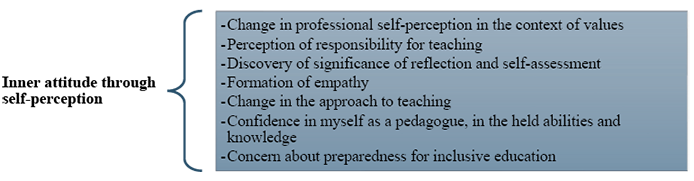
When developing the perception of responsibility for teaching, it is emphasised that it includes not only the transfer of knowledge, but also the provision of equal opportunities for every school student to fulfil himself/herself, while respecting the uniqueness of everyone, responsibility for the success and emotional, social well-being of every child (see Fig. 6). It should be noted that the well-being of school students is one of the most important features of inclusive education as well as a factor in the successful (self-)education of every school student, including those with disabilities (Downes et al., 2017). When reflecting on the ethical responsibilities of a teacher, the importance of comprehensive education and the possibility of self-development can be seen: “The study subject also allows us to understand the ethical responsibilities of a teacher, which is not only to provide knowledge, but also to develop responsibility, independence, respect and critical thinking. At the same time, it works as a tool for self-developing responsibility, respect and critical thinking” (PUP-31). It can be assumed that the implementation of ethical attitudes in educational practice that one is aware of is manifested by the teacher’s commitment to create a responsive learning environment, to notice and observe the effect of the applied teaching methods on school students, etc.
Scientific literature reveals that “reflection is beneficial for the reflection of the self because each repeatedly reflected thought encourages one to adjust his/her thoughts, activities, attitudes and personal relationship with the object. By reflecting, a person ascertains his/her successes and failures, the quality of goal achievement, the emotional relationship with the reflected activity etc., all of which encourage a deliberate commitment to reflect more often on his/her actions, arising thoughts, as well as an in-depth approach to the situation” (Žibėnienė, 2023, p. 423). These insights are supported by the results of the empirical study which conceptually suggests that teachers discover the significance of reflection and self-assessment for the development of self-perception during the retraining studies (see Fig. 6). It has been noted that studies encourage more frequent reflection on one’s pedagogical performance, attitudes, professional abilities and personal qualities, (self-)assessment of one’s strengths and areas for improvement. Such self-perception inspires a better understanding of one’s strengths and preparation/inner disposition to apply them in practice: “The knowledge gained during my studies helped me to better understand/perceive myself. I unexpectedly revealed my strengths and weaknesses. I found out what I lacked, in which areas I felt myself insecure and became more self-confident because I tried to compensate the lack of knowledge by gaining experience from university teachers and peers. Because of this experiential learning, I felt myself stronger and the awareness that I’m not the only one who doesn’t know some things encouraged me to more actively apply the principles of inclusive and personalised education not only in my professional activities, but also in my personal life” (PUP-9). Teachers claim that the study process and content, reflection of these components in the context of their own experience help them to notice and see inclusive education situations more broadly, from different perspectives, or from another angle, to see their mistakes and learn to react/act professionally: “I saw my mistakes of the last year, when I could approach a boy with special needs, though not officially identified, from a different angle and help him more effectively to be with other children, so that he could feel being less excluded as much as possible (that boy was transferred to another school after a few months, I failed to include him in the educational process and help him create a bond with his peers, and I feel some kind of guilt about that). Because of this module, I saw the mistakes I made, and I am already trying not to repeat them” (IPUP-17). The research results suggest that reflection is “useful for teachers due to the analysis of the lived experience and the process of self-cognition, the result of which is the broadening of knowledge about myself” (Žibėnienė, 2023, p. 424). According to Pollard (2002), a critical look at one’s performance, assessment of it, identification of its strengths and weaknesses is possible through reflective thinking; hence, it can be stated that reflection becomes a condition for learning from personal pedagogical experience.
“The essential values of inclusive education are tolerance, respect for school student diversity; equitable participation of all school students; attention to personality and different individual needs; recognition of every child’s potential and high expectations for every learner.” (Kaffemanienė, 2023, p. 13). The content of the teachers’ reflections reveals that the studies of the subject “Inclusive and Personalised Education” create prerequisites for the (self-)development of empathy: “At a personal level, I am more aware, I realise the importance of my actions as a teacher and the clarity of my decisions – more empathy, flexibility, dedication and the wish to nurture and grow myself” (PUP-5); moreover, they also are associated with a change in the attitude towards teaching (see Fig. 6). The content of the aforementioned values of inclusive education is met by the inner attitude constructed by teachers towards teaching as a more empathetic and socially responsible activity, where the teacher’s values (namely, respect, empathy, openness to diversity, emotional well-being, etc.) are positioned as key factors of the quality of education and the success of school students. It should be noted that this process is of a transformative nature, as it marks a break in professional self-perception and presupposes the ‘reloading’ of the teacher’s role – a transformation from the old to the new one: “The turning point happened when I stopped fighting against the old, established role of a teacher and decided to take the position of a teacher-consultant in the classroom and retained only a very small part of the old role of an information provider. I also realised that it was necessary to open as many doors to ingenuity and creativity as possible. This module and the current work situation shook me up from my lethargic sleep: I had to remember the competence of lifelong learning and admit that I still need to improve in many aspects and continuously search for new, innovative teaching methods in order to better respond to the needs of school students” (PUP-9).
Changes at a personal level inspire self-confidence in myself as a teacher, in my abilities and knowledge, and, at the same time, this raises a stronger wish to improve in order to ensure the right of every school student (child) to quality education: “(...) It encouraged me to rethink my own approach to my professional role. Now I feel more self-confident and having a stronger wish to improve in order to ensure every child’s right to quality education” (PUP-24). On the other hand, by reflecting the dynamics of the wider professional field, teachers express their concern about the preparedness for inclusive education (see Fig. 6). “Inclusion (physical integration) and the right to be in common educational spaces are seen as an essential condition for the development of inclusive education. However, only being physically present in common spaces is not enough. It is important to ensure the school student’s active and meaningful participation in the educational process, in joint activities with peers, the right and possibility to be accepted, to feel being part of the classroom and school community, to play a significant role in the community life” (Miltenienė et al., 2020, p. 58). The teachers who took part in the research emphasise the need to adapt the physical environment of educational institutions to all participants in the educational process: “(...) speaking of the physical environment, some educational institutions still do not have an environment created for the educational process (maladjusted uncomfortable doors, lifts are not installed, etc.) for all participants with special needs” (IPUP-10). There is also concern about the potential insufficiency of specific knowledge, time and other resources, likely difficulties in adapting the educational process and also in school students adapting to continuous changes in order to ensure the necessary support for every student: “(…) raises concern because such education may become complicated to both teacher and school student. It may be difficult for a teacher to adapt different educational strategies to everyone, and it can be difficult for learners to adapt to constantly changing tasks and methods. Sometimes I fear that there won’t be enough resources or time to provide all school students with the support they need” (IPUP-20). It should be noted that these insights resonate with the conclusions of the study carried out by Subačiūtė et al. (2022, p. 27) stating that “[t]here is a lack of additional staff in schools to ease the workload of teachers and educational support specialists. The optimal number of staff would allow school students with special educational needs to be given more individual classes or help in the mainstream education process. The study shows that both teachers and educational support specialists naturally feel overworked, personally accept the problems arising in the educational process due to the constantly growing number of school students with special educational needs and a lack of specialists, excessive documentation, making every effort to respond to the needs of every student”.
The content of the category Continuous Improvement in the Field of the Teaching Profession reveals that pedagogues experience and realise the importance of continuous improvement not only at a personal level, but also at a broader professional level during the retraining studies (see Fig. 7).
Fig. 7.
(Re-)construction of importance of the continuous development of a teacher

Continuous improvement is positioned as a necessity in connection with the variability of the educational process (see Fig. 7) and with the responsibility for teaching, professional obligations: “Studies of the subject can have a significant impact on both professional and personal self-perception and improvement. I cannot say I am not responsible, but it was these studies that helped me to view responsibility from other perspectives. I am talking about pedagogical responsibility and the importance of continuous improvement. (...). For this reason, it is extremely important to responsibly assess own professional obligations. This stimulates the implementation of one’s professional obligations. Therefore, it is very important to continuously strive for improvement, which not only ensures professional, but also personal growth, strengthening of value attitudes” (PUP-31).
The content of the category Personal Vision: What Kind of Teacher I Want to Be under deconstruction reveals that the retraining studies (in the context of the study subject “Inclusive and Personalised Education”) encouraged teachers to look at themselves in a broader perspective and to see themselves not only as teachers, but also as individuals – leaders who seek positive changes: “Value-based changes also allowed me to see myself not only as a teacher, but also as a person who can make a positive change in a wider context” (PUP-30) (see Fig. 8). These insights correspond to the ideas of Booth and Ainscow (2002), paraphrased by Lithuanian scholars (Miltenienė et al., 2020), claiming that, in order to achieve changes in educational practice, it is important to ensure responsible and committed leadership which aims at creating the culture, policy and practice of inclusive education at various levels; to take a holistic approach to the individual and education; to ensure the availability of information and physical environments; to create a beneficial for learning environment; to differentiate, individualise, and personalise education; to provide assistance to everyone, while taking into account the individual needs of school students, etc.
Fig. 8.
Construction of the personalised vision of a teacher

As can be seen in Figure 8, the personalised vision is developed in connection with a wish to be an empathic teacher, with a greater motivation to help school students, to build an enabling educational environment, i.e., to improve and search for new ways to meet the individual needs of school students, to contribute to their overall success: “As for me, I became more sensitive to school students’ experiences and challenges, I realised how important it is to take into account their unique situation. This knowledge encouraged me to try even harder to meet their individual needs and search for ways to contribute to their success both in and outside of school” (PUP-30). It can be declared that the content of a personal vision constructed by teachers responds to the principle of inclusive education, which is associated with a holistic approach to the needs of school students, that is, with the aim to identify, recognise and comprehensively meet the social, emotional and other needs of every school student, and not only academic needs (Downes et al., 2017).
To conceptualise the results of the study, it can be stated that teachers (re-)construct the values that are relevant to the professional field when they have the opportunity to reflect on their existing and newly acquired experience during the retraining studies. The content of the experiences reflected by the teachers reveals that a developed perception of the educational process presupposes the need to look back at the concept of the role of a teacher and construct the content of the role meeting a new, changed perception (a teacher is not only a transmitter of knowledge), in connection with evolving self-perception. Changes at a personal level (extension of pedagogical responsibility, discovery of the significance and need for reflection, formation of empathy, etc.) inspire transformation of the attitude to teaching, professional confidence, insights into the dynamics of the wider professional field and awareness of continuous improvement as a necessity of the teaching profession. In this context, the inward question is asked: “What kind of teacher do I want to be?”, and a personalised vision of a pedagogue responding to the changed values is being (re-)constructed.
Conclusions
The (re-)construction of teachers’ value attitudes during their retraining studies has most clearly been revealed in two main directions. The first direction is associated with the concept of inclusion treated as one of the key value-based philosophies and educational strategies of contemporary education. The second direction is related to the teacher’s reflection on one’s professional identity field encompassing a new perception of the self as a teacher and an individual personality, as well as the redefinition of the role of the profession.
The manifestation of inclusion as a key aspect of education was revealed through the dimensions of importance of enablement and inclusion, when teachers associate enablement with the identification of the child’s capabilities, recognition of them and provision of conditions for the development and consolidation of these capabilities. Teachers emphasise the importance of the values of inclusion: recognition of diversity, creation of a tolerant environment, fostering of respect in the educational process, as these are among the main conditions of quality education. As declared by the teachers, the understanding of the human rights in the process of education was consolidated during the studies; the importance of collaboration and communication was pointed out by teachers in their reflections in terms of collaboration with colleagues, parents and the development of teamwork. During the retraining studies, the attitude of teachers towards diversity in their classrooms, groups and educational institutions also changed. The teachers began understanding the diversity as an added value and an opportunity to enrich the educational process with value-based attitudes. Acceptance and valuing of the uniqueness of every school student was emphasised by the teachers as one of the strategies for the successful implementation of inclusive education. At the same time, the informants emphasised the importance of creating a favourable learning environment for every school student along with the need to create an environment where every school student feels accepted and valued.
The content of the teachers’ reflections reveals that the perception of the educational process is developed by emphasising the beneficial aspect of the educational environment for every participant of the process, education as a comprehensive and individualised/personalised process, and the importance of creativity for inclusion. This development of perception stimulates the rethinking of the role of a teacher – from knowledge transfer to holistic education, focused on the diversity of school students and social responsibility. The results of the study prove that changes at a personal level of teachers inspire professional transformation. The development of the awareness of pedagogical responsibility, the discovery of the significance of reflection and self-assessment, the formation of empathy show that the change of value attitudes takes place not only at a professional but also at a personal level. These changes presuppose a new approach to teaching, enhance professional confidence and insight into the dynamics of both local and broader professional field, and also allow elaboration on (un-)preparedness for inclusive education.
The research reveals that not only value attitudes change, but also an understanding of continuous improvement as necessity of the teaching profession in the context of the variability of the educational process, responsibility for teaching and professional obligations are being (self-)formed during the retraining studies. Responding to the changed value attitudes, teachers construct a personalised professional vision which highlights the teacher’s leadership in striving for positive changes, motivation to help school students by meeting their individual needs, creating an enabling educational environment, etc. This shows that the change at the level of value attitudes is related to the formation of professional identity.
The reconstruction of teachers’ values can be positioned as a key part in the retraining studies. The findings of the qualitative research prove that, on the basis of having an opportunity to reflect on their pedagogical activities, attitudes, professional skills and personal qualities in the context of the study process and content, teachers (re-)construct the value-based attitudes that are relevant to the professional field. Reflection becomes a significant tool that allows the integration of existing and newly acquired experiences, and also provides prerequisites for making the process of value-based transformation visible. This means that the change in value-based attitudes is inseparable from reflection, which, in the context of the study, can be identified as a catalyst of value-based transformation which is significant for the formation of the professional identity.
Author Contributions
Regina Karvelienė: conceptualization, methodology, formal analysis, investigation, writing – original draft, writing – review and editing, visualization.
Kristina Rūdytė: conceptualization, methodology, formal analysis, investigation, writing – original draft, writing – review and editing, and visualization.
References
Adams, D., Harris, A. & Jones, M. S. (2018). Teacher-Parent Collaboration for an Inclusive Classroom: Success for Every Child. MOJES: Malaysian Online Journal of Educational Sciences, 4(3), 58–72. https://ejournal.um.edu.my/index.php/MOJES/article/view/12657
Berger, P. L., & Luckman, T. (1966). The Social Construction of Reality: A Treatise It’s the Sociology of Knowledge. Anchor Books.
Boyle, C., Anderson, J., & Allen, K. A. (2020). The Importance of Teacher Attitudes to Inclusive Education. In C. Boyle, J. Anderson, A. Page & S. Mavropoulou (Eds.), Inclusive Education: Global Issues and Controversies (pp. 127–146). Brill. https://doi.org/10.1163/9789004431171_008
Bubnys, R. & Žydžiūnaitė, V. (2012). Reflektyvus mokymas(is) aukštosios mokyklos edukacinėje aplinkoje. Mokslo studija [Reflective Teaching and Learning in Educational Environment of a Higher Education Institution. A Scientific Study]. Šiaulių valstybinė kolegija, Vytauto Didžiojo universitetas.
Charitaki, G., Kourti, I., Gregory, J. L., Ozturk, M., Ismail, Z., Alevriadou, A., Soulis, S.-G., Sakici, Ş. & Demirel, C. (2022). Teachers’ Attitudes Towards Inclusive Education: a Cross-National Exploration. Trends in Psychology, 32, 1120–1147. https://doi.org/10.1007/s43076-022-00240-0
Chugh, R. (2015). Do Australian Universities Encourage Tacit Knowledge Transfer? In Proceedings of the 7th International Joint Conference on Knowledge Discovery, Knowledge Engineering and Knowledge Management (IC3K 2015) (pp. 128–135). Knowledge Engineering and Knowledge Management. https://doi.org/10.5220/0005585901280135
Dignath, C., Rimm-Kaufman, S., van Ewijk, R., & Kunter, M. (2022). Teachers’ Beliefs about Inclusive Education and Insights on What Contributes to Those Beliefs: A Meta-Analytical Study. Educational Psychology Review, 34, 2609–2660. https://doi.org/10.1007/s10648-022-09695-0
Downes, P., Nairz-Wirth, E., & Rusinaitė, V. (٢٠١٧). Structural Indicators for Inclusive Systems in and Around Schools: NESET II report. Publications Office of the European Union. https://doi.org/10.2766/200506
Elo, S. & Kyngäs, H. (2008). The qualitative content analysis process. Journal of Advanced Nursing, 62(1), 107–115. https://doi.org/10.1111/j.1365-2648.2007.04569.x
European Parliament & Council. (2006). Recommendation of the European Parliament and of the Council of 18 December 2006 on Key Competences for Lifelong Learning. Official Journal of the European Union, L 394, 10–18. https://eur-lex.europa.eu/LexUriServ/LexUriServ.do?uri=OJ:L:2006:394:0010:0018:en:PDF
Francisco, M. P. B., Hartman, M., & Wang, Y. (2020). Inclusion and Special Education. Education Sciences, 10(9), Article 238. https://doi.org/10.3390/educsci10090238
Gadamer, H.-G. (2006). Classical and Philosophical Hermeneutics. Theory, Culture & Society, 23(1), 29–56. https://doi.org/10.1177/0263276406063228
Gerrish, K., Lacey, A. & Cormack, D. (Eds.) (2010). The Research Process in Nursing (6th ed.). John Wiley & Sons, Incorporated.
Habermas, J. (2002). Modernybės filosofinis diskursas [The Philosophical Discourse of Modernity]. Alma littera.
Kaffemanienė, I. (2023). Įtraukiojo ugdymo gairės ir pedagoginės strategijos [Guidelines for Inclusive Education and Teaching Strategies]. In I. Kaffemanienė, R. Kantanavičiūtė-Petružė, G. Musteikienė, M. Jurevičienė, L. Giedraitienė, A. Žymantienė, L. Tomėnienė, I. Bilbokaitė-Skiauterienė & R. Bilbokaitė, Specialioji pedagoginė pagalba tvariam švietimui personalizuoto ugdymo kontekste [Special Pedagogical Support for Sustainable Education in the Context of Personalised Education] (pp. 7–50). Vilniaus universiteto leidykla.
Kivirand, T., Leijen, Ä., Lepp, L., & Malva, L. (2020). The meaning of inclusive education and factors for effective implementation in the Estonian context: a view of specialists who train or advise teachers. Estonian Journal of Education, 8(1), 48–71. https://doi.org/10.12697/eha.2020.8.1.03
Leijen, Ä., Arcidiacono, F., & Baucal, A. (2021). The Dilemma of Inclusive Education: Inclusion for Some or Inclusion for All. Frontiers in Psychology, 12, Article 633066. https://doi.org/10.3389/fpsyg.2021.633066
Miltenienė, L., Kaffemanienė, I., Melienė, R., Kairienė, D., Geležinienė, R. ir Tomėnienė, L. (2020). Specialusis ugdymas ir jo transformacijos įtraukiojo švietimo kontekste. Monografija [Special Education and Its Transformations in the Context of Inclusive Education. A Monograph]. Šiaulių universitetas.
Murphy, L., Espily, M. S., Auer, P., & Santilli, T. (2025). The role of values. In A community project from all-means-all.education (Ed.), All means all! – OpenTextbook for diversity in education. All Means All. https://book.all-means-all.education/ama-2025-en/chapter/the-role-of-values/
Peltier, J. W., Hay, A., & Drago, W. (2005). The Reflective Learning Continuum: Reflecting on Reflection. Journal of Marketing Education, 27(3), 250–263. https://doi.org/10.1177/0273475305279657
Perrin, A.-L., Jury, M., & Desombre, C. (2021). Are teachers’ personal values related to their attitudes toward inclusive education? A correlational study. Social Psychology of Education, 24(4), 1085–1104. https://doi.org/10.1007/s11218-021-09646-7
Petrauskienė, A. & Raudeliūnaitė, R. (2012). Supervizijos taikymas socialinio darbo studijose: mokslo studija [Application of Supervision in Studies of Social Work: A Scientific Study]. Mykolo Romerio universitetas.
Polanyi, M. (1966). The Tacit Dimension. University of Chicago Press.
Pollard, A. (2002). Refleksyvusis mokymas: veiksminga ir duomenimis paremta profesinė praktika [Reflective Teaching: Effective and Data-Based Professional Practice]. Garnelis.
Ramberg, J., & Watkins, A. (2020). Exploring inclusive education across Europe: Some insights from the European Agency Statistics on Inclusive Education. FIRE: Forum for International Research in Education, 6(1), 85–101. https://doi.org/10.32865/fire202061172
Ramsden, P. (2000). Kaip mokyti aukštojoje mokykloje [How to Teach in Higher Education]. Aidai.
Ricoeur, P. (2000). Interpretacijos teorija. Diskursas ir reikšmės perteklius [Interpretation Theory: Discourse and the Surplus Meaning]. Baltos lankos.
Ricœur, P. (2001). Egzistencija ir hermeneutika. Interpretacijų konfliktas [Existence and Hermenutics. The Conflict of Interpretations]. Baltos lankos.
Rupšienė, L. (2007). Kokybinio tyrimo duomenų rinkimo metodologija [Methodology for Collecting Qualitative Research Data]. Klaipėdos universiteto leidykla.
Ruškus, J. (2002). Negalės fenomenas [Phenomenon of Disability]. Šiaulių universiteto leidykla.
Saloviita, T. (2020). Teacher attitudes towards the inclusion of students with support needs. Journal of Research in Special Educational Needs, 20(1), 64–73. https://doi.org/10.1111/1471-3802.12466
Slušnys, L. & Šukytė, D. (2016). Ką gali mokytojas [What a Teacher Is Capable of]. Tyto alba.
Khakimov, S., & Choriyeva, V. (2023). The place and significance of inclusive education in modern educational processes. Journal of Entrepreneurship and Pedagogy, 1(1), 116–118. https://doi.org/10.5281/ZENODO.10158895
Subačiūtė, J., Daunoravičiūtė, E., Lapinskaitė, L. & Cibulskis, A. (2022). Mokytojų ir švietimo pagalbos specialistų praktinių patirčių taikant universalaus dizaino priemones ugdymui(si) analizė [Analysis of Practical Experiences of Teachers and Educational Support Specialists Applying Universal Design Measures for Teaching and Learning]. Nacionalinė švietimo agentūra. https://www.nsa.smsm.lt/wp-content/uploads/2025/08/buf_Universalaus-dizaino-priemones-ugdymuisi-1.pdf
Universalaus dizaino mokymuisi gairės: mokymosi kelias kiekvienam ir kiekvienai [Guidelines of Universal Design for Learning: the Path of Learning for Everyone]. (2023). Europos socialinio fondo agentūra [European Social Fund Agency].
Van Kessiel, R., Hrzic, R., Cassidy, S., Brayne, C., Baron-Cohen, S., Czabanowska, K. & Roman-Urrestarazu, A. (2021). Inclusive Education in the European Union: A Fuzzy-Set Qualitative Comparative Analysis of Education Policy for Autism. Social Work in Public Health, 36(2), 286–299. https://doi.org/10.1080/19371918.2021.1877590
Väyrynen, S., & Paksuniemi, M. (2020). Translating Inclusive Values into Pedagogical Actions. International Journal of Inclusive Education, 24(2), 147–161. https://doi.org/10.1080/13603116.2018.1452989
Žibėnienė, G., & Barkauskaitė, M. (2018). The Reflection Experience of Future Teachers as Professional Improvement Tool. Pedagogika, 130(2), 64–75. https://doi.org/10.15823/p.2018.22
Žibėnienė, G. (2023). Refleksija ir įsivertinimas socioedukacinės pagalbos praktikoje [Reflection and Self-assessment in Practice of Socioeducational Support]. In V. Gudžinskienė, N. Kurapkaitienė, O. Merfeldaitė, A. Petrauskienė, A. Railienė, J. Sadauskas, I. Žemaitaitytė & G. Žibėnienė, Multidimensinė socioedukacinė pagalba [Multidimensional Socioeducational Support] (pp. 420–471). Mykolo Romerio universitetas.
Žydžiūnaitė, V. & Sabaliauskas, S. (2017). Kokybiniai tyrimai. Principai ir metodai [Qualitative Methods. Principles and Methods]. Vaga.