Social Welfare: Interdisciplinary Approach eISSN 2424-3876
2026, vol. 16, pp. 113–137 DOI: https://doi.org/10.15388/SW.2026.16.6
The Model of Successful Interorganizational Collaboration in Digital Inclusion Field
Kristina Kulikauskienė
Šiauliai State Higher Education Institution, Lithuania
E-mail: k.kulikauskiene@svako.lt
https://orcid.org/0000-0001-7350-1218
https://ror.org/01w69qj84
Diana Šaparnienė
Klaipėda University, Lithuania
E-mail: diana.saparniene@gmail.com
https://orcid.org/0000-0002-0597-3309
https://ror.org/027sdcz20
Abstract. The aim of this article is to reveal the critical success factors of interorganizational collaboration in increasing digital inclusion in public libraries and to create a theoretical model of successful interorganizational collaboration. The theoretical significance of the study lies in integrating and extending existing knowledge on interorganizational collaboration by synthesizing relevant literature and applying the quadruple helix model to the field of digital inclusion. By using the constructivist grounded theory methodology, 21 semi-structured interviews were conducted with representatives of public libraries, higher education institutions, local government bodies, NGOs, businesses, and digital inclusion experts. Based on the formed grounded theory, this model reveals the critical success factors of interorganizational collaboration: mutuality, the integration of contractual and relational governance mechanisms, and collaborative capability, which were identified as having the greatest influence on the criteria for the success of interorganizational collaboration: the achievement of collaboration goals, ensuring the sustainability of the results achieved, and partner satisfaction with the collaboration process. The practical significance of the study lies in providing a structured framework and actionable insights for public libraries and their partners to design, manage, and sustain effective collaborative initiatives that promote digital inclusion at the community level and thus contribute to the well-being of society.
Keywords: Interorganizational collaboration, critical success factors, digital inclusion, well-being of society.
Recieved: 2026-01-14. Accepted: 2026-04-07
Copyright © 2026 Kristina Kulikauskienė, Diana Šaparnienė. Published by Vilnius University Press. This is an Open Access journal distributed under the terms of the Creative Commons Attribution 4.0, which permits unrestricted use, distribution, and reproduction in any medium, provided the original author and source are credited.
Introduction
Today’s world is facing complex global problems that cannot be solved by the efforts of individual organizations alone. This highlights the need for interorganizational collaboration, which can unite separate organizations for common goals, help create new services and products, open up opportunities to acquire additional resources, share existing knowledge, and create new knowledge. In order to achieve this ambition, the process of interorganizational collaboration must be successful, i.e., it must enable the collaborating organizations to achieve their intended goals. Researchers studying interorganizational collaboration (Thomson & Perry, 2006; Parent & Harvey, 2009; Chen, 2010; Chen & Grady, 2010; Bryson, Crosby, & Stone, 2015; Mattessich & Johnson, 2018; Miller-Stevens & Taylor, 2020; etc.) note that its success can be influenced by various factors, such as a favorable environment, appropriate partner characteristics, formal and informal management mechanisms, clearly defined partner roles, responsibilities, and commitments, developed trust, effective leadership, timely communication, partner involvement in the implementation of joint activities, sharing of benefits, evaluation of results achieved, etc. A successful interorganizational collaboration process enables the potential of several organizations to be pooled in addressing issues such as poverty, social exclusion and economic inequality (Hardy, Phillips, & Lawrence, 2003; Mitchell, O’Leary, & Gerard, 2015; Keyton, 2017; Miller-Stevens & Taylor, 2020). In this context, another problem relevant to today’s society becomes apparent: the lack of digital inclusion.
The need to increase digital inclusion became particularly apparent during the global COVID-19 pandemic and was further highlighted by the crisis in Ukraine, when it became important not only to have access to the internet and digital technologies, but also to be able to use digital services and products purposefully, to learn, work, communicate remotely, use digital e-government services, critically evaluate and safely handle information presented in the virtual space, be resistant to cyber-attacks, and have sufficient media and information literacy skills (Bertot, 2016; Wood & Grace, 2017; Gallardo, Beaulieu, & Geideman, 2020; Defitri et al., 2020; Strover et al., 2020; Malodia et al., 2021; Mavriki & Karyda, 2022; Milakovich, 2022). In a broad sense, the goals of increasing digital inclusion can be linked to improved well-being of society members, lifelong learning, creating opportunities for civic and economic participation, an increasing use of e-government and other digital public services, improving their accessibility, and promoting safe behavior in the digital space, with an emphasis on equality and the opportunity for everyone, without exception, to participate in activities aimed at increasing digital inclusion (Traunmüller & Wimmer, 2003; Galindo, 2004; Navarra & Cornford, 2005; Urs, 2013; Galindo, 2014; Galindo & Garcia, 2017;Traunmüller, 2017; Gann, 2019; Gallardo, Beaulieu, & Geideman, 2020; Johnston, 2020; Milakovich, 2022; Malodia et al., 2021). This diversity of objectives means that different parties are interested in increasing digital inclusion: international and national policy-making organizations, local government institutions, public libraries, other public sector organizations (employment services, social service centers, educational and social care institutions, etc.), non-governmental organizations, businesses, higher education institutions, and society and its individual members (Mariën & Van Audenhove, 2012; Damodaran et al., 2015; Bertot, 2016; Graves & German, 2018; Reid, 2019; Holgersson, Söderström, & Rose, 2019). By engaging in interorganizational collaboration, they can share their resources, improve the digital services they provide, increase their accessibility, and encourage society members to become more actively involved in activities that promote digital inclusion (Luterek, 2017; Gregg & McKendry, 2018; Graves & German, 2018). Public libraries play a particularly important role, as they perform one of the main functions and directly contribute to increasing digital inclusion, by providing free access to the internet and digital technologies, developing the digital, media and information literacy skills, offering digital services, creating digital products, etc. (Gallardo, Beaulieu, & Geideman, 2020; Strover et al., 2020). By engaging in interorganizational collaboration with other organizations interested in increasing digital inclusion, public libraries can improve the quality of services, improve their accessibility, reach members of society who lack digital skills, etc. (Bertot, 2016; Wood & Grace, 2017; Gallardo, Beaulieu, & Geideman, 2020; Strover et al., 2020; etc.).
However, organizations collaborating in the field of increasing digital inclusion face various challenges related to the selection of suitable partners, partner compatibility, effective collaboration management, partner involvement in decision-making procedures, insufficient attention to building and maintaining trust, developing communication processes, and involving stakeholders. Collaboration often lacks leadership, partners are not sufficiently involved in the implementation of joint activities, risk sharing, the benefits of collaboration may be not foreseen for each partner, the results achieved during collaboration are not evaluated, their continuity is not ensured, and the partners’ opinions on the collaboration process are not investigated (Rowley, 2011; Buchanan et al., 2012; Moxley & Abbas, 2016; Nicholson, 2019; Merga, 2019; etc.). These barriers can negatively affect the collaboration process and limit the possibilities of achieving the main goal that unites the partners – to increase digital inclusion in public libraries. To identify opportunities for overcoming these challenges, it is important to develop a model of successful interorganizational collaboration by revealing which factors influencing collaboration can be identified as the critical success factors that organizations collaborating in the field of increasing digital inclusion in public libraries should focus on to maintain a successful collaboration process that enables the achievement of the set goals.
The research problem is formulated as follows: What are the critical success factors for interorganizational collaboration, how do they help achieve collaboration goals, and increase digital inclusion in public libraries? The object of scientific research is the process of interorganizational collaboration and its critical success factors in the field of increasing digital inclusion.
The aim of this article is to reveal the critical success factors of interorganizational collaboration in increasing digital inclusion in public libraries and to create a theoretical model of successful interorganizational collaboration.
To achieve this aim, the following objectives are set: 1) to examine the theoretical dimensions of interorganizational collaboration and the factors influencing it in the field of increasing digital inclusion in public libraries; 2) to analyze the process of interorganizational collaboration in increasing digital inclusion in public libraries, to identify its critical success factors, and to create the theoretical model of successful interorganizational collaboration.
In the theoretical part of the article, scientific literature sources that study the process of interorganizational collaboration and the factors influencing it are analyzed, synthesized, and summarized. In the empirical part of the article, by applying the methodology of constructivist grounded theory, the process of interorganizational collaboration in increasing digital inclusion in public libraries is analyzed, its critical success factors are identified, and the theoretical model of successful interorganizational collaboration in increasing digital inclusion in public libraries is presented.
Theoretical framework
Digital inclusion increase can be considered a complex problem that requires the contribution of various parties, such as public sector organizations, including public libraries, businesses, NGOs, and society and its individual members (Ragnedda & Rui, 2017; Noh, 2019; Gallardo, 2019; Strover et al., 2020; Gallardo, Beaulieu, & Geideman, 2020). One of the most important organizations in the field of increasing digital inclusion are public libraries, which provide free access to ICT and the internet, develop the digital literacy skills of the society members, and provide access to a wide range of digital services (Real, Bertot, & Jaeger, 2014; Moxley & Abbas, 2016; Rutherford et al., 2018; Strover et al., 2020). By engaging in interorganizational collaboration with other organizations interested in increasing digital inclusion, public libraries can increase the sustainability of their digital inclusion programs and services, improve their quality, increase accessibility, encourage a greater user engagement in digital inclusion initiatives, increase the use of digital e-government services by members of the public, and contribute to the well-being of society by reaching the most digitally excluded groups (Traunmüller & Wimmer, 2003; Damodaran et al., 2015; Traunmüller, 2017; Gann, 2019; Strover et al., 2020). To achieve these goals, the process of interorganizational collaboration between public libraries and other organizations interested in increasing digital inclusion must be successful, i.e., it must enable the collaborating partners to achieve the set goals (Buchanan et al., 2012; Gwyn, 2016; Bryson, Crosby, & Stone, 2015; Mattessich & Johnson, 2018; Batti, 2019).
Stakeholders involved in increasing digital inclusion represent the four spheres of the quadruple helix (see Fig. 1), an innovation creation and collaboration model with a society and consumer-oriented perspective: government sector organizations, business enterprises, academia, and society (Carayannis & Campbell, 2009; Kaletka & Pelka, 2015; Domanski & Kaletka, 2017; Kriz, Bankins, & Molloy, 2017;McAdam, Miller, & McAdam, 2018; Marques et al., 2020; Hasche, Höglund, & Linton, 2020; Hernández-Pérez, Vilariño, & Domènech, 2020). These organizations carry out different activities, make different contributions to solving digital inclusion problems, and have different benefits as digital inclusion increases. However, by engaging in interorganizational collaboration, they can pool their resources, experience, and potential and work together to achieve a common goal (Ilse & Leo, 2012; Damodaran et al., 2015; Bertot, 2016; Graves & German, 2018; Reid, 2019; Holgersson, Söderström, & Rose, 2019).
Figure 1.
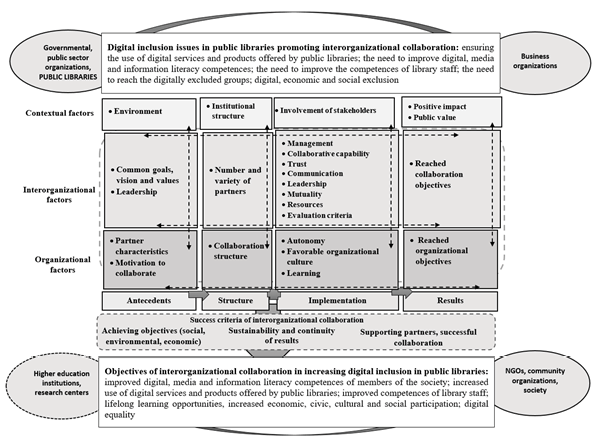
The factors influencing the process of interorganizational collaboration among stakeholders operating in the quadruple helix in the field of digital inclusion increase in public libraries
Source: compiled by the authors based on Kaletka and Pelka (2015), Bryson, Crosby, and Stone (2015), Mattessich and Johnson (2018), Carayannis et al. (2018), Velten, Jager, and Newig (2021), etc.
The information presented in Figure 1 shows that, in order to address the issues related to increasing digital inclusion in public libraries, and thus contributing to the well-being of society, the following stakeholders are involved in interorganizational collaboration in the quadruple helix: the first sphere consists of governmental organizations, local government institutions, public libraries, and other public sector organizations (employment services, social service centers, educational and social care institutions, etc.), the second sphere is made up of business organizations, and the third sphere is constituted of higher education institutions and research centers, which are not directly included in the implementation of core activities (marked with a dotted line), but on research into general trends and consumer needs in the digital inclusion field. Whereas, the fourth sphere of the helix contains NGOs, community organizations, and society and its individual members, who are directly involved in the digital inclusion activities offered by public libraries, they use ICT, digital services and products, improve their digital, media and information literacy skills, etc. (Kaletka & Pelka, 2015; Ilse & Leo, 2012; Beyene, 2018; Holgersson, Söderström, & Rose, 2019; Strover et al., 2020). By implementing digital inclusion activities (notably, by providing free access to ICT and the internet, digital services, including e-government, creating new digital services and products, improving the digital, media, and information literacy skills of society members, implementing project activities and other initiatives focused on increasing digital inclusion, etc.), public libraries face challenges that include issues related to the continuity and sustainability of digital inclusion activities, programs, and project activities, the lack of motivation among the society members to participate in the digital inclusion activities, the difficulties in reaching socially excluded groups (seniors, people with disabilities, the unemployed, etc.), issues related to improving the competencies of the library staff necessary for the implementation of digital inclusion activities, etc. (Buchanan et al., 2012; Real, Bertot, & Jaeger, 2014; Real et al., 2014; Gwyn, 2016; Bertot, 2016; Bertot, 2016; Borg & Smith, 2018; Manžuch & Macevičiūtė, 2019). These barriers can be overcome by developing a process of interorganizational collaboration, harnessing the potential of organizations operating in the first, second, third, and fourth spheres of the quadruple helix, pooling available resources, involving partners in the implementation of joint activities and working together towards a common goal – that of increasing digital inclusion in public libraries (Rutherford, Singleton, Derr, & Merga, 2018; Manžuch & Macevičiūtė, 2019; Strover, Whitacre, Rhinesmith, & Schrubbe, 2020).
Figure 1 shows that interorganizational collaboration in the field of increasing digital inclusion in public libraries can be understood as a process lasting a certain period of time, or a continuum with distinct stages or micro-processes associated with the antecedents, structures, implementation, and results of collaboration (Thomson & Perry, 2006; Parent & Harvey, 2009; Bryson, Crosby, & Stone, 2015; Miller-Stevens & Taylor, 2020). As shown in Figure 1, there are various contextual, interorganizational, and organizational factors that can influence collaboration at different stages. The contextual factors influencing interorganizational collaboration at the antecedents stage are related to the external environment and include the cultural, social, economic, and political systems in which organizations operate. These factors are important for interorganizational collaboration because they reflect the changing expectations of the societies in which organizations operate, the requirements of external organizations, library founders, etc. Therefore, collaborating organizations must be able to respond to these changes in a timely manner. At the stage of collaboration structures, collaboration may be influenced by such factors as institutional structure, at the implementation stage – by the involvement of stakeholders, and, at the results stage – by the positive impact of collaboration on the external environment and the creation of public value (Buchanan et al., 2012; Bertot, 2016; Schöttle, Haghsheno, & Ghbauer, 2014; Glowacki-Dudka & Murray, 2015; Bryson, Crosby, & Stone, 2015; Diaz-Kope et al., 2015; Gwyn, 2016; Seaton et al., 2018; Mattessich & Johnson, 2018).
Interorganizational factors influencing collaboration include: common goals, vision, and values, as well as leadership in the antecedents stage; a certain number and variety of partners in the structures stage; collaboration management; collaborative capability, trust, communication, leadership, mutuality, resources, evaluation criteria at the implementation stage, and reached collaboration objectives at the results stage (Bryson, Crosby, & Stone, 2015; Diaz-Kope et al., 2015; Gwyn, 2016; Seaton et al., 2018; Mattessich & Johnson, 2018; Nicholson, 2019; Miller-Stevens & Taylor, 2020; etc.).
Organizational factors that may influence collaboration include such aspects as the characteristics of partners and their motivation to collaborate at the antecedents stage, the structure of collaboration as a process at the collaboration structures stage, autonomy, a favorable organizational culture, and learning at the implementation stage, and achieved collaboration objectives at the results stage (Bryson, Crosby, & Stone, 2015; Gwyn, 2016; Seaton et al., 2018; Mattessich & Johnson, 2018; Miller-Stevens & Taylor, 2020; etc.). The dotted arrows indicate that these factors are interrelated and can influence each other. Interorganizational and organizational factors are not strictly separated; they are intertwined (as indicated by the dotted square), and the same factor can manifest itself at both the interorganizational and organizational levels, depending on the circumstances. A limitation of the information presented in Figure 1 is that it only provides a general overview of the various factors that can influence the process of interorganizational collaboration. However, it is unclear which factors can be considered critical to the success of collaboration, which, according to Velten (2014), Velten, Jager, and Newig (2021), can be measured by such criteria as the achievement of collaboration goals (social, environmental, economic), sustainability and continuity of collaboration results, and partner support, as well as satisfaction with the collaboration process. The criteria for the success of interorganizationalcollaboration in an increasing digital inclusion in public libraries can be understood as the main goals of collaboration: new and/or updated digital services and products created, projects aimed at increasing digital inclusion and other initiatives implemented, the digital, media and information literacy skills of the library staffimproved, socially excluded groups lacking digital inclusion reached and included in the activities offered by libraries, and broader opportunities for lifelong learning and economic, social, and cultural participation created, the well-being of society ensured; the continuity and sustainability of activities, projects, programs, and services aimed at increasing digital inclusion, as well as the funding of digital inclusion programs ensured; satisfaction with the collaboration process is achieved among partners (Buchanan et al., 2012; Real, Bertot, & Jaeger, 2014; Real et al., 2014; Gwyn, 2016; Bertot, 2016; Bertot, 2016; Borg & Smith, 2018; Manžuch & Macevičiūtė, 2019). In this regard, it is important to conduct the empirical analysis of the process of interorganizational collaboration among stakeholders operating in the quadruple helix in the field of digital inclusion, so that to identify which particular factors, from those presented in Figure 1, can be considered as the critical success factors by creating a theoretical model of successful interorganizational collaboration. In the context of interorganizational collaboration, critical success factors can be defined as factors that help sustain a successful collaboration process and achieve collaboration goals (Velten, Jager, & Newig, 2021).
Research methodology
Research period and characteristics of participants
The empirical research consisted of 2 phases, during which, 21 semi-structured interviews were conducted with representatives of public libraries, higher education institutions, local government organizations, NGOs, and businesses, that are directly involved in interorganizational collaboration in the field of digital inclusion, which opened up opportunities to analyze the factors influencing the process of interorganizational collaboration and reveal which factors can be identified as the critical success factors enabling the achievement of the intended collaboration goals. During the first phase, 17 semi-structured interviews were conducted. In total, 3 representatives of county public libraries, 2 representatives of special libraries, and 5 representatives of municipal public libraries (representing public libraries of different types that collaborate in the field of digital inclusion), one representative of a higher education institution, one representative of a local government institution, one representative of an educational institution, one representative of a business organization, and two representatives of non-governmental organizations participated in the first phase of the study. At the second phase of the study, 4 semi-structured interviews were conducted with experts working in the field of increasing digital inclusion in public libraries. The selection of experts was carried out in a targeted manner, with an expert being defined as a person who, according to Anger et al. (2022), is responsible for the creation, implementation, or monitoring of interorganizational collaboration in the field of increasing digital inclusion in public libraries and who has free access to information related to this process. The expert selection was based on their experience and expertise, with a minimum of 15 years of experience in the field of digital inclusion in public libraries and involvement in interorganizational collaboration activities in this field (planning, initiating, implementing activities, and evaluating the results achieved). The interviews with the experts helped to ground why the factors identified as the critical success factors in the previous phase of the study can be considered as having the greatest influence on the success of collaboration and reveal how they can help achieve the intended collaboration goals and increase digital inclusion in public libraries by forming a model of successful interorganizational collaboration.
Research method and tool
The empirical research was conducted by applying constructivist grounded theory (hereinafter – CGT) methodology which reflects the fundamental principles of data collection and analysis (Charmaz, 2006; 2012; Orlova, 2019): examination of previous studies, formulation of the research problem, data collection while conducting semi-structured interviews, initial coding, identification of initial categories, focused coding, development of theoretical concepts, writing memos, creating diagrams, theory building, and final model formation, etc.
While defining the research problem, which focuses on identifying the factors influencing the success of interorganizational collaboration in the field of increasing digital inclusion in public libraries, with the objective to ensure theoretical sensitivity, an analysis of the scientific literature was first conducted. By adopting the CGT methodological perspective, literature analysis can be used to formulate the research problem and pose initial research questions (Charmaz, 2006). During this analysis, which is presented in the theoretical framework of the article, sources from the scientific literature were examined regarding the issues of increasing digital inclusion in public libraries, the stakeholders involved in interorganizational collaboration with public libraries in this field, and the factors influencing interorganizational collaboration that may affect its success (Bryson, Crosby, & Stone, 2015; Diaz-Kope et al., 2015; Gwyn, 2016; Seaton et al., 2018; Mattessich & Johnson, 2018; Gallardo, 2019; Strover et al., 2020; Gallardo, Beaulieu, & Geideman, 2020, etc.). The analysis of the scientific literature ensured the theoretical sensitivity of the research, and allowed to identify the factors that might exert influence on the process of interorganizational collaboration among stakeholders operating in the quadruple helix in the field of digital inclusion (see Fig. 1). After conducting the empirical research, it was identified which particular factors, from those presented in Figure 1, can be considered as the critical success factors explaining how a successful interorganizational collaboration process can help achieve the goals of increasing digital inclusion in public libraries by creating the theoretical model of successful interorganizational collaboration emerging form the constructed grounded theory (see Fig. 6).
After formulating the research problem, a two-phase data collection strategy was chosen, involving the collection of ‘thick’ qualitative data (Charmaz, 2006) by conducting 21 semi-structured interviews. The interviews and the data collection process were guided by the provisions of CGT (Charmaz, 2006; Žydžiūnaitė, 2016; Orlova, 2019), which state that the quality of the research and the validity of the conclusions begin with data collection, which starts with theoretical selection while conducting the semi-structured interviews and continues until the data no longer raises new analytical units, i.e., theoretical saturation has been achieved. The categories and emerging characteristics of theoretical concepts were continuously improved through data analysis, which prompted further selection of the informants (in the first phase) and experts (in the second phase) until data saturation had been achieved, and the categories and theoretical concepts no longer acquired new features.
Analysis of the research data
Following the CGT methodology (Charmaz, 2006; Orlova, 2019), initial coding was initiated in both the first and second phases of the research immediately after the first interview was conducted, with the aim of describing the collected data by assigning names to individual data segments and thus taking the first steps towards data categorization and generalization. The data were coded by using the ‘line-by-line’ method, which Charmaz (2006; 2012) identifies as one of the most acceptable methods in CGT methodology. During the initial coding, each line of the transcribed text was assigned a code expressed by using a ‘gerund’, or, in other words, a verbal noun form (e.g., collaboration, implementation, trust, communication, consolidation, promotion, etc.), which, according to Orlova (2019), helps to focus more on process analysis and contributes to avoiding static descriptions (see Fig. 2).
Figure 2.
Example of initial ‘line-by-line’ coding

After the initial coding, the process moved on to focused coding, during which, the most frequent and significant codes were refined and identified, thereby forming subcategories and the categories at an umbrella level. After the categories were developed, theoretical coding was initiated, during which, theoretical concepts were refined, allowing the fragmented individual elements of the analysis (categories) to be integrated into a whole and the relationships between individual categories to be identified (see Fig. 3).
Figure 3.
Example of theoretical concept formation

Writing memos. Writing memos helped the researchers stay engaged in data analysis, compare data, raise questions, and plan the further course of the study. Based on the memos, analytical notes were compiled, which were later used to clarify and fill in the categories, develop focused codes, and formulate preliminary theoretical concepts (see Fig. 4).
Figure 4.
Example of a memo

Data visualization. Based on the observations of Charmaz (2006) and Orlova (2019) that data grouping, visualization, and integration are among the essential elements of CGT, the data collected during the study were grouped and visualized by using various charts and diagrams. Data grouping helped to integrate data analysis, while data visualization enabled the data to be grouped and integrated simultaneously (see Fig. 5).
Figure 5.
Example of charts used for data visualization
The charts and diagrams selected for data visualization reflected the directions of their analysis, depicting the relationships between individual categories, theoretical concepts, and so on. Theoretical grouping provided a logical framework for organizing data analysis, allowing for the structuring and establishment of theoretical relationships between categories as well as a comparison of categories with one another. Grouping helped to integrate and link individual categories and their groups at a theoretical level. Memo cards were grouped according to the same principle and later integrated into the analysis. They were categorized by category names, content, and relationships between categories (Charmaz, 2006).
While collecting the data, following the insights of Charmaz (2006), it was considered that theoretical saturation had been achieved when the collected data no longer provided new insights and did not reveal new categories and characteristics of theoretical concepts. A semi-structured interview questionnaire consisting of open-ended questions was developed for both phases of the study, comprising six groups of questions. The questions in the first group focused on analyzing the issues of increasing digital inclusion in public libraries, while the questions in the second group focused on discussing the stakeholders interested in increasing digital inclusion and their contribution to collaboration in this area. The questions in the third, fourth, fifth, and sixth groups were designed to discuss the factors that exert an influence on collaboration and identify the critical success factors for interorganizational collaboration in this field.
Research ethics
During the research, the relevant ethical procedures were followed (Charmaz, 2006; Žydžiūnaitė, 2016): the research was conducted in accordance with the informed consent process; specifically, the research participants were familiarized with the research methodology and purpose. The participants were allowed to withdraw from the study at any time. The initial consent to participate in the study was obtained by email, and was later confirmed in writing when the participant signed the consent form. The privacy and confidentiality of the research participants was ensured by protecting the recordings from third parties on computer media that were inaccessible to persons not involved in the research. Confidentiality was ensured by protecting the identity of the participants, by coding the informants’ responses, and agreeing on the extent to which the data would be published. When analyzing the data, the codes assigned to the informants are presented after the illustrative statement: CPL (county public library), I–5 (number of the informant); MPL (municipal public library), I–14; SL (special library), I–7; HEI (higher education institution), I – 3; BO (business organization) I–2; NGO (non-governmental organization), I–4; PSO (public sector organization), I–13; E (expert)–1 (number of the expert), etc.
Analysis of research results
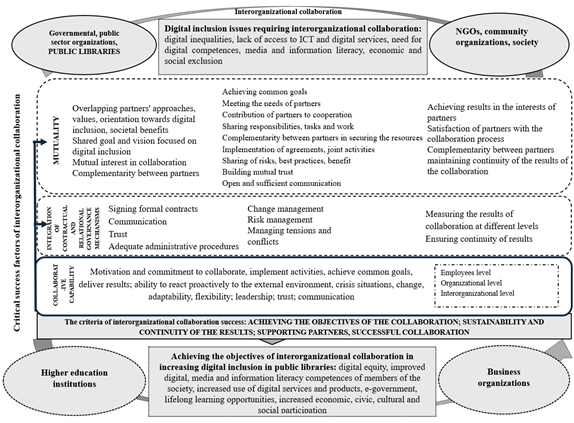
After analyzing the information obtained during the both phases of the empirical research in which the interviews with representatives of public libraries, public sector organizations, higher education institutions, NGOs, business organizations and digital inclusion experts were conducted, in accordance with the principles of CGT (primary, focused, and theoretical coding, continuous comparison, data grouping and visualization), the grounded theory revealing the factors that influence the success of interorganizational collaboration in increasing digital inclusion in public libraries was constructed. During the theoretical coding, three main theoretical concepts and their constituent categories were identified: factors influencing interorganizational collaboration in the field of digital inclusion at different stages and the categories comprising them, such as motives for collaboration, the internal organizational environment, the structure of collaboration, the number of partners, and autonomy; factors influencing interorganizational collaboration that manifest themselves at all stages of collaboration and the categories comprising them, such as the external environment, the involvement of society, community members,previous experience of collaboration, appropriate partner competencies; the critical success factors for interorganizational collaboration and the categories of mutuality, integration of contractual and relational governance mechanisms, and collaborative capability. The constructed grounded theory revealed that these categories (by analyzing the context of these categories, their characteristics, the conditions under which they appear and change, the consequences of their change, and the relationships between different categories) can be linked to the criteria for the success of interorganizational collaboration identified by Velten (2014), Velten, Jager, and Newig (2021) – i.e., achievement of collaboration goals encompassing the assurance of digital equity, improved digital, media, and information literacy competencies, increased use of digital services and products, opportunities for lifelong learning, increased economic, civic, cultural, and social participation, ensuring the sustainability and continuity of results achieved during the collaboration, and the support and satisfaction of partners with the collaboration process. Additionally, it was revealed how these factors can help achieve the intended collaboration goals and increase digital inclusion in public libraries by forming the theoretical model of successful interorganizational collaboration in the field of increasing digital inclusion in public libraries (see Fig. 6).
Figure 6.
Theoretical model of successful interorganizational collaboration in the field of digital inclusion increase in public libraries
Source: compiled by the authors on the basis of empirical research results
The formed grounded theory revealed that both the representatives of organizations and the digital inclusion experts agree that the field of digital inclusion is influenced by rapid, difficult-to-predict, and uncertain changes in content (<…> technology is changing <…> its content <…>E–1), which are caused by the extremely rapid development of digital technologies and the need for new digital literacy, media, and information literacy skills (<…> need to create digital products <…> improve media and information literacy <...> CPL, I–6), arising from the external environment and unexpected crises (<...> pandemic <…> infodemic <…> refugee crisis <…> war in Ukraine <…>economic and energy crises <...> CPL, I–5). The experts emphasized that these changes require the continuous development of new digital services and products, training programs, educational activities and the update of the content of existing services (<…> need for new services <…> media and information literacy trainings <…> artificial intelligence <…> E–4), as well as the continuous improvement of library staff competencies (<…> library employees should be competent <…> E–4) so that they can provide services that meet the needs of society.
The representatives of organizations and experts emphasized that, in the field of digital inclusion, it is particularly important to respond to society’s expectations (<...> meet the needs of the community <…> CPL, I–6; <...> assessment of what the audience needs <...> SB, I–8; <...> social responsibility <…> PSO, I–13) by reaching the groups lacking digital inclusion (seniors, people with disabilities), who are the main target audience(s) of digital inclusion activities (<…> benefits to society, reduced digital divide <…> that participants acquire digital literacy skills <…> feel like full members of society <…> E–3). The experts also highlighted to need to involve them in all stages of interorganizational collaboration through communication (<…> communication with <…> organizations, target groups <…> E–1), trust-building (<…> collaboration should be based on trust <…> E–3), and collaboration with NGOs (collaboration with NGOs <…> communities <…> E–1) representing socially excluded groups, and local communities.
Based on the opinion of the representatives of organizations and the digital inclusion experts, this model shows that the formation of interorganizational collaboration in the field of increasing digital inclusion in public libraries is driven by the need to address various digital inclusion issues (<…> need for media and information literacy improvement <…> new digital services and products <…> BO, I–2), such as the need to improve the digital, media, and information literacy skills of society members, increase the accessibility of digital services and products (<...> provision of <…>high-quality services <...> MPL, I–14; <…> improved their accessibility <…> E–3), including e-government, and address digital inequality. Both the representatives of organizations and the digital inclusion experts agreed that the main aim of interorganizational collaboration in the field of digital inclusion is the need improve the well-being of society by reducing digital inequality (<…> reduced digital divide <…> increased digital inclusion <…> which benefits society as a whole <…> E–4), increasing the use of digital services and products, and enhancing the skills of members of society (<...> libraries <...> seek to teach digital literacy <…> create new digital products <…> CPL, I–6). The experts also highlighted the fact that the area of digital inclusion in public libraries includes the creation of knowledge, innovation, innovative activities, services, and products (<…> innovative services and products are created <…> E–2).
The constructed grounded theory revealed that both the representatives of organizations and the digital inclusion experts indicated that the field of digital inclusion is not only extremely dynamic and rapidly changing (<...> everything related to information technology is changing more rapidly <…> E–4), but also requiring involvement of different stakeholders in interorganizational collaboration with public libraries. To increase digital inclusion, various organizations, such as public sector organizations (<...> schools <…> CPL, I–5; <…> other libraries <…> public sector organizations <…> E–1), higher education institutions (<…> universities <…> CPL, I–5), businesses (enterprises <…> MPL I–10; <…> businesses <…> E–1), NGOs, community organizations (NGOs <…> SL, I–7), etc., engage in interorganizational collaboration with public libraries. While collaborating within the quadruple helix model, these organizations implement various initiatives (<…> projects <…> trainings <…> HEI–3; <…> educational activities <…> events <…> MPL, I–16; <…> projects “Libraries for Progress” <…> “Connected Lithuania”, <…> media and information literacy program <…> E–3) aimed at digital inclusion increase.
The digital inclusion experts emphasized that the diversity of stakeholders involved in collaboration determines the different goals, interests, needs, expectations (<…> partners seek <…> reputation <…> improvement of digital competences of the community members <…>financial benefits <…> E–1; <…> creation of new digital services and products <…> E–2) and different potential, competencies, resources, and opportunities (<…> business organizations contribute with resources <…> higher education institutions train librarians <…> schools <…> community organizations <…> NGOs <…> reach <…> target audiences <…> E–4) of organizations to contribute to solving digital inclusion problems. By collaborating, diverse organizations can share their resources and expertise, improve their services, ensure their accessibility, and reach the members of society who lack digital inclusion most of all.
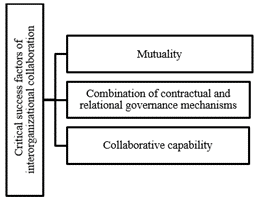
The formed grounded theory revealed that the above-mentioned characteristics of the digital inclusion field determine that the critical success factors of interorganizational collaboration in digital inclusion filed are mutuality, the integration of contractual and relational governance mechanisms, and collaborative capability, which enable the achievement of collaboration goals, help to maintain the continuity of the achieved results, and increase partner satisfaction with the collaboration process. The representatives of organizations pointed out that the diversity of partners with whom public libraries collaborate in the field of digital inclusion determines the diversity of organizational cultures (<…> partner differences are challenging <…> CPL, I–1; <…> diverse organizational cultures <…> NGO, I–4), operational practices, different approaches to achieving benefits for society (<…> different activity practices <…> expectations for collaboration <…> BO, I–2; <...> differently understand the problems of digital inclusion <...> CPL, I–6) and different goals in the field of digital inclusion (<…> partners have different goals <…> SL, I–7).The representatives of organizations stated that, in order to overcome these challenges, collaboration in the field of digital inclusion requires mutuality between partners, which is achieved through the alignment of partners’ views, focus on increasing digital inclusion, and pursuit of benefits for society (<...> mutual desire that digital divide should decrease <…> BO, I–2), the common interest of partners (partners must be <…> engaged <…> CPL, I–5), a shared vision, and mutual benefit (<…> common vision, common understanding <…> mutual benefit <…> PSO, I–13).
The digital inclusion experts also highlighted the importance of mutuality and confirmed that it can be considered as one of the critical success factors of interorganizational collaboration in the digital inclusion field. They emphasized that mutuality is achieved not only through a shared vision among partners, and a desire to solve digital inclusion problems (<…> same vision, values <…> motivation to solve digital inclusion problems <…> E–4), but also by setting common goals and committing to achieving them (<…> a common goal allows us to achieve the final result, E–1), sharing experience, responsibility, and tasks, implementing joint activities (<…> collaboration helps to combine the competencies of partners <…> E–1; sharing tasks, work <…> the involvement of partners in the implementation of activities <…> E–2;<…> combined contribution <…> E–3), and the pursuit of mutual benefits, in line with the interests of each partner (<…> results and benefits depend on the expectations and contribution of each partner <…> E–4). The experts emphasized that partner complementarity created by mutuality helps to implement joint activities more effectively, achieve the goals that meet the interests and expectations of partners (<…> mutuality is very important for results <…> E–3; Complementarity <…> helps to reach the planned results <…> E–4), ensure the involvement of partners in maintaining the continuity of the results achieved(<…> ensure their continuity <…> E–4), and increases the satisfaction of partners with the collaboration process (<…> increases their satisfaction with the collaboration <…> E–4).
According to the representatives of organizations, the nature of activities implemented in the field of increasing digital inclusion in public libraries determines that the governance of collaboration requires a combination of contractual and relational governance mechanisms. Analysis of the information showed that collaboration usually takes place when implementing project activities; in that case, formal agreements help to reinforce the commitment of partners. Also, it is required by the institutions financing project activities (<...> the objectives and tasks <…> are formulated by signing agreements, <...> in projects <...> these are requirements <...> MPL, I–10). Informal intentions to collaborate (based on communication and trust) are more characteristic of smaller-scale digital inclusion initiatives (events, educations) where there is previous experience of collaboration (<...> if we are familiar with the partners <…> communication is enough <...> we trust them <...> CPL, I–6).
The digital inclusion experts agreed that a combination of contractual and relational governance mechanisms can be considered as another critical success factor of interorganizational collaboration in the digital inclusion field and confirmed that, in this field, collaboration can be established through formal agreements (<…> formal contracts <…> are relevant, as all collaboration <…> takes place in projects <…> E–3) and can be based on trust, communication, and commitment (<…> trust <…>commitment <…> communication <...> E–4). The digital inclusion experts also highlighted the need for administrative procedures (<...> a team <…>created <…> functions distributed <…> leader assigned <…> activities evaluated <…> resources allocated <…> E–1), defining areas of responsibility and appointing responsible persons, monitoring interim results, planning the resources necessary for collaboration. The experts noted that constant changes arising both from the external environment and changing needs of society, as well as different organizational practices, cause various problems and conflicts (differences between organizations <…> employee turnover <…> ongoing changes cause conflicts <…> tensions <…> E–2; <...> when unexpected situations arise, planned activities have to be changed and implemented in a different way <…> E–4). Therefore, it is necessary to establish procedures for change and risk management, manage emerging tensions, and resolve conflicts (<…> change management <…> risk management <…> the ability to resolve conflicts, <…> E–1). The formed grounded theory revealed that, by choosing the appropriate collaboration governance mechanisms and administrative procedures, collaboration goals can be achieved (<…> contracts and informal mechanisms like trust and communication <…> guarantee that results will be achieved <…> E–4),the continuity of the results achieved is ensured (<…> necessary to allocate resources <…> include activities in plans, involve partners <…> E–3) and partner satisfaction with the collaboration process is reached (<…> proper management helps to achieve results that increase partner satisfaction <…> E–1).
The formed grounded theory revealed that, according to the representatives of organizations, the third critical success factor of interorganizational collaboration in the digital inclusion field is collaborative capability. This factor can be associated with partner motivation and commitment to collaborate (<...> motivation <...> commitment <...> SL, I–8), by taking responsibility for the implementation of planned activities and the achievement of results (<...> involved in joint activities <...> take responsibility <...> NGO, I–4), the ability to respond proactively to the external environment and changes (<...> adapt and adjust <> respondto crisis situations <...> changes in the environment <...> CPL, I–5), communication (<...> communication <…>NGO, I–4), trust (<...> reliability of partners is important <...> CPL, I–1) and appropriate collaboration skills at the employee level (<…> employees must be able to work in a team <...> communicate <…> CPL, I–5).
The digital inclusion experts confirmed that collaborative capability can be considered as the third critical success factor of interorganizational collaboration in the digital inclusion field. According to the experts, collaborative capability includes the ability to create and manage collaboration through developed trust (trust <…> E–4), effective communication (Communication <…> E–1), commitment, and leadership (<…> commitment <…> leadership <…> E–1), the ability to adapt and respond to the external environment, and flexibility (<…> adaptability <…> ability to respond to change <…> flexibility <…> E–4). The formed grounded theory revealed that collaboration capability in the field of digital inclusion in public libraries is a meta-competence comprising several components (trust, communication, commitment, leadership, adaptability, responsiveness to the external environment, flexibility), and that it is necessary at different levels of collaboration – at the employee level, team/organization level, and interorganizational level (<…> at the employee <…> organizational and interorganizational levels <…> E–1). According to the experts, collaborative capability is necessary to achieve collaboration goals (<…> communication is necessary to achieve results <…> leadership <…> trust <…> flexibility <…> E–1), to ensure the continuity of the results achieved (<…> trust and communication <…> commitment <…> E–3), it is also related to partner satisfaction with the collaboration process (<…> share the results with partners, <…> communicate <…> this builds trust <…> partners are happy <…> E–3). Collaborative capability helps to create conditions for pooling the resources and existing knowledge of different organizations involved in collaboration, for the creation of new knowledge, innovations, and innovative services in an uncertain and constantly changing environment. These factors form the theoretical concept of the critical success factors of interorganizational collaboration in the digital inclusion field. They are interrelated and complement each other, and their complementarity allows the expected goals of collaboration to be achieved, ensures the continuity of the results, and ensures that partners are satisfied with the collaboration.
The constructed grounded theory, based on the opinion of the digital inclusion experts involved, made it possible to identify opportunities for increasing digital inclusion in public libraries through successful interorganizational collaboration. They include the need to develop innovative activities, the creation of services and products, and the improvement of media and information literacy skills of society members. The formed grounded theory revealed that the creation of innovative services and products should be accompanied by more intensive collaboration between public libraries and business organizations (<…> projects for innovative services <…> E–1). The grounded theory revealed that one of the main problems currently faced by public libraries in the area of increasing digital inclusion is the insufficient competencies of library staff to implement media and information literacy activities (<…> media and information literacy training, libraries are lagging behind <…> library community need to improve their competencies <…> E–2). Solving this problem requires the systematic improvement of library staff competencies, emphasizing the need for more active involvement of higher education institutions (<…> higher education institutions could also join <…> E–3). Another problem is the lack of interest of society members to participate in digital inclusion activities offered by libraries, especially in the areas of media and information literacy (<…> the 40+ age group <…> young people <…> hard to attract them <…> E–3), which can be addressed through communication with the society members (<…> collaboration with organizations <…> workplaces, schools <…> non-governmental organizations <…> E–3), emphasizing the benefits of media and information literacy, the threats of propaganda, and intensifying collaboration with other organizations, which would allow to reach the target audiences.
Discussion
Based on the formed grounded theory, the theoretical model of successful interorganizational collaboration in the field of digital inclusion increase in public libraries has been created, in which such categories as mutuality, the integration of contractual and relational governance mechanisms, and collaborative capability have been identified. Analysis of the information showed that these categories can be linked to the criteria for successful interorganizational collaboration identified by Velten (2014), Velten, Jager, and Newig (2021) – these are collaboration goals that include ensuring the well-being of society members, digital equality, improved digital, media, and information literacy competencies, increased use of digital services and products, lifelong learning opportunities, increased economic, civic, cultural, and social participation, ensuring the sustainability and continuity of the results achieved through collaboration, and partner support and satisfaction with the collaboration process. The data also correlate with aspects identified in the scientific literature (Buchanan et al., 2012; Real et al., 2014; Gwyn, 2016; Bertot, 2016; Manžuch & Macevičiūtė, 2019) that, in implementing digital inclusion activities, public libraries face challenges that include lack of continuity and sustainability of digital inclusion activities, projects, programs, and services, insufficient financing for digital inclusion programs, inadequacy ofdigital, media, and information literacy skills of the staff, and the insufficient inclusion of socially excluded groups. The empirical research showed that these challenges can be successfully addressed through interorganizational collaboration, by leveraging the potential (knowledge and resources) of other organizations operating in the quadruple helix, and using them to solve problems related to increasing digital inclusion.
The possibilities for applying the theoretical model of successful interorganizational collaboration in the field of digital inclusion increase in public libraries (see Fig. 6) arise when interorganizational collaboration in the field of digital inclusion begins to form, or it can be applied to the ongoing process of interorganizational collaboration. This model can be applied not only to the interorganizational collaboration process in the field of increasing digital inclusion, but also to other areas of interorganizational collaboration in the creation and implementation of digital and social innovations, involving various stakeholders (organizations) representing the public, private, non-governmental, and community organizations, society, and its members.
Conclusions
After examining the theoretical dimensions of the process of interorganizational collaboration in increasing digital inclusion in public libraries and the factors that may influence its success, it was found that interorganizational collaboration, between stakeholders operating in the quadruple helix can be understood as a process lasting a certain period of time, or a continuum with separate stages linked to the antecedents, structures, implementation, and results. When analyzing interorganizational collaboration from a process perspective, factors influencing collaboration at each stage were identified, such as the external environment, partner characteristics, setting common goals, management and administration, trust, communication, leadership, collaborative competencies, mutuality, evaluation of achieved results, etc.
After conducting the empirical research, it was identified which factors can be considered as the critical success factors (that ensure the achievement of collaboration goals, help maintain the continuity of the results achieved, and achieve partner support and satisfaction with the collaboration process) explaining how a successful interorganizational collaboration process can help achieve the goals of increasing digital inclusion in public libraries by creating the theoretical model of successful interorganizational collaboration emerging form the constructed grounded theory. This model reveals the critical success factors of interorganizational collaboration: mutuality, the integration of contractual and relational governance mechanisms, and collaborative capability. The formed grounded theory revealed that mutuality between partners is ensured by a shared vision, aspiration to contribute to solving digital inclusion problems, setting common goals and committing to achieving them, sharing experiences, responsibilities, and tasks, implementation of joint activities, and pursuit of mutual benefits. The complementarity between partners created by mutuality helps to implement joint activities more effectively, achieve results that meet the interests and expectations of the partners, ensure the involvement of partners in maintaining the continuity of the results achieved, and increase the satisfaction of the partners with the collaboration process. After forming a grounded theory, it was identified that the activities implemented in the field of increasing digital inclusion in public libraries, in which collaboration takes place, indicate that the governance of collaboration requires integration of contractual and relational governance mechanisms. Constant changes arising from both the external environment and changing society’s needs, as well as changes within organizations, along with different organizational practices, cause various problems and conflicts; therefore, it is necessary to establish procedures for change and risk management, manage emerging tensions, and resolve conflicts. The grounded theory revealed that the process of interorganizational collaboration in the field of increasing digital inclusion in public libraries requires the collaborative capability of the partners involved in the collaboration, including the ability to create and manage collaboration through leadership, trust, communication, and flexibility.
Author contributions
Kristina Kulikauskienė: conceptualization, data curation, formal analysis, investigation, methodology, validation, visualization, writing – original draft.
Diana Šaparnienė: conceptualization, formal analysis, methodology, writing – original draft.
References
Anger, M., Wendelborn, C., Winkler, E. C., Schickhardt, C. (2022) Neither carrots nor sticks? Challenges surrounding data sharing from the perspective of research funding agencies—A qualitative expert interview study. PLoS ONE, 17(9), e0273259. https://doi.org/10.1371/journal.pone.0273259
Bertot, J. C. (2016). Building Digitally Inclusive Communities: The Roles of Public Libraries in Digital Inclusion and Development. Proceedings of the 9th International Conference on Theory and Practice of Electronic Governance, 95–102. https://doi.org/10.1145/2910019.2910082
Bryson, J. M., Crosby, B. C., Stone, M. M. (2015). Designing and Implementing Cross-Sector Collaborations: Needed and Challenging. Public Administration Review, 75(5), 647–663. https://doi.org/10.1111/puar.12432
Buchanan, S., Gibb, F., Simmons, S., McMenemy, D. (2012). Digital Library Collaboration: A Service-Oriented Perspective. Library Quarterly, 82(3), 337–359. https://doi.org/10.1086/665930
Carayannis, E. G., Campbell, D. F. J. (2009). ‘Mode 3’ and ‘Quadruple Helix’: Toward a 21st Century Fractal Innovation Ecosystem. International Journal of Technology Management, 46(3/4), 201–234. https://doi.org/10.1504/IJTM.2009.023374
Carayannis, E. G., Grigoroudis, E., Campbell, D. F. J., Meissner, D., Stamati, D. (2018). The Ecosystem as Helix: An Exploratory Theory-Building Study of Regional Co-Opetitive Entrepreneurial Ecosystems as Quadruple/Quintuple Helix Innovation Models. R&D Management, 48(1), 148–162. https://doi.org/10.1111/radm.12300
Charmaz, K. (2006). Constructing Grounded Theory: A Practical Guide Through Qualitative Analysis. Thousand Oaks, California: Sage.
Charmaz, K. (2012). The Power and Potential of Grounded Theory. Medical Sociology Online, 6(3), 1–15.
Chen, B. (2010). Antecedents or Processes? Determinants of Perceived Effectiveness of Interorganizational Collaborations for Public Service Delivery. International Public Management Journal, 13(4), 381–407. https://doi.org/10.1080/10967494.2010.524836
Chen, B., Graddy, E. A. (2010). The Effectiveness of Nonprofit Lead-Organization Networks for Social Service Delivery. Nonprofit Management & Leadership, 20(4), 405–422. https://doi.org/10.1002/nml.20002
Damodaran, L., Gilbertson, T., Olphert, W., Sandhu, J., Craig, M. (2015). Digital Inclusion – The Vision, the Challenges and the Way Forward. International Journal on Advances in Internet Technology, 8(3–4), 78–92.
Defitri, S., Bahari, Y., Handra, A., Febrianto, H. (2020). Determinant Factors of E-Government Implementation and Public Accountability: Toe Framework Approach. Viešoji Politika ir Administravimas/Public Policy and Administration, 19(4), 37–51. https://doi.org/10.13165/VPA-20-19-4-03
Diaz-Kope, L., Miller-Stevens, K., Morris, J. C. (2015). Collaboration Processes and Institutional Structure: Reexamining the Black Box. International Journal of Public Administration, 38(9), 607–615. https://doi.org/10.1080/01900692.2014.949755
Domanski, D., Kaletka, C. (Eds.). (2017). Exploring the Research Landscape of Social Innovation. A deliverable of the project Social Innovation Community (SIC). Dortmund: Sozialforschungsstelle.
Galindo, F. (2004). Electronic Government from the Legal Point of View: Methods. International Review of Law, Computers & Technology, 18(1), 7–23. https://doi.org/10.1080/13600860410001674706
Galindo, F. (2014). Methods for Law and ICT: An Approach for the Development of Smart Cities. In P. Casanovas, U. Pagallo, M. Palmirani, & G. Sartor (Eds.), AI Approaches to the Complexity of Legal Systems (Vol. 8929, pp. 26–40). Springer Berlin Heidelberg. https://doi.org/10.1007/978-3-662-45960-7_3
Galindo, F., García, M. J. (2017). Freedom and the Internet: Empowering Citizens and Addressing the Transparency Gap in Search Engines. European Journal of Law and Technology, 8(2).
Gallardo, R. (2019). Bringing Communities into the Digital Age. State and Local Government Review, 51(4), 233–241. https://doi.org/10.1177/0160323X20926696
Gallardo, R., Beaulieu, L. B., Geideman, C. (2020). Digital Inclusion and Parity: Implications for Community Development. Community Development, 52(1), 4–21. https://doi.org/10.1080/15575330.2020.1830815
Gann, B. (2019). Digital Inclusion and Health in Wales. Journal of Consumer Health on the Internet, 2(32), 146–160. https://doi.org/10.1080/15398285.2019.1608499
Graves, S. J., German, E. (2018). Evidence of Our Values: Disability Inclusion on Library Instruction Websites. Libraries and the Academy, 18(3), 559–574. https://doi.org/10.1353/pla.2018.0033
Gwynn, D. (2016). Community Connections, Community Collections: Building Partner Support for Collaborative Digitization projects. Digital Library Perspectives, 32(2), 88–102. https://doi.org/10.1108/DLP-08-2015-0013
Hardy, C., Phillips, N., Lawrence, T. B. (2003). Resources, Knowledge and Influence: The Organizational Effects of Interorganizational Collaboration. Journal of Management Studies, 40(2), 321–347. https://doi.org/10.1111/1467-6486.00342
Hernández-Pérez, O., Vilariño, F., Domènech, M. (2020). Public Libraries Engaging Communities through Technology and Innovation: Insights from the Library Living Lab. Public Library Quarterly, 41(1), 17–42. https://doi.org/10.1080/01616846.2020.1845047
Holgersson, J., Söderström, E., Rose, J. (2019). Digital Inclusion for Elderly Citizens for a Sustainable Society. In Proceedings of the 27th European Conference on Information Systems (ECIS). https://aisel.aisnet.org/ecis2019_rip/7
Jaeger, P. T., Thompson, K. M. (2003). E-government Around the World: Lessons, Challenges, And Future Directions. Government Information Quarterly, 20(4), 389–394. https://doi.org/10.1016/j.giq.2003.08.001
Johnston, N. (2020). The Shift towards Digital Literacy in Australian University Libraries: Developing a Digital Literacy Framework. Journal of the Australian Library and Information Association, 69(1), 93–101. https://doi.org/10.1080/24750158.2020.1712638
Kaletka, C., Pelka, B. (2015). (Digital) Social Innovation Through Public Internet Access Points. In M. Antona & C. Stephanidis (Eds.), Universal Access in Human-Computer Interaction. Access to Today’s Technologies (pp. 201–212). Springer International Publishing. https://doi.org/10.1007/978-3-319-20678-3_20
Keyton, J. (2017). Collaboration. In C. R. Scott, J. R. Barker, T. Kuhn, J. Keyton, P. K. Turner, & L. K. Lewis (Eds.), The International Encyclopedia of Organizational Communication (1st ed., pp. 1–16). Wiley. https://doi.org/10.1002/9781118955567.wbieoc026
Kriz, A., Bankins, S., Molloy, C. (2017). Readying a Region: Temporally Exploring the Development of an Australian Regional Quadruple Helix. R & D Management, 48(1), 25–43. https://doi.org/10.1111/radm.12294
Luterek, M. (2017). e-Government and e-Inclusion. The Role of the Public Libraries. In M. Themistocleous & V. Morabito (Eds.), Information Systems (pp. 275–283). Springer International Publishing. https://doi.org/10.1007/978-3-319-65930-5_23
Manžuch, Z., Macevičiūtė, E. (2019). Getting Ready to Reduce the Digital Divide: Scenarios of Lithuanian public libraries. Journal of the Association for Information Science and Technology, 71(10), 1205–1217. https://doi.org/10.1002/asi.24324
Marien, I., & Van Audenhove, L. (2012). Towards a Multi-Stakeholder Approach for Digital Inclusion. A case study of Ghent’s Digitaal Talent policy program. In IAMCR Conference Durban (pp. 95–96). International Association for Media and Communication Research.
Mattessich, P. W., Johnson, K. M. (2018). Collaboration: what makes it work (Third edition). Fieldstone Alliance.
Mavriki, P., Karyda, M. (2022). Big Data Analytics in E-Government and E-Democracy Applications: Privacy Threats, Implications and Mitigation. International Journal of Electronic Governance, 14(1/2), 58–82. https://doi.org/10.1504/IJEG.2022.123251
McAdam, M., Miller, K., McAdam, R. (2018). Understanding Quadruple Helix Relationships of University Technology Commercialisation: A Micro-Level Approach. Studies in Higher Education, 43(3), 1058–1073. https://doi.org/10.1080/03075079.2016.1212328
Merga, M. K. (2019). Collaborating With Teacher Librarians to Support Adolescents’ Literacy and Literature Learning. Journal of Adolescent & Adult Literacy, 63(1), 65–72. https://doi.org/10.1002/jaal.958
Milakovich, M. E. (2022). Digital Governance. Applying Advanced Technologies to Improve Public Service. Routledge.
Miller-Stevens, K., Taylor, J. A. (2020). Philanthropic Collaboration: A Conceptual Framework for Giving Circles. Public Integrity, 22(6), 575–589. https://doi.org/10.1080/10999922.2020.1719808
Mitchell, G. E, O’Leary, R., Gerard, C. (2015). Collaboration and Performance: Perspectives from Public Managers and NGO Leaders. Public Performance & Management Review, 38(4), 684–716. https://doi.org/10.1080/15309576.2015.1031015 .
Moxley, D. P., Abbas, J. M. (2016). Envisioning Libraries as Collaborative Community Anchors for Social Service Provision to Vulnerable Populations. Practice, 28(5), 311–330. https://doi.org/10.1080/09503153.2015.1135891
Nicholson, K. (2019). Collaborative, Creative, Participative: Trends in Public Library Innovation. Public Library Quarterly, 38(3), 331–347. https://doi.org/10.1080/01616846.2019.1571399
Noh, Y. (2019). A Comparative Study of Public Libraries’ Contribution to Digital Inclusion in Korea and the United States. Journal of Librarianship and Information Science, 51(1), 59–77. https://doi.org/10.1177/0961000616668571
Orlova, U. L. (2019). Neįprastos grindžiamosios teorijos radimosi aplinkybės: metodologijos istorijos raida. In B. Švedaitė-Sakalauskė (sud.), Tirti pagal grindžiamąją teoriją (pp. 12–25). Vilniaus universiteto leidykla.
Parent, M. M., Harvey, J. (2009). Towards a Management Model for Sport and Physical Activity Community-based Partnerships. European Sport Management Quarterly, 9(1), 23–45. https://doi.org/10.1080/16184740802461694
Ragnedda, M., Ruiu, M. (2017). Social Capital and the Three Levels of Digital Divide. In M. Ragnedda , G. Muschert (Eds.),Theorizing Digital Divides (pp. 21–34). Routledge. https://doi.org/10.4324/9781315455334
Real, B., Bertot, J. C., Jaeger, P. T. (2014). Rural Public Libraries and Digital Inclusion: Issues and Challenges. Information Technology and Libraries, 33(1), 6–24. https://doi.org/10.6017/ital.v33i1.5141
Reid, P. H. (2019). How Good is Our Public Library Service? The Evolution of a New Quality Standards Framework for Scottish Public Libraries 2012–2017. Journal of Librarianship and Information Science, 52(3), 647–658. https://doi.org/10.1177/0961000619855430
Rowley, J. (2011). Should your library have an innovation strategy?. Library Management, 32(4-5), 251–265. https://doi.org/10.1108/01435121111132266
Rutherford, L., Singleton, A., Derr, A., Merga, M. K. (2018). Do Digital Devices Enhance Teenagers’ Recreational Reading Engagement? Issues for Library Policy from a Recent Study in Two Australian States. Public Library Quarterly, 37(3), 318–340.https://doi.org/10.1080/01616846.2018.1511214
Seaton, C. L, Holm, N., Bottorff, J. L, Jones-Bricker, M., Errey, S., Caperchione, C. M., Lamont, S., Johnson, S. T., Healy, T. (2018). Factors That Impact the Success of Interorganizational Health Promotion Collaborations: A Scoping Review. American Journal of Health Promotion, 32(4), 1095–1109. https://doi.org/10.1177/0890117117710875
Strover, S., Whitacre, B., Rhinesmith, C., Schrubbe, A. (2020). The Digital Inclusion Role of Rural Libraries: Social Inequalities through Space and Place. Media, Culture & Society, 42(2), 242–259. https://doi.org/10.1177/0163443719853504
Traunmüller, R. (2017). Digitalization as Challenge for Electronic Government. In A. Kő & E. Francesconi (Eds.), Electronic Government and the Information Systems Perspective (pp. 3–8). Springer International Publishing. https://doi.org/10.1007/978-3-319-64248-2_1
Traunmüller, R., Wimmer, M. A. (2003). e-Government at a Decisive Moment: Sketching a Roadmap to Excellence. In R. Traunmüller (Ed.), Electronic Government (pp. 1–14). Springer. https://doi.org/10.1007/10929179_1
Velten, S. (2014). When are Interventions for a More Sustainable Agriculture Successful? Towards an Analytical Framework. Proceedings of the 4th World Sustainability Forum, g004. https://doi.org/10.3390/wsf-4-g004
Velten, S., Jager, N. W., Newig, J. (2021). Success of collaboration for sustainable agriculture: A case study meta-analysis. Environment, Development and Sustainability, 23, 14619–14641. https://doi.org/10.1007/s10668-021-01261-y
Žydžiūnaitė, V. (2016). Metodologiniai svarstymai apie grindžiamosios teorijos ir veiklos tyrimo derinimo galimybes. Pedagogika, 122(2), 141–161. https://doi.org/10.15823/p.2016.26