Social Welfare: Interdisciplinary Approach eISSN 2424-3876
2026, vol. 16, pp. 27–45 DOI: https://doi.org/10.15388/SW.2026.16.2
Subjective Perception of Violence: How Teachers Understand Violence Against Them
Daiva Penkauskienė
Mykolas Romeris University, Lithuania
E-mail: daiva.penkauskiene@mruni.eu
https://orcid.org/0000-0002-0875-4080
https://ror.org/0052k0e03
Valdonė Indrašienė
Mykolas Romeris University, Lithuania
E-mail: v.indrasiene@mruni.eu
https://orcid.org/0000-0001-9917-4526
https://ror.org/0052k0e03
Asta Railienė
Mykolas Romeris University, Lithuania
E-mail: asta.railiene@mruni.eu
https://orcid.org/0000-0002-8192-6184
https://ror.org/0052k0e03
Justinas Sadauskas
Mykolas Romeris University, Lithuania
E-mail: justas_sad@mruni.eu
https://orcid.org/0000-0002-1009-9193
https://ror.org/0052k0e03
Odeta Merfeldaitė
Mykolas Romeris University, Lithuania
E-mail: o.merfeldaite@mruni.eu
https://orcid.org/0000-0002-8217-7699
https://ror.org/0052k0e03
Violeta Jegelevičienė
Mykolas Romeris University, Lithuania
E-mail: violeta.suboc@mruni.eu
https://orcid.org/0000-0001-6437-8342
https://ror.org/0052k0e03
Romas Prakapas
Mykolas Romeris University, Lithuania
E-mail: prakapas@mruni.eu
https://orcid.org/0000-0002-4811-6681
https://ror.org/0052k0e03
Aistė Diržytė
Mykolas Romeris University, Lithuania
E-mail: aiste.dirzyte@mruni.eu
https://orcid.org/0000-0003-2057-3108
https://ror.org/0052k0e03
Rugilė Bitinaitė-Motiejūnienė
Mykolas Romeris University, Lithuania
E-mail: rug.bitinaite@gmail.com
https://orcid.org/0009-0005-5944-1753
https://ror.org/0052k0e03
Jolanta Pivorienė
Mykolas Romeris University, Lithuania
E-mail: jolantapiv@mruni.eu
https://orcid.org/0000-0001-6328-7940
https://ror.org/0052k0e03
-------------------------------
Funding: The research was funded by the Research Council of Lithuania (LMTLT), contract number: 989-S-MIP-24-108, 2024-2026.
-------------------------------
Abstract. There is a lack of research analyzing how teachers themselves define violence and what patterns of behavior they personally consider to be violent. It is precisely this subjective perception of violence that may explain why some situations remain invisible at the institutional level: they are not named and reported, or they are normalized as part of a teacher’s job, even though, in the long run, they can negatively affect a teacher’s professional identity and well-being. A phenomenographic perspective was applied in this research. It has been found that teachers understand violence in the workplace as pressure to obey, aggressive behavior, insults, public humiliation, and non-transparent decisions, which are characterized by verbal, physical, written, and visual expressions. The scope of the research results shows that the teachers’ perception of violence is not limited to incidents but is revealed as a process of constructing meaning that combines the form of violence, structural features, and orientation toward the teacher as a professional or as a person. The study broadens not only the concept of violence in the school environment but also the field of analysis of the teacher as an object of violence, and it reveals that the teachers’ understanding of violence is more related to administrative power practices.
Keywords: concept of violence; teachers’ perceptions; manifestation of violence; impact of violence.
Recieved: 2026-01-19. Accepted: 2026-01-30
Copyright © 2026 Daiva Penkauskienė, Valdonė Indrašienė, Asta Railienė, Justinas Sadauskas, Odeta Merfeldaitė, Violeta Jegelevičienė, Romas Prakapas, Aistė Diržytė, Rugilė Bitinaitė-Motiejūnienė, Jolanta Pivorienė. Published by Vilnius University Press. This is an Open Access journal distributed under the terms of the Creative Commons Attribution 4.0, which permits unrestricted use, distribution, and reproduction in any medium, provided the original author and source are credited.
Introduction
Scientific publications on violence against teachers appeared in academic literature as early as in the 1980s (Kratcoski, 1985). This phenomenon began to be analyzed more intensively approximately a decade ago (Lokmic et al., 2013; Reddy et al., 2013; McMahon et al., 2014; Berlanda et al., 2019). The field of teacher victimization research has expanded significantly in the context of the COVID-19 pandemic (Simões et al., 2022; Bilić, 2023; Perry et al., 2024; Reddy et al., 2023; Tarablus & Yablon, 2023, etc.).
Teacher victimization is recognized in academic literature as a phenomenon encompassing a wide spectrum of aggression and violence affecting teachers and the entire school community at all levels of education (McMahon et al., 2024). Research highlights that violence against teachers is often overlooked in the public discourse on school safety, which has historically focused more on the status of students as victims (Moon & McCluskey, 2020). Over the past three decades, research on violence in schools has expanded rapidly, but most of it has focused on students as victims and perpetrators. Meanwhile, violence against teachers has long been described as an “under-researched phenomenon” (Reddy et al., 2018; McMahon et al., 2024). However, recent research emphasizes that aggression and violence directed at teachers is a major cause of stress in the workplace (school), directly contributing to high teacher turnover in schools and teachers leaving the profession (McMahon et al., 2024). These problems not only negatively affect the teachers’ well-being but also weaken the interaction between students and teachers, thereby undermining the quality of the educational process (Stilwell et al., 2025). Researchers agree that quality teaching and learning are impossible when teachers experience violence in the workplace (Kõiv & Aia-Utsal, 2021).
In contemporary literature, violence is increasingly understood not only as overt physical actions but as a broad, multidimensional social problem, defined as encompassing physical, psychological, sexual, and other forms of harmful actions (Blom, Fadeeva, & Barbosa, 2023). In a broad sense, violence is considered to be any action or inaction that causes physical, psychological, sexual, economic, or other effects on a person, resulting in physical, material, or non-material damage (Gušauskienė et al., 2025). According to Gušauskienė et al. (2025), when defining the concept of violence against teachers, it is necessary to assess the territory (school) where the violence takes place, the perpetrators of the violence, and the objectives of the violence. In the case of this study, the school should be treated as a specific workplace where the power relations of various actors (students, parents, administration, colleagues, and the wider community) intersect, and violence against teachers can be analyzed as violence experienced in the workplace. Workplace violence is defined as a situation where an employee experiences physical, psychological, or other harmful behavior related to their professional role and functions (Reddy et al., 2018). Thus, the concept of violence against teachers can be defined as any physical or verbal aggression, physical violence, victimization, and bullying, including all negative processes occurring in or outside of school that are related to school (Kapa & Gimbert, 2018; McMahon et al., 2020).
Scientific literature offers a variety of taxonomies of violence: forms of violence are analyzed according to their nature (physical, social, verbal, cyber, sexual, and property damage) and the source of experience (violence experienced by students, students’ parents, colleagues, and the school administration). Verbal violence is one of the most common forms of violence against teachers; it includes threats, verbal abuse, intimidation, public humiliation, and bullying (Yang et al., 2019; McMahon et al., 2024; Anderman et al., 2024). Research emphasizes that although physical violence against teachers receives the most public attention, non-physical forms of violence (verbal abuse, bullying, and cyberbullying) against teachers are more widespread and frequent (Badenes-Ribera et al., 2022; Longobardi et al., 2019). It is emphasized that repeated non-physical aggression is a major factor contributing to teacher burnout and the intention to leave the profession (Stilwell et al., 2025). Studies show that a large proportion of teachers experience verbal abuse, non-physical aggression, and, in some cases, physical abuse and sexual harassment at work (McMahon et al., 2024; Reddy et al., 2024). It should be noted that, in the context of violence against teachers, violence can be both overt (e.g., physical aggression and direct threats) and latent (e.g., systematic devaluation, administrative pressure, and stigmatization of target groups).
The sources of violence experienced by teachers also vary. For a long time, research has focused heavily on analyzing student violence against teachers (Anderman et al., 2024). Violence by students against teachers is described as repeated aggressive actions, both direct and indirect, that a student takes against a teacher and that cause physical, psychological, emotional, or professional harm. Such violence is characterized by an imbalance of power – when the students have more power than the teacher, regardless of the teacher’s perceived authority (Garrett, 2018). Thus, “those who should teach, provide assistance, and set an example become the targets of those they teach, assist, and protect” (De Wet, 2010, p. 190). Parents of students have also been identified in research as a source of violence against teachers (Berkowitz et al., 2025). Their aggression toward teachers is associated with verbal hostility and threats of legal action, which are triggered by disagreements over a child’s academic performance or educational process (Berkowitz et al., 2025; Gušauskienė et al., 2025). Parental violence, similar to that of students, is most often non-physical (Badenes-Ribera et al., 2022; Diržytė et al., 2023). Another source of violence against teachers is that which is perpetrated by colleagues and the school administration. Studies show that interactions with colleagues involving bullying, humiliating behavior, or conflicts contribute to the victimization of teachers (Moon & McCluskey, 2016; Hyun & Wilcox, 2018; Moon, Kim, & McCluskey, 2022). Violence experienced by teachers from the administration is associated with administrative decisions or actions and a lack of communication or recognition, which is perceived as unfair or unsupportive (Astor et al., 2024). It has been found that a culture of bullying among teachers is not only harmful in itself but is also directly related to other forms of violence (verbal abuse experienced from parents and multiple forms of violence perpetrated by students) (Diržytė et al., 2024). Thus, violence against teachers is a complex problem in which various forms of violence are interrelated, and teachers become not only professionals who observe violence and implement violence prevention measures but also potential targets of violence and vulnerable subjects.
Although an increasing number of studies reveal the prevalence, forms, and consequences of violence against teachers, most studies are based on predefined theoretical constructs and standardized instruments that treat the boundaries of violence as theoretically and/or legally defined. Much less research has been done on the way(s) how teachers themselves define violence, and what types of behavior they personally consider to be violent.
This study, by using a phenomenographic perspective, aims to highlight qualitatively different ways in which teachers understand violence directed against them in the school environment. The aim is to gain a deeper understanding of the phenomenon of violence against teachers as a complex field of meanings, experiences, and power dynamics. This perspective is particularly valuable for educational science, as it helps to link teachers’ perceptions with decisions on violence prevention, school management, the process of aiding, and teacher training. The following problematic question is raised: How do teachers understand violence directed against them in the school environment, and what aspects of experience structure the differences in these perceptions?
Materials and Methods
Research methodology
Phenomenography was used as the main methodological tool in the research. Phenomenography states that the reality experienced by research participants can be interpreted in a variety of ways; therefore, the same phenomenon can be given different names. The differences in concepts and experiences that emerge in the phenomenographic analysis are referred to as categories of meaning (Marton, 1994), which reflect collective, i.e., not individual, meaning. In the case of this respective research, phenomenography was chosen because of its suitability for revealing the research subject and the main research question formulated: what do the research participants consider to be violence in the area of professional life? With this question, the researchers intended to find out the specific meaning of violence that the participants in the study attribute to violence existing and occurring in the work environment – in this particular case, at school.
Research participants
The research participants were selected by using purposeful sampling. The main selection criterion was experience of violence in the workplace. Other selection criteria were based on the diversity of: (1) School education levels (from primary to upper secondary); (2) School subjects (humanities, science, arts, technologies, social sciences, and natural sciences); (3) Geographical spread (different regions); (4) Work experience (from 1 to 38 years); (5) Professional qualification (teacher expert or teacher methodologist; senior teacher, teacher, or beginning teacher); (6) Teacher’s age (from 26 to 59 years old); (7) Sex (female/male). The 27 participants in the study, representing various academic disciplines and levels of school education and possessing diverse professional experience, were sufficient to answer the research questions and reveal the concept of the phenomenon under investigation. The collection of empirical data was suspended as soon as it was understood that sufficient data had already been collected to answer the research questions and ensure that the concept of violence has been extensively discussed.
Data collection
The researchers chose a semi-structured interview method. In order to understand the specific meaning of violence in the context of school life, we asked: What do you consider to be ‘violence’ at school? What do you think are the most obvious signs of violence? How can it be recognized? Please, give specific examples/what would you consider to be examples of violence. Open questions and their variations offered the possibility of free, unrestrained, and authentic answers, clearly signaling that ready-made, scholarly definitions were not expected from the participants. The interviews were conducted remotely by using the Microsoft Teams platform. This made it possible to reach the research participants more quickly and plan meeting times that were convenient for everyone involved. On average, each interview lasted between 45 and 75 minutes. Interviews were recorded and transcribed by using artificial intelligence on the Microsoft Teams platform. Each research participant was assigned a code in the interview transcription (TDA1, TDB2, TDD3, etc.).
Data analysis
Since the research focused on finding qualitatively different concepts of violence, the researchers searched the transcribed content for different explanations of this concept, then grouped them into separate categories, identified connections between them, and presented an overall picture in the outcome space. The meaning of a phenomenon was revealed not from just one decontextualized instance of manifestation, but from the source of all data. Variations in the perception and experience of a phenomenon were listed as categories that describe different aspects of the same phenomenon under study. More frequently recurring categories of meanings were considered to be dominant, while less frequently recurring categories were non-dominant. The relationships between the categories were revealed and described.
In the data analysis process, the researchers followed the steps proposed by Larson and Holstrom (2007): repeating readings of the text; marking the text where the interviewee gave answers to the interview questions; preparing initial descriptions; grouping the data into categories; describing categories; distinguishing between dominant and non-dominant categories; highlighting dimensions in relation to the categories; and creating a structural picture of the manifestation of the phenomenon in the outcome space. Data analysis started immediately after it had been transcribed. Once the researchers had all the data as plain text, they began analyzing it. After reading it several times, the similarities and differences in the perception of the violence concept began to emerge. The category groups were reorganized several times, and the interrelationships were dismantled and then re-established, until each team member was satisfied with the descriptions of the categories, dimensions of variations, and the structure of the outcome space.
Research ethics
This study received ethical approval from the Scientific Committee of the Lifelong Learning Laboratory at Mykolas Romeris University (Protocol No. 10-79 2.25 E-403) on February 25, 2025, ensuring compliance with ethical research standards. The study is part of a more extensive project examining victimization experiences and well-being among teachers in Lithuania. Essentially, the researchers adhered to the general ethical rules applicable to scientific research, ensuring voluntary participation in the research. The research participants were informed about the research project and its objectives in advance. To ensure confidentiality, the transcripts were anonymized before being used for analysis; data identifying elements were removed or replaced. As recommended (Merriam, 2002), the transcripts of the interviews were member-checked with the interview participants, in order to be sure that all data were correct.
Validity and limitations of the study
In phenomenography, validity is demonstrated by the researchers’ openness to the phenomenon under study, thorough data analysis, avoidance of hasty and unfounded generalizations, and the researcher’s reflexivity. The researchers did not push themselves or the research participants to stick to any specific definition of the term ‘violence’ during the initial stage. The participants were encouraged to share their subjective perception. The researchers also used the so-called ‘trustees’ approach to achieve reliability of data analysis. In the case of this study, this approach involved enlisting team members who carefully examined data, read descriptions of categories, listened to each other’s arguments, debated, and discussed. Joint discussions helped to refine ideas and find common solutions. This type of validity assurance is referred to as “communicative validity checking” (Kvale, 1994; Åkerlind, 2005).
The main limitation of the study was the time constraint. Phenomenographic research is highly time-consuming. It took a lot of time to form categories of meaning and determine their structural and hierarchical relationships.
Results
Data analysis revealed that teachers understand violence in the context of their professional activities as (A) pressure to obey, (B) aggressive behavior, (C) insults, (D) public humiliation, and E) non-transparent decisions. The first four categories of meanings (i.e., A–D) are the most frequently mentioned and are classified as dominant categories of meanings, while the fifth, category E, is non-dominant, as it is reflected in isolated experiences.
Dominant categories
Pressure to obey (A). In the category of pressure to obey, the concept of violence manifests itself as pressure from someone more powerful to carry out their will, and it is expressed through (1) increasing or decreasing the workload, (2) controlling work, and (3) imposing tasks. In the first three cases, the pressure is related to the behavior of the manager, and, in the fourth case, to that of the parents.
Imposing a heavier workload or assigning less work is treated as coercive pressure to agree and not resist, regardless of individual desires or capabilities, because the manager’s “expectations are much higher than what can be met by one’s work” [TDD6]. It also means not having “the freedom to choose, because you have to do what you are told” [TDB3]. Thus, imposing a workload or, conversely, reducing it is associated with the authoritarian behavior of the school manager.
Work control also falls into this category of meanings, as it is perceived as excessive “degrading checking” [TDA6], which aims to put emotional and psychological pressure on teachers. Unlike reducing or increasing workload, imposing work is associated with pressure to take on an additional burden – “doing work that is not part of the job” [TDB9]. This refers to work that goes beyond the scope of professional duties.
The pressure to obey is also evident in the parents’ constant demands that teachers “explain the application of their assessment system” [TDD6] or “account for every mark, comment, or action taken in relation to their child” [TDA2]. It can also be observed when parents simply tell teachers how they should do their job: “parents become your teachers – they tell you how to do your job. In other words, even though they are not teachers themselves and do not even know how to teach, they bring their children to school” [TDA5].
The participants in the study note that “parents very often view teachers not as partners with whom they can solve common problems but as people who cause those problems. Then they engage in a battle, believing that their child needs to be protected from something, and that is when the attack begins” [TDD2].
In all cases, pressure to obey is perceived as coercion, a restriction of professional freedom, and, at the same time, a lack of trust in the teacher. Pressure to obey is always associated with verbal abuse.
Aggressive behavior (B). In the category of aggressive behavior, violence is treated as (1) threats, (2) raised voices and shouting, (3) swearing, and (4) use of physical force, recognized by teachers through both verbal and physical expressions.
Aggressive behavior, such as threats, in the context of school life can manifest itself in the form of a threat by a supervisor to write a reprimand, reduce the workload, or dismiss an employee: “well, in reality, you are threatened with certain things, not that you are being punished, but you are threatened with dismissal or that I will do something so that you will receive a reprimand and so on. I would describe this as a certain form of violence at school” [TDB4].
In all cases, this is perceived as a potential punishment for unfinished work, disobedience, or disloyalty. A raised voice and shouting are also considered expressions of aggression due to particularly negative emotions directed at the teacher: “Such attacks. For example, a student doesn’t like their grade. And then it starts. Then you have to explain, you have to define why. And it is not that they ask politely, but ‘why did you give me a four and not a six’? If a person asks politely, you can answer politely. But if it’s, well, a raised voice, then it’s really a certain manifestation of violence” [TDA7].
In this category, violence is also associated with swear words, most often used by students: “swear words. Well, I don’t know, maybe it’s not so much violence, but that’s how I talk. You know, when they yell and scream and accuse you, well, it’s really unpleasant and uncomfortable. I think it’s still violence” [TDB7]. It also manifests itself as the use of physical force, for example, when “a child pushes or hits another child” [TDA1]. However, sometimes, it can also manifest itself in the use of force by the teacher. For example, “the teacher pulls the child harder by the arm” [TDB4]. Physical aggression, in the view of the study’s participants, is “contact with the aim of hurting or humiliating” [TDB1], and it can be directed at the teacher as a professional and as a person. Thus, violence as aggressive behavior is associated with overt verbal and physical aggression that threatens teachers’ work and emotional and physical well-being. This distinguishes it from pressure to obey, which, although disturbing and demoralizing, is not dangerous.
Insults (C). In the semantic category of insults, violence is associated with hurtful (1) remarks and insinuations, (2) jokes, (3) gossip, and (4) name-calling. In the first two cases, insulting is linked to violent behavior by the administration and colleagues. In the third case, it is linked to violent behavior by colleagues and students, whereas, in the fourth case, it is linked to students’ behavior.
Derogatory remarks and insinuations are construed as hurtful statements about the teacher both as a person and as a professional. This is described as “inappropriate behavior that causes another person to feel shame <...> and discomfort. Certain negative feelings <...> can be identified as violence” [TDA2]. At times, it may take the form of “words, remarks, certain statements through which you insult and hurt a person” [TDA8], or “some offhand comment [from colleagues] while walking down the corridor” [TDA9]. Such an “offhand comment” is likewise treated as a derogatory remark with manifestations of violence, because it is not an isolated incident but rather recurrent behavior. In cases of derogatory remarks, it is not always possible to clearly delineate the boundary between an insult directed at the teacher as a professional and one directed at the teacher as an individual.
Hurtful jokes are most often directed at the teacher as an individual, for example, on the basis of gender. They are voiced “not only by men toward women but also by women toward men” [TDA2]. It is argued that, superficially, such remarks may appear to be merely “jokes”; however, in practice, they overstep all boundaries and are “in bad taste” [TDA2]. Others may regard such behavior as relatively normal because it is seen as customary.
Hurtful gossip, unlike hurtful joking, is associated with an indirect form of verbal expression. Gossip takes place “behind one’s back” [TDA9], originating both from colleagues and from students. Among colleagues, it most often assumes a covert form, as information about the gossip reaches the target indirectly – as rumors conveyed through other individuals. In the case of students, gossip occurs “here and there”, that is, during lessons or breaks: “they discuss clothing – where it has been bought, and they discuss the devices you use. This also includes mobile phones. In short, it is mostly about material resources. They also raise issues related to appearance – especially when appearance is disparaged and, say, certain skin imperfections are discussed” [TDB6].
Such behavior also occurs “behind the teacher’s back”, most often via social media. For example, a teacher may even fail to notice that they are being “secretly photographed during a lesson” [TDA2], and only learn about it later. This is because a “photo report”, supplemented with a verbal narrative, is uploaded to the online environment and disseminated within students’ group messaging chats. Students “distort [things] and invent stories about those teachers, which then circulate within the school <...> Very recently, they themselves told me that they have such groups about teachers where they discuss [them] at school” [TDA2]. Thus, in this case, unlike hurtful remarks and joking, the insulting behavior is enacted in both verbal and visual forms.
Hurtful name-calling is exclusively associated with students’ behavior. It is claimed that “virtually every teacher is given a nickname before they even start working”. This might not be construed as violence were it not for the use of the nickname during lessons as a means of mocking the teacher. Such behavior “disrupts [one] psychologically – this is what violence is to me: when you become disoriented, and you feel like crying” [TDA5].
Overall, it can be argued that insulting behavior, as a form of workplace violence, is linked to colleague and student conduct that harms the teacher both as a person and as a professional, manifested verbally and, at times, visually.
Public humiliation (D). Within the category of meanings associated with public humiliation, violence is linked to (1) public ridicule, (2) public criticism, and (3) public non-acceptance of one’s opinion.
Public ridicule, criticism, and non-acceptance of an alternative viewpoint are attributed exclusively to the behavior of the school leader/manager. In all cases, humiliation is expressed verbally. Public ridicule by a leader is interpreted as a denial of a teacher’s professional competence: “<...> when they come only to drill you – to say, ‘I came to tell you this is bad, you didn’t do it, or now you should all be afraid’” [TDA6].
Participants describe this as feeling “entirely unrecognized and wholly unvalued” [TDD8]. In their view, the same goal is pursued through public criticism and the dismissal of a differing opinion. Ridicule also contains additional, latent ‘elements’ – sarcasm, schadenfreude, and irony – through which humiliation becomes, as it were, masked. By contrast, public criticism and the non-acceptance of one’s opinion manifest as direct and overt denial, non-recognition, and belittlement.
Thus, the undermining of authority is understood as being directed at the teacher-as-a-professional; their professionalism is questioned and doubted, and teachers are led to have less confidence in their professional capabilities.
Non-dominant category
Non-transparent decisions (E). Isolated statements by the study participants revealed a non-dominant meaning category: non-transparent decisions. Within this category, the understanding of violence is associated exclusively with the determination of working conditions and workplace arrangements. An example of a non-transparent decision is a situation in which it is difficult to understand “what exactly you are being paid for, <...> and it looks very underhanded” [TDA5]. Teachers may perceive that their work is not adequately remunerated compared with that of other colleagues. This is because, knowing their own and their colleagues’ workloads, teachers observe that compensation differs.
Non-transparent decisions are also linked to the granting of privileges to selected individuals, particularly in relation to timetable allocation. There is a lack of understanding and explanation as to what lesson scheduling looks like and why it is arranged “one way for one teacher and <...> differently for another teacher” [TDB2]. Thus, non-transparent decisions are associated with violent behavior because they are viewed as not only unjust but also, in a sense, concealed – known and understood only by the leader/manager. Clear communication, openness, and transparency are lacking. Unlike other manifestations of violence identified in the data, non-transparent decisions have neither verbal nor physical expression. Rather, they take the form of a written decision defining the teacher’s working conditions and communicated to the teacher de facto.
Relationships between categories
The category meanings denote variations in the understanding of violence (i.e., what is considered violence), whereas the identified dimension indicates the manifestation of violence in the space of professional practice (i.e., how it occurs). The qualitatively distinct experiences of violence identified in the data are interrelated through the dimension of violence manifestation, which specifies the form of expression to which violence is attributed (see Table 1).
Table 1.
Dimension of violence manifestation
|
Category |
Dimension of manifestation |
|||
|---|---|---|---|---|
|
Verbal |
Physical |
Visual |
Written |
|
|
Pressure to obey (A) |
Increasing or decreasing the workload (A1) |
- |
- |
- |
|
Controlling work (A2) |
- |
- |
- |
|
|
Imposing tasks (A3) |
- |
- |
- |
|
|
Aggressive behavior (B) |
Threats (B1) |
- |
- |
- |
|
Raised voices and shouting (B2) |
- |
- |
- |
|
|
Swear words (B3) |
- |
- |
- |
|
|
- |
Use of physical force (B4) |
- |
- |
|
|
Insults (C) |
Hurtful remarks and insinuations (C1) |
- |
- |
- |
|
Hurtful jokes (C2) |
- |
- |
- |
|
|
Hurtful gossiping (C3) |
- |
Hurtful gossiping (C3) |
Hurtful gossiping (C3) |
|
|
Hurtful name-calling (C4) |
- |
- |
- |
|
|
Public humiliation (D) |
Public ridicule (D1) |
- |
- |
- |
|
Public criticism (D2) |
- |
- |
- |
|
|
Public non-acceptance of one’s opinion (D3) |
- |
- |
- |
|
|
Non-transparent decisions (E) |
- |
- |
- |
Establishment of working conditions and procedures (E1) |
Study participants attribute workplace violence to: verbal forms of expression; physical forms, associated with students’ outbursts of aggression; written forms, linked to non-transparent managerial decisions; visual and written forms, associated with students’ gossip in online/social spaces. Thus, the meanings of categories A (A1–A3), B (B1–B3), C (C1–C4), and D (D1–D3) are interconnected through the verbal expression of violence, conceptualized as “pressure to comply”, “aggressive behavior”, “insulting behavior”, and “public humiliation.” The subcategory “Hurtful gossip” (C3) is the most extensive in terms of forms of expression, encompassing verbal, visual, and written modalities. A written form of expression is also characteristic of the “Non-transparent decisions” (E) category. Physical manifestation of violence is characteristic only of one indicator of “aggressive behavior”, namely, “use of physical force” (B4).
Outcome space
The pyramid image reflects a structured picture of the research results – the outcome space (see Figure 1).
Figure 1.
Outcome space
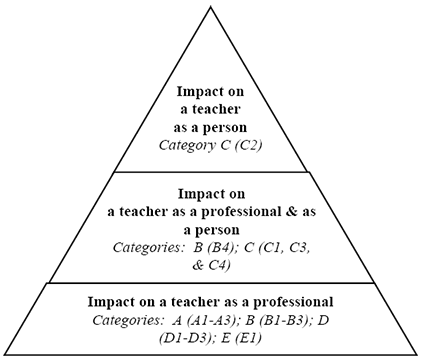
Figure 1 depicts what links and what differentiates the various categories of meanings. In the space of results, the hierarchical relationships among categories are reflected at the level of the impact of violence, i.e., the target of violence – whether it is directed at the teacher as a professional, the teacher as a person, or the teacher simultaneously as both a professional and a person. At the base of the pyramid are those category meanings that exhibit the greatest number of interconnections in terms of the impact of violence, whereas at the top are those with the fewest interconnections. The distribution of violence-related meanings indicating the target of violence is clearly most abundant at the “teacher-as-a-professional” level. Violence directed at the teacher as a professional implies an impact on the teacher’s professional qualities, abilities, and, more broadly, their professional competencies. By contrast, violence directed at the teacher as a person implies an impact on personal characteristics, for example, physical appearance. Only one meaning from Category C, that of “Hurtful jokes” (C2), indicating gender-based violence – can be attributed to the “teacher-as-a-person” level. However, there are also meanings that encompass both levels: “use of physical force” (B4), “hurtful remarks and insinuations” (C1), “hurtful gossiping” (C3), and “hurtful name-calling” (C4). In these cases, there is either no salient distinction regarding whether the violent behavior is directed at the teacher as a professional or as a person, or it is not possible to draw a clear demarcation between the two.
Discussion and Conclusions
The phenomenographic study conducted broadens the conceptualization of violence experienced by teachers in the professional school environment by presenting a relatively wide spectrum of subjective interpretations of violence. Teachers construe violence at school as pressure to comply, aggressive behavior, verbal insults, public humiliation, and non-transparent decision-making directed toward teachers. The study participants more strongly associate the notion of violence with actions undertaken by the school leader and/or administration, and to a lesser extent with actions by colleagues, students, and students’ parents. All violent acts are construed as harmful to teachers both professionally and personally. This appraisal partially aligns with previous research (Reddy et al., 2018), which defines violence experienced by teachers as detrimental and as exerting a negative impact on their professional practice.
Violence manifested in the school environment is, according to the participants of this study, most strongly associated with verbal expression. This is consistent with findings from previous studies (Badenes-Ribera et al., 2022; Longobardi et al., 2019; Yang et al., 2019; McMahon et al., 2024; Anderman et al., 2024), which confirm that verbally expressed violence constitutes the predominant form in teachers’ working environments. The present study also corroborates the claim that, although physical expression is one of the most overt forms of violence in general terms, it is not particularly frequent within teachers’ occupational settings (McMahon et al., 2024; Reddy et al., 2024).
The findings enable violence against teachers to be interpreted within a broader framework that integrates workplace violence (Calderon-Orellana, Díaz-Bórquez, & Calderón, 2025; McMahon et al., 2024; Berkowitz et al., 2022), workplace bullying and mobbing (Nielsen et al., 2024; Rosander & Nielsen, 2023), organizational injustice (Neall, Li, & Tuckey, 2021), and the culture and power relations of the school as an organization (Quinn, Waheduzzaman, & Djurkovic, 2024; Diržytė et al., 2024). Although some of the data illustrate manifestations of violence widely distinguished in the literature (e.g., threats, swearing, and insults), the study’s outcome space indicates that teachers’ understandings of violence are not limited to discrete incidents; rather, they emerge as a process of meaning construction that integrates the form of violence, structural characteristics (publicness, control, and procedural justice), and the orientation of violent conduct toward the teacher as a professional and/or as a person. The findings further highlight that teachers associate aggressive behavior with a logic of threat and an anticipation of punishment/sanctions (i.e., the possibility of being penalized for particular professional actions). Accordingly, threats are understood primarily as an instrument of administrative control. The phenomenographic analysis also showed that, within teachers’ conceptualizations, insults are interpreted more strongly through repetition, denigration, and risk to the teacher’s reputation – i.e., to features that align directly with the logic of bullying/mobbing, whereby harm is produced through sustained erosion of status and dignity (Nielsen et al., 2024; Rosander & Nielsen, 2023). The results also allow a clear distinction to be drawn between insults and public humiliation in teachers’ understandings of violence. While both involve similar content (denigration and humiliation), the critical difference concerns publicness – namely, the presence of an audience (colleagues, students, and parents). This extends prior research (Berkowitz et al., 2025; Choi et al., 2024) by providing a rationale for why teachers link violence not only to negative emotional impact but also to harm to professional autonomy, authority, and professional identity. Findings related to violence construed as pressure to comply indicate that violence is understood as a negative impact on the professional agency of teachers (i.e., constraints on the teacher’s right to decide and to be heard). Thus, teachers’ understandings of violence are linked to less visible exercises of power that may not be labeled as violence in the common discourse, and yet they are subjectively experienced as degrading. In this respect, the findings partially resonate with scholarship on micropolitics in schools, which conceptualizes the school as an organization where decision-making and negotiations over norms and resources (time, workload, and recognition) constitute a field of power (Giudici, 2021; Kelchtermans, 2005). Finally, understanding violence as non-transparent decision-making – although not the dominant category – remains important, as it suggests that violence may be construed not only as direct behavior but also as a lack of procedural transparency and related organizational mechanisms. These findings therefore support analyzing violence against teachers through the lens of power asymmetry and in relation to managerial and organizational decision-making processes.
This study broadens the conceptualization of violence occurring within the school environment and reveals several novel aspects. First, the study has shown that violence is associated not only with verbal and physical forms but also with visual and written expression. Written expression is linked to non-transparent decisions made by the school administration – orders and resolutions that are not communicated and with which teachers are not familiarized in advance. Visual expression emerges as part of hurtful gossip experienced by students and manifested verbally, visually, and in written form.
Second, the study extends the conceptualization of the teacher as an object of violence. Violence is construed as directed at the teacher-as-a-professional and also at the teacher-as-a-person. Violence expressed through gossip, remarks, insinuations, and name-calling undermines professional self-esteem, harms professional identity, and also infringes upon human dignity more broadly. Consequently, teachers consider violence as a behavior that affects both their professional functioning and their overall well-being.
Third, the study indicates that teachers’ understandings of violence are more strongly related to administrative power practices (i.e., actions by the school leader and/or administration rather than by students, students’ parents, or colleagues). In this respect, the findings contribute to the limited body of research documenting teachers’ experiences of injustice and harmful behavior from the school administration (Astor et al., 2024). School administrations are described as demonstrating power and deploying power instruments toward teachers, publicly humiliating and insulting them, behaving aggressively, and imposing non-negotiated and non-transparent decisions. Thus, violence as an expression of power is enacted vertically; individuals occupying higher formal positions direct violent actions toward those in lower positions.
In this regard, the present study differs from research examining so-called imbalanced power enactment (Garrett, 2018; De Wet, 2010), where power is exercised against teachers by their students. Although teachers occupy the higher position in terms of formal authority, they may be demeaned through students’ behavior – being belittled, mocked, and pressured. In the context of this study, violence is least strongly associated with students and somewhat more with students’ parents who instruct teachers on how to teach their children, and how to evaluate their achievement (or lack thereof). Accordingly, students and their parents are identified as sources of violence, but not as the primary sources.
In general terms, this study adds to the body of research on violence directed against teachers. As is well established, for some time it was customary to focus on student victimization at school, while comparatively little attention was paid to teachers as targets of violence (Reddy et al., 2018; McMahon et al., 2024). However, studies examining teachers’ conceptualizations and experiences of violence are critically important; they not only help to develop a more comprehensive picture of violent behavior in the school environment and to refine understanding of the concept and context of victimization but also to elucidate links between violence experienced by teachers and professional burnout (Moon & McCluskey, 2020; Moon, Kim, & McCluskey, 2023; Berkowitz, 2025; Yang et al., 2024), as well as lower life satisfaction levels (Diržytė et al., 2024).
Further research on violence perceived and experienced by teachers could be advanced by examining the multifaceted impact of violence on teachers’ professional and personal lives, including its implications for their personal development and change. In addition, future studies could explore teachers’ responses and coping strategies in relation to the violence they experience.
Author contributions
All authors have contributed to and explicitly approved the manuscript. All authors equally performed the role of conceptualization, methodology, formal analysis, investigation, writing – original draft, writing – review and editing, as well as visualization.
References
Åkerlind, G. S. (2005). Variation and commonality in phenomenographic research methods. Higher Education Research & Development, 24(4), 321–334. https://doi.org/10.1080/07294360500284672
Anderman, E. M., Perry, A. H., Lee, H. J., McMahon, S. D., Astor, R. A., Espelage, D. L., … Worrell, F. C. (2024). School Goal Structures and Violence Against Educators Before and During COVID-19. Journal of School Violence, 23(4), 433–447. https://doi.org/10.1080/15388220.2024.2318703
Astor, R. A., Benbenishty, R., Capp, G. P., Watson, K. R., Wu, C., McMahon, S. D., Worrell, F. C., Reddy, L. A., Martinez, A., Espelage, D. L., & Anderman, E. M. (2024). How school policies, strategies, and relational factors contribute to teacher victimization and school safety. Journal of community psychology, 52(1), 39–57. https://doi.org/10.1002/jcop.23084
Badenes-Ribera, L., Angelo Fabris, M., Martinez, A., McMahon, S. D., & Longobardi, C. (2022). Prevalence of Parental Violence Toward Teachers: A Meta-Analysis. Violence and victims, 37(3), 348–366. https://doi.org/10.1891/VV-D-20-00230
Berkowitz, R. (2025). Teacher-to-Student Victimization: The Role of Teachers’ Victimization and School Social and Organizational Climates. Education Sciences, 15(9), Article 1090. https://doi.org/10.3390/educsci15091090
Berkowitz, R., Bar-On Shmilovitch, N., Tzafrir, S., & Enosh, G. (2025). Exploring Parents’ Violence Against School Teachers: Manifestation, Risk Factors, and Coping Strategies. Behavioral sciences, 15(10), Article 1429. https://doi.org/10.3390/bs15101429
Berkowitz, R., Bar-On, N., Tzafrir, S., & Enosh, G. (2022). Teachers’ Safety and Workplace Victimization: A Socioecological Analysis of Teachers’ Perspective. Journal of School Violence, 21(4), 397–412. https://doi.org/10.1080/15388220.2022.2105857
Berlanda, S., Fraizzoli, M., de Cordova, F., & Pedrazza, M. (2019). Psychosocial risks and violence against teachers. Is it possible to promote well-being at work? International Journal of Environmental Research and Public Health, 16(22), Article 4439. https://doi.org/10.3390/ijerph16224439
Bilić, V. (2023). Violence by students’ parents against teachers: Forms, prevalence, reasons, potential risk factors and consequences. Napredak, 164(1/2), 77–98. https://doi.org/10.59549/n.164.1-2.5
Blom, N., Fadeeva, A., & Barbosa, E. C. (2023). The Concept and Measurement of Violence and Abuse in Health and Justice Fields: Toward a Framework Aligned with the UN Sustainable Development Goals. Social Sciences, 12(6), Article 316. https://doi.org/10.3390/socsci12060316
Calderon-Orellana, M., Díaz-Bórquez, D., & Calderón, P. (2025). Client Violence Against Educational Workers: A Systematic Review. Education Sciences, 15(4), Article 415. https://doi.org/10.3390/educsci15040415
Choi, J., Faucher, E., Newnam, M., & Han, S. (2024). Student-to-Teacher Victimization and Its Negative Impact on Teaching Approaches: Applying Propensity Score Matching. Journal of Interpersonal Violence, 39(21-22), 4387–4414. https://doi.org/10.1177/08862605241235123
De Wet, C. (2010). Victims of educator-targeted bullying: A qualitative study. South African Journal of Education, 30, 189–201.
Diržytė, A., Indrašienė, V., Jegelevičienė, V., Merfeldaitė, O., Prakapas, R., Railienė, A., & Gušauskienė, M. (2024). Teacher victimization by students, their parents, and school staff: Prevalence and links with teachers’ life satisfaction in a Lithuanian sample. Education Sciences, 14(2), Article 163. https://doi.org/10.3390/educsci14020163
Garrett, L. (2018). The Student Bullying of Teachers: An Exploration of the Nature of the Phenomenon and the Ways in which it is Experienced by Teachers. Aigne Journal, 5(1). https://doi.org/10.33178/aigne.vol5.5
Giudici, A. (2021). Teacher politics bottom-up: Theorising the impact of micro-politics on policy generation. Journal of Education Policy, 36(6), 801–821. https://doi.org/10.1080/02680939.2020.1730976
Gušauskienė, M., Indrašienė, V., Prakapas, R., Railienė, A., & Sadauskas, J. (2025). Teacher Victimisation in Educational Institutions: Analysis of the Legal Environment. Pedagogika, 158(2), 136–157. https://doi.org/10.15823/p.2025.158.7
Hyun, S., & Wilcox, P. (2018). Routine activity theory, target congruence, and school context: A multilevel analysis of teacher victimization. Victims & Offenders, 13(3), 349–372. https://doi.org/10.1080/15564886.2017.1329174
Kelchtermans, G. (2005). Teachers’ emotions in educational reforms: Self-understanding, vulnerable commitment and micropolitical literacy. Teaching and Teacher Education, 21, 995–1006. https://doi.org/10.1016/j.tate.2005.06.009
Kõiv, K., & Aia-Utsal, M. (2021). Victimized teachers’ experiences about teacher-targeted bullying by students. In C. Pracana & M. Wang (Eds.), Psychological Applications and Trends 2021 (pp. 172–176). inScience Press. https://doi.org/10.36315/2021inpact036
Kratcoski, P. C. (1985). School Disruption and Violence Against Teachers. Corrective & Social Psychiatry & Journal of Behavioral Technology, 31(3), 88–96.
Kvale, S. (1994). Validation as communication and action: On the social construction of validity. New Orleans, LA: ERIC.
Larsson, J., & Holmstrom, I. (2007). Phenomenographic or phenomenological analysis: does it matter? Examples from a study on anaesthesiologists’ work. International Journal of Qualitative Studies on Health and Well- Being, 2(1), 55–64. https://doi.org/10.1080/17482620601068105
Lokmić, M., Opić, S., & Bilić, V. (2013). Violence against Teachers - Rule or Exception? International Journal of Cognitive Research in Science, Engineering and Education (IJCRSEE), 1(2), 6–15.
Longobardi, C., Badenes-Ribera, L., Fabris, M. A., Martinez, A., & McMahon, S. D. (2018). Prevalence of student violence against teachers: A meta-analysis. Psychology of Violence, 9, 596–610. https://doi.org/10.1037/vio0000202
Marton, F. (1994). Phenomenography. In T. Husen & T. N. Postlethwaite (Eds.), International encyclopedia of education (pp. 4424–4429). Oxford, England: Pergamon.
Mcmahon, S. D., Martinez, A., Espelage, D., Rose, C., Reddy, L. A., Lane, K., … Brown, V. (2014). Violence Directed Against Teachers: Results from a National Survey. Psychology in the Schools, 51(7), 753–766. https://doi.org/10.1002/pits.21777
McMahon, S. D., Worrell, F. C., Reddy, L. A., Martinez, A., Espelage, D. L., Astor, R. A., Anderman, E. M., Valido, A., Swenski, T., Perry, A. H., Dudek, C. M., & Bare, K. (2024). Violence and aggression against educators and school personnel, retention, stress, and training needs: National survey results. American Psychologist, 79(7), 903–919. https://doi.org/10.1037/amp0001348
Merriam, S. B. (2002). Assessing and evaluating qualitative research. In S. B. Merriam (Ed.), Assessing and evaluating qualitative research in practice (pp. 18–33). San Francisco, CA: Jossey-Bass.
Moon, B., & McCluskey, J. (2016). School-based victimization of teachers in Korea: Focusing on individual and school characteristics. Journal of Interpersonal Violence, 31(7), 1340–1361. https://doi.org/10.1177/0886260514564156
Moon, B., & McCluskey, J. (2020). An Exploratory Study of Violence and Aggression Against Teachers in Middle and High Schools: Prevalence, Predictors, and Negative Consequences. Journal of School Violence, 19(2), 122–137. https://doi.org/10.1080/15388220.2018.1540010
Moon, B., Kim, J., & McCluskey, J. (2022). Using a group-based trajectory approach to assess theoretical predictors of teacher victimization. Journal of Developmental and Life-Course Criminology, 8, 75–95. https://doi.org/10.1007/s40865-022-00187-x
Moon, B., Kim, J., & McCluskey, J. (2023). Teacher victimization patterns: Establishing a group-based trajectory approach to assessing predictors of connectedness to school, job satisfaction, and depression. Victims & Offenders, 18(4), 607–622. https://doi.org/10.1080/15564886.2021.2014007
Neall, A. M., Li, Y., & Tuckey, M. R. (2021). Organizational Justice and Workplace Bullying: Lessons Learned from Externally Referred Complaints and Investigations. Societies, 11(4), Article 143. https://doi.org/10.3390/soc11040143
Nielsen, M. B., Einarsen, S. V., Parveen, S., & Rosander, M. (2024). Witnessing workplace bullying – A systematic review and meta-analysis of individual health and well-being outcomes. Aggression and Violent Behavior, 75, Article 101908. https://doi.org/10.1016/j.avb.2023.101908
Perry, A. H., Martinez, A., Reddy, L. A., McMahon, S. D., Anderman, E. M., Astor, R. A., Espelage, D. L., & Worrell, F. C. (2024). Addressing violence against educators: What do teachers say works? School Psychology, 39(5), 488–498. https://doi.org/10.1037/spq0000576
Quinn, S., Waheduzzaman, W., & Djurkovic, N. (2024). Impact of Organizational Culture on Bullying Behavior in Public Sector Organizations. Public Personnel Management, 54(2), 184–208. https://doi.org/10.1177/00910260241287619
Reddy, L. A., Espelage, D. L., McMahon, S. D., Anderman, E. M., Lane, K. L., Brown, V. E., Reynolds, C. R., Jones, A., & Kanrich, J. (2013). Violence against teachers: Case studies from the APA Task Force. International Journal of School & Educational Psychology, 1(4), 231–245. https://doi.org/10.1080/21683603.2013.837019
Reddy, L. A., Espelage, D. L., Anderman, E. M., Kanrich, J. B., McMahon, S. D. (2018). Addressing violence against educators through measurement and research. Aggression and Violent Behavior, 42, 9–28. https://doi.org/10.1016/j.avb.2018.06.006
Reddy, L. A., Martinez, A., Perry, A. H., McMahon, S. D., Espelage, D. L., Anderman, E. M., Astor, R. A., & Worrell, F. C. (2024). Violence directed against teachers during the COVID-19 pandemic: A social–ecological analysis of safety and well-being. School Psychology, 39(5), 510–519. https://doi.org/10.1037/spq0000562
Rosander, M., & Nielsen, M. B. (2023). Perceived ability to defend oneself against negative treatment at work: Gender differences and different types of bullying behaviours. Applied Psychology, 72(4), 1430–1448. https://doi.org/10.1111/apps.12443
Simões, E. C., & Cardoso, M. R. A. (2022). Violence against public school teachers and burnout. Ciencia & saude coletiva, 27(3), 1039–1048. https://doi.org/10.1590/1413-81232022273.28912020
Stilwell, S. M., Guzmán, P., Varela, J., McMahon, S. D., Bare, K., Heinze, J., & Zimmerman, M. (2025). Protecting Educators: A Scoping Review of Interventions That Address Teacher Victimization. Behavioral Sciences, 15(2), Article 214. https://doi.org/10.3390/bs15020214
Tarablus, T., & Yablon, Y. B. (2023). Teachers’ Willingness to Seek Help for Violence Against Them: The Moderating Effect of Teachers’ Seniority. Journal of Interpersonal Violence, 38(19/20), 10703–10722. https://doi.org/10.1177/08862605231175518
Trigwell, K. (2000). A phenomenographic interview on phenomenography. In J. Bowden & E. Walsh (Eds.), Phenomenography (pp. 63–82). Melbourne, Australia: RMIT University Press.
Yang, C., Fredrick, S. S., Nickerson, A. B., Jenkins, L. N., & Xie, J.-S. (2019). Initial development and validation of the Multidimensional Teacher Victimization Scale. School Psychology, 34(2), 244–252. https://doi.org/10.1037/spq0000307
Yang, C., Rho, E., Dong, Q., & Zhang, Y. (2024). Teacher Victimization, Burnout, and School Climate: Insights from a U.S. Study. PsychArchives. https://doi.org/10.23668/psycharchives.15459
Yates, C., Partridge, H., & Bruce, C. (2012). Exploring information experiences through phenomenography. Library and Information Research, 36(112), 96–119. https://doi.org/10.29173/lirg496