Social Welfare: Interdisciplinary Approach eISSN 2424-3876
2026, vol. 16, pp. 181–200 DOI: https://doi.org/10.15388/SW.2026.16.9
Expression of Values as a Criterion for the Suitability of Volunteers to Provide Assistance to Children from Families Facing Social Risks
Ilona Klanienė
Klaipėda University, Lithuania
E-mail: ilona.klaniene@ku.lt
https://orcid.org/0000-0001-8799-456X
https://ror.org/027sdcz20
Aleksandra Zamrykit
Klaipėda Port City Progymnasium, Lithuania
E-mail: aleksandrazamrykit@gmail.com
Abstract. In Lithuania, assistance to children growing up in families facing social risks is provided by non-governmental organisations, which engage volunteers after assessing their suitability for working with children. The present article reveals the expression of the values of volunteers as an essential criterion for selection for work with children from families facing social risks. The article presents the results of a quantitative study obtained by using various instruments: a written questionnaire was used to assess volunteers’ involvement in voluntary activities, satisfaction with activities, etc.; the Schwartz basic human values questionnaire helped identify the core values of volunteers, the Thomas-Kilmann instrument helped reveal the conflict resolution strategies used by volunteers and their links to the expression of values. The study involved 102 volunteers working with children in NGOs. The results of the quantitative study revealed links between the volunteers’ successful long-term activities and the expression of values. According to the results of the quantitative study, it can be stated that the expression of values should become one of the essential criteria when selecting volunteers to work with children from families facing social risks.
Keywords: children from families facing social risks, volunteers, value orientations and values, selection, voluntary activities.
Recieved: 2026-02-07. Accepted: 2026-06-11
Copyright © 2026 Ilona Klanienė, Aleksandra Zamrykit. Published by Vilnius University Press. This is an Open Access journal distributed under the terms of the Creative Commons Attribution 4.0, which permits unrestricted use, distribution, and reproduction in any medium, provided the original author and source are credited.
Introduction
Children are born and happen to live in different circumstances, and their socialisation and education are primarily the responsibility of their parents; however, families facing various social risks are not always able to do so for a variety of reasons. Klanienė et al. (2023) state that the welfare of children is cared for by a number of governmental organisations (children’s rights services, care institutions, educational institutions, etc.) and non-governmental organisations (hereinafter – NGOs), which supplement the assistance provided by formal institutions. Research shows that NGOs, involving volunteers, play an important role in addressing issues related to education and social assistance (Fernandes & Matos, 2023). A volunteer is defined in scientific literature as “an individual who freely devotes his/her time to the benefit of others, takes responsibility for his/her actions, expects no reward, and at the same time seeks personal improvement, gains experience, and receives spiritual benefits, which he/she shares with the community” (Jonutytė, 2007, p. 96). According to statistical data, approximately 17% of the population in Lithuania participates in volunteer activities (Department of Statistics of Lithuania, 2023). Meanwhile, in the European Union, about 32% of the population participates in volunteer activities (Eurostat, 2024). This indicates that the prevalence of volunteer activities in Lithuania is lower than the average for the European Union, and therefore greater attention must be paid to encouraging volunteer involvement and ensuring the continuity of these activities.
Volunteering in Lithuania has been evolving, and the standards for its activities are quite high, particularly when providing assistance to children from families facing social risks; therefore, the selection of volunteers and the continuity of their work are becoming increasingly important. Issues regarding the suitability of volunteers for certain activities have also been addressed in the national legislation of Lithuania (Law on Voluntary Activities of the Republic of Lithuania, 22 June 2011, No. XI-1500, Vilnius). Documents issued by the Ministry of Social Security and Labour of the Republic of Lithuania (Law on Social Services of the Republic of Lithuania (2006)) emphasise social responsibility in providing assistance to vulnerable groups, the importance of long-term and positive relationships, etc. Researchers investigating the possibilities of volunteer assistance for children also emphasise the same values. Grincevičius (2011) and Klanienė et al. (2023) note that establishing and maintaining a bond between a volunteer and a child provides the child with positive communication experiences and encourages self-confidence and trust in others. As the aforementioned authors note, a prerequisite for such relationships is that volunteers possess the relevant values (empathy, goodwill, positivity, etc.) and engage in long-term volunteering. Therefore, there is a need to select volunteers who share the respective values in order to ensure the continuity of activities with children from families facing social risks.
Vaicekavičienė and Petrulis (2022) note that, in order to operate successfully, NGOs should engage volunteers who are properly prepared for the work. This is also emphasised by Webley (2023), who states that not every volunteer is suitable for a particular activity, and therefore, it is necessary to organise the selection of volunteer candidates. Englert et al. (2019), who studied the specifics of volunteer selection, state that volunteer selection is the conscious recognition of a candidate as the most suitable for a specific activity. A candidate’s suitability for a specific voluntary activity is demonstrated when his/her personal motivations and abilities match the conditions and aims of the activity. The selection process is particularly important when working with children, as they are a socially vulnerable group; therefore, it is extremely important to assess the suitability of volunteers for this activity (Tsai et al., 2023).
An analysis of scientific literature has shown that, when selecting volunteers, it is highly important to possess objective criteria that indicate a volunteer’s suitability for social pedagogical work with children. It should be noted that, at all stages of the selection process, particular attention must be paid to the motivation and values of the prospective volunteer because the study revealed that volunteers whose motivation was the expression of certain values were characterised by long-term and successful activity (Zhou & Muscente, 2023). Chacon et al. (2017) justified that the values of volunteers are one of the important criteria when selecting volunteers for work with children because such volunteers are more likely to commit to long-term volunteering. Ruškienė (2021) and Savicka (2021) emphasise that the expression of values is the most important motive for voluntary activity. However, the issue of relationship between the volunteers’ values and the continuity of their work with socially vulnerable groups has not been sufficiently studied yet.
In Lithuania, the selection criteria for volunteers working with children whose families are facing social risks is a scarcely studied issue. Only a few sources (Jonutytė, 2001, 2007) have been found that analyse the selection criteria for volunteers working with children in camps. Foreign researchers more often analyse issues related to the suitability of volunteers for working with children. Schwartz (1992a, 2012b, 2021c) and Sagiv and Schwartz (2022) analysed the values that predict prosocial behaviour, as such behaviour is characteristic of social workers and volunteers. Studies by Ackermann (2019) and Kramer et al. (2021) revealed value orientations that predict success in voluntary activities. Alkadi et al. (2019) and Morse et al. (2022) investigated the relationship between volunteers’ value orientation and their intention to continue volunteering. Most researchers (Cho et al., 2020; Khoteyeva & Astaltseva, 2022; Zhou & Muscente, 2023) highlight values as an essential criterion for assessing a volunteer’s suitability for voluntary activity. As mentioned above, the suitability of volunteers for the activity and the importance of values for the success and continuity of the activity have been studied more extensively abroad, however, the criteria for selecting volunteers to work with children whose families face social risks, and especially the connection between values and the successful provision of assistance to children, is a little-studied issue.
The aim of the present article is to reveal the expression of the values of volunteers as an essential criterion for selection for work with children from families facing social risks. The article examines the following research question: How does the expression of volunteers’ values relate to their suitability for providing assistance to children from families facing social risks, taking into account the continuity of volunteers’ activities?
The object of the article is the relationship between the expression of volunteers’ values and their suitability to provide assistance to children from families facing social risks.
The aim of the article is to examine the relationship between the expression of volunteers’ values and their suitability to provide assistance to children from families facing social risks.
Literature Review
McMorris et al. (2018) and Klanienė et al. (2023) note that assistance provided by volunteers to children whose families face social risks is highly effective due to positive interaction with a well-disposed adult (volunteer), which improves students’ emotional well-being and learning outcomes, builds children’s confidence in themselves and others, and improves communication and problem-solving skills. Wang et al. (2025) note that, in order to ensure the effectiveness of volunteers’ assistance to children, especially those of parents facing social risks, it is necessary to assess their suitability for such activities.
Due to the social vulnerability of this group of children, it is essential that volunteers should commit to sustained, long-term engagement; accordingly, the implementation of a structured volunteer selection process is necessary. Ralston et al. (2005) and Tsai et al. (2023) argued that involvement in voluntary activities depends on motivation, expectations, and experiences. Molchanov et al. (2020) identified a link between the frequency of participation in voluntary activities and the recognition of volunteering as a value. Bahat (2021) states that values play a fundamental role in volunteers’ engagement in voluntary activities, as she found a statistically significant relationship between volunteers’ opportunities to realise their values in their activities and their commitment to voluntary activities. This means that such volunteers are motivated for long-term volunteering. Other authors also consider values to be an important motivational factor for engaging in voluntary activities (Sagiv & Roccas, 2021; Ruškienė, 2021). The authors listed above claim that the more an activity reflects the values that are important to the volunteer, the more motivated the individual is to achieve the goals of voluntary activity and to continue it.
Korolyov (2021) argued that values exist in culture and are an integral part of social life, because certain values, when accepted by an individual, become personal. Values form groups of value orientations. Value orientations are attitudes formed through personal social experience that reflect individuals’ goals, beliefs, and ideals. Value orientations are a coherent structure that determines individuals’ subjective attitudes toward the world, themselves, and specific values, i.e., they reflect individuals’ orientation toward certain goals. Schwartz (1992a, 2012b, 2021с) stated that values are constant beliefs that guide us in our actions and their evaluations. Taking into account the significance of values and value orientations for human behaviour, various theoretical approaches are distinguished in the scientific literature in an effort to explain the structure of values and their expression. Values are most often examined in the context of three main theories: Kluckhohn and Strodtbeck (1961), Rokeach (1973), and Schwartz (1992). Kluckhohn and Strodtbeck’s theory focuses on explaining value orientations and cultural differences (Hills, 2002). Rokeach’s theory emphasises a hierarchy of values based on their ranking by importance, which allows for the identification of the individual’s priorities but limits the ability to analyse the structural relationships between values (Smallenbroek et al., 2025). On the contrary, in Schwartz’s theory, values are understood as an interrelated system in which they form a coherent structure and determine human behaviour and the direction of one’s activities. Furthermore, this theory has predictive potential, making it possible to explain and predict behavioural characteristics based on value orientations (Smallenbroek et al., 2025; Karadag, 2025). Thus, identifying volunteers’ values can reveal their motivation for choosing a particular voluntary activity and makes it possible to predict their involvement in the process of providing voluntary assistance to children and the continuity of their activities.
When analysing values as one of the key criteria for selecting volunteers, the theory of basic human values developed by Schwartz (1992a, 2012b, 2021с) is used, which helps to better understand the motivation and priorities of individuals. Schwartz (1992a, 2012b, 2021с) grouped basic values into 10 types that differ in terms of motivation and interact to form 4 value orientations: ‘Openness to Change’, ‘Self-Transcendence’, ‘Self-Enhancement’, ‘Conservation’. Below, a brief overview of these value orientations is presented.
1. ‘Self-Transcendence’. This value orientation includes two values: ‘Universalism’ and ‘Benevolence’. People with this value orientation are empathetic, socially responsible, and inclined to help from altruistic motives both their relatives and members of the community.
2. The value orientation ‘Op enness to Change’ consists of three values: ‘Self-Direction’, ‘Stimulation’, and, to some extent, ‘Hedonism’. People with this value orientation are free-thinking, active, open to change and innovation, but they also seek instant gratification.
3. Three values are attributed to the value orientation ‘Self-Enhancement’: ‘Power’, ‘Achievement’, and, to some extent, ‘Hedonism’. People whose activities are dominated by this value orientation are ambitious, results-oriented, and tend to dominate.
4. The fourth value orientation, ‘Conservation’, encompasses three values: ‘Security’, ‘Tradition’, and ‘Conformity’. This value orientation motivates people to care for their own safety and that of their community, to create harmony and stability, to nurture mutual relationships, and to feel that they are in control of the situation, and that they are contributing to maintaining social stability.
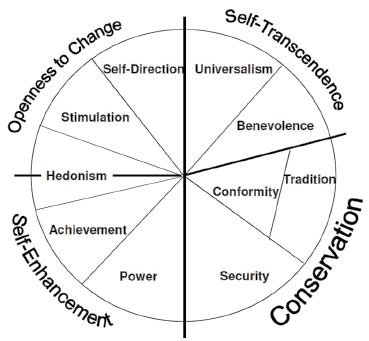
Schwartz (1992a, 2012b, 2021с) created a circular model of values, in which, ten basic values are grouped according to their meaning and are assigned to corresponding value orientations. It should also be noted that values placed next to each other are more closely related than those placed further apart or opposite each other. This classification shows that some values are compatible with each other, while others are in conflict with each other (see Figure 1, which presents a theoretical model of 10 types of motivational values and their links to value orientations).
Figure 1.
Relationship between motivational values and value orientations: a theoretical model (according to Schwartz (1992a, 2012b, 2021c))
Therefore, referring to the aforementioned theory, and after analysing the model of motivational values based on four value orientations, it is important to determine which value orientation and values encourage volunteers to provide unselfish assistance to children and ensure the continuity of their activities. Sagiv and Schwartz (2022) argued that values such as ‘Benevolence’ and ‘Universalism’, which belong to the value orientation ‘Self-Transcendence’, reflect a motivation to care for and look after others and are characteristic of people in professions that provide assistance to others (psychologists, teachers, social workers, and also volunteers).
Jonutytė (2007) and Cho et al. (2023) claimed that volunteers whose main motivation is personal development and self-discovery, which is characteristic of people with a value orientation ‘Openness to Change’, work more successfully and continue working with children for a longer period. The results of the study by Radovanovič and Simeunovič (2020) showed that volunteers are characterised by values that belong to the value orientation ‘Self-Transcendence’, which motivates them for caring for people and protection. Heilman and Kusev (2020) identified a link between volunteers’ dominant values – ‘Self-Transcendence’ – and their tendency to demonstrate prosocial behaviour. Thus, based on theoretical insights, it can be assumed that volunteers whose desire to help others is grounded in the value orientations of ‘Self-Transcendence’ and ‘Openness to Change’ will choose long-term volunteering and work effectively with children.
Previous studies have revealed that volunteers who demonstrated categorical thinking during the selection process had difficulty communicating with children (Jonutytė, 2007). One of the main reasons why volunteers stop their activities is conflictual relationships with the children (Klanienė et al., 2023). Lange et al. (2025) argued that a volunteer’s non-directive communication style helps establish a mutual relationship with children, in contrast to an authoritarian communication style. Categorical thinking is associated with values such as ‘Power’, as it indicates a need to dominate, which is a particularly inappropriate trait when providing assistance to children. As mentioned above, volunteers who improve themselves through voluntary activities and seek new knowledge and experiences can successfully provide assistance to children. However, as Schwartz (1992a, 2012b, 2021c) points out, the need to gain new experiences must be examined in light of the purpose for which the new experiences are being gained. If the motivational goal of volunteers is to acquire knowledge, this need reflects the value ‘Stimulation’; if the motive for acquiring new experience is career advancement, this corresponds to the value ‘Achievement’. This value is opposed to the values ‘Universalism’ and ‘Benevolence’. Based on these insights, it is assumed that volunteers who are characterised by a strongly expressed value ‘Achievement’ (also attributed to the value orientation ‘Self-Enhancement’) may encounter difficulties in providing assistance to children. A study by Khoteyeva and Astaltseva (2022) showed that volunteers who are career-oriented are eager to acquire new skills and abilities, however, they most often engage in activities and interact and collaborate with others only on work-related issues. Such volunteers are characterised by a maximum focus on the outcome of their activities, i.e., they derive pleasure not from the process of volunteering, but from achieving the goal. Therefore, volunteers who are strongly career-oriented will prioritise acquiring new skills over friendship with children and other volunteers. It is important to pay attention to this when selecting volunteers to work with children.
When selecting volunteers to work with children, in accordance with the Schwartz theory of basic human values, it is necessary to pay attention to the value orientation of the candidates’ motivational goals, i.e., to the high scores in the value orientations ‘Self-Transcendence’ and ‘Openness to Change’. Also, individuals who wish to provide voluntary assistance to children should not exhibit strong expressions of value orientations such as ‘Conservation’ and ‘Self-Enhancement’.
Research Methodology
In order to analyse the expression of volunteers’ values as an essential selection criterion for working with children from families facing social risks, as well as its relationship with the continuity of voluntary activity, a quantitative research strategy (written survey method) was chosen.
Research sample. A non-probability purposive sampling method was chosen for the study. A purposive sampling method was chosen in order to include respondents who most closely matched the characteristics of the target population. Respondents were reached through the coordinators of non-governmental organisations and/or the heads of organisations. Ten NGOs that provide social and pedagogical assistance to children from families facing social risks with the help of volunteers were selected for the study. The sociodemographic data of volunteers are presented in Table 1.
Table 1.
Sociodemographic data of volunteers
|
Characteristics |
In total, N (%) |
|
|---|---|---|
|
Age |
15-23 years old |
26 (25.5) |
|
24-32 years old |
19 (18.6) |
|
|
33-41 years old |
27 (26.5) |
|
|
42-50 years old |
21 (20.6) |
|
|
51 years old and older |
9 (8.8) |
|
|
Gender |
Female |
86 (84.3) |
|
Male |
16 (15.7) |
|
|
Education |
Basic |
4 (3.9) |
|
Secondary |
17 (16.7) |
|
|
Secondary (vocational) |
6 (5.9) |
|
|
Higher (non-university) |
9 (8.8) |
|
|
Higher (university) |
66 (64.7) |
|
As shown in the table, 102 volunteers working with children in NGOs participated in the study. Most of the volunteers participating in the study were in the age groups of 33–41 (26.5%) and 15–23 (25.5%) years old. The majority of the volunteers participating in the study were women 86 (84.3%). Most of the respondents (66, or 64.7%) had a higher university education.
Data collection methods and instruments. The study was conducted from 4 March 2024 to 17 March 2024. This study used a quantitative data collection method, i.e., a written survey. The online questionnaire was created by using ManoApklausa.lt and was not made public. These measures were taken to eliminate the possibility that respondents outside the target group could complete the questionnaire. An anonymous written questionnaire survey was conducted among volunteers working with children from families facing social risks, and it was divided into two parts:
The first part of the questionnaire consisted of information about the sociodemographic characteristics of the volunteers (gender, age, education), the volunteers’ involvement in voluntary activities (length of volunteering experience, frequency and intensity of voluntary activities), and evaluation of voluntary activities (how the respondents rate their satisfaction with voluntary activities and their success). This questionnaire was developed by the authors of the article based on the analysed scientific literature.
The second part of the questionnaire consisted of Schwartz’s (1992a, 2012b, 2021c) questionnaire on basic human values. Schwartz’s research on values is widely recognised in the field of social sciences. This questionnaire was designed not only with the objective to identify individual values but also to analyse their interrelationships, which determine the corresponding motivation to act, and this is particularly important when assessing volunteers’ suitability for working with children. This questionnaire is also used to study the values of professionals in the helping professions (social workers), and, since volunteer work is also focused on helping others, this questionnaire is suitable for studying the selected issue. This questionnaire consists of 40 statements. The personality values profile consists of 10 values that belong to 4 value orientations (see Fig. 1). Values are attributed to a certain value orientation, and each value also corresponds to a certain motivational goal. The respondents were given descriptions of people. The study participants were asked to rate to what extent each person described resembled the respondent. A six-point Likert scale was used to assess the values of volunteers, where ‘1’ = not at all similar, ‘2’ = not similar, ‘3’ = slightly similar, ‘4’ = fairly similar, ‘5’ = similar, ‘6’ = very similar.
Considering that one of the indicators of a volunteer’s successful performance is the ability to resolve conflict situations with children, the volunteers’ ability to resolve conflict situations was examined. The results of the study by Holtrop et al. (2026) show that one of the reasons why volunteers quit their activities is conflicts with children, staff, and others. This study examined how volunteers resolve conflicts and the relationship between this aspect and their values and the continuity of their activities. According to Schwartz (2012a, 2021b), it is suggested that volunteers characterised by value orientations such as ‘Self-Transcendence’ and ‘Openness to Change’ tend to resolve conflicts constructively, whereas volunteers dominated by the value orientation ‘Self-Enhancement’ and a particularly strong expression of the value ‘Power’ tend to choose destructive methods. The respondents were presented with five statements based on the test-questionnaire developed by Thomas and Kilmann (2008) with the objective to examine personal tendencies toward conflict behaviour and identify certain conflict resolution styles. The respondents were asked to evaluate the statements by marking the appropriate answer with an ‘X’. The respondents’ answers are presented on a 5-point ranking scale: ‘1’ = definitely not, ‘2’ = no, ‘3’ = neither yes nor no, ‘4’ = yes, ‘5’ = definitely yes.
Data analysis. Empirical data were processed, systematised, and graphically represented by using IBM SPSS 26.0 for Windows and Windows Microsoft Office software. The following statistical analysis methods were used to analyse the research data obtained: percentage frequencies were calculated in data distribution (ranking and nominal scales) (Vaitkevičius & Saudargienė, 2006). Spearman’s correlation coefficient was used to determine the dependence between the two variables. The interpretation of correlational relationships is based on the classification of correlation strength, as presented by Bitinas (2006): from 0 to 0.20, there is no correlation between variables; from 0.20 to 0.40, there is a very weak correlation; from 0.40 to 0.60, there is a significant correlation; from 0.60 to 0.80, there is a strong correlation; and from 0.80 to 1, there is a very strong correlation. Statistical significance is indicated by the letter ‘p’. Correlation in this study is considered statistically significant if p<0.05 and/or p<0.01.
Means are calculated in the distribution of data on values and value orientations. The average values for each orientation were calculated by adding together the means of the individual values belonging to it and dividing by the number of values in that orientation.
In order to reveal the phenomena that have the greatest impact on the success of voluntary activities with children, the research data obtained were analysed by using factor analysis (the principal component method). Factor analysis means dividing the observed variables into groups united by some directly unobserved factor, while taking into account their mutual correlation (Pukėnas, 2009). Based on the correlation analysis, 12 variables from the first and second parts of the questionnaire were selected and combined into four factors reflecting the success of voluntary activities.
Research validity and reliability. In order to assess the internal reliability of the profile scales of volunteers’ personality values, Cronbach’s alpha coefficient was calculated. Scientific literature indicates that results are more reliable when Cronbach’s alpha is between 0.6 and 1 (Rupšienė & Rutkienė, 2016). Cronbach’s alpha for all (Universalism = 0.747; Benevolence = 0.716; Self-Direction = 0.745; Stimulation = 0.896; Hedonism = 0.755; Achievement = 0.749; Power = 0.781; Security = 0.896; Conformity = 0.718; Tradition = 0.713) of the profile scales of volunteers’ personality values is above 0.7, thereby indicating adequate scale reliability. The data are suitable for factor analysis. The suitability of the variables (data) for factor analysis was assessed by using the Kaiser–Meyer–Olkin (KMO) measure and Bartlett’s test of sphericity. The results obtained (p=0.000 <0.050, KMO=0.727>0.70) suggest that factor analysis is applicable to the present data.
Research ethics. The quantitative study was conducted in accordance with the principles of benevolence, respect, confidentiality, and anonymity, while ensuring the protection of the respondents’ rights, voluntary participation, and informed consent. Before the study, consent was obtained from representatives of the NGOs, and the aim and significance of the study were clearly and comprehensively explained to the respondents themselves. The respondents were free to decide whether to participate and could choose to stop completing the questionnaire at any time, and the data collected were used only in a summarised, anonymised form for research purposes.
Research results
After summarising the results of the study and referring to the means of the volunteers’ values and value orientations, a value profile of the volunteers participating in this study was created (see Figure 2).
Figure 2.
Overall value profile of the volunteers who participated in the study
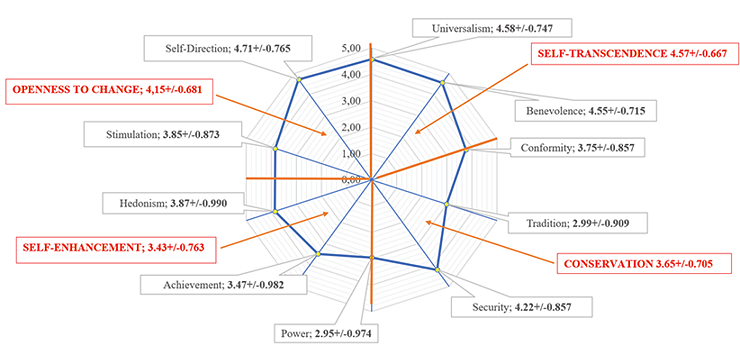
The research results presented in the figure show that the volunteers who participated in the survey are most characterised by self-direction, which means that they prioritise creativity and self-expression when choosing ways of conducting activities (the value ‘Self-Direction’ (M=4.71; SD=0.765)). The volunteers also expressed their desire to ensure equal rights, social justice, and well-being for all people (the value ‘Universalism’ (M=4.58; SD=0.747)). The study revealed that volunteers are characterised by sincerity, forgiveness, and helpfulness (the value ‘Benevolence’ (M=4.55; SD=0.715)). Both of these values belong to the value orientation ‘Self-Transcendence’ (M=4.57; SD=0.667), which reflects an individual’s desire to place the interests of society above personal interests. High scores on this orientation indicate volunteers’ empathy, courage in taking responsibility for their actions, and a tendency toward prosocial behaviour, as well as continuous activity. The results confirm the findings of Sagiv and Schwartz (2022) that the values ‘Universalism’ and ‘Benevolence’, which are components of the value orientation ‘Self-Transcendence’, reflect motivation to care for and concern for others and indicate a tendency toward socially responsible behaviour. Therefore, when selecting volunteers, it is necessary to pay attention to the high scores of values such as ‘Universalism’ and ‘Benevolence’. Such volunteers demonstrate tolerance, respect for diversity, the importance of warm interpersonal relationships and a sincere desire to help others, which is particularly important when providing assistance to children, for whom long-term, positive relationships with volunteers are very important (Klanienė et al., 2023).
The study found that volunteers are less likely to have values that reflect a desire for sensory pleasure and self-gratification (the value ‘Hedonism’ (M=3.87; SD=0.990)). There is also a weaker desire to take risks and seek diverse activities (the value ‘Stimulation’ (M=3.85; SD=0.873)). It should be emphasised that the values ‘Stimulation’ and ‘Hedonism’, as well as ‘Self-Direction’, belong to the value orientation ‘Openness to Change’ (M=4.15; SD=0.681). It can be concluded that volunteers’ openness to innovation and change is mainly based on a free and independent style of thinking and choice of activities, rather than on hedonistic motives. When selecting volunteers, it is necessary to pay attention to the strong expression of values such as ‘Self-Direction’.
Volunteers expressed less strongly the value orientation ‘Conservation’ (M=3.65; SD=0.705), which includes the values ‘Security’ (M=4.22; SD=0.857), ‘Conformity’ (M=3.75; SD=0.857), and ‘Tradition’ (M=2.99; SD=0.909). The most strongly expressed value is ‘Security’, which reflects volunteers’ need to ensure social stability and environmental safety. ‘Conformity’ reflects volunteers’ desire to adhere to socially acceptable norms, while ‘Tradition’, another less frequently chosen value, indicates volunteers’ weaker attachment to traditions, suggesting that they are more open to innovation. In this study, ‘Conservation’ is mainly based on the desire to ensure security; therefore, when selecting volunteers to work with children, it is particularly important to take into account the expression of security as a significant value.
The results of the study show that volunteers weakly expressed the value orientation ‘Self-Enhancement’ (M=3.43; SD=0.763). Considering that this value orientation includes the values ‘Power’, ‘Achievement’, and ‘Hedonism’, it can be concluded that volunteers are not characterised by a desire to dominate and control. Among the values attributed to this orientation, the most expressed is ‘Hedonism’, reflecting the participants’ desire to experience positive emotions, enjoy activities, and feel inner satisfaction. The value ‘Achievement’ was also rated as average, which indicates motivation to achieve results and recognition. Meanwhile, the least expressed value, ‘Power’, indicates a low tendency toward domination and control, which is particularly important when working with children. In summary, it can be said that the orientation ‘Self-Enhancement’ in this group of volunteers is mainly manifested through the desire to be effective and to experience satisfaction from their activities, however, it is not associated with the desire for power or control, which helps to maintain respectful, equal relationships with children and other volunteers.
When selecting volunteers to work with children, it is important to identify the links between the values held by volunteers and successful voluntary work (Chiu et al., 2023; Lorente et al., 2024; Munoz-Llerena et al., 2025; Holtrop et al., 2026). For this purpose, Spearman’s correlation coefficient was applied and statistically significant relationships between the variables – volunteers’ self-assessment of their activities as successful and their values – were identified. After analysing the data, it was found that the more strongly volunteers’ values ‘Self-Direction’ (r=0.226, p<0.05) and/or ‘Universalism’ (r=0.270; p<0.01), and/or ‘Benevolence’ (r=0.278, p<0.01) were expressed, the more volunteers rated their activities as successful. Therefore, when assessing the suitability of volunteers to work with children, it is necessary to include an assessment of the expression of these values in the selection process.
Sagiv and Schwartz (2022) argued that the value orientation ‘Self-Transcendence’ reflects a motivation to care for and look after others and is characteristic of people who provide assistance to others. Referring to Bochko’s (2019) statement on the importance of long-term and continuous involvement of volunteers for positive results in social pedagogical activities, Spearman’s correlation coefficient was applied between the value orientation ‘Self-Transcendence’ and variables revealing involvement in voluntary activities (length of volunteering experience and frequency of volunteering), which increases the likelihood of continuity of activity for more than one year. The data analysis revealed statistically significant correlations indicating that the more often volunteers engage in voluntary activities, the more important it is for them to care for the well-being of children (the value ‘Benevolence’) (r=0.237; p<0.05). At the same time, it became clear that the longer is the volunteers’ experience of voluntary work, the less they tend to listen to opinions that differ from their own, i.e., the expression of the value ‘Universalism’ (r=-0.196; p<0.05) decreases. It can be assumed that volunteers who have a strongly expressed value ‘Universalism’ may have a tendency to burn out. This should be taken into account when selecting volunteers to work with children and coordinating existing volunteers.
As mentioned above, the expression of volunteers’ values is related to the frequency of conflict situations and the choice of their resolution methods. After performing Spearman’s correlation analysis between the variables (frequency of conflict situations and ways of resolving such situations and expression of volunteers’ values), statistically significant correlations were identified, which are presented in Table 2.
As shown in Table 2, weak but statistically significant relationships between volunteers’ values, such as ‘Achievement’, ‘Security’, ‘Conformity’, ‘Tradition’, and ‘Hedonism’, and the frequency of conflicts with children were found. The more strongly these values are expressed, the more often these volunteers find themselves in conflict with the children. It should also be emphasised that the values expressed (‘Security’, ‘Conformity’, and ‘Hedonism’) are related to the choice of conflict resolution methods: the stronger these values are expressed, the more often volunteers choose the ‘Competing’ conflict resolution strategy, which can complicate assistance to children. When selecting volunteers, it is important to note that candidates who strongly express values such as ‘Hedonism’, ‘Security’, ‘Conformity’, and ‘Achievement’ may have conflictual relationships with children and choose unconstructive ways of resolving conflicts. For this reason, a lower expression of these values may be considered a more favourable factor in the volunteer selection process.
Table 2.
Correlations between the frequency of conflict situations, the choice of ways of resolving such situations, and the expression of volunteers’ values
|
Value |
Frequency of conflict situations between volunteers and children |
Competing |
|---|---|---|
|
Achievement |
0.293** |
|
|
Security |
0.306** |
0.214* |
|
Conformity |
0.233* |
0.249* |
|
Tradition |
0.276** |
|
|
Hedonism |
0.288** |
0.376** |
Note. * – correlation is significant at the 0.05 level; ** – correlation is significant at the 0.01 level.
In order to reveal the factors that determine the success of voluntary activities with children, the research data obtained were analysed using factor analysis. After applying Cattell’s method using a scree plot, the number of possible factors was determined to be 4 (the value orientation ‘Self-Transcendence’, self-direction, politeness, and the ability to express oneself).
However, this study focuses solely on a single factor related to the value orientation ‘Self-Transcendence’, which encompasses the values ‘Benevolence’ and ‘Universalism’ associated with caring for others and providing assistance. Other identified factors related to personal characteristics (e.g., politeness, ability to express oneself) are not analysed in detail in this study.
By applying the principal component method to common factors, while using orthogonal rotation with the Varimax method, the components of common factors were determined, which are presented in Table 3.
As the data in Table 3 show, the first factor consists of components belonging to the values ‘Universalism’ and ‘Benevolence’, which correspond to the value orientation ‘Self-Transcendence’.
In summary it can be said that, according to the results of the factor analysis, one main value factor was identified that is significant for the success of voluntary work with children: a value orientation ‘Self-Transcendence’. This confirms the findings of Alkadi et al. (2019), Radovanovič and Simeunovič (2020), Heilman and Kusev (2020), Sagiv and Schwartz (2022), and Caliskan (2025), which substantiate the links between value orientations and the successful performance of volunteers. Volunteers with this value orientation exhibit prosocial behaviour and are motivated to provide long-term, continuous assistance to children.
Table 3.
Weight matrix of factors contributing to the success of voluntary activities (after Varimax rotation)
|
Factor components |
Factor |
|---|---|
|
1 |
|
|
It is important for him/her to forgive people who have hurt him/her; he/she tries to see the good in them and not hold grudges (scale of benevolence) |
0.782 |
|
He/she wants everyone to be treated fairly, even people he/she does not know, and considers it important to defend the weak (scale of universalism) |
0.699 |
|
It is very important for him/her to help others, he/she wants to take care of their well-being (scale of benevolence) |
0.691 |
|
It is important for him/her to listen to people’s opinions that differ from his/her own (opinion), even if he/she disagrees with them, he/she still wants to understand them (scale of universalism) |
0.657 |
Discussion, conclusions
The analysis of scientific literature revealed that personal values are important for each individual in choosing their activities and determine their motivation to act (Ruškienė, 2021). The results of the quantitative study revealed that when selecting volunteers to work with children and ensuring that they successfully provide long-term assistance, it is most important to examine the expression of values and their links with the continuity of activity. An analysis of the value image of Lithuanian volunteers who provide assistance to children revealed that they are characterised by three fundamental values: ‘Self-Direction’, ‘Universalism’, and ‘Benevolence’. According to Schwartz’s theory of basic human values, volunteers who hold such values exhibit prosocial behaviour, take active action, are open to challenges, and tend to take on social responsibility for helping children.
Therefore, in order to select suitable volunteers to work with children from families facing social risks, it is important to focus on the value orientation ‘Self-Transcendence’ (the values ‘Benevolence’ and ‘Universalism’) during the selection process. This is also supported by the results of the factor analysis, which highlighted one of the key factors determining successful work with children: the expression of volunteers’ values (‘Benevolence’ and ‘Universalism’). Furthermore, an analysis of the relationship between the volunteers’ value orientation ‘Self-Transcendence’ and the duration of their voluntary work with children revealed statistically significant correlations. Volunteers, for whom these values are dominant, tend to continue working with children. However, it has been observed that the expression of the value ‘Universalism’ is linked to a decrease in volunteers’ cooperation with children, i.e., volunteers who engage in sustained, long-term work with children are less inclined to listen to others’ opinions, which is particularly important when providing assistance to children. This should be taken into account when organising volunteers’ activities to ensure that continuous activities do not lead to burnout or reduce the quality of the work.
Thus, the results obtained suggest that when selecting volunteers to work with children from families facing social risks, attention should be paid to the expression of values such as ‘Benevolence’ and ‘Universalism’, as this predicts successful and continuous work with children. ‘Self-Direction’ is also an important value, as, according to Schwartz’s model of values, it predicts volunteers’ flexibility and openness to change, which is particularly important when providing assistance to children. The least strongly expressed value orientation among volunteers is ‘Self-Enhancement’ (characterised by the values ‘Power’, ‘Achievement’, and ‘Hedonism’), which indicates that volunteers holding such values are less likely to continue working with children, and this is important when assessing the suitability of volunteers.
According to the results of the study, it can be concluded that it is important to also consider other values that are not essential for working with children but can contribute to more successful work and its continuity.
‘Conservation’ (moderately expressed values ‘Security’ and ‘Conformity’) is important for adhering to social norms and agreements, setting personal boundaries, and ensuring a safe environment for children. During the selection process, it is also important to pay attention to the expression of the values ‘Hedonism’ and ‘Stimulation’. Volunteers’ excessive pursuit of sensory pleasure or self-gratification, as well as a constant need for strong impressions and risk, may interfere with their focus on children and activities that meet their needs. The value ‘Achievement’ should be expressed moderately, as its presence helps strengthen volunteers’ internal motivation to perform their tasks well, but it can also divert attention from children’s needs to personal ambitions. Zhou and Muscente (2023) also noted that the activity of volunteers who wanted to solve their personal problems through volunteering was short-lasting.
Researchers Sagiv and Schwartz (2022) stated that volunteers are characterised by the value orientation ‘Self-Transcendence’. The empirical study is related to the results obtained by the aforementioned authors. The results of the study also resonate with the findings of Alkadi et al. (2019), Radovanovič and Simeunovič (2020), Heilman and Kusev (2020), Sagiv and Schwartz (2022), and Caliskan (2025), which revealed links between volunteers’ successful continuous voluntary activity and the expression of the value orientations ‘Self-Transcendence’ and ‘Openness to Change’. The results of this study indicate a statistically significant relationship between the volunteers’ values ‘Self-Direction’, ‘Universalism’, and ‘Benevolence’ and the assessment of voluntary activities as successful. Although no strong correlations have been identified between the aforementioned values, this should be analysed during the selection process, as volunteers who possess these values are more likely to view their activities as successful, which increases the likelihood of the continuity of their volunteer activities.
Klanienė et al. (2023) and Holtrop et al. (2026) stated that the principles of tolerance and flexibility are very important for successful work with children, because children strongly resist values that are categorically imposed on them. When assessing candidates’ suitability for working with children, it is important to pay attention to the expression of values such as ‘Hedonism’, ‘Security’, ‘Conformity’, and ‘Achievement’, as statistically significant correlations have been identified between the expression of these values and the frequency of conflict situations with children, as well as the choice of a destructive conflict resolution strategy such as ‘Competing’. This approach to conflict resolution is inappropriate when providing assistance to children facing social risks and increases the likelihood that volunteers will discontinue their activities.
Limitations of the study. The study was conducted with only one group of respondents, namely, volunteers who themselves considered their activities to be successful. In order to gain deeper insights into the identification of volunteers’ values as a key factor in selection, it would be important to conduct a study with NGO leaders and volunteer activity coordinators, who could provide an assessment of volunteers’ activities, the factors that influence them, identify criteria for volunteers’ suitability for working with children, etc. It would also be worthwhile to conduct a comparative study comparing the eligibility criteria for volunteers working with children and volunteers providing assistance to other community groups.
Author contributions
Ilona Klanienė: investigation, conceptualization, project administration, methodology, writing – original draft, writing – review and editing.
Aleksandra Zamrykit: data curation, formal analysis, visualization, writing – original draft.
References
Ackermann, K. (2019). Predisposed to Volunteer? Personality Traits and Different Forms of Volunteering. Nonprofit and Voluntary Sector Quarterly, 48(6), 1119–1142. https://doi.org/10.1177/0899764019848484
Alkadi, R., Jiang, G., & Aldamer, S. (2019). A Regression Analysis of Motivations for Saudi University Male Student Volunteers. Journal of Social Service Research, 45(5), 701–714. https://doi.org/10.1080/01488376.2018.1511501
Bahat, E. (2021). Person–Organization Fit and Commitment to Volunteer Organizations. Voluntas: International Journal of Voluntary and Nonprofit Organizations, 32(6), 1255–1270. https://doi.org/10.1007/s11266-020-00212-x
Bitinas, B. (2006). Edukologinis tyrimas: sistema ir procesas [Educational research: system and process]. Vilnius: Kronta.
Bochko, K. A. (2019). Pedagogicheskaya deyatelnost volonterov v Rossii i zarubezhom: teoriya i praktika [Pedagogical volunteering in Russia and abroad: theory and practice]. Izvestiya RGPU im. A. I. Gertsena [Izvestia: Herzen University Journal of Humanities & Sciences], 193, 172–186. https://rep.herzen.spb.ru/publication/1919
Caliskan, K. (2025). The Concept of Value Priorities; Could It Be the Crucial Link between Prosocial Motives and Helping Behavior? Open Journal of Social Sciences, 13(01), 449–465. https://doi.org/10.4236/jss.2025.131028
Chacón, F., Gutiérrez, G., Sauto, V., Vecina, M., & Pérez, A. (2017). Volunteer Functions Inventory: A systematic review. Psicothema, 3(29), 306–316. https://doi.org/10.7334/psicothema2016.371
Cho, H., Wong, Z., & Chiu, W. (2020). The Effect of Volunteer Management on Intention to Continue Volunteering: A Mediating Role of Job Satisfaction of Volunteers. Sage Open, 10(2), Article 2158244020920588. https://doi.org/10.1177/2158244020920588
Cho, H., Lee, H.-W., & Kim, T. (2023). Volunteers’ growth mindset and continuance intention: What are the roles of nostalgia and positive emotions? Frontiers in Psychology, Article 14, 1169221. https://doi.org/10.3389/fpsyg.2023.1169221
Chiu, W., Kang, H., & Cho, H. (2024). The relationship between volunteer management, satisfaction, and intention to continue volunteering in sport events: An environmental psychology perspective. Nonprofit Management and Leadership, 35(1), 7–33. https://doi.org/10.1002/nml.21600
Englert, B., Thaler, J., & Helmig, B. (2020). Fit Themes in Volunteering: How Do Volunteers Perceive Person–Environment Fit? Nonprofit and Voluntary Sector Quarterly, 49(2), 336–356. https://doi.org/10.1177/0899764019872005
Eurostat. (2024). Quality of life indicators: Governance and basic rights. https://ec.europa.eu/eurostat/statistics-explained/SEPDF/cache/30566.pdf
Fernandes, T., & Matos, M. A. D. (2023). Towards a better understanding of volunteer engagement: Self-determined motivations, self-expression needs and co-creation outcomes. Journal of Service Theory and Practice, 33(7), 1–27. https://doi.org/10.1108/JSTP-09-2022-0215
Grincevičius, O. (2011). Savanoriškos socialinės veiklos galimybės vaikų dienos centruose. Sveikatos mokslai, 21(5), 26–31. https://www.lituanistika.lt/content/34540
Heilman, R. M., & Kusev, P. (2020). Personal Values Associated with Prosocial Decisions. Behavioral Sciences, 10(4), Article 77. https://doi.org/10.3390/bs10040077
Hills, M. D. (2002). Kluckhohn and Strodtbeck’s Values Orientation Theory. Online Readings in Psychology and Culture, 4(4), Article 3. https://doi.org/10.9707/2307-0919.1040
Holtrop, D., Soo, C., Gagné, M., Kragt, D., Dunlop, P. D., & Luksyte, A. (2026). Exploring Volunteer Turnover Reasons, Intentions, and Behavior. Group & Organization Management, 51(2), 641–685. https://doi.org/10.1177/10596011241237841
Jonutytė, I. (2000). Savanorių socialinių pedagogų rengimas [Training of volunteer social educators]. [Doctoral dissertation. Klaipėda University]. Klaipėda University Press.
Jonutytė, I. (2007). Savanorystė socialinio ugdymo sistemoje [Volunteering in the social education system]. Monograph. Klaipėda: Klaipėda University Press.
Karadag, E., Ergin-Kocaturk, H., & Nasir, S. (2025). Evaluating value measures across cultures: Study on PVQ-RR, PVQ-40, and PVQ-21 in Turkey. BMC Psychology, 14(1), Article 54. https://doi.org/10.1186/s40359-025-03725-6
Khoteyeva, R. I. & Astaltseva, D. A. (2022). Osobennosti sotsialnogo povedeniya volonterov, rabotayushchikh s detmi s ogranichennymi vozmozhnostyami zdorovya [Features of the social behaviour of volunteers working with disabled children]. Psikhopedagogika v pravookhranitelnykh organakh [Psychopedagogy in Law Enforcement Agencies], 27 (4 (91)), 436–445. https://doi.org/10.24412/1999-6241-2022-491-436-445
Klanienė, I., Glybina, A., Šmitienė, G., & Lengvinas, D. (2023). Savanorių, kaip mentorių, veikla teikiant pagalbą vaikams, dalyvaujantiems “Big Brothers / Big Sisters” programoje. Regional Formation and Development Studies, 55–67. https://doi.org/10.15181/rfds.v40i2.2530
Korolyov, I. (2021). Nacionalinės vertybinės orientacijos kaip kalbinės sąmonės formantai. LOGOS, 107, 28–38. https://doi.org/10.24101/logos.2021.26
Kramer, M. W., Austin, J. T., & Hansen, G. J. (2021). Toward a Model of the Influence of Motivation and Communication on Volunteering: Expanding Self-Determination Theory. Management Communication Quarterly, 35(4), 572–601. https://doi.org/10.1177/08933189211023993
Lange, A. M. C., Zandbergen, M., Bijlsma, A. M. E., Overbeek, G. J., & Boendermaker, L. (2025). What Works in Home-Start According to Parents and Volunteers. Child & Youth Care Forum, 54(5), 1157–1177. https://doi.org/10.1007/s10566-025-09855-7
Lietuvos Respublikos Seimas [Seimas of the Republic of Lithuania]. (2006). Lietuvos Respublikos socialinių paslaugų įstatymas [Law on Social Services of the Republic of Lithuania] (No. X-493). Valstybės žinios, 17-589. https://www.lrs.lt
Lietuvos statistikos departamentas [Department of Statistics of Lithuania]. (2023). Gyventojų dalyvavimas savanoriškoje veikloje [Participation of residents in volunteer activities]. https://osp.stat.gov.lt/lietuvos-gyventoju-pajamos-ir-gyvenimo-salygos-2023/socialinis-ir-kulturinis-aktyvumas/gyventoju-dalyvavimas-savanoriskoje-veikloje
Lorente, J. M., Küster, I., & Vila, N. (2024). The role of engagement in retaining volunteers. International Review on Public and Nonprofit Marketing, 21(4), 1027–1055. https://doi.org/10.1007/s12208-024-00412-x
McMorris, B. J., Doty, J. L., Weiler, L. M., Beckman, K. J., & Garcia-Huidobro, D. (2018). A typology of school-based mentoring relationship quality: Implications for recruiting and retaining volunteer mentors. Children and Youth Services Review, 90, 149–157. https://doi.org/10.1016/j.childyouth.2018.05.019
Molchanov, S. V., Almazova, O. V., & Poskrebysheva, N. N. (2020). Ideas about volunteering among modern youth. National Psychological Journal, 40(4), 125–136. https://doi.org/10.11621/npj.2020.0410
Morse, J. L., Dik, B. J., Shimizu, A. B., & Reed, K. A. (2022). Volunteerism and Burnout: Does Satisfaction of Motives for Volunteering Protect Against Symptoms? Voluntas: International Journal of Voluntary and Nonprofit Organizations, 33(2), 229–241. https://doi.org/10.1007/s11266-020-00257-y
Muñoz-Llerena, A., Angosto, S., Pérez-Campos, C., & Alcaraz-Rodríguez, V. (2025). A Systematic Review of Volunteer Motivation and Satisfaction in Disability Sports Organizations. Disabilities, 5(2), Article 33. https://doi.org/10.3390/disabilities5020033
Pukėnas, K. (2009). Kokybinių duomenų analizė SPSS programa [Qualitative data analysis using SPSS]. Textbook. Kaunas: Lithuanian Academy of Physical Education.
Radovanovic, B., & Simeunovic, I. (2020). Who volunteers in Serbia? Motives and value orientations of Serbian volunteers. Sociologija, 62(2), 269–292. https://doi.org/10.2298/SOC2002269R
Ralston, R., Lumsdon, L., & Downward, P. (2005). The Third Force in Events Tourism: Volunteers at the XVII Commonwealth Games. Journal of Sustainable Tourism, 13(5), 504–519. https://doi.org/10.1080/09669580508668576
Rokeach, M. (1973). The nature of human values. Free press.
Rupšienė, L., & Rutkienė, A. (2016). Edukacinis eksperimentas [Educational experiment]. Textbook. Klaipėda: Klaipėda University Press.
Ruškienė, I. (2021). Skirtingų kartų darbuotojų vertybės ir darbo motyvacija [Values and work motivation of employees of different generations]. Study. Klaipėda: College of Social Sciences.
Sagiv, L., & Roccas, S. (2021). How Do Values Affect Behavior? Let Me Count the Ways. Personality and Social Psychology Review, 25(4), 295–316. https://doi.org/10.1177/10888683211015975
Sagiv, L., & Schwartz, S. H. (2022). Personal Values Across Cultures. Annual Review of Psychology, 73(1), 517–546. https://doi.org/10.1146/annurev-psych-020821-125100
Saveljeva, R. (2016). Studentų profesinio pašaukimo ugdymas plėtojant profesinę savimonę (socialinės pedagogikos studijų programos atvejis) [Developing students’ professional calling by developing their professional self-awareness (the case of the study programme of social pedagogy)]. [Doctoral dissertation, Klaipėda University]. Klaipėda: Klaipėda University Press.
Savicka, A. (2021). Volunteering in Lithuania: Comparative, Dynamic and Value Perspective. Socialinė Teorija, Empirija, Politika Ir Praktika, 22, 116–135. https://doi.org/10.15388/STEPP.2021.33
Schwartz, S. H. (1992). Universals in the Content and Structure of Values: Theoretical Advances and Empirical Tests in 20 Countries. In Advances in Experimental Social Psychology (Vol. 25, pp. 1–65). Elsevier. https://doi.org/10.1016/S0065-2601(08)60281-6
Schwartz, S. H. (2012). An Overview of the Schwartz Theory of Basic Values. Online Readings in Psychology and Culture, 2(1), Article 11. https://doi.org/10.9707/2307-0919.1116
Schwartz, Sh. H. (2021). A repository of Schwartz value scale with instructions and an introduction. Online Readings in Psychology and Culture, 2(2), Article 9. https://doi.org/10.9707/2307-0919.1173
Smallenbroek, O., Leijen, I., Stanciu, A., Van Herk, H., & Bardi, A. (2025). Constructing Schwartz values framework using the Rokeach values survey: Human value measurement in the longitudinal internet survey for social sciences. PLOS One, 20(8), Article e0329179. https://doi.org/10.1371/journal.pone.0329179
Thomas, K. W., & Kilmann, R. H. (2008). Conflict mode instrument profile and interpretive report. https://lig360.com/wp-content/uploads/2022/09/Conflict-Styles-Assessment.pdf
Tsai, A. C. Y., Newstead, T., Lewis, G., & Chuah, S.-H. (2024). Leading Volunteer Motivation: How Leader Behaviour can Trigger and Fulfil Volunteers’ Motivations. Voluntas: International Journal of Voluntary and Nonprofit Organizations, 35(2), 266–276. https://doi.org/10.1007/s11266-023-00588-6
Vaicekavičienė, J., & Petrulis, A. (2022). Savanorių pritraukimo į ne pelno siekiančias organizacijas priemonės. Regional Formation and Development Studies, 38(3), 83–95. https://doi.org/10.15181/rfds.v38i3.2447
Vaitkevičius, R., & Saudargienė, A. (2006). Statistika su SPSS psichologiniuose tyrimuose [Statistics with SPSS in psychological research]. Vytautas Magnus University Press.
Wang, Q., Zhang, J., Zhang, Z., Shen, Y., Ma, Y., Wu, Z., & Hall, B. J. (2025). Policy and care in tandem: Structuring youth volunteerism for psychological benefits in pediatric palliative care. BMC Palliative Care, 24(1), Article 67. https://doi.org/10.1186/s12904-025-01677-7
Webley, L. A. (2023). Leadership impact on the recruitment and retention of volunteers in nonprofit organizations, and differences observed when organizations are predicated on faith [Doctoral dissertation, Lynchburg, Virginia: Liberty University, School of Business].
Zhou, S., & Kodama Muscente, K. (2023). Meta-analysis of Volunteer Motives Using the Volunteer Functions Inventory to Predict Volunteer Satisfaction, Commitment, and Behavior. Nonprofit and Voluntary Sector Quarterly, 52(5), 1331–1356. https://doi.org/10.1177/08997640221129540