Tautosakos darbai 71, 2026, p. 63–79
ISSN 1392-2831 | eISSN 2783-6827
DOI: https://doi.org/10.51554/TD.26.71.04
Outi Lauhakangas
Independent researcher, Helsinki
outi.lauhakangas@sci.fi
https://orcid.org/0000-0003-1963-2756
ABSTRACT. Academician Matti Kuusi saw Finland as a convenient vantage point from which to make an international comparison of proverbs. His international type system of proverbs, which is online and free to use, is a comprehensive mapping of the human lifecycle, living conditions and social interaction. Kuusi’s typology can be regarded as a suggestion for a general pattern of worldviews maintained by proverb lore. The concept of proverbial worldview will be defined in this article. An analysis of Kuusi’s categorisation of proverbs comparing it with the main functions of proverb use in social interaction sheds light on the universal and national character of the proverb genre.
KEYWORDS: paremiology, proverbs, classification, databases, worldview, Matti Kuusi.
SANTRAUKA. Akademikas Matti Kuusi Suomiją laikė patogiu išeities tašku, nuo kurio galima pradėti lyginamąją skirtingų tautų patarlių analizę. Jo tarptautinė patarlių tipų sistema, nemokamai prieinama internete, – tai išsamus žmogaus gyvenimo ciklo, gyvenimo sąlygų ir socialinių sąveikų žemėlapis. Kuusi tipologiją galima laikyti bendro pasaulėžiūros modelio, kurį palaiko patarlių išmintis, apmatais. Šiame straipsnyje apibrėšime, kas yra patarlių pasaulėžiūra. Kuusi patarlių klasifikacijos analizė, lyginant ją su pagrindinėmis patarlių vartojimo funkcijomis socialinėje sąveikoje, padeda geriau suprasti universalų bei nacionalinį patarlių žanro pobūdį.
RAKTAŽODŽIAI: paremiologija, patarlės, klasifikacija, duomenų bazės, pasaulėžiūra, Matti Kuusi.
Received: 20/04/2024. Accepted: 21/04/2026
Copyright © Outi Lauhakangas, 2026. Published by the Institute of Lithuanian Literature and Folklore Press. This is an Open Access article distributed under the terms of the Creative Commons Attribution License, which permits unrestricted use, distribution, and reproduction in any medium, provided the original author and source are credited.
Academician Matti Kuusi (1914–1998) was professor of Finnish and Comparative Folk Poetry Studies (today called folkloristics) at the University of Helsinki from 1959 to 1977. Kuusi understood early in his studies that it was pointless to study folklore without an international comparative background. After gaining his doctorate in Finnish-Karelian epic poetry with a typological analysis of sampo poems, he moved to a different folkloristic genre, proverbs. Kuusi met the grand old man of paremiology, Archer Taylor. Quite soon after his professorship he accepted the challenge of starting the journal Proverbium.
In Kuusi’s view, Finland was a convenient vantage point from which to make an international comparison of proverbs. One reason for this is that Finland is situated on a small strip of the world in which it is permissible to demonstrate that the spiritual treasures of the nation are foreign loans. Finland has an appropriate geopolitical position between East and West. In practice, Finnish scholars could communicate both with scholars in the former Soviet Union and Western researchers. According to Kuusi, researchers of proverbs should have the means to communicate “like students of fairy tales with their A-T type numbers”.1
Kuusi writes in the introduction to Proverbia Septentrionalia:
[...] Proverbs are not merely linguistic means, they are also collective attitudes, crystallized views, recurring answers to recurring questions and problematic situations. One proverb in isolation cannot reveal anything about collective attitudes, but a frequency analysis of all the proverbs used by a community concerned with, for example, war–peace or strict–lenient upbringing of children, can reveal remarkable distinctions or similarities in the views of different peoples and cultures (1985: 22).One of his major works was a card index of proverbs with references to over 300 multilingual or national collections. He was not the only a scholar with an interest in understanding common human values based on proverb lore and the linguistic qualities of proverbs. Russian (or Permian) paremiologist Grigori Permyakov had published his logico-semantic systematisation of short forms of folklore (Пермяков 1970). Permyakov sent his articles to Helsinki, and they were published in Proverbium (Пермяков 1968a, 1968b, 1969). Texts were in Russian and summarised in German. Kuusi commented on Permyakov’s articles and used some of his examples in his first sample article on a type-index of international proverbs (1970a). Two years later he wanted to respond to Permyakov’s challenge and continued the dialogue through his multilingual experiment on numeral proverbs, Towards An International Type System of Proverbs (1972). Kuusi was able to meet Permyakov briefly in 1973 in Moscow. Permyakov’s logico-semantic systematisation was translated into English in 1972 but was published only seven years later (Permyakov 1979). Nobody seemed to be interested, or brave, enough to continue the mission of either Kuusi or Permyakov.
Perhaps Kuusi’s criteria, such as ‘a frequency analysis of all the proverbs used by a community’, were echoes of the geographic historical method of the previous decades. The current folkloristic approach to any tradition of a community does not postulate a common and measurable storage of folklore items. The interest has moved to lively variation of proverb-like sayings and situational, even personal, interpretations of traditional heritage. The earliest research into the use of proverbs was carried out by social anthropologists and ethno-sociologists (Westermarck 1930; Hain 1951). Today, it is already a premise of folkloristic paremiology to work on the assumption that the use and interpretation of proverbs depend on situation and framing as much as on cultural and historical differences (Kuusi 1994b; Seitel 1994; Prahlad 1996; Lauhakangas 2004; Granbom-Herranen 2018).
Using modern technology it is no longer an overwhelming task to analyse and compare large numbers of language corpora, even though we would not be interested in collecting complete materials from any language community. This is not contradictory to studying proverb lore as an impressive people’s mental and social resource. Thus, Matti Kuusi’s international type system of proverbs, using a large international database of proverb types, can be regarded as a suggestion for a general pattern for worldviews maintained by proverb lore.
Next, we will approach the title of this article. Is it justified to launch ‘proverbial worldview’ as a new concept to characterise a proverb typology? We will then introduce Kuusi’s typology, describing each of its main themes and the potential of the classification system to capture the common human elements involved in building a proverbial worldview. The third approach to proverbial worldviews is to analyse international proverb lore through the specific structural qualities manifested in the international proverb material.
In two chapters of professor Wolfgang Mieder’s book on stereotypes and proverbs The Politics of Proverbs he shows how proverbs have conveyed the general worldview as a result of discriminatory minority politics or historical periods such as the Cold War (1997: 105, 156). In these cases the subject matter of the worldview is connected to stereotypical thinking and a narrow perspective. Thus, an essential factor in worldview is its breadth, which is determined by the ability to accept and assume different points of view. Alan Dundes wanted to clarify the concept of worldview by creating fundamental units of analysis that he called “folk ideas”. He referred to folk ideas as “unstated premises”, “existential postulates”, “notions”, “conceptions”, or “cultural axioms”. According to Dundes, the worldview in folkloristics consists of “underlying assumptions” that affect outlooks as well as expressions (such as proverbs; 2007: 179). Elizabeth Ivanova has an interesting analysis of proverbial prototypes, writing that they allow us to “uncover deeply-rooted features of mentality and world perception, typical of the culture for a long time” (2020: 507). I choose the concept of worldview to describe Kuusi’s classification of proverbs. My proposal is that the Matti Kuusi international proverb typology means a construction of the variables of which any proverbial worldview consists.
Proverbs in speech represent a mode of thinking that is functional and effective in a way that differs from logical scientific argumentation. Ethnopsychologist Geoffrey White became interested in the multifaceted fabric of this ‘different’ thinking. Comprehension of the narratives used proverbs helps to get the point across. Proverbs draw on a rich body of knowledge on people and social action (White 1987: 152, 156). Thus, it is not possible to equate a proverbial worldview as individual or communal resource either with traditional or learned wisdom. Proverb lore is a complicated synthesis of literary and mundane tradition. Kuusi discussed this interchange in his early text about folk paradoxes.
Only through a general analysis of Finnish loan proverbs would it be possible to decide the question of when, whence and in what form the Finns take their earliest paradoxes, or whether they were born indigenously, without international influences? The crystallisation of an observation that strays from the path of conventional opinion into a clever manipulation of reason cannot have been the easiest of developments in the path of progress of our peasant culture (1994a: 140–141).The general pattern for proverbial worldviews does not have to change according to increasing knowledge of the world and human beings. Humour and irony applied to traditional proverbs or to the use of proverb patterns have always given a chance to keep the proverb lore alive. Proverbial statements can function in a reversed way, for example if they are used in situations where the balance of power is unequal. A proverb can be an indirect way to question generalisations. Didactic use of proverbs as well as their ironic use cannot both realise the same function (Lauhakangas 2014: 62). Even when proverbs from different cultures are compared, we are able to find same variables in the general proverbial worldview as ideas are familiar and popular in different culture areas.
It is possible to study historically explainable unique characteristics of cultures. We can find reasons, why the emphasis is different concerning the building materials of different worldviews. For example Wolfgang Mieder characterises the American way of life through its “future oriented worldview and emphasis on pragmatism, business, consumerism, mobility, and popular culture [...]”. He notes that it has “infiltrated societies throughout the globe” (Mieder 2014: 49). When the international typology of proverbs is concerned, it is not fruitful to speak about a solid system of proverbial values but rather an open construction of building blocks for differently rooted and oriented proverbial worldviews.
My definition of proverbial worldview is a construct of understanding and belief that originates from proverb lore. We can presume different proverbial worldviews maintained by different cultures and communities. They consist of basic proverb-based cause and effect experiences, a common means of survival in the world, common perceptions of life course, and self-perception. This definition leaves open the quality and values that any community member’s own worldview consists of, although this is more or less based on the proverbial worldview of his/her culture.
In the introduction I raised the question of whether it is justified to launch ‘proverbial worldview’ as a new concept to characterise a proverb typology. Here I want to add a second question: why can categories in Kuusi’s system be read as worldview components rather than as purely taxonomic labels? Kuusi’s international database of proverbs is not just a nice selection of proverbs from around the world, it is also a conscious attempt to compare worldly wisdom or strategies of living. His approach was folkloristic, although he used both his experience and intuition as an expert in proverbs along with structuralist methods to construct the classification (Kuusi 1974). My own background was in social psychology, the discipline in which moral judgment, value hierarchies across cultures, and individual integrity meet social and cultural regularities (see e.g. Moscovici 2001; Schwartz, Bardi 2001). My involvement in Kuusi’s work on proverbial typology appears as comments in a report on the construction of the database (Lauhakangas 2001).
The thirteen main themes of Kuusi’s typology listed below are a comprehensive mapping of the human life cycle, living conditions and social interactions, as well as human beliefs, ways of thinking and morality:
A) Practical Knowledge of Nature, B) Faith and Our Basic Attitude, C) Basic Observations and Socio-logic, D) The World and Human Life, E) A Sense of Proportion, F) Concepts of Morality, G) Social Life, H) Social Interaction, J) Communication, K) Social Position, L) Agreements and Norms, M) Coping and Learning, and T) Time and the Sense of Time (ibid.).
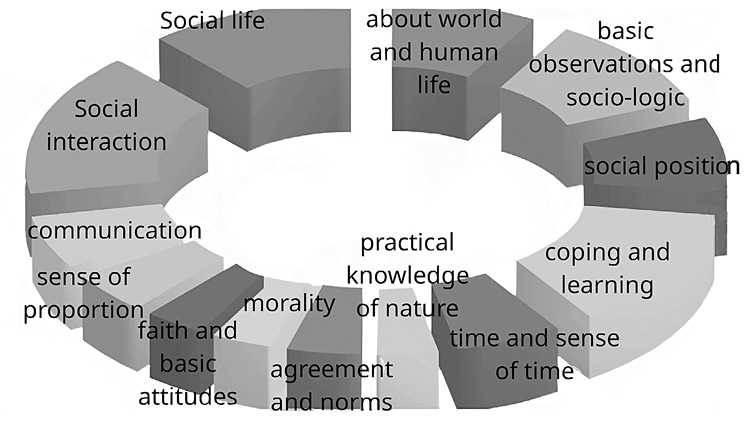
The main themes presented in Matti Kuusi’s typology are arranged slightly differently in Figure 1. Blocks of different sizes visualise the distribution of Kuusi’s detailed subgroups as well as the number of different proverb types in the main themes. Presented in this way, it is easy to see that the main themes of Social Life, Social Interaction and Communication constitute a large portion of the proverb types specified in the typology.
Fig. 1. The relative distribution of the proverb types in the thirteen main themes of Matti Kuusi’s international proverb typology.
The group titles and especially the names of subgroups, as will be shown below, follow the patterns of proverbial generalisation. The whole classified database with instructions is online and open to all users.2 The construction of Kuusi’s typology has been a pursuit of unique schemes of proverbs that have influenced the human way of thinking. Concerning the plurality of language families of the world this might seem an impossible task. Thus, we must remember that the majority of the proverb patterns that Kuusi uses for his typology are more or less European. One special area that became familiar to Kuusi before he tried the categorisation of proverb types was South West African proverbs. For his collection Ovambo Proverbs (1970b) he had to go through a huge number of sources and learn the elements of the Ndonga language. Permyakov had parallel interests in small Eastern cultures (Пермяков 1968c). Kuusi widened his view by comparing his classifying principles to Permyakov’s ideas, which he learned through their dialogue in the pages of Proverbium, as mentioned in the Introduction. Main theme C, Basic Observations and Socio-logic,3 best reflects Permyakov’s approach. It concentrates on patterns of thought.
Kuusi’s typology consists of three levels:
1. the 13 main themes described above, for example A) Practical Knowledge of Nature
2. numbered groups within these themes, for example A1 Natural Elements; A2 Animals, Humans : Animals; and A3 Weather, Calendar
3. subgroups within the groups, for example A1a water and fire as natural elements; A1b earth and sea as natural elements; A1c types of soil and flora as natural elements.
|
Main theme |
name of the numbered group |
name of the subgroup |
|
C |
C1 Durability of X’s nature / durability of identity |
C1b: X is always X, even if... |
|
E |
E1 Relativity of ranking / the essential unity of differing things |
E1e: the value of X increases through lack of Y |
|
G |
G6 Youth : old age |
G6c: if (not) X when young, then (not) Y when old |
|
K |
K1 Power, ruler : subject / superior : inferior |
K1c: two chiefs or masters cannot rule together |
Table 1. Examples of system hierarchy in Matti Kuusi’s international proverb typology.
A ) P r a c t i c a l K n o w l e d g e o f N a t u r e . The first part of Kuusi’s typology describes traditional knowledge of nature and agricultural wisdom, which are partly transferred to generalised metaphors about human life. Kuusi has kept them in these groups with possible cross-references to other topics. For example proverb type 17 in subgroup A1a, “Fire is a good servant but a bad master”, is perhaps seldom used to warn about fire or about anything. Proverb type 21 in subgroup K2k has the same structure: “Money is a good servant but a bad master”. It is in theme K Social Position, and specifically in subgroup K2k ‘The relativity of wealth and poverty; the rich have worries, the poor are sometimes happy’. The Finnish proverb “The east wind won’t cease before it rains and a wife’s scolding won’t cease before she cries” is recorded as a weather proverb (A3a 12), although it is a couplet that also has a reference to human behaviour.
B ) F a i t h a n d O u r B a s i c A t t i t u d e . This theme deals with faith, fortune, wisdom, the inevitability of destiny, acceptance of circumstances and awareness of man’s ignorance. The proverb type 13 in the subgroup B2a “A drop of luck rather than a cask of wisdom” is an example that shows how knowledge of proverbs could outweigh human wisdom. It is not possible to explain and exhaustively classify all events encountered in life.
C ) B a s i c O b s e r v a t i o n s a n d S o c i o - l o g i c . This theme differs from other categories in that it describes the basic rules of inference that guide people who are aware of proverb lore. Kuusi analysed proverb schemes and included in group C1 proverbs about the durability of nature or identity and about preserving habits. For example “A leopard cannot change his spots”. C2 deals with elements that correspond to each other, ‘X belonging to Y’, ‘X actions leading to X consequences’. For example “As you make your bed, so must you lie”. C3 consists of the consequences of doing nothing or of useless things and emphasises certainty, as in subgroup C3c ‘concrete, close at hand and certain is better than distant, uncertain or future’, for example “A bird in the hand is worth two in the bush”. The theme of subgroups in C4 continue to question the effects of something that is lacking, small or insignificant. For example “A small spark may make a great fire”. The last two groups, C5 and C6, contain proverbs that recognise authentic signals, for example “He that will lie will steal”, or recognise appearance, for example “Clothes make the man”.
D ) T h e W o r l d a n d H u m a n L i f e . Group D1 contains general statements about the world and human life, such as “Life is not a bed of roses”, as well as proverbs about natural differences and eternal antipodes. D2 deals with emotions, and D3 the dynamics of need, for example “Where the carcass is, the ravens will gather”. The main question is what activates one and what makes one passive. D4 and D5 are deal with food and drink.
E ) S e n s e o f P r o p o r t i o n . Here we deal with another main theme of Kuusi’s typology that differs from most of the others. The proverbs in these groups challenge certainty and the durability of generalisations. They are about relativity and carry the specificity of proverbial observations or useful beliefs, such as: “The exception proves the rule”, “In the kingdom of the blind the one-eyed man is king”, “Every light has its shadow”.
F ) C o n c e p t s o f M o r a l i t y . These proverbs have a solid base in repeated human experience as well as in educative instruction. There is always a connection to success and happiness. The concept of ‘evil’ is central. Will it be punished or rewarded? For example, “Great thieves hang little ones”. Honour and pride are the topics of F2, for example “Great honours are great burdens”.
G ) S o c i a l L i f e . All the life from childhood to death are present in the subgroups of this theme. The value of family and social rules regulating life are common heritage of international proverb lore. For example, “Blood is thicker than water”, “Children are poor men’s riches”, “Today gold, tomorrow dust”.
H ) S o c i a l I n t e r a c t i o n . This is the largest theme in Kuusi’s typology, although this is not surprising, since the theme includes subgroups that range from self-knowledge to war and conflict. Conforming to one’s community is a central question. The proverbs deal with questions of ethnocentrism and group solidarity. Subgroup H5d ‘Reciprocity, the way one treats other people predicts one’s own treatment’ contains short proverbs such as “Tit for tat”. Another group heading, ‘Attitude towards a barking dog’ (H7e) includes proverbs such as “Barking dogs seldom bite” and “The dogs bark but the caravan goes on”.
J ) C o m m u n i c a t i o n . The proverbs in this theme deal with concealment and the risks of talking as much as about the need for communication; tolerance of criticism is dealt with as an important communication strategy. The power of the word is strong but “Action speaks louder than words” (J1h 17). Moderation is valued in traditional wisdom. Another precious talent is prudence.
K ) S o c i a l P o s i t i o n . The importance of family (G), conforming to your community (H) and belief in God (B) are closely related to this theme. Most of the traditional proverbs teach strategies for subordination, such as “Whose bread I eat, his song I sing”. Both the foregone conclusion that power must be exercised, and the acceptance of social order, belong to this theme, for example “Fish begins to stink at the head”, “Two kings in one kingdom do not agree well together”. Proverbs about the power of money are also gathered under this theme, as are contradictions between the rich and the poor, which are a perennial topic of proverbs.
L ) A g r e e m e n t s a n d N o r m s . The proverb types in the subgroups of this theme deal with justice as well as ownership and the rules of business. Like coping with nature and weather conditions, man-made rules and laws are important contexts for proverbial wisdom. Unwritten laws dominate in proverb lore, for example “Custom rules the law”. Practical and local experience are more vital than the universality of any moral concept, for example “Not caught, not guilty”, “He’s an ill cook that cannot lick his own fingers”. Even quite complicated social phenomena, if they have taken the shape of a proverb, can persist in our communication, such as “Shoemakers’ wives are worst shod”.
M ) C o p i n g a n d L e a r n i n g . This theme covers practical wisdom and how to manage in life and is one of the largest in Kuusi’s typology. There is again an emphasis on watchfulness and precaution, for example “Do not keep all your eggs in one basket”. Wisdom means knowledge but also moderation, diligence and careful economy, for example “Knowledge is power” and “Diligence is the mother of good fortune”.
T ) T i m e a n d t h e S e n s e o f T i m e . This theme includes proverbs that talk about proper timing and use of opportunities, for example “The early bird catches the worm”, an important concept in the Western world. Proverbs in the subgroups of T3 deal with adaptability in the face of adversity and preparing for the future, for example “If one door shuts, another will open”. Here again, there are coping strategies. The subgroups within T4 emphasise the interdependence of the beginning and the end. Wisdom is a good start but the result must still be decided. Proverbs in these subgroups remind us that comfort is a social function of proverbial speech (Lauhakangas 2004), hence proverbs such as “He laughs best who laughs last”.
This description of the main themes shows the potential of Kuusi’s typology to serve as a general instrument in understanding human worldviews. The following remarks do not follow the order of Kuusi’s main themes, except that I will start with A) The Practical Knowledge of Nature because the proverbs within this theme are the basis of our human worldview. To what extent they constitute this worldview is another question that depends on how much practical advice and how many mnemonic rules have passed into metaphoric use. Another large theme is M) Coping and Learning, which includes practical advice for survival. The general proverbial worldview for the most part consists of moderation. One important element of human living conditions is our relationship to the use of time and our sense of time, which influences our ability to make plans and has certainly had a significant effect on our worldview.
Despite the fact that cultures differ in relation to the dominance of religious practices there are still some unifying factors such as belief in fortune or the acceptance of our given circumstances, which modify the proverbial worldview of each culture. Proverb types under theme F) Concepts of Morality include both educative advice and the voice of experience. These proverbs are among the unwritten laws that dominate proverb lore. Theme L) Agreements and Norms covers any practical or moral situation people can encounter. Two comprehensive themes D) The World and Human Life, and G) Social Life include observations, claims and value judgments. Perhaps the most important basis for anybody’s attitude towards life is built on family and close community. The acceptance of one’s social position and the way to perceive one’s power or inferiority and their constancy shapes one’s worldview, relations that are all regulated in proverb lore.
H) Social Interaction is an extensive concept in Kuusi’s typology consisting of subgroups ranging from self-knowledge to war and conflict. From the point of view of the proverbial worldview, attitudes towards the qualities and rules of human communication are quite central.
Kuusi’s typology shows the strength of proverbial rules of inference (Basic observations and socio-logic) and how it certainly shapes the worldview of different cultures, which all share these mental rules. Another group of proverb types, E) Sense of Proportion, adds to this mental repertoire of proverbs.
Anthropologist Robert Redfield’s (1897–1958) idea about the conscious self had its roots in George Herbert Mead’s (1863–1931) concept of Self as ‘I’ and ‘me’. Redfield saw as general aspects the separation of ‘we’ from ‘they’, ‘human’ from ‘non-human’, ‘human’ from ‘nature’ and ‘God’. This led Redfield to write about universal aspects of worldview.
Anthropologist Michael Kearney (1937–2009) continued Redfield’s analysis. He wrote about worldview universals and proposed a model that could be used to analyse Kuusi’s classification of proverbs. Kearney defined worldview as
culturally organized macro-thought; those dynamically inter-related basic assumptions of a people that determine much of their behavior and decision making, as well as organizing much of their body of symbolic creations (myth, religion, cosmology – and ethnophilosophy in general (1984: 1).Kearney’s classification was a logical and structural integration of presuppositions within any people (ibid.: 37–38). He identified five logico-structural categories: Self and Other; Relationship; Classification; Causality; Space and Time (ibid.: 68–89). Kearney constructed his model from cultural anthropology literature, while Kuusi built his typology from hundreds of proverb collections and archive material.
In the Matti Kuusi international proverb typology the groups under the main themes, and especially the subgroups, can be called proverb ‘classification contexts’. Each subgroup has traditional and well-known explanations as well as in alternative classification contexts for each proverb (cross-referenced in the database). In Kearney’s mind the worldviews, cultural practices and social relations of peasant communities (which he studied as an anthropologist) are historically determined and often constrained by the structures and practices of wider social entities.4 In this sense, proverb heritage can resonate with structures and practices into which people have been born. But at the same time proverbs function as distantly as possible from their literal meaning or domain, and this always brings individual and situational variety, and freedom, to the use of proverbs. This is why we must be careful not to deduce anyone’s personal worldview or mentality from their knowledge of or attitude towards proverbs.
A starting point that Kuusi and his predecessors (primarily Permyakov) certainly used for their classifications was basic pairs of human opposites. The human inclination to perceive dichotomies instead of a continuum is key to the pattern for proverbial worldviews and an interesting research subject. The categorisation of proverb lore was still not revertible to dichotomies when the author of this article made her analysis of Kuusi’s typology (Lauhakangas 2001: 41–61). Pairs of opposites were an overly simplistic tool if one wanted to recognise subtle and specific categories in proverb lore. The next seven structural categories will highlight general human ways of drawing conclusions and making observations. This will be demonstrated by subgroup titles and a few proverb examples from different cultures. Subgroups and proverb examples are coded as per Kuusi’s typology.
1 . C a t e g o r i e s r e l a t e d t o m a k i n g a n d r e a d i n g s i g n a l s. Proverbs which carry practical knowledge often deal with signs and signals. They include reasoning from observation, things that reveal something, for example A2b ‘Animals as signs of weather and harvest’, C5a ‘A (big) event (always) leaves a trace, a sign will reveal its cause and meaning’, A2b 10 “Halla hanhen siiven alla, talvi joutsenen takana” (Fin.) (Frost under the goose’s wing, winter behind the swan), C5a 18 “There is no smoke without some fire”.
2 . C a u s e a n d e f f e c t r e l a t i o n s h i p c a t e g o r i e s. Almost one-third of the 325 subgroups in Kuusi’s typology belong to this type of structure. Often in causal proverbs there is an obvious contrast between cause and effect, and this is heightened by the use of opposing pairs. The expectation in these groups is set up by a comparison of the contribution versus the output, for example H7b ‘An aggressive or provocative person will be the object of aggression’: “Tit for tat” H7b 21c and “If anyone steps on your foot, step on his neck” (Arabic) H7b 21c.
3 . D e s c r i p t i v e c a t e g o r i e s. The use of proverbs reveals that even if they seem to be neutral descriptions they always have some intention relating to social interaction (Lauhakangas 2004, 2007). These proverbs are law-like statements about settled knowledge, customs, rules, norms and other subjects, for example A3c ‘Spring autumn, summer winter, year and harvest’ and L2a ‘The nature of business and bargaining’. A3c 41 “An age to an age is not a brother” (Lithuanian), L2a 14 “Niiyala iha gu Niiyala iikwawo” (Xhosa) (Niiyala – (a mottled cow) is not exchanged for another Niiyala)
4 . C a t e g o r i e s i n d i c a t i n g a r e l a t i o n s h i p. The titles in this subgroup show relationships without a clear positive or negative connotation. They can be mutually exclusive pairs such as ‘earth and sea’, ‘night and day’ or ‘woman and man’. There is an interdependence between things (C2e), for example a correlation between drunkenness and madness, or there can be a unity of interest between performer and consumer, for example C1e ‘X and Y belong together /apart’ , H3a ‘Solidarity with one’s own people’. C2e 11 “Alltid kommer den dag att kon behöver sin rumpa igen” (Swedish; There will always come a day when the cow will need its buttocks again), H3a 27 “One hand washes the other and both wash the face”.
5 . P o s i t i v e l y o r n e g a t i v e l y c h a r g e d , a n d w a r n i n g , c a t e g o r i e s. Proverbs in these groups have clear positive or negative content. They include either descriptive or advisory, and sometimes normative, statements. Proverb of this type reflect generally positive values, although they can also be purely pragmatic or useful values such as egoism or distrust (H5a), compromise (H7h), precaution (M1a) or concentration on one thing at a time (M6d). Worthless or contemptible matters are portrayed as negatively charged. The same subject can have both positive and negative associations. For example, there are ambivalent attitudes towards priests, physicians or the value of novelty.
Warning categories clearly focus on strategies and tactics of coping with life. There is preventive advice on how to avoid trouble. Proverbs in these groups warn about deceitfulness of external surface. Subgroups include problems of exercising power and strategies of subordination (K1a, c, f, g and i). There is advice on how to treat uninvited guests, anticipate dangerous situations and deal with a madman, for example M1e ‘One should be on the alert, although a phenomenon seems harmless or safe’. M1e 24 “Wake not a sleeping dog”, M1e 24 “Älä herätä nukkuvaa karhua” (Finnish; Wake not a sleeping bear).
6 . C o m p a r i s o n - b a s e d c a t e g o r i e s. These categories show a relationship between two things with a positive emphasis on one of them. These proverbs can take a clear position, show ‘on the other hand’ situations and create ironic pro and con relations, for example C3h ‘Empty, poor or dead will lose nothing – cannot be afraid of loss’, H4b ‘One’s own home or home district is the best, the dearest, the safest and familiar > strange place’. C3h 13 “Chi ha terra, ha guerra” (Italian; He who has land has war) and H4b 13d “East or west, home is best.”
7 . C o n t r a s t i n g c a t e g o r i e s. These categories were analysed according to the type of contrast. Only one subgroup (K2j) explicitly deals with a contradiction: ‘Contradiction between the rich and the poor, the difference of living conditions and attitudes’. There are categories covering associated opposites, for example D1d ‘Eternal antipodes – contrasts / similarity of parts’. D1d 10 “They agree like cats and dogs” and D1d 10 “The terms of a dog and a monkey” (Japanese).
An interesting theme, E and the group E1 ‘Relativity of ranking’/‘the essential unity of differing things’, includes proverb types that show particular patterns of thought. Two subgroups can be called paradoxical contrasts: E1h ‘Apparently opposite beings having a common basic feature’ and E1k ‘Things are different from different points of view, paradoxes about luck in misfortune’. Another subgroup, E1l, includes proverbs about situations of internal conflict: ‘The being, action or situation is internally conflicting’. Matti Kuusi was especially interested in the means people have had to approach controversial situations. Subgroup E1i ‘Coincidentia oppositorum’/‘the fusion of opposites’ is a good definition for a socially important interpretation of disagreement. An earlier study found as many as ten different ways for opposites to be in fusion in Kuusi’s typology and database (Lauhakangas 2023: 34–36).
The structural analysis of Kuusi’s categorisation of proverbs into the seven categories above shows that Kuusi’s proverb typology and the database of proverb types can be approached in different ways. The purpose of the chosen analysis was to find the most general influential factors typical of proverbs. What are the possible mental structures and socio-logic that keep the proverb lore of any culture alive? Defining these would take us closer to understanding how the proverbial worldview of a certain culture could be found.
The concept of the proverbial worldview was defined in this article. Matti Kuusi’s international proverb typology can be understood as a construction of the variables that any proverbial worldview would consist of. The categories of Kuusi’s classification seem to join all the components that are essential to construct a proverbial worldview, although we cannot measure anyone’s personal worldview or mentality simply by enquiring about their knowledge of proverb lore. Proverb ideas are familiar and popular in different cultures and can even be used in reverse. We can search for reasons for the different emphases of the building materials of different worldviews.
Kuusi’s categorisation, which is based on deep familiarity with international proverb lore, has been shaped by more than general dichotomies and obvious topics. Through an analysis of Kuusi’s categorisation of proverbs into the seven structural types above, it has been possible to recognise better the interesting characteristics of proverbial language. In addition to the most apparent themes of human life, the general human ways of drawing conclusions and making observations where highlighted. There are subtle and specific categories of common proverb lore, for example paradoxical contrasts are an interesting species of proverb. From the point of view of studying worldviews the most interesting themes in Kuusi’s categorisation proved to be the strength of proverbial rules of inference (Basic observations and socio-logic) and the Sense of Proportion theme, where proverbs seem to challenge the certainty and durability of generalisations.
It might be interesting to continue the study of different possible proverbial worldviews through the use of these proverbs as the meaning and the intention of any proverb lies in its successful application. Thus, we must leave open how much, for example, a person’s breadth of perspective affects their use of proverbs or their attitude towards the traditional proverb lore of their culture. Many factors other than the underlying proverbial worldview of a culture certainly influence a community member’s own worldview.
Previously, it was only possible to register cross-references that point to individual proverbs. Today we are able to gather real-world contexts for proverbs, not only from newspapers or literature but also from online discussion forums (Lauhakangas 2011). This possibility could provide the basis for a new versatile international classification according to proverb function. The author of this article has previously suggested categorisation by use of proverbs in different social situations (Lauhakangas 2018). The possibility to develop a new tool based upon the classification of proverbial functions in different social interactions – even in different cultures – sounds far-fetched. But if different classification systems were combined with proverbial examples and even with real life examples of context, the capacity of automatic data processing would not be a hindrance (Kats, Lauhakangas 2010) and we would be able to go further in understanding the universal and national characters of proverbs as a genre.
Dundes Alan 2007. “Folk Ideas as Units of Worldview”, in: Alan Dundes: The Meaning of Folklore. The Analytical Essays of Alan Dundes, edited by Simon J. Bronner, Logan, Utah: University Press of Colorado, Utah State University Press, p. 179–195.
Goodwin Paul D., Wenzel Joseph W. 1981. “Proverbs and Practical Reasoning. A Study in Socio-logic”, in: The Wisdom of Many. Essays on the Proverb, edited by W. Mieder, A. Dundes, New York & London: Garland Publ., p. 140–160. (Originally in Quarterly Journal of Speech 65, 1979, p. 289–302.)
Granbom-Herranen Liisa 2018. Proverbs in SMS Messages: Archaic and Modern Communication: dissertation, Turku: The University of Turku.
Hain Mathilde 1951. Sprichwort und Volksprache. Eine volkskundlich- soziologische Dorfuntersuchung, Giessen: Wilhelm Schmitz Verlag.
Ivanova Elizaveta 2020. “On Modeling Proverbial Conceptualisation”, in: ACTAS ICP19 Proceedings. 13th Interdisciplinary Colloquium on Proverbs, edited by R. J. B. Soares, O. Lauhakangas, Tavira: AIP-IAP, p. 501–510.
Kats Paul, Lauhakangas Outi 2010. “Proverbial Databases, Variety and Challenges”, in: ACTAS ICP09 Proceedings. The 3rd Interdisciplinary Colloquium on Proverbs, edited by R. J. B. Soares, O. Lauhakangas, Tavira: AIP-IAP, p. 110–120.
Kearney Michael 1984. World View, Novato, California: Chandler & Sharp.
Kuusi Matti 1970a. “How Can a Type-index of International Proverbs Be Outlined?”, Proverbium 15, 473–476.
Kuusi Matti 1970b. Ovambo Proverbs with African Parallels, (Folklore Fellows’ Communications 208), Helsinki: Academia Scientiarum Fennica.
Kuusi Matti 1972. Towards an International Type System of Proverbs, (Folklore Fellows’ Communications 211), Helsinki: Academia Scientiarum Fennica.
Kuusi Matti 1974. “Tiefenstruktur und Oberflächenstruktur in der Parömiologie”, Proverbium 23, p. 920–924.
Kuusi Matti 1994a. “Concerning Folk Paradoxes”, in: Matti Kuusi. Mind and Form in Folklore. Selected articles, edited by Henni Ilomäki, Helsinki: The Finnish Literature Society, p. 131–141.
Kuusi Matti 1994b. “On the Aptness of Proverbs. (An unpublished lecture in 1956 with an epilogue by Kuusi in 1994)”, in: Matti Kuusi. Mind and Form in Folklore. Selected articles, edited by H. Ilomäki, Helsinki: Academia Scientiarum Fennica, p. 105–113.
Kuusi Matti et al. 1985. Proverbia Septentrionalia, (Folklore Fellows’ Communications 236), Helsinki: Academia Scientiarum Fennica.
Lauhakangas Outi 2001. The Matti Kuusi International Type System of Proverbs, (Folklore Fellows’ Communications 275), Helsinki: Academia Scientiarum Fennica.
Lauhakangas Outi 2004. Puheesta ihminen tunnetaan. Sananlaskujen funktiot sosiaalisessa vuorovaikutuksessa: dissertation, Helsinki: The Finnish Literature Society.
Lauhakangas Outi 2007. “Proverbs in Social Interaction: Questions Aroused by the Multi-Functionality of Proverbial speech”, Proverbium 24, p. 207–228.
Lauhakangas Outi 2011. “Discussion Forums in the Internet as the Substratum of Proverbs”, in: ACTAS ICP10 Proceedings, The 4th Interdisciplinary Colloquium on Proverbs, edited by R. Soares, O. Lauhakangas, Tavira: AIP-IAP, p. 399–416. (Original in Finnish: “Internetin keskustelufoorumit sananlaskujen kasvualustana”, Elore 18 (1), p. 28–48; http://www.elore.fi/arkisto/1_11/art_lauhakangas.pdf).
Lauhakangas Outi 2014. “Categorisation of Proverbs”, in: Introduction to Paremiology. A Comprehensive Guide to Proverbs Studies, edited by H. Hrisztova-Gotthardt, M. Aleksa Varga, Warsaw, Berlin: De Gruyter, p. 49–66.
Lauhakangas Outi 2018. “Arguments for a Special Status of Proverbs Among Set Phrases”, in: La phraséologie: théories et applications, edited by O. Soutet, S. Mejri, I. Sfar, (Bibliothèque de grammaire et de linguistique 57), Paris, p. 229–239.
Lauhakangas Outi 2023. “The ‘coincidentia oppositorum’ as a Category of Proverb Types”, in: Phraseology, Constructions and Translation. Corpus-based, Computational and Cultural Aspects, edited by Jean-Pierre Colson, UCLouvain: Presses universitaires de Louvain, p. 29–38.
Mieder Wolfgang 1997. The Politics of Proverbs. From Traditional Wisdom to Proverbial Stereotypes, Wisconsin, London: The University of Wisconsin Press.
Mieder Wolfgang 2014. “Origin of Proverbs”, in: Introduction to Paremiology. A Comprehensive Guide to Proverbs Studies, edited by H. Hrisztova-Gotthardt, M. Aleksa Varga, Warsaw, Berlin: De Gruyter, p. 41–59.
Moscovici Serge 2001. Social Representations: Explorations in Social Psychology, New York: New York University Press.
Permyakov G. L. 1979. From Proverb to Folk-Tale. Notes on the General Theory of Cliché, Moscow: Nauka.
Prahlad Sw. Anand 1996. African-American Proverbs in Context, Jackson: The University Press of Mississippi.
Seitel Peter 1994. “Proverbs: A Social Use of Metaphor”, in: The Wisdom of Many. Essays on the Proverb, edited by W. Mieder, A. Dundes, Madison: Garland Publishing, p. 122–139.
Schwartz Shalom H., Bardi Anat 2001. “Value Hierarchies Across Cultures: Taking a Similarities Perspective”, Journal of Cross-Cultural Psychology 32 (3), p. 268–290.
Westermarck Edvard 1930. Wit and Wisdom in Morocco. A Study of Native Proverbs, London: Routledge.
White Geoffrey M. 1987. “Proverbs and Cultural Models: an American Psychology of Problem Solving”, in: Cultural Models in Language and Thought, edited by D. Holland, N. Quinn, Cambridge: Cambridge University Press, p. 151–172.d
Пермяков Г. Л. 1968a. «О логическom аспектe пословиц и поговорок» = Der logisch semiotische Aspect der Sprichwörter und Redensarten, Proverbium 10, p. 225–235.
Пермяков Г. Л. 1968b. «Лингвистическом аспекте пословиц и поговорок», Proverbium 11, p. 276–285.
Пермяков Г. Л. 1968c. Избpaнныe пословицы и поговорки народов Востока, Мocквa.
Пермяков Г. Л. 1969. «O пpeдmeтнom аспекте пословиц и поговорок», Proverbium 12, p. 324–330.
1 Aarne-Thompson system for cataloguing folk stories: https://en.wikipedia.org/wiki/Aarne%E2%80%93Thompson%E2%80%93Uther_Index.
2 Database and typology: https://www.mattikuusiproverbtypology.fi/.
3 The term “socio-logic”, which was chosen as one of the main titles of Kuusi’s typology, has been used by Goodwin and Wenzel (1981).
4 T. C. Patterson, Michael’s Contributions to Anthropology. Dr. Michael Clark Kearney (1937–2009) In Memoriam, 2009 (https://anthropology.ucr.edu/memoriam visited 10/3/2025).