Tautosakos darbai 71, 2026, p. 298–315
ISSN 1392-2831 | eISSN 2783-6827
DOI: https://doi.org/10.51554/TD.26.71.17
Hrisztalina Hrisztova-Gotthardt
Secretariat fide, Berne, Switzerland
xpucuhu@gmail.com
https://orcid.org/0000-0002-9983-5184
ABSTRACT. The paper’s main objective is to examine the current paremiological situation in the German-speaking part of Switzerland and to investigate to what extent proverbs are present in modern language use, the specific areas and contexts in which they play an essential role, and whether they are used more often in their original or modified forms.
For this purpose, a corpus of examples illustrating the current use of traditional and modern proverbs, as well as their deliberate innovations, was analysed from both quantitative and qualitative perspectives. The examples were collected between 2019 and 2025 as part of a small field research project in the Swiss cantons of Basel City, Basel Country, Berne, and Solothurn.
The analysis reveals that traditional and modern proverbs, along with their deliberate innovations, remain undoubtedly an essential part of contemporary language use and continue to play a significant role in various areas of life, including advertising, culture and tradition, political and civil discourse, and the public space in general. Within the domains of language use examined, proverbs occur far more often in their modified than in their original form.
KEYWORDS: traditional and modern proverbs, proverb modifications, current paremiological situation in Switzerland, proverb revival.
SANTRAUKA. Pagrindinis straipsnio siekis – aptarti dabartinę patarlių vartoseną vokiškai kalbančioje Šveicarijos dalyje: ištirti, kiek patarlių vartojama šiuolaikinėje kalboje; išsiaiškinti, kokiose konkrečiose srityse ir kontekstuose jos vaidina esminį vaidmenį; nustatyti, ar patarlės dažniau vartojamos originalia, ar modifikuota forma.
Šiuo tikslu kiekybiniu ir kokybiniu požiūriais išanalizuoti pavyzdžiai, atspindintys dabartinę tradicinių bei šiuolaikinių patarlių vartoseną ir sąmoningą patarlių modifikavimą. Pavyzdžiai surinkti 2019–2025 m. atliekant nedidelį lauko tyrimų projektą Šveicarijos Bazelio miesto, Bazelio apygardos, Berno ir Zoloturno kantonuose.
Analizė atskleidžia, kad tradicinės ir šiuolaikinės patarlės, taip pat ir jų modifikacijos, neabejotinai tebėra reikšminga šiuolaikinės kalbos dalis. Patarlės ir toliau atlieka svarbų vaidmenį įvairiose gyvenimo srityse – reklamoje, tradicinėje kultūroje, politiniame bei pilietiniame diskurse ir viešojoje erdvėje apskritai. Šiose srityse patarlės dažniau pasitaiko ne originalia, o modifikuota forma.
RAKTAŽODŽIAI: tradicinės ir šiuolaikinės patarlės, patarlių modifikacijos, dabartinė patarlių vartosena Šveicarijoje, patarlių atgimimas.
Received: 20/02/2025. Accepted: 27/04/2026
Copyright © Hrisztalina Hrisztova-Gotthardt, 2026. Published by the Institute of Lithuanian Literature and Folklore Press. This is an Open Access article distributed under the terms of the Creative Commons Attribution License, which permits unrestricted use, distribution, and reproduction in any medium, provided the original author and source are credited.
According to Wolfgang Mieder, “proverbs are short, generally known sentences of the folk that contain wisdom, truths, morals, and traditional views in a metaphorical, fixed and memorizable form and that are handed down from generation to generation” (2004a: 4). Due to their originally didactic nature, proverbs are repeatedly referred to as “relics of the past” that are on their way to extinction in modern technological societies and are no longer an essential part of modern language use (cf. ibid.: xi; Komenda-Earle 2009: 711).
Despite these claims, various phraseological and paremiological studies conducted during the last two decades (cf. Mieder 2023) have clearly shown that traditional proverbs, as well as so-called modern proverbs1 and deliberate proverb innovations2 continue to be in use today. However, the role proverbs play in modern language use has significantly changed. They are no longer only “old bits of wisdom” that teach a moral lesson or summarise the experience of past generations, more often than not they express a (wise and truthful) comment that applies to the present time in general or to a particular current situation (see Röhrich, Mieder 1977: 117; Burger 2007: 123). Due to their hetero-situativity, poly-functionality, and poly-semanticity (Mieder 2006: 18), proverbs can be and are being deployed in a wide variety of non-linguistic real-life situations. Their flexibility and adaptability to various contexts and communicative situations (cf. Mieder 1993: x, xvi), as well as their multifaceted character and exceptional vitality, might even induce a so-called potential “proverb revival” in the modern world (see Szpila 2007: 40).
In addition, owing to their succinct form and formulaic language, proverbs are easy to remember. Consequently, they serve as ready-made linguistic building blocks that can be spontaneously and effectively used as rhetorical devices in oral and written communication (see Mieder 1993: 90; Mieder 2004b: 422).
In this context, the main objective of the present study is to examine to what extent Mieder’s claim that “proverbs continue to play a significant role in the modern world” (1993: xvi) and Szpila’s reference to a potential “proverb revival” due to the apparent “proverb vitality” in the present age (2007: 40) also apply to the current paremiological situation in the German-speaking part of Switzerland. The study aims to address the following three research questions:
RQ 1: To what degree are proverbs present in the modern language used in the German-speaking part of Switzerland?
RQ 2: In which areas and contexts of modern language use do proverbs play an important role?
RQ 3: Are proverbs used more often in their original or modified form?
In order to answer the three research questions listed in the previous section, a corpus of 78 examples illustrating the current use of traditional and modern proverbs and their deliberate innovations has been analysed from a quantitative and qualitative point of view. The examples were collected between August 2019 and February 2025 as part of a small-scale field research project initiated and conducted by the author. The project was carried out in the Swiss cantons of Basel-Stadt (Basel City), Basel-Landschaft (Basel Country), Bern, and Solothurn. Its main aim was to collect examples of the authentic use of proverbs in public spaces and in printed and digital media.
For this study, only proverbial items collected in public spaces were considered.3 The proverbial items recorded in the corpus have been used as:
In most cases, the texts were accompanied by a visual element added by the item’s creator, typically a photo, a hand drawing or a computer-generated illustration.
All corpus entries were recorded as JPG files4 and labelled with meta information on the date and place of finding the item in question. In addition, the proverbial items were categorised according to the following criteria:
Next, it was examined what percentage of all proverbial items recorded in the corpus occurred in the different domains of language use and whether these items occurred in their traditional or modified form.
The present section briefly summarises and discusses the results of the analysis. All findings are supported by examples from the corpus.
1. Domains of occurrence
In the following, those domains of language use will be briefly presented in which examples of the systematic use of proverbs were found.
1 . P r o v e r b s i n A d v e r t i s i n g. The nearly unlimited adaptability of proverbs is one of the main reasons they play an essential role in modern Swiss-German advertising media. Additionally, most proverbs come in the form of short and succinct sentences, which makes them “catchy and easy to understand”5 (cf. Röhrich, Mieder 1977: 111). An advertising slogan needs just this feature so that potential customers can remember it. Not least, copywriters know very well that advertising slogans built on traditional or modified proverbs attract the attention of potential buyers through their familiar and authoritative sound on the one hand and raise a sense of trust in the respective product and its producer on the other hand (cf. Forgács 1997: 76–77; Mieder 2004a: 151, 244; Mieder 2006: 181).
The relatively high percentage of examples (53 %) found in advertising confirms the thesis that proverbs are exceptionally well qualified as carriers of advertising messages. Due to space constraints, only two selected examples are presented here.
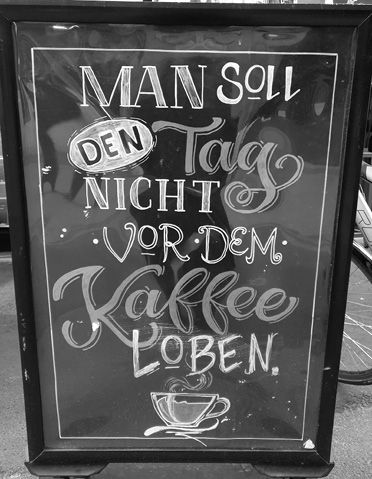
The first proverbial item, “Man soll den Tag nicht vor dem Kaffee loben” (Don’t praise the day before you have had a coffee),6 was located on the advertising board of a bookshop café in Basel (see Fig. 1). The traditional proverb, “Man soll den Tag nicht vor dem Abend loben” (Don’t praise the day before the evening), has been slightly modified to encourage customers to visit the bookshop café.
Fig. 1. Man soll den Tag nicht vor dem Kaffee loben. Photo taken in Basel on December 23, 2023
In the following example, a famous Swiss chocolate and confectionary manufacturer tries to grab the attention of potential customers by transforming the original proverb “Der Teufel steckt im Detail” (The devil is in the detail) into “Liebe steckt im Detail” (Love is in the detail). The phrase is deployed as an advertising slogan for various chocolate products designed with much love and attention to detail for the approaching Valentine’s Day (see Fig. 2).
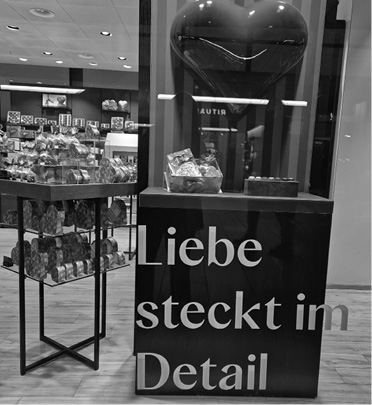
Fig. 2. Liebe steckt im Detail. Photo taken in Basel on February 2, 2025
2 . P r o v e r b s o n C a r n i v a l L a n t e r n s. Twenty-six percent of the proverbial items were discovered and registered during the Basel Carnival. The so-called Basler Fasnacht7 is celebrated every year on the streets of the biggest city in northwestern Switzerland and is considered a vibrant tradition that covers several areas and aspects of intangible cultural heritage, namely music, oral tradition and craft. Fasnacht is traditionally prepared and performed by the Cliques: carnival clubs or associations that function as strong personal networks and play an essential role in the social life of the city (Habicht 2001: 40). Every year, the cliques explore a specific theme (so-called Sujet), both in verbal (through ironic-satirical poems) and visual (through drawings and inscriptions on their lanterns) form. They present their verbal and visual masterpieces during the two large parades (Cortèges; cf. Hrisztova-Gotthardt 2014: 16–17; Hrisztova-Gotthardt 2016: 103). The cliques often choose a traditional or modified proverb as the title of their Sujet. In this way, they can effectively draw viewers’ attention to their lanterns and, thus, to their messages.
Fig. 3 shows the lantern of a clique that, in satirical form, exposes the monopolistic power of the current Russian president and his oligarchs and uses a traditional German proverb as the subtitle of its theme, namely “Wes’ Brot ich ess, des’ Lied ich sing” (Whose bread I eat, his song I sing).
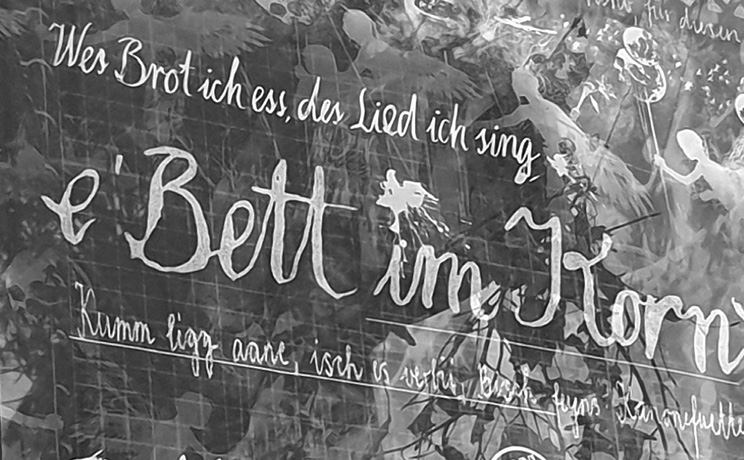
Fig. 3. Wes’ Brot ich ess, des’ Lied ich sing. Photo taken in Basel on March 1, 2023
Another clique compares famous political figures and other prominent personalities with different animals in a metaphorical way. Based on the idea that, like every animal, every politician has their own nature, quirks and scandals, the clique poet playfully reveals them with sharp wit and humour. For the title of its Sujet the clique chooses the dialectal form of the German proverb “Jedem Tierchen sein Pläsierchen” (To each his own), namely “E jeedem Dierli sy Pläsierli” (see Fig. 4).
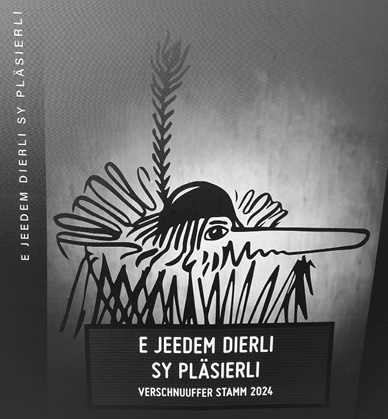
Fig. 4. E jeedem Dierli sy Pläsierli. Photo taken in Basel on February 20, 2024
3 . P r o v e r b s a s M o t t o e s o f E d u c a t i o n a l a n d C i v i l C a m p a i g n s. As Mieder (2004a: 146) argues, “proverbs contain much educational wisdom”, and can be, therefore, used as effective pedagogical tools in modern societies. Nine percent of the corpus contains examples illustrating how government agencies, non-governmental organisations, corporations, education institutions and civil initiatives can benefit from the didactic and communicative power of proverbs.
As can be seen from Fig. 5, the traditional German proverb “Vorsicht ist besser als Nachsicht” (Better safe than sorry) can be deliberately changed for educational purposes, for example, “Vorsicht ist besser als Blaulicht” (Better safe than [seeing] blue lights). The modified proverbial text is one of the slogans of a joint information campaign by the so-called BikeXperts from the Stayin’ Alive team and the Swiss Accident Prevention Council. The main focus of this initiative is to make motorcycling safer.8

Fig. 5. Vorsicht ist besser als Blaulicht. Photo taken in Ettingen, Basel Country on May 8, 2021
However, proverbs also prove to be very effective rhetorical devices in political and civil discourse (Mieder 2004a: 138). Due to their inherent wisdom and didactic tone, they can be applied to convince the public of the need for a particular action, or the inappropriateness of a given action. The following example shows how the traditional German proverb “Wer anderen eine Grube gräbt, fällt selbst hinein” (He who digs a pit will fall into it) was transformed and used as a slogan against the plan of the Swiss Federal Roads Office FEDRO to build a tunnel under the Rhine in Basel. The proverb modification “Wer anderen einen Tunnel gräbt, fällt selbst hinein” (He who digs a tunnel will fall into it) was created with the intent of drawing attention to the numerous dangers that such a giant construction project entail (see Fig. 6).
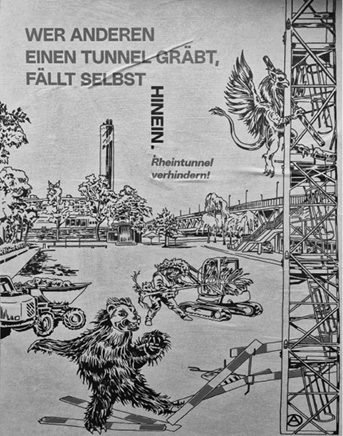
Fig. 6. Wer anderen einen Tunnel gräbt, fällt selbst hinein. Photo taken in Basel on November 30, 2024
4 . P r o v e r b s o n P o s t c a r d s a n d S o u v e n i r s. As Anna T. Litovkina et al. (2021: 141–142) indicate, proverbs are highly variable and serve, therefore, as a basis for language play and puns. This type of linguistic creativity introduces unexpected twists that contradict the audience’s expectations within a given context, frequently resulting in humour. Due to their familiarity and formal stability, proverbs are particularly well-suited for humorous transformations.
Seven percent of the corpus entries appear on postcards and various small souvenirs. These witty and often humorous phrases were discovered during the traditional Basel Autumn Fair. Fig. 7 shows a modification of the German proverb “Der Weg ist das Ziel” (The journey is the reward). The original message, which literally translates to The way (path) is the goal, has been transformed into “Mein Ziel ist im Weg” (My goal stands in my way), a humorous allusion to how sometimes our goals are too ambitious, and thus hinder our progress.
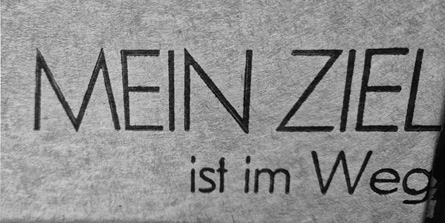
Fig. 7. Mein Ziel ist im Weg. Photo taken in Basel on October 26, 2024
5 . P r o v e r b s i n O p e n P u b l i c A r e a s. As four corpus examples, or 5 % of all corpus entries, prove, proverbs can also serve as an efficient communicative tool in open public spaces by addressing passers-by and drawing their attention to specific issues. The following example serves as a warning to those who might intend to steal flowers from a public garden. The traditional proverb “Unrecht Gut gedeiht nicht” (The unjust will never prosper) was used for this particular purpose (see Fig. 8):
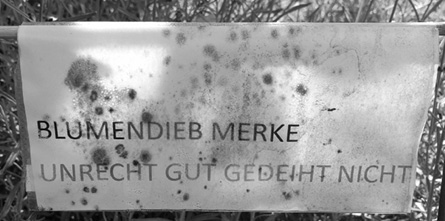
Fig. 8. Unrecht Gut gedeiht nicht. Photo taken in Basel on July 30, 2023
The next example illustrates that even today, people rely on proverbs to transmit religious, moral and educational messages (see Section 1.3, Proverbs as Mottoes of Educational and Civil Campaigns). The biblical saying “Liebe deinen Nächsten wie dich selbst” (Love your neighbour as yourself) was written on a stone placed in a wooded area near Oberwil in the canton of Basel Country frequently visited by passers-by (see Fig. 9).
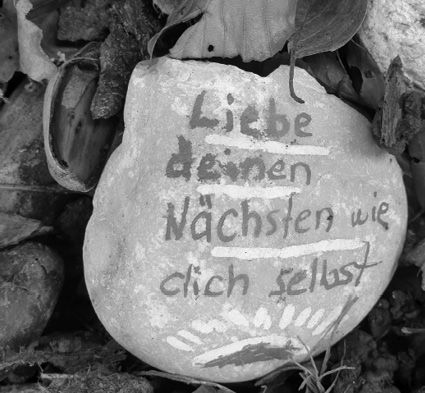
Fig. 9. Liebe deinen Nächsten wie dich selbst. Photo taken near Oberwil, Basel Country, on March 13, 2021
2. Form of occurrence
As previously discussed, proverbs are often used to capture the attention of potential customers, readers, viewers or passers-by. They are either cited in their original form or modified to suit specific communicative situations (cf. Röhrich, Mieder 1977: 111). In the following, the most common forms in which proverbs occur are presented using a few selected examples.
1 . P r o v e r b s U s e d i n t h e i r O r i g i n a l F o r m. The qualitative analysis of the examples from the corpus demonstrates that – as far as the German-speaking part of Switzerland and the domains of language use that were subject to this study are concerned – proverbs today occur less frequently in their original wording and more often in a modified form adapted to the specific communicative situation or context (cf. Mieder 2004a: 244). Only 18 % of all corpus entries contain proverbial items in their original wording.
As illustrated in Fig. 10, the traditional German proverb “Unkraut vergeht nicht” (Bad weeds never die) can be effectively used as a subtle advertisement for garden gravel.

Fig. 10. Unkraut vergeht nicht. Photo taken in Ettingen, Basel Country, on September 17, 2023
However, not only are proverbs in Standard German being deployed across various domains and contexts of use, but numerous items are also being used in Swiss German. As discussed in Section 1.2 (Proverbs on Carnival Lanterns), proverbs in the local dialect are particularly popular in the context of the Basel carnival. Figure 11 presents an example of the above through “Wär suecht, dä findet” (He who seeks shall find).
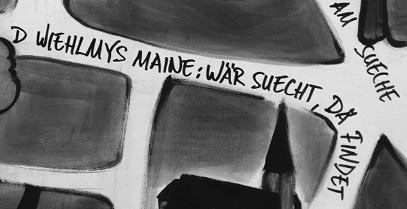
Fig. 11. Wär suecht, dä findet. Photo taken in Basel on February 20, 2024
It should also be noted that several proverbial items registered in the corpus appear in languages other than German. In light of the research results reported by Wolfgang Mieder in several of his studies (2005, 2018a, 2018b, 2019), English-language proverbs are also widely present in non-English-speaking countries. As Mieder points out, with English having become the world’s lingua franca, many traditional and modern Anglo-American (and British) proverbs have found their way into numerous European languages either in their original language or as loan translations. Miederʼs findings can be supported by the following example (see Fig. 12), which shows the lantern of a carnival clique that has chosen the modern Anglo-American proverb “Make love not war” as its motto.

Figure 12. Make love not war. Photo taken in Basel on March 12, 2019
Throughout the centuries, many Latin proverbs have become popular in Europe and have reached international status. In fact, “[t]he rich treasure trove of [...] Latin proverbs makes up the third major source for some of the most popular proverbs known throughout Europe” (Mieder 2015: 36). Fig. 13 underlines this statement by exemplifying how a pharmacist and naturopath utilises the Latin proverb “Nomen est omen” (The name says it all) to assure potential customers that he stands by the quality of his services with his name.
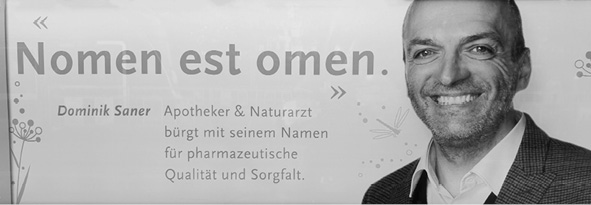
Fig. 13. Nomen est omen. Photo taken in Basel on September 18, 2024
2 . M o d i f i e d P r o v e r b s. As the following examples indicate, the target audience’s attention can be captured not only by deploying traditional proverbs but also through the intended use of various proverbial alterations. Eighty-two percent of all corpus entries contain modified proverbial items.
M o d i f i c a t i o n s o f T r a d i t i o n a l G e r m a n P r o v e r b s. Traditional proverbs have provided a framework for endless transformation for centuries. They have been modified for several purposes. These include negating the original statement, questioning the truth of traditional proverbs or expressing doubts regarding their messages, creating innovative language puns, or simply adapting them to new contexts or situations (cf. Litovkina et al. 2021: 17; Hrisztova-Gotthardt, Vargha, Barta 2023: 175).
Figure 14 provides an example of the latter intention. On one of the information boards of the SEXY – Driving Force of Life exhibition, hosted by the Natural History Museum in Basel, one could discover the modified form of the original proverb “Liebe geht durch den Magen” (The way to a man’s heart is through his stomach), namely “Liebe geht durch die Nase” (The way to someone’s heart is through his nose). The organisers wanted to draw attention to the fact that body odour plays an important role in the animal kingdom in terms of whether one animal finds another sexually attractive.
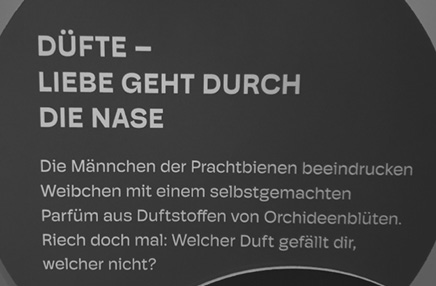
Fig. 14. Liebe geht durch die Nase. Photo taken in Basel on June 2, 2024
M o d i f i c a t i o n s o f M o d e r n G e r m a n P r o v e r b s. Apart from traditional sayings, modern proverbs, coined after 1900 (cf. Mieder 2018a), often appear in a modified form. The corpus contains a few modified modern German proverbs such as “Nach dr Fasnacht isch vor dr Fasnacht” (After the carnival is before the carnival). The original saying “Nach dem Spiel ist vor dem Spiel” (After the game is before the game)9 was coined by Sepp Herberger, former coach of the German national soccer team (see Das Runde muss ins Eckige 2017).
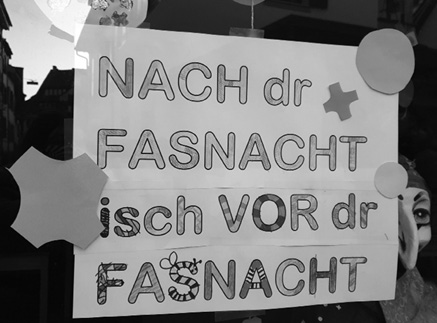
Fig. 15. Nach dr Fasnacht isch vor dr Fasnacht. Photo taken in Basel on February 17, 2021
M o d i f i c a t i o n s o f L o a n T r a n s l a t i o n s o f M o d e r n A n g l o - A m e r i c a n P r o v e r b s. As indicated in Section 2.1 (Proverbs Used in their Original Form), Anglo-American proverbs – either in their original wording or as loan translations – quickly find their way into German and other European languages, primarily via the media and the internet (see also Mieder 2018a: 29). Several of these loan translations are being modified and applied to specific Swiss situations and contexts. For instance, the German equivalent of “A picture is worth a thousand words”, namely “Ein Bild sagt mehr als tausend Wrote”, was altered to “Manchmal hilft ein Törtchen mehr als tausend Wörtchen” (Sometimes a piece of cake is worth a thousand words) and handwritten on the advertising board of an Italian restaurant in Basel.
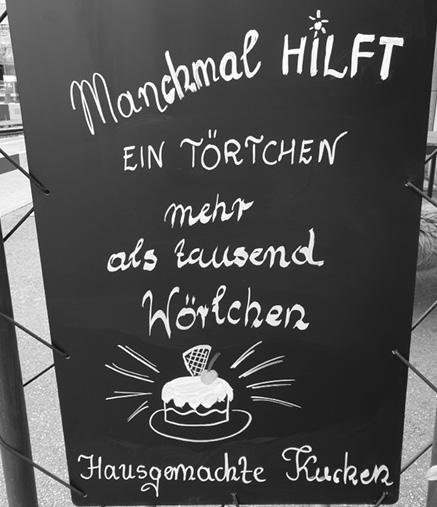
Fig. 16. Manchmal hilft ein Törtchen mehr als tausend Wörtchen. Photo taken in Basel on September 9, 2020
3 . T e x t s B a s e d o n T y p i c a l P r o v e r b i a l S t r u c t u r e s. The mere formal similarity to a proverbial structure can also prove to be very efficient when it comes to drawing the attention of potential customers to the product being advertised (Möckelmann, Zander 1970: 70). Accordingly, advertising copywriters use typical syntactic proverb structures such as “Wie A, so B” (Like X like Y), “Lieber A als B” (Better X than Y) or “Wer A, (der) B” (He who X, Y)10 when formulating their advertising slogans. This observation is reflected in various corpus examples, including “Wer seit 1993 Freilandhaltung macht, hat Eier” (He who has been doing free-range farming since 1993 has eggs11).
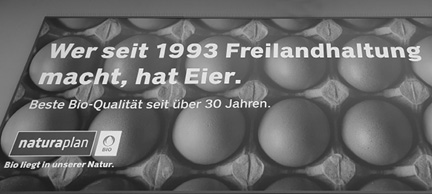
Fig. 17. Wer seit 1993 Freilandhaltung macht, hat Eier. The photo was taken in Basel on April 20, 2024
4 . A l l u s i o n s t o T r a d i t i o n a l P r o v e r b s. Occasionally, single words or passages from well-known proverbs – as in “Es wirft e Schatte voruss” (It casts its shadow before) – allude to the traditional proverb and its message. On their lantern the Junteressli carnival clique refers to the belief that dark times and challenging events casting shadows before they arrive, as expressed in the proverb “Große Ereignisse werfen ihren Schatten voraus” (Coming events cast their shadows before). However, the clique also reminds the carnival’s visitors that while one cannot prevent bad things from happening, one can choose to bring light into the darkness and leave the shadows behind. In multiple cases, as seen in Fig. 18, visual elements accompany the verbal allusions, making an even stronger link to the original proverb:
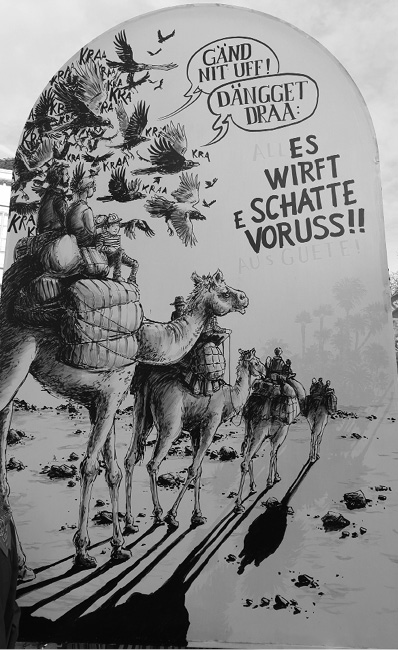
Fig. 18. Es wirft e Schatte voruss. Photo taken in Basel on February 20, 2024
Röhrich and Mieder (1977: 108) describe these types of modification as “Eintagsfliegen” (mayflies), i.e., occasional modifications of well-known proverbs that do not become established in active language use.
The detailed analysis of a corpus containing 78 proverbial items, identified in public space in the German-speaking part of Switzerland, has demonstrated that traditional and modern proverbs, along with their deliberate innovations, are most certainly an essential part of current language use. This testifies to their vitality in the present time and can be interpreted as evidence of a so-called “proverbial revival” in the modern world.
Moreover, the findings have revealed that proverbs continue to play an important role in various areas of life, including advertising, culture and tradition, political and civil discourse, and the public space in general.
Regarding the domains of language use examined in this paper, proverbs are much more often used in their modified than original form, once again demonstrating their adaptability to different contexts and situations.
A more extensive analysis of current proverb use in the German-speaking part of Switzerland, which is to follow this pilot study, can be seen as an initial step towards exploring the paremiological situation in this language region, something that Harald Burger (1996: 461; 2002: 19) has considered a desideratum of research.
The next research stage focuses on proverb use in digital and print media. Preliminary results suggest that traditional and modified proverbs are deployed with a nearly equal frequency in these media, a finding that differs from the conclusions of the present study.
Burger Harald 1996. “Zur Phraseologie des Schweizerhochdeutschen”, in: Studien zur Phraseologie des Deutschen und des Finnischen 2, edited by Jarmo Korhonen, Bochum: Universitätsverlag Dr. N. Brockmeyer, p. 461–488.
Burger Harald 2002. “Dialektale Phraseologie – am Beispiel der Schweizerdeutschen“, in: Phraseologie in Raum und Zeit: Akten der 10. Tagung des Westfälischen Arbeitskreises Phraseologie / Parömiologie (Münster, 2001), edited by Elisabeth Piirainen, Ilpo T. Piirainen, Baltmannsweiler: Schneider Verlag Hohengehren GmbH, p. 11–29.
Burger Harald 2007. Phraseologie. Eine Einführung am Beispiel des Deutschen, Berlin: Erich Schmidt Verlag. 3., neu bearbeitete Auflage.
Das Runde muss ins Eckige, 2017 (https://www.srf.ch/sport/fussball/fussball-allgemein/das-runde-muss-ins-eckige-in-erinnerung-an-sepp-herberger).
Forgács Erzsébet 1997. “Sprichwortabwandlungen in der Werbesprache”, in: Germanistik. Publications du Centre Universitaire du Luxembourg. Lettres Allemandes, Fascicule XI, Luxembourg: Centre Universitaire du Luxembourg, p. 71–95.
Habicht Peter 2001. Lifting the Mask. Your Guide to Basel Fasnacht, Basel: Bergli Books.
Hrisztova-Gotthardt Hrisztalina 2014. “The Basel Carnival. Where Folklore Meets Humour”, Eruditio-Educatio. Humour in Contemporary Societies 9 (3), p. 15–25.
Hrisztova-Gotthardt Hrisztalina 2016. “Regional geprägter Humor: Auszüge aus den Zeedeln der Basler Fasnacht 2014”, Baselbieter Heimatblätter 81 (4), p. 101–115.
Hrisztova-Gotthardt Hrisztalina, Vargha Katalin, Barta Péter 2023. “Deliberate Proverb Innovations: Terms, Definitions, and Concepts”, in: Diligence Brings Delight. A Festschrift in honour of Anna T. Litovkina on the occasion of her 60th birthday. Proverbium Online Supplement 2: 2023, edited by Hrisztalina Hrisztova-Gotthardt, Melita Aleksa Varga, Wolfgang Mieder, Osijek: Faculty of Humanities and Social Sciences, Josip Juraj Strossmayer University of Osijek, p. 175–196 (https://naklada.ffos.hr/knjige/index.php/ff/catalog/view/14/17/37).
Komenda-Earle Barbara 2009. “Moderne Sprichwörter untersuchen – das Was und das Wie, dargestellt an deutschem und polnischen Material”, in: Phraseologie disziplinär und interdisziplinär, edited by Csaba Földes, Tübingen: Gunter Narr Verlag, p. 711–721.
Litovkina Anna T. et al. 2021. Anti-Proverbs in Five Languages. Structural Features and Verbal Humor Devices, Cham: Palgrave Macmillan.
Mac Coinnigh Marcas 2015. “Structural Aspects of Proverbs”, in: Introduction to Paremiology. A Comprehensive Guide to Proverb Studies, edited by Hrisztalina Hrisztova-Gotthardt, Melita Aleksa Varga, Warsaw: De Gruyter Open Poland, p. 112–132 (https://doi.org/10.2478/9783110410167.5).
Mieder Wolfgang 1993. Proverbs Are Never Out of Season, New York, Oxford: Oxford University Press.
Mieder Wolfgang 2004a. Proverbs. A Handbook, Wesport, London: Greenwood Press.
Mieder Wolfgang 2004b. “‘Andere Zeiten, andere Lehren’ – Sprach- und kulturgeschichtliche Betrachtungen zum Sprichwort”, in: Wortverbidungen – mehr oder weniger fest, edited by Kathrin Steyer, Berlin: Walter de Gruyter, p. 415–438.
Mieder Wolfgang 2005. “‘Different Strokes for Different Folks’. American Proverbs as an International, National and Global Phenomenon”, in: Proverbs are the Best Policy. Folk Wisdom and American Politics, edited by Wolfgang Mieder, Logan, Utah: Utah State University Press, p. 1–14.
Mieder Wolfgang 2006. “Andere Zeiten, andere Lehren”. Sprichwörter zwischen Tradition und Innovation, Baltmannsweiler: Schneider Verlag Hohengehren.
Mieder Wolfgang 2012. “‘Think outside the box’: Origin, Nature, and Meaning of Modern Anglo-American Proverbs”, Proverbium: Yearbook of International Proverb Scholarship 29, p. 137–196.
Mieder Wolfgang 2015. “Origin of Proverbs”, in: Introduction to Paremiology. A Comprehensive Guide to Proverb Studies, edited by Hrisztalina Hrisztova-Gotthardt, Melita Aleksa Varga, Warsaw: De Gruyter Open Poland, p. 28–48 (https://doi.org/10.2478/9783110410167.2).
Mieder Wolfgang 2018a. “‘Neue Zeiten, neue Weisheiten’: Plädoyer für eine Parömiographie und Parömiologie moderner Sprichwörter“, in: Einblicke und Rückblicke: Beiträge zur deutschen Phraseologie und Parömiologie aus intra- und interlingualer Sicht 1, edited by Anna Gondek, Alina Jurasz, Joanna Szczęk, Baltmannsweiler: Schneider Verlag Hohengehren GmbH, p. 17–43.
Mieder Wolfgang 2018b. “‘Viele Wege führen zur Globalisierung’. Zur Übersetzung und Verbreitung angloamerikanischer Sprichwörter in Europa“, in: In Proverbiis Veritas. Sprachkulturelle, literarische und politische Studien, edited by Wolfgang Mieder, Münster: Waxmann, p. 73–92.
Mieder Wolfgang 2019. “‘Proverbs Are Worth a Thousand Words’: The Global Spread of American Proverbs”, in: Contexts of Folklore. Festschrift for Dan Ben-Amos on His Eighty-Fifth Birthday, edited by Simon J. Bronner, Wolfgang Mieder, New York: Peter Lang, p. 217–229.
Mieder Wolfgang 2021. “There’s No Free Lunch”. Six Essays on Modern Anglo-American Proverbs, Burlington, Vermont: The University of Vermont.
Mieder, Wolfgang 2023. International Bibliography of Paremiology and Phraseology (2008–2022). Proverbium Online Supplement 1: 2023, Osijek: Faculty of Humanities and Social Sciences, Josip Juraj Strossmayer University of Osijek (https://naklada.ffos.hr/knjige/index.php/ff/catalog/view/15/18/39).
Möckelmann Jochen, Zander Sönke 1970. Form und Funktion der Werbeslogans: Untersuchung der Sprache und werbepsychologischen Methoden in den Slogans, Göppingen: Kümmerle.
Norrick Neal R. 2007. „Proverbs as Set Phrases“, in: Phraseologie. Ein internationales Handbuch der zeitgenössischen Forschung (1. Halbband), edited by Harald Burger et al., Berlin, New York, Walter de Gruyter, p. 381–393.
Röhrich Lutz, Mieder Wolfgang 1977. Sprichwort, Stuttgart: J. B. Metzlersche Verlagsbuchhandlung.
Szpila Grzegorz 2007. “Proverbs as Vehicles of Truth in Contemporary English Literature”, Armenian Folia Anglistika 2 (4), p. 39–44.
1 Proverbial texts coined after 1900 are considered modern proverbs (cf. Mieder 2021: v).
2 Regarding “deliberate proverb innovations”, or proverb modifications and parodies, see: Hrisztova-Gotthardt, Vargha, Barta (2023).
3 Examples found in digital and printed media will form the subject of future research papers.
4 All photos published in this paper were taken by the author.
5 All non-English citations have been translated by the author.
6 The English translation of the German examples is given in brackets. The equivalent is cited if there is an English equivalent of the German proverb.
7 Fasnacht is the Swiss-German dialect word for carnival.
8 See https://www.stayin-alive.ch/ and https://www.bfu.ch/de/ratgeber/vortritt.
9 The saying has already established itself in modern German. It is often modified, and the origin as a quotation or a so-called winged word slowly faded into oblivion. Accordingly, it has been identified by Mieder, Steyer, and Grandl as a candidate for a new German proverb that will be codified in a future proverb dictionary (see Mieder 2018a: 34).
10 On the topic of proverbial structures see: Röhrich, Mieder 1977: 60, 108; Norrick 2007: 384; Mieder 2012: 154–155; Mac Coinnigh 2015: 121; Litovkina et al. 2021: 28–32.
11 This is an excellent example of a pun based on the polysemy of the German word Ei. On the one hand, the word means ‘egg’, on the other hand, the plural form Eier is used with the meaning of ‘testicle’. The informal phrase “jemand hat Eier” (someone has balls) is commonly applied to express someone who is powerful, courageous and can stand their ground.