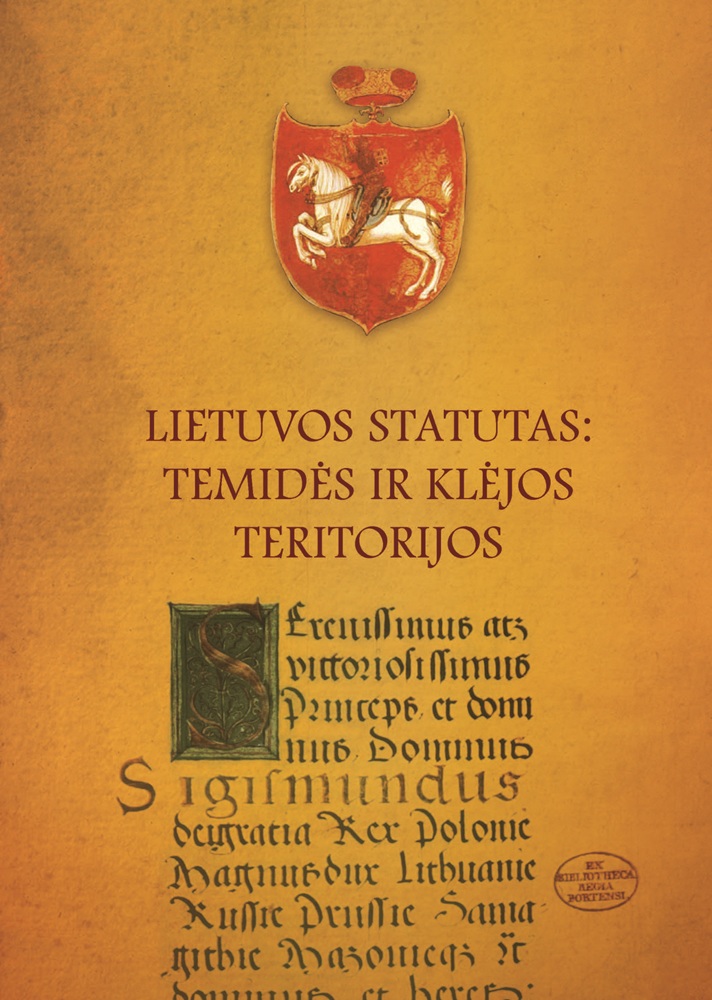
The “Constitutions of the Cathedral Church of the Diocese of Medininkai” (or Samogitia, “Žemaitija” in Lithuanian) were prepared by the two outstanding lawyers of the 16th century Lithuania – the bishop of Medininkai (Samogitia) Jan Domanowski, born in Podlasie, the then Polish-speaking region of the Grand Duchy of Lithuania, and the canon of the mentioned cathedral chapter, Petrus Roysius (Pedro Ruiz de Moros), a Spaniard famous for his Latin poetry and legal treatises. Both lawyers were engaged (one of them undoubtedly, another presumably) in the preparation of the Second Lithuanian Statute, and both of them launched a similar “project,” on a more modest scale, in the field of ecclesiastical law, accomplishing the codification of the rules of the cathedral chapter of Medininkai. Roysius, on the initiative of Bp Domanowski and at his request, produced three books of Constitutions in 1561, and in 1562, the Novels were promulgated by Bp Domanowski; the entire collection was confirmed by the Nuncio Berardo Bongiovanni in 1563.
The Constitutions of the cathedral chapter of Samogitia (they were in force for as long as until 1924) can be compared with the earlier Statutes of the cathedral chapter of Vilnius, originating from the early 16th century and probably used by Domanowski and Roysius. It appears that, in comparison with the Statutes, the contents of the Constitutions are more consequently and methodically structured, and the wording within them seems to be more laconical, but, at the same time, more rhetorically elaborated. A consideration of the eventual supplements of a particular law, the strict elimination of the Protestants from various fields of everyday life of the local Catholic Church, a greater concern about the economical prosperity of the subjects and more a flexible application of legal sanctions are to be distinguished as novelties of the Constitutions in regard to the Statutes. Lastly, the greater respect to the ancient tradition of the civil law, as well as the more refined rhetorical form of the text, betray the influence of the Renaissance humanism, more perceptible in the Constitutions than in their earlier counterpart.

This work is licensed under a Creative Commons Attribution 4.0 International License.