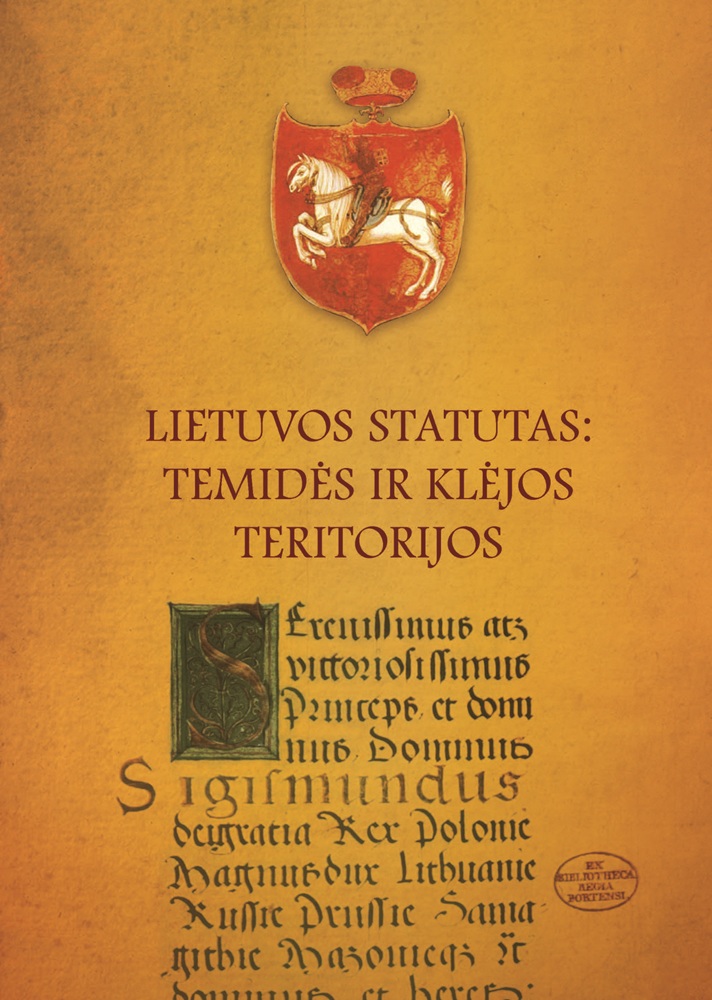
In this article, we attempt to reveal the interaction between political and legal cultures in the Grand Duchy of Lithuania. We chose for our analysis the most striking and long-lasting result of these interactions – the three redactions of the Lithuanian Statute (enacted in 1529, 1566 and 1588), which shaped the political and legal cultures of the society and became an integral part of its life until the end of the state’s existence.
Active interaction between the creation of a new legal environment and the political culture in the Grand Duchy of Lithuania began on the turn of the 16th century, when, on the initiative of Grand Duke Alexander, negotiations with the Polish Kingdom to conclude the union between the two states were resumed. Sources from the period between 1499 and 1501 show that the idea of the renewal of the union was supported by small group of members of the political nation of the Grand Duchy of Lithuania, which also present a list of their names. The majority in the Sejm did not support the conditions of the Union of 1501, announced by Grand Duke Alexander, which would have violated the independent status of the Lithuanian state.
This problem of the union reignited the activities of the political nation of the Grand Duchy of Lithuania. In the 16th century, the main institution where the proposals for new reforms of the state and society were born was the Sejm of the Grand Duchy of Lithuania. Mental space was formed in the Sejm, from where we can now observe the interactions taken between legal and political cultures.
We assume that one of the more serious incentives to prepare the First Lithuanian Statute (1529), without any references to the union between the Grand Duchy of Lithuania and Polish Kingdom, was the existence of the Polish statute of 1506. This notion was also realized in the Second (1566) and the Third (1588) Lithuanian Statutes.
The interaction between legal and political cultures is also revealed by the translation of the Second Lithuanian Statute into Latin (1576), attributed to the member of the Commission of the Lithuanian Statute Augustinas Rotundas, with an introduction and appeal to King Stefan Bathory: “Epitome principum Lithuaniae a migratione Italorum P. Libone vel, ut Lituanica historia scribit, Palemone duce vsque ad Iagellones.” In these texts, written by a lawyer, a vision of the state’s future is described, and it shows that the politics and law in the 16th century were the integral parts of an attempt to defend the independence of the Lithuanian state. The Lithuanian Statute (1566) and it’s translation to Latin (1576) shows that the commonwealth of the two nations, created in the Lublin Sejm of 1569, consisted of two independent states and had set a legal outline that separated the composite state of Poland and Lithuania into two different zones in terms of the law and political culture.

This work is licensed under a Creative Commons Attribution 4.0 International License.